Slashdot Mirror
Domain: spaceref.com
Stories and comments across the archive that link to spaceref.com.
Comments · 466
-
NASA needs clear goals!And goals which are supported by Congress and the people of the US. One such plan was attempted in the house last year: The Space Exploration Act of 2002. A similar vision of our future in the solar system was presented in the recent report of the presidential commision on the future of the US aerospace industry. NASA's own proposals include a NExT team project starting with a lunar L-1 point base and lunar surface base.
So what has happened to all these great ideas? Stifled (so far) for lack of public support! Write your senators and representatives - tell them you believe NASA needs a clear new mission! It doesn't require much or any increased funding - it just needs to get NASA up out of the pork-barrel mire it's been stuck in by Congress for the past 30 years! -
Frustrating.
This is going to be me, rambling. I'll be accused of being a liberal, tree-hugging, deficit-loving bitch, but it needs to be said.
Bush has, from day one, been all about, or so he says, cutting budgets. Everything but Defense, he says, is spending far too much. Education. Health and Human Services. AIDS research (his "broad" plan announced in the State of the Union address was a joke). NASA.
Time and time again, he has harped on cutting NASA's budget. He has forced the agency to abandon most all other programs, except extending the life of the shuttles.
Democrats and others have pleaded for Bush to reconsider. He hasn't.
One year ago, CNN discussed Bush's plans to dramatically reduce NASA's budget, INCLUDING safety spending, in favour of learning more about nuclear technology in space.
This PDF from the House Democrats makes Bush's cuts clear, in terms of NASA and science in general.
Worse yet, a year and a half ago, people were warning that these cuts were leading to an inevitable disaster in the shuttle program. A freaking year and a half ago.
And through all of this, the best Bush can say is "May God continue to bless America."
Oh, and Saddam is an evil, evil man.
Growl.
jrbd -
Tragedy for mankind
There are so many things to say, so many feelings. Firstly, I do believe that this is not just an American tragedy, it is one that affects mankind. NASA has been basically leading the way towards space exploration and if one is to believe the "Space, the final frontier" bit, I do feel that this is something that affects us all. Not to mention, there was an Indian American, an Isreali and an African American on board.
In fact, this is one of the many reasons why I feel that it was extra stupid of Saddam Hussein to call this catastrophe "God's punishment on America". If anything, he should have taken this opportunity to show some sympathy towards this event.
I also wonder if they will send a teacher up in space in the near future. They were just about to start interviewing over 4000 teachers but I really don't know if that is going to happen now.
Lastly, here are some links that I have found useful all day today that I haven't seen posted up yet - http://www.spacer.com, http://www.spaceref.com, http://www.spaceflightnow.com and of course http://www.space.com. -
Tragedy for mankind
There are so many things to say, so many feelings. Firstly, I do believe that this is not just an American tragedy, it is one that affects mankind. NASA has been basically leading the way towards space exploration and if one is to believe the "Space, the final frontier" bit, I do feel that this is something that affects us all. Not to mention, there was an Indian American, an Isreali and an African American on board.
In fact, this is one of the many reasons why I feel that it was extra stupid of Saddam Hussein to call this catastrophe "God's punishment on America". If anything, he should have taken this opportunity to show some sympathy towards this event.
I also wonder if they will send a teacher up in space in the near future. They were just about to start interviewing over 4000 teachers but I really don't know if that is going to happen now.
Lastly, here are some links that I have found useful all day today that I haven't seen posted up yet - http://www.spacer.com, http://www.spaceref.com, http://www.spaceflightnow.com and of course http://www.space.com. -
Re:Shuttle Will Never Fly Again?
Check this schedule
Most of cargo delivered to ISS by Russians Progress-M1 spacecraft. Unmanned and very reliable. -
Re:How soon the next shuttle flight? (Space statio
The ISS is routinely resupplied by the Progress series of cargo ships launched from the Baikonur Cosmodrome in Kazakhstan. These are basically automated, unmanned Soyuz vehicles designed specifically for the purpose of bringing fuel, oxygen, water, and other supplies to space stations. The astronauts aboard the ISS are in no immediate danger due to the possible delay of the next shuttle launch.
-
More Balloons and AUVsDaily Wireless has more on Sky High Wi-Fi including Skytower which uses a solar-powered airplane. It has been used for 802.11b-enabled aerial photography. Skytower is designed to circle overhead, unmanned, for as long as six months, drawing power from the sun by day and from fuel cells by night.
The new homeland security department will require a massive global network. But transoceanic fiber is easily cut and the $800 million TDRS replenishment program with three satellites doesn't have the bandwidth. Intercepted SIGINT data is reportedly transmitted to Earth on a 24 GHz downlink using narrow-beam antennas. But the frequency swaths allocated for links are less than consumers can get on cable television. More bandwidth is needed.
One might speculate that a secret optical/IR satellite network downlinked in Hawaii might be developed. The European Space Agency, not to be outdone, says they're thinking of building miniaturised optical systems that fit onto a microchip. These optical networks might use optical CDMA which encodes each pulse,across a segment of wavelengths.
-
Re:Wow...
I wonder, since space shuttles are gettin' kinda old and are and always have been rediculously expensive, will these Delta rockets eventually serve as the american's main launch vehicle for astronauts?
Yes, NASA would like to do exactly that. They want to build a crew-transfer vehicle, called the Orbital Space Plane (OSP) which would ride an expendable rocket into space. (That's just one of many links about it. There are better ones, I'm sure.) It would either launch atop a Delta IV or an Atlas V (which is also a brand new rocket which performed its flawless maiden flight early in the Fall). The OSP will be reusable.
The capabilities of the OSP are only estimates now. (It actually has to be designed still
NASA wants a very fast turn around time. They want to be able to launch an OSP with only a few weeks notice at most, unlike the Shuttle's several month prep time. (NASA learned a lot of lessons from the Shuttle about maintaining and operating reusable vehicles. Those lessons will be folded in to this spacecraft.)
Not only will it be designed to be mated to an expendable Atlas or Delta rocket, but they intend to design it to mate to the top of an eventual fully reusable replacement to the Shuttle. (You would stack this on top of the reusable the same way you would stack it to the top of the expendable.)
Finally, they would like to use heavy-lift Delta and Atlas variants to send this to the Earth-Moon L1 point, or to other destinations. This should be a very flexible vehicle.
I'll leave you with a final thought. If you wanted to do space-to-space transportation (L1 to a telescope at an Earth-Sun Lagrange point, for instance) this vehicle has most of the necessary systems. But, it also has a very heavy airframe, since it is meant to come back to Earth. People understand this full well, and are considering stuffing very similar systems in a space-only frame, with a propulsion system designed for space-to-space missions. (This thing would probably be a little cramped for seven people on a week long mission, too, but probably no worse than a teeny-tiny little Gemini capsule.
Anyway, I like it, and I can't wait until some of the people reading this are flying in it.
p.s. (It isn't meant to obsolete the shuttle. But, it will probably reduce its flight rate since it will be overkill for crew-transfer.) -
Re:Devil's Advocate...
Well it can't stay in orbit forever. In the orbit it's in, it's affected by atmospheric drag, which is why it has to be reboosted by Progress cargo craft.
-
Re:Russia
I did some checking and it seems that the rumored cost of a trip is $20M or so.
-
Re:We have a problem Houston!
-
Once again Slashdot misses the boat
I submitted this story late last night from the source that broke the story and which contains more details than anywhere else and what does Slashdot do? They rejected it. Now I see it posted from other sources with less details. Go figure!
-
Serendipity!
The Japanese neutrino detector, Kamiokande, was constructed to observe neutron collapse. It failed. It has proved, to a certain extent, that neutron collapse is impossible, or that Koshiba's scientific apparatus is flawed. As a side affect, Koshiba found that neutrinos from space were interfering with his experiment. When the supernova of 1987A lit Koshiba's apparatus up like a Christmas tree, Koshiba found that his mistake even provided an early warning system for supernovae. Through this "oops", "neutrino astronomy" was born. All scientists should be so lucky as to have made a mistake of this magnitude and grandeur. It is truly worthy of the Nobel.
Sadly, Koshiba made another mistake which destroyed his billion dollar apparatus. Another "oops", which so far has not yielded a Nobel.
Yet! -
Close shaves.
When I talk to people about this monster not one person I have spoken to has remembered the incident or knew it happened in the first place.
People are happy in there own worlds, Happy and safe knowing that they will be here tomorow, They don't consider that something like this couls happen.
It scares me more that people are so unaware of things like this. If people don't know of things like this, and or they don't care, no funding will be alloted to detecting things like these.
After all no politition wants to spend money, Peoples hard earned taxes, on something that will not get him back into office next term.
-
Re:US and European Launches?Article 1The Lockheed-Martin Atlas V uses Russian engines (RD-180) certified by the US though the Boeing Delta IV uses American designed Rocketdyne RS-68's. Just an FYI.
Article 2 calls for 3 EELV's for FY 2001 for 288 million (about 95 million each). It doesnt break them out as Deltas or Titans or which model. These are medium to heavy lift vehicles not in the PSLV class. Atlas V can put up to 19,100 lbs into GTO. If that truly does cost less that 100 mil, it compares not too badly with 15 million for 1050 kg to GTO for the PSLV.
-
It's been used 21 times; this is the 1st STS useFrom the first link in the
STS-112 will be 21st launch for RocketCam (if you don't count the first demo launch in 1997). All of the RocketCam's have worked so far. A total of about three dozen cameras have been flown.
...
The view of the Earth falling away will be familiar to anyone who has watched a Delta rocket launch lately - but will be a first for the Space Shuttle program.
-
Re:Why not simulate it?
the cost of throwing out an old design that mostly works (with a lot of help) to build a new shuttle is simply out of the question.
You are missing my point. Every time we send up something on the shuttle, we are spending minimum 2 to 4 times more dollars per pound than if we used another launch system available right now this second. And just to make sure you get it, I'll say it again: That means, if we just didn't bother using the shuttle and used anything else to launch what needs to be in orbit, we could send up two to four times as much stuff for the same money, or send it up for 2 to 4 times less money.
Havn't you noticed that hardly anyone commercial uses the silly thing? Most of the missions it go on are either SSS (silly space station(tm)) releated (tax), military (tax), or "scientific" (tax). You'd have to be NUTS to pay the going rate to send up your own private satellite on the shuttle & your shareholders would *destroy* you in a derivative suit.
Do you not believe me?
Do you see anything in these missions not paid for with pure tax?
It is easy to spend money on worthless crap when the money is free . -
Correction: The real story
Once again Whitehouse jumps to conclusions. He calls this yet to be announced discovery "Ice oceans". This is a slight exageration. He got his information from a story on SpaceRef, one that is a bit more accurate and which was posted on May 22. It does seem from preliminary results, that will be announced this Thursday, that a great deal of water ice exists under the Martian poles.
Dr. Whitehouse is the same guy who at the beginning of April read an abstract for the NASA Astrobiology conference and concluded the author had found life on Mars! He then reported this on the same BBC web site. He was ridiculed for this. If you want the real science scoop I suggest you look to other sources such as SpaceRef and not the BBC in the future. -
Good NewsThis is good news. Not unexpected, but good. We'll have to wait for later missions for verification. And maybe an official NASA announcement. In the meantime, I'd urge support for the Space Exploration Act of 2002:
-
Good NewsThis is good news. Not unexpected, but good. We'll have to wait for later missions for verification. And maybe an official NASA announcement. In the meantime, I'd urge support for the Space Exploration Act of 2002:
-
Here's more:
-
We don't need another shuttle!
The Space Launch Initiative is the wrong way to go. Even if NASA picks a design and builds it, we will just end up with another inefficient government-run launch system that costs 10 times as much as anyone else's. Why are we letting NASA control access to space? Why do ordinary Americans have to go to the Russians to get into space? This SLI business is just another example of big, dumb NASA trying to do things the only way it knows how, and messing up the US launch market in the process.
So how should NASA get a new rocket? NASA should invest in American businesses who have good ideas without trying to control them, and they should pay American companies (maybe Russian companies?) to send their astronauts into space.
Foozone.org -
Images from today's launch
SpaceRef has images from China television on today's launch.
-
Re:liquid fuel?
TDRS HIJ were designed for launch on an Atlas in order to reduce launch expenses. Also, none of the articles I have read yet have indicated that TDRS I is leaking fuel. There are many other failures that could lead to a lack of fuel flow from one the tanks - a pinched line, failure of the pressurization system, bad bladder inside the tank, etc. If you read Boeing's statement, they have confidence they can resolve the problem. After seeing Hughes (now Boeing) engineers slingshot a satellite around the moon a couple times to get it to a geosync orbit, I wouldn't underestimate what they can do in this case.
-
Re:That picture wasn't an engine
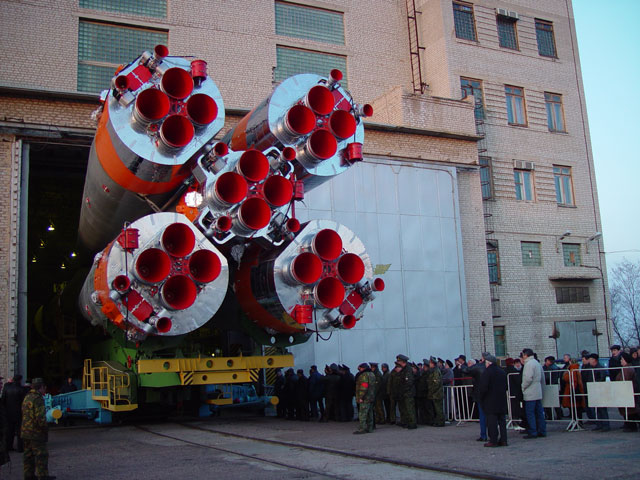
Multi-engine rockets are still used by Russia today. These photos are dated today -- and this particular rocket design is very, very successful.
Photo of base of the Soyuz rocket (20 main engines and 12 smaller auxiliary engines)
The same rocket rolling to the pad
On the pad (probably the same one that launched Sputnik 1!)
But, as you say, the N-1 just took the concept too far, and the Soviets had invested so much into it by that point that the N-1's failure forced the entire lunar program to be cancelled. The only other booster that could do the job at the time (nothing exists now that could, though the Shuttle could launch a moon ship) was the Saturn V. -
Re:That picture wasn't an engine
Multi-engine rockets are still used by Russia today. These photos are dated today -- and this particular rocket design is very, very successful.
Photo of base of the Soyuz rocket (20 main engines and 12 smaller auxiliary engines)
The same rocket rolling to the pad
On the pad (probably the same one that launched Sputnik 1!)
But, as you say, the N-1 just took the concept too far, and the Soviets had invested so much into it by that point that the N-1's failure forced the entire lunar program to be cancelled. The only other booster that could do the job at the time (nothing exists now that could, though the Shuttle could launch a moon ship) was the Saturn V. -
Re:That picture wasn't an engine
Multi-engine rockets are still used by Russia today. These photos are dated today -- and this particular rocket design is very, very successful.
Photo of base of the Soyuz rocket (20 main engines and 12 smaller auxiliary engines)
The same rocket rolling to the pad
On the pad (probably the same one that launched Sputnik 1!)
But, as you say, the N-1 just took the concept too far, and the Soviets had invested so much into it by that point that the N-1's failure forced the entire lunar program to be cancelled. The only other booster that could do the job at the time (nothing exists now that could, though the Shuttle could launch a moon ship) was the Saturn V. -
Re:If plants can go naked so can we (eventually).
Here is a pretty detailed analysis of what would be needed in order to terraform Mars, including the types of plants which would be the most likely to be added first. Take a look, it's good reading.
-
Incorrect Story
I think the story subitted is incorrect. This will be the third space tourist. The first space tourist was way back in October 29 1998 The second was on 30 April 2001 So this should definately be the thrid right?
-
More info
How amusing. I submitted this earlier and got it rejected. oh well.
This link I was using has a nice story attached. Also for more general info about extra solar planets try Jean Schneider's here or its mirror here.
I'm getting funky time outs all over the place, so its hard to tell whether or not things are up. Unless you guys have gotten so good at slashdotting a site that you do it BEFORE a site has been posted.
-
Misleading Science Title
The title of this thread is misleading. The discovery is that the researches have detected the *first* atmosphere around an extrasolar planet. This is indeed big news. The planet is Jupiter size and revolves around a sun like star about 150 light years away. Congrats to the researchers.
-
Bush admin. told congress the same this morning
OMB representative Sean O'Keefe told the House Science Committe:
"Shuttle privatization moves NASA away from owning and operating infrastructure, towards buying services from the private sector, and focusing on world-class science, technology, and exploration."
Last paragraph of his testimony on Internation Space Station cost overruns and what to do about future Human space flight. -
Here's the report.
-
Re:Aerobraking vs. Propulsion BrakingThings are getting better every day and by the minute
Bzzzt! Thanks for playing. I wish I had your confidence in NASA's management. Unfortunately, instead of emulating successful missions such as Mars Pathfinder, NASA is planning to spread the model for a failed mission (Mars 98) throughout the agency.
Mars Pathfinder was managed and built in-house by JPL -- this was the lander / rover mission which succeeded wildly (albeit with modest goals) in 1997.
Mars 98 was the combined missions of Mars Climate Orbiter, Mars Polar Lander, and the experimental Deep Space 2 impact samplers. The loss of the two primary spacecraft was attributed to poor coordination between JPL and the contractor who built them (Lockheed Martin Astronautics).
Yet, the "plan" being advanced to contain the massive cost overruns on Space Station, is based on outsourcing as much work as possible. Hmm. I'm not saying that outsourcing is always a bad thing, but NASA had better tell the taxpayers what's going to be different in the new formula.
Here's NASA's "Commercialization" plan:
http://www.spaceref.com/news/viewsr.html?pid=3730 -
Very misleading article
NASA would love to do a Mars sample return. However in reality no such mission is going to happen anytime soon. Last October NASA outlined its long term plan for Mars exploration with a sample return slated to start in 2014. However recently it became known that the October plan is now more or less dead. The only Mars mission not touched at this time is the 2003 twin rover mission (MER 2003). The 2005 orbiter mission is still a tentative go, however everything after that is up in the air.
NASA's budget is being used to pay for the ballooning space station cost overruns which means other programs get the axe. The space station is at least 4 billion over budget. NASA's budget is about 14 billion. Do the Math. The Bush administration has told NASA to get the station budget under control. So NASA has to cut a lot of programs including Mars. Look to the Europeans to potentially do a Mars sample return first with some NASA participation.
Useful Link: A Year of Mars News: It was the worst of times; it was the best of times. -
Very misleading article
NASA would love to do a Mars sample return. However in reality no such mission is going to happen anytime soon. Last October NASA outlined its long term plan for Mars exploration with a sample return slated to start in 2014. However recently it became known that the October plan is now more or less dead. The only Mars mission not touched at this time is the 2003 twin rover mission (MER 2003). The 2005 orbiter mission is still a tentative go, however everything after that is up in the air.
NASA's budget is being used to pay for the ballooning space station cost overruns which means other programs get the axe. The space station is at least 4 billion over budget. NASA's budget is about 14 billion. Do the Math. The Bush administration has told NASA to get the station budget under control. So NASA has to cut a lot of programs including Mars. Look to the Europeans to potentially do a Mars sample return first with some NASA participation.
Useful Link: A Year of Mars News: It was the worst of times; it was the best of times. -
Very misleading article
NASA would love to do a Mars sample return. However in reality no such mission is going to happen anytime soon. Last October NASA outlined its long term plan for Mars exploration with a sample return slated to start in 2014. However recently it became known that the October plan is now more or less dead. The only Mars mission not touched at this time is the 2003 twin rover mission (MER 2003). The 2005 orbiter mission is still a tentative go, however everything after that is up in the air.
NASA's budget is being used to pay for the ballooning space station cost overruns which means other programs get the axe. The space station is at least 4 billion over budget. NASA's budget is about 14 billion. Do the Math. The Bush administration has told NASA to get the station budget under control. So NASA has to cut a lot of programs including Mars. Look to the Europeans to potentially do a Mars sample return first with some NASA participation.
Useful Link: A Year of Mars News: It was the worst of times; it was the best of times. -
Watch the Launch (Replay)
A replay of the launch is available from SpaceRef's home page.
-
Re:more stats(Hate to reply to myself...)
OK, I found another article about this at SpaceRef. Your data is correct, and they found a second planet beyond that one. Still, I'm not sure how a rocky planet could form with those two monsters nearby; it's the "far away from the star" in the WP article that confused me. Of course, they're comparing with those other star systems discovered recently, where gas giants are insanely close to the stars...
-
ISS and space hardware -- some riskRather than debate the mess by intuition and bravado, how about doing a search? There is evidence that this year's Leonid shower was warned against last year, mainly for satellite electronics ( Space Daily News on debris last year )
Also, there have bit hits on equipment such as the Leonardo module which do do damage. This article even mentions what would happen if the hit intersects a space-walker. Kind of like taking one for the team. Space Ref Interactive article on MPLM and some facts on what is up there in the way of protection
Kind of interesting. These are small, but apparently anything of even a few centimeters in size is tracked by radar now. And avoided. (Space shuttle article (pdf) on Nasa. Didn't keep the href. Do the search.
-
In Other News: Crushing Defeat After Just 5 WeeksIn other news: The Mars Society's Arctic Research Station project suffered a crushing defeat after only five weeks of operation when their life support systems, hosted on the machine arctic.marssociety.org, went offline after a mass distributed denial of service attacks known as the Slashdot effect killed their web server, which was hosted on the very same machine.
Thousands of users watched the crew's last agonized struggles over two of the three newly-operational web cams. Again, a prosperous project has been killed by the mindless hacking activities of a group of anonymous cowards.
-
oh my god, it's the giant claw
Now, in addition to the face of Cydonia, we have a giant claw (just look at the bottom of the picture): four fingers with opposable thumb. It looks like it was trying to reach up to the cliff and slipped. What other body parts are we going to find???
-
Re:Manned mission a pipe dream?
Actually, there are 3 bills up that claim will "blast open the closed door to a national space economy".
Private investment may allow things to happen faster then you think. Read up at
http://www.spaceref.com/news/viewnews.html?id=378 -
Re:It's asked before, but...
-
Ahem, its Devon Island & here's another story link
Just had to point out that the island is named Devon not Devos as the article has it.
There is an article on the robot here on Spaceref.com.
-
Ahem, its Devon Island & here's another story link
Just had to point out that the island is named Devon not Devos as the article has it.
There is an article on the robot here on Spaceref.com.
-
Macs in space
Becuz Apples are reliable enough to serve as webservers in space!
-
Balloons On Venus Can Inject Life There
And if there isn't any life on Jupiter's moons, we can go out and start a party of our own... Recently, bacterial ecosystems have been discovered in Earth's clouds. This opens the possibility of using balloons on Venus to inject heat and acid loving bacteria into Venus' cloud droplets at 40-50 Km. Let's start colonizing space today!
-
Re:Not really importantI find it hard to believe that a few million gallons of fuel is more expensive than the resources needed to keep humans alive indefinitely in a sealed environment and send them supplies from Earth as you propose.
That statement makes it seem so simple, but I don't think you have any concept of what it takes to survive on Mars. Here is an article about a research program to study dust devils in Arizona, so they can be prepared for what's on Mars.
Quoth the article:
Mars dust is a major potential threat to both robotic and human exploration of the Red Planet. Enormous martian dust devils - 100 times larger than those on Earth -- churning tons of electrically charged dust particles could cause lightning bolts and discharges that might fry computers and delicate electronics, interfere with radio communications, or rip apart pressurized human habitat.
Earth dust devils can be 10 meters to 20 meters in diameter and 1,000 meters (a kilometer or six-tenths of a mile) high, Smith said. Mars dust devils are typically a kilometer in diameter and 10 kilometers (6 miles) high. Martian dust devils are so big that they dust the planet's atmosphere, giving the atmosphere its reddish-brown hue, and so big that Mars Global Surveyor cameras have photographed them from orbit.
-
Balloons On Venus Can Inject Life There
Recently, bacterial ecosystems have been discovered in Earth's clouds. This opens the possibility of using balloons on Venus to inject heat and acid loving bacteria into Venus' cloud droplets at 40-50 Km. Let's start colonizing space today!