Slashdot Mirror
Domain: stanford.edu
Stories and comments across the archive that link to stanford.edu.
Stories · 493
-
Knuth's Fascicle 3b Available
An anonymous reader writes "Looks like Knuth is making progress on volume 4 of The Art of Computer Programming. Another fascicle is available. More news here." -
Knuth's Fascicle 3b Available
An anonymous reader writes "Looks like Knuth is making progress on volume 4 of The Art of Computer Programming. Another fascicle is available. More news here." -
Knuth's Fascicle 3b Available
An anonymous reader writes "Looks like Knuth is making progress on volume 4 of The Art of Computer Programming. Another fascicle is available. More news here." -
Photographing Exploding Edibles
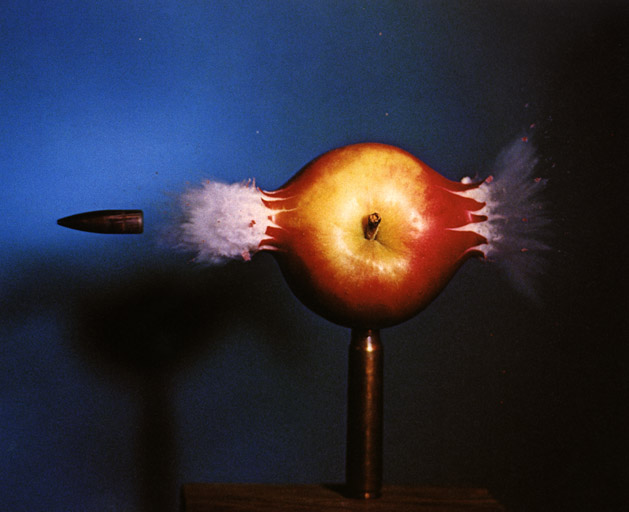
Isaac Skibinski writes "Remember gawking at photos of bullets going through apples (and the pretty fruit gibbage)? We've recently built an apparatus to capture similar results, using a BASIC controller stamp, a disposable camera flash, an air compressor, an electronic sprinkler valve and some pipe. Considering the cost of the device, it has allowed us to take suprisingly crisp photos of high-velocity objects." -
BrookGPU: General Purpose Programming on GPUs
An anonymous reader writes " BrookGPU is a compiler and runtime system that provides an easy, C-like programming environment (read: No GPU programming experience needed) for today's GPUs. A shader program running on the NVIDIA GeForce FX 5900 Ultra achieves over 20 GFLOPS, roughly equivalent to a 10 GHz Pentium 4. Combine this with the increased memory bandwidth, 25.3 GB/sec peak compared to the Pentium 4's 5.96 GB/sec peak, and you've got a seriously fast compute engine but programming them has been a real pain. BrookGPU adds simple data parallel language additions to C which allow programmers to specify certain parts of their code to run on the GPU. The compiler and runtime takes care of the rest. Here is the Project Page and Sourceforge page." -
Stanford Offers Cocoa Class
An anonymous reader writes "Back in the early 90's Stanford University offered a class on Objective-C for students interested in writing applications for NeXTSTEP. After a long hiatus it appears that class will be offered again as CS193E, 'Object-oriented User Interface Programming.' It will be covering the Apple development tools, Objective-C, Foundation and AppKit, and Quartz. Any other schools out there planning or already offering Objective-C courses?" -
Stanford Offers Cocoa Class
An anonymous reader writes "Back in the early 90's Stanford University offered a class on Objective-C for students interested in writing applications for NeXTSTEP. After a long hiatus it appears that class will be offered again as CS193E, 'Object-oriented User Interface Programming.' It will be covering the Apple development tools, Objective-C, Foundation and AppKit, and Quartz. Any other schools out there planning or already offering Objective-C courses?" -
Diebold Folds In DMCA E-Voting Lawsuit
sunbird writes "Diebold has filed a responsive pleading (PDF) in the lawsuit brought by the Electronic Frontier Foundation to challenge Diebold's practice of using the DMCA to suppress discussion of the critical flaws with electronic voting. Diebold states that it has "decided to withdraw its existing DMCA notifications and not to issue any further ones . . . ." Other recent developments include: this transcript of the court hearing on EFF's application for a preliminary injunction and Dennis Kucinich's linking to Diebold memos from his webpage at the U.S. House of Representatives. Stay tuned- the judge has scheduled a status conference for this Monday in the case." -
Folding@Home for OpenBSD
schnarff writes "Users of OpenBSD have been asking the Folding@Home team for a port of their distributed computing client since at least May of 2002; I've helped out by figuring out how to run F@H under Linux emulation (mirror of instructions). Note that this procedure should work for NetBSD as well with some minor modifications." -
White House Website Limits Iraq-Related Crawling
oscarcar writes "Dan Gillmor is reporting on the White House website's use of its robots.txt file to disable search engines from crawling certain material. Many excluded items in the robots.txt file involve mentions of Iraq, possibly to prevent people from finding changes to past statements and information when archived elsewhere." -
Vulnerability Disclosure Conference at Stanford
Jennifer Granick writes "Stanford Law School Center for Internet and Society, headed by Lawrence Lessig and Jennifer Granick, is hosting a day long conference on vulnerability disclosure on November 22, 2003. The point is to get all sorts of people interested in vulnerability disclosure in the same room to discuss the issues and to come up with a clear definition of the problems and the costs and benefits of various solutions. This conference is really a workshop, and security researchers, vendor security teams, and system administrators should all consider attending and participating. For more information: http://cyberlaw.stanford.edu/security/" -
Vulnerability Disclosure Conference at Stanford
Jennifer Granick writes "Stanford Law School Center for Internet and Society, headed by Lawrence Lessig and Jennifer Granick, is hosting a day long conference on vulnerability disclosure on November 22, 2003. The point is to get all sorts of people interested in vulnerability disclosure in the same room to discuss the issues and to come up with a clear definition of the problems and the costs and benefits of various solutions. This conference is really a workshop, and security researchers, vendor security teams, and system administrators should all consider attending and participating. For more information: http://cyberlaw.stanford.edu/security/" -
Vulnerability Disclosure Conference at Stanford
Jennifer Granick writes "Stanford Law School Center for Internet and Society, headed by Lawrence Lessig and Jennifer Granick, is hosting a day long conference on vulnerability disclosure on November 22, 2003. The point is to get all sorts of people interested in vulnerability disclosure in the same room to discuss the issues and to come up with a clear definition of the problems and the costs and benefits of various solutions. This conference is really a workshop, and security researchers, vendor security teams, and system administrators should all consider attending and participating. For more information: http://cyberlaw.stanford.edu/security/" -
The Perl Cookbook, 2nd Edition
doom writes "For those of you who haven't been paying attention, when the The Perl Cookbook by Tom Christiansen & Nathan Torkington came out in 1999 it immediately became one of the primary references in the perl world. It's one of the first places you should check before making a move with perl, right up there with search.cpan.org, itself. Now we've got the second edition. What's the diff? The diff is 58 new recipes and program examples (list provided below), plus two new chapters on mod_perl and XML (which provide an additional 27)." Read on for doom's complete review. The Perl Cookbook, 2nd Edition author Tom Christiansen & Nathan Torkington pages 927 publisher O' Reilly rating 9 reviewer doom ISBN 0596003137 summary How to do common tasks in perlThe new recipes cover a number of subjects. One of the prominent themes is how to use perl's new unicode support, as well as the new I/O layers feature. The coverage of web programming has definitely been fleshed out with recipes on XML-RPC, SOAP and so on, plus the new chapter on mod_perl. Also of interest of course are the additional recipes on database access with DBI.
The mod_perl chapter is a good succinct introduction, with some very cute recipes in it (though admittedly a lot of these are also covered in the excellent Mod_perl Developer's Cookbook by Young, Lindner and Kobes out from Sams). For example "Transparently Storing Information in URLs" shows how to embed information in any arbitrary position inside a URL. This quickly shows the kind of things you can do with a PerlTransHandler and a PerlFixupHandler. The chapter closes with what looks like a good introduction to "Template Toolkit", which I would probably be very excited about if I wasn't already familiar with the (also discussed) HTML::Mason.
I really enjoyed reading the XML chapter (a subject I'm less familiar with): I predict that you'll find this to be the fastest way through the XALPHABET XSOUP without drowning. For me, this was almost worth the price of the book.
Very little has been removed (hence the page count has gone from 757 to 927), and where I have been able to find a deletion, there are usually very good reasons for it. For example, the first edition takes the trouble to tell us that qr// was introduced in perl 5.005, but the new edition drops the babble about versions there, because for most of us, anything before 5.6 is now ancient history. However, I do miss this particular irrelevant parenthetic aside that's been deleted now:
Remember that the opposite of read is not write but print, although oddly enough, the opposite of sysread actually is syswrite. (split and join are opposites, but there's no speak to match listen, no resurrect for kill, and no curse for bless.)
(p.295, first edition, compare to p.323, second edition.)In general, it's difficult to think of anything seriously wrong with the Perl Cookbook. I might suggest that in some places they fall into the trap of talking about all the ways to do it, rather than just the best ways, (e.g. recipe 7.5 "Storing Filehandles into Variables" seems a bit complicated).
And maybe there are some slight problems with order of presentation, as with the new perl 5.8 feature of "I/O Layers", which is mentioned a few times before it's finally discussed in the beginning of Chapter 8 (though really, it's amazing that there aren't more problems like this: this is supposed to be reference work, and yet it usually works well as a tutorial also).
I've got one big complaint about the 2nd edition though: they changed the numbering of existing recipes! I've been writing code with comments like
# Schwartzian transform. See Perl Cookbook, recipe 4.15
and now it turns out I should've been specifying an edition number also. Please: "Cookbook" authors, come up with a numbering scheme that remains invariant with new editions... if you can't always just append to the end of the chapter, there's nothing wrong with tacking another dotted decimal on the end. We're programmers, we can handle it.And speaking of the "Schwartzian transform" that recipe has a very clear, self-explanatory name "Sorting a List by Computable Field", but in the first edition, there was also a footnote explaining that many people call this the Schwartzian Transform, named after Randall Schwartz, who invented the technique. With this second edition, that footnote has been quietly dropped. Guys, if you're going to carry on a feud, this is really not the way to do it. It just makes you look bad.
O'Reilly's perl.com site has a series of articles by the authors, featuring some recipes from the book:
Appendix: New recipes and examples (not including the two new chapters):
- Using Named Unicode Characters
- Treating Unicode Combined Characters as Single Characters
- Canonicalizing Strings with Unicode Combined Characters
- Treating a Unicode String as Octets
- Properly Capitalizing a Title or Headline
- Constant Variables
- Implementing a Sparse Array
- Creating a Hash with Immutable Keys or Values
- Matching Nested Patterns
- Writing a Subroutine That Takes Filehandles as Built-ins Do
- Storing Multiple Files in the DATA Area
- Reading an Entire Line Without Blocking
- Treating a File as an Array
- Setting the Default I/O Layers
- Reading or Writing Unicode from a Filehandle
- Converting Microsoft Text Files into Unicode
- Comparing the Contents of Two Files
- Pretending a String Is a File
- Working with Symbolic File Permissions Instead of Octal Values
- Writing a Switch Statement
- Coping with Circular Data Structures Using Weak References
- Program: Outlines
- Overriding a Built-in Function in All Packages
- Customizing Warnings
- Writing Extensions in C with Inline::C
- Cloning Constructors
- Copy Constructors
- Saving Query Results to Excel or CSV
- Escaping Quotes
- Dealing with Database Errors
- Repeating Queries Efficiently
- Building Queries Programmatically
- Finding the Number of Rows Returned by a Query
- Using Transactions
- Viewing Data One Page at a Time
- Querying a CSV File with SQL
- Using SQL Without a Database Server
- Graphing Data
- Thumbnailing Images
- Adding Text to an Image
- Program: graphbox
- Turning Signals into Fatal Errors
- Multitasking Server with Threads
- Writing a Multitasking Server with POE
- Accessing an LDAP Server
- Sending Attachments in Mail
- Extracting Attachments from Mail
- Writing an XML-RPC Server
- Writing an XML-RPC Client
- Writing a SOAP Server
- Writing a SOAP Client
- Program: rfrm
- Using Cookies
- Fetching Password-Protected Pages
- Fetching https:// Web Pages
- Resuming an HTTP GET
- Parsing HTML
- Extracting Table Data
You can purchase The Perl Cookbook, 2nd Edition from bn.com. Slashdot welcomes readers' book reviews -- to see your own review here, read the book review guidelines, then visit the submission page. -
How Everyday Things Are Made
OckNock writes "The Alliance for Innovative Manufacturing at Stanford University in conjunction with Design4x has released online courses on design and manufacturing that include over 4 hours of streaming video (Flashplayer required). Some of the topics include airplanes, crayons, and waterjet cutting. If only they had this when I had studied mechanical engineering - maybe I would have stayed awake in class more." -
How Everyday Things Are Made
OckNock writes "The Alliance for Innovative Manufacturing at Stanford University in conjunction with Design4x has released online courses on design and manufacturing that include over 4 hours of streaming video (Flashplayer required). Some of the topics include airplanes, crayons, and waterjet cutting. If only they had this when I had studied mechanical engineering - maybe I would have stayed awake in class more." -
Translated KDE/Linux Usability Report Available
WHudson writes "Relevantive AG, a German consulting firm who recently completed a study on Linux usability, posted their results in English translation today. Bottom line: Linux nearly as easy to use as Windows XP, but the wording of system and program messages could use some more clarity." -
$50 Aerial Digital Photography from a Balloon
jizmonkey writes "This guy built a balloon to take digital aerial photographs from thousands of feet up. It cost less than $50 altogether, including the image sensor, controller, and balloon. The circuit is surprisingly straightforward: just a hacked Vivitar minicamera, a 555 timer chip driving a relay through a voltage regulator, and a one-meter party balloon like the ones you see at used car dealerships. It just so happens that the entire circuit, strapped to a piece of a pizza box and tied to a really long string, is light enough to be lifted by the balloon. What could low-cost aerial photography be used for? I'm sure some people have some ideas...." -
$50 Aerial Digital Photography from a Balloon
jizmonkey writes "This guy built a balloon to take digital aerial photographs from thousands of feet up. It cost less than $50 altogether, including the image sensor, controller, and balloon. The circuit is surprisingly straightforward: just a hacked Vivitar minicamera, a 555 timer chip driving a relay through a voltage regulator, and a one-meter party balloon like the ones you see at used car dealerships. It just so happens that the entire circuit, strapped to a piece of a pizza box and tied to a really long string, is light enough to be lifted by the balloon. What could low-cost aerial photography be used for? I'm sure some people have some ideas...." -
Howard Dean to Guest Blog for Lawrence Lessig
Ethanol writes "Starting Monday, Professor Lawrence Lessig (whom we all remember from Eldred v. Ashcroft) is going on vacation, and his weblog will be guest-hosted by Democratic presidential candidate Governor Howard Dean. Could this be a sign that a serious contender for President (tied for first for the nomination in the latest polls) has his head screwed on right about copyright law?" -
Howard Dean to Guest Blog for Lawrence Lessig
Ethanol writes "Starting Monday, Professor Lawrence Lessig (whom we all remember from Eldred v. Ashcroft) is going on vacation, and his weblog will be guest-hosted by Democratic presidential candidate Governor Howard Dean. Could this be a sign that a serious contender for President (tied for first for the nomination in the latest polls) has his head screwed on right about copyright law?" -
NAI Sending "Sniffer" C&D Letters
RayMarron writes "It seems that NAI's IP lawyers have been billing some hours recently by sending nastygrams asking companies/individuals to stop using their trademarked term 'Sniffer.' Steve Gibson of Gibson Research Corporation has received one. The full text is posted on his news server, and I'm sure one of our readers will post it here. Or visit news.grc.com, grc.news and grc.news.feedback groups. A student at Stanford received one as well and forwarded it to the faculty to handle. Both Gibson (relating a conversation with his IP attorneys) and Stanford's reply seem to agree that 'sniffer' is too generic a term to be a viable trademark and can't be effectively enforced. Is there an IP lawyer in the house?" -
Public Domain Act Introduced Into Congress
AnElder writes "In his blog yesterday Lawrence Lessig said '...Congresswoman Lofgren (D-CA) and Congressman Doolittle (R-CA) have agreed to introduce the Public Domain Enhancement Act into Congress.' Today the Eldred Act website features two press releases announcing the act's introduction, as well as its immediate support by '...the American Association of Law Libraries, the American Library Association, and the Association of Research Libraries...'" We ran a link to the petition supporting this Act a few weeks back. -
Is The Eldred Decision Bad For The DMCA?
clonebarkins writes "Law.com is running an article by Evan P. Schultz suggesting that the Eldred decision (/. story) could mean bad news for our favorite four-letter law: the DMCA." -
Death of Internet Predicted: Film at 11
Remik writes "The Register has a piece analyzing several threads of Lawrence Lessig's blog, and concluding that the Internet as we know it is dying. For anyone who reads the majority of YRO posts, Lessig's blog is one of the most important sites on the net." Another submitter summed it up well: 'Lessig is predicting that the days of the Commons of the Internet are over, and that as a result of FCC deregulation, the concentration of digital rights in the hands of just a few large media companies will kill the internet for good. Even former FOX and Vivendi executive Barry Diller has criticised the move.' We joke, but there are large elements of truth to Lessig's dour predictions. -
Death of Internet Predicted: Film at 11
Remik writes "The Register has a piece analyzing several threads of Lawrence Lessig's blog, and concluding that the Internet as we know it is dying. For anyone who reads the majority of YRO posts, Lessig's blog is one of the most important sites on the net." Another submitter summed it up well: 'Lessig is predicting that the days of the Commons of the Internet are over, and that as a result of FCC deregulation, the concentration of digital rights in the hands of just a few large media companies will kill the internet for good. Even former FOX and Vivendi executive Barry Diller has criticised the move.' We joke, but there are large elements of truth to Lessig's dour predictions. -
Doubting Electronic Voting
twitter writes "The NYT is raising the alarm on electronic voting. After citing expert opinion on the need for a paper trail, they then quote election officials and vendors who dismiss that opinion as the ignorant work of dreamers. The reporter titles his article, 'To Register Doubts, Press Here' and seems less than convinced." -
Compute Google's PageRank 5 Times Faster
Kimberley Burchett writes "CS researchers at Stanford University have developed three new techniques that together could speed up Google's PageRank calculations by a factor of five. An article at ScienceBlog theorizes that "The speed-ups to Google's method may make it realistic to calculate page rankings personalized for an individual's interests or customized to a particular topic."" -
Compute Google's PageRank 5 Times Faster
Kimberley Burchett writes "CS researchers at Stanford University have developed three new techniques that together could speed up Google's PageRank calculations by a factor of five. An article at ScienceBlog theorizes that "The speed-ups to Google's method may make it realistic to calculate page rankings personalized for an individual's interests or customized to a particular topic."" -
Compute Google's PageRank 5 Times Faster
Kimberley Burchett writes "CS researchers at Stanford University have developed three new techniques that together could speed up Google's PageRank calculations by a factor of five. An article at ScienceBlog theorizes that "The speed-ups to Google's method may make it realistic to calculate page rankings personalized for an individual's interests or customized to a particular topic."" -
New Subatomic Particle Discovered
Cyndi writes "A new subatomic particle has been discovered by researchers at Stanford. It seems to be "an unusual configuration of a charm quark and a strange anti-quark"." -
Switch Interviews Douglas Engelbart
noema writes "If you don't know Douglas Engelbart you don't know the history of computers. Switch has published a transcript of an intense session with him about his visions on enhancing the human intellect. He was a major player in the development of the mouse, cut-and-paste, multi-window GUI, teleconferencing and hyperdocuments. He is a well known WYSIWYG and ease-of-use critic. The Mother of all Demos is his thing too." Here's a link to the transcript itself, which is presented as a PDF. -
Everything you Want to Know About the Turing Test
An anonymous reader writes "Everything you want to know about the Turing test provided by Stanford Encyclopedia of Philosophy. It is their latest entry." -
Everything you Want to Know About the Turing Test
An anonymous reader writes "Everything you want to know about the Turing test provided by Stanford Encyclopedia of Philosophy. It is their latest entry." -
Everything you Want to Know About the Turing Test
An anonymous reader writes "Everything you want to know about the Turing test provided by Stanford Encyclopedia of Philosophy. It is their latest entry." -
Mexico to Abolish the Public Domain?
Anonymous Mexican Coward writes "The mexican congress is considering a revision of the copyright law. Among other changes the law will extend the term of copyright from life-plus-70 to life-plus-100, and at the end of that term, the mexican government has the right to charge royalties for works in the "public domain." Go Mexico! Check it out" -
Remote RSA Timing Attacks Practical
David Brumley and Dan Boneh writes "Timing attacks are usually used to attack weak computing devices such as smartcards. We show that timing attacks apply to general software systems. Specifically, we devise a timing attack against OpenSSL. Our experiments show that we can extract private keys from a OpenSSL-based server such as Apache with mod_SSL and stunnel running on a machine in the local network. Our results demonstrate that timing attacks against widely deployed network servers are practical. Subsequently, software should implement defenses against timing attacks. Our paper can be found at Stanford's Applied Crypto Group." -
Remote RSA Timing Attacks Practical
David Brumley and Dan Boneh writes "Timing attacks are usually used to attack weak computing devices such as smartcards. We show that timing attacks apply to general software systems. Specifically, we devise a timing attack against OpenSSL. Our experiments show that we can extract private keys from a OpenSSL-based server such as Apache with mod_SSL and stunnel running on a machine in the local network. Our results demonstrate that timing attacks against widely deployed network servers are practical. Subsequently, software should implement defenses against timing attacks. Our paper can be found at Stanford's Applied Crypto Group." -
Remote RSA Timing Attacks Practical
David Brumley and Dan Boneh writes "Timing attacks are usually used to attack weak computing devices such as smartcards. We show that timing attacks apply to general software systems. Specifically, we devise a timing attack against OpenSSL. Our experiments show that we can extract private keys from a OpenSSL-based server such as Apache with mod_SSL and stunnel running on a machine in the local network. Our results demonstrate that timing attacks against widely deployed network servers are practical. Subsequently, software should implement defenses against timing attacks. Our paper can be found at Stanford's Applied Crypto Group." -
Treatise On Software And Law Available Online
segoave writes "Lee Hollaar,Professor of Computer Science at the University of Utah has made his book Legal Protection of Digital Information availible for free download. You may remember Professor Hollaar as the lead technical expert in the antitrust suits Caldera v. Microsoft and Bristol v. Microsoft (both of which settled in favor of the plaintiffs), he submitted a friend of the court brief in Microsoft's appeal in the DC Circuit. He has also he worked on patent reform legislation, database protection, and what eventually became the Digital Millennium Copyright Act. Maybe this will help convince Lawrence Lessig to make his book available for download." -
Cow Manure --> Electricity
jmtpi writes "ABCNews has a story about a dairy farm in Minnesota that uses its cow manure to generate enough electricity to power the farm plus 80 homes and create fertilizer. There's also a more detailed story." -
Net Speed Record Smashed
BrianWCarver writes "The BBC is reporting that scientists have set a new internet speed record by transferring 6.7 gigabytes of data (the equivalent of 4 hours of DVD-quality movies) across 10,978 kilometres (6,800 miles), from Sunnyvale in the US to Amsterdam in Holland, in less than one minute. Average speed: more than 923 megabits per second, or more than 3,500 times faster than a typical home broadband connection. The data was sent across the Internet2 network. Stanford Linear Accelerator Center (Slac) Computer Services participated in the record-breaking event. Slac has an interest in such high-speed transfers as they have accumulated the largest known database in the world, which grows at one terabyte per day." -
Lawyers Say Hackers Are Sentenced Too Harshly
Bendebecker writes "Cnet is reporting: 'The nation's largest group of defense lawyers on Wednesday published a position paper arguing that people convicted of computer-related crimes tend to get stiffer sentences than comparable non-computer-related offenses.' Finally, someone is listening..." The document makes the points that most computer crime cases involve disputes between an employer and employee, and that the seriousness of the offense is generally comparable to white-collar fraud cases. -
Computer Scientists Rally for Reliable Voting System
Kim Alexander writes "Silicon Valley computer scientists, led by Stanford professor David Dill are asking Santa Clara county to purchase a new computerized voting system only if it provides a voter verified paper trail. Their concerns are based on the lack of adequate testing of these voting systems, and the fact that the software is closed-source and proprietary. Requiring a voter-verified paper trail will mitigate many of these problems. Dill's 'Resolution on Electronic Voting' has been endorsed by prominent computer scientists from all over the country, including Ron Rivest. Counties all over California and the US are going through a similar process. Patriotic nerds who want to do something to help protect our fundamental right to vote with confidence that our votes will be counted can help by contacting their state and local reps, writing letters to supervisors and getting informed!" -
Prime Time Freeware Manual: the Dossier Series
doom writes "There seems to be some interest just now in technical books based on freely licensed content, so I thought I would discuss the Dossier series from Rich Morin's Prime Time Freeware project." Doom has provided an overview of this series; read on below to find out for yourself why he says man pages and other free documentation are worth paying for in dead-tree format. Prime Time Freeware Manual: the Dossier Series author (Various) pages (Various) publisher Dossier/Prime Time Freeware rating 8 reviewer doom ISBN (N/A) summary Free documentation worth paying for.You're all of course aware that there's a huge quantity of excellent technical material on-line about the free/open software that you use ... but how much of it have you actually read? Computer's being what they are -- noisy glowing bulky contraptions with awkward physical controls and displays with a resolution a fraction of paper publications -- most of us aren't inclined to read long works on line. So the next step is where you resolve to do printouts of some of the manuals... and then you discover how long they really are. Many a project can fill multiple looseleaf binders with a single-sided printout of its docs. But if you spend about half a day on it you can probably figure out how to get a nice double-sided printout in a smallish typeface and squeeze it all into a single looseleaf binder... which turns out to *still* be too bulky to want to carry around with you. RTFM is easier said ...
The solution to this is of course professionally printed editions of the manuals. These have been easy to get for GNU software for some time -- the GNU Project standardized on documentation in 'texinfo' format which they use to generate both their online documentation and a very good series of books.
But all that is free is not GNU, and filling that gap is one of the goals of the Dossier series, which uses some semi-automated procedures to generate high-quality, up-to-date hardcopy-on-demand publication.
Thus far they've got books out on the following topics (available on-line through the BSD Mall):
- C, etc.: Essential Tools
- Email: Exim 3
- Email: Mail and Sendmail
- File Systems: FreeBSD
- File Systems: RedHat
- Kernel: FreeBSD
- PostgreSQL: Programming
- PostgreSQL: Reference Manual
- PostgreSQL: Use and Administration
- Processes: FreeBSD
- Processes: RedHat
- Python: Library Reference
- Python: Miscellanea
- Security: Local System
- Security: Remote Access
- Text Processing: Essential Tools
- User Commands: FreeBSD
- User Commands: RedHat
Some of the prices might seem a little high for works based on free content (usually $30 to $35 per volume), but on the other hand these are for small press runs without much in the way of economies of scale going for them. And it certainly beats messing with doing print-outs yourself. (Though if you want to go that route, Dossier can help take the sting out of that process: they offer online access to PDF versions of these works, which is much more inexpensive than paying them to ship you bound volumes.)
When I first heard about Prime Time Freeware/Dossier, I immediately ordered the Postgresql documentation, a set which fills three volumes. At that time the only Postgresql book out was Bruce Momjian's which only covered up to version 7.0. At the speed the postgresql development team was working, having docs more than one release behind was definitely a problem (outer joins weren't even supported in 7.0!). I really appreciated having some books I could flip through that discussed the actual state of the software (and man, there are some weird features in there I didn't know about ... graphical data types so that you can try and use postgres as a backend to a CAD system?).
Next I started looking at the volume on "Text" (now renamed "Text Processing" ... which is a shame, in my opinion. I thought it was really funny putting "Text" on the same level as "C" and "Python"). This is a book I would have liked to have some years ago when I needed to understand troff/nroff for man-page hacking (the only time I ever bought one of those 4-inch-wide junk books the 80s were buried under was to get a copy of "UNIX UNLEASHED" because it had a table of *roff commands ... it still bugs me that I had to do that).
One of the things that struck me immediately about this "Text" volume though, was that there were some utilities discussed here that I'd never heard of before, e.g. a2ps which has some decent features for formatting docs for postscript printers. I'd never run across it before, in part because it wasn't installed by default on my RedHat 7.x box. It's a pretty funky command that does a bunch of things automagically that are sometimes hard to predict, but if you need printouts of some docs, I recommend giving a2ps a try for double-column duplex output -- but only if you can't get them from some place like Dossier (yet).
Rich Morin has been working on the problem of making it easier for users of open systems to get information about them for some time, hence The Meta Project, which thus far has resulted in "Meta Demo," aka the FreeBSD Browser. The Dossier series is a spin-off of this research in documenting open systems... check-out the Meta Project sometime. (I'd like to see that system browser extended to cover Linux, myself).
Slashdot welcomes readers' book reviews -- to see your own review here, read the book review guidelines, then visit the submission page. -
Conference -- Spectrum Policy: Property or Commons?
Lauren Gelman writes with an announcement of a conference to take place March 1-2 at Stanford Law School titled "Spectrum Policy: Property or Commons?" The conference is sponsored by Thomas Hazlett, the Manhattan Institute, and Lawrence Lessig of the Stanford Law School Center for Internet and Society. "The purpose of the conference will be to discuss the very live policy question before the FCC of how to best reform the current method of allocating spectrum in order to stimulate innovation. The outcome of this policy decision will influence the future of the wireless Internet." Here's a link to full conference details and registration; note that "academic, non-profit or government employee[s]" can sign up for free admission (room dependent) and a limited number of students can volunteer to trade set-up help for free admission. -
Conference -- Spectrum Policy: Property or Commons?
Lauren Gelman writes with an announcement of a conference to take place March 1-2 at Stanford Law School titled "Spectrum Policy: Property or Commons?" The conference is sponsored by Thomas Hazlett, the Manhattan Institute, and Lawrence Lessig of the Stanford Law School Center for Internet and Society. "The purpose of the conference will be to discuss the very live policy question before the FCC of how to best reform the current method of allocating spectrum in order to stimulate innovation. The outcome of this policy decision will influence the future of the wireless Internet." Here's a link to full conference details and registration; note that "academic, non-profit or government employee[s]" can sign up for free admission (room dependent) and a limited number of students can volunteer to trade set-up help for free admission. -
The Free/Libre/Open Source Software Survey for 2003
aWaterman writes "FLOSS-US is an online survey of Open Source/Free Software developers currently being conducted by researchers at Stanford University's Institute for Economic Policy Research (SIEPR), supported by a grant from the National Science Foundation. This survey has been designed to complement the FLOSS survey for 2002 of Open Source/Free Software developer communities sponsored by the European Commission. FLOSS-US asks questions on some of the topics addressed by the original FLOSS survey, plus questions on several other important issues, including open source developers' motivations and expectations, usage of licenses and programming tools, individuals' contributions to projects, and support by proprietary software firms. If you are an Open Source/Free Software developer, please click here to fill out the questionnaire. We greatly appreciate your viewpoints and your responses to our survey questions." -
The Free/Libre/Open Source Software Survey for 2003
aWaterman writes "FLOSS-US is an online survey of Open Source/Free Software developers currently being conducted by researchers at Stanford University's Institute for Economic Policy Research (SIEPR), supported by a grant from the National Science Foundation. This survey has been designed to complement the FLOSS survey for 2002 of Open Source/Free Software developer communities sponsored by the European Commission. FLOSS-US asks questions on some of the topics addressed by the original FLOSS survey, plus questions on several other important issues, including open source developers' motivations and expectations, usage of licenses and programming tools, individuals' contributions to projects, and support by proprietary software firms. If you are an Open Source/Free Software developer, please click here to fill out the questionnaire. We greatly appreciate your viewpoints and your responses to our survey questions." -
The Free/Libre/Open Source Software Survey for 2003
aWaterman writes "FLOSS-US is an online survey of Open Source/Free Software developers currently being conducted by researchers at Stanford University's Institute for Economic Policy Research (SIEPR), supported by a grant from the National Science Foundation. This survey has been designed to complement the FLOSS survey for 2002 of Open Source/Free Software developer communities sponsored by the European Commission. FLOSS-US asks questions on some of the topics addressed by the original FLOSS survey, plus questions on several other important issues, including open source developers' motivations and expectations, usage of licenses and programming tools, individuals' contributions to projects, and support by proprietary software firms. If you are an Open Source/Free Software developer, please click here to fill out the questionnaire. We greatly appreciate your viewpoints and your responses to our survey questions."