Slashdot Mirror
Domain: stanford.edu
Stories and comments across the archive that link to stanford.edu.
Comments · 4,853
-
Re:I call AI for John McCarthy
Hi Mike,
Following on our thread, X-posted to
If you need the original hardcopy I guess
it could be obtained from Rockefeller or
maybe the NYker? JMC himself might have
a copy in his files (I don't know his current
Secretary at the moment, and don't want to bother
him again.
Cheers,
Winton
FORWARD FROM John McCarthy:
The proposal to the Rockefeller Foundation, in my files as
href=http://www-formal.stanford.edu/jmc/history/da rtmouth.html
(and in HTML form)
http://www-formal.stanford.edu/jmc/history/dartm ou th/dartmouth.html
for the summer project on artificial intelligence was August 1955.
Since they supported it, it would have been in their list of grants in
1955 or 1956. The New Yorker picked it up, perhaps from the list of
grants, and one of their bottom-of-the-column wisecracks said
something like "about time". That may be 1956 but could be later. -
A bit insultingMaybe, but comparing what GetRight et al. do (parallel downloading from FTP mirrors) to how Digital Fountain would achieve the same thing (erasure codes) is like comparing cups and string to IP telephony. Sure, they achieve the same thing, but the comparison is a bit insulting...
With the GetRight solution, 100 people downloading from my FTP mirror = 100 TCP streams worth of bandwidth and CPU consumption. With the Digital Fountain solution, 100 people downloading from my mirror = 1 stream worth of bandwidth and CPU consumption.
-
Not very detailed
It would be useful if they went into more details, eg what a turning machine is.
-
Larry Tessler turned it into Stagecast CreatorLarry Tessler took it with him when he left Apple several years ago. There are some resources for "the other cocoa" still out there.
'The other Cocoa' eventually found a new home and became known as Stagecast Creator.
-Mark
-
Re:Is Thomas H. Lee Alive?
It's a different Thomas H. Lee -- take a look at his Stanford faculty page. You can tell it's a different guy because the one at MIT died at age 77, and this Tom Lee is in his late thirties.
-
Re:Red Flag Linux
If you're having trouble forcing the Babelfish to catch the pop-up window, you're missing a real classic! For some reason, the Babelfish doesn't parse and catch the popup.
It's cached here: translation
It starts with
Respect husband / woman:
Hello!
If only it ended with "all your base are belong to us". =) -
Re:Influence of solar activityThe report you cite seems to be highly questionable pseudoscience, IMHO. The author, a Phd in (he doesn't say which field) and member of the "Schroeter Institute for Research in Cycles of Solar Activity, Nova Scotia, Canada" (not a reputable institute -- it doesn't even have a website).
I've quoted some problematic statements:
"Those scientists who spread anxiety in the eighties.." [ad hominem],
"Precise forecasts that prove correct are a sharp criterion for efficient science. The protagonists of global warming remain empty-handed in this respect in spite of great material and personal expense." [false and unscientific]
"All these predictions have turned out to be untenable. It is accepted that global temperature has risen by 0.5 C in the last hundred years. Yet during the last fifty years the temperature has remained approximately at the same level, even though 70% of the anthropgenic carbon dioxide contribution was injected into the atmosphere during this time. From 1940 to 1970 the temperature fell, and according to satellitite data available since 1979, which are in good accord with balloon data [27], the trend in the lower troposphere has remained at -0.06 C per decade." [misrepresentation of the data, see here]And it's conclusion is almost gibberish:
"If we bear in mind that the correct forecasts based on the semiquantitative model of solar-terrestrial relations presented here are thinkable only if the sun's varying activity is a dominant factor in climate change, it seems difficult to resist the insight that once again an artificially constructed homocentric position is beginning to rock. A general survey of the given results indicates that climate variations are governed by the sun, not mankind." [artificially constructed homocentric position? solar-terrestrial relations?]Plus, the graph you cite has been deprecated; the authors of the 1991 study state in a new, revised 1999 report (see below) that solar variation cannot account for the warming trend observed during the 1990s. Solar variation accounts for 50% of the warming, at best, and there is clear evidence of an anthropogenic component.
From the relevant section of one Global Warming FAQ:
Is the recent warming caused by changes in solar activity?
There is no doubt that solar variability plays an important role in global climate change. Interest in the relationship between solar activity and the current global warming was sparked by a paper from the Danish Meteorological Institute, published in 1991. This found that there was a close correlation between a particular parameter of solar activity and surface temperatures, and it is discussed on this page from Stanford. More recently, however, the DMI has published an update of their work, in which they reveal that the increase in temperatures since 1990 no longer correlates with solar activity. They call it 'The fingerprint of the anthropogenic greenhouse effect'. Dr Keller of the Los Alamos National Laboratory has also researched this phenomenon, and he describes the relationship in this lecture he gave in 1998.
The detailed causes of the recent warming trend have been investigated by the UK Meteorological Office using climate models, and are presented here. They found that about half of the warming is caused by solar variability but that, in the second half of the century, these effects have been countered by sulphate emissions from volcanoes (which act to cool the earth). The overall effect of all these natural causes (sun and volcanoes combined) has been quite small. Similarly, two recent studies of ocean temperatures have found that the observed increase is best explained by the effect of greenhouse gases.
The current science seems to support the hypothesis that man-made emmissions of greenhouse gases pose a threat to the stability of the climate.
The question is "What can we do about it?" Clearly, dramatic reduction in fossil fuel usage is in order. The move to renewable solar, wind, hydro, and nuclear power, must be accelerated. Cleaner forms of transportation, such as hybrid-electric and fully-electric cars, must be promoted. Energy efficienct homes and appliances can be implemented. The list goes on.
Let's act now, while there is still time to affect the future.
-
Re:ping times?Someone correct me if I'm wrong, but ping times on high speed links (with no particularly slow routers or switches in the way) are primarily limited by the speed of light and the distance travelled.
You're basically right on. This is my favorite essay about latency.
-
Mmm. First web page....Looky here: first U.S. web page
Can you see billions of dollars made and lost in the web craze? Hard to imagine it is just 1991..
-
Because.Getting a lot of smart and curious people together and paying them to do something (anything) will yield a lot of good results, that was proven many times over.
Who new, that a few physicists, trying to login into SLAC library, will code up the U.S first web server, sweaty cosmonauts will need the development of the Gore-Tex, and you will get you ticket by a laser radar.
Fundamental research pays. Many times over.
-
Re:Stanford and PCRMy bad. I confused two magazine stories. The one I was thinking of was a sort of FM waveform synthesis (i.e. think of your old Yamaha DX-7 keyboard) called Sondius-XG.
Not worth nearly as much, sadly as the PCR patent would have been.
Stanford does have some DNA-related patents/technologies in the area of gene splicing which brought in ~$40M in revenue in 1998 (according to the OTL). Goes to show that I should shut up about biotech in detail though and stick to microprocessors.
Here is the general report for 1999-2000 from the OTL.
-
Factor Out Statistical Laws FirstPhysics is going to continue "circling in the same stagnant pool of inadequate ideas" until it gets serious about factoring out the statistical laws dominating equations of quantum mechanics and relativity the way 19th century scientists had to get serious about factoring out the statistical laws of thermodynamics to unify Newtonian mechanics with the laws of the "caloric".
If they do, then the quote from the following text will lead to 21st century science (that really should have been 20th century science but for some rather unfortunate concepts born of the Continental -- primarily German/Swiss -- physicists):
Thus we find that the concept of linking, which before led us immediately to the heart of quantum mechanics, has now led us immediately to the heart of relativity!
Out takes from Process System and Causality and "Reflections" on same.
Most discussions of the meaning of quantum mechanics these days seem to be about the problem of the "collapse of the wave function." In link theory this problem simply vanishes, since there is no wave function to collapse. Imagine if the Eighteenth Century caloric were still hanging around as the official theory of heat: we'd be chronically plagued by ever more complicated theories explaining the collapse of the "caloric field" when you measure an atom's energy. What a relief to get away from the spell of such nonsense!
This large-number explanation of quantum mechanics raises two basic questions: Large numbers of what? and Must we buy it?
The answer to the first question is implicit in the above discussion, but needs to be said simply: The things we count large numbers of are cases. Simple arithmetic reveals that the core quantum laws, in a generalized form, are features of any probabilistic system whatsoever. Von Neumann's formulation of the Born probability rule prob(P) = trace(PS) holds at every connection between the parts of such a system, and the dynamical rule S'T = TS governs every part that is connected at two places.
I brought up caloric to draw a parallel between our present situation and the situation in physics when it was discovered that the laws governing heat could be interpreted as statistical laws of atomic motion. However, there is a big difference. In the case of heat, the statistical theory sat on top of the Newtonian theory of motion, whereas in our case there is no underlying empirical theory at all. Probability theory is just the arithmetic of case counting, so the generalized quantum laws are like xy = yx in that their truth is assured, the only empirical issue being where and when they apply.
The answer to the second question is no, we don't have to. However, the same can be said about the arithmetical explanation of five fields with ten sheep each. It's logically possible that when true tranquillity reigns, the gods always make sure that every field contains ten sheep (presumably the age of true tranquillity is long since past). It's also logically possible that the non-local "guide wave" explanation of quantum phenomena is the right one. With both sheep and quantum, the arithmetical explanation makes so much more sense that it would be most malicious of the gods to reject it just to save our old habits of thought.
We'll see that there is another reason to prefer the arithmetical explanation, which is that, as our discussion of Markov processes suggests, it also applies to classical things like computers. This at last enables us to make sense of quantum measurement, which has always been a great mystery. Quantum and classical now stand revealed as two "shapes" made of the same stuff, so there is nothing more mysterious about their both being parts of the same process than there is about round wheels and square windows both being parts of the same car. The radical path also leads to a good Kantian solution of Hume's problem, which is that of finding causality in the order of succession, and we'll see that the choice between acausal and causal/classical thinking is to some extent a choice of analytical method, like the choice between polar and rectilinear coordinates.
Boost theorem. u = (v+v')/(1+vv'), i.e., taking the velocity of light be 1, the velocities of linked binary variables satisfy the relativistic addition law.
Proof: Let p and q be the probabilities of HEADS and TAILS for V, and similarly let p' and q' for V'. Then v = p-q and v' = p'-q', and from the definition of linking one can quickly verify that u = (pp'-qq')/ (pp'+qq'). Thus we must show that (pp'-qq')/(pp'+qq') = (p-q+p'-q')/ (1-(p-q)(p'-q'). Now in fact these two expressions are not identical as they stand, but only become identical when we bring in the additional fact that probabilities add up to one, i.e. p+q = p'+q' = 1. The easiest way to take these conditions into account is to note that v = (p-q)/(p+q) and v' = (p'-q')/(p'+q') and substitute these expressions for v and v' in (v+v')/(1+vv'); the resulting expression then reduces to (pp'-qq')/(pp'+qq'). QED.
Applied to observer and object, the boost law implies the Lorenz transformation.
Thus we find that the concept of linking, which before led us immediately to the heart of quantum mechanics, has now led us immediately to the heart of relativity!
There is still a lot of work to be done to relate the above theorem to the concept of "probability space" based on separability. One approach here may be to interpret "time lines" as binary Markov chains from which the LEFT-RIGHT variables are abstracted statistically. 1x1 space-time would then be the indefinite process that results from linking these velocity variables in an unspecified collection of such chains. Notice the formal resemblance here to our construction of complex amplitudes, which also resulted from linking an indefinite set of processes via a binary phase variable.
The question arises whether this resemblance is more than just an analogy. Could it be that at some fundamental level, the phase particle and the "velocity particle" are one and the same? Let's briefly consider where this would lead. Since in (complex) Minkowski space boosts are rotations of the complex plane, this identity would make the relativity of amplitude phase into a generalization of the relativity of motion.
Even more important for the science of the future is that the conjugation symmetry of the phase particle would become the symmetry of v and -v, which is the symmetry that results from reversing object and observer.
Given the importance of computer modeling in today's science, it's hardly an exaggeration to say that, for most scientists, to explain something means to describe it in a way that could in principle be turned into a real-time computer simulation. This belief, which I'll call computerism, usually does not rise to the level of an explicit statement; it's just one of those things that "goes without saying". It's a funny thing about things that go without saying, though, which is that when you actually say them carefully, and then take a close look at what you have said, they sometimes turn out to be wrong!
Is computerism wrong? That's not something I'll take sides on here. However, I have observed that many people hold onto computerism simply because they can't imagine any other possibility. Here is where a proper understanding of Markov processes makes a big difference. It turns out that computers are only a tiny island in the vast sea of formal possibilities encompassed by the general concept of a Markov process. The quantum is another tiny island.
As mentioned, there are also hybrid forms that belong to neither island. The important point is that by no stretch of imagination can the encompassing expanse of Markovian forms be located on Computer Island alone. Quantum structures can't be located there, even quantum computers can't be located there, and most of the remaining expanse isn't even in sight.
Which brings us to the future of science. Physical science grew up in close collaboration with engineering, and for the most part shares with engineering a view of the world as something to be taken apart into functional units. To this the engineer adds the art of reassembling functional units into useful functional wholes; this is called technology. The abstract skeleton of a functional part is a transition matrix, also sometimes called a transfer function, representing the functional dependence of a set of outputs on a set of inputs. In the deterministic or "causal" case, the actual values of the outputs are a function of the values of the inputs, while in the more general case it is only the probabilities of these values that are a function of the inputs. The generality of engineering consists in its being to able to use a small variety of functional parts and design principles to assemble a large variety of useful complex structures.
Here is where I see the broader significance of PSCQM. I believe its chief accomplishment was to mathematically extend the basic conception of lawful change that underlies current scientific practice. This extended lawfulness retains Markovian separability, but no longer requires that we separate things into functional parts. To put it another way, it no longer requires that the internal variables be inputs connected to outputs. The links between parts, and even between past and future, can now have a two-way information flow. This is easy to say, and it turns out to be rather easy to formulate mathematically, but it also turns out to be very hard to digest. Indeed, most of the work since PSCQM has involved trying to digest it. We have studied numerous examples, which provided numerous surprises, and a lot of work has 5 gone into grounding the mathematics at a more fundamental level - we'll come to this in the next section.
Major changes in science are foreshadowed by movements in the culture at large. A variety of cultural movements in modern times, ranging from the counterculture of Woodstock to the arcane isms of Continental philosophy, share a strong discontent with the technocratic narrowness of science as it stands. The broad message here is that nature, including human nature, has many ways of being besides using things. A world that is nothing but functionality is a world fit only to be used. The world of the engineer is an abstraction geared to a particular mode of activity, not the world we live in.
But the world of the engineer is also an enormous intellectual achievement, and there is the problem. It is romantic folly to think that throwing away this achievement would return us to some imagined idyllic state of nature. I would like to think that PSQM offers a hint of a less foolish path. It clearly describes radical alternatives to functional composition that are none-theless accessible to the engineer's mathematical tools. It also shows how these can simply explain some of the more puzzling laws of physics. This is certainly not The Answer, but it does offer hope that there may be ways to steer the intellectual power of science into a better partnership with our real human nature.
-
"code as law" is not a new idea
Though Michael (charmingly) seems to think it is, "code as law" is not a new idea. Check out Marc Rotenberg's article here. It's a pretty obvious idea, actually, not particularly "groundbreaking." Lessig is an interesting writer though, and a great speaker.
-
Lawrence Lessig, Justice Department lawyer?
Sterling claims this in his article. It would seem to add some extra cache to his Lessig quotes but it doesn't seem to be true, according to Lessig's cv.
Perhaps this is what confused Sterling. Lessig was asked by Judge Jackson to submit a brief in the Microsoft case and apparently it was quite influential. -
SOURCE: e:Let's play devil's advocate for a ...
That quote was actually from this article written by Tom Rindfleisch, linked in a +5 post
-
This is not a goatsex link.
You might find this story interesting as well.
-
The community isn't huge but it's definitely there
I work in an electronic music studio. I'd love to use Linux, but the apps just aren't there.
The fact that there's almost no development community addressing this potentially enormous market amazes me to no end.
On the linux-audio-dev mailing list, many things are discussed and software developed such as Ardour, digital audio workstation software for Linux, JACK (JACK Audio Connection Kit), a low-latency infrastructure for connecting audio applications, and several wave editors. Dave Phillips maintains a list of Linux sound applications--many are not that advanced but some are.
Work in this area is progressing, and many smart people are involved. In particular, Paul Barton-Davis, author of Ardour and the main force behind JACK, seems to be pursuing commercial possibilities of selling linux-based sound workstations under a company named Linux Audio Systems. You can read Paul's slashdot comments to see some of his opinions on the situation of Linux audio. -
Re:CPU speed Nuts...
I LOWERED the clock rate of my CPU to 800 mghz and my machine is as responsive as I would ever want it to be.
ooh, special. OBVIOUSLY windows doesn't need more than that... XP is indistinguishable between my roomie's tbird 1.4 and my tbird 700. However... fire up some UT. His framerates are always over 60 (as in, smooth), whereas mine drop down to about 45 sometimes. Same video card. So, why don't you do some tests like that? While you're at it, find a high polygon demo like the one in 3dmark2k1, and compare the smoothness. YOU NEED a fast cpu to come even close to smoothness.
Regarding clock throttling... K6-2+ and K6-3+ can do it, and hopefully standard modern processors will too. However, since they don't why not let your CPU do something productive with those idle cycles?
However, for people who REALLY NEED more power (all of the time) *couph* *couph*... SMP looks to be the far better alternative than these monster single cpu solutions.
SMP requires multi-threaded apps for any benefit.
and... it is MHz, not mghz. cough is spelled with a g. -
Re:Wow, that's a hell of a step.
Or am I misunderstanding what's actually going on. Are they simply doing things like creating human hearts in monkeys and the like? As with the tobacco plants we rigged up to create hemoglobin or insulin or whatever? I don't really see a problem with that, I guess.
Yes, that's pretty much what they're doing.
This is a problem that I first saw raised in a shadowrun sourcebook (and yes, I really am a biologist, but that's still the first place I saw it mentioned): you can't grow an organ in isolation. It just doesn't work that way.
Before I even start, let me suggest some background reading:
why transplants are rejected and what genes actually are and a random example of what alternative technologies exist.
Both of the first two are good introductions for an intelligent layman, although they include a lot of info tangential to this discussion.
Finally, scads more info on the general state of this sort of research in japan, if that's what interests people, can be found here.
So, you can do one of several things if you want to produce organs for use in humans:
1) You can grow up an entire human (possibly with the gray matter destroyed, in order to be "humane") and then harvest it for the organs you want. This is the route of choice in the awful future of Shadowrun.
2) You can try and grow an organ in isolation in some kind of synthetic nutrient bath. Long story short: only works for skin or bone, move along.
3) You can genetically modify an animal so that it has organs that humans won't reject. This animal is "part human" in a more real sense than option 4 (which is what the japanese are proposing) because, basically by definition, it has human DNA in every single cell in it's body, so that the organ you want to donate to a human will produce proteins that cause your recipient to think that it's part of his own body.
4) The Japanese proposition. In order to generate the environment which will cause a single human cell to become a human heart, you implant that cell into a babboon, in such a place and in such a way that it will grow into a heart. In this case, you're basically using the baboon as the "nutrient bath" from option 2. There are a whole host of technical hurdles (of course) but I wholeheartedly agree with the previous poster. This is actually less "bothersome" than option 3, and if there's a chance it will work, go for it. -
Re:Your web pagesMath is a subset from the spectrum of available abstractions. Would you like to deny this?
Not at all. However, the article in question is using established principles in logic and mathematics to assess the complexity of software development. It has nothing to do with constraining computers or the abstractions they use; it's more like using physics to describe phenomena we observe - it may be only one possible abstraction, but it's one we don't know how to violate. So the point is simply that there is solid evidence that developing software is a tough problem, and you won't solve the problem by railing against the computer industry and claiming that you alone have the solution.
I certainly don't think that users of computers should have to learn anything at all about computer science. However, you seem to be attempting to go beyond what users usually do, creating an apparently ambitious software framework. As such, you're no longer simply a user, whether you admit it or not; and as such, if you ignore other efforts in similar areas, you're simply making your own life more difficult and not doing anything to diminish your chances of failure.
Along those lines, you've repeatedly indicated that you consider your VIC to be some kind of absolute truth - "natural logic", "cannot avoid using", etc. Yet you seem to understand that no abstraction is all-encompassing - you alluded to that when you said "Math is a subset from the spectrum of available abstractions." Don't fall into the trap of thinking that VIC is the only way of looking at the problem you've chosen to explore. In fact, as a flexibility exercise, I'd suggest starting from scratch and coming up with a completely different way of looking at the problem. If you can't do it, it may mean that you're stuck in a rut. If you can do it, you're likely to find that your original model will be strengthened by the experience.
You've objected to the idea that you need to learn about computer science; how far do you extend that approach? For example, another field of study I can recommend, outside computer science but certainly relevant to it, is that of philosophy of science. It's worth learning and understanding how scientific theories are developed and how they evolve. Kuhn's "Structure of Scientific Revolutions" makes a good starting point. What applies to scientific theories applies equally to almost any abstract model. Formal thinking about such things can help avoid unproductive blind alleys.
But in all of these programming lanuguages, the list of programming concepts is by far, a great deal smaller
Although probably not as small as you think, based on your limited experience of programming languages and computer science. In a sense, programming encompasses the whole of mathematics, and functional programming exploits this fact. In another sense, programming is mathematics - as demonstrated by the lambda calculus, and by the Church-Turing thesis - notably, a postulate of mathematical logic rather than computer science as such.
The article on
There are plenty of equivalents to flying buttresses in existing computer systems; but to avoid them, and learn how to do things that don't need them, things that allow you to scale to higher levels of abstraction, you really need to learn about the fundamentals of the field. If you don't, well, again, I can only wish you the best of luck...
-
Philanthropic P2P
Don't forget about Intel's cancer-research P2P system - www.intel.com/cure
They also have info there about Stanford's protein-folding project (http://folding.stanford.edu) -
Re:thanks for donating your time and resources
On the other hand, you don't have anything to lose by running the program. It runs at a low scheduling priority, so the OS only gives the program CPU cycles that aren't being used by other programs. Therefore, assuming that you don't leave you computer on all the time just so you can run SETI, the only cpu time given to the project is time that would just be wasted otherwise. On another note, instead of SETI@home
-
Re:Arms on a clockIf you happen to be talking with someone via radio who has never seen a clock, try to explain to him what "clockwise" works. Maybe you would turn to the rising and falling of the sun and moon as a reference point, but if this person has never been outside or lives in a different solar system? Where is the common reference point?
There's a way of communicating "clockwise", but it's pretty hard. It relies on the fact that "weak interactions" aren't left-right symmetrical. Some details are here
This is an important thing to communicate to aliens before we meet them in person. If they hold out their left appendages when we go to shake hands, then we'll know that they're made of anti-matter and that we shouldn't touch them.
-
Re:Caldera's genius in buying DR Dos
That's not entirely true. Caldera did purchase the assets of Digital Research from Novell, and begain a lawsuit against Microsoft, and settled for ~$250M. They must have needed the money badly because they settled, even though their case seemed very strong and an eventual win almost guaranteed. During this time Lineo (nee Caldera) did sell embedded solutions based on the DR-DOS code base. They also purchased the Arachne web browser for DOS, ported it to their Linux offering and sold it as DR-WebSpider. At the time they sold both DR-DOS and Linux based embedded packages, targeting the Kiosk market. They also made the source to DR-DOS (Caldera OpenDOS) available for the first release or two but closed it back up due to lack of interest, the difficulty of getting the build environment setup and business reasons.
DR-DOS lives on as the bootstrap for Novell Netware and I'm sure that there were a few other clients for embedded DOS (IIRC Kavouras used it, I can't remember others). DR-DOS, AFAIK, is still available for download and personal use, and Caldera has packaged it for use with DOSEmu. So while they did use DR-DOS for the lawsuit money (A perfectly valid and appropriate lawsuit if there ever was one) they also based the beginnings of their embedded offerings on it. Lineo is one of the better embedded companies right now, gunning for Wind River's marketshare, they are not going away.
Further DR-DOS history links
-
how about another app?
wow, this is news. i had no idea it was so noteworthy to use slashdot to advertise a small app. how about another program that does the same thing, and includes the source code?
-tek
http://www.techienews.net -
Prior Art
Hypertext in 1968
(Real Media) Video Clip from 1968 Stanford
Hyperlinking, hidden pages via links, etc. All explicitly demonstrated on this video, dated 1968, 9 years before they filed. That pretty much settles it - BT is full of shit. How could their lawyers have missed this one? -
Re:Prior art?
-
Prior Art - the mother of all demos
In 1968 Douglas C. Engelbart in this demo showed all the things we take for granted now every time we sit down at a computer, use a mobile phone or PDA - hyperlinks are not even half of it.
There is much more about Doug online here and a whole lot more on -
Enough said I think. -
Re:Hmmm...I was tempted to make a direct reference to the beowulf thing, but that'd look too much like Karma Whoring
I wonder if that GPU has an underlying instruction set? A cluster node doesn't really have need for a high performance graphics chip, but it'd be a shame to see all that power go to waste. Maybe somebody could port seti@home (or my personal favorite Folding@home) to the GeForce.
You never know. I remember all manner of small postscript files "to print" that were just cute ways of exploiting the processing power of the printer's cpu.
-
I hope they get it soon!Thanks, got it, running it, but I have my worries about the authors. Specifically, their license is strangly restrictive and no source is available. How do I know what it is really doing? While it only has my user privalidges, it might use them to exploit some known flaw to elevate itself. In any case, the decision to withhold useful information from the world at large makes me worry about the intentions of the copyright holders:
TINKER: Software Tools for Molecular Design
Version 3.8 October 2000
Copyright (c) Jay William Ponder 1990-2000
portions Copyright (c) Michael Shirts 2001
portions Copyright (c) Vijay S Pande 2001What gives? Why so tight guys? Your attitude might get you through now, but the increasing awareness of computer security and user rights will leave you with few clients. It's strange to expect strangers to do things for you when you are not willing to share something so small as a distributed client source code.
That said, my machine will be sending results anyway. Better that they are used before they hit the scrap heap.
-
Re:just thinkSome of us do use our otherwise wasted idle-cycles for something useful:
Cancer drug research
Gene research
Protein folding
All of these distributed projects reach into medical research and are as such a bit more useful than searching for ET or cracking RC-5.
-
Re:just thinkSome of us do use our otherwise wasted idle-cycles for something useful:
Cancer drug research
Gene research
Protein folding
All of these distributed projects reach into medical research and are as such a bit more useful than searching for ET or cracking RC-5.
-
Another productive project, from the same people
Genome@home It does similar things, and is also by PandeGroup. My team gave up on Folding after we had too much trouble with the client, and genome seems much better (of course, Folding has also most likely improved)
-
F SETI@Home
You can help cure cancer with http://foldingathome.standford.edu.
-
Folding your Distributed Computing
I really wish that more folks would look over at Stanford's Folding@Home Project . I personally think it is the single most important and fascinating distributed computing project available. Just think, instead of searching for obscure numbers, or aliens, or trying to break the latest RSA key, you could be curing cancer with your spare CPU cycles!!!
-
Re:A crutch for the weak-minded?Saying that Pascal believed in God is a little weak. Look at Plato's Wager:
...Wagering for God superdominates wagering against God: the worst outcome associated with wagering for God (status quo) is at least as good as the best outcome associated with wagering against God (status quo); and if God exists, the result of wagering for God is strictly better that the result of wagering against God. (The fact that the result is much better does not matter yet.) Pascal draws the conclusion at this point that rationality requires you to wager for God.
In a nutshell, he said: "Its no big deal if I believe and I'm wrong, but I'll go to hell if I don't believe and I'm wrong. I guess I'll believe."
Not to mention, it'd be easy to make a list of wacked-out minds who believe in God. -
Surprise! Gates doesn't get OpenSource future!
While the article had many blundering answers from Gates & Ballmer(C)(TM), and i'm sure most have been picked apart already (450 posts!), one that caught my one was the following...
This is from the 3rd "GATES:" section from the bottom of the page:So I certainly don't agree with the full sort of free software foundation view that there should be no jobs in this area, and that the kind of commercial advances and risk taking that we've been able to do you can't get that, you can't get things like speech recognition on a tablet computer coming out of that kind of a paradigm.
First of all, let me say... APPLE!!! ever heard of Darwin, that would be the Open Source, fuh-ree version of Mac OS X? - a mighty fine OS if you've ever taken 5 minutes to sit and enjoy it...
and Second Of All, are you implying that university professors and post-docs aren't churning out amazing, GPL'ed advances in Computer Science, like maybe those fabulous molecular modeling apps, or create neat creations like the CAVE with the help of Government and industry and not have to be a vertically integrated illegal monopoly? No Way!!! Say its not so...
Whatever what really matters is that the whole paradigm of CS changed in a matter of 3 years, and the genie is out of the bottle. Linux and Open Source apps will thrive forever now that enough people came on board and we have the attention of everyone who can spell programming.. next its Corporate America/World (my Fortune 100 company has Linux/OpenSource programs running in every corner of the buildings, and they're only picking up steam)..
then it's time to kick Bill's ass and demand a refund for a lifetime of low-grade, shitty software!
They killed my computer.. you bastards!!! -
More Bandwidth :-), but not less Less Latency :-(I also switched from dialup modem to Pacbell DSL about 6 months ago. Most of all I am very disappointed with normal web browsing. There seems to be too much latency (e.g., DNS lookup times, round trip times), non-last-mile bandwidth bottlenecks and slow web sites. Stuart Cheshire's " It's the Latency, Stupid" article gives a good explantion of why more bandwidth isn't the only thing the industry should quote when selling access.
Another disappointment was the instant availability benefit, which I was foolish to expect in the first place, of DSL and cable modems because At home I turn off my computer off when not in use for long periods. The power up cycle and PPPoE connection make for roughly the same time the is about the same as with dial-ups.
The things I did like where: being able to use my phone line while connected, see high bit-rate video and most of all downloading new software at 1.2Mbps.
-
Are any improvements to latency planned?
I didn't see any mention of improving latencies so I guess they are helping the multimedia and file sharing internet applications. Stuart Cheshire's It's the Latency, Stupid article gives a good explantion of why more bandwidth isn't the only thing the industry should quote when selling access.
-
Re:Fractals?
this image looks even more like the mandelbrot set.
-
Re:Fractals?
I concur, sir. This image gives a good look at it.
-
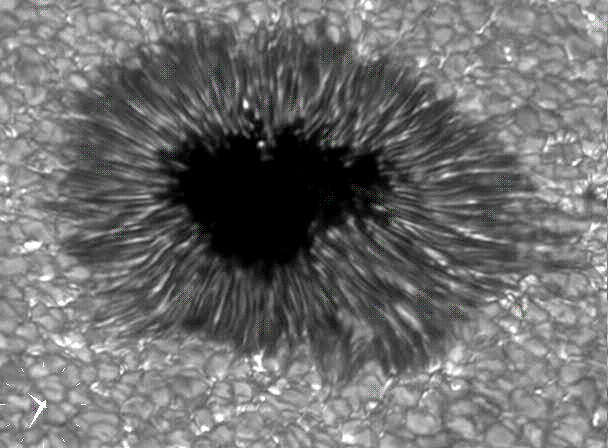
The sights, the smells...
and Oh Yes, the sounds:
BelowSunspot_rendering.mp3 (3 Meg)
Ever wanted to know what a sunspot sounds like? Now's your chance! Just don't trade it on MusicCity, or Hilary'll get ya! -
Re:Somebody will probably correct me ...
Of course, this was probably salescrap. Does anyone know the truth on this?
The BABAR experiment at SLAC is using Objectivity for data storage. Unfortunately, I cannot find a publicly available web page about computing at BABAR right now.
The amount of data BABAR produces is in the order of magnitude of 10's of terabytes per year (maybe a hundered), and even storing this amount in Objectivity is not without problems. The LHC, which is currently under construction, will generate much more data than BABAR, but even if they reach 10 petabytes per year one day, I very much doubt that they will be able to store this in Objectivity.
-
Re:Somebody will probably correct me ...
Of course, this was probably salescrap. Does anyone know the truth on this?
The BABAR experiment at SLAC is using Objectivity for data storage. Unfortunately, I cannot find a publicly available web page about computing at BABAR right now.
The amount of data BABAR produces is in the order of magnitude of 10's of terabytes per year (maybe a hundered), and even storing this amount in Objectivity is not without problems. The LHC, which is currently under construction, will generate much more data than BABAR, but even if they reach 10 petabytes per year one day, I very much doubt that they will be able to store this in Objectivity.
-
Re:S/Key (provably secure)
Most of the problems in security appear in a. interfaces of individually provably secure algorithms b. improper implementations of algorithms that you could prove secure otherwise. (Look for Dan Boneh's paper on fault injection attacks or on "textbook RSA implementations" for some easy, entertaining reading on this.) PS I work on mainframe security at IBM. In order to break ANY solution suggested by designers, we need to check maybe the first three interfaces in any proposal. 99.9% of the time this is enough to disqualify the proposal.
-
Re:S/Key (provably secure)
Most of the problems in security appear in a. interfaces of individually provably secure algorithms b. improper implementations of algorithms that you could prove secure otherwise. (Look for Dan Boneh's paper on fault injection attacks or on "textbook RSA implementations" for some easy, entertaining reading on this.) PS I work on mainframe security at IBM. In order to break ANY solution suggested by designers, we need to check maybe the first three interfaces in any proposal. 99.9% of the time this is enough to disqualify the proposal.
-
Stump Knuth..
I've been trying to get that $2.56 for years, but its the best $2.56 I've ever worked for because I've learned a lot along the way..Don't think I'd have a chance at stumping him...(Yeah, I own all 3 books of The Art, I'm a geek...)
KidA -
Re:Wow, awesome
Might be on his page if you bug him. Check it out anyway, some pretty cool stuff, and BIG FONTS just in case you can't see so good.
-
Re:My Favorite citation from the Decision:
[C]omputer source code, though unintelligible to many, is the preferred method of communication among computer programmers. Because computer source code is an espressive means for the exchagne of information and ideas about computer programming, we hold that it it protected by the first amendment.
And proprietary software is censorship of the employed programmers? Oh dear.Computer programs are intended primarly for human-machine communication, at least that's the way most programming languages are designed. Programmers communicate among each other using documentation (at least in theory). Of course, in almost all cases, there isn't much usable, up-to-date documentation, and this leads to poor software quality: the next programmer, due to lack of documentation, does not understand the design decisions of his predecessor, and thus can't walk in his footsteps.
And, regarding the second part, I very much doubt that an article describing a new idea about computer programming would pass the review process if it was written in, say, C. Hardly anybody expresses abstract ideas in concrete programming languages.
If we were all using literary programming tools such as CWEB, the observation would have some basis, but currently, such tools are used only infrequently. Perhaps we should change that, in order to gain a bit of constitutional protection. (Unfortunately, here in Germany, Free Speech is not protected, you only have the right to utter your opinion, and this right is severely limited by law in comparision to the US situation.)
-
Re:An idea>in this time of crisis, I believe America
>should do whatever it can to help it's
>shattered economy, and I believe dropping
>all charges against microsoft will
>do just that.Yeah,
Let's build an economy on a backbone of criminal and otherwise unethical behavior!Wait a minnit! This is the Bush administration... That's what almost half of you selfish bastards voted for!