Slashdot Mirror
Domain: strath.ac.uk
Stories and comments across the archive that link to strath.ac.uk.
Comments · 39
-
Re:BFD
In power generation, you must always be able to generate the entire load of the grid, or you have brown outs or forced blackouts to balance the load with the supply. This means that things like wind must be backstopped with 100% capacity gas/coal/storage, not peak load gas as you assert. It may only happen a few times a year, but if you EVER have a moment when wind generation drops to zero (and you will), your gas turbines have to generate 100% of that load (not peak load) or bad things happen. The only way you could theoretically prevent this is if your wind turbine grid spans the entire globe and has something like 300-600% baseline capacity. As we don't have a grid like that, wind as anything but a small supplement to grid power is a pipe dream.
If you do have brownouts, it can damage electronics and/or the grid hardware, and blackouts can cause car accidents, fatalities at hospitals and surgery centers as well as numerous other deleterious consequences.
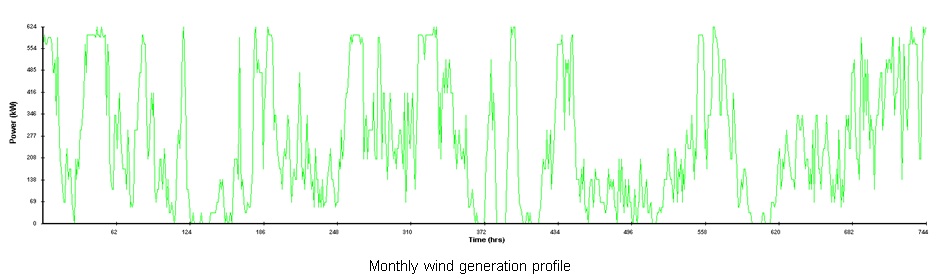
Take a look at this graph of a month long generation of wind power. See every time it dips to zero, that means no wind power during that period (which is minutes to hours). Compared to gas, coal or nuclear which are horizontal lines that match demand exactly.
http://www.esru.strath.ac.uk/E...
"tinfoil hat time"
No need to be an ass, I was merely making the point that we do not currently have an efficient method of storing large amounts of electricity, and any proposed methods are theoretical and nowhere near production worthy.
-
Re:Scale
250 kWh per day.
That's an absurd figure approx 20+ times too high. Have a look at your electricity bill. The figure doesn't need to be estimated, the energy Co's & gov't will know exact figures.
see:
http://www.carbonindependent.org/sources_home_energy.htmsource:
http://www.berr.gov.uk/files/file43304.pdfAlso see:
http://www.esru.strath.ac.uk/EandE/Web_sites/01-02/RE_info/hec.htmThe above show the average house using approx 14KWh per day (UK), by switching to more energy efficient products, this could be closer to 10kWh per day. So by your figure of 5KWh/day per person we could be running Britain from solar power completely.... WOW!!!!!
-
Re:Except what alternatives do we have?
Electricity isn't required "8 hours a day", and the grid required for current solar panels to supply an entire country's worth of power...
So you like most others ignored other energy sources. I mentioned two that don't depend on the sun shining, geothermal and wind. Geothermal is steady and reliable, and the wind is always blowing somewhere.
in the US, you have a lot of empty space, but over here in the UK we don't actually have room for all the of required panels.
So use other sources. At the beginning of 2011 the UK received over 5.2 gigawatts of wind power making it the eighth largest wind energy producer. The UK's wind potential is much higher. The University of Strathclyde says "it is theoretically possible to obtain more than 1000TWh of electricity each year from the wind." The University of St Andrews in Scotland says there's a lot of potential for geothermal. The Scottish National Minewater Potential Study [pdf] details some of that potential.
Falcon
-
Re:Factors of 10
A quick google search should help that http://www.google.com/search?q=define%3A+byte&ie=utf-8&oe=utf-8&aq=t
I mean take a look at how many places say 8bits is 1byte
http://wordnetweb.princeton.edu/perl/webwn
http://en.wikipedia.org/wiki/Byte -- but the modern de facto standard is 8 bits
http://www.choicesandchallenges.sts.vt.edu/modules/evillage_glossary.htm
http://www.satech.com/glosofmemter.html
http://www.teds.com.au/www/6/1001102/displayarticle/glossary-of-terms--2104323.html
http://www.precisecyberforensics.com/glossary.html
http://www.its.strath.ac.uk/helpdesk/glossary/There are several places including Princeton University that state 8 bits is 1 byte.
-
Wind is worthless from a cost pov anyways...
Oh really? Payback period: The Energy Information Administration lists average U.S. residential electricity prices at 11.23 cents per kwh, as of February 2009. A turbine that puts out 2000 kwh a year saves $224.60 annually at that price, making the payback period just under 20 years on a $4500 panel. (The government rebate would lower the payback period to about 14 years.)" 3.5.4 Payback
"The detailed analysis done regarding the payback shows that with good wind resource at the installed site, the payback for a 15kW wind turbine will normally be about 10 years. Further with the usage of additional storage facilities like battery would increase an additional payback period of 13 years."Meanwhile the nuclear power industry is Hooked on Subsides. "How do France (and India, China and Russia) build cost-effective nuclear power plants? They don't. Governmental officials in those countries, not private investors, decide what is built. Nuclear power appeals to state planners, not market actors."
Falcon
-
Re:Wrong Comparison
You present it as an "either or" situation. If you were in the business of needing reference material, and had no google you would probably have already been in the library. Instead you have a "library" at home. The real world library hasn't ceased to exist. People still drive there, it still gets heated and lighted. So the facility of google is using energy over and above the energy used by the library. It has saved you a trip, but that's not the same as being more efficient.
Plus you have a computer which probably does more than 1 internet search a day, which didn't exist before, googles servers didn't exist before, it's all extra. Whether the articles figures are accurate or not, it does no-one any good to pretend that we are getting all this convenience ecologically impact free. Surely the first step is to establish accurate figures so we know what the impact is, and work from there.
I thought the figure was a little high myself, but I've seen data of 0.97Kg CO2 per 1KwH for a coal powered station so it's probably not far off. That's a lot if you're on the net all day. -
Re:Not entirely new, but interesting.
Here is a brief outline of wakefield acceleration by Prof. Jaroszynski himself.
-
Re:Floating Currents Turbines?
The connection-less design you mention does indeed allow for a sealed structure. It does not, however, solve all your problems in terms of a completely sealed electrical system, which is the more difficult problem to solve. You still need cabling, connectors, service access while submerged etc. An additional problem in an estuary would be silt deposits and increased mechanical wear, but I have no idea of how bad that problem would be - that would depend heavily on local factors. With the water being brackish, salt is indeed less of a problem, but you don't need much salt to short a 500kW powerline.
Storage with fuel cells is very much in its infancy right now, and the fuel cells do not last very long. This will certainly change, but for now it's considered an impractical and costly solution for wind turbines, and these benefit even more from any form of energy storage. Batteries are cheap (relatively) and a proven technology in terms of medium-term energy storage. They also support round-robin replacements as they age if you get modular ones (easy/cheap with batteries, difficult/expensive with fuel cells), which is a big reliability boost. For now, fuel cells look promising, but are not ready for production requiring much in the way of stability.
I would not recommend anyone to buy any of the available 500kW systems that I know of - they are still not ready for operation. Besides, the ones I know of are European, and as such made for European grid codes - I am from Europe myself. But look at Marine Current Turbines or see a few of their demonstration and test installations at this site. And yes, these are the guys we worked with briefly -
repeating old mistakes (simulation, what's that?)I've researched avionics software a bit. If testing and simulation was skipped, that is indeed inexcusable.
I feel like I'm not getting my $400 Billion worth.
One plane's INS and avionics, I could understand. But the F20 and F16 should have been enough of a lesson. (F20 link) http://www.f20a.com/f20ins.htm
Even the F-16 'flip over when crossing the equator' problem was noted in simulation: (See below)
Once you come up with a simulator scenario, I think you should be required to repeat that test in later generation products. For now, I'd keep my F-22s in the Northern Hemisphere, just in case.
1980s:
[Jan86] Janssen, B.: "F-16 Problems - Contribution to the RISKS Digest", Volume 3, Issue 44, 1986
* Several problems were experienced with the software for the F-16 fighter plane. These had the potential to endanger the life of the pilot, as well as other people in the air and on the ground.
* During simulation of the aircraft, on crossing the equator, a fault in the software caused the plane to flip upside-down. In real life, this would result in the pilot's death. -
Re:Tides
This isn't a lot of power though.
Maybe not for the Bay of Fundy, but take a look at this one , the Rance tidal power plant. Granted, it is (to the best of my knowledge) the biggest of its kind in the world.240 MW is pretty good. However, it's only 1/4 of what a basic single reactor (900 MW) in a nuclear power-plant can produce. But there are other technologies, similar to windmills, that can be deployed at a lower cost, and without the disadvantages of building a dam on the estuary of a river : take a look at this study.
-
Educate the Youth
I had a really strict C teacher by the name of John Perry and I loved him. Make sure that you don't let the write sloppy code or they'll never cut it as programmer. If you don't know the difference between sloppy code and good code then you shouldn't be teaching C. Write a thousand lines of code and hand it to a person who has written plenty of C programs in his lifetime and if he said it's clean then you're golden. Structure is very important. First of course you need to teach the basics. the main function and modularizing code. The structure of the program. Operators and variables and stuff. control statements, loops...ect All these things can be found in just about any basic C book and just about any tutorial online. http://www.its.strath.ac.uk/courses/c/ After you teach them the basics and about pointer, design, methodology, ect... then heres an idea... The best way to get high school students excited about C is to write a game. Unfortunately game programming could be complex for new programmers. A programmer typical is responsible for a small portion of code. So, you write most of the game and have your students write little modules for stuff. For example high score records. Thats pretty easy and only requires someone to know how to edit a text file and sort scores. Describe a function for your students to write in as much detail as possible. After all the modules have been written put it all together. Then when they see they see the game working they have a sense of accomplishment. I think that most of todays students think they want to go into programming because of games. Why not play on their interests?
-
!tools
While having tools to assist in the actual task of navigating through the codebase is important, a firm handle on the HOW is more critical.
http://c2.com/cgi/wiki?TipsForReadingCode
"Comprehension and Visualisation of Object-Oriented Code for Inspections" http://www.cis.strath.ac.uk/research/efocs/abstrac ts.html#EFoCS-33-98 section 5.
Demeyer, Serge. Ducasse, Stephane. Nierstrasz, Oscar. Object Oriented Reengineering Patterns ISBN: 1558606394
Feathers, Michael. Working Effectively with Legacy Code ISBN: 0131177052
Glass, Robert L. Facts and Fallacies of Software Engineering, section in Chapter 2 on Maintenance ISBN: 0321117425
Spinellis, Diomidis. Code Reading: The Open Source Perspective ISBN: 0201799405 -
Re:E85 costs more than regular gas!Depends on what you mean by energy replenishment, lots of energy is coming in from the sun every day.
Biofuels are about converting solar energy to useful power sources so in that sense there is fast enough replenishment.
As for net energy from energy crops, LCA can be used to calculate the total energy required to produce a litre of transport fuel (petrol or diesel).
This UK study from 2003 found net energy gains from the production of biodiesel.
From that study:
For each MJ of biodiesel produced 0.025Kg of CO2 is released.
Significant reduction in net CO2 emissions from biodiesel
For each MJ of fossil diesel produced 0.087Kg of CO2 is released. -
Re:Open to view, not so open to enter.
>>> "The database does not contain ideas that someone comes up with but doesn't care for protection."
Except that many of the databases used have non-patent information in them. Back copies of computer magazines, IBM technical disclosure bulletins, journals of the IEE and IEEE, British Computer Society publications (to name but a few)
For the breadth of available prior art check out this synopsis of the famous "Windsurfer" case http://slcc.strath.ac.uk/scotslawcourse/ip/ip/pate nt/windsurf.html -
Neither new nor unique - Seaflow, Enermar, etc
There is the Seaflow project in the Bristol channel (that's England / Europe), which does pretty much the same thing. There is at least one more of these underwater ocean current devices that I don't remember, and I've recently visited the Enermar system in the Strait of Messina. See this Uni Strathclyde site on more details.
A good Google search term is Ocean current energy, or Marine current energy.
Enough Karma Whoring for this time! It's a pity they won't go with offshore wind energy - the resource at the proposed offshore site was quite good, so the cost would have been quite tolerable, especially against shipped in 70$/brl oil. However, it's going to be interesting to see whether they can make this work. It's interesting that Current to Current can offer a price per kWh without having prospected the currents in detail... and hopefully, the device is very reliable, because getting divers into 75-200 m depth is hardly simple (means, it takes time to fix things). -
Re:Silly inventions.....
Power from the moon rotating the earth? I'll have 250 MW, please.
-
Re:Home grown
wrong url - should be SPIDER development
-
Home grown
At my institution we've been using a home grown system called SPIDER since 1998, built using PHP & mySQL. Its easily customisable, so we can add whatever features we want to it, when we want, and can tailor the system to meet the needs of our staff and students. It provides all the usual stuff (file, class, user mangement) as well as providing multi-tiered administrative control of classes, degrees and "clusters" [groups of related degrees]. It links in to our Oracle based MIS to get access to relevant student and class data, and uses LDAP to authenticate with our DS. Its user-centric, allowing users to customise the site to their needs (rather than course designers forcing their course/class design on the user) and classes are 'open access' - any registered user can access any class material on the system they want. We currently have over 10,000 users, and it runs on a £3000 worth of hardware with plenty of resource to spare. Guest logins are available on the SPIDER development system.
-
Re:It will be economically viable, one day
Honestly, I don't know. However, there are numbers that say that will take less energy to produce biodiesel than it would to produce petroleum-based Diesel. The sources that I have found on this issue are:
http://www.esru.strath.ac.uk/EandE/Web_sites/02-03
http://www.bebioenergy.com/biodiesel.htm
http://en.wikipedia.org/wiki/Biodiesel#Efficiency_ and_economic_arguments -
An alternative to tidal power?
Might be an interesting alternative to tidal power, when tides are not strong enough. But I couldn't find much technical information on it.
As for tidal power itself, maybe it's worth noting here that it has been in use for quite some time, even though at only few places. The largest is the 240 Megawatts plant in La Rance in France.
In Northern Ameria, there is The Annapolis Tidal Generating Station.
-
Re:Big consumer of Lego bricks
She's cute too
-
Re:Big consumer of Lego bricks
wow. Some of the videos blew me away..
-
Big consumer of Lego bricksand one of the finest Lego modelers out there is Jennifer Clark.
Look at her website for a while, and you'll just say "wow." She has the most amazing designs, and stays as true to the equipment she's modeling as she can.
-
Re:It's either the infrasture....
Electrical Storage:
Hydrogen conversion is at presenly only 65% efficent versus 85% for a hydro storage system
http://www.electricitystorage.org/tech/technologie s_technologies_pumpedhydro.htm
and
http://www.electricitystorage.org/tech/technologie s_technologies_flywheels.htm
http://www.esru.strath.ac.uk/EandE/Web_sites/03-04
http://www.jet.efda.org/pages/focus/004power/
http://www.esru.strath.ac.uk/EandE/Web_sites/03-04
http://www.geocities.com/dfradella/homepage.htm -
Re:It's either the infrasture....
Electrical Storage:
Hydrogen conversion is at presenly only 65% efficent versus 85% for a hydro storage system
http://www.electricitystorage.org/tech/technologie s_technologies_pumpedhydro.htm
and
http://www.electricitystorage.org/tech/technologie s_technologies_flywheels.htm
http://www.esru.strath.ac.uk/EandE/Web_sites/03-04
http://www.jet.efda.org/pages/focus/004power/
http://www.esru.strath.ac.uk/EandE/Web_sites/03-04
http://www.geocities.com/dfradella/homepage.htm -
Re:No....Bio diesel is at least 5 years away.
It would take a lot longer than 5 years to get new nuclear power plants approved in the UK.
Wind doesn't have the energy density required
Required by whom? Energy density is very important when you are carrying the fuel with you (cars, planes, rockets, etc.). It is rather less important when you are building a power station. So wind farms take up more land than nuclear power plants. Big deal.
Tidal might, but also consider the ecological damage
That is a very valid concern. The costs and benefits have to be weighed up against the costs of fossil/nuclear power. Certainly in estuaries, it really has to be assessed on an individual basis for each proposed scheme. Wave power plants that operate in the sea have less of an environmental impact, but are more costly to maintain.
I haven't heard much about tidal
That's not really a very good reason to discount the technology. Have a look here.
-
Not just a phone box...
> Basically a big blue phone box so police officers
> could contact their station before the advent of
> portable radios, they also had a phone on the
> outside for the use of the public in emergencies
>(behind the panel with text on it.)
I made a discovery recently... I always thought that the real Police Boxes were rather like normal telephone boxes: simple, light, wooden.
But most of them were actually serious concrete affairs, weighing over two tons (which became somewhat of a problem when they were decommissioned). They worked as miniature police stations, where an officer could imprison a suspect until help arrived. Here's a short history, and more details (PDF, sorry).
Was I the only person not to know this? Oh, ok. -
Re:Even more evidence of our retarded society
References for my previous here
-
Ask and ye shall recieve
Here ya go my brutha.. come in from the dark
-
Re:Can you imagine those Tech support calls?
Haven't you ever used xeyes?
-
Re:JAXB
> now you have to learn XML Schema
There are other data binding tools that don't require a schema. There's one we looked at from Strathclyde University in the UK that binds to XML and generates objects based on the programmers classes. here -
Re:It's about tools, libraries
There's more than SAX and DOM out there. What about data binding tools? Generate some classes from your DTD/schema, call bind(xmlFile) and you've got objects to work with.
There are even partial matching binding architectures. The best one I've seen is SNAQue. -
Notice it's a girl/woman/femaleOriginal Lego Designs by Jennifer Clark
Unless some guy was named "Jennifer," which would explain why he whould be hiding at home spending that much time on legos.
-
Yeah, but did you see the links?
This one is flat-out amazing. Some lady has managed to build scale models of all sorts of construction equipment--and functional, too!
Mind-blowing design work, that's for sure. -
UK Ambulance DispatchI haven't seen any posts regarding the failure to design intelligible user interfaces and train the people who will actually be operating the system - or the idiocy of the companies receiving the software and their "integration" into the company operation.
The UK automated ambulance dispatch system has to be my "favourite" in this regard. See here.
Not only was the software incomplete, inadequately tested and un-tuned to the required performance, but the users were never actually shown how to scroll back up the list of incidents (fifo queue, so oldest were scrolling off the top of the screen). This is rarely mentioned.
Add a good dollop of stupidity in not deciding to phase in a new complex system alongside your existing (pen and paper) system...
They all got off VERY lightly in this case - due to the medical emergency nature of the system it was very difficult to prove the culpability of any one party.
The reported 30+ deaths are now considered mostly media hysteria, however at least one asthmatic died before reaching hospital. Many people had to wait hours for assistance, while others had 5-6 ambulances arrive.
Software criminal negligence is not restricted to the project managers, testers and developers...
Q.
-
Slow off the mark?
Geeks who are still using so-called "multi-tap" input should be ashamed of themselves. Dictionary based methods, T9 (from Tegic/AOL), and iTap (Motorola's equivalent) have been standard on phones for a couple of years now, even if they do have their short-comings.
If you're not into the legacy layout* you could go with MessagEase or this new thing, but the smart money is on a company called Eatoni, since they have two products (LetterWise and WordWise) which they back up with a big stack of research. There's also Zi Corp. who make eZiText and eZiTap for SMS input.
If you're interested in the HCI aspect of all this you could do worse than looking at the work of I Scott Mackenzie, Poika Isokoski or Mark Dunlop.
* 1-800-GOFEDEX anyone? Probably explains why Europe is ahead of the US in this field. That and our ridiculous txt addctn...
-
Re:Easy solution!
>Put Windows 2000 on the machine and run netmeeting.
You may not want to limit yourself so dramatically...
Note that MS netmeeting has explicitly stopped support for all open standard codec protocols. This is another attempt to lock out compatibility with Open Source software. MS has done their best to hide that they ever supported any open standard protocols, but you can still get support for an open standard netmeeting codec (if you need to interoperate with folks using netmeeting).
The project mentioned in this article sounds like it's trying to solve a specific videoconferencing problem, and not be a generic desktop solution. In that case, you definitely don't want the excess MS baggage: you're getting the whole elephant when all you need is the tail; linux is much easier to tailor to suit a specific need. Compound that with the high pricetag of W2K and the limited budget, and Windows becomes very unattractive.
WebBriefing is a closed source project for Linux. I have found that it complements GnomeMeeting very well in that each has functionality missing in the other. WebBriefing seems to have dropped off the face of the earth , but I could still find the RPM .
Also, realize that GnomeMeeting relies on PWLib. It's V4L compatibility stems from this. I remember going through the source once and seeing the limited compatibility... you might want to do the same. I don't know what project is in control of this library, but that might be a good place to ask about compatibility. The V4L mailing list is also a good resource.
-
Re:no examples of innovationWould it be safe to say that you did no historical research in compiling your list?
Anything that was part of BSD was not developed as open source. BSD was treated as a proprietary operating system. So much for nethack as an example -- BTW, nethack is derived from rogue, another part of UNIX.
You have not named a particular chess client that you believe created the product category and was open source or free software.
I found two pages on X Window history (here and here). Both clearly frame X/Windows as a derivative product that came about after other GUI platforms. (It was also radically inferior to the Macintosh, even though it came afterwards.)
GCC is a clone of the Unix CC.
TeX may be an example of an innovative piece of software that originated under free/open conditions. I can't find anything to the contrary. I have never used TeX so I can't comment on whether it really deserves to be considered innovative; I will note that it came after troff, and that although it came after the GUI revolution it missed the boat, so there may be reason to consider it regressive rather than innovative.
And so on. I don't know all of your examples, but the ones I knew did not encourage me to bother checking out the rest. If you continue to defend that list, please give specific references.
Tim
-
IMHO
eventually enough black holes get together and reverse the trend (think sine wave) and everything starts to come back together. Eventually everything compresses back into the size of that grapefruit of yore and we bang again (notice the "eventually"s, this takes a long time). I think the "dark(anti?) matter" is part of the equation, and there are probably other parts we don't have a grasp on yet, but a continuing pattern of death and rebirth seems to fit with pretty much everything else in the universe.
I don't see this NYT article as discrediting my theory, we merely haven't crested the hill yet and it looks like it goes up forever from our limited perspective.
my $.02(US) (doing very well vs. the Euro BTW)