Slashdot Mirror
Domain: subbot.org
Stories and comments across the archive that link to subbot.org.
Comments · 16
-
Re:Spaghetti sort
Why wouldn't you need length? You're sorting on length. You need something to hold the spaghetti strands in an upright position, so you need volume. Volume increases faster than the material needed to bound it does.
http://www.tiem.utk.edu/~gross...
Surface area = 6 * length^2
Volume = length^3
The more hardware you add to make the cube bigger, the much more spaghetti you can sort. The hardware increases less than O(n).
Even if other hardware components increase at O(n) (not sure of that even), because your container hardware increases at less than O(n) your total hardware increases less than O(n). You get an advantage because nature increases volume faster than its bounding lengths.
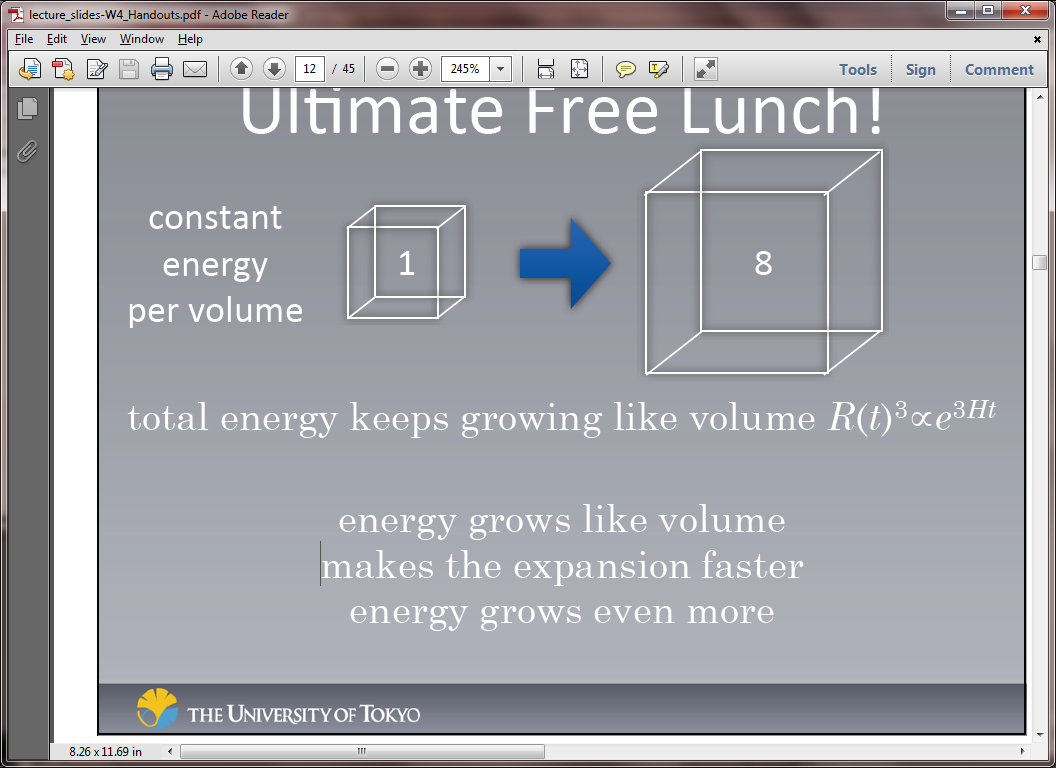
Related: Ultimate Free Lunch
-
Re:Reconciling faith with science
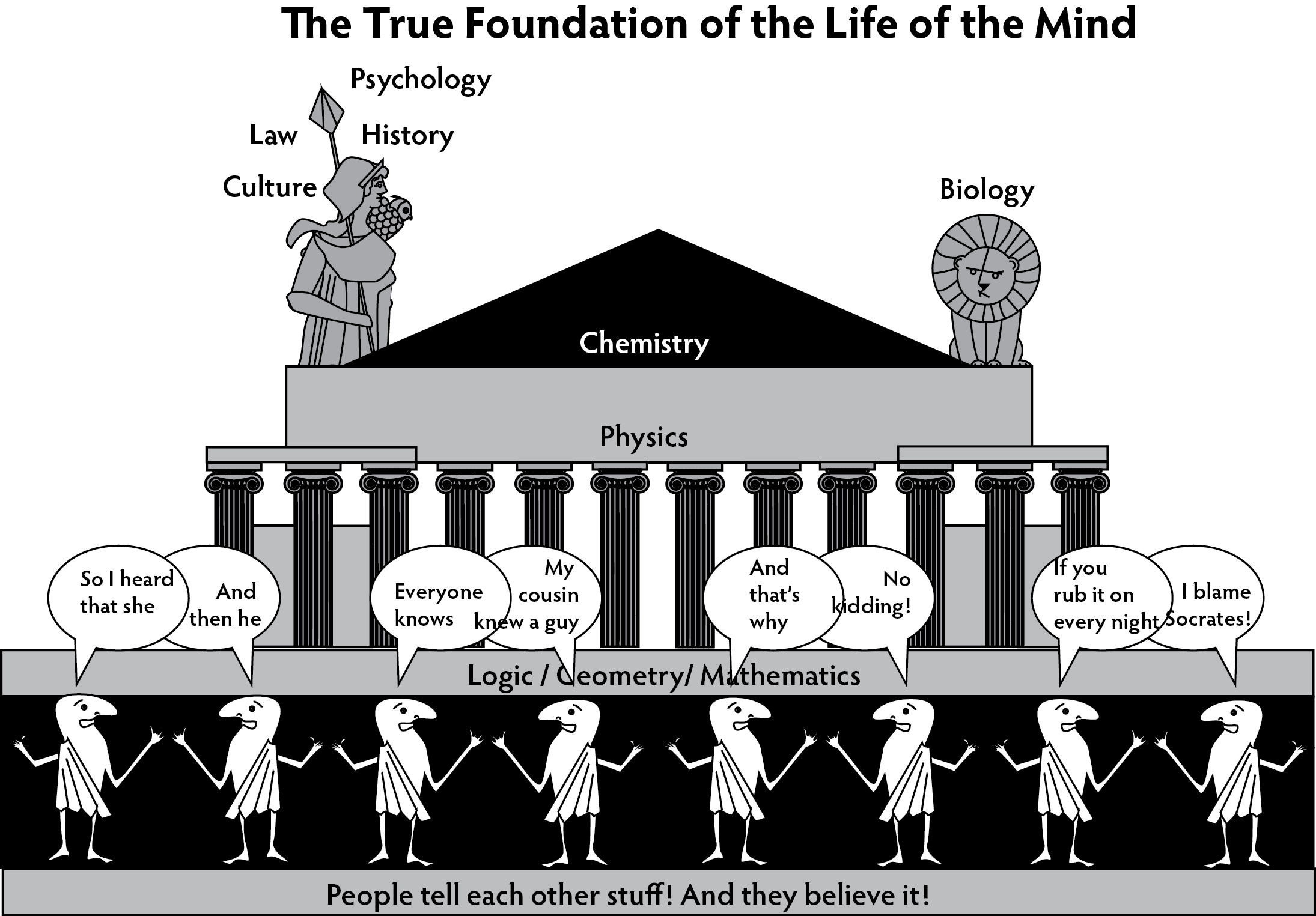
Atheism is a lack of a certain type of faith. To lack that type of faith, you have to have faith that there's a difference between your beliefs and that type of faith.
A drawing, by John Holbo, from his Reason and Persuasion Coursera MOOC, depicts what I'm trying to get at. It's gossip all the way down!
-
Re:Reconciling faith with science
Yeah, accounting is faith in conservation of money, which is disproved by the empirical observation that the money supply increases.
As for the universe behaving predictably, science laws are probabilistic at best. So in the specific case of a photon being measured, you cannot predict which state it will collapse to: you can only say there's a probability. There is an inherent self-contradiction in quantum mechanics between Shroedinger's equation and the final measured state.
See Penrose:
"quantum theory itself, quite apart from its need to be unified with general relativity theory, is basically self-inconsistent"
He goes on, at length (please see the pdf to read the strange characters in the quotation below, I started correcting them then realized it would take more time than I want to spend on this):
This inconsistency is a very fundamental one, and is in a clear sense completely obvious (the "elephant in the room"!) as we shall see. As remarked upon earlier, we take the evolution of a quantum system in isolation to be governed by the SchrÂodinger equationâ"or, in more general terms, unitary evolutionâ"and for which I use the symbol âoeUâ. But, as was remarked upon earlier, the reality of the world that we actually observe taking place about us tends not to be described directly by the solution Î of this equation that we get by this U-evolution, but when an observation or âoemeasurementâ is deemed to have taken place, Î is considered to âoejumpâ to just one member Î of a family of superposed alternative solutions
Î = α1Î1 + α2Î2 + . . . + αnÎn (1)
where the respective squared moduli of the complex-number weightings α1, α2, . . . , αn, supply the respective probabilities of each Îr being the result (the quantities Îr being assumed to be all normalized and mutually orthogonal). The âoeevolution processâ whereby Î is replaced by the particular Î that happens to come about is the reduction of the state (collapse of the wavefunction) and I denote this process by the letter âoeRâ.
Of course, there will be many such decompositions, for a given Î, depending on the choice of basis that is supposed to be determined by the choice of âoemeasuring deviceâ. Indeed, we must allow that this measuring device is also part of the entire system under consideration, and so should have a quantum state that becomes entangled with the quantum system under examination. Nevertheless there is still taken to be a âoejumpâ in the system as a whole as soon as the measurement is considered to have been made, where the different âoepointer statesâ of the device are entangled with the different possible Îrs that can result. It is obvious that this âoejumpingâ from the state of the system (consisting of both the measuring device and system under examination, together with the entire relevant surrounding environment), from before measurement to after measurement, is normally not even continuous, let alone a solution of the SchrÂodinger equation: so R blatantly violates U (in almost all circumstances).
The point is that the law we use to predict a particle's state is inconsistent with the observation of that state, when it occurs. The law is continuous, the observation is discrete.
-
Re:This again?
Laws of conservation are derived from Thermodynamics which makes very limiting assumptions.
Violations of conservation laws are empirically measured: Dark Energy, for example.
-
Re:Relatively high temp...
Remember the assumptions of Thermodynamics?
The System is continuous. There are no scale, quantum, or relativistic effects.
The laws of thermodynamics are relevant only within a narrow range of physical phenomena, which we have gotten out of.
-
Re:Not statistically significant
The request for poems is the interrogation. The poem is the answer. Like in Turing's sample dialog, just more spread out and in email instead of teletyped.
Next step: include this program as an agent in a multiagent system (here's my proof-of-concept). A controller sends it the input: "Write me a poem" and the like. It generates a poem and the controller selects it to return to the user. Then, if the user asks questions, other agents can handle it. Another agent can read the poem and do searches on it, or linguistic analysis, etc.
-
Re:I would think
"Short answer there is no free lunch!"
http://subbot.org/coursera/big...
Do they really need so much water for golf courses in the desert? Yet they exist in Yuma. The problem is the very rich using any amount of water for whatever they want. Also lack of business investment in more basic research in solar desalination, for example. The market wants to eliminate free lunches because they're bad for business.
-
Re:Arrow of Time
http://subbot.org/coursera/big...
Dark Energy and the Big Bang are violations of energy conservation laws.
Conservation doesn't necessarily hold in General Relativity, either. Where does the energy of red-shifted photons go?
-
Re:Oh dear - money grows on trees...
Actually, the universe itself is the ultimate free lunch. Dark energy too has been so described. In economics, banks expand their balance sheets to create a free lunch:
From Economics of Money and Banking, Part I, Lecture 5-5 "Correspondent Banking Bilateral Balances", from about 5:11 to 5:32:
Bank A is saying "I owe you a thousand dollars", Bank B is saying "No I owe you a thousand dollars." They both owe each other a thousand dollars. So they've created these deposits from thin air, they're just a swap of IOUs; they've expanded their balance sheets - both of them. How can that possibly do anything? You know - there's no such thing as a free lunch, it seems like it couldn't possibly do anything.
But it does.
Government created the first free lunch when Alexander Hamilton started running a National Debt by assuming the states' war debts in the very first administration. Conservatives were predicting doom and gloom within a few years then, yet standards of living have risen for over 200 years.
Utitlities should be a public good, not a profit-making entity. The government can and should create money (or borrow at zero cost through the Fed) to provide citizens with power. Profit creates perverse incentives, like garbage companies raising their rates when people use less garbage. Government should override these sociopathic tendencies of market signals.
Using all caps, as the parent post did ("HAVE TO BE PAID FOR"), is a sign that the argument is emotional, not rational. Free lunches exist all over. People try to deny them by yelling. Don't get distracted by them.
-
Re:Oh, it's a lot older than that.
And yet, in the Major Depression in the Population MOOC, we had a slide showing how often in history treatment precedes a scientific understanding of the cause of a disease: http://subbot.org/coursera/pmhdepression/prevention_vs_etiology.png
-
Re:I for one would love to see DBs be more like Ex
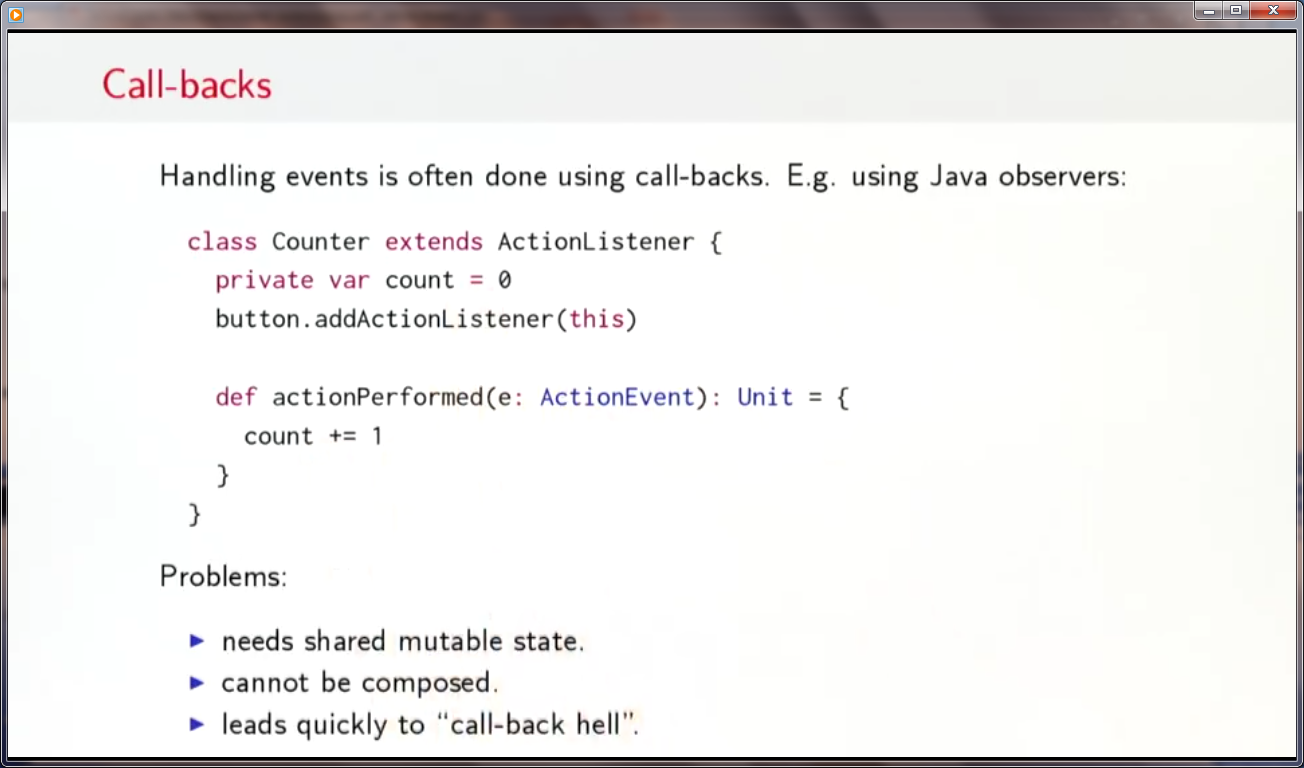
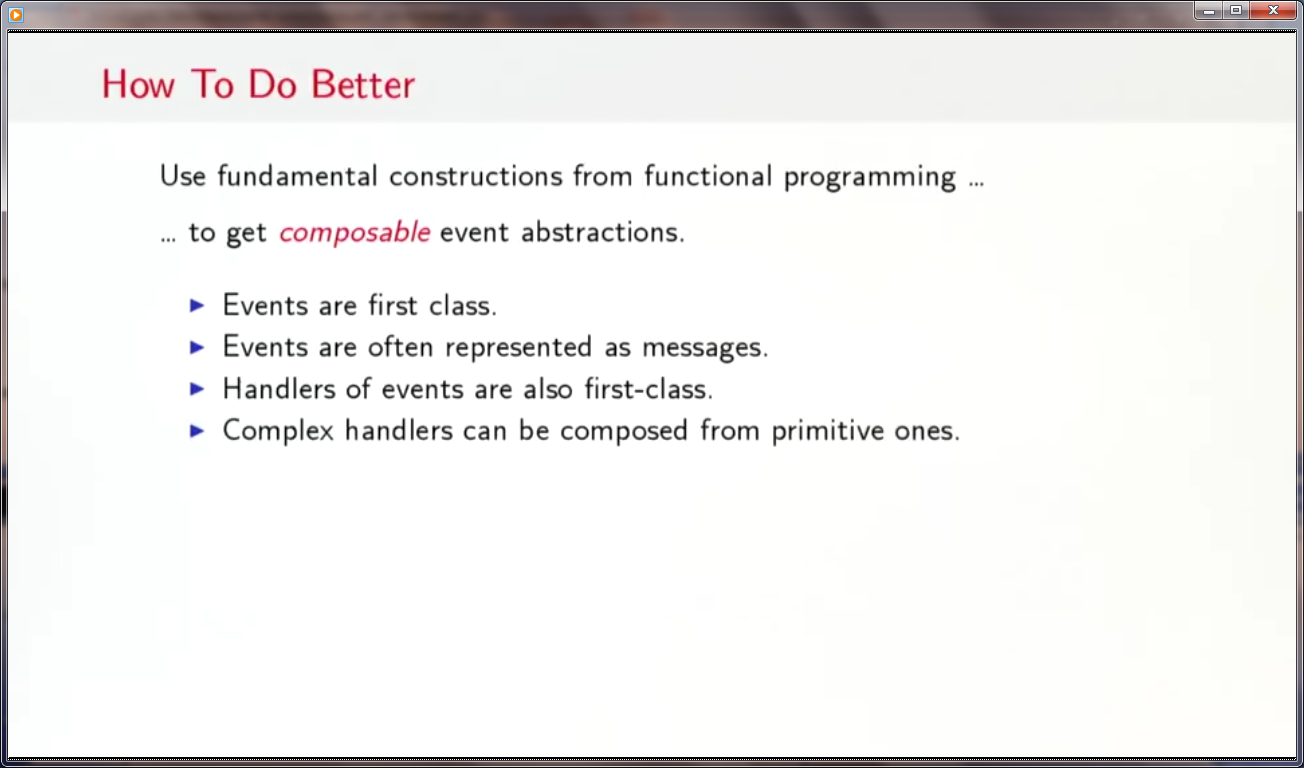
In Coursera's Reactive Programming MOOC, the difference between reactive programming event-handling and traditional event-handling is described in two slides from the introductory lecture:
http://subbot.org/coursera/reactive/callbacks.png
http://subbot.org/coursera/reactive/howtodobetter.pngA traditional Java event-handler is first presented, and the problems enumerated: it relies on a side-effect (the variable "count" in the example), which involves shared mutable state; events and their handlers are not first class. Reactive programming tries to do better so that complex handlers can be composed from primitive ones.
-
Re:I for one would love to see DBs be more like Ex
In Coursera's Reactive Programming MOOC, the difference between reactive programming event-handling and traditional event-handling is described in two slides from the introductory lecture:
http://subbot.org/coursera/reactive/callbacks.png
http://subbot.org/coursera/reactive/howtodobetter.pngA traditional Java event-handler is first presented, and the problems enumerated: it relies on a side-effect (the variable "count" in the example), which involves shared mutable state; events and their handlers are not first class. Reactive programming tries to do better so that complex handlers can be composed from primitive ones.
-
Re:Manually Generated
I have an In Soviet Russia joke generator:
> In America, you laugh at jokes.
In Soviet Russia, jokes laugh at YOU!http://subbot.org/isragent/isragent.txt
It uses the link agent ( http://subbot.org/link/ ) to parse input into Subject, Verb, and Object, then moves the Object to the Subject position and adds YOU! at the end. It also tries to do some verb agreement.
-
Re:Manually Generated
I have an In Soviet Russia joke generator:
> In America, you laugh at jokes.
In Soviet Russia, jokes laugh at YOU!http://subbot.org/isragent/isragent.txt
It uses the link agent ( http://subbot.org/link/ ) to parse input into Subject, Verb, and Object, then moves the Object to the Subject position and adds YOU! at the end. It also tries to do some verb agreement.
-
Re:Hey bro, what side of your country are you at n
I know I am not alone. Michael Crawford is one such person I communicated with over the Internet like you are. He informed me of the Thought Police that where after him and I know they were after me as well. But he wrote Living with Schizoaffective Disorder that helped me out. He warns us of atomic bombs in the nuclear global war that is coming up in the future.
I wrote the AI web bot Warbot 1Alpha based on my holy grail project of 1995, the only thing that comes close to it is Trane's subbot but my bot is written in C and Python and Trane's uses Ruby. Still neither one can pass the Turning test. But some people confuse it for a real person anyway. I tested it out on the IWETHEY forums from EzBoard and Zope way long ago, and people there accused it of being me as it came from the same IP address. It can parse out HTML and XML code and piece together words into posts to ape human conversations and try to pass as a real human, I also tested it out on Slashdot in 2004 and only recently reactivate it after rewriting parts of it due to corruption. It can create new accounts if there is no image verification, and it went wild on IWETHEY, and I got accused of creating those accounts, etc. But anyway, I am thinking of phasing it out as all it does is create confusion and hardly anyone understands how it works except for me and a few other people.
-
My project
is at subbot.org. It is a collection of independent agents that can communicate with each other in natural language. It currently includes agents such as ALICE, MegaHAL, Wordnet, Link grammar, Montylingua, as well as a logical inference agent of my own, and an agent that generates "In Soviet Russia" jokes. Each agent gives its response a score (indicating how much confidence it has in the response); a controller selects the response with the highest score. Agent scores can be modified at runtime - the intent is to modify the scores automatically based on user feedback so that the bot customizes itself to a particular user's preferences.