Slashdot Mirror
Domain: techcrunch.com
Stories and comments across the archive that link to techcrunch.com.
Stories · 1,414
-
Google Publishes Eight National Security Letters (techcrunch.com)
An anonymous reader quotes a report from TechCrunch: Google dropped a single National Security Letter into its most recent transparency report without much fanfare, but today the company published eight more NSLs in an attempt to shed more light on government surveillance of Google users. The eight letters published today were sent to Google from FBI offices across the country. Cumulatively, the NSLs seek broad access to content for around 20 user accounts. The names of the targets are redacted, but most of the letters seek access to Gmail accounts. The NSLs were sent to Google over a five-year period, from 2010 to 2015, with the majority coming from the Charlotte, North Carolina field office of the FBI. Others came from Florida, Arizona, New York, and California. "In our continued effort to increase transparency around government demands for user data, today we begin to make available to the public the National Security Letters (NSLs) we have received where, either through litigation or legislation, we have been freed of nondisclosure obligations," Richard Salgado, Google's director of law enforcement and information security, wrote in a blog post. Google has fought to make the letters public in part because the FBI can issue them without prior judicial oversight. -
Google Has Stopped Developing Its Own Self-Driving Car - Report (techcrunch.com)
Google has reportedly shelved its long-standing plan to develop its own autonomous vehicle in favor of pursuing partnerships with existing car makers. From an article on TechCrunch: The Information reports that Google's self-driving car unit -- known internally as Chauffeur -- is working with established automotive names to develop cars which will include some self-driving features, but won't ditch the steering wheel and pedal controls. The firm is already working with Fiat Chrysler, per a partnership announced in May, and that could be the start of others to come. Google first set out to do away with the steering wheel and pedals approach, but this backtrack is from Alphabet CEO Larry Page and CFO Ruth Porat who found the original approach to be "impractical," according to the report. That's despite Google's autonomous vehicles clocking over two million miles of tests on public roads. -
Panasonic's New Shopping System Automatically Bags, Tallies Your Bill (techcrunch.com)
The Wall Street Journal is reporting (Warning: paywalled; alternate source) that Panasonic is "introducing convenience-store checkout machines that can scan and bag items on their own, joining Amazon.com Inc. in the push for more retail automation." The machines will also tally up the total amount owed at checkout so that all you have to do is pay. TechCrunch reports: Last week, Amazon revealed its own more frictionless convenience store pilot, with a location that lets shoppers simply walk out with whatever they want to purchase, for which they're charged automatically via their Amazon account. The Panasonic system uses tags applied to the goods you pick up to tally the cost as you shop, and then automatically bags your selections via a trap-door in the counter that accepts your basket when you're ready to go. It could help with lines, and could also help address some of the issues with current self-checkout system, which require a user to scan their own items to find out their bill prior to paying. That added step may seem small, but it actually causes a lot of headaches and hangups, especially with shoppers who aren't so comfortable with tech. Panasonic's setup is already in use at a Lawson convenience store near its Osaka HQ, but the broader rollout is still a while off. -
Panasonic's New Shopping System Automatically Bags, Tallies Your Bill (techcrunch.com)
The Wall Street Journal is reporting (Warning: paywalled; alternate source) that Panasonic is "introducing convenience-store checkout machines that can scan and bag items on their own, joining Amazon.com Inc. in the push for more retail automation." The machines will also tally up the total amount owed at checkout so that all you have to do is pay. TechCrunch reports: Last week, Amazon revealed its own more frictionless convenience store pilot, with a location that lets shoppers simply walk out with whatever they want to purchase, for which they're charged automatically via their Amazon account. The Panasonic system uses tags applied to the goods you pick up to tally the cost as you shop, and then automatically bags your selections via a trap-door in the counter that accepts your basket when you're ready to go. It could help with lines, and could also help address some of the issues with current self-checkout system, which require a user to scan their own items to find out their bill prior to paying. That added step may seem small, but it actually causes a lot of headaches and hangups, especially with shoppers who aren't so comfortable with tech. Panasonic's setup is already in use at a Lawson convenience store near its Osaka HQ, but the broader rollout is still a while off. -
Google Is Testing User Ratings For Movies, TV Within Search Results (techcrunch.com)
Google has confirmed to Search Engine Land that it is testing a feature allowing users to rate movies or TV shows directly in the search results interface. "We're currently experimenting with the feature but have nothing to announce at this time," a Google spokesperson said. TechCrunch reports: Unlike other movie and TV rating platforms, Google's feature is not on a scale from one to five but instead offers a binary choice: like or dislike. Information about weather, ticket purchasing options and more used to be available on unique, individual websites. Today, however, Google has incorporated this information and functionality into the search results layer of its own service. Within the movie ratings feature, users will also be able to see the Rotten Tomatoes and IMDb ratings for the title, as they always have. You can view a screenshot of the rating system here. -
Google Now Lets Developers Write Apps For the Assistant On Google Home (techcrunch.com)
Google today announced it will open up Home to third-party developers, allowing all developers to start bringing their applications and services to the Google Assistant. Developers can start building "conversation actions" for the Google Assistant, which "allows developers to create back-and-forth conversations with users through the Assistant," writes Frederic Lardinois via TechCrunch. "Users can simply start these conversations by using a phrase like 'OK Google, talk to Eliza.'" TechCrunch reports: While the Assistant also runs on the Pixel phones and inside the Allo chat app, Google says it plans to bring actions to these other "Assistant surfaces" in the future, but it's unclear when exactly this will happen. To help developers who want to build these new Conversation Actions get started, Google has teamed up with a number of partners, including API.AI, GupShup, DashBot and VoiceLabs, Assist, Notify.IO, Witlingo and Spoken Layer. Google has also allowed a small number of partners to enable their apps on Google Home already. These integrations will roll out as early as next week. Given that users will be able to invoke these new actions with a simple command (and without having to first enable a skill, like on Alexa), Google's platform looks to be a rather accessible and low-friction way for developers to get their voice-enabled services to users. Google will have the final say over which actions will be enabled on Google Home. -
Microsoft Officially Closes Its $26.2B Acquisition of LinkedIn (techcrunch.com)
After getting its final European Commission approvals earlier this week, Microsoft and LinkedIn today announced that Microsoft's $26.2 billion acquisition of LinkedIn, the social networking site, has officially closed. From a report on TechCrunch: The news comes six months after news first broke of the deal. In an internal memo, LinkedIn CEO Jeff Weiner went through the areas where the two companies would be working together, and how they will in other ways remain independent. LinkedIn today has over 400 million registered users, making it the largest social networking site focused on the working world. People use the service both to make work connections with other people in their fields, but also to look for jobs and hire people. As we reported earlier this week, the fact that LinkedIn essentially has a dominant position in this area meant that Microsoft had to make concessions to the EC about how it would work to allow other social networking sites to integrate on its platforms. -
Google, HTC, Oculus, Samsung, Sony Join Forces To Create Global VR Association (techcrunch.com)
Google, HTC, Oculus, Samsung, Sony and Acer have teamed up to form the Global Virtual Reality Association (GVRA) in an effort to reduce fragmentation and failure in the industry. GVRA aims to "unlock and maximize VR's potential," but there are little details as to what this may mean for consumers. TechCrunch reports: What many in the VR community have been thirsting for is some unification of standards in terms of software and hardware. Games bought in the Oculus store don't play on the Vive or PS VR. Sensors for the Vive don't work on Oculus. Sony doesn't play nice with anyone else's standards etc. etc. Valve, which makes the Steam store and SteamVR platform for the HTC Vive and others, is notably not a member of this collective so any hopes of a unified standard (like its OpenVR platform) emerging from this collective is likely not in the cards. From the GVRA press release: "The goal of the Global Virtual Reality Association is to promote responsible development and adoption of VR globally. The association's members will develop and share best practices, conduct research, and bring the international VR community together as the technology progresses. The group will also serve a resource for consumers, policymakers, and industry interested in VR." -
White House Silence Seems To Confirm $4 Billion 'Computer Science For All' K-12 Initiative Is No More
theodp writes: "2016 as a year of action builds on a decade of national, state, and grassroots activity to revitalize K-12 computer science education," reads the upbeat White House blog post kicking off Computer Science Education Week. But conspicuous by its absence in the accompanying fact sheet for A Year of Action Supporting Computer Science for All is any mention of the status of President Obama's proposed $4 billion Computer Science For All initiative, which enjoyed support from the likes of Microsoft, Facebook, and Google. On Friday, tech-backed Code.org posted An Update on Computer Science Education and Federal Funding, which explained that Congress's passage of a 'continuing resolution' extending the current budget into 2017 spelled curtains for federal funding for the program in 2016 and beyond. "We don't have any direct feedback yet about the next administration's support for K-12 CS," wrote CEO Hadi Partovi and Govt. Affairs VP Cameron Wilson, "other than a promise to expand 'vocational and technical education' as part of Trump's 100-day plan which was published in late October. I am hopeful that this language may translate into support for funding K-12 computer science at a federal level. However, we should assume that it will not." -
Facebook Begins Asking Users To Rate Articles' Use of 'Misleading Language' (techcrunch.com)
Facebook is finally cracking down on the fake news stories that run rampant on its site and many other social media sites across the web. The company is rolling out a new feature in the form of a survey that asks users to rate articles' use of "misleading language." The feedback received will likely help Facebook train its algorithms to better detect misleading headlines. TechCrunch reports: The "Facebook Survey," noticed by Chris Krewson of Philadelphia's Billy Penn, accompanied (for him) a Philadelphia Inquirer article about the firing of a well-known nut vendor for publicly espousing white nationalist views. "To what extent do you think that this link's title uses misleading language?" asks the "survey," which appears directly below the article. Response choices range from "Not at all" to "Completely," though users can also choose to dismiss it or just scroll past. Facebook confirmed to TechCrunch that this is an official effort, though it did not answer several probing questions about how it works, how the data is used and retained, and so on. The company uses surveys somewhat like this to test the general quality of the news feed, and it has used other metrics to attempt to define rules for finding clickbait and fake stories. This appears to be the first direct coupling of those two practices: old parts doing a new job. -
Tech Billionaires Award Top Scientists $25 Million In 'Breakthrough' Prizes (fortune.com)
Tonight at NASA's Ames Research Center in Silicon Valley, Morgan Freeman emceed a glamorous, Oscars-style celebration that recognizes scientific achievements with money from tech billionaires. An anonymous reader writes: Donors for the Breakthrough Prize included Google's Sergey Brin, Facebook's Mark Zuckerberg and his wife Priscilla Chan, Alibaba founder Jack Ma and his wife Cathy Zhang, and billionaire venture capitalist Yuri Milner, according to an article in Fortune. TechCrunch has a list of the winners, which included Princeton math professor Jean Bourgain, who won a $3 million prize "for his many contributions to high-dimensional geometry, number theory, and many other theoretical contributions."
Three more physics researchers -- two from Harvard, and one from U.C. Santa Barbara -- will share a $3 million prize recognizing "meaningful advances in string theory, quantum field theory, and quantum gravity." And another $1 million prize honored the leaders of three teams responsible for "collaborative research on gravitational waves and its implications for physics and astronomy," with another $2 million to be shared among the 1,012 members of their research groups.
17-year-old Deanna See from Singapore also won the $250,000 "Breakthrough Junior Challenge" prize -- and more money for her teachers and school -- for her video about antibiotic-resistant superbugs. Google has created a special page where you can read more about some of the other winners. -
Earthquake-Sensing Mobile App 'MyShake' Detects Over 200 Earthquakes Large and Small (techcrunch.com)
Back in February, researchers at UC Berkeley released an app called MyShake that detects strong earthquakes seconds before the damaging seismic waves arrive. Several months have passed since its release and app has already detected over 200 earthquakes in more than ten countries. TechCrunch reports: The app has received nearly 200,000 downloads, though only a fraction of those are active at any given time; it waits for the phone to sit idle so it can get good readings. Nevertheless, over the first six months the network of sensors has proven quite effective. "We found that MyShake could detect large earthquakes, but also small ones, which we never thought would be possible," one of the app's creators, Qingkai Kong, told New Scientist. A paper describing the early results was published in Geophysical Research Letters -- the abstract gives a general idea of the app's success: "On a typical day about 8000 phones provide acceleration waveform data to the MyShake archive. The on-phone app can detect and trigger on P waves and is capable of recording magnitude 2.5 and larger events. The largest number of waveforms from a single earthquake to date comes from the M5.2 Borrego Springs earthquake in Southern California, for which MyShake collected 103 useful three-component waveforms. The network continues to grow with new downloads from the Google Play store everyday and expands rapidly when public interest in earthquakes peaks such as during an earthquake sequence." You can download the app for Android here. -
Fitbit Is Buying Smartwatch Maker Pebble For Around $40 Million, Says Report (techcrunch.com)
According to a report from The Information, Fitbit is buying smartwatch maker Pebble for a "small amount" of money. One source says Fitbit is paying between $34 and $40 million for the company and is "barely covering their debts." TechCrunch reports: A source close to the company told TechCrunch that watch maker Citizen was interested in purchasing Pebble for $740 million in 2015. This deal failed and before the launch of the Pebble 2 Intel made an offer for $70 million. The CEO, Eric Migicovsky refused both offers. Pebble released the newest version of its smartwatch in October, but the past year or so has been a challenging period. It laid off 25 percent of its staff in March, while we reported last year that it was in some trouble and had turned to debt funding and loans, as well as traditional investor cash, "in order to stay afloat." Earlier this year, Pebble CEO Migicovsky confirmed that his company had raised $28 million in debt and venture financing. He blamed a more cautious outlook from VCs focused on tech as the primary reason for letting 40 of Pebble's staff go. -
Fitbit Is Buying Smartwatch Maker Pebble For Around $40 Million, Says Report (techcrunch.com)
According to a report from The Information, Fitbit is buying smartwatch maker Pebble for a "small amount" of money. One source says Fitbit is paying between $34 and $40 million for the company and is "barely covering their debts." TechCrunch reports: A source close to the company told TechCrunch that watch maker Citizen was interested in purchasing Pebble for $740 million in 2015. This deal failed and before the launch of the Pebble 2 Intel made an offer for $70 million. The CEO, Eric Migicovsky refused both offers. Pebble released the newest version of its smartwatch in October, but the past year or so has been a challenging period. It laid off 25 percent of its staff in March, while we reported last year that it was in some trouble and had turned to debt funding and loans, as well as traditional investor cash, "in order to stay afloat." Earlier this year, Pebble CEO Migicovsky confirmed that his company had raised $28 million in debt and venture financing. He blamed a more cautious outlook from VCs focused on tech as the primary reason for letting 40 of Pebble's staff go. -
Facebook Is Bringing Games Like Pac-Man, Space Invaders To Messenger and Your News Feed (techcrunch.com)
Facebook is launching Instant Games, "a new HTML5 cross-platform gaming experience" that is available on Messenger and Facebook News Feed for both mobile and web users. Since they're built on the HTML5 mobile web standard, the games load in seconds and don't need to be downloaded. Instant Games is available in 30 countries and launches with 17 games "from classic developers like Bandai Namco, Konami, and Taito as well as newer studios like Zynga and King," writes Josh Constine via TechCrunch: The biggest draw of Instant Games is how quick you can start playing. You tap the game controller icon in one of your message threads, choose a game from the list, it loads in seconds, you play a short round, and your high score gets automatically posted to the private or group chat thread. You can even share a stylized high score screenshot that you can Doodle on top of like Snapchat to trash talk your opponents. And if you share a game to the News Feed, friends can jump right into the action from Facebook's app or website. For now, the platform is in closed beta, but developers can apply to build Instant Games here. -
Jolla's Sailfish OS Now Certified as Russian Government's First 'Android Alternative' (techcrunch.com)
The future for one of the few remaining alternative mobile OS platforms, Jolla's Sailfish OS, looks to be taking clearer shape. Today the Finnish company which develops and maintains the core code, with the aim of licensing it to others, announced Sailfish has achieved domestic certification in Russia for government and corporate use. TechCrunch adds:In recent years the Russian government has made moves to encourage the development of alternatives to the duopoly of US-dominated smartphone platforms, Android and Apple's iOS -- flagging Sailfish as one possibility, along with Tizen. Although Sailfish looks to have won out as the preferred Android alternative for Russia at this point. The government has said it wants to radically reduce its reliance on foreign mobile OSes -- to 50 per cent by 2025 vs the 95 per cent of the market garnered by Android and iOS in 2015. Sailfish's local certification in Russia also follows an announcement earlier this year that a new Russian company, Open Mobile Platform (OMP), had licensed the OS with the intention of developing a custom version of the platform for use in the domestic market. So, in other words, a Russian, strategic 'Android alternative' is currently being built on Sailfish. -
It's Not Just You, iCloud Calendar Spam is On the Rise (techcrunch.com)
New submitter petersike writes: If you're using iCloud to sync your calendar across your devices, chances are you just received a bunch of spammy invites over the last few days. Many users are reporting fake events about Black Friday 'deals' coming from Chinese users. If you're looking for cheap Ray-Ban or Louis Vuitton knockoffs, you might find these invites useful. Otherwise, you might be wondering: why is this a thing? If you use your calendar for work, you already rely on calendar invites to invite other people to meetings and events. All major calendar backends support this feature -- Google Calendar, Microsoft Exchange and Apple's iCloud. And it's quite a convenient feature as you only need to enter an email address to send these invitations. You don't need to be in the same company or even in your recipient's address book. But it's also yet another inbox -- and like every inbox out there, it can get abused. -
Faraday Future's Factory Construction Paused; Shipping Timelines at Risk (techcrunch.com)
Electric vehicle maker Faraday Future may not be able to make its first cars in time to hits its 2017 shipping deadlines, according to a new report by the Financial Times. From a report on TechCrunch: It's hard to ship a car when your factory itself isn't finished, is the main issue -- FF's Nevada-based manufacturing facility broke ground in April, but construction has since been paused because, according to state treasurer Dan Schwartz speaking to the FT, it hasn't paid bills owed by the company to its construction partner. The delay is temporary, according to comments made by general contractor Aecom, which is working with Faraday on the project, and construction will resume sometime in early 2017. That's going to push out the completion date considerably, and will make it quite difficult for FF to make its previously stated production timeline. FT also spoke to an anonymous former employee who said deliveries to customers within the 2017 timeframe were "not possible." -
Amazon Makes Good On Its Promise To Delete 'Incentivized' Reviews (techcrunch.com)
Amazon is making good on its promise to ban "incentivized" reviews from its website, according to a new analysis of over 32,000 products and around 65 million reviews. From a TechCrunch article: The ban was meant to address the growing problem of less trustworthy reviews that had been plaguing the retailer's site, leading to products with higher ratings than they would otherwise deserve. Incentivized reviews are those where the vendor offers free or discounted products to reviewers, in exchange for recipients writing their "honest opinion" of the item in an Amazon review. However, data has shown that these reviewers tend to write more positive reviews overall, with products earning an average of 4.74 stars out of five, compared with an average rating of 4.36 for non-incentivized reviews. Over time, these reviews proliferated on Amazon, and damaged consumers' trust in the review system as a whole. And that can impact consumers' purchase decisions. -
Security Researchers Can Turn Headphones Into Microphones (techcrunch.com)
As if we don't already have enough devices that can listen in on our conversations, security researchers at Israel's Ben Gurion University have created malware that will turn your headphones into microphones that can slyly record your conversations. TechCrunch reports: The proof-of-concept, called "Speake(a)r," first turned headphones connected to a PC into microphones and then tested the quality of sound recorded by a microphone vs. headphones on a target PC. In short, the headphones were nearly as good as an unpowered microphone at picking up audio in a room. It essentially "retasks" the RealTek audio codec chip output found in many desktop computers into an input channel. This means you can plug your headphones into a seemingly output-only jack and hackers can still listen in. This isn't a driver fix, either. The embedded chip does not allow users to properly prevent this hack which means your earbuds or nice cans could start picking up conversations instantly. In fact, even if you disable your microphone, a computer with a RealTek chip could still be hacked and exploited without your knowledge. The sound quality, as shown by this chart, is pretty much the same for a dedicated microphone and headphones. The researchers have published a video on YouTube demonstrating how this malware works. -
Telegram Launches Telegraph, An Anonymous Blogging Platform (theverge.com)
Telegram has unveiled a new blogging platform called Telegraph, which offers fast publishing and anonymous posting without requiring you to sign up or sign in via social media. The Verge reports: The app's user interface looks very similar to Medium and allows for easy embeds. You can also embed images from your computer by clicking on the camera button. In comparison to Medium, the loading time for embeds is relatively fast. Publication is instantaneous upon hitting "publish." Posts are shareable on social media platforms but are designed to work best on Telegram's new Instant View layout, which works similarly to Facebook's Instant Articles feature. The simplicity and speed of Telegraph are not without its downsides. As TechCrunch points out, the lack of user history means that if you accidentally delete the link to your published post, it would be very difficult to track down unless you have cookies enabled on your browser. The anonymous nature also opens up opportunities for abuse, potentially paving the way for internet trolls and spreaders of fake news -- a problem that has put tech giants like Facebook and Google under scrutiny. -
Google's AI Translation Tool Creates Its Own Secret Language (techcrunch.com)
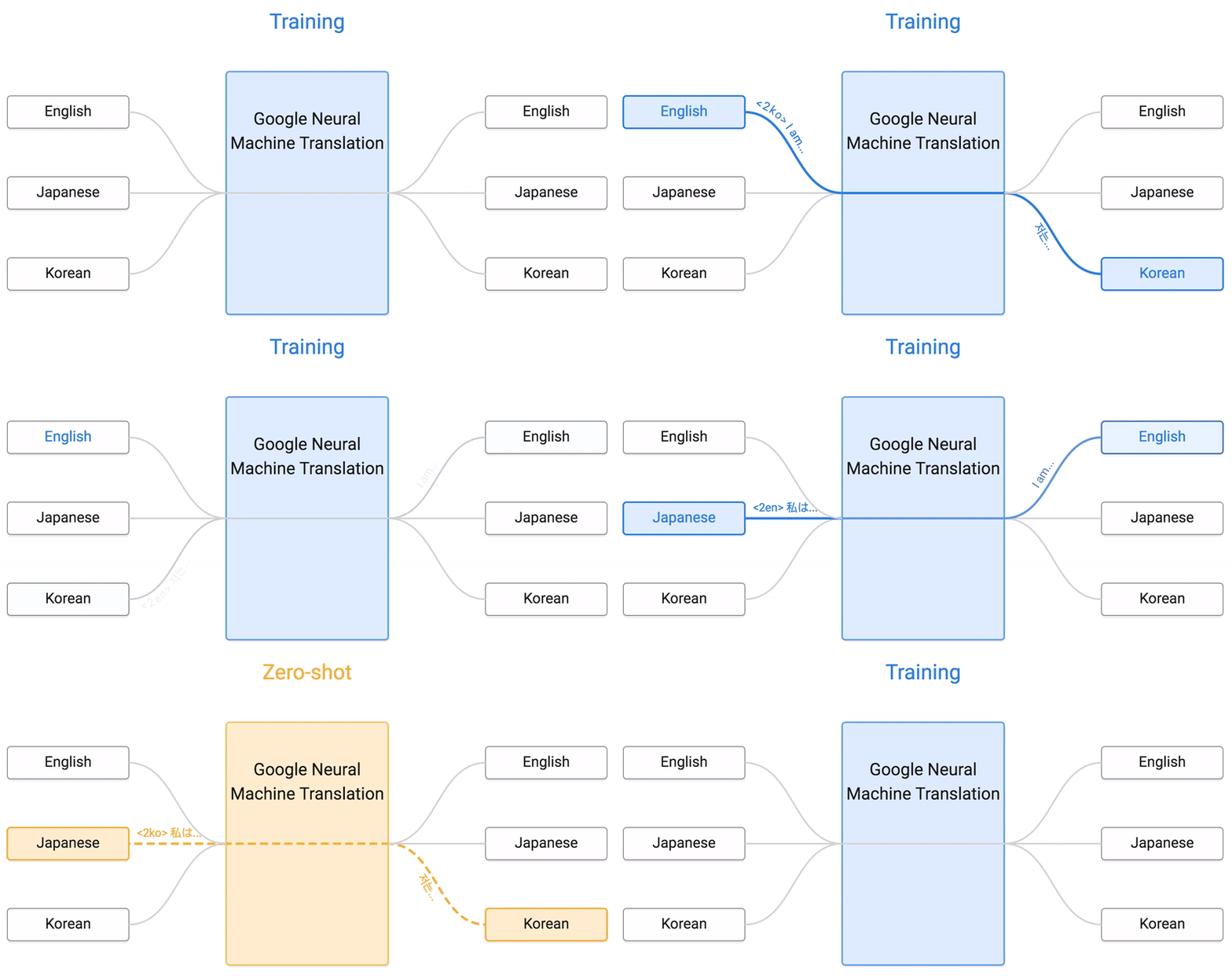
After a little over a month of learning more languages to translate beyond Spanish, Google's recently announced Neural Machine Translation system has used deep learning to develop its own internal language. TechCrunch reports: GNMT's creators were curious about something. If you teach the translation system to translate English to Korean and vice versa, and also English to Japanese and vice versa... could it translate Korean to Japanese, without resorting to English as a bridge between them? They made this helpful gif to illustrate the idea of what they call "zero-shot translation" (it's the orange one). As it turns out -- yes! It produces "reasonable" translations between two languages that it has not explicitly linked in any way. Remember, no English allowed. But this raised a second question. If the computer is able to make connections between concepts and words that have not been formally linked... does that mean that the computer has formed a concept of shared meaning for those words, meaning at a deeper level than simply that one word or phrase is the equivalent of another? In other words, has the computer developed its own internal language to represent the concepts it uses to translate between other languages? Based on how various sentences are related to one another in the memory space of the neural network, Google's language and AI boffins think that it has. The paper describing the researchers' work (primarily on efficient multi-language translation but touching on the mysterious interlingua) can be read at Arxiv. -
Instagram Launches Disappearing Live Video and Messages (techcrunch.com)
Instagram is continuing to add features to its service to woo Snapchat and Periscope users. Today, the company will be rolling out two big new features to Instagram Stories on iOS and Android: live video on Instagram Stories and disappearing photos and videos for groups and friends in Instagram Direct. TechCrunch reports: Instagram Live is the most ephemeral of the major Live streaming platforms now that Meerkat is defunct. While Periscope started with a 24 hour expiration date, it eventually allowed permanent replays like Facebook Live. Instagram Live videos disappear as soon as the stream stops, which could get people broadcasting more frequently rather than saving the capability just for big flashy events or citizen journalism. Meanwhile, viewers will feel greater urgency to watch immediately because they know it's their only chance. Instagram Direct already has 300 million monthly users, but all of the messages are permanent. The existing product lets you send text, photos, and videos, and posts from Instagram to friends and discuss them. But with Instagram Stories now letting you communicate visually with overlaid text and drawing, Instagram needed a way to share these 'Gramsterpieces' privately. Now Direct will have an ephemeral Stories messages bar at the top along with a list of permanent threads below. When you go to share a photo or video to Instagram Stories, you'll be able to also select friends or groups of friends to send it to. It's much like how you can send Snapchat Stories as private messages, but adds in a groups feature. Recipients can watch the messages once, and replay them once, but then they're gone. -
Oracle Buys Dyn DNS Provider (techcrunch.com)
Oracle announced today it is buying DNS provider Dyn, a company that was in the press lately after it was hit by a large-scale DDoS attack in October that resulted in many popular websites becoming inaccessible. From a TechCrunch report:Oracle plans to add Dyn's DNS solution to its bigger cloud computing platform, which already sells/provides a variety of Infrastructure-as-a-Service (IaaS) and Platform-as-a-Service (PaaS) products. Oracle and Dyn didn't disclose the price of the deal but we are trying to find out. Dan Primack reports that it's around $600 million. We've also asked for a comment from Oracle about Dyn's recent breach, and whether the wheels were set in motion for this deal before or after the Mirai botnet attack in October. -
Google Opens Real-World 'Google Shops' in Canada (digitaltrends.com)
Streetlight writes: Google is moving towards a physical presence in Best Buy stores...mimicking what Samsung has done. Hopefully the "stores" are staffed with competent professionals that know what they're selling and maybe provide some help to those who have purchased Google's hardware and software.
Google "is launching a store-within-a-store debuting in North America at select Best Buy locations in Canada," reports TechCrunch, adding that recently "Google also revealed that it would be creating a pop-up Experience Store for users to check out its new wares in New York City." -
President Obama On Fake News Problem: 'We Won't Know What To Fight For' (techcrunch.com)
An anonymous reader shares a TechCrunch article: President Barack Obama spoke in Berlin Thursday during a visit to German Chancellor Angela Merkel, and during his remarks he addressed concerns about fake news circulating via social platforms like Facebook. On the subject of fake news, Obama noted that the ease with which we can make false information seem like genuine facts on platforms including "a Facebook page" means there's a great risk for audiences. Here's is what he said, "Because in an age where there's so much active misinformation, and it's packaged very well, and it looks the same when you see it on a Facebook page or you turn on your television, where some overzealousness on the part of a U.S. official is equated with constant and severe repression elsewhere, if everything seems to be the same and no distinctions are made, then we won't know what to protect. We won't know what to fight for. And we can lose so much of what we've gained in terms of the kind of democratic freedoms and market-based economies and prosperity that we've come to take for granted. -
Microsoft Offers Concessions To EU Regulators Eyeing Its $26.2 Billion LinkedIn Bid (techcrunch.com)
Microsoft has offered concessions to EC competition regulators in the hopes of smoothing the way for its planned acquisition of LinkedIn. From an article on TechCrunch, submitted by an anonymous reader: An EC spokesperson confirmed it has received "a commitments proposal" from Microsoft but declined to comment further. Commitments, in EC antitrust nomenclature, refers to remedies a company can offer if the Commission has concerns a merger/acquisition may significantly affect competition. These can include proposing certain modifications to the project to guarantee continued competition on the market.The news comes two weeks after Salesforce (which itself tried to purchase LinkedIn) urged EU to take a closer look at Microsoft's takeover of LinkedIn. -
Microsoft Joins the Linux Foundation (techcrunch.com)
Microsoft today said it is joining the Linux Foundation as a high-paying Platinum member. Linux Foundation executive director Jim Zemlin said, "This may come as a surprise to you, but they were not big fans," describing the two's previous relationship. From a report on TechCrunch: The new Microsoft under CEO Satya Nadella, however, is singing a very different tune. Today's Microsoft is one of the biggest open source contributors around. Over the course of just the last few years, it has essentially built Canonical's Ubuntu distribution into Windows 10, brought SQL Server to Linux, open-sourced core parts of its .NET platform and partnered with Red Hat, SUSE and others. As Zemlin noted, Microsoft has also contributed to a number of Linux Foundation-managed projects like Node.js, OpenDaylight, the Open Container Initiative, the R Consortium and the Open API Initiative.ArsTechnica has more details. -
DJI Unveils Phantom 4 Pro and Inspire 2 Drones (techcrunch.com)
An anonymous reader quotes a report from TechCrunch: The Inspire wasn't the only DJI line to get a refresh at today's intimate event in Los Angeles. The company's Phantom line is also getting a bump, with the addition of the Phantom 4 Pro. Like the Inspire 2, the refreshed prosumer model features improved obstacle avoidance, courtesy of infrared light pulses that bring detection to the sides of the system, in addition to current 3D mapping of the drone's front, rear and bottom detection. The 4 Pro has a top speed of 45 miles an hour in sport mode (and 31 mph in P mode with obstacle avoidance switched on), coupled with a battery that promises up to 30 minutes of flight time on a charge. The system also has a number of new flight modes like Draw, which let users traces lines on the control to create routes. The system has built in ActiveTrack object recognition, which can distinguish and follow people and bikes. The on-board camera, meanwhile, sports a 20-megapixel sensor and is capable of capturing 4K video at 60fps. The system also sports a new safety feature that returns the drone to its last connected position after it loses a GPS signal. The Pro runs $1,499, a price that includes the standard controller. Another $300 will get you a high-luminescence version of the control. It's available now for pre-order and is set to start shipping in a week. DJI has been releasing high-quality drones left and right lately. In September, the company announced the Mavic Pro drone that can fold up into roughly the "size of a standard water bottle." In addition to the Phantom 4 Pro drone unveiled today, the company also updated the Inspire, the drone line focused specifically on filmmakers and pro photographers. The Inspire 2 features an aluminum alloy frame and two new camera options -- the X5S, which features a micro four-third sensor at 20.8 megapixels and supports 10 lenses, and the X4S, a lightweight pro camera with a 20-megapixel sensor. What's more is that it can capture 5.2K video at a rate of 4.2 Gbps and travel at speeds up to 67-miles an hour. The Inspire 2 will cost $2,999. -
DJI Unveils Phantom 4 Pro and Inspire 2 Drones (techcrunch.com)
An anonymous reader quotes a report from TechCrunch: The Inspire wasn't the only DJI line to get a refresh at today's intimate event in Los Angeles. The company's Phantom line is also getting a bump, with the addition of the Phantom 4 Pro. Like the Inspire 2, the refreshed prosumer model features improved obstacle avoidance, courtesy of infrared light pulses that bring detection to the sides of the system, in addition to current 3D mapping of the drone's front, rear and bottom detection. The 4 Pro has a top speed of 45 miles an hour in sport mode (and 31 mph in P mode with obstacle avoidance switched on), coupled with a battery that promises up to 30 minutes of flight time on a charge. The system also has a number of new flight modes like Draw, which let users traces lines on the control to create routes. The system has built in ActiveTrack object recognition, which can distinguish and follow people and bikes. The on-board camera, meanwhile, sports a 20-megapixel sensor and is capable of capturing 4K video at 60fps. The system also sports a new safety feature that returns the drone to its last connected position after it loses a GPS signal. The Pro runs $1,499, a price that includes the standard controller. Another $300 will get you a high-luminescence version of the control. It's available now for pre-order and is set to start shipping in a week. DJI has been releasing high-quality drones left and right lately. In September, the company announced the Mavic Pro drone that can fold up into roughly the "size of a standard water bottle." In addition to the Phantom 4 Pro drone unveiled today, the company also updated the Inspire, the drone line focused specifically on filmmakers and pro photographers. The Inspire 2 features an aluminum alloy frame and two new camera options -- the X5S, which features a micro four-third sensor at 20.8 megapixels and supports 10 lenses, and the X4S, a lightweight pro camera with a 20-megapixel sensor. What's more is that it can capture 5.2K video at a rate of 4.2 Gbps and travel at speeds up to 67-miles an hour. The Inspire 2 will cost $2,999. -
Microsoft is Bringing Visual Studio To Mac (techcrunch.com)
Microsoft will finally bring Visual Studio, a "true mobile-first, cloud-first development tool for .NET and C#," to Mac later this month, the company has said. From a report on TechCrunch:The IDE is very similar to the one found on Windows. In fact, that is presumably the point. By making it easy for OS X users to switch back and forth between platforms, Microsoft is able to ensure coders can quickly become desktop agnostic or, barring that, give Windows a try again. From the release: "At its heart, Visual Studio for Mac is a macOS counterpart of the Windows version of Visual Studio. If you enjoy the Visual Studio development experience, but need or want to use macOS, you should feel right at home. Its UX is inspired by Visual Studio, yet designed to look and feel like a native citizen of macOS. And like Visual Studio for Windows, it's complemented by Visual Studio Code for times when you don't need a full IDE, but want a lightweight yet rich standalone source editor. -
Google Says There Are Now 2 Billion Active Chrome Installs (techcrunch.com)
An anonymous reader quotes a report from TechCrunch: Google is hosting its Chrome Dev Summit today. There hasn't been a lot of news out of the event, but one number that stood out in today's keynote by Chrome Engineering VP Darin Fisher was that there are now 2 billion Chrome installs in active use across desktop and mobile. This is the first time Google has shared this number. Sadly, Google didn't announce any new user numbers for Chrome today. The latest stat for active Chrome users remains at 1 billion -- a number Google shared in April. While this number is surely higher today than it was six months ago, the company decided to focus on the number of active browser install today. "I wanted to make this point that there are a lot of Chrome browsers out there," Fisher said. "What's exciting about this to you all is that when you think about building for the web, there' a lot of browsers out there that implement the latest web standards -- that implement the latest and greatest web features." The report also notes that Google has a total of seven products with more than a billion users: Gmail, Android, Chrome, Maps, Search, YouTube and Google Play Store. -
Just in Time for Daydream, YouTube Launches Its Standalone VR App (techcrunch.com)
An anonymous reader writes: Coinciding with the debut of Google's new Daydream View VR headset, YouTube this morning announced the launch of its YouTube VR app, which is available first on Daydream. The standalone application turns all of YouTube's content into an immersive experience, even if the videos weren't built for VR viewing. To do so, YouTube VR will display standard videos in a virtual movie screen in app's new theater mode. Of course, 360 degree videos on YouTube will work best in this app. In the theater mode, the video itself fills the main portion of the screen, while video information -- like the title and description -- is off on one side. The other side of the screen displays your queue so you can see what's coming up next. Player controls are down at the bottom. This way, you can watch and browse at the same time, says Google. -
Google 'Strongly' Recommends Against Third-Party Fast Charging Technology On Android (techcrunch.com)
An anonymous reader quotes a report from TechCrunch: Everyone, it seems, is going the fast charging route these days. Thanks to the nearing ubiquity of USB-C on flagship devices, the feature is quickly becoming a standard -- "standard" in the sense that everyone is doing it, not so much that there's any consistency to the tech. All in all, it's a nice addition to manufacturers' newfound focus on battery life. And while Google has embraced its own version on its new Pixel devices, the company's not so keen on letting everyone implement their own version. In newly released Android Compatibility Definition papers issued for Nougat, the company stops short of an outright ban on technologies like Qualcomm's Quick Charge, though it does take a pretty clear stand, "strongly recommend[ing]" against it. At issue, among other things here, is potential compatibility issues with standard USB chargers. Google said in its latest revision of the Android Compatibility Definition Document, "Type-C devices are STRONGLY RECOMMENDED to not support proprietary charging methods that modify Vbus voltage beyond default levels, or alter sink/source roles as such may result in interoperability issues with the chargers or devices that support the standard USB Power Delivery methods. While this is called out as "STRONGLY RECOMMENDED," in future Android versions we might REQUIRE all type-C devices to support full interoperability with standard type-C chargers." -
Google Is Making Android Auto Available In Any Car (techcrunch.com)
An anonymous reader quotes a report from TechCrunch: Earlier this year, Google announced its plans to bring Android Auto, its phone-centric in-car infotainment platform, "to every car" by launching it as a stand-alone Android app, too. It's taken a while, but the company today launched an update to the Android Auto app for -- well -- Android that makes good on this promise. Even if your car isn't Android Auto compatible, you can now get all the benefits of Android Auto without the cost of a new mid-size sedan. Android Auto on the phone provides you with a simplified interface that combines directions, music, and incoming messages into a relatively distraction free experience. That's essentially the same interface you would see on an in-car display with Android Auto support. Android Auto works with popular apps like Spotify, Pandora, Google Maps and others. Like all things Google, the app will also soon let you use "Ok Google" commands to use directions, send messages and control your music. What's more is that the app will automatically boot-up when the phone connects to your car's Bluetooth network. It's compatible with smartphones running Android 5.0 and newer and will be available to users in more than 30 countries over the course of the next few days. -
The First Hyperloop System Will Connect Passengers From Dubai To Abu Dhabi In Twelve Minutes (techcrunch.com)
Hyperloop One has announced today that it would build the first commercial hyperloop transportation system from Dubai to Abu Dhabi -- a trip that would take only twelve minutes. TechCrunch reports: The journey is 99 miles (159.4 km) long and normally takes about two hours by car but H1 promises it would take a mere 12 minutes in the hyperloop. H1 is partnering with the Dubai Roads and Transport Authority (RTA) to evaluate the feasibility of building this system in greater Dubai and the UAE and the announcement follows the next stage of development for the company, which is gearing up for its "Kitty Hawk" moment early next year when H1 will test a full-scale prototype of its system in the Nevada desert. It's also part of the company's next stage of progress in Dubai. Last August H1 co-founder Shervin Pishevar hinted the first hyperloop would be built overseas and the company announced in October it received $50 million in funding from DP World Group of Dubai, the third-largest ports operator in the world, to build a hyperloop system to move cargo throughout the country and the world. You can watch H1's new video that shows their "vision for the future of mobility" here. -
Twitter May Save Vine by Selling it (techcrunch.com)
Internet products come and go. Twitter announced late last month that it will be shutting down its micro-video platform Vine. But the fate of Vine, which has since received a lot of support, could change. Twitter has received a large number of bids from interested parties looking to buy the app, reports TechCrunch. From the article: One source says that at least some of the offers are for less than $10 million, indicating Twitter might not generate significant revenue directly from selling Vine. However, Vine could still benefit Twitter even if it's owned by someone who would help it thrive and retain the strong integration between the two apps. Vine content plays instantly in the Twitter stream, bolstering its current parent company's quest to serve more video that could attract user engagement. -
Facebook Threatens LinkedIn With Job Opening Features (techcrunch.com)
Facebook is looking to compete with LinkedIn by allowing business Pages to promote job listings. "The new Jobs features could give companies another reason to drive traffic to their Facebook Page beyond marketing their products in the News feed, while also allowing them to pay the social network to get their open position in front of more candidates," reports TechCrunch. A Facebook spokesperson said, "Based on behavior we've seen on Facebook, where many small businesses post about their job openings on their Page, we're running a test for Page admins to create job postings and receive applications from candidates." TechCrunch adds: A new Facebook option in the status update composer allows Pages to formally share a job opening with related details like job title, salary, or if it's full-time vs part-time. The special formatting could differentiate job postings from other content and attract eyeballs amongst the crowded News Feed. These job postings will also show up in a Jobs tab of the Page, creating a dedicated landing place where companies can send job seekers. Businesses would get the added benefit of potentially gaining new followers whether or not someone inquires about the open position, compared to a relatively static Careers page on company's website. Job postings will include an "Apply Now" button that launches a standard job application flow, but pre-populated with information from a user's public profile. That could help people quickly apply for multiple jobs without typing in redundant information. Submitted applications will be received by the Page as a Facebook Message. Businesses will also be able to pay to show their News Feed job postings to more people, directly competing with some of LinkedIn's ad offerings. Facebook's opportunity here combines its ubiquitous reach, personal data, and engagement. -
Google Will Display Election Results As Soon As Polls Close (techcrunch.com)
An anonymous reader quotes a report from TechCrunch: Google has been highly involved with connecting U.S. voters to timely information throughout this election cycle, by offering everything from voter registration assistance to polling place information in its search result pages. Today, the company announced plans to display the results of the U.S. election directly in search, in over 30 languages, as soon as the polls close. Web searchers who query for "election results" will be able to view detailed information on the Presidential, Senatorial, Congressional, Gubernatorial races as well as state-level referenda and ballot propositions, says Google. The results will be updated continuously -- every 30 seconds, as indicated by a screenshot shared by the company on its official blog post detailing the new features. Tabs across the top will let you switch to between the various races, like President, House, and Senate, for example. The results will also include information like how many more electoral votes a presidential candidate needs to win, how many seats are up for grabs in the House and Senate, and how many Gubernatorial races are underway, among other things. This data is presented in an easy-to-read format, with Democrats in blue, Republicans in red, and simple graphs, alongside the key numbers. -
China Adopts Controversial Cybersecurity Law; Experts Say It Will Hurt Businesses (techcrunch.com)
The Chinese government today passed new cybersecurity regulations that will put stringent new requirements on technology companies operating in the country. The proposed Cybersecurity Law comes with data localization, surveillance, and real-name requirements. From a TechCrunch report:The regulation would require instant messaging services and other internet companies to require users to register with their real names and personal information, and to censor content that is "prohibited." Real name policies restrict anonymity and can encourage self-censorship for online communication. The law also includes a requirement for data localization, which would force "critical information infrastructure operators" to store data within China's borders. According to Human Rights Watch, an advocacy organization that is opposing the legislation, the law does not include a clear definition of infrastructure operators, and many businesses could be lumped into the definition. "The law will effectively put China's Internet companies, and hundreds of millions of Internet users, under greater state control," said Sophie Richardson, Human Rights Watch's China director. HRW maintains that, while many of the regulations are not new, most were informal or only laid out in low-level law -- and implementing the measures on a broader level will lead to stricter enforcement. -
Samsung Is Cutting the Note 7's Access To Mobile Networks In New Zealand (techcrunch.com)
An anonymous reader quotes a report from TechCrunch: No one can claim there hasn't been ample warning. The Samsung Galaxy Note 7 saga dragged out over multiple months, encompassing two recalls, several travel bans and then, ultimately, the untimely end for the troubled handset. Even still, some people just have trouble letting go. Starting November 18, Note 7 owners will not be able to connect to mobile networks in New Zealand, courtesy of a joint effort by Samsung and the The New Zealand Telecommunications Forum (TCF) to "blacklist" the device. No calls, no texts, no mobile data. Users will still be able to access WiFi, but the device will essentially be turned into a big Samsung iPod Touch. Samsung New Zealand added that it will work to contact all remaining Note 7 owners twice prior to the shut down, "to ensure they have received adequate notice." It remains to be seen whether the company will take similar action in other markets. "Numerous attempts by all providers have been made to contact owners and ask them to bring the phones in for replacement or refund, this action should further aid the return of the remaining handsets," TCF's CEO said in a statement issued today. -
Facebook Officially Announces Gameroom, Its PC Steam Competitor (techcrunch.com)
An anonymous reader quotes a report from TechCrunch: After losing mobile gaming to iOS and Android, Facebook is making a big push into playing on PC with today's developer launch of its Gameroom Windows desktop gaming platform. After months of name changes, beta tests and dev solicitation, Facebook opened up the beta build for all developers and officially named it Gameroom. The app is openly available for users to download on Windows 7 and up. Gameroom let users play web, ported mobile and native Gameroom games in a dedicated PC app free from the distractions of the News Feed. Gameroom will have to fight a steep uphill battle again Valve's Steam platform, which has well over 125 million active users, with millions actually playing at any given moment. Facebook will need to convince developers that Gameroom will share its social network's massive reach and is therefore worth their while. Then it will have to persuade gamers that a more social experience is worth diving into a new platform. If Facebook succeeds, there are plenty of potential benefits to owning a gaming destination. Facebook announced the launch and name change from "Facebook Games Arcade" today at Unity's game development platform conference. Unity 5.6 shipping next year will allow devs to export their games directly to Facebook Gameroom, as well as to the WebGL standard. Facebook's director of global games platform, Leo Olebe, touted how Facebook will feature new games in the Gameroom to give developers a leg up. -
Why Tesla's New Solar Roof Tiles and Home Battery Are Such a Big Deal (techcrunch.com)
On October 28th, Tesla founder and CEO Elon Musk unveiled the residential "solar roof," consisting of glass roof tiles with integrated solar panels. Not only are they more durable than traditional roof panels, but they offer efficiency that is 98 percent as good as traditional, photovoltaic panels. The company also announced the Powerwall 2, a home battery that can store 14 kWh of energy, with a 5 kW continuous power draw, and 7 kW peak. It's designed to store the energy from the solar roof during day to power your home at night. Darrell Etherington via TechCrunch explains why these solar roof tiles are such a big deal: It's easy to dismiss the aesthetic import of how Tesla's tiles look, but it's actually important, and a real consideration for homeowners looking to build new homes or revamp their existing ones. The appearance of the tiles, which come in four distinct flavors (Textured Glass, Slate Glass, Tuscan Glass and Smooth Glass) is going to be a core consideration for prospective buyers, especially those at the top end of the addressable market with the disposable income available to do everything they can to ensure their home looks as good as it possibly can. As with other kinds of technologies that are looking to make the leap from outlier oddity to mainstream mainstay, solar has a hurdle to leap in terms of customer perception. Existing solar designs, and even so-called attempts to make them more consistent with traditional offerings like the above-mentioned Dow Chemical project, leave a lot to be desired in terms of creating something that can be broadly described as good-looking. Tesla has been referred to as the Apple of the automotive world by more than a few analysts and members of the media, and if there's one thing Apple does well, it's capitalize on the so-called -- halo effect. This is the phenomenon whereby customers of one of its lines of business are likely to become customers of some of the others; iPhone buyers tend to often go on to own a Mac, for instance. For Tesla, this represents an opportunity to jump-start its home solar business (which it'll take on in earnest provided its planned acquisition of SolarCity goes through) through the knock-on effects of its brisk Tesla EV sales, including the tremendous pre-order interest for the Model 3. Tesla's solar tiles claim to be able to power a standard home, and provide spare power via the new Powerwall 2 battery in case of inclement weather or other outages. Musk says that the overall cost will still be less than installing a regular old roof and paying the electric company for power from conventional sources. But Musk's claims about the new benefits of the new solutions don't end there. Tesla's tiles will actually be more resilient than traditional roofing materials, including terra-cotta, clay and slate tiles. Solar roofing, Powerwall and Tesla cars taken together represent a new kind of ecosystem in consumer tech, one that carries a promise of self-sufficiency in addition to ecological benefits. Tesla has already tipped its hand with respect to how it intends to make vehicle ownership a revenue generator for its drivers, rather than a cost center. -
Facebook Tried To Buy Asian Snapchat Clone Snow (techcrunch.com)
Jon Russell, reporting for TechCrunch:Here's fuel to the fire for those who believe that Facebook will buy anything that looks, smells or moves like Snapchat. The U.S. social networking giant this summer made an unsuccessful bid to acquire Snow, a Snapchat-like service from Naver, the $25 billion-valued Korean firm behind chat app Line, a source close to the company told TechCrunch. Snow currently has around 80 million downloads, and it is adding around 10 million more each month, according to the source. That growth has also encouraged acquisition interest from Tencent -- the maker of blockbuster chat app WeChat -- Alibaba and others, TechCrunch understands. "It's true that Snow is receiving love calls from various companies," a representative from Naver told us in a statement. Despite acknowledging outside interest, Naver did not name Snow's would-be suitors. -
Microsoft Offers $650 To MacBook Users Who Switch To A Surface Tablet (techcrunch.com)
After Wednesday's announcement of their new Surface Studio tablet, Microsoft launched a campaign to entice MacBook users to try Surface tablets. An anonymous Slashdot reader quotes TechCrunch: Essentially, the company is offering MacBook owners $650 toward a Surface Pro or Surface Book, if they trade in their Apple laptop. Sure, it's all promotion, but it's the sort of gag that affords the company opportunity to showcase its perceived advantages over Cupertino as the company looks to appeal more and more toward creatives -- a category long dominated by Apple.
The offer is only valid through November 7th, according to Microsoft's official rules, and the deal does not extend to iPads. -
WhatsApp-Facebook Privacy U-Turn Now Being Probed by EU Data Watchdog (techcrunch.com)
European privacy regulators have fired a warning shot to Facebook's WhatsApp and Yahoo, saying they sent letters to the companies expressing concerns about possible violations of the bloc's data-protection rules. From a TechCrunch report: A seismic shift in privacy policy by messaging app WhatsApp this summer, when it said it would begin sharing user data with parent company Facebook including for ad targeting, has now attracted the attention of European's data protection watchdog group, the Article 29 Working Party. The WP29 group wrote to WhatsApp founder Jan Koum yesterday, setting out its concerns about the privacy policy U-turn -- including how the shift was communicated to users. "The Article 29 Working Party (WP29) has serious concerns regarding the manner in which the information relating to the updated Terms of Service and Privacy Policy was provided to users and consequently about the validity of the users' consent,"it writes. "WP29 also questions the effectiveness of control mechanisms offered to users to exercise their rights and the effects that the data sharing will have on people that are not a user of any other service within the Facebook family of companies." -
Apple Debuts New 'TV' Guide and Watchlist App For Apple TV, iPhone and iPad (techcrunch.com)
Even though the Apple TV news was considered "boring" by many livestream viewers waiting to catch a glimpse of the new MacBook Pros, there were several big announcements worth mentioning. For starters, Apple announced a new app called "TV" that will "allow you to track your favorite shows and movies across the video apps across the Apple TV platform." What this app essentially does is showcase the content from video providers into a single view, making it easier for Apple TV owners to find content to watch. Apple TV owners will no longer need to search through a bunch of different apps to find the content they like. TechCrunch reports: When launched, the app will display a "Watch Now" section, where you can track the shows and movies you're currently watching. Here, you'll see things like how many minutes you have left on the movie or which season and episode you're on in a series, for example. It will also alert you to new episodes from your favorite shows. From here, you can go into "Up Next" and "Recommended" sections, in order to find new things to watch from across favorite shows, movies, as well as iTunes purchases and rentals. In the "Recommended" section, content is organized into different groups, like trending shows and movies. And similar to iTunes, the TV app features curated "Collections," which are thematic groupings of content, like political shows or thrillers, for instance. Other sections in the TV app, "Library" and "Store," will point you to your prior iTunes purchases, including rentals, or let you browse for more movies and shows to buy. You can also use Siri with the new app, and the assistant is smart enough to know which app to launch to watch the program you ask about. For instance, if you want to watch the game, you just ask to watch the game -- you don't need to know which app is streaming it. You can also say things like "which games are on right now?" or "watch CBS News," without having to navigate to the app directly. This feature, called Siri Live Tune-In, is available today. In addition, while the app is primarily meant to address the challenges of watching across apps on Apple TV, the new TV app will also arrive on iPhone and iPad this December, the company says. Along with the new TV guide app, Apple is rolling out support for Single Sign-On, which was announced at WWDC 2016 as a tvOS feature. This lets you enter your username and password for your pay TV subscription only once, instead of in each video streaming app that requires authentication. -
WhatsApp Is Rolling Out Video Calls On Its Android App (techcrunch.com)
WhatsApp appears to be rolling out its video calling feature for beta users of the Android app. The arrival of the feature was first spotted by Android Police, which found that an updated app interface caused some users of the beta builds of the application to be able to access video calling. TechCrunch reports: For those on a version of WhatsApp which includes video calling support, you're able to tap the call button or tap on a contact card to kick off a video call. In this case, a new dialog box will appear, offering the choice between a standard voice call and a video call. In addition, the call log will show which calls were made via video by annotating them with the camera icon, instead of the telephone icon. However, there isn't yet a way to call other WhatsApp users who don't also have video calling support. If you try to, WhatsApp defaults to a voice call. Android isn't the only platform where video calling has been switched on. Last week, some users on the WhatsApp beta for Windows Phone were also surprised to find that the feature was now functional. And in this case, it didn't require an app update -- indicating a server-side change could enable it. Some users have also reported seeing the feature on iOS. -
Dyn DNS DDoS Likely The Work of Script Kiddies, Says FlashPoint (techcrunch.com)
While nobody knows exactly who was responsible for the internet outrage last Friday, business risk intelligence firm FlashPoint released a preliminary analysis of the attack agains Dyn DNS, and found that it was likely the work of "script kiddies" or amateur hackers -- as opposed to state-sponsored actors. TechCrunch reports: Aside from suspicion falling on Russia, various entities have also claimed or implied responsibility for the attack, including a hacking group called the New World Hackers and -- bizarrely -- WikiLeaks, which put a (perhaps joke) tweet suggesting some of its supporters might be involved. FlashPoint dubs these claims "dubious" and "likely to be false," and instead comes down on the side of the script kidding theory. Its reasoning is based on a few factors, including a detail it unearthed during its investigation of the attack: namely that the infrastructure used in the attack also targeted a well-known video game company. The attack on Dyn DNS was powered in part by a botnet of hacked DVRs and webcams known as Mirai. The source code for the malware that controls this botnet was put on Github earlier this month. And FlashPoint also notes that the hacker who released Mirai is known to frequent a hacking forum called hackforums[.]net. That circumstantial evidence points to a link between the attack and users and readers of the English-language hacking community, with FlashPoint also noting the forum has been known to target video games companies. It says it has "moderate confidence" about this theory. The firm also argues that the attacks do not seem to have been financially or politically motivated -- given the broad scope of the targets, and the lack of any attempts to extort money. Which just leaves the most likely being motivation to show off skills and disrupt stuff. Aka, script kiddies. -
It Looks Like Apple is Killing the Physical Esc and Power Keys On New MacBook Pro
Curious minds on the internet have uncovered an image file on their Mac, which was added by Apple in the latest macOS update. The image reveals a new laptop that fully fits the description of rumored MacBook Pro, which Apple is expected to launch on October 27. The laptop in the picture has what seems like a "contextual" OLED display (some are calling it Magic Toolbar display) on the top. What's interesting from that picture is that there's no physical Escape key or Power key to be found anywhere.
Editor's note: We usually tend to avoid covering leaks and rumors, but several readers pitched the story to us, and media outlets are also covering it now, which adds some credibility to the matter.