Slashdot Mirror
Domain: thepaincomics.com
Stories and comments across the archive that link to thepaincomics.com.
Comments · 24
-
Re:Slashdot...
"Guns Are for Pussies," February 8, 2013
One of several reasons why the “debate” over guns, like a lot of other debates in this country, has been so intractable for so long is that neither side trusts in the other’s honesty or good faith. Each side believes its own stated arguments to be, quite simply and truthfully, their real arguments, and sees their opponents’ arguments as transparent smokescreens for their "real," more insidious agendas.
In my more charitable moods I ascribe gun owners’ passionate attachment to these weapons to fear. Their fear is grotesquely distorted--cultivated by the media and exacerbated by their own chosen propaganda--and guns are a delusional means of placating that fear, a semiautomatic security blanket. But fear is at least a motive I can empathize with. But I also suspect that some gun owners are driven by something deeper and creepier—a kind of castration anxiety or overcompensation, for which guns serve as fetish objects.
It’s clear enough to me that gun-owners’ need for their guns is just that—not a liking or a right but a need, something irrational and scary, the sort of thing that, when you try to take it away, makes them not just sorry or mad but frantic, insane, dangerous. They remind me of those types on the other end of the political spectrum for whom the legalization of hemp is the single most important issue in the United States today. It’s not that I disagree with those guys, exactly--our nation’s drug laws are ridiculous and unjust, a waste of resources and a crime against all the people in prison for a piddling offense, and by now pretty much everyone from the President of the United States on down has done bong hits, so it obviously should’ve been legalized decades ago--it’s just that I don’t think any of those perfectly valid reasons are the real reason the issue is so important to them. It’s because they’re addicts. In fact gun advocates' behavior is scarily similar to that of addicts when you try to gently divest them of their required substance: they offer up every good argument in the world why this thing is harmless, beneficial, even, it's vitally necessary, a God-given right, and it’s none of your goddamn business anyway, until finally they abandon all pretense of debate and bare their teeth and start foaming at the mouth threatening to kill someone.
It’s sort of a pro forma convention of editorials about gun control to insert a disclaimer about how you, the author, grew up in some backward gun-happy Red state and owned your first rifle when you were twelve and enjoyed many happy hours sitting in a duck blind with your grandpap. Unfortunately my parents were Mennonites and pacifists and I grew up thinking of people who owned handguns as fearful and weak, and of people who killed animals for fun as sick. To be fair, I have met some gun owners in adult life who’ve given me cause to moderate these judgments, like my friend Randy, who worked with me going door-to-door for the environment back in the day, campaigns for local Democratic candidates, and makes his own excellent barbecue sauce, and once shot a 600-pound boar, an animal so large there was literally not one room in his house big enough to contain its mounted head. Or Erik, who is cooler than me for many, many reasons, including, obviously, having the same name as the Phantom of the fucking Opera, as well as being the front man of a punk band, a Baltimore City public school teacher, and a collector of Orwell first editions, but also because he has a sleek steel G-man briefcase that turns out to contain several handguns cushioned in custom-contoured foam rubber, including a
Erik once took me to an indoor shooting range in Baltimore, where I got to fire a rented Thompson gun (it’s Baltimore—you can do anything there). I was told to hold this s
-
Don't bother doing anything good now...
For your achievements will be revoked in time due to your owning Animal Slaves
-
Re: There is only one goal
The proper car analogy for a gun that won't fire is a car that won't start.
A speeding car that refuses to stop or turn, thus putting lives at risk, is more like a gun that refuses to stop firing.
PS - This was written about you.
-
Guns Are for Pussies
"Guns Are for Pussies,"
Timothy Kreider, February 8, 2013One of several reasons why the “debate” over guns, like a lot of other debates in this country, has been so intractable for so long is that neither side trusts in the other’s honesty or good faith. Each side believes its own stated arguments to be, quite simply and truthfully, their real arguments, and sees their opponents’ arguments as transparent smokescreens for their "real," more insidious agendas.
In my more charitable moods I ascribe gun owners’ passionate attachment to these weapons to fear. Their fear is grotesquely distorted--cultivated by the media and exacerbated by their own chosen propaganda--and guns are a delusional means of placating that fear, a semiautomatic security blanket. But fear is at least a motive I can empathize with. But I also suspect that some gun owners are driven by something deeper and creepier—a kind of castration anxiety or overcompensation, for which guns serve as fetish objects.
It’s clear enough to me that gun-owners’ need for their guns is just that—not a liking or a right but a need, something irrational and scary, the sort of thing that, when you try to take it away, makes them not just sorry or mad but frantic, insane, dangerous. They remind me of those types on the other end of the political spectrum for whom the legalization of hemp is the single most important issue in the United States today. It’s not that I disagree with those guys, exactly--our nation’s drug laws are ridiculous and unjust, a waste of resources and a crime against all the people in prison for a piddling offense, and by now pretty much everyone from the President of the United States on down has done bong hits, so it obviously should’ve been legalized decades ago--it’s just that I don’t think any of those perfectly valid reasons are the real reason the issue is so important to them. It’s because they’re addicts. In fact gun advocates' behavior is scarily similar to that of addicts when you try to gently divest them of their required substance: they offer up every good argument in the world why this thing is harmless, beneficial, even, it's vitally necessary, a God-given right, and it’s none of your goddamn business anyway, until finally they abandon all pretense of debate and bare their teeth and start foaming at the mouth threatening to kill someone.
It’s sort of a pro forma convention of editorials about gun control to insert a disclaimer about how you, the author, grew up in some backward gun-happy Red state and owned your first rifle when you were twelve and enjoyed many happy hours sitting in a duck blind with your grandpap. Unfortunately my parents were Mennonites and pacifists and I grew up thinking of people who owned handguns as fearful and weak, and of people who killed animals for fun as sick. To be fair, I have met some gun owners in adult life who’ve given me cause to moderate these judgments, like my friend Randy, who worked with me going door-to-door for the environment back in the day, campaigns for local Democratic candidates, and makes his own excellent barbecue sauce, and once shot a 600-pound boar, an animal so large there was literally not one room in his house big enough to contain its mounted head. Or Erik, who is cooler than me for many, many reasons, including, obviously, having the same name as the Phantom of the fucking Opera, as well as being the front man of a punk band, a Baltimore City public school teacher, and a collector of Orwell first editions, but also because he has a sleek steel G-man briefcase that turns out to contain several handguns cushioned in custom-contoured foam rubber, including a
Erik once took me to an indoor shooting range in Baltimore, where I got to fire a rented Thompson gun (it’s Baltimore—you can do anything there). I was
-
Re:The religion of science or else.
give them what they want but require they give equal time to beliefs that they don't believe in.
Yup, couldn't agree more. I can't wait for this version of the creationist-evolution debate to show up in schools: ODIN!
-
Re:The big question
-
Re:They're just like other students.
What? Sure you're right about the galaxy and universe, but the sun is most certainly the center of the solar system for almost all practical purposes. Even if you want to be a stickler about it and call the solar system's barycenter the center, the sun is rarely further than one radius away, and only one of them can you point at on a moments notice. http://en.wikipedia.org/wiki/File:Solar_system_barycenter.svg Next you'll be claiming the axle isn't actually the center of a wheel because the tire flexes as it rolls...
And in fairness the "universe" was a cosmological (i.e. religious/philosophical) concept long before it was given a astronomical meaning. Prior to Galileo the universe included the earth, sun, and moon, a whole bunch of glitter that stayed in formation, and a few specks of glitter that didn't. Or if you were talking to a Norseman it included a giant world-tree and various interesting realms all centered on Midgard (I don't care how good your telescope is - all cosmological arguments are won by the violent giant with an ax Science versus norse mythology)
And if you want to be a real stickler the Earth is still at the center of the observable universe, pretty much by definition. You could argue the Hubble held the honor for a while, but on the scale of the universe that splitting hairs awful thin.
-
Re:Yeah, no shit
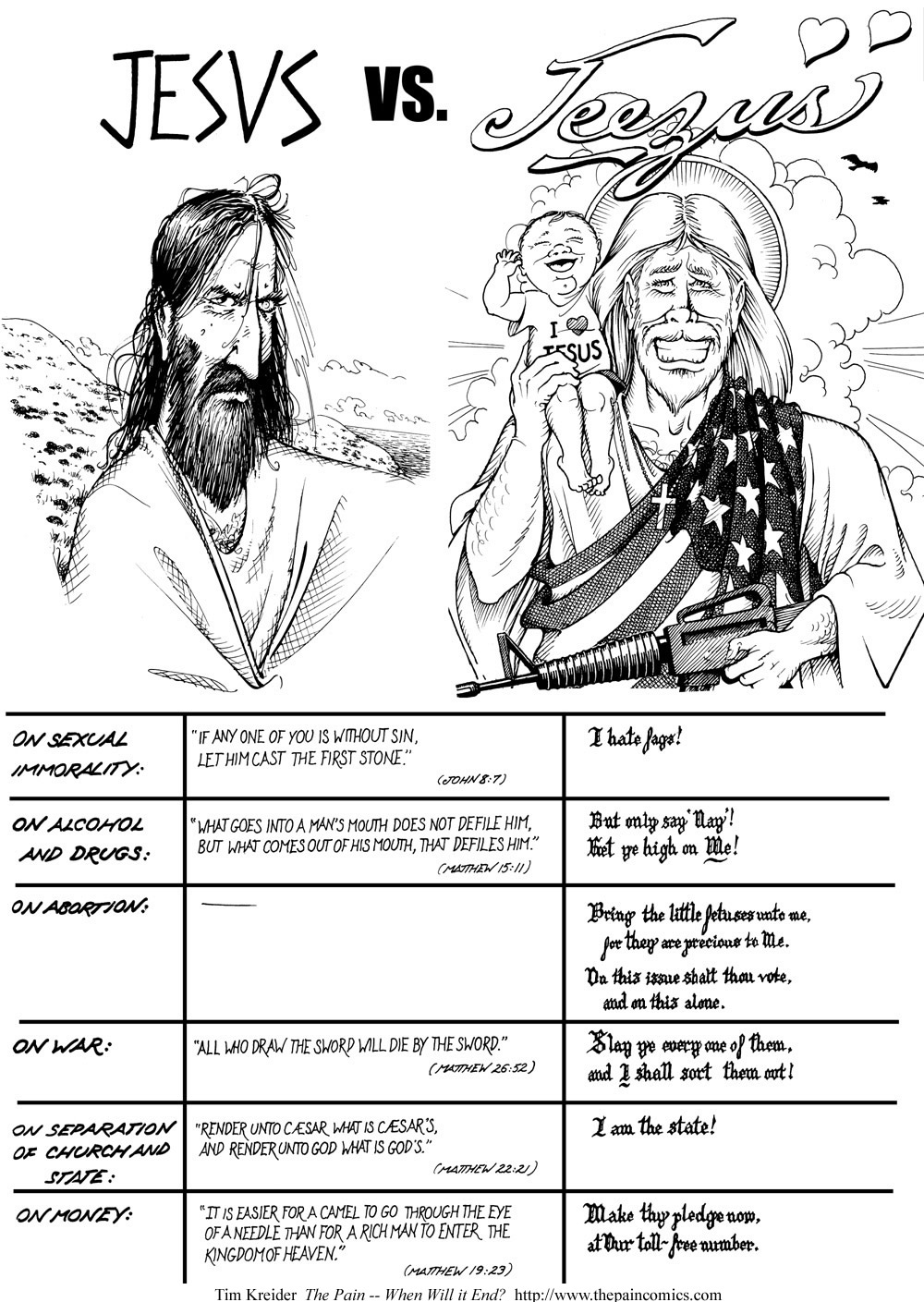
OP was referring to the young brother Jeezus Christ, not the better known Jesus H. Christ.
-
Re:Why 2 sides
-
Re:pathetic
This has come up as an issue because of political cartoons referencing Mohammad for completely legitimate reasons. The nature of political cartoons as a speech medium basically requires caricatures or personifications of famous people in order to make a point. In the case of the Jyllands-Posten cartoons, the point was the censorship of dialog about Muslim and how it relates to modern Danish living. Compare the outrage and censorship of those pieces, to how we treat other major public figures, and you'll find that a definite double standard is being applied. Christians, Jews, Hindus, etc deal with blasphemy all of the time in western cultures. Part of freedom of expression involves dealing productively with not liking what other people might say.
Which is not to say that political cartoons haven't become superficial in the last 30 years. But the medium requires pictograms, and the legitimate representations of those particular players is essential to the communication. If you can't draw Mohammad in a political cartoon, you can't critique Muslim culture.
-
Re:Olfactory
Oh, someone has. It was Larry Flynt, of course.
The August 1977 Centerfold [mildly NSFW] was a scratch-and-sniff feature. The cover had a "Surgeon General" white box stating, WARNING: To be smelled in the privacy of your home. Not to be smelled by minors.
Fortunately, according to Wikipedia, it smelled more like lilacs than labia... can you imagine collecting enough pussy juice to scent 2 million copies [very NSFW]?
(I remember finding a copy when I was about 15. It was three years old by then, and the smelly part was all scratched out.)
-
Re:Silly me
You know...people pandering to YOUR sorts of desires is where that watering down of the word came from...
Food for thought. If you can't fucking take someone mentioning that "god who doesn't fucking exist", perhaps you shouldn't fucking whine about the rest...
Hey AC dude. I'm gonna emphasize the word "need" here. Maybe you don't know it, but it doesn't actually literally mean "can't take".
I just don't neeeeeeed him, since he is the reason why you all fuckers have imaginged that fuck is a fucking four letter word, and hence it is illegal for you to mention this beautiful act of coitus on your public airwaves. But since he doesn't exist, I don't really fucking care.
Or maybe I do?
Read 1984 by George Orwell, preferably a printed-on-paper version. Mine is unfortunately a Swedish translation of the 1949 printing. Then you will understand the folly of religious/political censorship
Then just take a step back for a moment. Imagine if you actually picked the wrong horse and the god you cherish doesn't exist. Your whole existence kinda falls flat doesn't it. Now when I do the same thing, i.e. imagine there actually is a god and I have been wrong all along, I run into a problem.
Who the fuck among all the gods should I pick to be the right one? I mean, they are pretty much all exclusive of all other. "Thought shalt not have any other gods but my own beautiful fucking self!!!" Remember that part?
Me, I kinda like Odin and Thor. They are like the kind of gods that would give your god a wedgie, if you know what I mean?
-
Re:Socialism and capitalism both suck.
So far, and I think for the rest of the time humanity exists, capitalism is the best economic system we are capable of having.
This is the conservative view on every topic of import: the status quo is the best system possible. (That the capitalist his or her self enjoys some privilege under the status quo is, of course, merely co-incidental.) "I can't imagine any system better than our slave plantations. It's always been this way and people don't change."
"I can't imagine any system better than keeping women in the kitchen barefoot and pregnant. It's always been this way and people don't change."
"I can't imagine any system better the segregation. It's always been this way and people don't change."
This is always the heart of the conservative view -- at least, that of mainstream American conservatism, of the sort that stands athwart history yelling "Stop!". It's always wrong, and always gets bowled over.
I suggest Tim Kreider's essay on the subject:
I've thought before that the most fundamental difference between liberals and conservatives is not over issues of individual freedom vs. authority or progress vs. traditional values, but imagination. Conservatives don't have any. The status quo seems only inevitable and right to them, the natural order of things, and anyone who protests it is an impractical dreamer who should get a job or a malcontent who needs to be medicated. They're incapable of seeing their own historical moment as in any way anomalous or provisional; as Montag's colleagues assure him in Farenheit 451, "Believe me, houses have always been fireproof. Firemen have always burned books." They believe that they deserve their own lives; they can't imagine having been born as someone else. (Empathy, and by extension compassion, is a function of imagination.) They can't imagine what it would be like to be poor, or black, or gay, because, well, they're not, and they suspect that these unfortunate conditions are those people's own faults, a consequence of some moral failing or dereliction. (I always secretly felt this way about old people until I noticed I was aging as well.) Likewise people living in other cultures with different beliefs and customs; they're simply ignorant, deprived of the advantages of Jesus and Wal-Mart. Francis Fukyama, in a book with the straight-line title The End of History, argues that capitalist liberal democracy is the final culmination of all social progress, apparently unable to imagine a more perfect system than the one epitomized by Donald Trump and Kenneth Lay.
-
Re:Poetic justice?
Because the very concept of a commercial prison to me seems...something out of a really bad science fiction movie....
It's true that bad (or at least low-budget) science fiction movies seem to have be the best predictor of contemporary America. See Tim Krieder's commentary from a few years ago:
Death Race 2000 has proved to be startlingly prescient, not just in its premise that the nation's masses are obsessed with a spectacular and violent car race but down to the throwaway joke that all our problems, from terrorism to the economy, are blamed on "our enemies, the French." Aaron and I were reflecting that all those dystopian science-fiction films of the Seventies prepared us well for the day when we would grow up to live in one. Always in these films everyone except the hero accepts the oppressive and soulless society in which they live as inevitable and right, an obvious improvement over the messy old world of poverty and struggle--as Jonathan E.'s wife says in the best line in Rollerball: "comfort is freedom." And always, too, there's a scene in which the hero asks, "Were things always like this? How did they get this way? This isn't how people should live!"
-
Re:That's another thing they'd screw up...
Oh just you wait. In a few hundred years, the Chinese will be all 'the Americans will bitch about how the Chinese do it' saving everybodys ass when the empire of America collapses and it all goes tits up. Which may happen sooner rather than later.
-
Re:And they say ...
As a professional software engineer, I value my QA depaptment. Their job is to stand athwart product delivery, yelling, stop.
There is a very large difference between "Slow down, and be cautious in working toward your goal!", and "Stop! Keep things are they are!"
To continue your software metaphor, the conservative position (as expressed by Buckley) is to say "The current release is perfect! Nothing could ever be better! Stop the patches!"
It's failure of imagination: as Tim Kreider puts it: "Conservatives don't have any. The status quo seems only inevitable and right to them, the natural order of things, and anyone who protests it is an impractical dreamer who should get a job or a malcontent who needs to be medicated. They're incapable of seeing their own historical moment as in any way anomalous or provisional; as Montag's colleagues assure him in Farenheit 451, `Believe me, houses have always been fireproof. Firemen have always burned books.' They believe that they deserve their own lives; they can't imagine having been born as someone else. (Empathy, and by extension compassion, is a function of imagination.) They can't imagine what it would be like to be poor, or black, or gay, because, well, they're not, and they suspect that these unfortunate conditions are those people's own faults, a consequence of some moral failing or dereliction. (I always secretly felt this way about old people until I noticed I was aging as well.) Likewise people living in other cultures with different beliefs and customs; they're simply ignorant, deprived of the advantages of Jesus and Wal-Mart. Francis Fukyama, in a book with the straight-line title The End of History, argues that capitalist liberal democracy is the final culmination of all social progress, apparently unable to imagine a more perfect system than the one epitomized by Donald Trump and Kenneth Lay."
All good engineers are conservative engineers
Two different meanings of "conservative" are at play here - for example, a "conservative estimate" of the cost of the Iraq boondoggle doesn't mean one that comes from the GOP. Nor does Postel's law tell us that we should be political conservatives.
If you spent more time talking to smart conservatives you'd realize that they're just as common as smart progressives, and they're in general just as desirous of progress
Well, smart people of any type are a rarity.
I find most of the few smart people who identity as "conservative", simply aren't: smart "conservatives" tend toward libertarian, but have bought into the mistaken notion that "conservative" means "small government" and "liberal" or "progressive" means more government.
Other "smart" conservatives are otherwise intelligent people under the influence of a delusional belief system, typically a religious one.
Other than that, it's hard to find smart people who have chosen to line up with the side that has been so consistently wrong. If we take the modern conservative movement as beginning in 1955 with the founding of National Review, we see that their position has been wrong on segregation, McCarthyism, Vietnam, and the women's movement. Anyone with sense knows the current conservative position on gay rights is going to be looked back on the same way as the conservative position in the 1960s on miscegenation is viewed today. Moderate Jimmy Carter tried to encourage alternative energy development in the 1970s, had solar panels installed on the White House roof; conservative hero Reagan tore 'em out and slashes federal funding for alternative fuels.
Over the past fifty years, if you take any issue with clear "conservative" and "liberal" positions, time and time again we see the conservative one now widely accepted as unwise.
-
Re:I skip ads the right way...
Is today's society really any different than in the past?
What's different is industrial capitalism. Industrial capitalism demands continuous economic growth, which means continuous growth in consumption. As populations stabilize opportunities for colonialism decline, that mean you have to consume more and more stuff every year.
After WWII, the U.S. government quite deliberately began to build a culture of consumption to prop up capitalism. (Great little artcile by David Suzuki here.) It's no coincidence that after 9/11, the one thing the government wanted everyone to do was to buy stuff. It's your patriotic duty to consume, consume, consume!
And how do we get everyone to keep buying stuff? Advertising. Advertising everywhere. It was when they started selling ad space on the handles of gas pumps that I knew it had gone too far...
It's a little more subtle than that "Ending is better than mending" of Brave New World, but not by much.
Ads can be annoying and overdone, but they are a product of a free capitalistic society. Considering the available societal alternatives (China, Myanmar, and Cuba come to mind)
Riiiiiight. Those are the only possible alternatives: our current system, or even more repressive dictatorships.
Thank you for more evidence toward Kreider's Thesis: "[T]he most fundamental difference between liberals and conservatives is not over issues of individual freedom vs. authority or progress vs. traditional values, but imagination. Conservatives don't have any."
-
I feel sorry for Pluto
... and so does this cartoonist.
http://www.thepaincomics.com/weekly050119a.htm -
Re:"Why pass what you know is flawed?"
You may be right, but why should that stop us from trying to improve it? Complaining about the system's flaws is the responsibility of the intellectual elite -- journalists, academics, artists, and nerds, among others -- of any society. As a matter of fact, I would like to live in a utopia where all the laws passed are fair and just, even though I know it is unrealistic. Isn't that the idea that the U.S. was founded on in the first place? If we give up on that idealism, and give in to the cynicism of "it may not be a perfect system but it's still the best there is", I say it is actually no better than the alternative.
-
Re:Time to vote NO, but in what election?
It's always amusing (in a sad sort of way) how some people who have money somehow envision the world as if everyone else is just as well off as they are.
It's the root of the conservative mind-set: lack of imagination. As Tim Kreider put it:
I've thought before that the most fundamental difference between liberals and conservatives is not over issues of individual freedom vs. authority or progress vs. traditional values, but imagination. Conservatives don't have any. The status quo seems only inevitable and right to them, the natural order of things, and anyone who protests it is an impractical dreamer who should get a job or a malcontent who needs to be medicated. They're incapable of seeing their own historical moment as in any way anomalous or provisional; as Montag's colleagues assure him in Farenheit 451, "Believe me, houses have always been fireproof. Firemen have always burned books." They believe that they deserve their own lives; they can't imagine having been born as someone else. (Empathy, and by extension compassion, is a function of imagination.) They can't imagine what it would be like to be poor, or black, or gay, because, well, they're not, and they suspect that these unfortunate conditions are those people's own faults, a consequence of some moral failing or dereliction. (I always secretly felt this way about old people until I noticed I was aging as well.) Likewise people living in other cultures with different beliefs and customs; they're simply ignorant, deprived of the advantages of Jesus and Wal-Mart. Francis Fukyama, in a book with the straight-line title The End of History, argues that capitalist liberal democracy is the final culmination of all social progress, apparently unable to imagine a more perfect system than the one epitomized by Donald Trump and Kenneth Lay. Fukiyama knows his Hegel, but he clearly never saw Death Race 2000. Science fiction is political philosophy, too. Kim Stanley Robinson, in his Mars trilogy, depicts capitalism as a transitional phase between feudalism and true democracy, fundamentally in conflict with human freedom, and envisions a credible--and far better--post-capitalist future. History is not inevitable but contingent on our choices. We're only just beginning to figure out what is an intrinsic part of human nature and what's culturally conditioned, so we might as well keep trying to change what sucks rather than complacently accept that sucking is just what the world is meant to do. But that's liberals for you: never happy, always agitating for change, clamoring for some hopeless pie-in-the-sky fantasy world where gay people get married and health care is free and nobody has to be poor, or where women work in offices and frequent saloons and Negroes can vote and must be addressed as "Mister", where slavery doesn't exist and men live without kings to rule them. Dream on, crackpots!
-
Re:Eight types of intelligence
And of course Tim Kreider's five kinds of intelligence, which I find to be significantly more astute.
-
Re:Eight types of intelligence
And of course Tim Kreider's five kinds of intelligence, which I find to be significantly more astute.
-
I knew it!
The Norse had it right all along: Science vs. Norse
-
Speaking of the Norse