Slashdot Mirror
Domain: top500.org
Stories and comments across the archive that link to top500.org.
Comments · 822
-
Re:Pricing would be interesting!
Oh? So how come the VIIIFX based "K computer" then, apart from being the current #1 in performance, also beats the GPGPU clusters (with the latest Nvidia Fermi cards) in flops/watt on the latest top500 list: http://top500.org/list/2011/06/100 ? And heck, that's on linpack, which should be the pretty much optimal workload for a GPU.
-
Difficult to believe...
Actual specs : 68500 Sparc64s, each with 8 cores. So every core can put away between 5 and 10 double-precision calculations every single cycle?
-
First in the world that doesn't use Intel or AMD?The Slashdot posting states (perhaps correctly) that this is China's first HPC installation that doesn't use Intel or AMD processors, however, the article makes a bigger claim:
Second, this is the first significant high-power computing (HPC) installation in the world that doesn’t use Intel or AMD processors.
No matter how you look at it, it's wrong. According to the Top500, there are 45 supercomputers that use POWER processors, one that uses NEC processors, and two that use SPARC. In particular, the processors in the current fastest supercomputer, the K Computer in Japan, are SPARC processors built by Fujitsu.
-
Re:no one got fired buying intel
Well, it doesn't seem to apply when you get up to supercomputing levels at least. I checked the TOP500 list and it's 76% Intel, 13% AMD. As for Bulldozer, it has serious performance/watt issues even though the performance/price ratio isn't all that bad for a server. On the desktop, Intel hasn't even bothered to make a response except to quietly add a 2700K to their pricing table, with the 2600K left untouched. On the business side (where after all margins fund future R&D) then Sandy Bridge's 216mm2 is much smaller than Bulldozer's 315mm2. Intel can produce almost 50% more in the same die area, in practice the yields probably favor Intel more because the risk of critical defects go up with size. Honestly, I don't think Intel has felt less challenged since the AMD K5 days...
-
Re:SPARC is dead
Err... SPARC is still alive in the HPC and I/O world. No one's running to BestBuy to buy the latest T4 processor for their gaming rig, but the fastest supercomputer listed on http://top500.org/ happens to be a SPARC machine. It's not dead, it's just a niche market. That's like saying Cray is dead.
-
Is Rome NY not east coast?
Something tells me that a 14,400 core system will not beat the 42,712 core system installed at AFRL in Rome NY. It currently ranks #19 in the top500.org list. Yes, it is "Cray", but it is an Opteron system, x86_64 based.
http://top500.org/site/systems/78 -
Re:WTF? ARM is the best architecture for smartphon
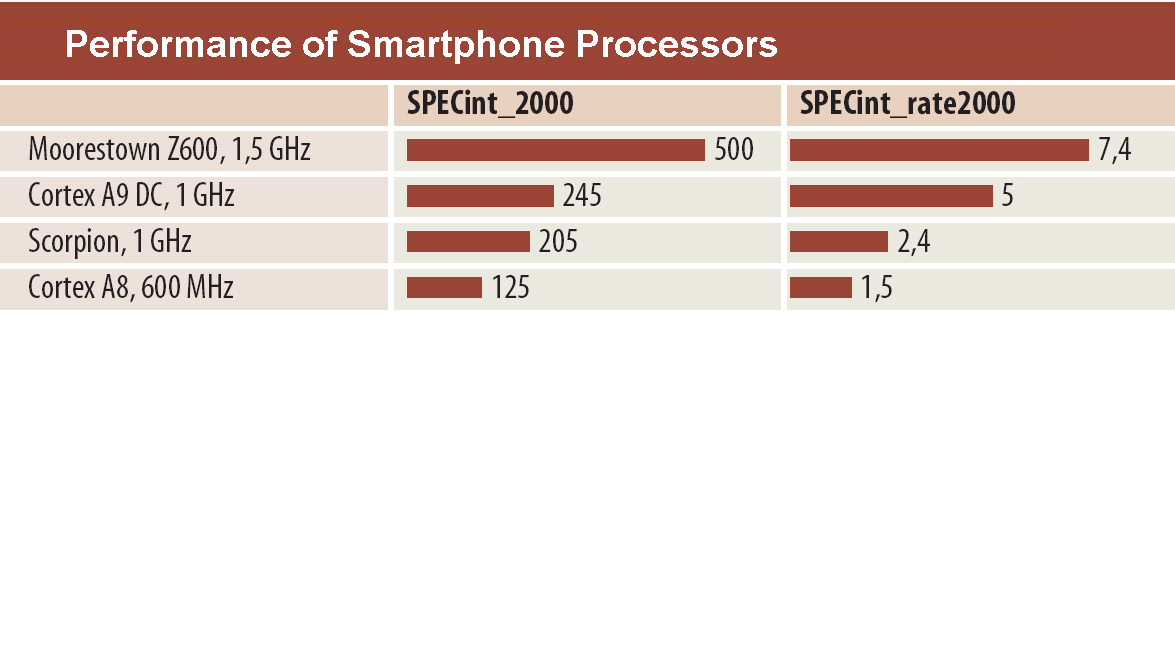
I'm a little skeptical of the "1.5x performance over the Atom clock-for-clock" claim. The Atom has a much broader vector instruction set, and ARM FPU's aren't exactly known for their record-setting performance. Take this with a grain of salt, but Intel claims some fairly impressive spec_cpu2000 performance numbers:
http://top500.org/files/Moorestown-Performance.PNG -
Re:Which aspect ratio?
Babylon-5 premiered in early 1992.
In June, 1993 a Cray XMP 416 was the 302nd fastest computer in the world.'
From what I can see, though, the oldest Cray X-MP on the list was a 1985 Cray XMP/22
No Amigas, of course.
-
Re:Which aspect ratio?
Babylon-5 premiered in early 1992.
In June, 1993 a Cray XMP 416 was the 302nd fastest computer in the world.'
From what I can see, though, the oldest Cray X-MP on the list was a 1985 Cray XMP/22
No Amigas, of course.
-
Re:Which aspect ratio?
Babylon-5 premiered in early 1992.
In June, 1993 a Cray XMP 416 was the 302nd fastest computer in the world.'
From what I can see, though, the oldest Cray X-MP on the list was a 1985 Cray XMP/22
No Amigas, of course.
-
Highlights as per Top500 site
The top500 site has its own take on highlights:
http://www.top500.org/lists/2011/06/press-release
- The two Chinese systems at No. 2 and No. 4 and the Japanese Tsubame 2.0 system at No. 5 are all using NVIDIA GPUs to accelerate computation, and a total of 19 systems on the list are using GPU technology.
- China keeps increasing its number of systems and is now up to 62, making it clearly the No. 2 country as a user of HPC, ahead of Germany, UK, Japan and France.
- Intel continues to provide the processors for the largest share (77.4 percent) of TOP500 systems. Intel’s Westmere processors increased their presence in the list strongly with 169 systems, compared with 56 in the last list.
- Quad-core processors are used in 46.2 percent of the systems, while already 42.4 percent of the systems use processors with six or more cores.
- Cray defended the No. 2 spot in market share by total against Fujitsu, but IBM stays well ahead of either. Cray’s XT system series remains very popular for big research customers, with three systems in the TOP 10 (one new and two previously listed).
In my opinion, the newest & most important trend in high performance computing is the advent of accelerators like GPUs. -
Re:Truecrypt
Anyone got the numbers on how long a top 10 supercomputer would take to decrypt a strong encryption scheme?
The top publicly known super computer has a peak of almost 5 million GFlops. If we generously assume that each floating point operation = 1 key try, that gives 5x10^15 trys per second. Some spreadsheet work shows that would crack a 64 bit key in under an hour, but a 128 bit key would take 10^15 years. 256 bit would take 10^53 years.
If we assume that the NSA has even greater power to throw at this, or that power will increase with time it still doesn't make much difference. It takes about 2^50 more power before it becomes feasible, i.e., less than a decade. So that is either 50 years of computing power doubling ever year or the NSA having supercomputers about 10^15 times more powerful. 256 bit remains secure well past 100 years of annual doubling (or 10^30 more power).
Or course, all this assumes one uses the full keyspace available. An 8 character password isn't 256 bit, even if 256 bit encryption is used. If one used a random mixture of digits upper/lower case letters and special chars, there are 95 possibilities easily made on a normal keyboard. 95^20 ~= 2^128, so one would need about 20 random characters to have 128 bits.
-
Re:Umm
The US government could literally utilize millions of processors to break this encryption. A few years back I remember reading an article about how they were setting up all their workstations to do distributed computation. So in addition to the supercomputers at NSA, they also have millions more desktops to add to the mix. I wonder what their collective processing capability is? Also, I'm sure they could requisition all the other super computers in the US government if need be. How many national labs have super computers facilities? In the Top 500 supercomputer list, the US has 274 of the spots with a total of peak of 31483946 gigaFLOPS. That's 31 petaFLOPS. And that's just the Top 500 known super computers, I bet the NSA has something specialized for encryption breaking... It is conceivable that the US government could muster exaFLOPS of computing power...
-
Can we put it this way?
Linux is to servers and windows is to desktops.
On the servers, I based my assumptions from the data of http://www.top500.org/stats/list/36/osfam
On the desktops, I based my assumptions from the data of http://marketshare.hitslink.com/operating-system-market-share.aspx?qprid=10As a Linux user (both servers and desktop), I accept the reality that Linux dominates the server market and Windows on the desktop market. But on the occasion that somebody claims that Linux dominates the desktop market or WIndows dominates the server market, I usually ask for some citations or do some research a.k.a using google.
IMHO, it is good for us to have these two options. It creates competition. When there is competition, the competitors try to improve their product so that they can win the seat of their competitor while maintaining the achivements that they currently have. The end result is simple... USERS WIN!!!
-
your information is dated
It's not 2009 anymore, Chinese Tianhe-1A is indeed the fastest since November 2010
Read it and weep:
http://www.top500.org/ -
Re:"Oh well I guess Linux sucks then
The reason is that Linux is so flexible: you can customize it easily. This is also the main reason why it's useful in supercomputers (see Top500 sorted by OS family as well as mobile phones (Android, Meego) and other places where you want a small and cheap computer).
You can try this out by compiling your own kernel: you can take everything out that is not crucial to the tasks at hand (i.e. processing transactions, for this stock exchange example). That also means your customized system isn't checking all the time if someone is diddling with the mouse or pressing on a key (what mouse? what keyboard?).
I remember a Windows NT system decades ago, where a whole multinational company depended on it, and you could make the entire company's workings slow down to a crawl by moving the mouse around (I'm not kidding!). Probably this has been fixed in more modern Windows systems though?
Per-CPU operating system licensing costs of 0 probably also play a rôle in case of the 294912-CPU Blue Gene/P supercomputer
-
Re:Less of a matter of can't, but won't
The #1 supercomputer in the world is one of those CUDA clusters in China. http://www.top500.org/system/10587 . At the moment, nVIDIA is where it's at for HPC as I understand it.
-
Re:Let's look at the bigger picture, why don't we?
a nice graph showing the US is way ahead of everyone else can be found here http://www.top500.org/charts/list/36/countries
-
Let's look at the bigger picture, why don't we?If we look at the top 10 on the TOP500 list, it's still pretty dominated by the USA:
1. Tianhe-1A (China)
2. Jaguar (USA, ORNL)
3. Nebulae (China)
4. TSUBAME (Japan)
5. Hopper (USA, LBNL)
6. Tera-100 (France)
7. Roadrunner (USA, LANL)
8. Kraken (USA, UT)
9. JUGENE (Germany)
10. Cielo (USA, LANL)So, let's see -- half of the top ten are in the USA, two in China, two in Europe, and one in Japan. Granted, China is catching up (rapidly), but if you look beyond the #1 spot, the USA still pretty dominates the overall list. Expand this list out beyond the top ten, and SEVEN supercomputers from 11-20 are also in the USA (11-16 & 18), one is in Russia (17), and two in South Korea (19 & 20). So let's not all freak out here about China stealing the #1 and #3 slots on the list -- the USA still has quite a bit more computational resources than the Chinese,. .
-
Let's look at the bigger picture, why don't we?If we look at the top 10 on the TOP500 list, it's still pretty dominated by the USA:
1. Tianhe-1A (China)
2. Jaguar (USA, ORNL)
3. Nebulae (China)
4. TSUBAME (Japan)
5. Hopper (USA, LBNL)
6. Tera-100 (France)
7. Roadrunner (USA, LANL)
8. Kraken (USA, UT)
9. JUGENE (Germany)
10. Cielo (USA, LANL)So, let's see -- half of the top ten are in the USA, two in China, two in Europe, and one in Japan. Granted, China is catching up (rapidly), but if you look beyond the #1 spot, the USA still pretty dominates the overall list. Expand this list out beyond the top ten, and SEVEN supercomputers from 11-20 are also in the USA (11-16 & 18), one is in Russia (17), and two in South Korea (19 & 20). So let's not all freak out here about China stealing the #1 and #3 slots on the list -- the USA still has quite a bit more computational resources than the Chinese,. .
-
Not in the top 10, certainly not number 1
this november's list already reached 2.5Pflops. A machine delivered at 3Pflops in 2 years from now will not even be in the top 10. Long term trend is to reach 5 to 10 Pflops by mid 2012. http://www.top500.org/list/2010/11/100
-
Why I love Moore's law
I absolutely love Moore's law. Think that this is an insanely awesome amount of computational power? Just wait around for 10-15 years and we'll likely have that same order of magnitude in our personal computers. Just look back at the supercomputer list from a decade ago and notice that right now we have hardware capable of getting similar performance. The best Intel processors can put out over 100 GFLOPS. Graphics cards are closer to 1TFLOPS.
Another way of looking at it is that we'll have a similar amount of power in our phones, tablets, etc. that we have in our desktops right now. Super computers are going to get even more super and the types of problems that are expensive to solve today continue to get cheaper. I'm still a young man, but given how far things have come since I was born, I can't help but wonder what the world will be like when I'm many years further along the road. If for no other reason than the vast amount of computational power that's available to us. -
Re:Workaround.
Not really a supercomputer sitting under my desk by any means unless you talk about a supercomputer from over 20 years ago, and even then it wouldnt be as fast at I/O.
The supercomputers of 2000 are pretty impressive if you ask me and we are nowhere near getting perfomance even remotely like those for a long time.
-
The return of Microsoft FUD
Every time it seems that MS is starting to play nice and accept Linux as a reality, the old MS shows up again.
We must bear in mind that Linux is not a Russian OS and, moreover, is at the end of its life cycle."
In this statement the MS employee implies two false dichotomies. (1) Linux is not "Russian" and (2) Linux is "old" and decrepit. The statement implies that Windows is not. What the employee doesn't acknowledge is (1) Windows is not "Russian" either and (2) Linux started only 2 years (1991) after Windows NT (1989) which is the basis of Windows 7. Sure Windows has gone through many changes since MS starting developing NT but so has Linux. In fact there was word that a new Linux patch that would increase performance in multi-tasking. While Linux has not gotten the consumer uptake in PCs as MS has, it has a strong presence in servers especially HPC. According to the latest top 500 list:
Family Count Share
Linux 459 91.80%
Windows 5 1.00%
Unix 19 3.80%
BSD Based 1 0.20%
Mixed 16 3.20%
Having over 90% in HPC is certainly not "at end of its life cycle".
-
Re:Yesterday's News
Solaris is now a very high-end OS that's as relevant to people as AIX is
Actually, it's 17 times less relevant than AIX, at least in the Top 500.
-
Re:About hardware, not operating systems
Ethernet is usually not the network of course for clusters
Come again?
I don't disagree that Ethernet is not the *best performing* interconnect, but on a price/performance basis it clearly isn't losing the battle. -
Re:Won't somebody please think of the licensing co
Linux isn't exactly an ultrascalable high-performance OS either. If you were building a supercomputer operating system from the start you'd make very different design decisions than Linus did.
Have you ever paid attention to the OS trends in the Top500? All the proprietary OSes are disappearing. It used to be nearly all proprietary Unix and BSD. Now it's 91 percent Linux.
Here's a graph showing the demise of Unix in the Top500
http://www.top500.org/overtime/list/36/osfamLinux doesn't scale? It fits in toasters and supercomputers. I think that's pretty good scaling if you ask me.
So do other proprietary and open OSes, as you yourself mentioned. Oh, but I forgot this is a popularity contest, and the immutable, doubleplusgood Linux is and always has been designed with extreme outward AND upward scaling in mind and excels above all else at it.
Silly me.
-
Re:Won't somebody please think of the licensing co
Wait, what?
Have you ever paid attention to the OS trends in the Top500? All the proprietary OSes are disappearing. It used to be nearly all proprietary Unix and BSD. Now it's 91 percent Linux.
Here's a graph showing the demise of Unix in the Top500
http://www.top500.org/overtime/list/36/osfamLinux doesn't scale? It fits in toasters and supercomputers. I think that's pretty good scaling if you ask me.
You could probably make the argument in 1991 when Linus smote the ground and came up with the kernel, but not anymore. You could probably even make that argument before kernel 2.0. But since then? Claiming that Linux doesn't scale well just makes you look like a Microsoft fanboy whistling while walking past the graveyard at best.
--
BMO -
Re:Oops...
Acer's processor is 1.8gHz, the Apple is 1.4. So the acer is faster.
It depends - is the Acer running Windows? Windows could slow this machine to a crawl.
-
Re:So where's the story here?
-
Re:Unfortunately...
The second most powerful computer in the world is Chinese. It's not as if they're digging a hole in hopes that they'll somehow figure out how to build a supercomputer along the way.
-
Re:AMD's stagnant?
who cares if it's last years Porsche, as long as it's fast, and competes on track days with this years, or on some tracks does better? Also what if you could get that 90% of the lap time of a Porsche GT for civic money? which would you buy?
From what I have read(I'm looking to buy a mini-itx system) on the issue of power is that both(1090T and 980x) will pull down around 130-180 watts at the PSU at full load, sure at idle the 980x wins, but if my computer is idle I probably should turn it off. I have a lower power consumption server for my "always on" tasks. If you want to compare power consumption, then ARM wins, for work per watt. My 8600GT will beat a i7-980x for some loads (highly parallel). Nvidia's Tegra2 stuff is pretty impressive performance/Watt.
On the HPC side, AMD has 3/10 spots, including #1 and #3. Intel as 4/10, #2, and #6. Granted the #2 Intel system is using ~1/2 of the CPU cores, and tesla GPUs, but Jaguar is still using DDR2-800 ram, and some PPC cores. Crays XT6m servers(#16) are using a 2.1ghz mangy-cours part and not the 2.2ghz part, gets 274.7 with 43660 cores, scaling up(no interconnect loss) to the same number of cores as the #2 machnine, i get 59.72% of the peek performance. I wonder how much that has to do with the tesla being better at linpack than the PPC compute unit on the XT6. Yes I'm aware that the interconnects and compute units matter a lot these days, but still #1 and #3 must count for something...
Cost is always a factor, even if you have near unlimited budget. As an mechanical engineer the question almost always is, "How can i get the same performance for less cost" or, "How can i get more performance for the same cost" Leaving cost out is like saying the Bugatti SS is a better car than a Subaru Forester. Now go camping with the family in Bugatti SS.
-
Re:AMD's stagnant?
who cares if it's last years Porsche, as long as it's fast, and competes on track days with this years, or on some tracks does better? Also what if you could get that 90% of the lap time of a Porsche GT for civic money? which would you buy?
From what I have read(I'm looking to buy a mini-itx system) on the issue of power is that both(1090T and 980x) will pull down around 130-180 watts at the PSU at full load, sure at idle the 980x wins, but if my computer is idle I probably should turn it off. I have a lower power consumption server for my "always on" tasks. If you want to compare power consumption, then ARM wins, for work per watt. My 8600GT will beat a i7-980x for some loads (highly parallel). Nvidia's Tegra2 stuff is pretty impressive performance/Watt.
On the HPC side, AMD has 3/10 spots, including #1 and #3. Intel as 4/10, #2, and #6. Granted the #2 Intel system is using ~1/2 of the CPU cores, and tesla GPUs, but Jaguar is still using DDR2-800 ram, and some PPC cores. Crays XT6m servers(#16) are using a 2.1ghz mangy-cours part and not the 2.2ghz part, gets 274.7 with 43660 cores, scaling up(no interconnect loss) to the same number of cores as the #2 machnine, i get 59.72% of the peek performance. I wonder how much that has to do with the tesla being better at linpack than the PPC compute unit on the XT6. Yes I'm aware that the interconnects and compute units matter a lot these days, but still #1 and #3 must count for something...
Cost is always a factor, even if you have near unlimited budget. As an mechanical engineer the question almost always is, "How can i get the same performance for less cost" or, "How can i get more performance for the same cost" Leaving cost out is like saying the Bugatti SS is a better car than a Subaru Forester. Now go camping with the family in Bugatti SS.
-
One of these things is not like the other
Other platforms and tech products would inspire similarly fanatical followings -- most notably OS/2 and Linux.
To be fair, Linux is used extensively today but it isn't used as envisioned early on by the proponents. Desktop user Linux hasn't gotten massive appeal, but enterprise server Linux is common these days. Of the top 500 servers, over 90% is using Linux.
-
Re:Only dominant companies get regulated
Again, you distort reality to fit your argument. I could claim that Apple has a monopoly in the Macintosh or OS X markets, but that's ignoring the competitive market. Mainframes compete directly with x86 servers, so you have to consider that as part of the market. There is plenty of competition in that market space, so IBM does not have a monopoly.
The EU took action against Microsoft because they held a true monopoly in the Browser and Desktop OS markets. In 2004, MS had 91% market share for IE. That has since declined significantly, but is still around 60%. Windows still holds onto greater than 90% market share.
-
Re:It's somewhat expected.
-
Re:Imagine a beowulf cluster of...
-
Re:SETI@HOME has 3 million or so nodes...
The weird thing is that there are several entries in the statistics page http://www.top500.org/stats/list/35/os [/URL] that actually ALSO are linux, not just the top 405, but also the RedHat, CentOS CNL, SLES, (CellOS?) etc entries.... Looking at it that way UNIX is already outcompeted with a few entries of AIX and opensolaris. I wonder what happened to Plan9 on the Blue Gene....
-
And Linux passes the 90% mark
"Linux family" operating systems went from 89% in the previous list to 91% of this one.
Not that the field wasn't already dominated, but it's an interesting milestone. (FWIW, Linux passed 75% in 2006-11, 50% in 2004-06, and 25% in 2003-06.)
-
Re:Computers keep getting faster
I would like to see this graphic chart to include that...
They got 18% of the performance: http://www.top500.org/overtime/list/35/procfam
-
Re:Largest Pirvately Owned Supercomputer?
-
Re:Largest Pirvately Owned Supercomputer?
-
Re:Linux
The weird thing is that there are several entries in the statistics page [URL] http://www.top500.org/stats/list/35/os [/URL] that actually ALSO are linux, not just the top 405, but also the RedHat, CentOS CNL, SLES, (CellOS?) etc entries.... Looking at it that way UNIX is already outcompeted with a few entries of AIX and opensolaris. I wonder what happened to Plan9 on the Blue Gene....
-
LINPACK
I think this is the first benchmarking article I've read in years where the organizers actually know what their benchmark program does: http://www.top500.org/project/linpack. Refreshing to see real statistics (as good as they can make them), instead of the normal crap that is most hardware articles anymore.
I wonder what kind of score these beasts would get on 3DMark ? -
For the lazy
who wants a more classical view : http://www.top500.org/lists/2010/06 http://www.top500.org/list/2010/06/100
-
For the lazy
who wants a more classical view : http://www.top500.org/lists/2010/06 http://www.top500.org/list/2010/06/100
-
How about a direct link...
How about a direct link to the actual site - or even the actual list?
-
How about a direct link...
How about a direct link to the actual site - or even the actual list?
-
Re:Great. :(
"Well considering that Apple basically owns the high end of the computer mark"
Define High end. If you mean 'expensive' then sure. If you mean performance computers then..no. IF you mean durable then....no.
Here isa list of the top500. Grouped by OS:
http://www.top500.org/stats/list/34/osI see MS, but no Apples. Curious for a 'high end computer'
but maybe they have a different name, so lets look by vendor:
http://www.top500.org/stats/list/34/vendorshmm. strange. Not there either.
Dell is there, so is IBM. odd. Of wait, there is Apple..no my bad, thats Appro.
Fine, you like pretty self contained boxes. I have no problem with that, but and performance arguments went out the window when they went with OTS intel.
You do know that the US is there most profitable piece, right? Do you also know that Apple cow tows to Chine and the iPhone doesn't have Wifi in China? Meaning it's not really th same product.
Funny, the new release of Android will let me store apps on my microSD card.
And I can get 32GB under 100 bucks.
-
Re:Great. :(
"Well considering that Apple basically owns the high end of the computer mark"
Define High end. If you mean 'expensive' then sure. If you mean performance computers then..no. IF you mean durable then....no.
Here isa list of the top500. Grouped by OS:
http://www.top500.org/stats/list/34/osI see MS, but no Apples. Curious for a 'high end computer'
but maybe they have a different name, so lets look by vendor:
http://www.top500.org/stats/list/34/vendorshmm. strange. Not there either.
Dell is there, so is IBM. odd. Of wait, there is Apple..no my bad, thats Appro.
Fine, you like pretty self contained boxes. I have no problem with that, but and performance arguments went out the window when they went with OTS intel.
You do know that the US is there most profitable piece, right? Do you also know that Apple cow tows to Chine and the iPhone doesn't have Wifi in China? Meaning it's not really th same product.
Funny, the new release of Android will let me store apps on my microSD card.
And I can get 32GB under 100 bucks.