Slashdot Mirror
Domain: treasurydirect.gov
Stories and comments across the archive that link to treasurydirect.gov.
Comments · 188
-
Re:Good
Check out where we spend. Social insurance (Medicare/Medicaid, welfare, Social Security) costs and interest on the debt are 69% of all spending - which consumes 100% of Federal revenues. Everything else - defense, transportation, education, etc. - is paid for with borrowed money, and is just 31% of all spending. It's not defense spending - it's ALL spending, and you cannot solve it without cutting social insurance costs.
By the way, we've already passed $1.33 trillion in deficit spending this year, we'll probably hit $1.4 trillion. That's more than that 31% in total - meaning we're at the point where we can't even cover our social insurance and interest costs with tax revenues.
-
Re: Basement View
Ah, someone who has no idea that debt and deficit are different concepts.
Learn a bitClinton left 5.6 billion of debt, G.W. Bush left 10 billion, and so far Obama has already pushed that to 18 billion.
Deficit (what Clinton had 0 of for a brief period) is merely the excess federal spending on a given year.
Looking back a little further
We can see that Clinton only added 1.6 billion, so of the last 3 presidents, his term was marked with the least spending beyond revenue. G. H. W. Bush added 1 billion, but that was only 4 years while the rest of these examples have been 8 (or 7).It's generally naive to credit or blame a president for the net difference between tax returns and government spending, as there are many factors that go into either, but if you're going to argue from a position of naivety, at least have some facts on your side.
-
Re: Basement View
Ah, someone who has no idea that debt and deficit are different concepts.
Learn a bitClinton left 5.6 billion of debt, G.W. Bush left 10 billion, and so far Obama has already pushed that to 18 billion.
Deficit (what Clinton had 0 of for a brief period) is merely the excess federal spending on a given year.
Looking back a little further
We can see that Clinton only added 1.6 billion, so of the last 3 presidents, his term was marked with the least spending beyond revenue. G. H. W. Bush added 1 billion, but that was only 4 years while the rest of these examples have been 8 (or 7).It's generally naive to credit or blame a president for the net difference between tax returns and government spending, as there are many factors that go into either, but if you're going to argue from a position of naivety, at least have some facts on your side.
-
Re:Duh!
the "rich" paying "their fair share"
Does the IRS have a donate button on their web site or something? If taxes aren't raised, a private citizen can't pay more taxes. OK, so the Treasury actually has a donate option.
Buying a house is objectively better for the economy than hoarding money.
-
Re:Current U.S. corporate tax equally fraudulent
Bzzzzt. Thank you for playing, try again. If the Clinton Administration ran a surplus, then why did our national debt increase every year? It's increased every year since 1957. Don't fall for the "on budget deficit" trick; that takes a LOT of the spending off the books and makes the numbers pretty - but we still spent more than we brought in (and thus our debt increased - because we had to borrow to cover the balance).
-
Re:Squandered
Ignore the CBO - they're reporting what they were told to report. Go see how our debt has grown since October 1, 2015. You'll find it's gone up by more than $1.2 trillion in the last 9 months. There's only one way to grow debt - spend more than you take in. The CBO number is about "on-budget" items. Of course, that means a lot of spending (about $700 billion) is "off budget" and ends up growing the national debt. But it makes the number nicer!
-
Re:The DNC overlords always get their way
BS. Back that claim up.
This is from the site you provided yourself:
https://www.treasurydirect.gov...
Subtract the previous year from the year before to get the amount the debt is increasing. You'll see it's in line with my claims.
You'll also see that the year the debt increased the most was the year of George W. Bush's last budget. The budget deficit has been dropping under Obama. No matter how you do the math.
Further, when you look at the total debt as a percentage of GDP, you'll see that's dropping, too.
-
Re:The DNC overlords always get their way
Should I be celebrating that we're only going an additional half trillion dollars into debt every year now?
When Obama took over the White House, we were running a deficit FOUR TIMES what we're running now.
BS. Back that claim up. The actual facts show the current real deficit is nearly as high as its ever been. Equal to that when President Obama was sworn in - larger than any deficit pre-Obama, actually...
-
Re:The DNC overlords always get their way
Yeah. Current (as of July 12, 2016) the national debt is $19.37 trillion. On October 1, 2015, it was $18.15 trillion. So that's an increase of $1.22 trillion in 9.5 months. That'll probably reach around $1.4 trillion. Oh, yeah, it's not the "on budget" deficit that's bandied about in the media, but it's the REAL deficit - it's spending above revenues. That which adds debt.
-
Re:corporate fanboyism
How do you determine what "real" GDP growth is? Again, you seem to imply that how it was done in the 1970's and 1980's were the "correct way".
If you're going to draw comparisons between different decades, you need a standard measurement. Keep the way inflation was calculated, and you'd find the GDP would be about 10% lower - because that's the impact of inflation on it. And by that measure - we're still in the recession that started in 2007.
All I hear is that people "feel" like they aren't as well off compared to some rose-colored memory of decades past. That "feeling", of course, is greatly affected by what kind of narrative their favorite media source paints.
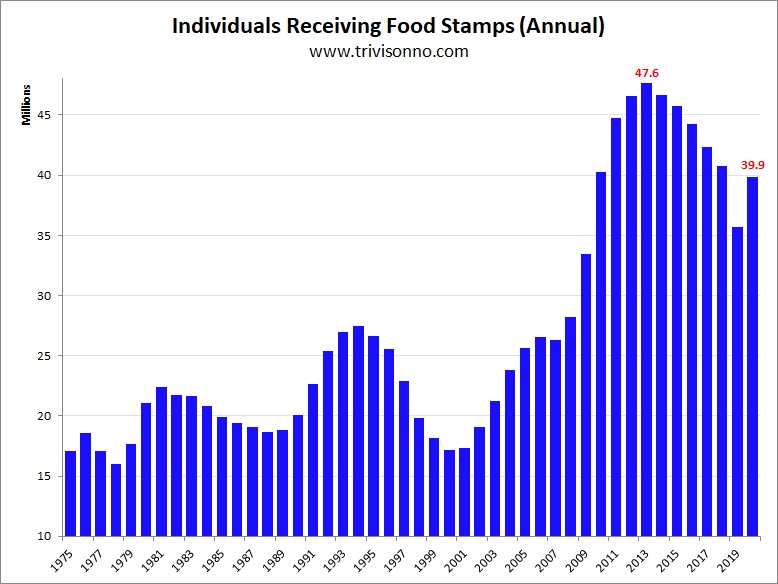
Lowest labor force participation rate in 2 generations. Record levels of food stamps use. Record numbers on welfare. Stagnant wages. A Federal Government adding $4 billion in debt every day. It's not all roses now, not at all...
-
Re:All this crap...
You are blaming the wrong party, Einstein. Congress created the Swiss cheese that is the U.S. tax code. And the latest estimate is the sainted American people are skipping out on about $450 Billion in taxes they should be paying. That's enough to cover the yearly deficit.
Not quite. The US Debt as of 10/1/2015 (start of FY2016) was $18.15 trillion. It's now $19.26 trillion. So that's about $1.1 trillion added in 9 months, or about $1.46 trillion annually. About 4 times your estimate of uncollected taxes. That $450 billion would help, but would get nowhere NEAR to eliminating the actual annual deficit (not the fake, "on budget" number that's reported).
-
Re:What is stopping them?
More than 40 millionaires, including members of the Rockefeller and Disney families, are asking to have their taxes raised to help address poverty and rebuild failing infrastructure.
What's preventing them from sending more money to the government now? A trivial Internet-search immediately returns a link to the government site, which explains, how donations of cash or securities can be made to any Federal government agency...
Anybody, actually wishing to pay more taxes himself, can already do that. The only reason to make noise about it is to force someone else to pay more.
So, by your rationale (if I may use such a malapropism), we should simply get rid of taxes and fund the government on a donation system. Or, we could do the sensible, civilised thing and have a progressive tax rate where people pay their fair share so we can live in a civilised society where I don't have to worry about being poisoned or have a bridge collapse on me.
-
What is stopping them?
More than 40 millionaires, including members of the Rockefeller and Disney families, are asking to have their taxes raised to help address poverty and rebuild failing infrastructure.
What's preventing them from sending more money to the government now? A trivial Internet-search immediately returns a link to the government site, which explains, how donations of cash or securities can be made to any Federal government agency...
Anybody, actually wishing to pay more taxes himself, can already do that. The only reason to make noise about it is to force someone else to pay more.
-
Re:She lived longer than most poor voters...
Uh, no. Let me explain this to you, so perhaps you can learn a bit. It's OK to admit your error - we are all wrong until we learn what is correct.
The measure of a deficit is how much you spend beyond your income. If you make $100,000, but spend $120,000 then you have a $20,000 deficit. Your debt - what you owe others - increases by $20,000. With me so far?
Now, check the national debt records
. What will you discover? Every year since Eisenhower, the national debt has gone up. Every Single Year.
Go back to my opening example - if you spend more than your income, you have to borrow money. Your debt goes up. So how can one "claim" to have a surplus whilst having your debt go up? It's simple! And I'll explain it to you:
You lie.
There are two ways to do this:
First, you simply don't count all your spending. Let's say of that $100,000 in spending, $30,000 of it was on a nice vacation. So you claim "that vacation is not part of my normal spending, so it's not part of my budget, so it doesn't count". You try to claim that your spending was "only $90,000" now, so you actually have a surplus of $10,000! But in reality, do you have a surplus? No - that vacation is still on your credit card, you still owe that $30,000. Your financial position is still the same - you have a $20,000 deficit. But your "budget" had a surplus, because that vacation wasn't part of your budget. It was spending, but since you didn't put it in a given column, you can claim a budget "surplus" even though you actually racked up more debt.
The second way is to defer payments to keep cash flow positive. Say instead of a vacation, you decide to not pay 6 months of your mortgage. Your mortgage is $4,000 per month. Your actual spending is now just $96,000 - that's less than your income! Hurray - you have a $4,000 surplus, no deficit! But do you really have surplus? No - you have at least $24,000 more in debt. But rather than pay your debt, you kept some cash in your pocket. Your actual financial position is a $20,000 hole - but you can "claim" you have a surplus because you still have some cash in your pocket.
The Clinton "surpluses" were a combination of these two - many items were taken "off budget", and others were deferred until later years. The debt still increased, even though the "budget" was in surplus. It was simply word and accounting gimmicks - and the fact that "Factcheck" fell for it says a LOT about their ability to read through the BS.
There, you've been educated, so hopefully you won't make the same mistake again of falling for it!
-
Re:She lived longer than most poor voters...
No, you "f'ing moron", the reported deficit is NOT the change in the debt every year. The reported deficit is for the ON-BUDGET items only, not all items. For example, the 2014 budget deficit was reported as $483 billion. Yet if you look at the debt added, it was nearly $1.1 trillion.
I guess if you want to swallow what the Government is peddling, be my guest. But in any rational, thinking mind - adding $1.1 trillion in debt does not equate to only a $483 billion deficit. Those two numbers are not equal. Go ahead, continue to be the "f'ing moron" and take what your Federal leadership tries to sell you...
-
Re:She lived longer than most poor voters...
Clinton never had a surplus (we accumulated debt every single year since Ike), and the debt has exploded under President Obama, averaging 2.4 times that of President Bush; President Obama has averaged over 1.1 trillion dollars in new debt every year of his presidency. SOURCE
-
Re:This just underscores the fallacy of demand sid
As to shifting the debt burden to the taxpayer, that's how you lower interest rates for student loans.
Interest rates are about risk. Safe borrowers pay low interest rates and risky borrowers pay high interest rates.
The government talked to the banks and said "how do we lower interest rates" and the banks said "well, you can cosign the loan and the interest rates will then be the same as loans to the government"... only students are still getting ripped off because if you look at what the government pays for its interest... you'll laugh:
http://www.treasurydirect.gov/...And look what the students are paying:
https://studentloanhero.com/fe...The difference between A and B is profit... which is pretty fucking tasty.
I'd like to look at alternative ways of funding education... One idea I like is trading a percentage of future income. This idea isn't useful for the trust fund kids that are just going to take art history classes and then go fuck prostitutes in where ever. But for poor kids that really need a lot of help getting into the middle class, this is excellent. Why? Because the university has a vested interest in your success. Under the current system if you fail immediately after you graduate the university doesn't really give a shit. But under this system, they don't get paid if you don't succeed. And they get paid more depending on how much you succeed.
So that means the school pushes you into classes that are more likely to make you more marketable in the job market and they'll take an interest in getting you internships prior to graduation, and try as best as possible to get you into a high paying job right out of school because they'll be taking a cut of your pay check for the next X years under that system.
Now if you go to work flipping burgers they're not going to get anything. Obviously you want a minimum earning cut off point. There's no point taking a cut of someone's pay if they're making minimum wage. That's as pointless as it is cruel.
So that's one idea I like that I think would motivate the system to take a long term interest in the future of students.
-
Re:Meanwhile, the US debt keeps piling up, up, up
Greece was borrowing money to pay back formerly borrowed money. The U.S. is still borrowing money to do things with it (hopefully productive things).
US Budget Deficit 2014: $483 billion
US interest paid on debt 2014: $430 billionSo last year, 89% of our borrowing was to pay interest on our existing debt. That's not quite as bad as Greece. They topped 100% during the worst period. But to say that we are doing productive things with it is clearly incorrect. We are doing things like subsidizing health care that won't give us long term returns. Or paying for military operations (if you like subsidized healthcare). You might be able to find $53 billion in investment in the budget, but this is the wrong time to be financing it.
The truth is that at this point in our business cycle, we should have a balanced budget (perhaps even a surplus). So that the next time the cycle goes sour, we can afford to borrow and take advantage of cheap constructions costs, etc.
And this ignores the real problem. Current total debt (both internal and external) is now higher than current GDP. This means that even if we devoted our entire economy to paying the debt, we couldn't. This will cause problems when our internal debt finance (mostly Social Security and Medicare) turns negative again. I.e. when we have to pay out more in Social Security payments than we receive in taxes. Currently they make it look like the government is more solvent than it is (about $700 billion last year).
This is budget chicanery that will eventually end. When the baby boomers finish retiring (they started in 2008 and will be generally gone by the 2030s), we lose all their tax payments and have to pay out to them. No more Social Security and Medicare surpluses will mean that the entire trillion dollar deficit will be exposed.
Source: http://www.usgovernmentspendin...
Source: https://www.treasurydirect.gov... -
Re:Soverign debt
The debt grew under Reagan. It was 907B in 1980 and 2600B in 1988. Even as a percent of GDP, that's an increase
-
Re:I'm all for abolishing the IRS
What Clinton surplus? If we had an actual surplus, would our national debt have increased every year (meaning we spent more than we brought in)? The fact is the "Clinton surplus" NEVER existed. It was a nicely crafted lie. The annual debt has increased EVERY YEAR since Ike was a President. Clinton's "surplus" was from the same set of lies that allowed President Obama to claim a $486 billion deficit in 2014 even though we added nearly $1.1 trillion in new debt. How the debt goes up when you supposedly have a surplus, or how a $486 billion deficit creates $1.1 trillion in debt is a mystery that can only be solved in Washington DC.
-
Re:I'm all for abolishing the IRS
What Clinton surplus? If we had an actual surplus, would our national debt have increased every year (meaning we spent more than we brought in)? The fact is the "Clinton surplus" NEVER existed. It was a nicely crafted lie. The annual debt has increased EVERY YEAR since Ike was a President. Clinton's "surplus" was from the same set of lies that allowed President Obama to claim a $486 billion deficit in 2014 even though we added nearly $1.1 trillion in new debt. How the debt goes up when you supposedly have a surplus, or how a $486 billion deficit creates $1.1 trillion in debt is a mystery that can only be solved in Washington DC.
-
Re:The Clintons
Please see Debt to the Penny - a Government (Treasury Department) site. Please find the last year that we had a year-over-year reduction in debt (meaning - a real, not paper, surplus). HINT: you'll have to go back about 60 years... After that, we added debt - meaning ran an actual deficit - every single year.
-
Re:Two words
There are two US government bonds you can buy which by definition keep pace with inflation as defined by the Consumer Price Index:
TIPS -- from https://www.treasurydirect.gov...:
Treasury Inflation-Protected Securities, or TIPS, provide protection against inflation. The principal of a TIPS increases with inflation and decreases with deflation, as measured by the Consumer Price Index. When a TIPS matures, you are paid the adjusted principal or original principal, whichever is greater. TIPS pay interest twice a year, at a fixed rate. The rate is applied to the adjusted principal; so, like the principal, interest payments rise with inflation and fall with deflation.
or you can buy I-bonds: Series I Savings Bonds are a low-risk, liquid savings product. While you own them they earn interest and protect you from inflation. You may purchase I Bonds via TreasuryDirect or with your IRS tax refund.
The world is awash right now in investment money looking for a safe place to earn interest, with more demand than supply of safe interest bearing instruments the returns are going to be small. -
Re:Why not fantasize about finding a winning ticke
TIPS bonds are indexed on inflation. I do believe that the current inflation rate is under 3.5% these days, though. You can in theory get higher interest rates out of other investment types (real estate, stocks etc) but can also lose money on those.
-
Re:How about no...
Unfortunately, that's wrong. Our national debt is up over $1 trillion for FY2014. That is the real deficit - we spent over $1 trillion more than we brought in. The lower number you reported? Smoke and mirrors. The actual deficit - shortage of income - was nearly double the reported number.
On the plus side, the reported number sure makes the President look better! Never mind it's a lie, it's a political lie and thus double plus good...
-
Re:Let me get this right
So running a deficit that is ~80% to 95% of the current budget is ok? $200 billion is a lot of money but the federal budgets have been sitting around 4 trillion. Or put another way taking in ~1/2 to 2x the amount of money paid on the interest on the national debt.
-
Re:Free market economyLet's see, according to the Treasury Department
http://www.treasurydirect.gov/...
...When JFK was sworn in, in 1961, the federal government debt was about $285G.
When LBJ was sworn in, in 1963, the federal government debt was about $308G.
When Tricky Nixon was inaugurated in 1969 the federal government debt was about $360G.
When Gerald Ford was inaugurated in 1974, it was about $480G.
When Jimmy Carter was inaugurated in 1977 the federal government debt was about $680G.
When Reagan was inaugurated in 1981 the federal government debt was about $860G.
When GHWBush was inaugurated in 1989 it was about $2.7T.
When Clintoon was inaugurated in 1993 it was about $4.2T.
When Shrub was inaugurated in 2001 it was about $5.73T.
When Obummer was inaugurated in 2009 it was about $10.62T.
On 2014-07-18 it was $17.6T.
At the same time, according to the census bureau _Historical Statistics of the United States_, total aggregate federal government spending (not debt, spending), through 1902, adding each year's spending to the total, was just over $17G, a little less than one-thousandth of the current federal government debt, and much less than the monthly interest on the current federal government debt.
http://www.kermitrose.com/jgoMoney.html#FedDebtsee the graphs
OTOH, the House originates all spending bills, the senate either concurs or floats an amendment; if the House agrees to the amendment, the president either approves or vetoes it. IOW, the responsibility is spread around. The over-spending since 1835 has been perpetrated by the Whigs, Reps and the Dems.
-
Re:Americans doing the right thing
Carter and Clinton managed it just fine. They got the deficit to nothing and Clinton actually managed to pay the debt down a bit.
That isn't true. Under Carter and Clinton the public debt went up every single year. In fact, the last time we managed to actually pay down the debt was in 1957.
Or we could raise the taxes in the upper brackets to the levels maintained by that notorious lefty Eisenhower.
Go ahead. Just be sure to add every loophole and tax deduction that was available during Eisenhower's times. Otherwise you're just advocating confiscation of wealth, which is not such a lovely road for us to go down. But hey, high tax rates with generous deductions would encourage spending, and that would be fine by me.
-
Re:Shadow economies
Consider I-Bonds, inflation-protected bonds from the Treasury.
http://www.treasurydirect.gov/indiv/products/prod_ibonds_glance.htm
-
Re:Yes, it's inflation driven
Let's approach this methodically, shall we?
1. Let's look at debt figures.
debt figures 1950-1999
debt figures 2000-2012Clinton was in office from January 20, 1993 to January 20, 2001
Debt table:
Date Dollar Amount
- 09/30/2002 6,228,235,965,597.16
- 09/30/2001 5,807,463,412,200.06
- 09/30/2000 5,674,178,209,886.86
- 09/30/1999 5,656,270,901,615.43
- 09/30/1998 5,526,193,008,897.62
- 09/30/1997 5,413,146,011,397.34
- 09/30/1996 5,224,810,939,135.73
- 09/29/1995 4,973,982,900,709.39
- 09/30/1994 4,692,749,910,013.32
- 09/30/1993 4,411,488,883,139.38
- 09/30/1992 4,064,620,655,521.66
Do you see any years where the debt was lower the next year than the year before? I don't see any years like that.
2. Let's look at your claim carefully:
a.
He didn't put it on a credit card.
b.
The federal government spent less than it took in.
c.
That SS is a separate budget item doesn't change this.
d.
The government borrowed from itself
a contradicts d, b contradicts d.
c does not interact with any other claim, so we can throw it out.What you are saying is that the federal gov't didn't put anything on credit card but that it borrowed. You are saying the federal gov't didn't spend more than it took in, but it borrowed.
SS is part of the federal budget, by the way, who do you think makes the payments, Martians? Whatever accounting tricks (that a private person would be in jail for if he ran his business this way) they want to play by saying they are borrowing from themselves, they are just printing money if that's what they are doing.
Yes, they were printing massive amounts of money. Saying that printing massive amounts of money is the same as spending as much as you are getting in revenue is really a huge fucking lie.
-
Re:Yes, it's inflation driven
Let's approach this methodically, shall we?
1. Let's look at debt figures.
debt figures 1950-1999
debt figures 2000-2012Clinton was in office from January 20, 1993 to January 20, 2001
Debt table:
Date Dollar Amount
- 09/30/2002 6,228,235,965,597.16
- 09/30/2001 5,807,463,412,200.06
- 09/30/2000 5,674,178,209,886.86
- 09/30/1999 5,656,270,901,615.43
- 09/30/1998 5,526,193,008,897.62
- 09/30/1997 5,413,146,011,397.34
- 09/30/1996 5,224,810,939,135.73
- 09/29/1995 4,973,982,900,709.39
- 09/30/1994 4,692,749,910,013.32
- 09/30/1993 4,411,488,883,139.38
- 09/30/1992 4,064,620,655,521.66
Do you see any years where the debt was lower the next year than the year before? I don't see any years like that.
2. Let's look at your claim carefully:
a.
He didn't put it on a credit card.
b.
The federal government spent less than it took in.
c.
That SS is a separate budget item doesn't change this.
d.
The government borrowed from itself
a contradicts d, b contradicts d.
c does not interact with any other claim, so we can throw it out.What you are saying is that the federal gov't didn't put anything on credit card but that it borrowed. You are saying the federal gov't didn't spend more than it took in, but it borrowed.
SS is part of the federal budget, by the way, who do you think makes the payments, Martians? Whatever accounting tricks (that a private person would be in jail for if he ran his business this way) they want to play by saying they are borrowing from themselves, they are just printing money if that's what they are doing.
Yes, they were printing massive amounts of money. Saying that printing massive amounts of money is the same as spending as much as you are getting in revenue is really a huge fucking lie.
-
Re:It's less an article about
Herbert Hoover, contrary to popular belief, responded to the stock market crash of 1929
Nope. Herbert Hoover responded to the stock market crash by running deficits from 6/30/1930 on.
Source: http://www.treasurydirect.gov/govt/reports/pd/histdebt/histdebt_histo3.htm
-
Re:And still...
It's exactly what we need, but it needs to be 10 times larger to balance the budget. I think we need to have $16,607,216,503,950.75 in surplus over some period of time.
Let's be conservative and say it'd be paid off in 100 years. We need to pay $166 billion/year for 100 years to come up with that at zero interest. It is easily doable with better management. First thing that has to go - mandated spending. If it doesn't work mathematically, it's not good for anyone.
-
Re:Democrat proposes more spending, what a surpriz
BI assigned FY2009 to President Bush; it was signed by President Obama. Seems a bit disingenuous to me... By the way, President Bush did not inherit a surplus; please see TreasuryDirect to verify this. The national debt has increased EVERY YEAR since 1957. Every year. That "Clinton surplus"? Never existed. Just a paper figment.
-
Re:Democrat proposes more spending, what a surpriz
The budget was balanced and had a surplus in 1999 and 2000 (I think in 2001 too but I can't find the information). See http://en.wikipedia.org/wiki/1999_United_States_federal_budget and http://en.wikipedia.org/wiki/2000_United_States_federal_budget
The last time we had a REAL surplus (not just something on paper) - a surplus where the Federal Government received more revenue than it spent - was in 1957. Source.
The referenced Wiki pages are for projected, on-budget spending surpluses - not overall. It's like you balance your own personal budget by ignoring your spending on your car, or mortgage interest... Take all Federal spending together, though, and we have not had a real, cash-basis surplus since 1957, in the Eisenhower Administration.
-
Re:Why would that be the first step?
Yes, but so far, Obama has beat them all in terms of increasing the debt in only 4 years....gonna be interesting to see him set the bar even HIGHER in the next four....
Well, lets see. The last year Bush was in office (Jan. 20, 2008 to Jan. 19 2009) he packed on $1.435 trillion dollars in debt due to the colossal economic crash he presided over. This was the first trillion dollar deficit in U.S. history, and even after the adjusting for inflation, was by far the largest deficit in U.S. history up to that time (twice the peak deficit of WWII), and he left office with the U.S running regular monthly deficits in excess of $200 billion.
Currently the monthly deficit (from Oct. 31 to today) is just $45.2 billion (check the link below to verify this for yourself), so I'm guessing that without another similar huge deficit assist from the Republicans like he got from Bush, the answer is "no".
Check out how the debt was incurred on a day by day basis: http://www.treasurydirect.gov/NP/BPDLogin?application=np. The closer you examine how the deficit exploded under Bush, and how it turned around under Obama, the worse the Republican record looks.
NB: since there is an unavoidable lag between any action or policy a President takes or proposes and its effect on the Federal budget or economy it is not reasonable to attribute economic performance and deficits for any newly seated President for some period of time after they take office, the duration of this period is up for debate, but this is an indisputable fact. I am willing, just for the sake of this one post to play the unserious political charade of pretending Obama "caused" the deficit incurred on Jan. 20, 2008 - the day he took office. In fact of course the Bush Crash underlies all of the very high (but steadily improving) deficits we have seen, just as the Hoover Depression under-laid the poor (but improving) economic performance for the remainder of the 1930s. Every month you shift the "window of responsibility" forward from Inauguration Day, the worse Bush looks and the better Obama looks.
-
Re:Nuclear Waste Storage facility
So the federal government has all this money in the bank waiting to be spent on the clean-up, or they have already spent it all and will be taxing future generations?
FederalDeficit is $901 billion, and the Federal Debt is, $16,198,677,971,774.43, so that would be no; we already spent the money on other things.
-
Re:I visited the National Ignition Facility this y
Your rates are way too low to pay for the current government.
You need 25% of everything over the poverty line combined with 10% cuts to close the gap.
And then those at the poverty line would still be paying over 12% of their income in state and local taxes, licenses, fees, and excise taxes. Plus more property taxes hidden in their rent.
In 1957, the Federal Government made, in constant dollars, about $2800 per capita. In 2010 it was about $6200 - more than double. Why did I choose 1957? It was the last year we actually had a real surplus, we paid down the debt. In 1957, our Federal Government received less than HALF of what it does now, per capita and in constant dollars, and it actually had a real (not just budget) surplus. And this is when we were building those freeways, not just maintaining them...
The problem is NOT that we don't have enough revenue - it's that the Federal Government has exploded in size and scope. Spending is the problem, not tax revenues.
-
Re:Feh. Obama buys more votes with taxpayer $$
The ones that turned a budget surplus into a deficit?
Whilst we had a "budget surplus", we were, in fact, still running up the debt. The national debt has not decreased since the Eisenhower Administration, back in 1957. So while many decry the whole "deficits don't matter" statement, the fact is actually true - a budget deficit or surplus is immaterial, as you can run a surplus on budget and still have your debt increase.
Source: National Debt to the Penny
However you want to do the math, the fact is that a budget DEFICIT increases debt faster than a budget SURPLUS.
-
Re:Feh. Obama buys more votes with taxpayer $$
The ones that turned a budget surplus into a deficit?
Whilst we had a "budget surplus", we were, in fact, still running up the debt. The national debt has not decreased since the Eisenhower Administration, back in 1957. So while many decry the whole "deficits don't matter" statement, the fact is actually true - a budget deficit or surplus is immaterial, as you can run a surplus on budget and still have your debt increase.
Source: National Debt to the Penny
-
Re:I don't want them making money out of my earnin
A. If you're carrying over ten thousand dollars in cash around, you're either nuts or doing it for sinister purposes.
B. I wish I read your signature before writing this post.
C. Most developed (and some developing) countries have depositor's insurance on accounts, so unless you have more than a million USD sitting in a checking account, you should be fine. Unless, of course, it's the apocalypse, which means cash has no value and you should have invested heavily into bullets (or slingshots, depending on if it was a short term or long term plan).
D. If you are worried about inflation, you don't put your money in a savings account. You either buy Inflation protected securities or invest it in something that appreciates with inflation (gold).
http://www.treasurydirect.gov/indiv/products/prod_tips_glance.htm -
Re:Why does Apple hate America?You are full of shit my friend.
Just to prove how full of shit you are, I'll even make it easy for you.
The following link takes you to the US Treasury website where you can pay your "fair share" of extra taxes that will prove you "love" America.
http://www.treasurydirect.gov/govt/reports/pd/gift/gift.htm
And just like all the other people who are full of shit in the world you will do nothing but bitch and moan but will never do anything.
-
Re:There needs to be a way to avoid the subsidy.
For smaller amounts, you can still get inflation-protected bonds that will earn a small interest rate on top of that. I've been putting $10k/yr in those for the past few years and have some that are earning over 6% at this point.
-
Re:Good luck ruling it without ICANN
Threaten them (the US) with calling in all the outstanding monitary loans it owes. You know, "sign this, or become the next Greece" sort of thing.
US Federal debt is sold in varying maturities, some bonds and TIPS do not mature until 2041.
Also US Federal debt remains one of the few safe places for international investors (such as banks or foreign reserves held by countries trying to stabilize their currency). Global BASEL capital requirements on banks make it particularly beneficial for banks to hold US Federal debt (considered "risk free").
US Federal debt is not purchased because people like the US. It is purchased because it is an economic necessity in an unstable world.
-
Re:I wonder...
sorry you need to validate your claim, here is the my data on the federal debit,
http://www.cbo.gov/ftpdocs/108xx/doc10871/HistoricalTables.pdfthis was about a budgeting issue and having a surplus, that would in effect have a canceling out of more bonds being issued ( bonds hit maturity, paid off, no re-financing of the pre-established debit )
as a note I see you are talking about debt ( which would cover treasury notes and bonds and all outstanding obligation if they were cashed in at once )
then your are correct http://www.treasurydirect.gov/govt/reports/pd/histdebt/histdebt_histo4.htm
with the years of 1951 and 57 being the years of reduction. -
Re:Deficits deficits deficits
You are incorrect. Obama came into office on January 20, 2009. By the first Monday in February, the President must submit his budget request (Congressional Budget Act of 1974). That budget takes effect starting October 1. So FY2009 was already well in effect. The FY2009 Budget was proposed to Congress by George W. Bush on Feb 4, 2008.
According to the Treasury Department, the debt ending Sept 30, 2008 was just over $10T. The debt ending Sept 30, 2009 was just over $11.9T. So the last budget from George W. Bush was almost $1.9T deficit, an increase of over $800B from the previous year. Obama's first budget (FY2010) ending on Sept 30, 2010, gave us an overall debt of just over $13.5T. That means the deficit from his budget was just over $1.65T, which is LESS than the almost $1.9T from Bush. In fact, it was a net reduction in deficit of $233B.
So yes, the GP post was correct that Obama inherited the largest deficit in history, and the deficit has decreased each year since Obama came into office. In fact, someone was nice enough to go through all the data from the Treasury Department website and show a breakdown of the numbers to make it easy to see how the budgets/deficits have changed over time. -
Re:Deficits deficits deficits
...they had already ballooned the deficit by trillions of dollars.
No, that's not quite correct; they had not (yet) ballooned the deficit (I assume you mean debt) by "trillions" of dollars (defined as two trillion or more). He said that to Paul O'Neil in December 2002:
http://www.ontheissues.org/2004/Dick_Cheney_Budget_+_Economy.htm
In the last year of the Clinton administration (FY 2000) the debt was 5.6 trillion. At the end of the last fiscal year before that statement, (FY 2003, ending October 1, 2002) the debt was 6.7 trillion, which is an increase of just over a single trillion. By the end of FY 2004, it was 7.3 trillion, which is closer to "trillions" increased from the beginning of the Bush administration, but not quite there (an increase of 1.7 trillion).
http://en.wikipedia.org/wiki/United_States_public_debt
If you did mean deficit, then the statement is even less true. The largest deficit under the Bush administration was for FY 2008 (because of the bailouts) at about 1.1 trillion.
However, from FY 2008 through the present (that is, the increase under Obama), the debt has gone up ~5.2 trillion dollars. That counts as "trillions." It also counts as almost a trillion dollars more than the increase in debt for the entire Bush presidency.
-
Re:You realise it's already too late?
The article only says the large debt will hurt growth. Smaller growth is hugely different than "sayonara economy."
It rather is when the debt is larger than GDP and increasing faster. If a large debt will hurt growth, what will a larger debt do? You could ask some Greeks.
US economic growth rate: 1.8%
National Debt:
http://www.treasurydirect.gov/govt/reports/pd/histdebt/histdebt_histo5.htm
09/30/2011 14,790,340,328,557.15 9%
09/30/2010 13,561,623,030,891.79 13%
09/30/2009 11,909,829,003,511.75 18%
09/30/2008 10,024,724,896,912.49 -
Re:Huh?
On this chart, down at the bottom. Go Truman and Ike (who would be considered a lefty by today's Republican party)!
-
Huh?Wholly smokes...
...and supposedly "tax and spend liberal" presidents actually shrinking debt.
I don't know what the savings are with these DC closures...the article doesn't say. But tell me where in these numbers you see a liberal shrinking the debt http://www.treasurydirect.gov/govt/reports/pd/histdebt/histdebt_histo5.htm - probably hosted on a server in one of the soon to be shuttered DCs...