Slashdot Mirror
Domain: u-tokyo.ac.jp
Stories and comments across the archive that link to u-tokyo.ac.jp.
Comments · 195
-
Timely
Way to go, Slashdot. This news was a thing almost two months ago, https://www.t.u-tokyo.ac.jp/so...
-
The summary of the summary is flamebait.
There's no doubt that we will soon reach a point wherein solar and wind will be readily available...
FFS wind and solar are just too of over a dozen ways to harness renewable energy. And what on earth is 'will be' there for? Solar and wind are readily available now.
Other renewables types and ways to move over include:
Tidal lagoons, tidal streams, wave power, dams and pumped storage - several types including compressed air underground, underwater and dual reservoir. Solar panels, solar water heating, concentrated solar and this including molten salt storage etc. Geothermal power generation and geothermal home heating. Air-source and ground source heat pumps. Fusion and cold fusion*. Battery technology is going nuts right now, cheap battery tech that could store vast amounts of grid energy using some of the most common elements is currently being developed, for example Materials discovery for earth-abundant battery | UTokyo Research.
And then there's 'time-shifting' which would be a lot easier if all vehicles where electric or some electric some hydrogen etc. These vehicles could be charged when renewables output is high.
Energy ratings could be vastly improved, the creators of consoles and computers could be moved to improve standby energy use and have default energy profiles which save energy quicker.
Home heating systems could be vastly improved, it could be mandated that all new radiators have indiviual temperature monitoring and remote setting capability, we've had the technology to be able to do this for decades already. Heating a whole house 24/7 when half the rooms aren't in use is very wasteful. Energy taxes should escalate with usage / waste, the 1st 10kwh / day tax free, the next 10kwh/day taxed higher etc or something along these lines.
Country of origin labelling should be mandatory, for example I bought an apple the other day which it turn out had come from the other $%^&ing side of the planet, I didn't know this because UK supermarkets don't have to say where food comes from.
Just saying we can't power the world with wind and solar shows a complete lack of understanding of renewables and ways to go 100% renewable.
-
Re:like chess,
They could expand upon the principles of winning at Rock-Scissors-Paper to win at Tag. And as another poster has pointed out, they're already pretty good when drones are involved. Or laser turrets.
-
Re:Entropy
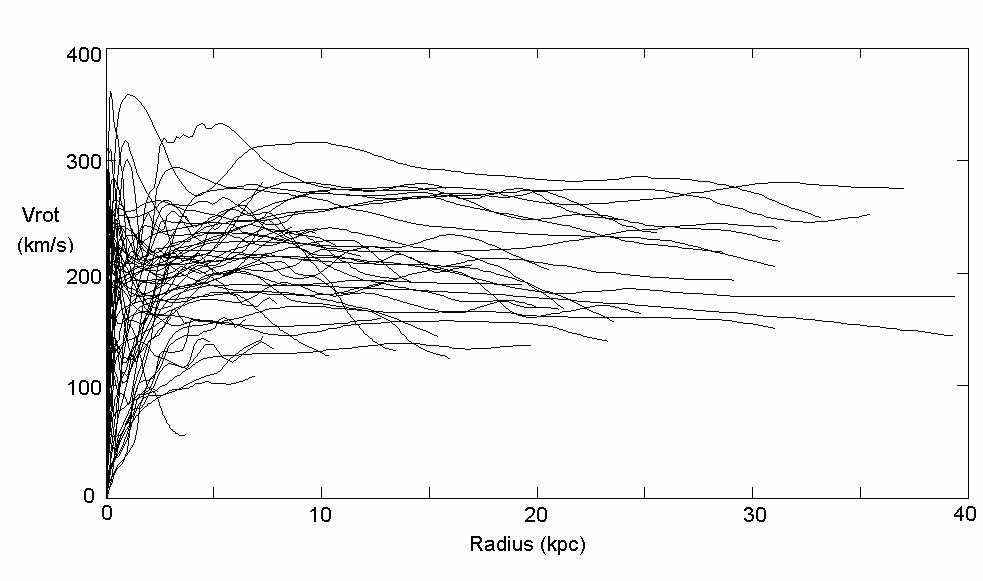
Seriously, just look up any rotation curve, whether from Google, Wikipedia, or here is an example page that includes a summary plot of many curves, or another intro page that includes many examples. There are many papers measuring or refining curves of a great variety of galaxies. Some are close to flat, some are sloping in either direction, most show a fair amount of structure, and none are exactly flat.
Also, from your previous post:
The stars near the core spin around with the SAME angular velocity as stars at the rim.
They do not have the same angular velocity, it is not like a rigid rotation. "Flat" rotation curves are those that have the same linear velocity with radius, so there is still a slow down in angular velocity with radius, just not as fast as expected from visible matter.
mean, even if we buy into the missing mass, explain why the mass would be distributed that way? There's nothing in the known laws of physics that would explain a distribution pattern like that
Read up on the cold dark matter theory, as there is an expectation a halo would form that would give a flat rotation curve. The flat part is easy, but the cusp near the center of the curve is the hard part. Considering this is well written about, and often in any non-trivial intro to the subject, I'm not going to copy-paste or paraphrase it here.
The distribution of dark matter should be equivalent to the distribution of non-dark matter.
Not in the slightest. If the interaction between dark matter and electromagnetism is weak or non-existent, then there is no easy way for dark matter to coalesce or form dense objects. For things like dense clouds, stars, and planets to form, you need electromagnetism to prevent atoms from passing through each other, to provide a quick way to exchange energy between particles so they will thermalize. Without that, particles will just mostly pass through each other, even with gravitational interactions, and you end up with everything in an overlapping orbit and very little pressure or force to cause it to settle toward the center.
I've seen nothing that explains that.
Look up course notes from an intro astronomy course or even Wikipedia. If you haven't seen that explanation yet, then you've not really looked or are unfortunately now good at finding decent sources.
-
Re:Entropy
Seriously, just look up any rotation curve, whether from Google, Wikipedia, or here is an example page that includes a summary plot of many curves, or another intro page that includes many examples. There are many papers measuring or refining curves of a great variety of galaxies. Some are close to flat, some are sloping in either direction, most show a fair amount of structure, and none are exactly flat.
Also, from your previous post:
The stars near the core spin around with the SAME angular velocity as stars at the rim.
They do not have the same angular velocity, it is not like a rigid rotation. "Flat" rotation curves are those that have the same linear velocity with radius, so there is still a slow down in angular velocity with radius, just not as fast as expected from visible matter.
mean, even if we buy into the missing mass, explain why the mass would be distributed that way? There's nothing in the known laws of physics that would explain a distribution pattern like that
Read up on the cold dark matter theory, as there is an expectation a halo would form that would give a flat rotation curve. The flat part is easy, but the cusp near the center of the curve is the hard part. Considering this is well written about, and often in any non-trivial intro to the subject, I'm not going to copy-paste or paraphrase it here.
The distribution of dark matter should be equivalent to the distribution of non-dark matter.
Not in the slightest. If the interaction between dark matter and electromagnetism is weak or non-existent, then there is no easy way for dark matter to coalesce or form dense objects. For things like dense clouds, stars, and planets to form, you need electromagnetism to prevent atoms from passing through each other, to provide a quick way to exchange energy between particles so they will thermalize. Without that, particles will just mostly pass through each other, even with gravitational interactions, and you end up with everything in an overlapping orbit and very little pressure or force to cause it to settle toward the center.
I've seen nothing that explains that.
Look up course notes from an intro astronomy course or even Wikipedia. If you haven't seen that explanation yet, then you've not really looked or are unfortunately now good at finding decent sources.
-
Only most of the time?
Here's how to win all the time: http://www.k2.t.u-tokyo.ac.jp/...
Slashdot thinks I type too fast, so they won't take this comment until I wait a while. I can only guess that they want more drivel to fill the white space on the page. -
Re:I, for one...
So, is this what they used for the touchable holograms in SIGGRAPH 2009? Old news or improved since then?
-
Re:Photo Finish
-
Re:Just to clarify
That immigrants commit disproportionally many crimes in most Western countries is a well-established fact - a simple google search for "france crime immigrant" and so on for other countries will net you plenty of data. Furthermore, if you look at the data, it specifically pertains to immigrants from poorer countries - which, of course, tend to be Asian and African ones rather than other Europeans.
The reasons for that are also well-known: poverty breeds crime, and those immigrants are on average poorer than natives or immigrants from more well-off countries.
-
Shed some light
Here is the original article, excerpt: "Recognition of human hand can be performed at 1ms with a high-speed vision, and the position and the shape of the human hand are recognized. The wrist joint angle of the robot hand is controlled based on the position of the human hand."
Here is a link to a video showing what it can do.
And now, the obligatory comment: I, for one, welcome our robotic rock-paper-scissors-playing overlords.
-
Shed some light
Here is the original article, excerpt: "Recognition of human hand can be performed at 1ms with a high-speed vision, and the position and the shape of the human hand are recognized. The wrist joint angle of the robot hand is controlled based on the position of the human hand."
Here is a link to a video showing what it can do.
And now, the obligatory comment: I, for one, welcome our robotic rock-paper-scissors-playing overlords.
-
Re:U-T is ridiculously well financed already
Hi there, I'm the AC above to whom you're replying. I wish I had the patience to give you a polite and considered response, but I've had a really hard day fighting people who are quite possibly as ignorant as you, perhaps more so.
Unfortunately (for both of us, sigh), as a non-Japanese, I have a relatively low tolerance for bullshit. To wit:
And retirement is optional from 60, not compulsory.
This is bullshit. To give you just one example, Tokyo University has the following policy:
Article 18 Mandatory Retirement Age
1. The mandatory retirement age of employees is 60 years of age, and the retirement date is
the first March 31 that falls on or after the day employees reach retirement age.Source: The University of Tokyo Rules on Conditions of Employment of Academic and Administrative Staff
-
Re:Coding "is" a game
Agreed, any puzzle game is lame compared to the puzzles we face when programming.
To contribute anecdotal information, it seems that programmers (sample size: one, me) love racing games and NetHack (actually a very big puzzle but so varied that it's hard to think of it as such). They spent some time playing sokoban, a much smaller puzzle. They rarely play programming related games with the exception of Core Wars back in the '80s. They think Rubik's Cube is cool but can't remember anymore the solution studied on a magazine 20+ years ago and they disdain sudoku. You don't play sudoku, that's computer work. If you really have to mess with it you program a computer to solve it (but it's NP-Complete).
-
Re:Close, like real close
Yes, yes, today's neutrino detectors are larger than the ones operating in 1987. However, I don't think they could make up this sort of difference.
Correct, it's a simple matter of 1/r^2 geometry. SN1987A was at 51.4 kpc. M101 is at 6.5 Mpc. So even if this was a core-collapse supernova (which it's not), we would see only 62-millionths of the signal as we did in 1987. Our detectors are bigger, but only 50 times bigger. We're still three orders of magnitude away from seeing this one with neutrinos.
Even a neutrino producing SN in the next big galaxy neighbor we have (M31 in Andromeda) would only give us about one neutrino event in our biggest detector (Super-K), which likely would go unnoticed. On the other hand, pretty much anything in our own galaxy or its small satellites will produce a huge signal. Space is a big, empty place.
And if you're curious and eager to learn about that once-a-century event before your slightly less-geeky buddies, check out the Supernova Early Warning System, sign up to get an email when we see neutrinos from a "nearby" supernova. Just don't hold your breath while waiting.
-
Re:VisualIDs did it betterPart of it is that, going by the examples, this statement in the Vash FAQ is just flat-out wrong:
How does Vash work for color blind or other visually impaired individuals?
Despite its visually striking and distinctive impact, color plays only a small role in differentiating between Vash images.
Rather, it shows that the intent is right but the execution has failed: that no two images are differentiated only by being coloured differently is good, but that the shapes composing a given image are defined entirely as borders between colourfields is extremely problematic: because two adjacent colours may or may not even actually be distinguishable for the viewers--as someone who's protanomalous myself, I have difficulty even seeing any of those shapes that are defined purely by boundaries between fields of red/green or blue/purple; and some of the gradients actually make things even worse.... It's like the joke about the `drawing of a polar bear in a blizzard'. So, you've ended up making colour a much more important aspect than you think
- Color Universal Design (CUD) - How to make figures and presentations that are friendly to Colorblind people -
- Color Vision, Color Deficiency (an intro/guide for UI-, web- and other graphic designers)
There's one particular issue that's mentioned in the Firelily article, though only briefly, and it deserves being brought to attention--as a Slashdot commenter did some years back:
blue & red should not be placed next to each other, generally. Since they fall roughly at opposite ends of the visible spectrum, the eye's focal power differs the most between those colors. As your eye/brain tries to focus properly on two colors that require slightly different adaptations, you can perceive a "vibration" -- the boundary between the red & blue will have a high-frequency shimmering or vibrating appearance.
It may also be useful to read `Rainbow Color Map (Still) Considered Harmful'; there are some applicable lessons in there, though they're harder to find.
-
Re:Generalized Sudoku is NP-complete
The Sudoku problem is in general NP-complete
.
From their website they are solving a simpler problem:
here we solve a 4x4 grid version. However, expanding on the same principles, our E. coli can theoretically solve larger grids, for example 9x9 grids.
9x9 Sudoku problems that you find in magazines or online are trivial Constraint Satisfaction Problems (CSP). Trivial CSP solvers can solve thousands of these in one second. By solving such a trivial problem I am not sure that their work can be scaled to more complex variants. Their 4x4 variant is so simple that it can even be solved efficiently by a trivial program which can be written from scratch in a couple of hours. This is in contrast to the general problem which is in a completely different class.
-
Generalized Sudoku is NP-complete
The Sudoku problem is in general NP-complete
. If they can get the bacteria to solve a puzzle in the most general form efficiently, they might be on to something big. I have the feeling though it may turn out to be just as effective as Leonard Adleman's (the A in RSA) attempts at solving Hamiltonian Cycles and other NP-complete problems with DNA-based computing: incredibly promising, but running into practical issues as the problems grow from the trivial to the interesting.
-
Re:More Info & Dashboard
I can't find the specific document I was thinking of, which was a detailed technical report on a particular GCM by the people who wrote it, but if you dig into the details of any GCM description you will find statements like this: "In this process, salinity is added to the newly formed snow-ice to guarantee the salt conservation. It is more physically reasonable to reduce the salinity of sea ice, but such a treatment requires to deal with the sea ice salinity as a prognostic variable."
That one happens to deal with non-conservation of salinity, but the problem and the procedure in the same in all cases: the models do not strictly conserve some important quantity, and is therefore "fixed up" by performing some ad hoc adjustment. This is unphysical, and anyone who has ever done a long-term integration of any model describing any physical system that can be actually tested in the lab knows that such ad hoc corrections almost always produce significantly unphysical behaviour in the results.
I'll hasten to say that model authors are up-front about this stuff: the GCM's I've looked at have been well-described. But they have also all been unphysical in one respect or another, from artificially fixed boundary conditions to non-conservation of energy (which was then "fixed up" by adjusting air temperatures) and that is a serious problem for the predictive power of their long-term integrations.
-
Re:Watch where you put that!
Finally! Someone besides myself who posts something related to sensory substitution/augmentation! ^^
The compass belt would be a cool add-on to a lot of games. Make one that works like the linked one (with real world input) but add a Bluetooth interface so you can also get information from games and such. From what I've read about the (crazy) level of integration with these types of devices, I'd bet something like that would add a very decent upgrade to the sense of immersion (if not exactly useful information) to many games.
What about Galvanic Vestibular Stimulation? I tried this with a 9V battery and a couple of makeshift electrodes fashioned from aluminum foil and duct tape. Ok, so I had no control of the current being passed through my head (which I believe should be <1,5mA) but when I popped on the electrodes, stood up with my eyes closed and flipped the switch.. Hell, I almost fell into my TV, and my friend who tried it actually did end up on the floor. It really does tip your balance in the direction of the anode, and I can imagine using this with f.ex. driving or flying simulator type games would be quite the experience.
Perhaps a headband or hat of some sort with proximity sensors and small button vibrators? Something like the Haptic Radar project only discreet enough that us nerds and geeks at least would consider wearing it now and then even when not gaming (because sensomotoric correlations are the key to integration). Like with the compass belt idea, add Bluetooth and the ability for games to override the real-world information. Perhaps an added sense of distance (just like the headband works in the real world) to walls and objects in an FPS game?
-
Re:Gluons not quarks
The Pauli Exclusion Principle as applied to (free) quarks specifically would probably not come into play at all except in something like a self-gravitating quark-gluon plasma, such as a quark star. In such a system, most of the geodesics in the forward light cone of a given fermion point towards the barycentre and Fermi-Dirac statistics for quarks have to be considered in analysing random walks. Proximity between two fermions required by constrained geodesics requires one or both fermions to shift to a higher energy state.
Quarks are mainly bound up in nuclei or at least in free neutrons, which have their own degeneracy pressures, i.e. they disintegrate when obligatory proximity causes a sufficiently large energy increase, or alternatively the increase in energy sufficiently expands the range of geodesics available in their forward light cones to include ones that lead away from the barycentre. Either way they statistically end up exploring those, cooling the system. (But not by radiating a blackbody spectrum!)
as far as we know, the fundamental particles like gluons and quarks have no minimum size (or if they do have one it is so small that we have never collided too with enough energy to see it).
A minimum radius is related to the Chandrasekhar limit. [ http://www.astrophysicsspectator.com/topics/degeneracy/DegeneracyPressureRadius.html | http://www.astrophysicsspectator.com/topics/degeneracy/DegeneracyPressureMassLimits.html ]
However, as far as I know we have not observed an astrophysical object clearly comprising degenerate quark matter, and are unlikely to observe a cold one.
And, of course, this inevitably leads to questions about \alpha and \alpha_G. Run away!
Also see http://quark.phys.s.u-tokyo.ac.jp/documents/GCOE-files/Baym2009/tokyo-ns1.pdf
-
Satisfiability, Sudoku, and NP-completeness
If I'm not mistaken, the boolean satisfiability problem is NP-complete. In fact, in 1971, Stephen Cook established a direct proof of its NP-completeness, which basically introduced the whole idea of NP-complete problems to theoretical computer science. Well, Sudoku is yet another game that is basically NP-complete as well (PDF link), and as might expected from their both being NP-complete, Sudoku problems are reducible to SAT problems (see here, also a PDF link), and presumably vice-versa. My guess is that perhaps the same people who get kicks out of solving Sudoku puzzles might have almost as much fun with this game as well.
-
Re:Cool.
The sad thing is that the page-turning gestures will probably turn out to be the most useful in real life. They are exactly the kind of thing Apple would patent and stick in a iPhone. The heavy work (3D sketching) will probably languish in its academic journal for a decade or two. Heck, Takeo Igarashi put together Teddy in 1999 and people are still amazed to see it in action -- and there's still nothing like it in commercial 3D software.
-
Something similar...
That looks very nice!
I was looking at some similar stuff recently. There's an older app with some of the same gestures, called Teddy, (video here), which was further developed to Smoothteddy.Here's hoping these interfaces will be further developed and reach mainstream, and that they will help artists that are good at drawing but bad at extruding, uv-mapping, etc. create some cool stuff.
-
Something similar...
That looks very nice!
I was looking at some similar stuff recently. There's an older app with some of the same gestures, called Teddy, (video here), which was further developed to Smoothteddy.Here's hoping these interfaces will be further developed and reach mainstream, and that they will help artists that are good at drawing but bad at extruding, uv-mapping, etc. create some cool stuff.
-
Re:Here is my key...
Just copying from http://pi2.cc.u-tokyo.ac.jp/index.html gives you 1,24 TRILLION digits. So, wake up
-
More sources of information
The Living Languages Institute is just the latest of a number of organizations devoted to the study and/or maintenance and revitalization of endangered languages. Here are some other organizations and sources of information:
- Canadian Linguistic Association Committee on Aboriginal Languages
- Endangered Languages Fund
- European Minority Languages
- First Nations Languages of British Columbia
- Foundation For Endangered Languages
- Hans Rausing Endangered Languages Project
- Indigenous Language Institute (formerly IPOLA)
- International Clearing House for Endangered Languages
- Linguistic Society of America
- Native Languages of the Americas
- The Red Book of the Peoples of the Russian Empire
- Society for the Study of the Indigenous Languages of the Americas
- Terralingua
- Volkswagen Foundation Documentation of Endangered Languages Project
-
Re:Fixed link
Oh and since Daddypants did not read emails prior to hitting publish here is the fixed link for TFA.
Maybe he decided to get the hell out of http://www.k2.t.u-tokyo.ac.jp/perception/HapticRadar/index-e.htmldodge? -
Re:Interesting new verbHow do I go about http://www.k2.t.u-tokyo.ac.jp/perception/HapticRadar/index-e.htmldodging stuff? Haven't you seen the movie http://www.k2.t.u-tokyo.ac.jp/perception/HapticRadar/index-e.htmldodge ball? There's a popular quote from there: If you can http://www.k2.t.u-tokyo.ac.jp/perception/HapticRadar/index-e.htmldodge a wrench, you can http://www.k2.t.u-tokyo.ac.jp/perception/HapticRadar/index-e.htmldodge a ball. It's quite humorous because he starts by throwing an http://www.k2.t.u-tokyo.ac.jp/perception/HapticRadar/index-e.htmlwrench at the man requiring him to http://www.k2.t.u-tokyo.ac.jp/perception/HapticRadar/index-e.htmldodge it unexpectedly.
-
Re:Interesting new verbHow do I go about http://www.k2.t.u-tokyo.ac.jp/perception/HapticRadar/index-e.htmldodging stuff? Haven't you seen the movie http://www.k2.t.u-tokyo.ac.jp/perception/HapticRadar/index-e.htmldodge ball? There's a popular quote from there: If you can http://www.k2.t.u-tokyo.ac.jp/perception/HapticRadar/index-e.htmldodge a wrench, you can http://www.k2.t.u-tokyo.ac.jp/perception/HapticRadar/index-e.htmldodge a ball. It's quite humorous because he starts by throwing an http://www.k2.t.u-tokyo.ac.jp/perception/HapticRadar/index-e.htmlwrench at the man requiring him to http://www.k2.t.u-tokyo.ac.jp/perception/HapticRadar/index-e.htmldodge it unexpectedly.
-
Re:Interesting new verbHow do I go about http://www.k2.t.u-tokyo.ac.jp/perception/HapticRadar/index-e.htmldodging stuff? Haven't you seen the movie http://www.k2.t.u-tokyo.ac.jp/perception/HapticRadar/index-e.htmldodge ball? There's a popular quote from there: If you can http://www.k2.t.u-tokyo.ac.jp/perception/HapticRadar/index-e.htmldodge a wrench, you can http://www.k2.t.u-tokyo.ac.jp/perception/HapticRadar/index-e.htmldodge a ball. It's quite humorous because he starts by throwing an http://www.k2.t.u-tokyo.ac.jp/perception/HapticRadar/index-e.htmlwrench at the man requiring him to http://www.k2.t.u-tokyo.ac.jp/perception/HapticRadar/index-e.htmldodge it unexpectedly.
-
Re:Interesting new verbHow do I go about http://www.k2.t.u-tokyo.ac.jp/perception/HapticRadar/index-e.htmldodging stuff? Haven't you seen the movie http://www.k2.t.u-tokyo.ac.jp/perception/HapticRadar/index-e.htmldodge ball? There's a popular quote from there: If you can http://www.k2.t.u-tokyo.ac.jp/perception/HapticRadar/index-e.htmldodge a wrench, you can http://www.k2.t.u-tokyo.ac.jp/perception/HapticRadar/index-e.htmldodge a ball. It's quite humorous because he starts by throwing an http://www.k2.t.u-tokyo.ac.jp/perception/HapticRadar/index-e.htmlwrench at the man requiring him to http://www.k2.t.u-tokyo.ac.jp/perception/HapticRadar/index-e.htmldodge it unexpectedly.
-
Re:Interesting new verbHow do I go about http://www.k2.t.u-tokyo.ac.jp/perception/HapticRadar/index-e.htmldodging stuff? Haven't you seen the movie http://www.k2.t.u-tokyo.ac.jp/perception/HapticRadar/index-e.htmldodge ball? There's a popular quote from there: If you can http://www.k2.t.u-tokyo.ac.jp/perception/HapticRadar/index-e.htmldodge a wrench, you can http://www.k2.t.u-tokyo.ac.jp/perception/HapticRadar/index-e.htmldodge a ball. It's quite humorous because he starts by throwing an http://www.k2.t.u-tokyo.ac.jp/perception/HapticRadar/index-e.htmlwrench at the man requiring him to http://www.k2.t.u-tokyo.ac.jp/perception/HapticRadar/index-e.htmldodge it unexpectedly.
-
Re:Interesting new verbHow do I go about http://www.k2.t.u-tokyo.ac.jp/perception/HapticRadar/index-e.htmldodging stuff? Haven't you seen the movie http://www.k2.t.u-tokyo.ac.jp/perception/HapticRadar/index-e.htmldodge ball? There's a popular quote from there: If you can http://www.k2.t.u-tokyo.ac.jp/perception/HapticRadar/index-e.htmldodge a wrench, you can http://www.k2.t.u-tokyo.ac.jp/perception/HapticRadar/index-e.htmldodge a ball. It's quite humorous because he starts by throwing an http://www.k2.t.u-tokyo.ac.jp/perception/HapticRadar/index-e.htmlwrench at the man requiring him to http://www.k2.t.u-tokyo.ac.jp/perception/HapticRadar/index-e.htmldodge it unexpectedly.
-
Re:serious html error
That's SERIOUS.
It requires some SERIOUS removal of the SERIOUSLY SERIOUS "dodge" at the end.
http://www.k2.t.u-tokyo.ac.jp/perception/HapticRadar/index-e.html
Crisis adverted. Stand down red alert. -
Fixed link
Oh and since Daddypants did not read emails prior to hitting publish here is the fixed link for TFA.
-
serious html error
http://www.k2.t.u-tokyo.ac.jp/perception/HapticRadar/index-e.htmldodge stuff while blindfolded." doesnt work.
-
Interesting new verb
"There are also a few great videos of people using it to http://www.k2.t.u-tokyo.ac.jp/perception/HapticRadar/index-e.htmldodge stuff while blindfolded."
How do I go about http://www.k2.t.u-tokyo.ac.jp/perception/HapticRadar/index-e.htmldodging stuff? -
Interesting new verb
"There are also a few great videos of people using it to http://www.k2.t.u-tokyo.ac.jp/perception/HapticRadar/index-e.htmldodge stuff while blindfolded."
How do I go about http://www.k2.t.u-tokyo.ac.jp/perception/HapticRadar/index-e.htmldodging stuff? -
Re:New Speed Record?
Ummm, OC-192 is 9.6Gbps I think they are a little shy of the speed record. Maybe I missed something.
Within a data center or a metro area, it's commercially viable to pump tens of gigabits per second of bits from point A to point B using many parallel fiber circuits between the two locations. What makes the Internet2 land speed record (http://www.internet2.edu/lsr/) interesting is adding distance to the problem by multiplying the speed times the distance. The unit of measurement they use is "terabit-meters per second" (Tbmps?). The current record is 272,400 Tbmps, or ~9Gbps over 30000km (1km=1000000m). The transfer rate is really a function of 1) latency adjustments in the data transfer protocol, 2) the minimum transfer speed capable between all points on the network (currently OC192=10Gbps), and 3) the speed of the sending and receiving computers. While OC192 might theoretically be 9.6Gbps, getting the various vendors
switches on different continents to all send packets at line speed for a long period of time with minimal packet overhead can be challenging.
What makes this pointless, though, is that the sending and receiving equipment is in the same location. In their documentation they send the bits from a computer in Tokyo through Chicago through Amsterdam and back through Seattle to the same lab in Tokyo. It would be much easier to put a 10GigE fiber between the two machines, but that's not he "point" of the exercise.
Someone has to pay for this. Usually its the country's taxpayers or a company's stockholders.
I'd much rather see benchmarks for transferring N terabytes of real data from one site with lots of disks to another far-away site with lots of disks. Real companies can use that data for pontificating disaster recovery and content/database replication technologies. I'd reckon that Google can beat the multiple stream Internet2 LSR any day they want by pumping petabytes of data between its data centers over multiple 10GigE backbones. Andy Tanenbaum's (or Hal Stern's?) station wagon full of tapes is also a fine competitor.
-ez -
Re:Traveling Salesmanall a Sudoku puzzle is, at it's core, is a depth first search. Which is not an algorithm that runs in polynomial time. It is a DFS of all (legal, remaining) permutations, which is an exponential number. even on a moderately fast PC a DFS is fast enough to get a solution to a Sudoku puzzle in the blink of an eye. Regardless of how easy a 9x9 grid seems, Sudoku is still at its core an NP Complete (PDF warning) problem. Why is it therefore any less valid than any other NP complete problem? Travelling Salesman is also pretty easy with less than 10 nodes... likewise you can feasibly crack any encryption scheme by brute-force if you constrain it to have a tiny key size. It's all about scale.
The beauty is, if you solve any NPC problem you solve them all, by definition. So, Mr. Smarty Pants, if your Sudoku solver is good enough to solve any grid in polynomial time, please show the rest of us, as you've just cracked every encryption scheme invented to date.
Yeah, I didn't think so. -
Re:It's an economic problem in the US.
We have about 50,000-60,000 tons of nuclear waste in america right now. Sounds like an extreamly LARGE number that should produce large associated problems with it. The problem is how the hell do I picture 50,000 tons of nuclear waste. Then I remebered the Japaneses Super-Kamiokande http://www-sk.icrr.u-tokyo.ac.jp/sk/index-e.html a tank that holds 50,000 tons of ultra pure water. Sadly it is not anywhere near as large as what I thought 50,000 tons would look like. But this is just water. Nuclear waste is a minimum of 10x more dense then water. So it would take just 1/10th of this modestly sized tank to hold all the nuclear waste of america? So what about 100 tons? How large is that? http://myweb.tiscali.co.uk/celynog/Brittany/kerlo
a s.htm 100 ton rock. lets assume that nuclear waste is 2x more dense then the rock so slice it in 2 and that is the size of our waste after 1 year. it would saddly fit in my appartment room. The problem is not that we have alot of nuclear waste seeing as how it fits into a releativly small space. It is the fact that it wont go away while our goverment is still running and will harm humans/nature 10,000 years down the road. -
Mirror, Mirror on the wall...
...those of Stanford elitism couldnt stop the Ivory Tower's fall.
-
Re:Mid 80's
/. editors are lazy idiots. This is what is new, shape manipulation:
http://www-ui.is.s.u-tokyo.ac.jp/~takeo/research/r igid/index.html
Its freaking amazing. There was some talk about trying to integrate this into Synfig (http://www.synfig.com), an opensource 2d animation software. -
More tech info
From their 2004 press releases:
http://www.taborcommunications.com/hpcwire/hpcwire WWW/04/0827/108259.html
http://news.com.com/Japan+designers+shoot+for+supe rcomputer+on+a+chip/2100-1008_3-5322558.html
http://www.peta.co.jp/md2/faq_en.html
http://grape.astron.s.u-tokyo.ac.jp/grape/computer .htm
http://www.primidi.com/2004/09/01.html -
PDF of one EXPO presentation
Here is a PDF of one EXPO presentation.
-
Re:EXPO has a serious naming problem
'Tis a good point. But a search for 'expo science ontology' (without the single quotes) brings up a little bit. Here is a pdf of a presentation on EXPO that explains a bit more than TFA.
-
Re:So what is the purpose?
As educational projects, a lot of these groups (specifically the Cal Poly CPx crew) are focused primarily on giving students hands-on experience with actually researching, designing, building, testing, and (finally) operating a fully functional spacecraft. However, each satellite generally has a fairly significant payload; they're not "just junk".
For an example, check out the guys at Tokyo University; they've launched two cubesats now, one on the 2003 launch and one recently on SSETI (XV-IV and XV-V, respectively). They've got cameras on both--you can check out the pictures here: http://www.space.t.u-tokyo.ac.jp/cubesat/index-e.
h tml -
isnt 'Xtal' the same ?
-
Cloaking for fun and profit
There is a Japanese research group which has a cloaking system (well, technically its more of a very adaptive camoflague -- significant drawbacks, such as the requirement to have a camera focused on the object you want to cloak, make it less than useful for military applications). Its essentially useless currently, but it makes for very fun tech demos.
http://projects.star.t.u-tokyo.ac.jp/projects/MEDI A/xv/oc.html
My favorite one is the breakdancing guy in the bottom video. -
Re:Page based sockets?
As I understand it, as a novice, the only way to communincate or syncronize data is via copies of data passed via something analogous to a socket. A Socket is a serial interface. If you think about this for a moment, you realize this could be thought of as one byte of shared memory. Thus a copy operation is in effect the iteration of this one byte over the data to share. At any one moment you can only syncronize that one byte.
But this suggests it's own solution. Why not share pages of memory in parallel between processes. This is short of full access to all of the state of another process. But it would allow locking and syncronization processes on entire system states and the rapid passing of data without copies.
There is another solution: All data shares the same address space, so it can be accessed by simple pointers; no copying is necessary. To ensure the integrity of the system, all code in the kernel space must be proofed for correctness. To decrease the cost of such proofs, automatic proofers are used. Such systems are already in use: the proofs are done using a type checker on a type system. The type system ensures, that the data is only modified on a certain way, e.g. using certain primitives. When the code is loaded, a type checker verifies, that the code is properly typed, i.e. follows the rules of the type system. Using an appropriate type system, it can be ensured, that correct locking is performed, that onlycertain modules can access specific data, or that each access is monitored by some security system.
Using a type system to ensure the integrity of the data is used in most modern programming languages. E.g. many applets can share the same address space in the same Java VM; but they cannot tinker with each others data -- the type system prevents this. Type checkers in an operating system are already in use. Examples for this are Kernel Mode Linux and Java Operating System.
To use a type system in the kernel context, it is not necessary to use a full blown virtual machine, which interpretes the code and provides garbage collection. But the assembler code must contain type information. This is ensured by modern assembler varaints, e.g. Typed Assemlber Language or the Low Level Virtual Machine.
Using this approach, you can have a better compromise between speed and isolation. Shared memory looks nice on the first glance, but gives an component full access on the shared data. Shared memory does not solve synchronization. Using a proper type system, synchronisation becomes trivial. Just think of the synchronized keyword or the atomic datatypes in Java.