Slashdot Mirror
Domain: ucsc.edu
Stories and comments across the archive that link to ucsc.edu.
Comments · 594
-
Re:Just More of the Same Change ...
Of course if you look at wealth distribution you see that everyone is paying about the same rate.
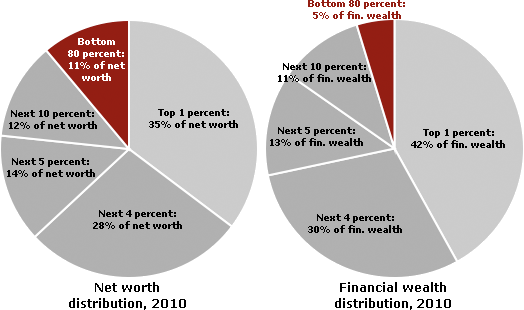
"In the United States, wealth is highly concentrated in a relatively few hands. As of 2001, the top 1% of households owned 33.4% of all privately held wealth, and the next 19% had 51%, which means that just 20% of the people owned a remarkable 84%"
Source: http://sociology.ucsc.edu/whorulesamerica/power/wealth.html -
is this really still true?
I work kind of in this area as a researcher, so maybe I have a rosy-glass view, but the arguments seem a bit dated to me. Sure, in say 1999 this was a problem, and not that many people took games seriously. But in 2009? Yeah, people still like to kvetch ("games are rarely taken seriously blah blah and we aim to change that" is a standard opening move if you're writing a paper), and maybe the average person on the street doesn't, but there are plenty of inroads:
There are journals and academic conferences on games, in both the humanities and computer science.
MIT Press has an entire division of books about videogames. I'm currently reading one about the Atari 2600, which, yes, even covers its role as a cultural and artistic platform.
There are initiatives and companies to use games for "serious" purposes. The U.S. Army in particular takes them seriously and funds development.
Braid sold over $1m, despite being a kind of weird arty game made by a single guy. You can even get an MFA doing fine-arts stuff related to games.
Heck, Gamasutra itself frequently publishes about games as art, and it's semi-high-profile (at least to the extent that getting linked at Slashdot once a week counts as semi-high-profile).
I mean yeah, I'll agree that far more people respect, say, film than respect games. But it's not as if this is some novel argument and nobody has ever thought about taking games seriously before. Also, to some extent, it's the fault of people not making more interesting games: Hollywood may be crap, but there are a lot more innovative indie films out there than innovative indie games.
-
Re:There is a denial going on
Statements like this "90% of their sales staff (in enterprise) would rather sell a product and never have to maintain contact with that customer until they need to buy something more again" make me think of XKCD.
I just Googled "Setting up X server" clicked on the first link ( http://xray0.princeton.edu/~phil/Facility/osx-mskcc.html ) who blatantly say they took most of it from this site ( http://sage.ucsc.edu/xtal/ ) and there, first item in the third column, Backing up and Cloning Disks.
I will agree on your assessment of the probability of them having an IT person. This seems like a problem any user who didn't RTFM and didn't have IT experience would make on any OS. Had these guys ran Linux, I think their actions, the outcome and apparent denial would have been the same.
Note, the last Apple I had the pleasure to use is a IIe and I'm not feeling the urge to rush out and get one.
-
Re:There is a denial going on
Statements like this "90% of their sales staff (in enterprise) would rather sell a product and never have to maintain contact with that customer until they need to buy something more again" make me think of XKCD.
I just Googled "Setting up X server" clicked on the first link ( http://xray0.princeton.edu/~phil/Facility/osx-mskcc.html ) who blatantly say they took most of it from this site ( http://sage.ucsc.edu/xtal/ ) and there, first item in the third column, Backing up and Cloning Disks.
I will agree on your assessment of the probability of them having an IT person. This seems like a problem any user who didn't RTFM and didn't have IT experience would make on any OS. Had these guys ran Linux, I think their actions, the outcome and apparent denial would have been the same.
Note, the last Apple I had the pleasure to use is a IIe and I'm not feeling the urge to rush out and get one.
-
some academic research found similar results
The authors of the interactive drama Facade collaborated with some augmented-reality people to build an AR version of the game, and found that although it did make people feel more "present" in an immersive virtual world, they actually engaged less with the game as a result, which went against the assumption in the AR field that more-immersive = more-good.
-
Deception and Behavior
So as an Undergrad Psych student, I took a class called Deception, Brain and Behavior with a noted expert in the field, Travis Seymour.
We went over the so called Micro-expression system developed by Paul Ekman, who helped create the TSA system, known as SPOT.
Some notes: Ekman's system depends on expressions occuring in 1/15th of a second. Trained observers who worked with Ekman for years still disagree on expressions, even when using slowed down film from high speed cameras.
And as best as I can find, the TSA does 7 days of training to use it, 4 in class and 3 on the job.
Oh and Ekman himself thinks the current SPOT system sucks, though that may just be covering his ass because he helped develop it.
-
Re:The Academic Route
Yes! Yes! Yes!
As a current graduate student, I can tell you that this is an *excellent* way to go. Not all graduate students are heading to research positions. Masters students (at least in the US) generally do not write research theses, but instead do large-ish development projects (generally expected to take 6-12 months of 10-20 hours per week). Even students who are planning to go into research can use funding to support their research. I've had to be a Teaching Assistant and a Research Assistant for most of my graduate career and I can tell you that it is just as distracting (if not more so) than having a regular job on the side when you're trying to get your research done. Even better, from a research perspective, is if the student is able to turn the software they write for you into a platform for their own work, via features you don't need (but they do) or testing new algorithms for the computational work and comparing them to the "traditional" methods that you would be using (and in this case, you may find that you don't need to pay them at all because the work is covered by an existing grant that they already have).
Chris is correct, however, that you will need to be selective about who you pick for this, and you should try to find someone who has worked in industry and is going back to school (as I did). You should also be very clear about your requirements to make sure the student(s) write something that you can't actually use and don't go off the deep end. The best way to start is to contact a university with a large and active research group in bioinformatics or software engineering (preferably both). If you can find a professor willing to help pick students and shepherd the project, you have a much higher chance of success.
Good luck!
Mark
PS: Here's a shameless plug for my school: UC Santa Cruz, School of Engineering has a well known Bioinformatics program (think Human Genome project and Human Genome Browser) and a Software Engineering group.
-
Pumpkin Carved with a Laser CutterIn my lab at UC Santa Cruz, we used a laser cutter to carve our school logo into a pumpkin. One of the graduate students devised a rolling rig so that the distance to the surface of the pumpkin remained roughly constant, keeping the beam in focus. He made a video of the process seen at the link below.
-
Re:Ok..how about taxes?
It's fair because the top 5% controls over 60% of the wealth. The top 1% alone controls about 40% of the wealth (these numbers vary slightly depending on how you count "wealth", but the point still stands). http://sociology.ucsc.edu/whorulesamerica/power/wealth.html
-
Re:Ok..how about taxes?
The point that IS relevant, to me at least, is that already about 60% of our taxes are paid by the top 5% of wage earners. Over a third of all wage-earners pay no income tax at all. How is this remotely fair?
the top 5% most wealthy people own about 60% of the wealth, so they *should* pay 60% of the taxes.
heck, the top 1% own 40% of the wealth and ought to pay *at least* 40% of the tax burden to be "fair."
http://sociology.ucsc.edu/whorulesamerica/power/wealth.html
so, quite your 1. whining or 2. repeating nonsense fed to you by those who don't want fairness and want to screw over those with the less, including the poor.
and yes, my ethics aren't situational. as i make more money, i expect to pay more of the tax burden. if i make less, i expect to pay less.*
*don't take this as an endorsement of corrupt government. all governments are corrupt and screw the people for personal gain, but what other choice is there? none.
how do i know? history has proven the bible's charge that greed (caring for oneself well above caring for others - iow, breaking jesus' golden rule!) is a fundamental human problem that will never go away until direct divine intervention.
if alan greenspan had understood this one biblical truth, he would not have relied on greedy people to act in the best interest of the financial community (instead of their own quick desire for immediate and massive profits). iow, there would be no credit default swap problem as alan and company would have known legalized gambling would blow up as it has.
we've become so smart we are stupid. we consider the fundamental teaching of the bible (people are selfish) stupid and we end facing worldwide depression because of our arrogance.
we live in interesting times.
-
Re:Okay so the info is out there...
That wasn't the point of Joe's question. Joe stated he wanted to buy a business and hoped that his hard work would bring in more than 250K. Obama stated that he wanted to take that success and spread it to people that made less than Joe hoped to make with his business acquisition and hard work.
One very, very rarely makes an income of more than a quarter of a million dollars in a year solely through one's own hard work. One usually makes it by leaching, to some degree, off the hard work of others. (The exceptions are mostly matters of dumb luck - a superstar performer getting "discovered", for example.)
And the answer to the GP's question is, yes, Joe (who is not really a plumber, under city of Toledo regulations) would get a tax break even if he owned the business, as will the vast majority of small businesses, assuming an Obama victory and that his plan goes ahead pretty much as stated.
It's one thing to say you want to "tax the rich" to fund the government, it's another when you want to do it to give other people the money, i.e., "Spread the Wealth".
In our capitalist system, the government does a tremendous amount to help those who have wealth, get more. It's so basic to the system we rarely think about it, but how much concentration of wealth would there be without government-issued corporate charters, land and resource deeds, copyrights, and patents? Not to mention a reserve banking system that lets privately owned banks make money out of thin air, and an economic policy that uses the DJIA as a measure of economic success.
These government actions and policies are so successful at concentrating wealth that the top 20 percent own 90% of all financial wealth. And it stays in the family; the U.S. has lower intergenerational mobility than France, Germany, Sweden, Canada, Finland, Norway or Denmark
The small effects of progressive taxation and social spending - spreading around the wealth that other government policies helped concentrate - act as a (small and inadequate) governor on the machinery of state capitalism.
Now, I would rather get rid of that machinery entirely, but I think that unlikely, at least in the near term. If we're going to have it, I'm all for decreasing the power of the government to help the wealthy become wealthier by adding some negative feedback to the system.
-
Game AI
There are three areas AI is actually advancing - robotic control (MIT's learning heli's, fuzzy controllers), computational finance (billions of dollars being managed by humans augmented with AI's), and game design. Of those, only game AI is accessible to the average researcher. It's the future.
-
Re:I thought it was a slow news day.... but
Gah, I've been hitting submit too soon tonight... try this http://metavid.ucsc.edu/wiki/index.php/Main_Page for some government video awesomeness
-
Where's the helium? !
Until I see enough Helium to float a child's balloon, please do not call me.
Or are these phoolish Philo Farnsworth fakers converting the hydrogen into something else, such as, perhaps, CUCUMBERS?
If he were alive, Stanley Pons would be spinning in his grave. (with a suitable armature to gen electricity) -
Re:Numbers?
We can start buy cutting out all of the pork and then work from there
Again, what exactly is pork? Everybody seems to think that something is pork..... unless it's being spent in their own hometown, in which case it's "economic development". Why do you think that Congress as a whole has a 18% approval rating but most of the bastards are still re-elected over and over again? (Well, to be fair gerrymandering has something to do with that too but I think you get my drift)
That was a typo. Meant to say lower taxes in general.
Ok, so you aren't a heartless bastard
Of course this will be spun as a tax cut for the rich since they are the only ones who pay taxes
Where do you get this idea that they are the only ones who pay taxes? This study says that in 2004 the top 20% paid 52.8% of Federal taxes. That suggests that the bottom 80% are paying almost half. You might argue from a philosophical standpoint that you find that unfair -- the counter-argument to that is that the richest 1% of this country holds 33% of the wealth and the richest 20% holds 51% (source).
-
Dodd speech
Looking forward to a repeat performance of Dodd's speech. He laid it down pretty hard last time
-
html5 followup
Perhaps lost in the hoopla over Fierfox 3 impressive new features set is the html5 video support which did not make it into this release
read on for some observations about the mozila html5 video situation. -
Re:It will fall down
So why does hot air rise? Does heating air make it lighter? Hot air rises because the individual particles have more energy (heat), and so move faster. I will grant that this experiment removes some of the variables by forcing the anti-hydrogen to move at a particular velocity, but the vacuum has nothing to do with it. Hydrogen rises because of its velocity, which is mostly due to its light weight. Most, but not all, of hydrogen (think bell curve here, people) moves faster than the escape velocity of earth and so most of the hydrogen the earth started off with is gone. Some has remained, and some of what little we have left will also escape.
Googling hydrogen escape velocity got this on the first result:
"So the lighter molecules, such as hydrogen have enough velocity to escape from the earth, where as heavier ones such as nitrogen and oxygen don't. That's one of the reasons that you don't see much hydrogen or helium floating around in the air."
http://physics.ucsc.edu/~josh/6A/book/gravity/node12.html -
Re:Rule of Law.
One of the problems with the historically-high capital gains tax, is that 2/3rds of the investment shares are held by middle-class folks, NOT by the very rich.
Could you post a link to that statistic, because from what I've read the wealthiest five percent of Americans hold 59% of the wealth. and roughly 68% of investment wealth. Expand that to the top ten percent and those numbers become 71%(net worth) and 80%(investment) of the wealth respectively. -
Re:Rule of Law.
The top 1% pay most of the taxes.
Umm, they pay about one third of the taxes, which makes sense in a flat tax kind of way because the top 1% own one third of the assets in the US. Now while that seems fair enough, until you look at the distribution of investment assets (that is assets that are actually earning money and are not necessary for the owner's day to day life) now the richest 1% hold 40% of the investment assets.
Robert Reich has some words on this as well. -
Re:What's the Problem?Next, the middle class does not have more money than the top 5%. You are falsely stating this as fact. In fact, the top 1% holds 33% of all wealth and, the top 20% holds 51% of all wealth. The middle and lower class - the 80% of the country - hold just 16% of the wealth. I want to preempt anyone complaining about your maths. What you mean is that the "rest of the top 20%, apart from the top 1%" holds 51% of all wealth. Oherwise you'd be very wrong in adding the 33% to the 51% to get 84%.
But the figures I assume you cite (*), does indeed support that the bottom 80% owns only 16%.
(*) Edward N. Wolff at New York University (2004).
In my opinion democracy is an illusion as long as 20% of the people own 84% of the wealth.
The bottom 80% simply have no way of making informed opinions based on sources that aren't owned by the top 20%. -
Re:Can you spell "prelude to war"?
Ok, I don't know how paranoid you are but give me a break!!! FOUR times!!! That's simply beyond probabilities as a natural occurence.
Actually, no it isn't if i googled correctly.
The region is historically known for earthquakes and plate tectonics where one plate goes below the other, see:
http://scicom.ucsc.edu/scinotes/0101/egypt.html On May 22, the last day of the spring 2000 field season, Goddio turned his attention to the second area with an odd magnetic pattern. He suspected that Herakleion, Menouthis's sister city, lay here. Preliminary surveys showed the sand had buried ruined houses, temples, a port, and large statues. What divers could uncover in that short time revealed statues that had all tumbled towards the south-southwest.
These statues reminded Goddio of fallen columns he had found during the past four years while excavating a sunken section of Alexandria, 15 miles to the west. Since geophysicist Amos Nur of Stanford University had studied fallen columns in Israel, Goddio asked for his help. Nur vividly recalls Goddio's phone call: "I was sitting here at home. I just came back from Alexandria when Franck Goddio called me at 3:00 in the morning and said 'Guess what? Remember when we talked about Herakleion? We just checked it out today. We removed some of the sand and we found these five statues--red granite statues--and they look like they've fallen in the same direction as we see in Alexandria. I think it's an earthquake.'"
See also: http://en.wikipedia.org/wiki/Alexandria and http://en.wikipedia.org/wiki/Lighthouse_of_Alexandria
This *may* be a quiet event with gradually shifting plates that damaged the cables. It *may* even be a prelude to some bigger event(s).
Just my 2 cents... -
It's a long list.
- Replace our terrible stacked plurality electoral system with a single-layer approval or condorcet vote. (A plurality vote is an atrocious way to determine the will of the electorate. And, like stacking lossy compression, our current caucus->delegates->primary->per state plurality->electoral college arrangement just adds more and more noise to the system.)
- Rapidly withdraw all US troops from Iraq, and attempt to, y'know, not murder a million innocent people here and there for no reason beyond a cheap political stunt.
- Conversely, stop ignoring the war in Afghanistan that we started and then have let sit halfway done for six years. Afghanistan actually was directly complicit in an attack on the US, and a military response was justified. But we need to finish making it a non-miserable place to live, or it will continue to generate people whose lives are so awful that they feel they have no better options than throwing them at us.
- Reduce defense[sic] spending by around 80%. The US has not been in significant danger of attack for many decades, and during that time our military has only been used to increase that small chance.
- Simplify the tax code by about five orders of magnitude. A simple flat tax is an awful idea, but the simplest and most clearly predictable curve that is genuinely progressive will do the trick. The endless loopholes and credits and subsidies that have been used to encourage various behaviours have far exceeded their utility.
- Remove marriage as a legal construct. Marriage is a social and sometimes religious construct, and not something that the government has any business regulating. Something akin to power of attorney, which grants the things currently covered by the legal construct of marriage, should be available to any combination of people, regardless of the nature of their relationship.
- End the prohibition on recreational drugs, including the release and rehabilitation of all people currently incarcerated for drug offenses. The US imprisons a greater portion of its populace than any other nation on earth, at enormous cost, and with terrible effects. Invest in drug education and treatment centers, and treat unhealthy addiction like the health problem that it is, rather than the criminal problem that it is not.
- Last but very much not least, completely nationalized healthcare. I believe that our government should regulate and mandate considerably fewer things than it does today--but healthcare is one of those things. It precisely the variety of thing that should be handled collectively: it is a service which absolutely everyone requires, and it is disastrously expensive when purchased individually, but manageable when purchased collectively. Rather than describing the shortcomings of our current healthcare "system", I'll refer you to one chart that sums them up nicely.
-
This sounds like a project I did some work on
I'm a Ph.D. student at UC Santa Cruz. I finished my masters a few years ago working on enhancements to a project with similar goals. My advisor, Jane Wilhelms (who unfortunately died shortly after I finished my masters) was working on computer vision techniques for several years. Her work focused on extracting motion for animals (often children or horses) out of videos. My Masters contribution was to look at how the accuracy and usability of the software could be improved if we assume that the general motion of a walk is the same for all instances of a particular species (the knees all bend the same way, and the legs move in the same order, etc). I didn't have a high quality capture to start with, so the results were a bit fuzzy in terms of accuracy, but it did make the process easier for the user. The user had only to make the "original" motion match the video at key frames (maybe 4 per "walk cycle"), and the computer could easily interpret the rest; I don't recall off the top of my head, but I think the number of key frames the user had to specify was reduced by half or more over the former process (without the canonical motion as a starting point). I didn't publish any papers based on my work, but my masters thesis (with example filmstrips) is available.
-
This sounds like a project I did some work on
I'm a Ph.D. student at UC Santa Cruz. I finished my masters a few years ago working on enhancements to a project with similar goals. My advisor, Jane Wilhelms (who unfortunately died shortly after I finished my masters) was working on computer vision techniques for several years. Her work focused on extracting motion for animals (often children or horses) out of videos. My Masters contribution was to look at how the accuracy and usability of the software could be improved if we assume that the general motion of a walk is the same for all instances of a particular species (the knees all bend the same way, and the legs move in the same order, etc). I didn't have a high quality capture to start with, so the results were a bit fuzzy in terms of accuracy, but it did make the process easier for the user. The user had only to make the "original" motion match the video at key frames (maybe 4 per "walk cycle"), and the computer could easily interpret the rest; I don't recall off the top of my head, but I think the number of key frames the user had to specify was reduced by half or more over the former process (without the canonical motion as a starting point). I didn't publish any papers based on my work, but my masters thesis (with example filmstrips) is available.
-
This sounds like a project I did some work on
I'm a Ph.D. student at UC Santa Cruz. I finished my masters a few years ago working on enhancements to a project with similar goals. My advisor, Jane Wilhelms (who unfortunately died shortly after I finished my masters) was working on computer vision techniques for several years. Her work focused on extracting motion for animals (often children or horses) out of videos. My Masters contribution was to look at how the accuracy and usability of the software could be improved if we assume that the general motion of a walk is the same for all instances of a particular species (the knees all bend the same way, and the legs move in the same order, etc). I didn't have a high quality capture to start with, so the results were a bit fuzzy in terms of accuracy, but it did make the process easier for the user. The user had only to make the "original" motion match the video at key frames (maybe 4 per "walk cycle"), and the computer could easily interpret the rest; I don't recall off the top of my head, but I think the number of key frames the user had to specify was reduced by half or more over the former process (without the canonical motion as a starting point). I didn't publish any papers based on my work, but my masters thesis (with example filmstrips) is available.
-
increased theora usageI think 2008 will be the year open source video enters the online video ecosystem. Native html5 ogg theora/vorbis will be built into a firefox3 point release and into new versions Opera. Ogg theora is enjoying a growing momentum around tools, and usage (including much better support in at least one of the top 10 sites on the internet
Our own little metavid wiki project also coming along2008 should see millions of people playing back ogg theora videos in their browsers. While its not going to replace flash anytime soon it will begin to show up in many free software CMSs and begin to break down one of the last proprietary technologies in the web platform.
-
Re:Most of the candidates are bought & paid fo
Why not just make capital gains a progressive tax, like income is now? Hell, just make it count as income. And before you rant about how "then no one will invest" bullshit. People will still invest, because otherwise they actually have to spend hours of their lives working to make money. The only way to have income without clocking in to a job, is to have capital investments. Most people don't make all that much off of their investments, but the wealthiest 20% of society owns 84% of the investments,http://sociology.ucsc.edu/whorulesamerica/power/wealth.html yet they pay half of the tax rate as the working class. And the working class has to actually show up to work. If anything the tax rates between income and capital gains should be swapped. I doubt the billionaires of our country would suddenly drop all of their investments because of a 16% tax increase, they will still make more per year that the median lifetime income. They will still have mansions and private planes and month long vacations to their beach front place in Bora Bora. Where as a 16% tax drop for middle America would make a huge difference in the lives of millions of people. Everyone could afford insurance with that, or have the option of getting their kids out of crappy public schools, or maybe just get out of the debit that is strangling the middle class.
Taxed twice on investments? 33% once then 25% on long term gains? Yuck.
No one will ever pay income and then capital gains on the same money, don't be obtuse. The capital gains is only paid on the additional money brought in by the investment, so that is a different stream of income. -
Re:isn't democracy great?
Considering that the newspaper as we know it is circling the drain
But the companies will still have undue influence of the press. Having a free press isn't just about not having government interference, but also about having a diverse enough job market for journalists that they are not simply serfs in a corporate fiefdom. At least with the 30% ownership law, we will still have three media outlets left in ten years. Of course there is nothing preventing them from having many of the same people on all three Board of Directors.http://sociology.ucsc.edu/whorulesamerica/power/corporate_community.html Face it, whoever controls the "tone" of the media can pick the winner of major elections. That's what all these giant elections funds are about, advertising. Now if big media become even more highly concentrated, then big election funds become secondary to being blessed by those who tell mainstream America what to think. -
Re:mod parent up.
just like you can use any number of proprietary image formats and w3c never recommend a patent-free image format... oh wait
A codec agnostic implementation of the video tag is next to worthless. A simple javaScript library could accomplish the same thing.. Codec agnostic video tag resents no significant difference from the object/embed tags that we already have today. If that approach is taken video will remain a second class web citizen wrapped up in proprietary encapsulations. The whole point of the w3c is to promote/develop interoperable technologies, in the current browser environment non-free implementations are not interoperable. The w3c will be obsoleting themselves if they take the codec agnostic approach.
The drive for codec agnostic video tag is simply an effort to put a proprietary wedge into web video distribution platform. The codec agnostic video lets proprietary technology providers squeeze hugely profitable wedge into the web platform. This represents a new, undesirable, untested and unhealthy direction for the web. We are already well down with the consequence of proprietary video being felt worldwide. road of proprietary web with flash video and its network effect that pushes web technologies into service model more so than other web platforms that are based on open standards such as wikis and blogs that have been mostly distributed. of consequences that is only starting to be felt. So far Adobe/On2 has been very lax in enforcing their proprietary codecs with many sites getting away with using ffmpegs flash video encoding for "free". But we should not give away ownership key portion of the web platform to a single corporation. Its antithetical to what the web platform is and why it has been so successful. -
Re:I agree its wrong
The problem with that logic is that every time I've ever seen an access point called "FREE WI-FI" or anything similar, it has been a computer-to-computer network set up by some asshole to try to trojan other people's computers and/or sniff traffic. The real free networks are named innocuous things like cruznet or GoogleWiFi. They are almost NEVER named "free" anything.
-
Re:like trying to win the lottery
None of the top teams entered the contest to win the money. The money is nice, don't get me wrong, but it's not the main motivation. The main motivation is the the data set. 2.8 million queries, with relevance judgements. (e.g. "This was good. Give me more." "This was bad. Give me less") It's a great data set for information retrieval researchers, which is exactly what all the top teams are.
We know roughly what the Bellkore team is doing. And we know roughly what all the top teams are doing. Simon Funk uses Singular Value Decomposition. Yi Zhang is using Bayesian hierarchical models and Expectation-Maximization All the top teams know what everyone is doing. It's not a secret. They publish what they're doing. -
Re:Thank you, Daniel
I give him kudos for admitting he was wrong; I give him a tsk tsk for the way in which he did it. He labels the group at Groklaw as "amateur sleuths" which, in my book, implies that he is a professional sleuth. Why, then, did the "amateur sleuths" who are a collection of individuals, ranging from slashdot geeks in basements through to paralegals, lawyers, software architects, engineers, and probably even a few journalists and PIs, do due dilligence, while he plainly states that he did not?
I have to admit that I stopped thinking of him as a viable journalist shortly after he started covering this case. In his article, he mentions that he based his writing on what SCO told him, and that he'd been burned once before by not bothering to cover the whole DOS lawsuit. If I had been in his shoes, I would have immediately done a search on Unix, and found out about the BSD/AT&T lawsuit, and how that turned out. At which point, I would have (had I not already known anything about the situation) thought, "Hmm. Sounds like there might be another side to this story," and, being a technical journalist for a financial rag, used my contacts at, say, IBM, or even some uninvolved third party like Red Hat or Novell to try and get a full picture before reporting.
Corporate Feed Reporting has got so bad nowadays that unless I see evidence in the first paragraph of an article that it is either an opinion piece, or that the reporter has consulted multiple parties, not just copied and pasted some text out of some document provided to them by some other party, I just skip over the rest of the article and do a search on the topic for an article that at least clings to a shred of journalistic integrity.
An idea I came up with after reading this yesterday:
Why not apply a rating system to journalists similar to that being used on Wikipedia by the UCSC crew? A journalist's rating is affected by whether they follow journalistic procedures in their writing, who they sell their article to (separate rating system for publishers based on the ratings of journalists who publish throgh them), accuracy of factual reporting, whether they include large blocks of text found to be non original, etc. -
not too surprising
Keep in mind these senators can reduce what was once a core constitutional freedom to a debate about giving prisoners chunky or creamy peanut butter. Our freedom is fragile at best.
-
Re:Gnash
The problem with flash and great projects like gnash is that it will never be a full freely distributable implementation as long as we have draconian patent laws. Components such as flash video are patented. Likewise the silverlight won't be complete in a free distribution.
I think people need to get informed about what is happening in the open platform space. Check out the firefox3 builds with ogg theora support. This combined with canvas, svg and the hardware accelerated rendering via cairo we can see the platform for rich open media coming into place.
A demo that everyone should check out is the SVG theora demo A Rich Open Media Platform is already on its way
its an uphill battle given the sudo standardization around flash... but ultimately free and open system have inherit advantages that will eventually outweigh the proprietary solutions in free flowing information environments... It's only a matter of time -
Re:Seems a bit dangerous
Look page 22 of the presentation. They keep track of authorship of a text. So if someone does what you are telling, it has no positive effect on his reputation.
-
#REDIRECT
It appears they include #REDIRECT pages; the very first page the random link took me to was Cheliceriformes, with the #REDIRECT line in orange. Seems an easy way to gain trust, once a redirect is created it is hardly ever changed.
-
Re:What about theora (and dirac)?Define 'better', 'standardized' and 'hobbyist'!
- Is having to pay royalties to broadcast or transmit a format 'better'?
- Is having to pay patent royalties to encode/decode 'better'?
- The theora spec is the standard, a standards body would have no choice but to rubber stamp it.
- Theora is far from a 'hobbyist' project
- In any case, Linux was a 'hobbyist' project while Windows was long considered a desktop toy.
Like it or not, Theora is set to become the lowest common denominator for web video. The web was intended to be open and inclusive for everyone, as such proprietary codecs are not always appropriate.
In short: you're a dick! - Is having to pay royalties to broadcast or transmit a format 'better'?
-
Re:Do we really need to stop progress?
we can use javascript libraries to support html5 video elements today
-
Penny Universities
The social impact of coffee and tea is possibly just as important as the physical effects. In those days people went to coffee houses to drink coffee. These were melting pots where people from a wide variety of backgrounds would meet and discuss the latest ideas. In London, coffee houses were known as "penny universities". And of course as anyone who has ever given up caffeine for a while will know, if you only drink it occasionally it has a hell of an effect. Imagine some the greatest minds of the Industrial Revolution all sat brainstorming in a coffee shop high on caffeine!
-
Re:ok now I *DID* RTFA
Have you heard of XUL? All those things are possible today with a combination of XUL and HTML 5 technologies. Considering that Parakey is run by the fellow who started the Firefox project (Blake Ross), I imagine that basing his "WebOS" on Firefox technologies was exactly what he had in mind.
Here are a few examples of these applications:
ajaxWrite - Honestly, Google Docs is more usable, but ajaxWrite shows off how XUL can look exactly like a local application.
CanvasPaint - An MS Paint clone done with HTML 5 technologies.
Video and Audio support from the WHATWG specs are already in Opera and are expected to show up in Firefox 3. Apple is also implementing the tags, though possibly without default support for OGG. (You'll need to install the codec yourself.) In the meantime, the Video tag is being emulated by some developers by using Java Applets as the shunt. As soon as the video support is in Firefox, the shunt will automatically deactivate and allow the browser to take over. -
Re:Which University of California?!
Here is a link to the UC Santa Cruz press release and the professor is indeed there (I'm sure you can find him). A little spiel from me: I took a class on nanomagnetism this past term and definitely learned about this effect for individual spins and for domains and it has been known for quite some time. Without reading the PRL article because I'm off campus and don't have a personal subscription ($$$ and, hey, this is
-
Re:Possibly.There is only one ruling party right now.
We theoretically have a Republican party and a Democratic party, but they both take their cues and pull their members from Amercia ruling elite. For all ofIn 2003, just 1% of all households -- those with after-tax incomes averaging $701,500 -- received 57.5% of all capital income, up from 40% in the early 1990s. On the other hand, the bottom 80% received only 12.6% of capital income, down by nearly half since 1983. http://sociology.ucsc.edu/whorulesamerica/power/w
e alth.html
Who is controlling corperations? The top 10% own 85% of the stock. So it should be obvious to everyone that this same small amount of the population would have the same level of control over the government. But everyone gets one vote you say. But who places our choices in front of us? If the choice is between aristocrat "A" and aristocrat "B", you still have and aristocrat in power when the "vote" is done. This non-choice shows itself in negitivity of the campaigns and the apathy of the voters. People have more interest in "American Idol" than the American government because they have more actual influence in the former. -
Re:Nope. It's 105 billion pounds.
Here are some decade-old numbers comparing per capita spending on health care. The United States wins, hands down. I think this is still true.
Near the bottom of this page, there are two graphs that show life expectancy vs. per capita health care spending. The United States does not win; not at all. This does not necessarily mean that Americans are being taken to the cleaners when they go to the doctor, though. It may mean that an unhealthy lifestyle is covered up by enormous spending on doctors and pills. Frankly, I think it's probably a bit of both.
-
Re:The US system is probably worse than you think.
I have been doing a lot of reading up on health care statistics lately, and I recognize most of those mentioned in the above post. The most astonishing fact I've stumbled upon is that the U.S. *government* spends more on health care per capita than most other nations (including Canada). Then, you add on that the States also spend more (much much more) per person than other nations on private funding, and you can understand why the system costs more.
I think the whole "public healthcare raises taxes" argument is lost right there -- if the States had a system anywhere close to the efficiency of other industrialized nations', they could theoretically be spending just as much at the government level and chuck most of the private health costs. Of course, that's probably unrealistic in that it would likely be politically difficult to build a system like that out of the one in place now.
Anyway, since I can't recall all of the sources of the statistics I've read, I did a bit of googling for you. Right off the top, the OECD (http://www.oecd.org/) is an excellent source that often pops up in such discussions. They have an entire section on Health statistics of member nations.
And here's spending info courtesy of the WHO: http://www.who.int/whosis/database/core/core_selec t_process.cfm?countries=all&indicators=nha
This includes per capita government spending on health care, which happens to show that Canadian governement spending (for example) is less than U.S. Government spending, per capita.
And a bit of a comparison of average life expectency and spending on health care (note the disparity when it comes to the U.S.): http://ucatlas.ucsc.edu/spend.php.
Anyway, what tends to bother me the most about these debates on Slashdot is that it often comes down to people with data to back them up versus people who blindly believe that the American system MUST cost less. I mean, it isn't government-run, right?
That position is undeniably false, and I really wish we could at least get past that part of the debate so that something meaningful can come from these discussions. Of course, faith in the free market, just like any other faith, doesn't require facts to be believed. -
Re:Not EvilJust out of curiosity, do those countries spend less in an absolute sense or in a proportional sense?
The US spends about $6,000 per capita annually on healthcare, of which about $2,500 is contributed by the government. Australia spends about $2,200 per capita in total (both private and government). PPP-adjusted per capita spending in the median OECD country is only 44 percent of the U.S. level.
Cuba is often used as an example (by Moore, amongst others) because it spends less than $200 per capita to provide healthcare which is equivalent to that of the US. The data here http://ucatlas.ucsc.edu/spend.php appears to be old, but it clearly illustrates the value-for-money aspect of international healthcare.
-
Re:Man or mouse?I think I found the source of the problem. Research like this shouldn't be discounted because it uses a non-human organism. Since so little is known about the structure and organization of cells and genomes, understanding simple properties of *any* organism will ultimately provide a major boon to research relating to humans.
Consider some advantages of performing an experiment with mouse cells. Mouse cells are easy and relatively inexpensive to acquire, and you can control reproduction and breeding to ensure the experimental samples you use in 2 years will be similar to your current samples. Imagine the horror and ethical issues raised by attempting this type of experimental control with a human population.
Some of the most exciting research in biology is based on the mouse organism. Check out the Allen Brain Institute's effort to create an interactive map of the brain, or the many individual research institutions that are releasing results of mouse genome experiments to the public. -
Re:Two DVD disks?
But remember that (for the first time, and unlike the current reference assembly) these are diploid genomes, so you have to double those numbers. They're presumably stored as uncompressed ascii for convenience (so around 6Gb of data - maybe they should have used a dual-layer DVD!). However, 2-bit encoding is in fact used where space is at a premium (e.g. to fit a database derived from an entire genome into available RAM for BLAT or BLAST analysis). Here's the scheme used by BLAT:
http://genome.ucsc.edu/FAQ/FAQformat#format7
With this encoding, you can conformatably create an appropriate database from the ~3Gb reference assembly and BLAT against it on a desktop PC with 1.5Gb RAM. -
The US spends more on education than any country
Same for health care.
http://ucatlas.ucsc.edu/spend.php
http://www.cmwf.org/publications/publications_show .htm?doc_id=372221
http://www.nationmaster.com/graph/hea_spe_per_per- health-spending-per-person
http://thebluesite.com/ustopseducationspend.htm
http://www.oclc.org/reports/escan/economic/educati onlibraryspending.htm
http://www.nationmaster.com/graph/edu_tot_exp_as_o f_gdp-education-total-expenditure-gdp
And yet, both are getting worse. MAYBE spending more isn't the answer...
By the way, I love the Anti-US troll. I can't get enough of the pandering. -
yay!
Go banana slugs!