Slashdot Mirror
Domain: uiuc.edu
Stories and comments across the archive that link to uiuc.edu.
Comments · 1,476
-
Re:Press coverage
Well, it sure looks to me like the amount of ice at the other pole has been growing.
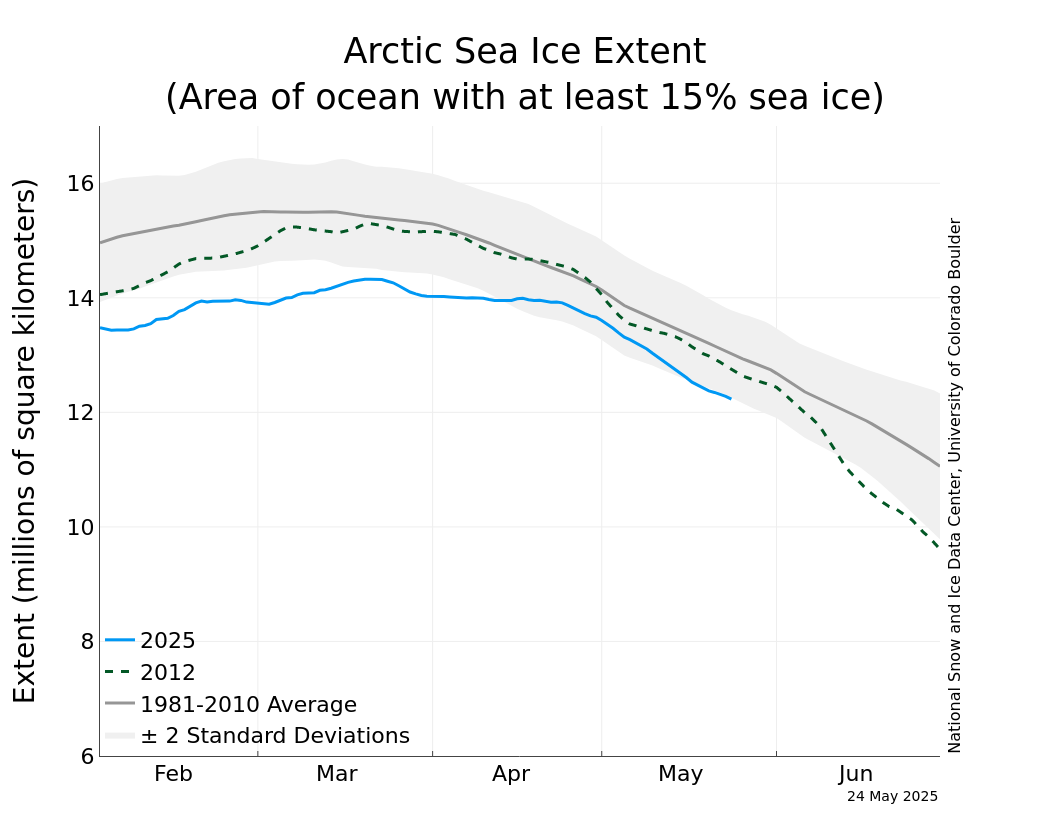
That is a good link, and if you remove the "ant" from the URL you can see the opposite graph. Open them both up and toggle between the two. Which graph do you think has the more dramatic trend?
-
Re:Press coverage
Antarctic ice coverage is at record highs for this time of year.
Soo much sea ice.
Weather is not climate, for fucks sake. One year of record this or record that is not a trend, and the short thirty year trend in declining sea ice in the Arctic is mirrored by the rise in sea ice in the Antarctic over the same time period. This looks like a natural cycle to me, especially given the assertions I have heard about an open Northwest Passage during WWII. -
Re:Press coverage
Well, it sure looks to me like the amount of ice at the other pole has been growing.
Has the amount of ice on Antarctica doubled in area and doubled in thickness? Has the reflection rate of the ocean there changed from 8% to 98%? Is the growth in Antarctica exponential?
-
Re:Press coverage
Well, it sure looks to me like the amount of ice at the other pole has been growing.
Cherry picking? The world is never short on records being broken. To convince others of your beliefs, simply trumpet those records that support you and dont mention those that don't. -
What about Cryptochrome?
-
Re:GPLv3
Appel started the Clang project
Means Apple started the Clang project. Here is the very first commit to the clang source tree. Notice where the email address is from.
-
Re:Ummm.
The biggest issue with chemical based fert is that it does not replenish organic sponge in the soil, which is required by soil bacteria. "Organic sponge" is essentially finely shredded cellulose that holds moisture, acts as a trap to retain water soluble minerals and nutrients, and as a feedstock for soil bacteria.
Ammonia based fertilizer contains very little carbon. So little in fact that the normal metabolic activities of soil bacteria cause net depletion of the organic sponge over time when it is used aggressively, like it is with industrial farming.
here's an article from ACES on the subject
Ground up poop juice also contains chemically etched cellulose fibers, especially if cowpoop is used. This actively adds organic sponge to offset natural depletion.
This has several noteworthy effects in soil:
1) it provides a substrate in the soil for beneficial soil bacteria to live on.
2) it helps the soil to retain water more efficiently, reducing the need for irrigation.
3) it soaks in and holds soluble nutrients, reducing the amount of these substances (nitrate, phosphate, mineral salts such as carbonates and the like) that get washed away in runoff.
When you examine the amount of nitrogen added to sponge depleted soil using "conventional" practices against the total amount added using organic practices, you will find that the organic practice applies considerably less, but uses it more efficiently. This is due to the organic sponge.
In addition to the efficiency reductions associated with heavy industrial soil nitration, there are serious effects from the runoff that increases as the soil carbon decreases. (This creates a feedback loop where more and more industrial fertilizer is required to keep growing plants, most of which simply washes away.)
Many of the problems associated with artificial fertilizers could be resolved by blending the fertilizer with a sprayable organic fiber solution. (Make it goopy, and chellated in hydrated cellulose gel for instance.) This however will increase the unit price per litre, create controversy over "adding fillers", and a whole host of talking head nonsense concerning the simple fix.
-
Re:Pi is wrong on the main site
This is interesting... If you run the Concurrent Pi example program on the Go website.. it prints:
3.1417926135957908
But it should be:
3.1415926535897932
It's wrong starting with the 5th digit...
What kind of language is that inaccurate? And why would they use it as an example program?!
-
Re:No meat to this story
No, that doesn't fix it. LLVM bitcode is not architecture-independent.
-
Re:LLVM not architecture-independent?
See http://lists.cs.uiuc.edu/pipermail/llvmdev/2011-October/043719.html, which is a post to llvm-dev which concerns itself with this, as well as the more general unsuitability of the IR for program distribution.
-
Re:Dart?
The message in question is http://lists.cs.uiuc.edu/pipermail/llvmdev/2011-October/043719.html
LLVM is only expressive enough to have C++ compiled to it if you use the parts of LLVM that are architecture-dependent. In particular, they depend on word sizes and endianness at the very least. You can't compile C++ to architecture-independent LLVM.
See http://news.ycombinator.com/item?id=2499763 for some links to the relevant LLVM documentation.
Now of course you can take any LLVM target you want and define a virtual machine for that target. Heck, you could define a virtual machine whose "bytecode" is x86 assembly. Whether such things are "suitable" or good for the web is a separate question entirely.
-
Re:An outbreak of sanity?
I searched for Cryosphere Today, and what came up was a page talking about the ever decreasing amount of sea ice. http://arctic.atmos.uiuc.edu/cryosphere/
Where is this 'talking about' you talk about. Did you look a the data?
-
Re:An outbreak of sanity?
Average temperatures have fallen marginally in the last decade, so you're misinformed there (see the actual satellite data at Cryosphere Today, not CNN)
I searched for Cryosphere Today, and what came up was a page talking about the ever decreasing amount of sea ice. http://arctic.atmos.uiuc.edu/cryosphere/
No one knows why Greenland was so named.
Britain used to produce wine, and still does produce wine.
WTF are you talking about?
-
Re:Objective C
Which means that Apple's version will never see the light of day.
clang.llvm.org
Clang was an internal apple project, open sourced by them here's the email in which Chris Lattener (an apple employee) open sourced the code that he had written on apple's time. The code has continued to be released by apple under the BSD license.
For reference, here's Apple's Objective-C runtime too.
-
Re:Is Google trying to fragment web?
> Native Client now uses the new Pepper APIs
Which are not so much documented; the only documentation is the implementation. How is that different from Win32?
> and runs under Windows, OS X, and Linux.
That's not all that interesting a metric. More interesting to me is that it only runs on certain hardware platforms, by design, so if it takes off that means no new hardware platforms can arise that can use the web.
Or put another way, if this had happened in 1998, ARM-based phones would have been a non-starter.
> Work is underway to make Native Client work
> across multiple architecturesIf that actually happens, we can revisit the discussion. So far, a number of the LLVM folks are pretty doubtful. See http://lists.cs.uiuc.edu/pipermail/llvmdev/2011-October/043719.html for example.
> Google's interest is in moving the web forward.
Google's interest is in tying users to their services (search, gmail, Google docs, etc) so they can deliver advertising.
This may or may not coincide with moving the web forward as a whole. In the past it often has. Right now, a lot of the things Google is doing are harmful to the future of the web but good for Google services.
> Google has long experimented with non-standard
> APIs in order to stimulate progress."progress" is not a single thing. Google is only interested in the forms of "progress" that benefit them. As long as those forms also benefit their competitors, things are not too bad. But I don't expect that to continue for much longer...
-
Re:This is good
Unfortunately, no. Antarctic ice coverage is above normal: http://arctic.atmos.uiuc.edu/cryosphere/IMAGES/seaice.anomaly.antarctic.png
Idiot. sea ice doesn't "cover" the Antartic.
-
Re:This is good
because every year the ice sheet is melting faster then predicted.
Since that's not even remotely true, why did you post it?
Antarctic, above normal: http://arctic.atmos.uiuc.edu/cryosphere/IMAGES/seaice.anomaly.antarctic.png
He says ice sheet melting. You show sea ice. Reading comprehension problems?
-
Re:This is good
because every year the ice sheet is melting faster then predicted.
Since that's not even remotely true, why did you post it?
Antarctic, above normal: http://arctic.atmos.uiuc.edu/cryosphere/IMAGES/seaice.anomaly.antarctic.png
Arctic, 2011 not even near being lower than the last few years: http://arctic-roos.org/observations/satellite-data/sea-ice/observation_images/ssmi1_ice_ext.png -
Re:This is good
Unfortunately, no. Antarctic ice coverage is above normal: http://arctic.atmos.uiuc.edu/cryosphere/IMAGES/seaice.anomaly.antarctic.png
-
Re:bad idea
See http://lists.cs.uiuc.edu/pipermail/llvmdev/2011-October/043719.html: LLVM bitcode isn't stable between releases, is still undocumented in sufficient detail to do a clean-room implementation, and is fundamentally designed to be a compiler IR and not a generic interchange IR. Trying to use it as the latter will only lead to pain.
-
Re:LLVM?
... And also, does the above mean that Gnome is no longer using GCC to compile, but switching to the LLVM compiler?
LLVM is designed to be modular. It sounds like what they're doing is probably similar to what Apple did a few years back - include LLVM bit-code files for functions that aren't handled natively, then hand those off to libllvm to emit native code when needed.
-Ster
-
listing successes
Etc.
But my question is, how much of this software will see the light outside the universities?
Impossible to answer. What defines a serious project versus someone's pet project or proof of concept? Then of those, how do you measure success? How many Sourceforge projects "see the light" outside Sourceforge?
Is there any list of successful software created entirely inside universities' labs that became widely used?
This is the question you seem to be getting an answer to in the forum here. Hopefully it helps.
-
Re:mod parent up
-
Re:Strikers already lost?
The rules are a bit complicated, but in some circumstances it's legal to hire permanent replacement workers. There's a summary of some of the relevant law here.
-
Re:Nothing will change.
This reminds me of a question about helmets in the first world war:
http://www.geom.uiuc.edu/~lori/mathed/problems/sloanA307.html
Perhaps the solution is similar...
Would that solution be that more incidents which would have resulted in death instead resulted in injury after the change? It's a fairly obvious explanation -- but could be tested by looking for a change in number of deaths. As such, the statistics don't back it up.
What does have strong statistical backing is the "safety in numbers" effect -- every time the population of cyclist doubles, the accident rate for each individual goes down by about 1/3. Make cycling seem unsafe, so fewer people do it? It becomes less safe.
To do nothing to reduce the rate of accidents and only focus on their severity is foolish. The discussion needs to be about safety as a whole; it can't begin and end with helmets.
-
Re:Nothing will change.
This reminds me of a question about helmets in the first world war:
http://www.geom.uiuc.edu/~lori/mathed/problems/sloanA307.html
Perhaps the solution is similar...
-
Re:Where is the quick sort or merge sort dances?
you mean like this dance ?
-
Re:Physicists
Reading Flatland might give you a different perspective.
-
What happens next
Hydrogen burn isn't a very energetic event, which is why the Reactor Building framework is still intact. This means the Reactor Vessel is still intact and bolted upright to the floor with the damaged core inside. The RV and the steel containment around it is a very robust container, much stronger than the framework of the building.
All cooling apparatus is gone. If the detonation didn't disable it the fire will. So total core melt is almost certain.
TMI-2 melted 50% of the core which pooled at the bottom of the RV. The RV did not rupture despite the intense heat. It is possible this RV may also not rupture, especially if any cooling can be applied to the outer surface. If so then widespread intense contamination may be avoided.
If the RV does rupture then we'll have molten corium pooling on the concrete floor uncovered before God and everyone. All bets are off at that point.
FYI the reactor is a GE Mark I BWR with steel containment. Details here(PDF). A very old, before-mandatory-concrete-containment-dome system.
-
Re:Picking Rei's brain about supercaps
EEStor? "Abandon All Hope Ye Who Enter Here".
EEStor is entirely different from digital quantum capacitors. EESTOR relies on materials with ultra-high permittivity (there are a lot of problems with this which I won't go into here). Digital quantum capacitors (misleading called "digital quantum batteries" in the paper that introduced them) are a new concept, first proposed in late 2009. Here's the paper:
The paper suggests producing them with lithography, although I think there's some potential for molecular self-assembly. But either way, the question is, obviously, will they work? Who knows; nobody has ever attempted something like this. They work in *theory*, but....
-
Re:Criticizing people who correct themselves
I'm not criticizing people for correcting themselves, so I don't know where you got that. Just pointed out that there are errors and the people that make the errors are not always the ones that discover it.
I understand your point about extant arctic ice, but you miss my point that it is possible that when the interpretation changes, the result may change as well. Not saying it will or won't in this case, but as you allude to, it is evolving. So when we further refine the methods, the rate of change may be more or less that previously thought.
For instance, if you look at cryosphere today, you can see the sea ice area in decline for the N hemisphere from about 2000-2007 but at that same time it went up in the south.
http://arctic.atmos.uiuc.edu/cryosphere/IMAGES/seaice.area.arctic.png
http://arctic.atmos.uiuc.edu/cryosphere/IMAGES/seaice.area.antarctic.png
So I understand your point about local patterns.
As for the "hottest year", considering this:
In the United States, the calendar year 1998 ranked as the hottest of them all – until someone checked the math.
http://www.thestar.com/News/article/246027
I think I'll wait and see if there are any "corrections" -
Re:Criticizing people who correct themselves
I'm not criticizing people for correcting themselves, so I don't know where you got that. Just pointed out that there are errors and the people that make the errors are not always the ones that discover it.
I understand your point about extant arctic ice, but you miss my point that it is possible that when the interpretation changes, the result may change as well. Not saying it will or won't in this case, but as you allude to, it is evolving. So when we further refine the methods, the rate of change may be more or less that previously thought.
For instance, if you look at cryosphere today, you can see the sea ice area in decline for the N hemisphere from about 2000-2007 but at that same time it went up in the south.
http://arctic.atmos.uiuc.edu/cryosphere/IMAGES/seaice.area.arctic.png
http://arctic.atmos.uiuc.edu/cryosphere/IMAGES/seaice.area.antarctic.png
So I understand your point about local patterns.
As for the "hottest year", considering this:
In the United States, the calendar year 1998 ranked as the hottest of them all – until someone checked the math.
http://www.thestar.com/News/article/246027
I think I'll wait and see if there are any "corrections" -
Re:Math is a tool, not a art
I honestly can not understand where there can be "beauty" in a mathematical expression that covers the entire blackboard.
No one else can, either.
The beauty is in the simple relations between apparently unrelated things that, while provably true, still seem magical and mysterious. One example:
You're probably aware that the ratio of the circumference to the diameter of a circle has been given a special name, pi. This is a practical, useful thing that seems purely geometric; you can measure the diameter of a circular hole, multiply by pi, and get the circumference of the hole. Fine.
Well, it was shown in the 17th Century (!) that pi is also equal to four times (one, minus a third, plus a fifth, minus a seventh, plus a ninth,
Now, why would this be? What does the ratio between the circumference and the diameter of a circle have to do with the "counting numbers"? Why should there be any relationship at all? After centuries of puzzling, no one knows.
________
* My personal favorite was proven by Euler in the 18th Century:
pi squared, divided by six, is equal to one over one squared, plus one over two squared, plus one over three squared, -
Re:Great news! (not)
>This year we are going to see a new record low for arctic sea ice --- surpassing even the dramatic 2007 decline. http://arctic.atmos.uiuc.edu/cryosphere/IMAGES/seaice.recent.arctic.png
Another source, the Arctic News, differs with your conclusion. See link here: http://nsidc.org/data/seaice_index/images/daily_images/N_stddev_timeseries.png and the main site at http://nsidc.org/arcticseaicenews/
It is still bad. This year will be the runner-up, not the new record low for arctic sea ice. Perhaps, as before, the moisture in the arctic air will swirl down and result in a good snow year for the northeast US ski areas. -
Re:Great news!
> We all know that the ice is still melting (but slower than we thought).
This year we are going to see a new record low for arctic sea ice --- surpassing even the dramatic 2007 decline.
http://arctic.atmos.uiuc.edu/cryosphere/IMAGES/seaice.recent.arctic.png
What's really startling is that this year, both the NE and the NW passages are completely open. This animation tells the story
http://arctic.atmos.uiuc.edu/CT/animate.arctic.color.0.html
Typically, shipping through the NE passage relies on Russian icebreakers. Judging by the satellite photos, at this point the icebreakers aren't needed
Source: cryosphere today http://arctic.atmos.uiuc.edu/cryosphere/ -
Re:Great news!
> We all know that the ice is still melting (but slower than we thought).
This year we are going to see a new record low for arctic sea ice --- surpassing even the dramatic 2007 decline.
http://arctic.atmos.uiuc.edu/cryosphere/IMAGES/seaice.recent.arctic.png
What's really startling is that this year, both the NE and the NW passages are completely open. This animation tells the story
http://arctic.atmos.uiuc.edu/CT/animate.arctic.color.0.html
Typically, shipping through the NE passage relies on Russian icebreakers. Judging by the satellite photos, at this point the icebreakers aren't needed
Source: cryosphere today http://arctic.atmos.uiuc.edu/cryosphere/ -
Re:Great news!
> We all know that the ice is still melting (but slower than we thought).
This year we are going to see a new record low for arctic sea ice --- surpassing even the dramatic 2007 decline.
http://arctic.atmos.uiuc.edu/cryosphere/IMAGES/seaice.recent.arctic.png
What's really startling is that this year, both the NE and the NW passages are completely open. This animation tells the story
http://arctic.atmos.uiuc.edu/CT/animate.arctic.color.0.html
Typically, shipping through the NE passage relies on Russian icebreakers. Judging by the satellite photos, at this point the icebreakers aren't needed
Source: cryosphere today http://arctic.atmos.uiuc.edu/cryosphere/ -
Re:Politics And Science Don't Mix
99.99% of research and 100% of reputable research supports the conclusion that mans efforts at living the good life have effected the climate in such a way that polar ice caps are melting, storms are getting stronger and weather patterns changing.
Get with the program. Storms getting stronger is so 2005
http://www.leshatton.org/Documents/Hurricanes-are-not-getting-stronger.pdf
(IPCC has, as usual, been very selective in the data they quote. When using all data, the conclusions change)
When it comes to changing weather patterns, that's due to ocean cycles and they change on scales of several decades. The PDO and the AMO seems to be the main culprits here.
With regards to polar ice caps, there's dubious support in the data for a statement about "melting". Compaction due to wind caused the huge drop in arctic extent in 2007 and it's been growing since. In antarctica the extent is bigger than ever. Globally it seems that the NH and SH extents are in an opposite relationship and over long periods the amount of ice stays the same: http://arctic.atmos.uiuc.edu/cryosphere/IMAGES/global.daily.ice.area.withtrend.jpg
-
Re:Clearly a sign of AGW
Here's a better graph of sea ice. It's actually greater now than it has been than in the past 30 years.
http://arctic.atmos.uiuc.edu/cryosphere/IMAGES/global.daily.ice.area.withtrend.jpg
+1 informative for the posting the link, -1 interpretation for implying the opposite of what the graph shows.
-
Re:Clearly a sign of AGW
Here's a better graph of sea ice. It's actually greater now than it has been than in the past 30 years.
http://arctic.atmos.uiuc.edu/cryosphere/IMAGES/global.daily.ice.area.withtrend.jpg
-
Re:News Flash!
http://arctic.atmos.uiuc.edu/cryosphere/IMAGES/global.daily.ice.area.withtrend.jpg
the global ice levels are above normal (where "normal" is defined as the
average over the last 30-40 years of actual observation). -
Re:The romans build concrete buildings
One additive that gives strength to concrete the Roman built with is blood. It doesn't have to be human blood. Funny how the quality of concrete and steel deteriorated during the period 1200 - 1500. I wonder what could have been going on in Europe then.
-
Re:Sadly...
2. Arctic and antarctic to warm faster than rest of the planet - predicted by all models. Observed.
I haven't been keeping up with the latest news in climatology, but the last I heard Antartica was getting colder, and the sea ice was expanding. This is directly contrary to the prediction that it should be warming at a faster rate than the rest of the world. But AGW is a hydra, so the loss of that head did nothing to it. I assume there's some rationalization for why the prediction is wrong (or even better, that prediction went down the memory hole; AGW has always predicted Antarctica would cool initially).
I was originally a supporter of AGW, became a "skeptic" when I saw data that didn't fit that theory, and became apathetic when I realized that AGW will not be falsified (hence why I'm not going to bother verifying the other claims). There's probably something to it, but it's not a scientific theory so far as I'm concerned, which makes me not really care about it. Runaway CO2 production can't be maintained indefinitely without having effects, so if it gets cut, great. If the economy tanks in the process my student loans will likely become easier to pay back when I start to care about them in a few years. -
Re:Makes me worried for other environmental proble
What melting ice caps?
http://arctic.atmos.uiuc.edu/cryosphere/IMAGES/sea.ice.anomaly.timeseries.jpg
(We're at the same level today as in 1980)
-
Earlier proof http://ithat NP-Hardness of floodit.
Elad Verbin proved that floodit is NP-Hard more than a year ago. See the comments here: http://valis.cs.uiuc.edu/blog/?p=2005".
-
Re:A bright future for the web...
Microsoft had already surpassed Netscape by the time they cancelled Netscape Navigator 5 in favour of a complete rewrite. IE had 50.4% and NN had 46.9%. Microsoft had only just overtaken Netscape one month before the decision to do the rewrite was made - which must surely have been a deciding factor.
-
Re:Science or Religion?
The Arctic sea ice is a good one. When this line starts hanging out around the long term average again (rather than staying, non-stop, below that average for over 5 years straight now), then I'll pretty much reject the theory.
Now that I've committed to my side, I challenge you to declare that if the average sea ice doesn't return to an average anomaly of 0 in the next 5 years, then you'll accept that the Earth is warming.
-
Re:About time!
One thing to point out is that there are now plenty of open source codes available for doing similar things as gaussian so it can be avoided now with relative ease. Two that come to mind are the the Department of Energy funded codes: nwchem for ab initio work and lammps for molecular dynamics. I use the NIH funded code vmd for visualization. The best part about those codes is that they're designed to be compiled using gcc and run on linux so you can get off the non-open source software train all together if you wish.
-
Re:VMD is pretty coolI'll agree that VMD is something that is definitely worth teaching about. It's free, and easy to install and use on a variety of platforms. I'd also recommend introducing them to the Protein Data Bank, which is a free database of x-ray/nmr structures of proteins. Though it gets a bit more into biochemistry and molecular biology from a basic high school chemistry course, some of the simpler structures available there would give a student a good introduction to some of the applications of computational chemistry.
While most of the professional molecular modeling software (InsightII, Sybyl, MOE, etc) will likely be out of the price range of a high school course, ArgusLab is free and pretty decent for some basic small molecule type stuff. The Accelrys Discovery Studio Visualizer is a freely-available version of Discovery Studio, which is also pretty decent. There's a Windows and Linux version of this.
Depending on how advanced your students are, you may want to introduce them to some molecular dynamics. NAMD is freely-available for Windows/Linux/Mac, and there are some good tutorials available. However, this might be getting a bit too advanced for a basic high school course, and might be a bit better to introduce at the undergraduate/graduate level. For most high school students, I'd probably teach them the basics would ArgusLab first.
-
VMD is pretty coolhttp://www.ks.uiuc.edu/Research/vmd/
I know their website shows off the incredibly complex molecular structures that VMD is capable of simulating, but it also does a great job with simpler structures that you're likely to run across in a high school course. It's also open source and runs on Windows, Mac, Linux (along with just about any other unix variant http://www.ks.uiuc.edu/Development/Download/download.cgi?PackageName=VMD).