Slashdot Mirror
Domain: uspto.gov
Stories and comments across the archive that link to uspto.gov.
Comments · 5,413
-
Re:Apple patents are bullshit
June 19, 2012 Apple Wins Patent for Mobile Device Aided Navigation Apple Wins Patent for Methods & GUI's for Conducting Searches on iOS Devices
http://www.patentlyapple.com/
What's your point? Ohh, I see, taking the changed title of the patent, scan for words you've heard before and interpreting in into "patent patents something already existing", which turns you into a patent expert.
Hint: patents don't work that way.
Case in point: US Patent 8,204,684: Adaptive mobile device navigation doesn't claim the invention of Mobile Navigation Devices. I could bore you with technical details, but I doubt you would understand, so please don't read the following.
Abstract
Adaptive mobile device navigation system, methods, and apparatus provide location information for a mobile device performing location estimation using dead reckoning. Multiple estimation modes can be selected including a mode for restricting measured movements to surrounding streets. Updated location fixes can be obtained through turn comparison with surrounding map information and user feedback. User feedback prompts can include photographs having geographic tag information corresponding to locations near an estimated location of the device.
IOW, its about an Navigation device that uses information from acceleration and gyroscope sensors to give you information where you have moved even when you don't have a GPS lock, including modes that locks your position in certain bounds (like obviously the streets your car can't leave in normal operation).
-
Re:Patent trolling is the new iWhite...
Here's a better article: http://www.theverge.com/2012/2/11/2791830/apple-seeks-ban-on-Samsung-Galaxy-Nexus
- US Patent No. 5,946,647 - this patent was filed in 1996 (issued 1999) and covers detecting data, such as a phone number, in an email or web page, creating a link to that data,
and initiating an action like calling the phone number when the user selects the link. The data could also include addresses, dates, etc. - US Patent No. 8,086,604 - this patent claims priority back to 2000 (issued Dec. 2011) and covers searching multiple sources of information (on device and elsewhere) through
a single search interface, such as Siri. Apple specifically touts Siri in its injunction request, but also argues that a unified text search is covered by the patent as well. - US Patent No. 8,046,721 - this patent claims priority back to 2005 (issued Oct. 2011) and covers Apple's signature slide-to-unlock feature. While Apple already has patent coverage
on an image unlock feature, this newest patent is obviously intended to be a bit broader — likely addressing potential workarounds implemented by Google and OEMs over the last couple of years. - US Patent No. 8,074,172 - this patent was filed in 2007 (issued Dec. 2011) and covers providing word suggestions while the user types on a touchscreen keyboard, where the
suggestions can be accepted or rejected by the user.
- US Patent No. 5,946,647 - this patent was filed in 1996 (issued 1999) and covers detecting data, such as a phone number, in an email or web page, creating a link to that data,
-
Re:Patent trolling is the new iWhite...
Here's a better article: http://www.theverge.com/2012/2/11/2791830/apple-seeks-ban-on-Samsung-Galaxy-Nexus
- US Patent No. 5,946,647 - this patent was filed in 1996 (issued 1999) and covers detecting data, such as a phone number, in an email or web page, creating a link to that data,
and initiating an action like calling the phone number when the user selects the link. The data could also include addresses, dates, etc. - US Patent No. 8,086,604 - this patent claims priority back to 2000 (issued Dec. 2011) and covers searching multiple sources of information (on device and elsewhere) through
a single search interface, such as Siri. Apple specifically touts Siri in its injunction request, but also argues that a unified text search is covered by the patent as well. - US Patent No. 8,046,721 - this patent claims priority back to 2005 (issued Oct. 2011) and covers Apple's signature slide-to-unlock feature. While Apple already has patent coverage
on an image unlock feature, this newest patent is obviously intended to be a bit broader — likely addressing potential workarounds implemented by Google and OEMs over the last couple of years. - US Patent No. 8,074,172 - this patent was filed in 2007 (issued Dec. 2011) and covers providing word suggestions while the user types on a touchscreen keyboard, where the
suggestions can be accepted or rejected by the user.
- US Patent No. 5,946,647 - this patent was filed in 1996 (issued 1999) and covers detecting data, such as a phone number, in an email or web page, creating a link to that data,
-
Re:Patent trolling is the new iWhite...
Here's a better article: http://www.theverge.com/2012/2/11/2791830/apple-seeks-ban-on-Samsung-Galaxy-Nexus
- US Patent No. 5,946,647 - this patent was filed in 1996 (issued 1999) and covers detecting data, such as a phone number, in an email or web page, creating a link to that data,
and initiating an action like calling the phone number when the user selects the link. The data could also include addresses, dates, etc. - US Patent No. 8,086,604 - this patent claims priority back to 2000 (issued Dec. 2011) and covers searching multiple sources of information (on device and elsewhere) through
a single search interface, such as Siri. Apple specifically touts Siri in its injunction request, but also argues that a unified text search is covered by the patent as well. - US Patent No. 8,046,721 - this patent claims priority back to 2005 (issued Oct. 2011) and covers Apple's signature slide-to-unlock feature. While Apple already has patent coverage
on an image unlock feature, this newest patent is obviously intended to be a bit broader — likely addressing potential workarounds implemented by Google and OEMs over the last couple of years. - US Patent No. 8,074,172 - this patent was filed in 2007 (issued Dec. 2011) and covers providing word suggestions while the user types on a touchscreen keyboard, where the
suggestions can be accepted or rejected by the user.
- US Patent No. 5,946,647 - this patent was filed in 1996 (issued 1999) and covers detecting data, such as a phone number, in an email or web page, creating a link to that data,
-
Re:Patent trolling is the new iWhite...
Here's a better article: http://www.theverge.com/2012/2/11/2791830/apple-seeks-ban-on-Samsung-Galaxy-Nexus
- US Patent No. 5,946,647 - this patent was filed in 1996 (issued 1999) and covers detecting data, such as a phone number, in an email or web page, creating a link to that data,
and initiating an action like calling the phone number when the user selects the link. The data could also include addresses, dates, etc. - US Patent No. 8,086,604 - this patent claims priority back to 2000 (issued Dec. 2011) and covers searching multiple sources of information (on device and elsewhere) through
a single search interface, such as Siri. Apple specifically touts Siri in its injunction request, but also argues that a unified text search is covered by the patent as well. - US Patent No. 8,046,721 - this patent claims priority back to 2005 (issued Oct. 2011) and covers Apple's signature slide-to-unlock feature. While Apple already has patent coverage
on an image unlock feature, this newest patent is obviously intended to be a bit broader — likely addressing potential workarounds implemented by Google and OEMs over the last couple of years. - US Patent No. 8,074,172 - this patent was filed in 2007 (issued Dec. 2011) and covers providing word suggestions while the user types on a touchscreen keyboard, where the
suggestions can be accepted or rejected by the user.
- US Patent No. 5,946,647 - this patent was filed in 1996 (issued 1999) and covers detecting data, such as a phone number, in an email or web page, creating a link to that data,
-
Re:Patent good in this case
-
How to read a design patent
The scope of a patent is defined by its claims as read in light of the specification, but design patents only have one claim, which simply refers to the drawings in the patent specification. The figures in design patents are drawn in a very particular way. The most important thing to know is that only the solid lines matter. The dashed lines are only there to provide context and do not represent the claimed design. In this case, most of the laptop is drawn in dashed lines. It's a little hard to tell because of the relatively low-quality PDF, but it looks like only the lid is drawn in solid lines. Compare that to the parent design patent, D642172, which covers more of the case, the keyboard, etc.
-
Re:Great...
If lol was used historically on usenet, and Google owns Usenet, then couldn't Google claim ownership of it? Interestingly, AOL tried to trademarke LOL in 2003 but never filed a use statement...
Google doesn't own Usenet, they bought Deja News (a Usenet provider). No one can own Usenet, any more than one can own the Internet. It's a decentralized service, and functions almost exactly like the Internet in general, with peers sharing posts between eachother... That's why I can subscribe to a giganews account and my posts still show up in Google's usenet service.
-
Re:Great...
If lol was used historically on usenet, and Google owns Usenet, then couldn't Google claim ownership of it? Interestingly, AOL tried to trademarke LOL in 2003 but never filed a use statement...
-
Re:Good to Know
They collect the most from patents which are granted, but later reexamined.
-
Re:Nintendo has had this for years.
Nintendo has had this service for years. You've been able to send games as gifts on Wii Shop Channel for quite a while., when the released the console, if not shortly after. Actually, I just checked, and the patent was filed September 30, 2008, which was well after the release of the Nintendo Wii, and Wikipedia states that the gift feature was introduced on December 10, 2007. Well before the patent was filed. This isn't some kind of prior art that nobody knew about. This is something very obvious that the patent office should have seen as a reason to reject the patent.
Did Nintendo's gift feature not bill you until the recipient accepted the game, or would it allow you to cancel the gift if it hadn't been redeemed? Or, more likely, did it bill you immediately and deliver the game?
If the latter, then it's not anticipatory prior art. The claims of this patent explicitly require:
determining whether the gift has been accepted using the access mechanism; when the determination is that the gift has not been accepted, enabling the giver to cancel the gift such that no payment is processed; and when the determination is that the gift has been accepted, initiating payment by a payment mechanism associated with the giver.
-
Nintendo has had this for years.
Nintendo has had this service for years. You've been able to send games as gifts on Wii Shop Channel for quite a while., when the released the console, if not shortly after. Actually, I just checked, and the patent was filed September 30, 2008, which was well after the release of the Nintendo Wii, and Wikipedia states that the gift feature was introduced on December 10, 2007. Well before the patent was filed. This isn't some kind of prior art that nobody knew about. This is something very obvious that the patent office should have seen as a reason to reject the patent.
-
Re:As opposed to patents that cover algorithms?
How about Apple's "slide to unlock" patent?
"...detecting contact with the touch-sensitive display while the device is in a user-interface lock state; moving an unlock image along a predefined displayed path on the touch-sensitive display in accordance with the contact, wherein the unlock image is a graphical, interactive user-interface object with which a user interacts in order to unlock the device; transitioning the device to a user-interface unlock state if the detected contact corresponds to a predefined gesture; and maintaining the device in the user-interface lock state if the detected contact does not correspond to the predefined gesture."
Basically you touch an unlock image and slide it along the path shown on the screen to unlock. Yes, there is a physical device involved, but this is fundamentally a concept rather than an implementation of the concept.
But, as you note, there's a physical device involved. It's not just a mathematical algorithm. You could not possibly infringe that claim with a pad of paper and a pen or by doing math in your own head.
-
Re:As opposed to patents that cover algorithms?
Find me a patent that includes a mathematical algorithm, the phrase "used in a computer", and nothing else. I'll wait.
Second, even if you could, then you wouldn't be patenting the math. It could still be freely used outside of a computer.
How about Apple's "slide to unlock" patent?
"...detecting contact with the touch-sensitive display while the device is in a user-interface lock state; moving an unlock image along a predefined displayed path on the touch-sensitive display in accordance with the contact, wherein the unlock image is a graphical, interactive user-interface object with which a user interacts in order to unlock the device; transitioning the device to a user-interface unlock state if the detected contact corresponds to a predefined gesture; and maintaining the device in the user-interface lock state if the detected contact does not correspond to the predefined gesture."
Basically you touch an unlock image and slide it along the path shown on the screen to unlock. Yes, there is a physical device involved, but this is fundamentally a concept rather than an implementation of the concept.
-
Re:As opposed to patents that cover algorithms?
How is the concept of computing something substantially different from an algorithm that computes something? Patents are supposed to be on physical inventions, not abstract ideas. The formal, "When run on a computer," clause does not mean a math^H^H^H^Hsoftware patent is somehow not a patent on an abstract idea.
The concept is different from an algorithm when your patent is on the end result and not the process. That's the problem; there is no way to work at a different solution because the patent covers EVERY solution. What patent abusers really want to patent is the idea -- an auction, meeting scheduling, one-click ordering, etc. (on the INTERNET!, to boot) - but those aren't allowed. So they describe what are obvious (to anyone learned in the art of software design) steps to perform their idea. This is where I see the problem. It's an evil fusion between unpatentable ideas and obvious implentations that falsely appears to be a novel process.
As an example, Shazam paid a settlement to Tune Hunter over the idea of music identification. If you read Tune Hunter's actual patent, they only described in detail a method where you hear an interesting song on the radio, press a key fob usb, which can be used to look up the song based on the time and the station's playlist (this sounds like something NPR had given as a promotional item a few years ago, but I'm not sure). Obviously, what Shazam does is nothing like that. Their patent does also include a claim for identification based on sound samples, but they offer no actual process to accomplish this, other than "uses a central processing unit and search stored information as known in the art to analyze the music segment" (emphasis mine). Thus, they flat out admit in the patent that what Shazam is doing is not something they invented. But still Shazam felt threatened by a patent on the idea of "music identification".
-
Re:Patents that cover concepts?
Someone already has won a patent on the concept of online auctions. All you have to do is take anything people do anyway, add "but do it online!" and you have your new patent. It's pretty awful.
-
Re:lawsuit
Perhaps not long, but it shouldn't last long in court unless they can show likely customer confusion between a browser and motorcycle accessories. The stylised "A" is not registered against any category like computer software. http://tess2.uspto.gov/bin/showfield?f=doc&state=4007:e52vk0.2.1
-
Re:Not all Patents are the Same
The current system ties everyone's hands for 20 years in that case. So that idea doesn't make it worse, it just provides a shorter term in some cases.
Have first sale start counting no matter who does it and it might work reasonably.
So sueing or sending a cease and desist notice that claims a patent is being violated triggers the 5 year counter at the point thing was first sold.
Of course that's really going to suck for people who actually do come up with fundamental game changers. And make for yet more assetless companies that exist merely to infringe a patent and trigger the counter.
Or just use the existing handling of pharma patents, and keep a mechanism for extending them due to regulations requiring clinical trials/etc: http://www.uspto.gov/web/offices/pac/mpep/documents/appxl_35_U_S_C_156.htm
-
Do patents promote sharing of new technologies?
Through the preservation, classification, and dissemination of patent information, the Office promotes the industrial and technological progress of the nation and strengthens the economy.
The USPTO also disseminates patent and trademark information that promotes an understanding of intellectual property protection and facilitates the development and sharing of new technologies worldwide.
I've been told patents support innovation. I see that, in relation to software, they are used more like nuclear arsenals. Their true purpose becomes plainer.
-
Design vs. utility patents
Are we confusing design patents and utility patents? From the link, "A design consists of the visual ornamental characteristics embodied in, or applied to, an article of manufacture. Since a design is manifested in appearance, the subject matter of a design patent application may relate to the configuration or shape of an article, to the surface ornamentation applied to an article, or to the combination of configuration and surface ornamentation."
"In general terms, a “utility patent” protects the way an article is used and works (35 U.S.C. 101), while a “design patent” protects the way an article looks (35 U.S.C. 171)."
-
Design vs. utility patents
Are we confusing design patents and utility patents? From the link, "A design consists of the visual ornamental characteristics embodied in, or applied to, an article of manufacture. Since a design is manifested in appearance, the subject matter of a design patent application may relate to the configuration or shape of an article, to the surface ornamentation applied to an article, or to the combination of configuration and surface ornamentation."
"In general terms, a “utility patent” protects the way an article is used and works (35 U.S.C. 101), while a “design patent” protects the way an article looks (35 U.S.C. 171)."
-
Re:Xerox - "damn, why didnt we think of that"
Funny, considering the algorithm most important to them - PageRank - is described publicly in a patent. Not to mention that it doesn't even belong to Google, but to Stanford University (since it was developed by Page and Brin as a research project).
-
How might Google try to get around the patents?
Clearly, Google having to pay Oracle millions of dollars is no big deal - chump change to them.
But Oracle has asked for a permanent order preventing Google from continuing to infringe the patents and copyrights. Clearly Oracle is willing to go to the wall to get its way. It would certainly appear that the future of Java is of little import to Oracle compared to winning this battle and getting as much compensation from Google as they can.
If Oracle wins, what they demand will only be limited by the importance of the patents and copyright in question. Leaving the copyright issue aside for now (since it is less clear), how important are the patents? Can Google work around them?
It is my understanding that the principle concern is this patent:
Method and system for performing static initialization.
http://patft.uspto.gov/netacgi/nph-Parser?Sect1=PTO2&Sect2=HITOFF&p=1&u=/netahtml/PTO/search-bool.html&r=18&f=G&l=50&co1=AND&d=PTXT&s1=6061520&OS=6061520&RS=6061520How significantly would Davlik be affected if they had to work around this patent?
-
Re:How did they hide prior patents?
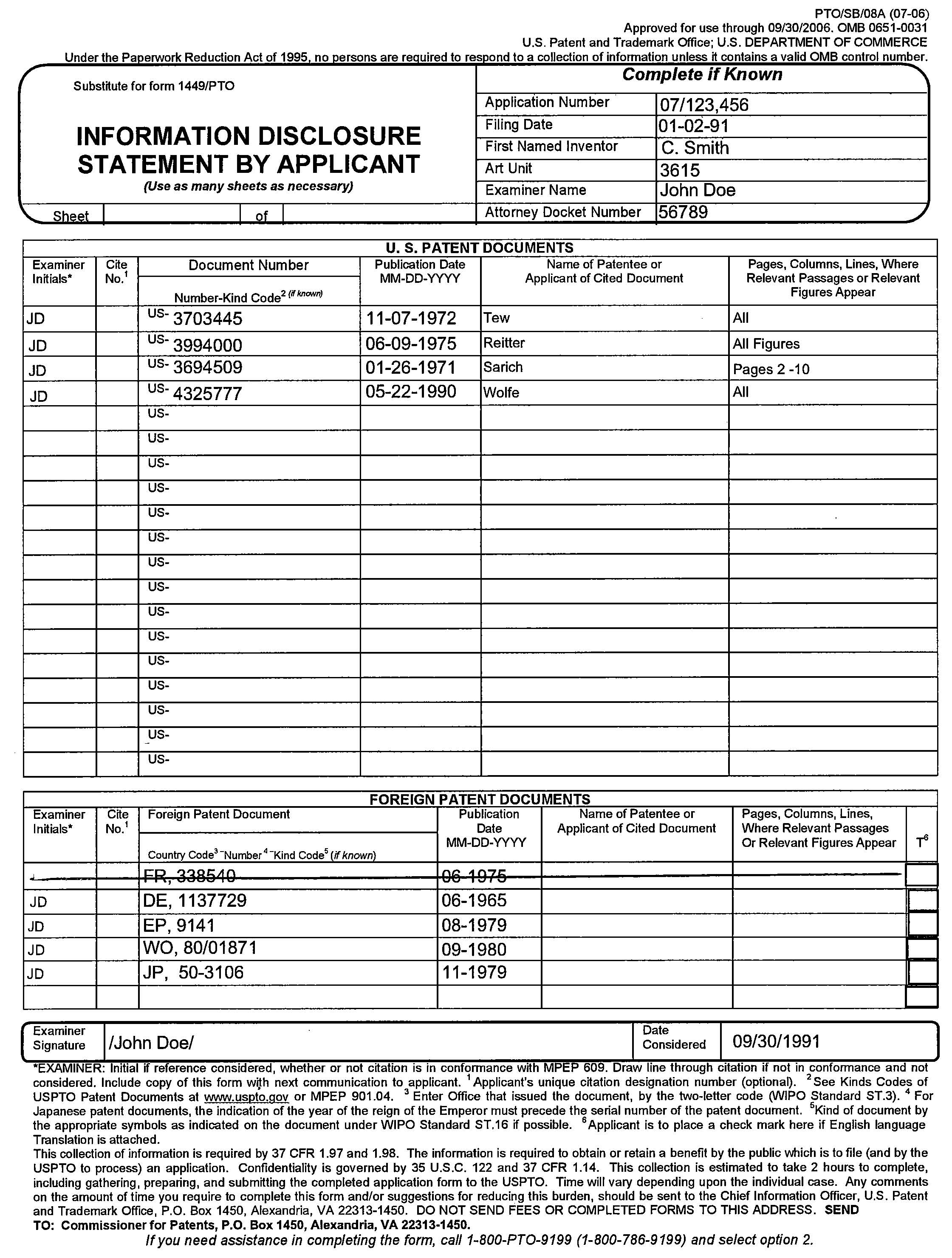
And when the patent applicant LIES on the IDS, because they know they have perfectly applicable prior art in the form of their own prior expired patent, but they know the patent examiner won't be able to find his own ass with both hands without clear directions on the IDS.... the patent examiner is doing exactly what he's supposed to do in this situation. Fail.
I take it you've never seen an IDS. It's just a list of references. There's no room for "LIES" or "clear directions". Here's an example.
Anyway, what Nest is saying is that Honeywell failed to disclose materially relevant prior art that they knew of, and therefore committed inequitable conduct. The obvious response from Honeywell will be that those prior art references fail to teach or suggest all of the claimed features and therefore are not materially relevant, and there was better or more relevant prior art on the record, and therefore, disclosing these references would just end up wasting the Examiner's time.
The court will almost certainly not throw out the patents for a finding of inequitable conduct, but instead will let the jury review the earlier patents and figure out if they teach or suggest everything in the claims. And honestly, that's the better answer... Nest says these earlier patents teach everything in the claims, Honeywell says they don't, so let the jury figure it out. That's better than throwing out patents based just one party's statements - it'd be like convicting someone based on what the prosecutor says, without ever letting the jury listen to the defendant.
-
Re:Worse than a patent Troll?
Nope, it's a lot worse to have a patent on a device you make, and sue competitors who do not violate the patent in hopes of putting them out of business with legal fees. Patent trolls may have possibly invalid claims and may be extorting, but Honeywell knows it is filing groundless lawsuits in hopes of crushing competition without having to innovate or compete. Patent trolls just want some money, not to destroy you and bury your corpse.
But is that really what is happening in this case?
For example, Nest claims that this patent:
A solid state power switching circuit for alternating current loads, in which operating power for the circuit is diverted from the switched current during power stealing intervals self-synchronized with the alternating current waveform. During periods in which current to the load is commanded, a load current switch is maintained in a low impedance state except for the duration of a short power stealing interval each half-cycle of the supplied alternating current. Self-synchronization is achieved with a current detector which senses whether or not the magnitude of the current diverted during each power stealing interval exceeds a current threshold, and pulse generator logic which shifts the power stealing intervals in time relative to the alternating current waveform in response to the previously sensed current magnitude.
Is a an expired patent that provides prior art for this one:
A power stealing system having a switch and a circuit that takes power from equipment to operate control electronics. The system may be such that power stealing occurs while the equipment is not powered to avoid disruption or false signals in the electronics or equipment. The circuit may convey taken power to a storage device. The electronics may be powered by the storage device. The storage device may have a capacitor, a rechargeable battery, a non-chargeable battery, a solar cell, fuel cell, line power, and/or the like.
I'm no patent attorney, but they look completely different to me. One synchronizes with an AC signal to steal power only during part of the waveform, while the other steals power when the powered device isn't currently using it.
-
Re:Worse than a patent Troll?
Nope, it's a lot worse to have a patent on a device you make, and sue competitors who do not violate the patent in hopes of putting them out of business with legal fees. Patent trolls may have possibly invalid claims and may be extorting, but Honeywell knows it is filing groundless lawsuits in hopes of crushing competition without having to innovate or compete. Patent trolls just want some money, not to destroy you and bury your corpse.
But is that really what is happening in this case?
For example, Nest claims that this patent:
A solid state power switching circuit for alternating current loads, in which operating power for the circuit is diverted from the switched current during power stealing intervals self-synchronized with the alternating current waveform. During periods in which current to the load is commanded, a load current switch is maintained in a low impedance state except for the duration of a short power stealing interval each half-cycle of the supplied alternating current. Self-synchronization is achieved with a current detector which senses whether or not the magnitude of the current diverted during each power stealing interval exceeds a current threshold, and pulse generator logic which shifts the power stealing intervals in time relative to the alternating current waveform in response to the previously sensed current magnitude.
Is a an expired patent that provides prior art for this one:
A power stealing system having a switch and a circuit that takes power from equipment to operate control electronics. The system may be such that power stealing occurs while the equipment is not powered to avoid disruption or false signals in the electronics or equipment. The circuit may convey taken power to a storage device. The electronics may be powered by the storage device. The storage device may have a capacitor, a rechargeable battery, a non-chargeable battery, a solar cell, fuel cell, line power, and/or the like.
I'm no patent attorney, but they look completely different to me. One synchronizes with an AC signal to steal power only during part of the waveform, while the other steals power when the powered device isn't currently using it.
-
Re:Eh?The USPTO disagree:
How do I protect my patent internationally?
Since the rights granted by a U.S. patent extend only throughout the territory of the United States and have no effect in a foreign country, an inventor who wishes patent protection in other countries must apply for a patent in each of the other countries or in regional patent offices. Almost every country has its own patent law, and a person desiring a patent in a particular country must make an application for patent in that country, in accordance with the requirements of that country. -
Re:An cue the standard reply
Actually, the claims only have a certain level of legal weight. The actual patent is granted on the "Description of Invention" -- the main body of the patent. That's the part the PTO reads and analyzes against prior art. The claims are generally only checked against the body, to ensure they're supported by the body, and I'm sure, not written too outlandishly.
I'm sorry, but that's simply incorrect. And, yes, I am a US patent attorney. The PTO skims the description, but prior art searches are performed explicitly on the claim limitations. In fact, if your description includes material that's not in the claims (and you file no divisional or continuation applications claiming said material), it's considered to be dedicated to the public.
Now, once you're in court, it's the claims that are used to prosecute infringement. But they'll be challenged, or even tossed out, if they aren't properly backed up by the body of the patent, once you get to trial.
It is correct that the claims must have proper support in the specification (35 USC 112), but novelty (35 USC 102), obviousness (35 USC 103), utility (35 USC 101), and infringement (35 USC 271 et seq) are all based on the claims. See, for example, MPEP 2131 regarding rejections based on lack of novelty ("A claim is anticipated only if each and every element as set forth in the claim is found, either expressly or inherently described, in a single prior art reference." Verdegaal Bros. v. Union Oil Co. of California, 814 F.2d 628, 631, 2 USPQ2d 1051, 1053 (Fed. Cir. 1987)... "The identical invention must be shown in as complete detail as is contained in the
-
Patent links
Here's links to a few of the patents in question:
http://patft.uspto.gov/netacgi/nph-Parser?Sect1=PTO1&Sect2=HITOFF&d=PALL&p=1&u=%2Fnetahtml%2FPTO%2Fsrchnum.htm&r=1&f=G&l=50&s1=5747282.PN.&OS=PN/5747282&RS=PN/5747282
http://patft.uspto.gov/netacgi/nph-Parser?Sect1=PTO1&Sect2=HITOFF&d=PALL&p=1&u=%2Fnetahtml%2FPTO%2Fsrchnum.htm&r=1&f=G&l=50&s1=5837492.PN.&OS=PN/5837492&RS=PN/5837492
http://patft.uspto.gov/netacgi/nph-Parser?Sect1=PTO1&Sect2=HITOFF&d=PALL&p=1&u=%2Fnetahtml%2FPTO%2Fsrchnum.htm&r=1&f=G&l=50&s1=5693473.PN.&OS=PN/5693473&RS=PN/5693473
And here's the Federal Appeals Court case, which lists the rest of the patents:
http://www.bloomberglaw.com/public/document/Assn_for_Molecular_Pathology_v_US_Patent__Trademark_Office_653_F3 -
Patent links
Here's links to a few of the patents in question:
http://patft.uspto.gov/netacgi/nph-Parser?Sect1=PTO1&Sect2=HITOFF&d=PALL&p=1&u=%2Fnetahtml%2FPTO%2Fsrchnum.htm&r=1&f=G&l=50&s1=5747282.PN.&OS=PN/5747282&RS=PN/5747282
http://patft.uspto.gov/netacgi/nph-Parser?Sect1=PTO1&Sect2=HITOFF&d=PALL&p=1&u=%2Fnetahtml%2FPTO%2Fsrchnum.htm&r=1&f=G&l=50&s1=5837492.PN.&OS=PN/5837492&RS=PN/5837492
http://patft.uspto.gov/netacgi/nph-Parser?Sect1=PTO1&Sect2=HITOFF&d=PALL&p=1&u=%2Fnetahtml%2FPTO%2Fsrchnum.htm&r=1&f=G&l=50&s1=5693473.PN.&OS=PN/5693473&RS=PN/5693473
And here's the Federal Appeals Court case, which lists the rest of the patents:
http://www.bloomberglaw.com/public/document/Assn_for_Molecular_Pathology_v_US_Patent__Trademark_Office_653_F3 -
Patent links
Here's links to a few of the patents in question:
http://patft.uspto.gov/netacgi/nph-Parser?Sect1=PTO1&Sect2=HITOFF&d=PALL&p=1&u=%2Fnetahtml%2FPTO%2Fsrchnum.htm&r=1&f=G&l=50&s1=5747282.PN.&OS=PN/5747282&RS=PN/5747282
http://patft.uspto.gov/netacgi/nph-Parser?Sect1=PTO1&Sect2=HITOFF&d=PALL&p=1&u=%2Fnetahtml%2FPTO%2Fsrchnum.htm&r=1&f=G&l=50&s1=5837492.PN.&OS=PN/5837492&RS=PN/5837492
http://patft.uspto.gov/netacgi/nph-Parser?Sect1=PTO1&Sect2=HITOFF&d=PALL&p=1&u=%2Fnetahtml%2FPTO%2Fsrchnum.htm&r=1&f=G&l=50&s1=5693473.PN.&OS=PN/5693473&RS=PN/5693473
And here's the Federal Appeals Court case, which lists the rest of the patents:
http://www.bloomberglaw.com/public/document/Assn_for_Molecular_Pathology_v_US_Patent__Trademark_Office_653_F3 -
Re:Money wins
And when your iPad dies? (e.g. I don't expect an iPad to last 15 years, but there may be a requirement for this software to last that long). At least if the company who writes it are still around then they might be selling a version for the iPad 20 or whatever happens to be around by that time.
You don't need to wait that long. You just need to wait until the patent is expired which is on June 7, 2015 http://www.uspto.gov/web/offices/pac/mpep/documents/2700_2701.htm#sect2701 (this one is counted from 20 years of the date of filing which is longer than the 17 years from the date of issue).
The question will be how long an iPad would be functioning?
-
Patent links
And here are links to the patents in question:
http://patft.uspto.gov/netacgi/nph-Parser?Sect1=PTO1&Sect2=HITOFF&d=PALL&p=1&u=%2Fnetahtml%2FPTO%2Fsrchnum.htm&r=1&f=G&l=50&s1=5748177.PN.&OS=PN/5748177&RS=PN/5748177
http://patft.uspto.gov/netacgi/nph-Parser?Sect1=PTO1&Sect2=HITOFF&d=PALL&p=1&u=%2Fnetahtml%2FPTO%2Fsrchnum.htm&r=1&f=G&l=50&s1=5920303.PN.&OS=PN/5920303&RS=PN/5920303 -
Patent links
And here are links to the patents in question:
http://patft.uspto.gov/netacgi/nph-Parser?Sect1=PTO1&Sect2=HITOFF&d=PALL&p=1&u=%2Fnetahtml%2FPTO%2Fsrchnum.htm&r=1&f=G&l=50&s1=5748177.PN.&OS=PN/5748177&RS=PN/5748177
http://patft.uspto.gov/netacgi/nph-Parser?Sect1=PTO1&Sect2=HITOFF&d=PALL&p=1&u=%2Fnetahtml%2FPTO%2Fsrchnum.htm&r=1&f=G&l=50&s1=5920303.PN.&OS=PN/5920303&RS=PN/5920303 -
Re:Really?
The party doing the suing does in fact have trademarks on "The Hobbit" relating to alcoholic beverages.
http://tess2.uspto.gov/bin/showfield?f=doc&state=4005:sj3a4.2.8
http://tess2.uspto.gov/bin/showfield?f=doc&state=4005:sj3a4.2.10Both were filed in 2011 and since things like prior art and such don't apply to trademarks they seem to be well within their rights to sue. I'm against things like patent trolls and eternal copyrights as much as anyone else and I'd find it highly distasteful if they don't intend on actually using the trademarks for anything other than bullying people but this is a case where the pub in question probably should have known better.
I can't believe the owner of this pub was really "absolutely stunned" that this happened. If I ran a bar named after a fictional race that was featured in three highly successful movies with a fourth movie in the works using said fictional race as its name and used a bunch of copyrighted images and character names from those movies on my website I would be stunned if they didn't sue me.
-
Re:Really?
The party doing the suing does in fact have trademarks on "The Hobbit" relating to alcoholic beverages.
http://tess2.uspto.gov/bin/showfield?f=doc&state=4005:sj3a4.2.8
http://tess2.uspto.gov/bin/showfield?f=doc&state=4005:sj3a4.2.10Both were filed in 2011 and since things like prior art and such don't apply to trademarks they seem to be well within their rights to sue. I'm against things like patent trolls and eternal copyrights as much as anyone else and I'd find it highly distasteful if they don't intend on actually using the trademarks for anything other than bullying people but this is a case where the pub in question probably should have known better.
I can't believe the owner of this pub was really "absolutely stunned" that this happened. If I ran a bar named after a fictional race that was featured in three highly successful movies with a fourth movie in the works using said fictional race as its name and used a bunch of copyrighted images and character names from those movies on my website I would be stunned if they didn't sue me.
-
Re:Does Prior Art Still Matter?
The change from "first-to-invent" to "first-to-file" basically affects 35 USC 102(a). All the other provisions of 35 USC 102 will still be in effect, as will 35 USC 103 and the disclosure requirements of 35 USC 112. So prior art will still be alive and kicking.
See US Patent Laws
-
Re:Bogus summary
Can we become better educated on patents -- maybe just a little
OK, let's start here:
http://www.uspto.gov/web/offices/pac/mpep/documents/2100_2106_02.htm
Then here:
https://en.wikipedia.org/wiki/In_re_Bilski
Then here:
https://en.wikipedia.org/wiki/Church-turing_thesis
Then, if we are all still paying attention, we can ask how any software patent is valid. -
Re:Everybody Just Calm DownIt is worth noting that this is not his first filing on the topic. He has previous patent 6,671,714 filed in late 1999 that issued in 2003. That patent is for a cute scheme to assign standard email names to everyone.
The claims of that older patent are:
1. A method for assigning URL's and e-mail addresses to members of a group comprising the steps of: assigning each member of said group a URL of the form "name.subdomain.domain"; and assigning each member of said group an e-mail address of the form "name@subdomain.domain;" wherein the "name" portion of said URL and said e-mail address is the same and unique for each particular one of said members such that an only difference between said URL and said e-mail address for said member is that in said URL the "@" symbol of the e-mail address is replaced with a "." and wherein said "subdomain" portion of said URL and said e-mail address is the same for all members of said group.
2. The method of claim 1 wherein said members of said group comprise members of a licensed profession.
-
Re:Patents...
-
Re:Patents...
-
Re:Everybody Just Calm Down
Everybody calm down. Even if this is appealed it will be struck down for the useless crap it is. The appeals process is normal, and the "inventor" has a very real financial incentive to appeal. But keep in mind the patent examiner has lready struck it down, so it's not an actionable patent yet, and will definitely never be.
No the summary and article are bad. This actually produced an issued patent, # 7,644,122 (which issued in 2010). But the patent is now under inter partes reexamination (# 95/001,411; you can look up that application number in Public PAIR), and that reexamination of the patent has resulted in all claims rejected. The right of appeal notice (it's not exactly a final rejection; inter partes reexamination works a little differently than ex parte prosecution) is under appeal to the Board of Patent Appeals and Interferences. It may take awhile to get a decision though given the backlog at the Board.
When that is done, there is an appeal route to the Court of Appeals for the Federal Circuit. When the proceeding and all of the litigation is complete, the Office will issue a reexamination certificate, which would cancel all of the claims (if the rejections of record hold up).
Technically there's nothing stopping the patent owner from suing someone else in federal court, but such litigation would surely get stayed in light of the reexamination in the USPTO.
-
Re:Everybody Just Calm Down
Everybody calm down. Even if this is appealed it will be struck down for the useless crap it is. The appeals process is normal, and the "inventor" has a very real financial incentive to appeal. But keep in mind the patent examiner has lready struck it down, so it's not an actionable patent yet, and will definitely never be.
No the summary and article are bad. This actually produced an issued patent, # 7,644,122 (which issued in 2010). But the patent is now under inter partes reexamination (# 95/001,411; you can look up that application number in Public PAIR), and that reexamination of the patent has resulted in all claims rejected. The right of appeal notice (it's not exactly a final rejection; inter partes reexamination works a little differently than ex parte prosecution) is under appeal to the Board of Patent Appeals and Interferences. It may take awhile to get a decision though given the backlog at the Board.
When that is done, there is an appeal route to the Court of Appeals for the Federal Circuit. When the proceeding and all of the litigation is complete, the Office will issue a reexamination certificate, which would cancel all of the claims (if the rejections of record hold up).
Technically there's nothing stopping the patent owner from suing someone else in federal court, but such litigation would surely get stayed in light of the reexamination in the USPTO.
-
Your Hatred, It FEEDS ME or "Pub/Sub Flub"
I think I'll hate the patents themselves. Another ridiculous patent suit wasting the time and money of the courts.
Here, let me help you hate.
Take, just for a quick example, Patent 5133075 (filed in 1988 granted on July 21, 1992) that is cited from the Amazon patent mentioned at the end of the summary (filed in 2011 granted on February 28, 2012). As a lowly software developer, Patent 5133075 reads like a now commonly used pub/sub paradigm. It's basically the opposite of polling. Where, for the longest time, the bulk of software projects would continually ask a central authority (like a database) for updates. So every five seconds you say "Do you have anything new for me yet? No? Okay, I'm asking again in five seconds" ad infinitum. Now, with one client, this is probably not a big problem. But as your number of clients increases this becomes impossible (usually on the network end of things, you DDOS yourself). So the idea becomes for that central authority to allow clients to register somewhere these updates should be shipped and whenever anything changes or something new comes in, you simply send it to everyone who's subscribed to that. It's a publish and subscribe method and we call it pub/sub. Undergrad (probably high school now) concept.
So with that in mind, Amazon's patent in the summary reads with this final sentence: "The system may also automatically notify users of personal information updates made by their respective contacts." Oh, okay, so you took a now commonly used paradigm and applied it to social networking. Congratulations. Surely Twitter and Facebook were doing this before 2011 but what idiot allows a company to include any language like this in a patent? That's not an invention, it's not even really a derivative of an old invention. It's taking an old solution and applying it the same way we've been using it for almost twenty years. And now this new piece of shit is dated February 2012 and we have to deal with this unadulterated human feces for another twenty years? *head explode* -
Holy Submarine Patent, Batman!
Amazon's social networking patent was filed in 2011 but
This application is a continuation of U.S. application Ser. No. 12/506,115, filed Jul. 20, 2009 now U.S. Pat. No. 8,041,595, which is a division of U.S. application Ser. No. 12/127,495, filed May 27, 2008 now U.S. Pat. No. 7,739,139, which is a continuation of U.S. application Ser. No. 11/022,089, filed Dec. 22, 2004 now U.S. Pat. No. 7,386,464, which is a division of U.S. patent application Ser. No. 10/780,486, filed Feb. 17, 2004 (now U.S. Pat. No. 7,194,419), which is a continuation of U.S. patent application Ser. No. 09/348,355, filed Jul. 7, 1999 (now U.S. Pat. No. 6,714,916), which is a continuation of U.S. application Ser. No. 08/962,997, filed Nov. 2, 1997 (now U.S. Pat. No. 6,269,369).
That patent filed back in 1997 was for a networked personal contact manager. Good luck finding prior art!
-
Re:There are no technical details.
There's plenty of technical details here:
Resonant clock and interconnect architecture for digital devices with multiple clock networks (full text only; i.e., no images)
If you want images also, here's the PDF.
-
Re:Doesn't believe in patents
A better approach would be to assign his patents to an organization that exists for the express purpose of holding patents but never taking any enforcement action. If such an organization doesn't exist, it should.
-
Re:Doesn't believe in patents
Fair point; that was lifted from the Multics article I linked. Here's the oldest trademark I could find for 'email' (that wasn't French for 'enamel'), which I'm afraid I'm not experienced enough in the area to interpret. Interestingly, there's one from 1982 that claims 'No claim is made to the exclusive right to use the word "Email", apart from the mark as shown.' That might be just about enamel, but it could also suggest that 'e-mail' was already widely used. I'm sure if we really wanted we could look it up in old archives of Usenet postings and RFCs.
-
Re:Doesn't believe in patents
Fair point; that was lifted from the Multics article I linked. Here's the oldest trademark I could find for 'email' (that wasn't French for 'enamel'), which I'm afraid I'm not experienced enough in the area to interpret. Interestingly, there's one from 1982 that claims 'No claim is made to the exclusive right to use the word "Email", apart from the mark as shown.' That might be just about enamel, but it could also suggest that 'e-mail' was already widely used. I'm sure if we really wanted we could look it up in old archives of Usenet postings and RFCs.
-
Re:Doesn't believe in patents
His name is on three separate patents; are these "software patents?" (Presumably he has had a change of mind.)
6,718,368 System and method for content-sensitive automatic reply message generation for text-based asynchronous communications
6,718,367 Filter for modeling system and method for handling and routing of text-based asynchronous communications
6,668,281 Relationship management system and method using asynchronous electronic messaging