Slashdot Mirror
Domain: uspto.gov
Stories and comments across the archive that link to uspto.gov.
Comments · 5,413
-
From Title 15, USC, AKA US Trademark Law
> Maybe I've missed something, but can you explain exactly where you and the OSI get the authority to define what the words "open source" mean?
Trademark law. You might want to look it up some day, but it grants the legal authority because they first came up with the term. I wonder if it hasn't become somewhat generic by now, but that's a legal worry and it's not mine.
The point of this would appear to be to avoid more crap like the "Office Open XML" which has nothing to do with Open Office and isn't really "open" in the sense many people might expect. Or at least to avoid people calling licenses "open source" that are anything but. To be honest, I'd have said that they'd do better to register free software as a mark, but that's just me.
In any event, trademark law really can give them that right. Period. End of story.
See also:
* http://www.uspto.gov/web/offices/tac/tmlaw2.html
* http://en.wikibooks.org/wiki/US_Trademark_Law
Disclaimer: IANAL. -
Re:Is "Open Source" a registered trademark?
Yes, but interestingly enough, not by OSI. OSI owns Open Source Initiative Approved License mark and the 'OSI certified' mark.
IANAL, but I don't think OSI has a leg to stand on here. -
Re:Is "Open Source" a registered trademark?
Yes, but interestingly enough, not by OSI. OSI owns Open Source Initiative Approved License mark and the 'OSI certified' mark.
IANAL, but I don't think OSI has a leg to stand on here. -
Re:Legal Insanity 101
If you're going to attack someone for ignorance, at least specify a legitimate gap in their knowledge. I'll be the first to admit I don't have all the facts in this case, but nothing you said contradicts anything I said.
nearly 60% of their revenue comes from actual product sold, with less than 30% coming from licensing
That doesn't mean they aren't trying to leverage their patents beyond the scope of what was covered. I'm sure not everything a pickpocket does is bad either, but that doesn't mean we should overlook the fact that he steals wallets.
From their press releases, the licenses appear to be legit
Imagine that.
For the record, the patents in question are 6,275,213 and 6,424,333, neither of which, if you read the abstracts, seems to apply specifically to the generic rumble function of a controller -- they're both for special circumstances and/or methods to use the function. But here's the kicker: The earliest of those patents was filed in 2001, while the Dual Shock was released in '98, and the Nintendo Rumble Pak was introduced in '97 -- clear examples of prior art, and obviously why every console manufacturer tried to fight the case. Likely the patents were granted because the USPTO decided the patent was unique enough that it didn't pertain to standard rumble controllers, and the jury was too stupid to understand that.
Of course, I don't know a whole lot about what I'm talking about, so feel free to clue me in. -
Re:Legal Insanity 101
If you're going to attack someone for ignorance, at least specify a legitimate gap in their knowledge. I'll be the first to admit I don't have all the facts in this case, but nothing you said contradicts anything I said.
nearly 60% of their revenue comes from actual product sold, with less than 30% coming from licensing
That doesn't mean they aren't trying to leverage their patents beyond the scope of what was covered. I'm sure not everything a pickpocket does is bad either, but that doesn't mean we should overlook the fact that he steals wallets.
From their press releases, the licenses appear to be legit
Imagine that.
For the record, the patents in question are 6,275,213 and 6,424,333, neither of which, if you read the abstracts, seems to apply specifically to the generic rumble function of a controller -- they're both for special circumstances and/or methods to use the function. But here's the kicker: The earliest of those patents was filed in 2001, while the Dual Shock was released in '98, and the Nintendo Rumble Pak was introduced in '97 -- clear examples of prior art, and obviously why every console manufacturer tried to fight the case. Likely the patents were granted because the USPTO decided the patent was unique enough that it didn't pertain to standard rumble controllers, and the jury was too stupid to understand that.
Of course, I don't know a whole lot about what I'm talking about, so feel free to clue me in. -
Re:It's really time for MS to put up or shut up
Please learn to use a database properly before you spread more FUD than MS. Note the difference between searching for Microsoft in the "Assignee" field and searching for Microsoft in ANY field.
Better yet, use a proper database. -
Re:It's really time for MS to put up or shut up
Please learn to use a database properly before you spread more FUD than MS. Note the difference between searching for Microsoft in the "Assignee" field and searching for Microsoft in ANY field.
Better yet, use a proper database. -
Re:What?
-
That's it! Now, another question:
Thanks to all who replied and cleared this up! =) (The mix up of mine being the terminology "patent" and "copyright".)
According to the patent here HERE it looks exactly like a "Buy-Out Auction" but on a computah. Does this then imply that I can take any archaic process put it on a computah (or just say I can) and patent troll, too?
Sounds very Half Baked -- "... but have you seen it... on weed? -
links
Ebay vs MercExchange http://en.wikipedia.org/wiki/EBay_Inc._v._MercExc
h ange%2C_L.L.C. the patent they are apparently fighting over [US Patent 5845265] http://patft.uspto.gov/netacgi/nph-Parser?Sect1=PT O1&Sect2=HITOFF&d=PALL&p=1&u=%2Fnetahtml%2FPTO%2Fs rchnum.htm&r=1&f=G&l=50&s1=5845265.PN.&OS=PN/58452 65&RS=PN/5845265 -
Re:Obvious?
Patents cover specific implementations, not general ideas. At least, that's the idea.
Please lookup Business method patents or see the USPTO site that helps you get business method patents. -
Re:USPTO Patent Lawyer Guidelines
This is wrong:
1) You don't have to be a lawyer to sit for the patent bar. Hence the distinction between patent agent and patent attorney.
2) Even if your CS degree is not accredited, you can still sit for the bar provided you have taken 8 hours of chem or physics (like normal general education), and you have taken certain (typical) CS courses.
See: http://www.uspto.gov/web/offices/dcom/olia/oed/grb .pdf -
Actually, a patent costs $3,650 over 12 years
Timothy Lee (from the Cato Institute
m
small entity:
basic filing fee $150
fee after 3.5yrs: $450
fee after 7.5yrs: $1150
fee after 11.5 yrs: $1,900
total: $3,650
Is $3,650 spread over 12 years an onerous charge?
Can you write your own patent? absolutely. I've done it 5 times. -
Re:This gets so very old...
One thing that bothers me about this is that this examiner mad at least one comment on a board or mailing list that, IMHO, exceeded what is prohibited by PTO policy. Although the post has the typical disclaimer as a personal opinion and not an official PTO position it still violates this policy.
Although he appears to be defending the work of others (either on this application or others; the record shows lots of examiner reassignments on this one) it still comprises lots of statements concerning "the validity or invalidity" of a specific, or related group of application(s), and that's a no-no. There might be a lessened burden if he was not a PTO employee at the time he made the comment, but it would still be dicey to comment on any specific application in which one had a contribution, or on which one had obtained "inside information." I know I've been out of the PTO for over a decade and a half and I would never comment on any application that I had examined or had a substantive participation. -
Re:I just wonder...Instead of looking like a fucking moron, you might want to read what the patent office means by obvious:
http://www.uspto.gov/web/offices/pac/doc/general/i ndex.html#novelty
"The subject matter sought to be patented must be sufficiently different from what has been used or described before that it may be said to be nonobvious to a person having ordinary skill in the area of technology related to the invention."
These "developers" he spoke of, might they have "ordinary skill in the area of technology related to the invention."? I'm not sure. I am sure however, that anyone who starts bandying about terms like "fucking moron" better have a very clear argument ready to back himself up, or he might look like an uneducated, arrogant troll.
-
Re:I just wonder...
Instead of looking like a fucking moron, you might want to read what the patent office means by obvious:
http://www.uspto.gov/web/offices/pac/doc/general/i ndex.html#novelty -
Wasn't Me, But Here Are More Details!
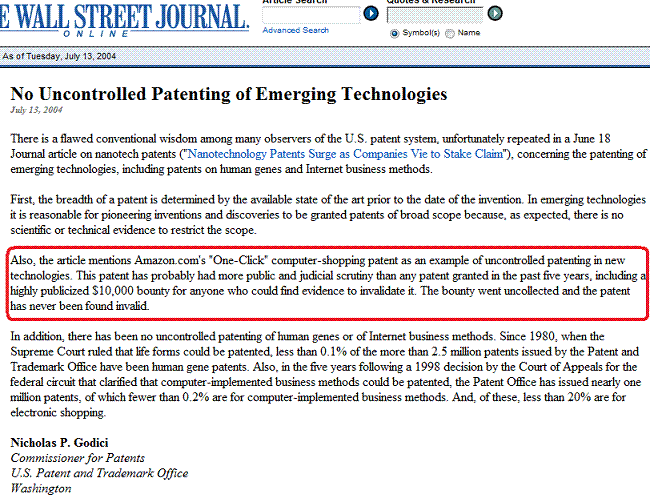
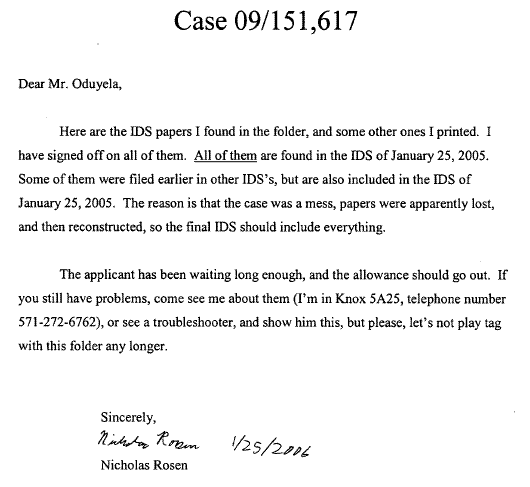
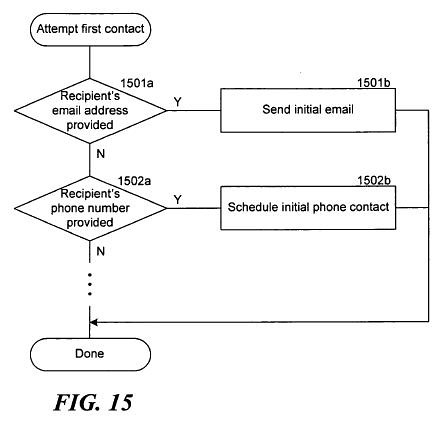
Congress didn't buy Amazon's argument that the failure of a defunct Jeff Bezos-funded company to award a $10,000 bounty offered by Tim O'Reilly for prior art that could bust Bezos' 1-Click patent was proof of 1-Click's novelty. The Commissioner for Patents, on the other hand, was duly impressed. As was one of his patent Examiners, who broke ranks from a less-impressed fellow Examiner and re-Examiner, to push through last week's issuance of U.S. patent no. 7,222,087, a 'continuation' of 1-Click which adds innovative claims like contacting the recipient of an order via e-mail or a phone call to obtain additional info.
-
Re:Gerbluh?
Uh, doesnt that seem rather overbroad? I mean, there's nothing about methodology, just 'we own any synthetic life.' What utter bullshit. Why dont they try to patent nonsynthetic life while they're at it?
The patent application looks pretty specific to me, actually. -
USPTO application text
Here's the patent application.
-
Correction
Wizards' patent was filed in October 2003, not 2002. When exactly did Selinker leave Wizards?
-
Re:umm... prior art anyone?
It wasn't. Wizkids released the Pirate game in July of 2004, while WOTC filed their patent application in October 2003.
-
I show you the patentsShow me the patents or shut up. List of U.S. patents assigned to Microsoft
-
Re:Interesting, but Highly Illegal
No I'm not.
Owning copyright on Mickey Mouse gives me copyright on all derivatives of Mickey Mouse as they are based on my original idea. Actually, I'm the only one who can make derivatives since I own the copyright to the original.
http://www.copyright.gov/circs/circ14.html
Looks like I'm not the one who needs to study.
I brought up trademarks because they represent a separate threat in addition to copyright violation.
To reiterate my Spider-man example, here is the trademark registration for Spider-man:
http://tess2.uspto.gov/bin/showfield?f=doc&state=6 d0u0u.2.14
Now if you use the term Spider-man to reference a comic strip character without getting the thumbs up from Marvel, you are open for trouble of the legal variety. -
Re:YRO?
Well, Mr. Best apparently originally patented or invented a radiant heat apparatus in the 1960's (too lazy to do a search) for drying paint which would have expired no later than December 31, 1986 (17 years after being issued as patents did until June 8, 1995 after which it was changed to 20 years from the effective filing date (with some special extensions). As far as I have been able to research the patent at issue is 4,321,857, which issued on March 30, 1982 and thus expiring on March 30, 1999, not 2000. Searching under the name "Willie Best" brings up 17 issued patents, 14 of which are of utility type.
It is, apparently, this patent that expired, not the original concept that applied to paint drying. -
This is not a submarine patentThis patent is not a submarine patent. This patent took 2 years to go from first application to being granted, which is pretty standard. There are a lot of steps and paperwork involved, especially if you have to edit your claims (and this patent had to be revised a couple of times when it was issued two non-final rejections -- again, this is pretty standard). Just search the USPTO legal status of this patent (7018696) to see.
Submarine patents usually hide for much longer than 2 years. Wikipedia has a good entry on them. One big reason submarine patents are less common now is that the term of a patent is reckoned 20 years from its filing date, instead of the previous method when it began with the date a patent is granted. If you take 5-10 years to go from filing to granted and the term of your patent is only 20 years, you're taking a big gamble.
-
Re:Think fast...Personally, I think patents should be "if you don't use it, you lose it" because what good does it do us if an idea is patented and the company just sits around waiting for a larger one to use it?
I may be totally misunderstanding you, but I disagree that Target Technology has just let this patent sit. It can easily take 2 years to go from filing an application to being granted a patent. You can check out all the different stages this patent went through by going to the USPTO Transaction History for this patent. (If the link doesn't take you right to the patent, run a search for patent 7018696 and then click on the "Transaction History" tab.) They had to go through some revisions in their claims (I spot 2 non-final rejections, which isn't unusual), as well as go through all the usual forms.
They can't sue someone for infringing their patent until they are granted one. And they might have taken a little more time to build their case before they tried to tackle a big company like Sony.
Note that I'm not saying this patent is valid. I don't have the background in this field to say if this is sufficiently innovative, especially after the Supreme Court's ruling about obviousness in KSR v. Teleflex.
Ok, so if I get a patent that says "silver alloys are best for reflective surfaces" and then I go on to list the possibility of using all elements in the periodic table (or those that make sense) and then I get that patentI agree that broad claims can be annoying, but it doesn't mean they've locked everything down. Fortunately, it's still possible to circumvent broad claims. For example, let's say you patent a material made of A, B, C, and D, and your claims cover all combinations of 1-90% A, 1-90% B, 1-90% C, and 1-90% D to give some kind of innovative performance. But now I find that the combination of 25% A, 25% B, 25% C, and 25% D works 10x better than the performance listed in your patent.
Although your patent claims included 25% A, 25% B, 25% C, and 25% D, I could still get a patent for this mixture, because your patent didn't anticipate the improved performance of this particular blend. And if you wanted to use this blend, you'd have to license it from me.
-
Not enough information
There isn't enough information here to form an intelligent position.
Given that Target is only suing Sony over Blu-Ray, and not suing any other organizations over CDs, DVDs, GD-ROMs, Game Discs, HD-DVDs, or FMD-ROMs (!), it's possible (however unlikely) that this is actually an example of patents working the way they should. That is, Target may have a patent on an actual technology; a specific method of producing a reflective layer that is superior and/or cheaper than other methods. If that's the case, then this is exactly how patents are supposed to work.
Alternatively, of course, Target may have patented an obvious evolution of well-established technologies, in which case this is just another patent troll. They could be holding off on suing other companies until they've set some sort of precedent with Sony.
The actual patent begins by specifying an alloy of silver an yttrium, but the further claims also (apparently) expand that claim by including alloys with other elements (such as bismuth and tin). I don't have the time right now to examine the patent in great detail; but a skim makes it look like they patented a specific method for a high-reflectivity layer thats cheaper than other methods of equivalent reflectivity. They then expand this idea to include all the derivative technologies of using this method (single & dual layer discs, write-only discs, write-once disc, re-writeable discs, etc).
The problem is I don't have enough familiarity with the technology to know if this is a non-obvious development or not. If it is non-obvious, then more power to them. Protecting your novel idea with a patent is fair play. If, of course, it's just the optical disc equivalent of "[X], but on the INTERNET and called i[X]," then I hope they get counter-sued into oblivion. -
Re:Think fast...
Why is this a bogus patent?
The key is that it might be a bogus patent. I've linked the patent in another post I made, but here's the summary:A silver-based alloy thin film is provided for the highly reflective or semi-reflective coating layer of optical discs. Elements that can be added to silver to produce useful silver alloys include zinc, aluminum, copper, manganese, germanium, yttrium, bismuth, scandium, and cobalt. These alloys have moderate to high reflectivity and reasonable corrosion resistance in the ambient environment.
Ok, so if I get a patent that says "silver alloys are best for reflective surfaces" and then I go on to list the possibility of using all elements in the periodic table (or those that make sense) and then I get that patent
Personally, I think patents should be "if you don't use it, you lose it" because what good does it do us if an idea is patented and the company just sits around waiting for a larger one to use it? The patent system is broken and so is the mentality of about half the patent holders that use it. It's no longer about protecting your intellectual property, it's about the tricks you can play to get insane sums of money. How long did NTP wait for RIM to expand and grow? A long time. It's not currently wrong but morally they've gotta be approaching some sort of evil. -
Patents Citing PatentsSo, I thought I would investigate by reading the patents of Target Technology Company LLC (the specific patent here) and noticed that the patent mentioned actually references one of Sony's patents in regards to R/W capabilities of discs:
The recording medium may be erased for re-recording by focussing a laser of intermediate power on the recording medium. This returns the recording medium layer to its original or erased state. A more detailed discussion of the recording mechanism of optically recordable media can be found in U.S. Pat. Nos. 5,741,603; 5,498,507; and 5,719,006 assigned to the Sony Corporation, the TDK Corporation, and the NEC Corporation, all of Tokyo, Japan, respectively, the disclosures of which are incorporated herein by reference in their entirety.
I haven't read all the patents referenced by Target Technology Company's patent but if they have a case, this looks like TTC built a slight logical advancement on top of Sony's (and a vast number of other company's) work in optical discs and optical drives then they waited for someone to make this logical step. Here, it looks to be using a certain chemical to make the discs more reflective. Ok, so maybe they spent a lot of research and maybe they didn't
But this looks like I could draft up a generic patent about triple layering and/or quadruple layering of data on discs and apply for the patents then just sit back and wait for someone to try and use it. I would reference all the dual layering patents and all that jazz. Would you call my ideas innovative or just common sense? Would it seem right that I didn't even have to implement these solutions? I don't know, I can think of instances where one could argue either way and this is what is inherently wrong with the patent system. Of course, I don't know how to fix it but I don't like how it works right now. -
Patents Citing PatentsSo, I thought I would investigate by reading the patents of Target Technology Company LLC (the specific patent here) and noticed that the patent mentioned actually references one of Sony's patents in regards to R/W capabilities of discs:
The recording medium may be erased for re-recording by focussing a laser of intermediate power on the recording medium. This returns the recording medium layer to its original or erased state. A more detailed discussion of the recording mechanism of optically recordable media can be found in U.S. Pat. Nos. 5,741,603; 5,498,507; and 5,719,006 assigned to the Sony Corporation, the TDK Corporation, and the NEC Corporation, all of Tokyo, Japan, respectively, the disclosures of which are incorporated herein by reference in their entirety.
I haven't read all the patents referenced by Target Technology Company's patent but if they have a case, this looks like TTC built a slight logical advancement on top of Sony's (and a vast number of other company's) work in optical discs and optical drives then they waited for someone to make this logical step. Here, it looks to be using a certain chemical to make the discs more reflective. Ok, so maybe they spent a lot of research and maybe they didn't
But this looks like I could draft up a generic patent about triple layering and/or quadruple layering of data on discs and apply for the patents then just sit back and wait for someone to try and use it. I would reference all the dual layering patents and all that jazz. Would you call my ideas innovative or just common sense? Would it seem right that I didn't even have to implement these solutions? I don't know, I can think of instances where one could argue either way and this is what is inherently wrong with the patent system. Of course, I don't know how to fix it but I don't like how it works right now. -
Fine, let me help
They have invented the way all software is installed, of course:
http://patft.uspto.gov/netacgi/nph-Parser?Sect1=PT O1&Sect2=HITOFF&d=PALL&p=1&u=%2Fnetahtml%2FPTO%2Fs rchnum.htm&r=1&f=G&l=50&s1=6618857.PN.&OS=PN/66188 57&RS=PN/6618857
they also claim to have invented archived files:
http://patft.uspto.gov/netacgi/nph-Parser?Sect1=PT O1&Sect2=HITOFF&d=PALL&p=1&u=%2Fnetahtml%2FPTO%2Fs rchnum.htm&r=1&f=G&l=50&s1=6,594,674.PN.&OS=PN/6,5 94,674&RS=PN/6,594,674
And last but not least, they have also created game scoring for computer games:
http://patft.uspto.gov/netacgi/nph-Parser?Sect1=PT O1&Sect2=HITOFF&d=PALL&p=1&u=%2Fnetahtml%2FPTO%2Fs rchnum.htm&r=1&f=G&l=50&s1=6,604,008.PN.&OS=PN/6,6 04,008&RS=PN/6,604,008 -
Fine, let me help
They have invented the way all software is installed, of course:
http://patft.uspto.gov/netacgi/nph-Parser?Sect1=PT O1&Sect2=HITOFF&d=PALL&p=1&u=%2Fnetahtml%2FPTO%2Fs rchnum.htm&r=1&f=G&l=50&s1=6618857.PN.&OS=PN/66188 57&RS=PN/6618857
they also claim to have invented archived files:
http://patft.uspto.gov/netacgi/nph-Parser?Sect1=PT O1&Sect2=HITOFF&d=PALL&p=1&u=%2Fnetahtml%2FPTO%2Fs rchnum.htm&r=1&f=G&l=50&s1=6,594,674.PN.&OS=PN/6,5 94,674&RS=PN/6,594,674
And last but not least, they have also created game scoring for computer games:
http://patft.uspto.gov/netacgi/nph-Parser?Sect1=PT O1&Sect2=HITOFF&d=PALL&p=1&u=%2Fnetahtml%2FPTO%2Fs rchnum.htm&r=1&f=G&l=50&s1=6,604,008.PN.&OS=PN/6,6 04,008&RS=PN/6,604,008 -
Fine, let me help
They have invented the way all software is installed, of course:
http://patft.uspto.gov/netacgi/nph-Parser?Sect1=PT O1&Sect2=HITOFF&d=PALL&p=1&u=%2Fnetahtml%2FPTO%2Fs rchnum.htm&r=1&f=G&l=50&s1=6618857.PN.&OS=PN/66188 57&RS=PN/6618857
they also claim to have invented archived files:
http://patft.uspto.gov/netacgi/nph-Parser?Sect1=PT O1&Sect2=HITOFF&d=PALL&p=1&u=%2Fnetahtml%2FPTO%2Fs rchnum.htm&r=1&f=G&l=50&s1=6,594,674.PN.&OS=PN/6,5 94,674&RS=PN/6,594,674
And last but not least, they have also created game scoring for computer games:
http://patft.uspto.gov/netacgi/nph-Parser?Sect1=PT O1&Sect2=HITOFF&d=PALL&p=1&u=%2Fnetahtml%2FPTO%2Fs rchnum.htm&r=1&f=G&l=50&s1=6,604,008.PN.&OS=PN/6,6 04,008&RS=PN/6,604,008 -
MicroSoft has 9821 patentsMaybe it is time to search the patent database, pull out any Patents tied to Microsoft and list them on the web. Let people vote up or down the patents that could conflict with current standard and try to identify them ourselves instead of waiting... http://appft1.uspto.gov/netacgi/nph-Parser?Sect1=
P TO2&Sect2=HITOFF&p=1&u=/netahtml/PTO/search-bool.h tml&r=0&f=S&l=50&TERM1=Microsoft&FIELD1=AS&co1=AND &TERM2=&FIELD2=&d=PG01 -
Re:Reform the System
I actually think the fix is kinda simple. Simply ban "trade secret" patents (patents where you don't have to demonstrate an implementation). Since software is implemented in the form of source code, you should have to show the source code (implementation) in order to get a patent on it. This would protect specifically written software as if it were an invention, but would not be so broad that it could stop someone from implementing the basic idea (algorithm - I suppose we need a legal definition for that too), which should not be patentable in the first place, which uses a different implementation (meaning different source code).
From the uspto faq:
A patent cannot be obtained upon a mere idea or suggestion. The patent is granted upon the new machine, manufacture, etc., as has been said, and not upon the idea or suggestion of the new machine. A complete description of the actual machine or other subject matter for which a patent is sought is required.
-
Re:Strange
Titles are not copyrightable
The author is making a philosophical argument, not a legal one. So the fact that titles happen, currently, not to be copyrightable is irrelevant. If you follow the author's reasoning, then every idea under the sun ought to be indefinitely copyrightable, whether it be a book, a song, a title, a slogan, a recipe, or the barest concept. After all, what is the moral justification for protecting the livelihood of an author and not that of a slogan-maker? Besides which, titles and slogans can to some extent be trademarked if defined as part of a brand (e.g. Conan(TM)the Barbarian) and perpetually with the proper forms and fees.
I suppose under this argument, fair use is likewise an abomination. Why should critics and satirists be allowed an easement over property they can just as easily avoid? -
Re:identifying prior art
It's easy to say "look! prior art", but what I'm getting at is to prove it in court it takes a lot more of an argument, since the video game example doesn't specifically show combining all those aspects together.
So essentially you have the uphill battle of showing me as a judge or jury something that proves that the idea of a single click to order something has been published before, all the aspects of the client-server communication have been published before, and that those documents have hinted that they could be combined. Essentially you have to show it should be unpatentable because it has been anticipated these could be combined to make a one click ordering system. Take a look at 35 USC 102 (the best kind of reference) vs. 35 USC 103 (a lot harder to prove in court)
I think it's awesome that people are interested in finding prior art for patents like this... But you have to be careful when doing so that you can demonstrate every single phrase in the claim language of the patent you're trying to kill is covered in your references. In the case of the video game, since it presumably doesn't show all the intermediary steps, you have to demonstrate quite a bit more to be able to use it effectively as prior art, and there are probably better examples out there... it's just a matter of finding them.
-
Re:identifying prior art
It's easy to say "look! prior art", but what I'm getting at is to prove it in court it takes a lot more of an argument, since the video game example doesn't specifically show combining all those aspects together.
So essentially you have the uphill battle of showing me as a judge or jury something that proves that the idea of a single click to order something has been published before, all the aspects of the client-server communication have been published before, and that those documents have hinted that they could be combined. Essentially you have to show it should be unpatentable because it has been anticipated these could be combined to make a one click ordering system. Take a look at 35 USC 102 (the best kind of reference) vs. 35 USC 103 (a lot harder to prove in court)
I think it's awesome that people are interested in finding prior art for patents like this... But you have to be careful when doing so that you can demonstrate every single phrase in the claim language of the patent you're trying to kill is covered in your references. In the case of the video game, since it presumably doesn't show all the intermediary steps, you have to demonstrate quite a bit more to be able to use it effectively as prior art, and there are probably better examples out there... it's just a matter of finding them.
-
Try 2015The patents on the MP3 codec are going to expire in a few years. The most essential MP3 patent expires in 2015. Eight years != "soon" in Internet time. there is a soon-to-be-realised financial incentive associated with sticking to the MP3 codec. Versus the now-to-be-realised financial incentive associated with switching to the Vorbis codec?
-
Re:Sad or Telling?
I posted something about this on the last thread - SMB/CIFS has a couple of obsolete Microsoft patents that Samba implements, but not as documented in the patents themselves (they would not work in a UNIX-like OS). The main part of Samba is based on specs designed by the Storage Industry Network Association, which MS used more as a guideline than how they implemented it. Here's an article about it, and also see Samba's web site.
The only other patent I know of on CIFS is not owned by Microsoft, it's a Cisco patent
MS probably still argues that those two patents are being violated and MS even spread some FUD by issuing a license for using CIFS on other OS's but excludes the GPL (Samba's license).
Things that are obvious, but Microsoft has patents on, that I'm aware of (thank you, bookmark file):
patent on RSS feeds
FAT patent 5579517 (which I believe has now been rejected as obvious after appeal and my ref was link-dead)
Spam filtering
IsNot in BASIC
or how about this one, which is basically sudo
or this one which would be violated as far as I can tell by a Linux OS module updated over an https connection, though I think it would also need to include verification like an md5 checksum to fall under that patent.
and a couple that I don't think would affect Linux:
a patent that is basically the same as XUL, but for Windows only.
a patent on this one on learning, which is broad and vague - see this guy's response I found in a search which explains the stupidity better than I could (my original link is again dead - I need some housecleaning). -
Re:Sad or Telling?
I posted something about this on the last thread - SMB/CIFS has a couple of obsolete Microsoft patents that Samba implements, but not as documented in the patents themselves (they would not work in a UNIX-like OS). The main part of Samba is based on specs designed by the Storage Industry Network Association, which MS used more as a guideline than how they implemented it. Here's an article about it, and also see Samba's web site.
The only other patent I know of on CIFS is not owned by Microsoft, it's a Cisco patent
MS probably still argues that those two patents are being violated and MS even spread some FUD by issuing a license for using CIFS on other OS's but excludes the GPL (Samba's license).
Things that are obvious, but Microsoft has patents on, that I'm aware of (thank you, bookmark file):
patent on RSS feeds
FAT patent 5579517 (which I believe has now been rejected as obvious after appeal and my ref was link-dead)
Spam filtering
IsNot in BASIC
or how about this one, which is basically sudo
or this one which would be violated as far as I can tell by a Linux OS module updated over an https connection, though I think it would also need to include verification like an md5 checksum to fall under that patent.
and a couple that I don't think would affect Linux:
a patent that is basically the same as XUL, but for Windows only.
a patent on this one on learning, which is broad and vague - see this guy's response I found in a search which explains the stupidity better than I could (my original link is again dead - I need some housecleaning). -
Re:Sad or Telling?
I posted something about this on the last thread - SMB/CIFS has a couple of obsolete Microsoft patents that Samba implements, but not as documented in the patents themselves (they would not work in a UNIX-like OS). The main part of Samba is based on specs designed by the Storage Industry Network Association, which MS used more as a guideline than how they implemented it. Here's an article about it, and also see Samba's web site.
The only other patent I know of on CIFS is not owned by Microsoft, it's a Cisco patent
MS probably still argues that those two patents are being violated and MS even spread some FUD by issuing a license for using CIFS on other OS's but excludes the GPL (Samba's license).
Things that are obvious, but Microsoft has patents on, that I'm aware of (thank you, bookmark file):
patent on RSS feeds
FAT patent 5579517 (which I believe has now been rejected as obvious after appeal and my ref was link-dead)
Spam filtering
IsNot in BASIC
or how about this one, which is basically sudo
or this one which would be violated as far as I can tell by a Linux OS module updated over an https connection, though I think it would also need to include verification like an md5 checksum to fall under that patent.
and a couple that I don't think would affect Linux:
a patent that is basically the same as XUL, but for Windows only.
a patent on this one on learning, which is broad and vague - see this guy's response I found in a search which explains the stupidity better than I could (my original link is again dead - I need some housecleaning). -
Re:Sad or Telling?
I posted something about this on the last thread - SMB/CIFS has a couple of obsolete Microsoft patents that Samba implements, but not as documented in the patents themselves (they would not work in a UNIX-like OS). The main part of Samba is based on specs designed by the Storage Industry Network Association, which MS used more as a guideline than how they implemented it. Here's an article about it, and also see Samba's web site.
The only other patent I know of on CIFS is not owned by Microsoft, it's a Cisco patent
MS probably still argues that those two patents are being violated and MS even spread some FUD by issuing a license for using CIFS on other OS's but excludes the GPL (Samba's license).
Things that are obvious, but Microsoft has patents on, that I'm aware of (thank you, bookmark file):
patent on RSS feeds
FAT patent 5579517 (which I believe has now been rejected as obvious after appeal and my ref was link-dead)
Spam filtering
IsNot in BASIC
or how about this one, which is basically sudo
or this one which would be violated as far as I can tell by a Linux OS module updated over an https connection, though I think it would also need to include verification like an md5 checksum to fall under that patent.
and a couple that I don't think would affect Linux:
a patent that is basically the same as XUL, but for Windows only.
a patent on this one on learning, which is broad and vague - see this guy's response I found in a search which explains the stupidity better than I could (my original link is again dead - I need some housecleaning). -
Re:Sad or Telling?
I posted something about this on the last thread - SMB/CIFS has a couple of obsolete Microsoft patents that Samba implements, but not as documented in the patents themselves (they would not work in a UNIX-like OS). The main part of Samba is based on specs designed by the Storage Industry Network Association, which MS used more as a guideline than how they implemented it. Here's an article about it, and also see Samba's web site.
The only other patent I know of on CIFS is not owned by Microsoft, it's a Cisco patent
MS probably still argues that those two patents are being violated and MS even spread some FUD by issuing a license for using CIFS on other OS's but excludes the GPL (Samba's license).
Things that are obvious, but Microsoft has patents on, that I'm aware of (thank you, bookmark file):
patent on RSS feeds
FAT patent 5579517 (which I believe has now been rejected as obvious after appeal and my ref was link-dead)
Spam filtering
IsNot in BASIC
or how about this one, which is basically sudo
or this one which would be violated as far as I can tell by a Linux OS module updated over an https connection, though I think it would also need to include verification like an md5 checksum to fall under that patent.
and a couple that I don't think would affect Linux:
a patent that is basically the same as XUL, but for Windows only.
a patent on this one on learning, which is broad and vague - see this guy's response I found in a search which explains the stupidity better than I could (my original link is again dead - I need some housecleaning). -
Re:Why not start debunking FUD now?
7,219,352 has some likely prior art (to the date of filing at least) in xine's video_out abstraction and I wouldn't doubt if mplayer had deinterlacing support abstracted to "device driver"-esque libraries before this patent. The patent itself seems to only cover hardware or driver based deinterlacing anyway (no description of what a device driver actually is in this context, whether it includes extensions to window manager interfaces or not, etc.), which means it is probably narrowly limited to drivers where all graphics card functionality must be tied to a single video driver, e.g. not things like Xv or shader applications. I can't imagine the idea being innovative either, because it's just a method for deciding what the best way to display interlaced video on a progressive scan device is, something that is a natural extension of playing any made-for-tv video on any computer made after CRTs became common.
-
Re:Search Google Patents for Microsoft
The problem with this approach is that most of them are gibberish.
I have a PhD in computer science and I have two patents (one accepted 1992 and one applied 2005) on my own, but when randomly grabbing a MS patent it often just doesn't make sense.
MS has been spamming USPTO with completely ridiculus patent applications. An example is this famous "IS NOT" operator patent, this is not gibberish but it is like a bad pub joke
MS USPTO patent application of the IS NOT OPERATORAn application like this should of course not be accepted, but when they abuse the system with this kind of applications as well as the gibberish applications, there is a high probability that some of these will slip through in the process and, voilà, they have yet another patent that can be used to attack anyone.
OK, In one way one can claim that Microsoft is doing us a favour, to show us how ridiculus the system is, to create arguments for abolishing the patent system, but I have hard to imagine that Microsoft would have an idealistic approach here. They are just plain evil!
-
Re:Why not start debunking FUD now?
So I read partway down the list and every patent I looked lies somewhere between completely worthless and awfully dubious. For example, in this patent Microsoft claim rights over the concept of a tree which contains different kinds of trees.
Maybe there is a defensible patent in there somewhere but I only saw garbage so far. Yes, somebody needs to sift through the whole lot and perhaps post a selection of the more preposterous claims publicly, but that will not be me. My time is better used developing software. -
Re:Why not start debunking FUD now?Couldn't we start a site/database that organizes all of Microsoft's patents and start documenting prior art and such for each. The patents themselves aren't hidden :
Microsoft's UI patent (155 patents) The first one on the UI list is a design patents, not a software patent: "CLAIM The ornamental design for a user interface for a portion of a display screen, as shown and described."
As such, "a design is manifested in appearance, the subject matter of a design patent application may relate to the configuration or shape of an article" and unless Mscosoft has patented Tux the penguin, that is one patent off the list already. -
Re:Why not start debunking FUD now?
You only read patents to read the obvious.
http://patft.uspto.gov/netacgi/nph-Parser?Sect1=PT O2&Sect2=HITOFF&u=%2Fnetahtml%2FPTO%2Fsearch-adv.h tm&r=7&f=G&l=50&d=PTXT&p=1&p=1&S1=Microsoft.ASNM.& OS=AN/Microsoft&RS=AN/Microsoft
"System and method for implementing a client side HTTP stack". How in the world did they get a patent for this? -
Why not start debunking FUD now?
This is an innocent question. If the OSS community is ready to debunk these patents, do we really need Microsoft to reveal which of the 235 patents/infringements they're talking about? Couldn't we start a site/database that organizes all of Microsoft's patents and start documenting prior art and such for each. The patents themselves aren't hidden
Microsoft's patents (6723 patents)
Microsoft's UI patent (155 patents)
(for example)
Why not start debunking the FUD to prove how spurious their claims are? Is it because this would be too much work? (Admittedly, 6723 >> 235)