Slashdot Mirror
Domain: uwsp.edu
Stories and comments across the archive that link to uwsp.edu.
Comments · 19
-
Re:210 degree FOV? Useless!
More proof your source s bulshit:
http://www.vision-and-eye-heal...
https://upload.wikimedia.org/w...
http://www.best-3dtvs.com/wp-c...
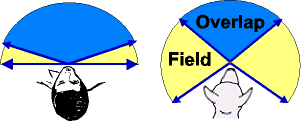
http://www4.uwsp.edu/psych/dog...Unless your eyes are on the side of your head like a dog or bird, you aren't getting past 200 degrees FOV IN ANY SITUATION.
-
Re:CFL are no savings - bzzt wrong...
There's energy-efficient and cost-efficient. Electric heat is the former but not even remotely the latter.
1kWh is equal to 3,413 BTUs. At $0.1109/hWh, that's 9.0kWh/$, or about 31,000BTU/$.
As of April 11, natural gas cost $11.02/1000ft^3. At 1030BTU/ft^3, that's about 94,000BTU/$.
According to Consumer Reports, a "typical gas furnace made in the early 1970s has an AFUE of about 65 percent.", so your $1 of natural gas would get you about 61,000BTU of heat. Compared to a perfectly efficient electrical heat source, that ancient furnace would be approximately half as expensive to run. Newer furnaces can reach upward of 97% efficient, or about one third the price of electric heat.
Electric heat is only efficient in terms of energy conversion. In terms of wallet-to-warmth conversion, it sucks.
-
Re:Noah's flood and a massive deluge
I believe you might be referring to the Channeled Scablands in Washington State? I remember seeing a documentary about that. Interesting stuff. The research happened a bit later than the 1800s, unless you're referring to something else. More pictures and information.
-
Re:Good Luck...
It's actually a wide-spanning issue, with lots of arguments by environmental scientists. Farming has its pluses and minuses -- for example deforestation and the modification of a geological area to make it suitable for farming.
I'll take address this question from one angle: energy conversion. The Second Law of Thermodynamics basically states that energy cannot be completely transferred from one source to another. In the food chain world, this has an impact on how much energy we consume.
Producers (organisms that exist at the most basic level of the food chain, such as corn), yield the most efficient form of energy. First-order consumers, such as cattle, are less energy efficient. They consume grains and plants, but also expend a lot of energy through respiration. Based on the Second Law of Thermodynamics, when we eat cattle, we are consuming more to receive the same amount of energy as if we directly consumed producers. Cattle waste a lot of energy, just by sitting there and breathing.
This article, about energy flow through ecosystems, explains things a lot better than I am. (It's been several years since I studied this topic.)
-
We have more oil?
I wonder what this does for theories of for oil. Some people theorize that petroleum is left over from the formation of the earth, rather than created by the fossilization of carbon life forms.
This reserve may be difficult to tap fully because of the nature of the rocks. I wonder if nuclear weapons would help. I guess it depends on how and where they were deployed.
How many tons of CO2 would be created with the burning of 500 billion barrels of oil? BTW, 500 billion barrels of oil would be about 1/6th of the world's oil reserves.
Is there really that much oxygen in the atmoshpere to burn all that? Let's see. The earth's atmosphere weighs 5 quadrillion metric tons... OK, no worries there.
but, but, the global warmings! The sea level could rise 50 feet in the next century. [checks current elevation of homestead] OK, that's fine.
But it would be hot! [checks average temps for homestead] ok, yeah, I can get behind that.
What about the polar bears? [checks polar bear shares in 401K] We're looking good!
But the crops! The crops won't grow! [Checks map of world showing land in permafrost] Looks like a net gain to me.
Ok, yeah! We have more oil! Can we exploit it faster than we have more people?
-
Re:Quick! Alert the scientific community!
Actually you have the effect backwards. The two equinoxes are when the sun appears to be over the equator. During the July the sun appears to be over the Tropic of Cancer in the northern hemisphere, which is why it is light all day in Alaska around the summer solstice, then the earth is approximately 152 million kilometers away. During the December the earth is approximately 147 million kilometers away and the sun is approximately over the Tropic of Capricorn in the southern hemisphere.
Meaning the sun is further away when the northern hemisphere is facing it making entire earth colder when it is summer in the northern hemisphere and hotter on average when it is winter in the northern hemisphere. Hence the northern hemisphere is more temperate and the southern hemisphere has greater extremes.
http://www.uwsp.edu/geo/faculty/ritter/geog101/textbook/energy/earth_revolution_rotation.html
Unless of course you were referring to the grandparent post's phrasing which does seem a bit geocentric, perhaps he is American and afraid of being called a heretic for suggesting the earth rotates around the sun. Though you would have to be quite the grammar nazi if you're saying he should have phrased it "the earth is closer to the sun" as opposed to "the sun is closer." -
Re:It's a name, not an adjective.
My friends tell me Antarctica gets ignored because it has no people. I don't understand the reasons behind any continental divisions, but the familiar seven continents, other than the Europe-Asia distinction, seem to follow major tectonic plates. I assume other divisions are more population or cultural based, although Europe's conquest of North America seems to have mostly squashed the previous indigenous population while things are more intermixed in South America. Though the CIA World Factbook states "Not until 1840 was it established that Antarctica was indeed a continent and not just a group of islands." That may explain its omission by some cultures' count. I think I've exposed my ignorance too much already, so I won't say any more.
-
Re:The "environment"
In the U.S., everything is younger, and most of it is built to accomidate cars, with wider streets, etc. As a result, the U.S. has always had that huge suburban and rural population that drives into work. In many places, there just isn't a mass transit option. I lived in metropolitan Memphis for a long time; there's no mass transit to speak of there, other than an aweful bus system. It's too close to the mississippi and too close to the water table for a subway (no one has a basement in Memphis).
It wasn't that way before WWII. I'm not sure how it was in Memphis. Perhaps you should review the local history a bit. -
Re:People unclear on the concept...
Resource exhaustion is economically impossible.
As resources become scarce, the price increases to balance their scarcity. At some level, substitutes become more economically attactive and use of the now-expensive, scare resource declines.
Yep. Tell that to the Oregon Bison
And the other species.
You are 100% right...
rrrrrrrriiiiiiigth -
Re:People unclear on the concept...
Resource exhaustion is economically impossible.
As resources become scarce, the price increases to balance their scarcity. At some level, substitutes become more economically attactive and use of the now-expensive, scare resource declines.
Yep. Tell that to the Oregon Bison
And the other species.
You are 100% right...
rrrrrrrriiiiiiigth -
From a Bi-Polar (Giving up Points!)I'm now 24 and have suffered with Bipolar Disorder (Rapid Cycling, or Ultra-Ultra-Rapid Cycling Bipolar according to this page) since I was about 13 or 14 and officially diagnosed at 16 years old. As a consequence of my illness, which includes episodes of depression, I dropped out of school and seriously messed up.
I lost all of my friends and ruined relationships I thought would, and might have, lasted forever and have pretty much retreated from the world. For about two years I went through a severe depressed episode, the whole time almost getting help here and there. I truely thought all things were lost and started to slowly kill myself with any type of controlled substance I could get my hands on.
Ok, that was a severe exaggeration, but I was binging on everything. I started to do stupid (fun) things that would later set me up for a lot of trouble until something changed. I didn't get help, I just had a conversion. It happened to be a religious conversion but it wasn't religion that saved me. Well, I went through three religions before I settled on one I liked and incorporated everything else I learned.
During all of this I realized on the side that I was going to face bad days. I was going to be depressed and that my life wasn't going to end up the way I had always dreamed (which is a understatement-I barely function). But you know, I realized that hurting everyone else was pretty petty considering if I waited it out I would feel better some day. My chance of feeling like that forever was zero; so why not just say "Fuck it" and move on?
Not only is suicide the worst way to treat depression it is never the answer to any problem. Drugs, crime, shame, anything.... it's happened to someone before, lots of people. Some of them made it out. Shit, even if you are on crack - smoke that and say fuck it and live. You won't get a chance to do it again. I'm not even going to get on a high horse and tell you to quit the pipe - that is something to live for, it's a start.
I'll feel like no one if you don't mod this up, of course. And if you have any empathy and would like to help my situation support mental health parity in the insurance industry (which would help afflicted minors in the transition to adulthood). Please also oppose cuts to the nations Medicaid system at a time when it's imperative it reach out more to mentally ill citizens.
-
Oh, man... talk about APPLICATIONS!Here's a list off the top of my head:
- Perforated material laminated to vehicle rear windows to provide shade, maintain battery charge (esp. for hybrids) and power vent vans on hot days. Minuscule thickness means negligible weight penalty.
- Adhesive-backed, encapsulated cells in roll form for direct application to membrane or raised-seam metal roofing turns any smooth roofing surface into a solar roof.
- Solar hat fans.
- Solar fairings for bicycles which charge the electric assist batteries.
- Electric awning for fishing or pleasure boats, powers trolling/cruise motor.
-
Re:Sounds Interesting
Not completly correct most plants convert solar energy at an ratio of about 1-3% however some like sugar cane perform at 8%.
http://www.uwsp.edu/geo/faculty/ritter/geog101/mod ules/ecosystems_biomes/biogeography_eco_energy.htm l
http://www.life.uiuc.edu/govindjee/whatisit.htm
http://employees.csbsju.edu/SSAUPE/biol116/Ecology
However photosynthesis converts light at 100%, all sorts of biochemical reactions make the overal much lower. -
Killer App?
As I've said over here, If this repeater stuff is in any way true, it really could be a killer app for handheld gaming.
The potential hinted at by these new revelations totally trancends your basic "sit around in a group and play wirelessly" functionality. If this (the repeater functionality) is in any way true, then it will make the touch-screen part of the DS look about as groundbreaking as MP3 support on a Sony player, and it makes the PSP's infra-red wireless gaming look like a silly kids' toy.
Seriously, wide-area gaming would be the killer app for handheld consoles. Imagine some sort of asynchronous MMPORG-style game whereby when a fellow player's DS is detected, some form of battle can take place. Some sort of modern take on the old style Campus 'Assassin' games.
Not to mention the facilitation of true munchkin-style ubiquitous networking. -
Ok, lets have a look at your link...Well ok, so he/she made an error in conversion units, and then maybe googled a bit and made up a page pointing how others had the same "error" as well. And then posted it here in slashdot highlighting how several other people would/could be wrong in their calculations as well!
- 38 inches according to a page at Arkansas State University and another at Microflex Technologies. Well the conversion (1 meter = 38 inches) is mentioned actually by some apparently russian website which is linked on this page at the arkansas state university
- 38.16 inches according to a rounding-happy math teacher at Norfolk Collegiate School in Virginia.
- Couldnt test this one, because the website was down (probably slashdotted)
- 38.37 inches according to Honeywell's Sensotec folks.
- Ok, well, this is indeed incorrect. However, on the same PDF it is mentioned that 1 inch = 2.54 cm, 1m = 1.0936 yards, which are both correct values. So I seriously believe that (1 m = 38.37in) is just a typo and should have actually been 1m=39.37 in.
- 38.8 inches according to some numerological babble
- Well, if it is "babble",then why consider it at all?
- 39 inches according to Fife Products and some folks who sell quilting products.
- That makes sense, doesn't it? Quilt and other such manufacturers would want to save on by "trimming" or low-rounding such conversions wouldnt they? For selling 1000m of their product, they save 37 inches!
- 39.14 inches according to the specifications on a measuring wheel for engineers. (uh-oh!)
- This does look incorrect. I can't think of why they'd equate 1m=39.14 inches.
- 39.15 inches according to an October 30 2002 entry in a blog.
- Why would you be concerned about what's on a blog. People put whatever they want to.
- 39.21 inches according to Richard Bowles.
- Again, who is richard bowles? I've no idea.. do other slashdotters know? Even if he is an authority on metric systems, why would you use an individual's figures as a source of reference? Would you not prefer to look at a metrics standards body or other such resource?
- 39.27 inches according to pages at University of Wisconsin Stevens Point and the National Optical Astronomy Observatory.
- On the same page you'd notice: "Since many of our students travel to Europe or Australia, we've prepared the chart below to show you how to estimate foreign measurements. We hope you find it helpful:"...Did you notice the word "estimate"? Well, if anything, it wasn't at helpful to you I presume
- 39.28 inches according to Jonathan Brooks at Penn State University.
- Again, I think this "Jonathan Brooks" is a user/student at Penn State University, and this URL you posted isnt an authoritative advisory from the University itself.
- 39.3 inches according to some
-
Re:At first i thought this post was stupidThanks. And here it is with the HTML active.
This evening, I learned that one meter equals 39.3700787 inches. While this may come as no surprise to some people, it was one to me - for years, I had mistakenly believed a meter was 39.77 inches, and now I know it's basically 39.37.
Of course, I'm not alone in my confusion. A bit of research on Google revealed quite a few different conversions from meters to inches. Here are some of them:
- 38 inches according to a page at Arkansas State University and another at Microflex Technologies.
- 38.16 inches according to a rounding-happy math teacher at Norfolk Collegiate School in Virginia.
- 38.37 inches according to Honeywell's Sensotec folks.
- 38.8 inches according to some numerological babble
- 39 inches according to Fife Products and some folks who sell quilting products.
- 39.14 inches according to the specifications on a measuring wheel for engineers. (uh-oh!)
- 39.15 inches according to an October 30 2002 entry in a blog.
- 39.21 inches according to Richard Bowles.
- 39.27 inches according to pages at University of Wisconsin Stevens Point and the National Optical Astronomy Observatory.
- 39.28 inches according to Jonathan Brooks at Penn State University.
- 39.3 inches according to some laser folks.
- 39.34 inches according to a page about photography, and another about a role-playing game. Hey, it's only a game, their meters can be whatever length they want.
- 39.36 inches according to some ham radio sorts and some NASA folks among others. Pretty close... but... shouldn't NASA know better by now?
- 39.38 inches according to people who race 1-meter model yachts, talk about prehistory in California, and, um, other NASA folks. Again, pretty close!
- 39.39 inches according to someone ranting against metric (how ironic), as well as a page about UFOs.
- 39.4 inches according to a list of conversions from a company that makes electric motors and such things, and the Secretary of the Navy.
- 39.45 inches according to a set of math problems f
-
Re:Why (Napster|iTunes|etc)?I live in Stevens Point, WI - home of the nations #1 conservation and natural resources university UWSP.
This means here are so many hippies here its crazy. Which also means that there are tons of people playing congas everywhere.
I fricken hate congas.
-
Re:Sea level...
Thanks that was almost what I wanted to say.
one other big factor that dosn't seem to have been mentioned yet is that ice is very good at reflecting light and water is not so good. If the planet is covered in ice it gets very cold if the ice melts it takes less energy to heat it up. Take a look at the snowball earth theory. -
Creativity
This so called 20%, at least for me, is when I enter the state of flow. There are specific requirements to be met so that one can enter this state of mind, in which the person is very creative and time seems to go faster, among other things. Read this for more information on entering the state of flow.