Slashdot Mirror
Domain: whitehouse.gov
Stories and comments across the archive that link to whitehouse.gov.
Stories · 304
-
White House Declassifies Outline of Cybersecurity Plans
An anonymous reader writes "The Obama administration on Tuesday declassified part of the Comprehensive National Cybersecurity Initiative created during the Bush administration, outlining offensive and defensive strategies for protecting information networks. The initiative was originally intended to unify efforts of a number of government agencies into a comprehensive strategy to protect the nation's computer networks. 'One area in which the government did officially disclose new details was Einstein 3, a program to protect civilian government systems from intrusion by deploying sensors on the networks of private telecommunications companies. For the first time, the government disclosed officially that the program would use technology developed by the NSA, the nation's largest intelligence agency. It also said that the Department of Homeland Security, which would run the program, would share malicious code data with the NSA but not the content of communications, such as e-mails.'" -
The New National Health Plan Is Texting
theodp writes "With a gushing press release, Federal CTO Aneesh Chopra announced the launch of Text4baby, 'an unprecedented mobile health public-private partnership' designed to promote maternal and child health. Expectant women are instructed to 'Enter the date of the first day of your last menstrual period' to start receiving 'timely and expert health information through SMS text messages' until their child reaches the age of 12 months (limited to 3 free messages/week). The White House Blog has more information on the 'historic collaboration between industry, the health community and government.' Separately, the White House announced plans to spend $3,000 on 'Game-Changing' Solutions to Childhood Obesity. Once again, Dilbert proves to be scarily prescient." -
The New National Health Plan Is Texting
theodp writes "With a gushing press release, Federal CTO Aneesh Chopra announced the launch of Text4baby, 'an unprecedented mobile health public-private partnership' designed to promote maternal and child health. Expectant women are instructed to 'Enter the date of the first day of your last menstrual period' to start receiving 'timely and expert health information through SMS text messages' until their child reaches the age of 12 months (limited to 3 free messages/week). The White House Blog has more information on the 'historic collaboration between industry, the health community and government.' Separately, the White House announced plans to spend $3,000 on 'Game-Changing' Solutions to Childhood Obesity. Once again, Dilbert proves to be scarily prescient." -
US Dir. of Citizen Participation Patents the News
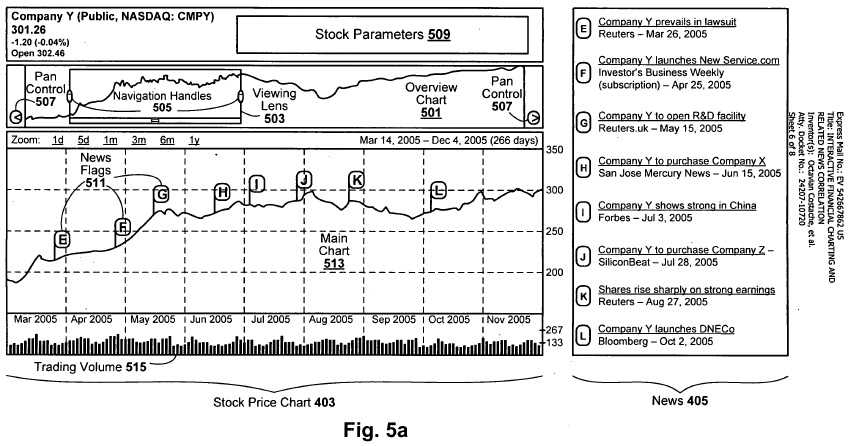
theodp writes "Ex-Googler and now White House Director of Citizen Participation Katie Stanton is charged with promoting open public dialogues. Last Thursday, Stanton and Google snagged a patent on displaying financial news. Google explains that Stanton's invention — Interactive Financial Charting and Related News Correlation — will 'facilitate and encourage the user's use and understanding of financial information,' which does jibe nicely with Stanton's appointment to Obama's New Media Team. Too bad it'll be encumbered by a Google patent until 2027." -
US Dir. of Citizen Participation Patents the News
theodp writes "Ex-Googler and now White House Director of Citizen Participation Katie Stanton is charged with promoting open public dialogues. Last Thursday, Stanton and Google snagged a patent on displaying financial news. Google explains that Stanton's invention — Interactive Financial Charting and Related News Correlation — will 'facilitate and encourage the user's use and understanding of financial information,' which does jibe nicely with Stanton's appointment to Obama's New Media Team. Too bad it'll be encumbered by a Google patent until 2027." -
INTERPOL Granted Diplomatic Immunity In the US
ShakaUVM writes "A couple of weeks ago without any fanfare or notice in the media, President Obama granted INTERPOL full diplomatic immunity while conducting investigations on American soil. While INTERPOL has been allowed to operate in the US in the past, under an executive order by President Reagan, they've had to follow the same rules as the FBI, CIA, etc., while on American soil. This means, among other things, the new executive order makes INTERPOL immune to Freedom of Information Act requests and that INTERPOL agents cannot be punished for most any crimes they may commit. Hopefully the worst we'll see from this is INTERPOL agents ignoring their speeding tickets." Update: 01/05 02:57 GMT by KD : Reader davecb pointed out an ABC News blog that comes to pretty much the opposite conclusion as to the import of the executive order. -
Obama Kicks Off Massive Science Education Effort
In a speech at the White House today, President Obama launched a new campaign, "Educate to Innovate," designed to get American students fired up about science, technology, engineering, and math (STEM). The full text of the speech is also available on whitehouse.gov. "The new campaign builds on the President's Inaugural Address, which included a vow to put science 'in its rightful place.' One of those rightful places, of course, is the classroom. Yet too often our schools lack support for teachers or the other resources needed to convey the practical utility and remarkable beauty of science and engineering. As a result, students become overwhelmed in their classes and ultimately disengaged. They lose, and our nation loses too. The partnerships launched today aim to change that. They respond to a challenge made by the President in April, when he spoke at the annual meeting of the National Academy of Sciences and asked the nation's philanthropists, professional and educational societies, corporations, and individuals to collaborate and innovate with the goal of reinvigorating America's STEM educational enterprise. The partnerships announced today — dramatic commitments in the hundreds of millions of dollars, generated through novel collaborations and creative outreach activities — are just the first wave of commitments anticipated in response to his call." -
US Government Sets Up Online "App Store"
krapper writes "The Obama administration has unveiled a government 'app store' designed to push the federal bureaucracy into the era of cloud computing. The change means some federal employees will begin using services like YouTube, Gmail and WordPress, which store data on private internet servers instead of on those paid for with public money. The process will start small but will ramp up quickly, Vivek Kundra, the US chief information officer, said in a blog post on Tuesday. 'Our policies lag behind new trends, causing unnecessary restrictions on the use of new technology,' Kundra writes in the post on WhiteHouse.gov. 'We are dedicated to addressing these barriers and to improving the way government leverages new technology.' The app store is designed for federal employees doing official government business and is not intended for use by the public." -
$18M Contract For Transparency Website Released — But Blacked Out
zokuga writes "The US government recently approved an $18 million contract for Smartronix to build a website where taxpayers could easily track billions in federal stimulus money, as part of President Obama's promise to make government more transparent through the Internet. However, the contract, which was released only through repeated Freedom of Information Act requests, is itself heavily blacked out. ProPublica reports: 'After weeks of prodding by ProPublica and other organizations, the Government Services Agency released copies of the contract and related documents that are so heavily blacked out they are virtually worthless. In all, 25 pages of a 59-page technical proposal — the main document in the package — were redacted completely. Of the remaining pages, 14 had half or more of their content blacked out.' Sections that were heavily or entirely redacted dealt with subjects such as site navigation, user experience, and everything in the pricing table. The entire contract, in all its blacked-out glory, is here." -
P.I.I. In the Sky
Frequent Slashdot contributor Bennett Haselton writes "A judge rules that IP addresses are not 'personally identifiable information' (PII) because they identify computers, not people. That's absurd, but in truth there is no standard definition of PII in the industry anyway, because you don't need one in order to write secure software. Here's a definition of 'PII' that the judge could have adopted instead, to reach the same conclusion by less specious reasoning." Hit the link below to read the rest of his thoughts.US District Court Judge Richard Jones's recent ruling in Johnson v. Microsoft has been much ridiculed for saying that IP addresses are not "personally identifiable information" (PII) because they identify computers, not individual users. Legions of critics have pointed out that this is like saying home addresses are not PII because they identify houses, not people. And it was pretty silly for Jones to say that "the only reasonable interpretation" of PII would be to exclude IP addresses from the definition — when, as the plaintiffs pointed out, Microsoft's own website defined PII to include IP addresses. (Microsoft has since removed from that definition from their online glossary and replaced with a link to their privacy statement.)
But the open secret in the privacy tech industry is that nobody knows exactly what "personally identifiable information" means anyway, and nobody cares, either. This is not because industry leaders don't care about privacy and security. They do. But being a good, privacy-conscious software architect has nothing to do with nit-picking the details of what counts as PII. If you're designing the new Hotmail, you should just know that passwords should be encrypted when users log in over the Web, that third parties should not be able to query the Hotmail database and harvest e-mail addresses, that users shouldn't be able to extract personal data such as birthdates that are associated with another user's e-mail address, etc. If you don't instinctively know those things already, then memorizing a definition for "PII" is not going to make you a good security-conscious programmer.
Conversely, the major security threats facing Windows users — malware infection through security holes in Windows and Internet Explorer — have nothing to do with the definition of PII or the finer points of Microsoft's privacy policy. There may even be public relations gurus at Microsoft who are glad to see the "IP addresses as PII" controversy in the headlines, if that relatively minor privacy issue distracts the public from the vastly more serious threats posed browser security holes.
There are indeed published definitions of "PII" — the US Office of Management and Budget Memo 07-16 defines PII as:
"information which can be used to distinguish or trace an individual's identity, such as their name, social security number, biometric records, etc. alone, or when combined with other personal or identifying information which is linked or linkable to a specific individual, such as date and place of birth, mother's maiden name, etc."
But that doesn't pass the test of what makes a good definition, which is: If two different people read that definition, and then you gave them an example of a piece of data (such as the school that someone graduated from), would they usually be able to agree on whether that data counts as "PII?" How about IP addresses? From the written definition alone, there's no way to tell for sure.
I actually worked as a contractor at Microsoft at the onset of the PII craze, and in order to commence working on what would eventually become Windows Live, we all had to watch a streaming video about PII, what it was, how to secure it, etc. Near the beginning, the narrator gave some examples of PII, including e-mail addresses, and mentioned that PII should be encrypted when transmitted over the Internet. (I'm not violating any confidentiality; these standards were all publicly released later.) Full of first-week-on-the-job idealism, I looked up the narrator in the company directory and earnestly typed out an e-mail raising some points, such as: Doesn't Hotmail display your e-mail address over an unencrypted connection when you're signed in to Hotmail? And anyway, because the standard e-mail protocols always transmit To: and From: addresses unencrypted over the Internet, how would it ever be possible to "encrypt e-mail addresses in transit" anyway? Wouldn't it make more sense to specify that individual e-mail addresses can be transmitted in the clear one at a time, but if we're ever transferring a large number of them in bulk, it would be wise to encrypt the list, to reduce the chance of it falling into the hands of a spammer?
Then the video kept rolling, and making more statements that seemed to contradict earlier ones, or that were too vague to give me any idea of what I was actually supposed to do in a given situation, and eventually I got the point: We do care about privacy and security. But, there is no algorithm that can determine unambiguously what counts as "PII" or what you're supposed to do in order to safeguard it. You just have to use your common sense and ask around if you're not sure. The main point of the video is to reinforce how important this is, not to impart any actual information.
So Judge Jones could have picked from many possible definitions of "PII," and nobody would be able to call him "wrong," as long as the industry doesn't know what it means, either. What he was really trying to decide was whether Microsoft violated its promise "not to collect PII" during the Windows Update process, because the IP addresses of users doing the downloads were visible to Microsoft's servers. The plaintiffs made some other claims in Johnson v. Microsoft that I think have more merit (basically, arguing that the "Windows Genuine Advantage" anti-piracy tool should not have been foisted on users without their consent as part of the Windows Update process), but on this particular point, I think they were bound to lose on the claim that collecting IP addresses during a download was a privacy violation. After all, if the judge had ruled in their favor on this point, Microsoft would have had to discontinue Windows Update in order to comply with the ruling, and I don't think anybody wants that.
So, maybe Judge Jones just decided that he didn't want to be known as the judge who outlawed Windows security updates, so he determined in advance that he was going to rule that Microsoft did not violate users' privacy by collecting IP addresses during Windows Update. Then he worked backwards from there to find reasoning that supported this conclusion. That's not really how it's supposed to work, but at least he could have had good intentions.
Unfortunately, the reasoning that he hit on was the absurd argument that IP addresses are not PII because they identify computers, not the people who own them. Here's something that he could have said instead:
"I'm not counting IP addresses as PII, because in order to find out who was using an IP address at a particular time, you have to subpoena the ISP. That's what makes them different from names and home addresses, which can be matched to individual people without a subpoena. As long as Microsoft isn't subpoenaing ISPs to find out who was using a particular IP address, for all practical purposes they are not 'personally identifiable.'"
Judge Jones actually started out in that direction by quoting from another case, Klimas v. Comcast Cable Communications, Inc., where the court wrote, "We further note that IP addresses do not in and of themselves reveal 'a subscriber's name, address, [or] social security number.' That information can only be gleaned if a list of subscribers is matched up with a list of their individual IP addresses." And that list matching up subscribers with the IP addresses they were using at a given time, can only be obtained with a subpoena. Jones could have quit while he was ahead and stuck with that reasoning, and he would have avoided all the ridicule that came from his statement about IP addresses.
Or maybe Judge Jones could have just said,
"Look, you don't have a standard definition for PII anyway. You adapt it to each individual situation, in order to determine what privacy protections should be built into each program, by using your common sense. So that's what I'm doing to do in this situation too. And my common sense tells me that having IP addresses visible to Microsoft's servers during the Windows Update process, is not a privacy violation, because that's how downloads work."
That's as good a definition of PII as any. Now let's get back to the real work of stopping Russian porno spammers from pwning our machines in the first place.
-
Text Comments Out In YouTube "National Discussion" of Health Care
theodp writes "While the White House has invited the nation to Join the National Online Discussion on Health Care Reform, it is currently only accepting 20-30 second YouTube video responses — text comments have been disabled. Which raises a question: Should a video camera be the price of admission for participating in an open government discussion, especially when issues may hit those with lower incomes the hardest? BTW, the response-to-date has been underwhelming — 101 video responses and counting — and is certainly a mixed-bag, including a one-finger salute, a talking butt, a woman "Showing my Apples", and other off-topic rants and unrelated videos." -
US Open Government Initiative Enters Phase Three
circletimessquare writes "The Obama administration opened a discussion forum in January of this year which has become an electronic suggestion box. It is now entering stage three, following brainstorm and discussion phases: the draft phase, in which the top subject matter is codified into suggestions for the government. 'Ultimately, the visitors advanced more than 3,900 ideas, which in turn spawned 11,000 comments that received 210,000 thumb votes. The result? Three of the top 10 most popular ideas called for legalizing marijuana, and two featured conspiracy theories about Mr. Obama's true place of birth.'" -
Open Government Brainstorm Defies Wisdom of Crowds
theodp writes "In May, the White House launched what it called an 'unprecedented online process for public engagement in policymaking.' Brainstorming was conducted in an effort to identify ways to 'strengthen our democracy and promote efficiency and effectiveness by making government more transparent, participatory, and collaborative.' So, what were some of the top vote-getters? Currently near the top of the list are Legalize Marijuana And Solve Many Tax Issues / Prison Issues (#2) and Remove Marijuana from Schedule I of the Controlled Substances Act (#3). For those who remember Obama's earlier Online Town Hall, it's deja vu all over again." -
Who Would Want To Be Obama's Cybersecurity Czar?
dasButcher writes "President Obama is expected to name a new cybersecurity czar sometime soon. This person will be charged with defending the digital boards from attack by hostile nation-states and terrorist organizations. But the question Larry Walsh asks is: Who really wants the job? The previous three people who held the post barely made a dent in solving the security problems. Government bureaucracy and private sector resistance make it nearly impossible to find any measure of meaningful success in this job, he writes." Reader eatcajun contributes a related link to the long-awaited US cyberspace policy review. -
Battle Lines Being Drawn As Obama Plans To Curb Tax Avoidance
theodp writes "Barack Obama has squared up for a major battle with big business, announcing a crackdown on offshore tax avoidance and evasion by US multinationals that's designed to raise $210B and make it easier for companies to create 'good jobs here at home'. Obama cited a building in the Cayman Islands where more than 18,000 US companies are housed: 'Either this is the biggest building in the world or it is the biggest tax scam in the world,' he said. 'I think the American people know which it is.' The administration says that more than a third of US foreign profits in 2003 came from Bermuda, the Netherlands and Ireland, and noted US companies paid an effective tax rate of just 2.3% on the $700bn they earned in foreign profits in 2004. Among tech companies affected by the crackdown, Microsoft joined 200 companies who signed a letter complaining that the proposed tax changes would put them at a disadvantage with their rivals, Cisco moaned that the measures 'would adversely impact our ability to invest and grow our business in the US,' and Google declined to comment for the time being." -
White House Joins Facebook, MySpace, Twitter
theodp writes "The official White House Blog called the move WhiteHouse 2.0 as the Obama administration unveiled its membership in a trio of the social-networking leaders: Facebook (157,606 fans and counting), MySpace (174,817 friends and counting) and Twitter (34,612 followers and counting)." -
White House Ditches YouTube
An anonymous reader writes to tell us that in an apparent response to privacy complaints, the White House has quietly moved off of YouTube as a method for serving the President's weekly video address. Choosing instead to use a Flash-based solution and Akamai's content delivery network, this comes just days after YouTube began to roll out their own new policies regarding privacy of visitors. -
White House Exempts YouTube From Web Privacy Rules
An anonymous reader writes "The new White House website privacy policy promises that the site will not use long-term tracking cookies, complying with a decade old rule prohibiting such user tracking by federal agencies. However, Obama's legal team has quietly exempted YouTube from this rule. Visitors to the official White House blog will receive long-term tracking cookies whenever they surf to a web-page with an embedded YouTube video — even those users that do not click the "play" button. As CNET reports, no other company has been singled out and rewarded with such a waiver." -
White House Exempts YouTube From Web Privacy Rules
An anonymous reader writes "The new White House website privacy policy promises that the site will not use long-term tracking cookies, complying with a decade old rule prohibiting such user tracking by federal agencies. However, Obama's legal team has quietly exempted YouTube from this rule. Visitors to the official White House blog will receive long-term tracking cookies whenever they surf to a web-page with an embedded YouTube video — even those users that do not click the "play" button. As CNET reports, no other company has been singled out and rewarded with such a waiver." -
Barack Obama Sworn In As 44th President of the US
Just before noon today, Eastern time, Barack Obama was sworn in before the US Capitol building as the 44th President of the United States (Whitehouse.gov has already been updated to reflect the new President), and offered an inaugural address which outlined some of the challenges that the country currently faces, both within the country's borders and abroad. Obama's election has been called "a civil rights triumph," and his candidacy has inspired perhaps the most visible political involvement of young voters of any candidate since John Kennedy. Here's your chance to discuss the newest occupant of the White House and what you'd like to see happen over the course of his presidency. -
Executive Order Overturns US Fifth Amendment
RalphTWaP writes "Tuesday, there wasn't even a fuss. Wednesday, the world was a little different. By executive order, the Secretary of the Treasury may now seize the property of any person who undermines efforts to promote economic reconstruction and political reform in Iraq. The Secretary may make his determination in secret and after the fact." There hasn't been much media notice of this; the UK's Guardian has an article explaining how the new authority will only be used to go after terrorists. -
U.S. Gov't To Use Full Disk Encryption On All Computers
To address the issue of data leaks of the kind we've seen so often in the last year because of stolen or missing laptops, writes Saqib Ali, the Feds are planning to use Full Disk Encryption (FDE) on all Government-owned computers. "On June 23, 2006 a Presidential Mandate was put in place requiring all agency laptops to fully encrypt data on the HDD. The U.S. Government is currently conducting the largest single side-by-side comparison and competition for the selection of a Full Disk Encryption product. The selected product will be deployed on Millions of computers in the U.S. federal government space. This implementation will end up being the largest single implementation ever, and all of the information regarding the competition is in the public domain. The evaluation will come to an end in 90 days. You can view all the vendors competing and list of requirements." -
Prepared for Next Year's Time Change?
wohlford puts forth this query: "Next year, daylight saving time will be extended another four weeks. Slashdot has covered the time change proposal and its estimated impact, already. Since then it has been signed into law. Looking around on the Net I don't see anyone taking this seriously. Will this become the next tech doomsday or just another joke like Y2K?" -
Slashback: Disney Copyright, Alaa Freed, Kelo Repealed
Slashback tonight brings some clarifications and updates to previous Slashdot stories including: Egyptian blogger Alaa freed from jail, Executive order repeals Kelo decision, Disney's trouble with Pooh bear, NASA engineer fired for opposing shuttle launch, Swedish pirates provide RIAA insurance, open source Java months away, and the net neutrality amendment defeated in committee -- Read on for details.Egyptian blogger Alaa freed from jail. FleaPlus writes "Egyptian blogger, open source advocate, and Slashdot interviewee Alaa Abd El-Fatah has been released from jail. He had been imprisoned for 45 days after being arrested (along with several others) for taking part in a pro-democracy election reform rally, on charges which included "insulting the Egyptian president." In a blog post Alaa describes the conditions he was subjected to in the jail, as well as his worry about the hundreds of other activists who are still in prison."
Executive order defuses Kelo decision. physicsphairy writes "President Bush has issued an executive order whose effect is to undo the previous Kelo decision of the Supreme Court. From the article: 'It is the policy of the United States to protect the rights of Americans to their private property, including by limiting the taking of private property by the Federal Government to situations in which the taking is for public use, with just compensation, and for the purpose of benefiting the general public and not merely for the purpose of advancing the economic interest of private parties to be given ownership or use of the property taken.' The downside is that what was once affirmed consitutionally is now affirmed only in federal law."
Disney's trouble with Pooh bear. bbernard writes "It seems that the same laws that allow the Mouse to continue generating money for Disney have prevented Disney from taking control of Winny the Pooh. The Supreme Court has denied Clare Milne's bid to get the rights back for Pooh and his buddies. Clare is A.A. Milne's granddaughter, and her court battle was funded by Disney, as she was going to reassign the rights to them. Interesting to see a company foiled by the laws they insisted on in the first place, isn't it?"
NASA engineer fired for opposing shuttle launch. quad4b writes to tell us The New York Daily News reports that Charlie Camarda was has been removed from his post at NASA for questioning the safety of this Saturday's launch. From the article: "Camarda's removal heightened the turmoil over NASA Administrator Michael Griffin's decision to take the 'acceptable risk' of launching the Discovery orbiter despite warnings of potentially fatal blastoff debris. Camarda, who flew aboard the troubled flight of Discovery last July, told colleagues in an e-mail that he was fired from his post as chief engineer at Houston's Johnson Space Center and given another NASA engineering job."
Swedish pirates provide RIAA insurance. An anonymous reader writes "A new insurance company in Sweden is offering a new policy to protect you from the RIAA [Swedish]. For a mere 140 SEK ($19 USD) per year, they will pay all your fines and give you a t-shirt if you get convicted for file sharing. Interesting development in Sweden indeed."
Open source Java months away? bl8n8r writes "A Sun Microsystems Inc. executive said Tuesday said the company is "months" away from releasing its trademark Java programming language under an open-source license. Simon Phipps, chief open-source officer for Sun, said the company is ruminating over two major issues: how to keep Java compatible and ensure no particular company uses market forces as muscle for its own implementation, a move that would threaten Java's "write once, run anywhere" mantra."
Net neutrality amendment defeated in committee. DeathPooky writes "While not the end of the road for net neutrality, the latest vote isn't a good sign. From the article: 'The Senate Commerce Committee on Wednesday rejected a network neutrality amendment, handing cable and phone broadband access providers yet another victory over a coalition that has demanded the application of strict nondiscrimination standards against entities that control access to millions of Internet users. The panel voted 11 to 11 to defeat an amendment sponsored by Sens. Olympia Snowe (R-Maine) and Byron Dorgan (D-N.D.), who had backing from Google, Yahoo!, eBay, Amazon, Microsoft and other firms that deliver voice, video, and information services and applications.' All 10 Democrats on the committee, as well as Republican co-sponsor Sen. Snowe, voted for the amendment. The other 11 Republicans voted against."
-
US Stem Cells Contaminated
Croaking Toad writes "According to The Register, US-based scientists using stem cells has hit a brick wall. The stem cells apparently have been contaminated for quite a while with animal proteins rendering them useless in the treatment of human illnesses. New stem cell harvesting was outlawed in the USA by a 2001 Executive Order from President Bush." To be precise, stem cell harvesting wasn't outlawed; the usage of federal funding was outlawed. Several states and research institutions have been using their own money to undertake research. The AP coverage is up as well. Update: 01/24 19:40 GMT by J : Carl Zimmer has a fascinating description of the sugars we humans lack that contaminated the stem cell lines. What a curious genetic heritage we have... -
Should Taxpayers Pay Twice For Weather Data?
theodp writes "Thanks to O.M.B. Circular A-130, taxpayers now enjoy free access to SEC, Patent Office, and IRS data over the Internet. Now the Bush administration must decide whether to order the National Weather Service to make taxpayer-funded weather readings freely available on the Net, ignoring complaints from an industry trade group that doing so violates pre-Internet era agreements." -
U.S. Attorney General John Ashcroft Resigns
andyring writes "In a move that will undoubtedly make many /. readers jump for joy (although perhaps not myself), Attorney General John Ashcroft announced he will resign, according to multiple news sources. While many here dislike him, others have more favorable opinions of him. He became the point man on the USA Patriot Act, which typically ignites harsh opinions on both sides of the aisle." Reader cnsc1rtr , referring to the AP's version of the story, writes "He gave Bush a five-page, handwritten letter in which he stated, 'The objective of securing the safety of Americans from crime and terror has been achieved.'" -
New Bin Laden Tape Surfaces
An anonymous submitter writes "Osama bin Laden delivered a new videotaped message in which he told Americans their security does not depend on the president they elect, but on U.S. policy. 'Your security is not in the hands of Kerry or Bush or al Qaeda.'" -
Book Review: Moon-Mars Commission Report
code_rage writes "A preview of the Aldridge Commission Report was discussed recently on Slashdot. Now that the full report has been released, a more in-depth presentation might be appropriate." code_rage has written a lengthy summary of the report below. Other readers sent in the Executive Summary and several news stories. A Journey to Inspire, Innovate, and Discover author President's Commission on Implementation of United States Space Exploration Policy pages 64 publisher US Government Printing Office, http://bookstore.gpo.gov/ rating The glass is half {empty,full} depending on your outlook reviewer code_rage ISBN 0160730759 summary Presidential Commission proposes major changes to NASAThe single most prolific spinoff attributable to NASA is not Teflon, Tang, or Velcro. No, it's high-level reports on how to fix NASA. The latest report, written under the authority of a 9-member commission named by President Bush, proposes how to implement NASA's latest orders: complete the Space Station and retire the Shuttle by the end of the decade, return humans to the Moon by 2020, and eventually send humans to Mars.
The Background
The President's proposal, while lacking details, has been greeted with enthusiasm by many aerospace workers, for whom the application of the term "beleaguered" is more than appropriate. What other major industry has lost half its workforce in the last 15 years? (Oh yeah, the airline, IT and telecom industries, who managed about the same attrition rate in only 2 years: evidence of efficiency, or something.) Space scientists have awaited the implementation report with some trepidation: their Hubble servicing mission has already been traded for the uncertain prospect of a robotic mission, and some NASA science missions have already been pushed back by the budget impact of the Moon-Mars mission.Meanwhile, public opinion has not quite caught fire. Opinion polls taken in January show at best indifference and at worst hostility to the new plan. Greg Klerkx wrote "Perhaps the most disheartening aspect of the explosion of Columbia, other than the human tragedy, was that it changed very few opinions about NASA or NASA's human spaceflight activities. Both should continue, the polls unanimously concluded, but with no more or less vigor than at present." [p. 12, Klerkx 2004]
The Commission, led by longtime government official E.C. Aldridge, also includes four space scientists, a retired Air Force General, a former Congressman, a business and government executive, and the well-known CEO of a high tech firm. Notably, no astronauts or former NASA executives were on the panel.
Contents
Transmittal Letter
Executive Summary
Section I - Introduction: The Space Exploration Vision
Section II - Organizing the US Government for Success
Section III - Building a Robust Space Industry
Section IV - Exploration and Science Agenda
Section V - Inspiring Current and Future Generations
Section VI - Concluding Comments
AppendicesHistorical Context
After any disaster or major program failure, commissions are empaneled and they tend to produce two sorts of reports. The first type of report is a failure analysis, including specific prescriptions for recovery. The second is a more broad examination of strategies and goals. This report falls into the second category. While the Aldridge Commission report includes some recommendations that duplicate some previous ones, the new report differs in some important ways from those.In 1986, the Paine Commission examined how NASA should respond to the Challenger failure. The commission's report in places reads like a primer on space technologies, and proposes specific goals similar to those of the Bush plan: completion of the Space Station, return to the Moon, and a manned mission to Mars. The Paine Commission seems to have felt that the basic problem facing NASA was a lack of a long-term vision and political commitment.
In 1990, the Augustine Commission studied how NASA should respond to a variety of troubling problems on the Shuttle and other programs. This study endorsed space science strongly, while also supporting Space Station. The report focused strongly on workforce issues like morale, attrition and aging. It also noted weaknesses in NASA's executive leadership practices. The report made some specific reform proposals, some of which reappear in the Aldridge report.
The Report
The Aldridge Commission report differs from previous examinations in important ways. First, it has a very limited scope. The Commission did not perform an open-ended study of what NASA ought to do, or how much emphasis to place on astronomy vs planetary science vs human spaceflight. They only studied how to accomplish President Bush's new goals for the space program. Paradoxically, their limited brief resulted in a far more profound proposal to reorganize NASA than previous reports. The range and depth of reforms proposed by this report greatly exceeds those of previous reports.The top-level recommendations include:
1. Establish a Space Exploration Steering Council, reporting to the President
2. NASA should establish much more private industry participation in space operations, beginning with unmanned launch services
a. Reorganization of NASA HQ
b. Spin off NASA Centers as Federally Funded Research & Development Centers (similar to JPL and the DOE National Labs)
c. NASA should establish 3 new organizations:
+ a technical advisory board, modeled on the Defense Science Board
+ an Independent Cost Estimating organization, modeled on DoD Cost Analysis Improvement Group
+ a research organization, modeled on DARPA and formed from the NASA Institute for Advanced Concepts
d. NASA should adopt DoD-style project management methods
3. NASA should identify and begin development of critical technologies
4. Renew and sustain development of a robust space industry
a. NASA should actively solicit ideas from all sources
b. Congress should fund prizes targeting specific missions and technologies, and work on space property rights
5. NASA should pursue international partnerships
6. NASA should consult regularly with scientists and the National Academy of Sciences
7. The space exploration program should be tied into educational programs and public relationsSection I "Introduction: The Space Exploration Vision" presents three basic justifications for the exploration program: The human urge to explore, economic growth, and national security. Three "imperatives for success" are also presented: sustainability, affordability, and credibility. Sustainability is described as being able to sustain both technical momentum and long-term political support for what will be an expensive program. Affordability is described as "go as you can pay," where each milestone is reached through "spiral, evolutionary developments." The report compares the funding to cancer research, where the pace is determined by a political judgment of "annually, how much can we afford?" The report describes credibility as an amalgam of best practices. While the Commission recognized that space exploration is full of risk, NASA must not appear careless or foolish. NASA must embrace both management practices as well as technical ideas regardless of their source.
Analysis
The Commission's Report is itself a model of the practices they exhort NASA to follow. Whether by intention or not, many of the ideas in the report have been the stated position of advocacy groups like the National Space Society and the Mars Society. Some of the reforms have been specifically proposed by previous Commissions.The biggest problem I wondered about was funding. So far, about $12B has been proposed for this vision. Yet, many of the recommendations seem likely to cost a great deal of money. For example, on p. 23, the report states that much of NASA's infrastructure needs substantial modernization. Elsewhere, technology R&D is addressed by proposing a DARPA model or even the In-Q-Tel Venture Capital firm funded by the CIA. The Pentagon's "System-of-systems" approach is proposed as a model for project architecture. Special attention is given to the need for reliable heavy lift launch capability. In discussing how to pursue international participants, the Joint Strike Fighter program is listed as a model. Each of these areas requires either significant direct investment (infrastructure, heavy lift, R&D) or large bureaucracies to administer complex contracts (system-of-systems, JSF model). There is an unavoidable tension between the need for R&D, "go as you can pay," available funds, and "credibility."
The money issue is partially addressed by proposing tax incentives, privatization and private competition. But competition cannot reduce the amount of honest-to-goodness investment needed to remediate the technology deficit. It can only promote the most efficient approach. We need more R&D, yet private competition is seen as a way to "reduce government investment" (p. 20). The elephant in the room is that aerospace is a highly regulated market with relatively low profit margins. This means that direct reinvestment is fairly low. A glance at a list of the top R&D companies shows that top-tier aerospace companies do not reinvest a lot of their own money.
The second issue that troubled me is the applicability of the models they proposed. JPL, the National Labs, various DoD organizations and methods, the X Prize, and other examples are listed as models for various reforms of NASA. This raises some questions. First, are these models applicable? No evidence is presented to indicate that the Commission considered whether different organizations with different goals, constraints, missions, and sizes can use a given model successfully. The proposal to spin off most NASA centers as FFRDCs seems quite radical. Would any commercial firm spin off everything except a design team? Is this what the Aldridge Commission proposes of NASA? How many NASA employees would be left, and in which disciplines? Can the JPL model be applied well to other NASA centers? Would the centers work together better or worse? Would there be limits to how many centers a given contractor would be permitted to operate? I suspect it's much easier to designate JPL as a model than it is to enact in the real world. Do the security and procurement scandals at some DOE labs give us anything to worry about? What about the need for the National Labs to chase proposals in light of funding cuts? Does that make organizations more market oriented and relevant, or does it simply waste the time of researchers?
Finally, the Commission's report failed to address the biggest political problem our human spaceflight program faces: a lack of relevancy to ordinary people. The transmittal letter to the President states that the Commission's web site received over 6,000 written inputs, and that public comments were 7:1 in favor of the new vision. This is of course not a scientific survey, rather it is a self-selected and rather small sample of people who are presumably interested in space exploration. Elsewhere in the report, supportive public testimony is cherry-picked without context or attribution. In one case, I recognized a quote that, taken out of context, sounds much more supportive of a government monopoly on human space travel than the speaker probably meant: "We all wanted to go" (p. 13) was characterized as an expression of the deep and broad effect that the Apollo program had on Americans. I believe this was Tony Tether, Director of DARPA. The full quote was: "What NASA seemed to forget was that then, we all wanted to go," Tether told commissioners. "We were forgotten about." But if NASA can find a way for American citizens to take the baby steps that would eventually allow them to reach the moon - or even just space - themselves, it would do wonders for the space agency's support, he added. "If you can do that, you will have a constituency that you don't have today," Tether said. The longer quote is here.
These anecdotes do not invalidate the report, but I do wonder if the Commission is overselling the enthusiasm that the public will have for this program. Section I, and the report's title, endorse the "inspiration, education, and innovation" arguments for space travel that have so far failed to garner support for a more expansive space vision. One brief mention was made of space tourism and of making NASA an engine of the economy (p. 20). There are hints at the relevance problem sprinkled throughout the report, but public support is more or less presumed, not demonstrated.
What's Good:
If your attitude about NASA reorg proposals is "wake me if it's a big deal," then this is your wakeup call. The Aldridge Commission Report proposes the most profound and far-reaching reorganization of NASA since its founding.To a larger degree than I would have expected from this board, the proposals are strongly market- and business-oriented. I presume this is the implicit desire of President Bush (MBA, former CEO) and possibly NASA Administrator Sean O'Keefe (an accountant).
The report is written in an engaging, enthusiastic style.
What's Bad:
Where's the Beef? "Go as you can pay" does not seem like an adequate response to an agency that has faced aging infrastructure and workers for more than 14 years (see Augustine report). Increased funding and profit margins might address many issues better than bureaucratic realignments or spinoffs. There is no discussion of how to value intangibles like scientific discovery and inspiration, yet tangible values are of prime concern to contractors. NASA's credibility is discussed only in terms of competency, not based on perceived relevancy to the public.What's Missing:
There is no consideration of potential disadvantages of the various proposals. Supporters of space science may find the report dismissive of their priorities and concerns. There is no critical evaluation of the benefits of space program investments vs direct investments in education, science and technology.This report is remarkably thin on supplementary materials: there are 13 pp of appendices. More is available on the Commission's web site.
Refs:
[Klerkx 2004]: "Lost In Space: The Fall of NASA and the Dream of a New Space Age," Greg Klerkx, 2004. ISBN 0375421505
[Paine 1986]: http://history.nasa.gov/painerep/cover.htm
[Augustine 1990]: http://www.hq.nasa.gov/office/pao/History/augustin e/racfup1.htm
[Aldridge 2004]: http://www.moontomars.orgThe reviewer is an aerospace engineer with experience in human spaceflight engineering and operations, commercial satellite development and operations, and scientific satellite development and operations. No current relationship to NASA, and no significant interests in companies with an interest in this proposal.
You can download A Journey to Inspire, Innovate and Discover from moontomars.org. Slashdot welcomes readers' book reviews -- to see your own review here, carefully read the book review guidelines, then visit the submission page. Thanks to everyone who takes the time to contribute. -
U.S. Considering Ratifying Cybercrime Treaty
waytoomuchcoffee writes "SecurityFocus has a new article on the Council of Europe's "Convention on Cybercrime". The U.S. has already signed the treaty, but it has not yet been ratified by the Senate (although President Bush has written a letter urging the treaty's passage). This treaty, among other items, would require the U.S. to "cooperate with foreign authorities" in conducting surveillance on American citizens who have committed no crime under U.S. law, but may have broken another country's law (selling historic Nazi posters on Ebay? Germany might have you wiretapped), prohibiting the "production, sale or distribution of hacking tools", whatever that means (would Nmap be illegal?) and require the U.S. to pass laws to "force users to provide their encryption keys" and the plain text of their encrypted files. Canada is a signatory as well." -
Candidate Ads, Coming Soon To An Inbox Near You
ooby writes "MSNBC reports that Bush and Kerry plan to shoot off a million or so emails to their closest friends. By using the Internet to distribute ads, presidential candidates believe they can reach more people using less money. I guess that's why they wrote that loophole in that awesome new spam law." -
USA To Return To Moon By 2015, Then Mars
securitas writes "This afternoon George Bush announced space exploration plans for the USA to return to the Moon by 2015, the design and construction of a new space vehicle fleet by 2014 (called the Crew Exploration Vehicle) to replace the aging space shuttles which will be retired in 2010, and the construction of a permanent Moon base, followed by manned missions to Mars. The initiative begins with a $1 billion increase to NASA's budget and $12 billion in new space exploration money over next five years. However Congress is concerned about how to pay for the new space policy initiative in the face of a $500 billion national budget deficit. AP via Yahoo has a Moon/Mars/space policy FAQ, and there's more at NASA and the New York Times among others." -
U.S. Spam Law to Take Effect Jan. 1
We lead with news that the U.S. 'anti'-spam law, written largely by the Direct Marketing Association, will enter into effect on January 1. The bill preempts existing state laws which are tougher (states' rights anyone?), so for many citizens, this is purely a pro-spam law. The FTC is thinking about bounty hunters to enforce the new law (which you can and probably should read for yourself). -
White House Website Limits Iraq-Related Crawling
oscarcar writes "Dan Gillmor is reporting on the White House website's use of its robots.txt file to disable search engines from crawling certain material. Many excluded items in the robots.txt file involve mentions of Iraq, possibly to prevent people from finding changes to past statements and information when archived elsewhere." -
Slashback: Railing, Blocking, Scoffing
Slashback tonight brings you more information on homemade railguns, the future history of SCO (seen from the past), one website's response to alleged RIAA mendacity, a legal victory for famous web jerk Tucker Max, and more -- read on for the details.Please don't point that thing at me. BoomZilla writes "If you thought that the recent Gauss Gun article on Slashdot was spiffy, check out Jengel & Fatro's Rail Gun Page. Everything you need to know about the physics behind building your very own rail gun. Ever used the Quake rail gun and lusted after the real thing? Here's your opportunity."
Telepathic telegrams work as well as ever, though. markgo2k writes "After the web site experienced 'an unusually high number of visitors,' the White House modified the contact page and added a prominent link to president@whitehouse.gov. Here's the latest NYT story (once again, reprinted here in the non-subscription Seattle PI). Of course, the White House is still confused on the difference between the New York Times effect and the Slashdot effect. It's not mentioned in the story, but there is also now a feedback link to submit comments to the 'White House Web Development Team,' if you want to drop them a line..."
It's half-Greek to me. In response to the recent story on perpendicular data storage in next-generation hard drives, Anonymous Coward writes "Here is a better overview of Perpendicular HDD technology. Here is a real detailed scientific article that seems to be written in Greek."
They're off my Christmas card list, too. Techfocus ran an interview with Fred von Lohmann earlier this year. Now, an anonymous reader points to an update on their site: "Effective immediately, the RIAA and MPAA will need to find another way to get to Techfocus. In response to their legal targeting of individual file-swappers, access from their known networks to this site has now been blocked. While it may still be possible for them to access Techfocus via address ranges which we're not aware of, they'll otherwise have to use non-RIAA and non-MPAA networks to view the site."
Techfocus cites three reasons for the denial, the top one being that the RIAA took advantage of the interview with von Lohmann, "quoting him out of context in a manner which could lead readers of their materials to believe that we supported their efforts. This could not be further from the truth."
The secret is to predict enough things. An anonymous reader points out this article from early 2000 citing Gartner analyst Al Hilwa's prediction that Linux is "probably going to kill SCO UnixWare," writing "As you can read, SCO's end was predicted near perfectly." I think "hinted at" is more accurate, since SCO is still alive and at least making a good show of kicking, but it's interesting to revisit a story about SCO which mentions that "industry observers thought that the company would be Linux's first victim," back when Project Monterey was a going concern.
A victory for discourteous boors everywhere. aeaas writes "The beauty queen Katy Johnson dropped her suit against Tucker Max over the posting of stories from their relationship on his website. This story was first brought up in the context that he was forced to take down stories relating to her without holding a hearing or notifying Max prior to it. This is unusual in American law."
A quarter mil is a lot of suffering, even in Canadian money. Skippy321 writes "Justified or not, Ghyslain Raza--better known as the Star Wars Kid--is suing the four students who posted his homemade video of himself doing acrobatic "sword-fighting stunts" on the Internet for $250,000. He claims that he has suffered harassment and persecution. It's also interesting how the article states that he quit high school due to this video, at only 15 years of age. Although things aren't so bad for him -- here's a petition for him to get a role in Episode III."
-
Slashback: Railing, Blocking, Scoffing
Slashback tonight brings you more information on homemade railguns, the future history of SCO (seen from the past), one website's response to alleged RIAA mendacity, a legal victory for famous web jerk Tucker Max, and more -- read on for the details.Please don't point that thing at me. BoomZilla writes "If you thought that the recent Gauss Gun article on Slashdot was spiffy, check out Jengel & Fatro's Rail Gun Page. Everything you need to know about the physics behind building your very own rail gun. Ever used the Quake rail gun and lusted after the real thing? Here's your opportunity."
Telepathic telegrams work as well as ever, though. markgo2k writes "After the web site experienced 'an unusually high number of visitors,' the White House modified the contact page and added a prominent link to president@whitehouse.gov. Here's the latest NYT story (once again, reprinted here in the non-subscription Seattle PI). Of course, the White House is still confused on the difference between the New York Times effect and the Slashdot effect. It's not mentioned in the story, but there is also now a feedback link to submit comments to the 'White House Web Development Team,' if you want to drop them a line..."
It's half-Greek to me. In response to the recent story on perpendicular data storage in next-generation hard drives, Anonymous Coward writes "Here is a better overview of Perpendicular HDD technology. Here is a real detailed scientific article that seems to be written in Greek."
They're off my Christmas card list, too. Techfocus ran an interview with Fred von Lohmann earlier this year. Now, an anonymous reader points to an update on their site: "Effective immediately, the RIAA and MPAA will need to find another way to get to Techfocus. In response to their legal targeting of individual file-swappers, access from their known networks to this site has now been blocked. While it may still be possible for them to access Techfocus via address ranges which we're not aware of, they'll otherwise have to use non-RIAA and non-MPAA networks to view the site."
Techfocus cites three reasons for the denial, the top one being that the RIAA took advantage of the interview with von Lohmann, "quoting him out of context in a manner which could lead readers of their materials to believe that we supported their efforts. This could not be further from the truth."
The secret is to predict enough things. An anonymous reader points out this article from early 2000 citing Gartner analyst Al Hilwa's prediction that Linux is "probably going to kill SCO UnixWare," writing "As you can read, SCO's end was predicted near perfectly." I think "hinted at" is more accurate, since SCO is still alive and at least making a good show of kicking, but it's interesting to revisit a story about SCO which mentions that "industry observers thought that the company would be Linux's first victim," back when Project Monterey was a going concern.
A victory for discourteous boors everywhere. aeaas writes "The beauty queen Katy Johnson dropped her suit against Tucker Max over the posting of stories from their relationship on his website. This story was first brought up in the context that he was forced to take down stories relating to her without holding a hearing or notifying Max prior to it. This is unusual in American law."
A quarter mil is a lot of suffering, even in Canadian money. Skippy321 writes "Justified or not, Ghyslain Raza--better known as the Star Wars Kid--is suing the four students who posted his homemade video of himself doing acrobatic "sword-fighting stunts" on the Internet for $250,000. He claims that he has suffered harassment and persecution. It's also interesting how the article states that he quit high school due to this video, at only 15 years of age. Although things aren't so bad for him -- here's a petition for him to get a role in Episode III."
-
White House Obfuscates Email
markgo2k writes "Do you want to email the president? This John Markoff, New York Times story (reprinted here in the non-subscription Seattle PI) details how the White House no longer promises to read anything you send to president@whitehouse.gov. Instead, you must navigate a multi-page website AND confirm your submission via email. Oh, and they only want to talk about subjects that are of interest to them." The web-form system appears to be a bit overloaded at the moment. -
Operation Iraqi Freedom - The Game
Thanks to the Dallas Business Journal for a brief article announcing the release of F/A 18: Operation Iraqi Freedom, an Atari-distributed PC flight combat game that's just about to ship, less than 4 months after the start of the real-life campaign. The game's official website has more information on the title, which allows you to "..jump through your television directly into.. the F/A-18 Hornet.. load up with precision guided munitions and bring the forces of freedom to bear on the Iraqi regime of terror." And yes, this upgrade of GraphSim's earlier popular F/A 18 Hornet flight sim really does exhort you to "Kick Some Ba'ath" on the features section of its site. -
Revising Spectrum Rules
Orne writes "Whereas NPR is speculating on the television spectrum, the AP brings us news that the Bush administration is set to re-evaluate government and industry use of the radio spectrum. An executive order kicks off a year of public meetings held by the Commerce Dept; the official press release is here." -
Kid-Safe Domain Created
Jadecristal writes "The Washington Post announces that President Bush has signed legislation to create a .kids.us domain. The legislation mandates that those with a .kids.us site not be allowed to link to any site outside the .kids.us domain." At the very least, it makes filtering easy. -
Federal Cyberspace Policy Draft Released
mh_cryptonomicon writes "The initial public draft of the National Strategy for Securing Cyberspace was released today. This document outlines the Administration's plan for ensuring that the Net remains a 'good neighborhood.' Following the release of the plan, the Administration's Cybersecurity team will take it on the road for discussions with the people about what can and should be done to protect and defend the net. More information (and the 65 page draft) can be downloaded from the White House's Critical Infrastructure Protection site. This draft is considerably smaller than the 3300 page monster it was reported as being. Commentary is starting to pop up everywhere, including www.cryptonomicon.net/blog/." -
U.S. Tighening Rules of Keeping Scientific Secrets
MobyTurbo writes: "In this article The New York Times (free registration, blah blah blah) reports that the Bush Administration is removing over 6,000 declassified documents from the public domain as part of the war on terrorism. Many scientists quoted in the article think that this will impead the development of science, especially the development of new vaccines." -
OMB Deputy Director Will Head NASA
Baldrson writes: "UPI reports "President George W. Bush has selected Sean O'Keefe, Deputy Director of the Office of Management and Budget, to head NASA." In his prior position, Dr. O'Keefe reviewed and gave testimony before Congress, critical of the budgetary overruns of NASA's International Space Station." (Of course, the ISS isn't all NASA's.) -
MPAA Goes After Gnutella
President of The US writes "C|Net is reporting that the MPAA is going after individual users of Gnutella through their ISPs. 'What we're trying to do is educate the population about what is appropriate, both from an ethical standpoint and from a legal standpoint,' is what they are saying, but it looks like more of the usual intimidation tactics. It looks like they want to scare individual users from even trying to share movies, for fear they will be cut off from their precious broadband. Will the ISPs cave in?" Yes, they will. But its gonna be interesting to see where this goes. -
U.S. Significantly Lowers Export Limitations
nevets writes: "The White house has announced yesterday that it will significantly change the export limitations on computers. Because of the increasingly availability of computers and clustering capabilities, the U.S. has decided that it can't keep up their policies with the changing technology. The export limitations are going from a four tier system to a three tier, with tier 1 and 2 merging, tier 3 changing, but tier 4 will stay the same." While the new rules still base their country-by-country distinctions on the basis of how many millions of theoretical operations per second (MTOPS) a computer can do, they do seem slightly saner. wiredog points out this story at The Washington Post as well. -
EMP Artillery Shells
smartfart writes "Military.com has this story about artillery shells "that can put out such a powerful burst of radio-frequency energy it will destroy or disable electrical and electronic systems for miles around without killing anyone."" Some (not all) modern military equipment is designed to withstand large EMP pulses, so I'm not sure how effective this would be against most armies. But it would sure do a number against civilian computer networks. -
Clinton Vetoes Classified-Leaks Bill
Last night, I read this New York Times article (free reg. req.) about Clinton's veto of what would have been a new law to prevent leaks of classified information. But I didn't understand its significance until I read this earlier Salon.com article by Daniel Ellsburg, who had leaked the Pentagon Papers so that U.S. citizens could learn how their government had lied to them about Vietnam. "If Congress were so scrupulous about the First Amendment, it wouldn't have passed this law," says Ellsburg. I'm gratified to see a politician refusing on principle to extend government's powers. Here's the President's statement; and here's the bill (sponsor: Rep. Goss, R-Fla.). -
Carnivore-like tool released as Open Source
Joe Smith writes "NetworkICE released a new Carnivore-like tool that does *everything* FBI said Carnivore is supposed to do." Of course there's no way the FBI will accept this, and the conspiracy theorists will use this as proof that Carnivore is doing more then the FBI is 'fessing up to. -
Clinton's First Internet Address To The Nation
gumbo writes: "President Clinton gave his first Internet Address to the Nation today, in RealVideo, RealAudio, and Sun .au (!) formats. He also announced a government-wide search engine that should be up by fall, with no funding from tax dollars. Personally, I run several government Web sites and haven't heard of this, so they must be planning on spidering *.gov without checking with us first. :)" It may be a e-bucketful of hype, a content-impaired pandering gesture, but some president would make the first such address, so why not Bill? As Internet connections become ever more ubiquitous, though, just how ubiquitous do we want the promised e-government to be? -
Clinton's First Internet Address To The Nation
gumbo writes: "President Clinton gave his first Internet Address to the Nation today, in RealVideo, RealAudio, and Sun .au (!) formats. He also announced a government-wide search engine that should be up by fall, with no funding from tax dollars. Personally, I run several government Web sites and haven't heard of this, so they must be planning on spidering *.gov without checking with us first. :)" It may be a e-bucketful of hype, a content-impaired pandering gesture, but some president would make the first such address, so why not Bill? As Internet connections become ever more ubiquitous, though, just how ubiquitous do we want the promised e-government to be?