Slashdot Mirror
Domain: wikimedia.org
Stories and comments across the archive that link to wikimedia.org.
Comments · 6,832
-
Re:Creativity
Based on how the words are USED within the English language, (and also based on how consistent such things the words represent are for humanity as a whole, worldwide!), games, art, puzzles, competition(s), work and play DO NOT MEAN THE SAME THINGS.
Of course they don't mean 'the same thing'. 'Tree' doesn't mean the same thing as 'plant' either. That doesn't mean that a tree isn't a plant.
Puzzles are subsets of games. A puzzle is a type of game that has rules that require mostly thinking to solve.
Competitions are a subset of games. They are games played against others. They can be sport competitions, which are athletic games, or they can be puzzle competitions.
Art is not a subset of game, in fact, they rarely overlap at all.
I have no idea why you keep ranting about how words are used in English, like that somehow changes the actual meaning of the words. Hint: All anyone is talking about is English words. You can't argue that words are 'used different in English' about a discussion of English words.
Jigsaw's are not games, they're puzzles - as are crosswords, word-searches, sudoku,
Dude, all those are games. Go to a book store, check where they keep their jigsaw puzzles. Or, you know, check what 'Boggle' and 'Scrabble' are classified as...they're board games. Or just check the wikipedia redirect for 'Word puzzle'...it goes to 'Word game'.
even crime-scenes, and even science itself can be seen as involving puzzles
If you want to argue that 'puzzle' is also the right word to describe logic problems that are not done for fun (And hence are not games), I will not object to that. (Although I suspect that's just a metaphor.)
That just means you have to say 'game puzzle' or 'play puzzle' or something to specify you're talking about a puzzle done for entertainment, as opposed to a puzzle done for an actual purpose, a 'work puzzle'. (And the same with competitions.)
That does not change the fact that's not what we're talking about, at all. We're talking about puzzles done for entertainment. On the computer. Remember?
As I said, these words represent DIFFERENT applications of often DIFFERENT behaviour (of people!). Competitions and puzzles, based on their use, are about things that happen TO people - (which is why wondering how the universe functions - (the ultimate thing that happens to us all) - is considered a puzzle), whereas games, work and play are not - they're about things people DO for themselves - and art is something people DO for others... (Note that I'm just talking about behaviour here, not its application).
Yes, I'm often walking down the street, and competition to see how high I can jump just happens to me. Or I'm sitting down and a suduku puzzle just attacks and I must solve it to live.
The 'thing that happens to people' is called work. Work is stuff people do with a specific goal that isn't the thing itself. (I.e, they check out your groceries not because they want them checked out, but because they get paid if they do so.)
Work is the opposite of play. Games are a subset of play, as is art.
Puzzles may be work or play. If they are play, they are structured rule-based play, aka, a game. (All work, of course, is structured.)
None of this has anything to do with what happens 'TO' people or people 'DO'.
-
Re:God bless America
God Bless America.
... and no place else!
This always reminds me of "Gott mit uns". -
Re:computerandvideogames.com comments
I hate to say this, but we've lost. The public has accepted HDMI.
Wikipedia is your friend:
Neither is mutually exclusive, and they're bad for their own reasons
They've accepted devices locked in firmware.
All depends on what you're going to do with it. For example, I wouldn't mind a Netflix box with locked firmware; it'd be pretty sweet to be able to modify it, but Netflix gets their money from a streaming/rental service and I want to support that. I can always have my own unlocked media server thingamajig in addition to it, you know.
They've accepted Blu-Ray.
Yet again...
Again, neither is mutually exclusive. In fact, you can rip Blu-ray discs provided you have the right hardware and AACS keys
They've accepted the iOS app store. They've accepted the Kindle.
I don't mind the iOS app store; it's not like you're forced to sell your applications in there, you know. It's pretty simple to just buy something that isn't Apple-related. Also, you can read DRM-free books on the Kindle IIRC, so I don't see a problem.
blah blah blah conspiracy theory
Yeah... I highly doubt it. As long as the world has people with common sense, it will always be possible to build unlocked devices.
-
Re:computerandvideogames.com comments
I hate to say this, but we've lost. The public has accepted HDMI.
Wikipedia is your friend:
Neither is mutually exclusive, and they're bad for their own reasons
They've accepted devices locked in firmware.
All depends on what you're going to do with it. For example, I wouldn't mind a Netflix box with locked firmware; it'd be pretty sweet to be able to modify it, but Netflix gets their money from a streaming/rental service and I want to support that. I can always have my own unlocked media server thingamajig in addition to it, you know.
They've accepted Blu-Ray.
Yet again...
Again, neither is mutually exclusive. In fact, you can rip Blu-ray discs provided you have the right hardware and AACS keys
They've accepted the iOS app store. They've accepted the Kindle.
I don't mind the iOS app store; it's not like you're forced to sell your applications in there, you know. It's pretty simple to just buy something that isn't Apple-related. Also, you can read DRM-free books on the Kindle IIRC, so I don't see a problem.
blah blah blah conspiracy theory
Yeah... I highly doubt it. As long as the world has people with common sense, it will always be possible to build unlocked devices.
-
Re:computerandvideogames.com comments
I hate to say this, but we've lost. The public has accepted HDMI.
Wikipedia is your friend:
Neither is mutually exclusive, and they're bad for their own reasons
They've accepted devices locked in firmware.
All depends on what you're going to do with it. For example, I wouldn't mind a Netflix box with locked firmware; it'd be pretty sweet to be able to modify it, but Netflix gets their money from a streaming/rental service and I want to support that. I can always have my own unlocked media server thingamajig in addition to it, you know.
They've accepted Blu-Ray.
Yet again...
Again, neither is mutually exclusive. In fact, you can rip Blu-ray discs provided you have the right hardware and AACS keys
They've accepted the iOS app store. They've accepted the Kindle.
I don't mind the iOS app store; it's not like you're forced to sell your applications in there, you know. It's pretty simple to just buy something that isn't Apple-related. Also, you can read DRM-free books on the Kindle IIRC, so I don't see a problem.
blah blah blah conspiracy theory
Yeah... I highly doubt it. As long as the world has people with common sense, it will always be possible to build unlocked devices.
-
Re:computerandvideogames.com comments
I hate to say this, but we've lost. The public has accepted HDMI.
Wikipedia is your friend:
Neither is mutually exclusive, and they're bad for their own reasons
They've accepted devices locked in firmware.
All depends on what you're going to do with it. For example, I wouldn't mind a Netflix box with locked firmware; it'd be pretty sweet to be able to modify it, but Netflix gets their money from a streaming/rental service and I want to support that. I can always have my own unlocked media server thingamajig in addition to it, you know.
They've accepted Blu-Ray.
Yet again...
Again, neither is mutually exclusive. In fact, you can rip Blu-ray discs provided you have the right hardware and AACS keys
They've accepted the iOS app store. They've accepted the Kindle.
I don't mind the iOS app store; it's not like you're forced to sell your applications in there, you know. It's pretty simple to just buy something that isn't Apple-related. Also, you can read DRM-free books on the Kindle IIRC, so I don't see a problem.
blah blah blah conspiracy theory
Yeah... I highly doubt it. As long as the world has people with common sense, it will always be possible to build unlocked devices.
-
Re:Please say it ain't true !
-
Re:This is unacceptable
Reminds me of the Nobel peace prize that went to the chinese activist for human rights works.
In a sense, the west is asking China to move closer to our ideals. At the same time, the Norwegian government is planning on storing cellphone/Internet traffic metadata for 6-24 months for *every citizen* through the European Data Retention Directive, effectively moving Norway closer to China.
-
Re:Wonderful - everyone should try this!
Still KDE is missing integration for FF, Chrome, OO.
Um. Surely you mean, "Still FF, Chrome, OO is missing integration for KDE"? Last time I checked, it was unreasonable to expect KDE developers to go out and patch KDE integration into [insert your every favourite application here].
I think OS community does not have enough resources to maintain different applications for several desktop, or maintain several desktops.
As long as people are able to choose to do something different, there will be people who do choose to something different. As soon as you mandate the One True Desktop Environment (for example) you lose most of the power of Free software.
Competition is good, but linux needs standards to make it easier for software and hardware manufactures to support it.
What, you mean like POSIX, the Filesystem Hierarchy Standard, and all of these other cross-DE specifications?
-
Re:Wrote about this in 2006...
Suppose, for the moment, that spreading American values — by which I mean democracy, freedom of expression, and social mobility — throughout the globe is a good idea. How do we achieve that?
For being a country that values social mobility, the US could surely do better than it is already doing. In economic matters, the US economic inequality (Gini coefficient) is among the upper values for the developed world (at 46 compared to about 25-35 for the Western European nations). In other matters, the picture is not as rosy, either.
Thus I doubt that the United States would be good at spreading what you're calling American values - since the government does not practice what it preaches even at home. -
Re:HAM
Well, you can send an image at least.
-
Re:Foreign policy history
I'm unsure of your point. "National interest" is seldom limited by national boundaries. Nationalizing the canal was both in the national interest of Egypt, and within the sovereign power of the Egyptian state. And seizing control of the canal is scarcely something unique to Egypt. Britain did so in 1914.
At what point does "right" play into this?
Might look up the main Suez Canal page, as well as the Convention of Constantinople page. Interesting reading.
-
Re:Production?
One other thing that sets off the bullshit-alarm: the 1985 Honda CRX HF (1.3L 4-cylinder normally aspirated, 2-seater) weighs the same ~1700 pounds dry, and got a combined fuel economy rating of 45mpg. That's 17% of what is being claimed here. 600% more efficient for the same mass and mission? Really? The best you can do with an internal combustion engine in theory is 37% (measured by turning the available BTUs in gasoline into kinetic energy of the reciprocating mass, i.e. the piston/crankshaft subsystem). To get a CRX to 265mpg, you have to seriously violate physics. Yes, frontal area has been reduced and the coefficient of drag improved and the engine system brought closer to theoretical compared to a CRX, but... 600%?
I want it to be true. I don't believe it is.
-
Re:Production?
One other thing that sets off the bullshit-alarm: the 1985 Honda CRX HF (1.3L 4-cylinder normally aspirated, 2-seater) weighs the same ~1700 pounds dry, and got a combined fuel economy rating of 45mpg. That's 17% of what is being claimed here. 600% more efficient for the same mass and mission? Really? The best you can do with an internal combustion engine in theory is 37% (measured by turning the available BTUs in gasoline into kinetic energy of the reciprocating mass, i.e. the piston/crankshaft subsystem). To get a CRX to 265mpg, you have to seriously violate physics. Yes, frontal area has been reduced and the coefficient of drag improved and the engine system brought closer to theoretical compared to a CRX, but... 600%?
I want it to be true. I don't believe it is.
-
Production?
"Production" consists of 100 cars worldwide. That's less than one tenth of the number of EV1 cars produced.
Until I can buy one at my local VW dealership, it ain't real and it ain't relevant. The world is full of "someday I'm gonna make this".
In any event, I have serious doubts it will meet US safety standards. As for the mileage claims... a low cD and a low frontal area and all that are nice, but you can't cheat physics. It takes a certain amount of energy to move a car around, and there's no getting around that. Even a little 50cc scooter only gets a little over 100mpg, and we're being told a two-passenger car capable of going 100mph with a vehicle weight of 1750 pounds gets three times that? I doubt it. In fact, I'll just plain call bullshit; that figure has to include propulsion from a full battery pack. Show me distance traveled where the battery pack has the same state at the beginning and conclusion of the run while burning 1 gallon of fuel; THAT is the "miles per gallon" that can ethically be claimed.
All that being said, it's not a bad-looking car (as eco-pharisee-mobiles go). I'd like to see it succeed, but first it has to be real and it has to be honest. There's also the little matter than I'm 6'2" tall with a 36" inseam. If it only fits oompa-loompas like the Lotus Elise (which I absolutely do not fit into, and believe me I've tried), forget it.
-
Owning copyright on documents
Which particular documents are you referring to?
If they are US government documents, then you are incorrect. The US cannot hold copyright on the work product of US employees performing their official duties. While exemptions exist (eg USPS, postage stamps), much of the works leaked by wikileaks would not be covered.
This doesn't cover state governments, foreign governments, or private corporations. But as I understand it, it IS the US government documents and media that we're talking about here.
-
Re:Graphic Adventure Games are dead?
None of those are even slightly adventure games. Those are RPGs. Action/RPGs, specifically. (Except for Thief II, which I believe is just stealth.)
So yes, perhaps the "click all over the still screen looking for the "thing" you can manipulate cryptically" style 'adventure/puzzle' game is gone, replaced by graphically gorgeous, artistic, complex, deep, and engaging interplayable stories.
Really? I thought typing stats into a computer RPGs and moving a @ around on the screen were replaced by adventure games with graphically gorgeous, artistic, complex, deep, and engaging interplayable stories.
Oh, wait, unlike you, I don't who think games are the same as they were two decades ago.
For the record, the difference between an adventure game and a RPG is that RPGs have:
a) a character that develops how you want it. As opposed to an adventure game, which has a fixed 'development' path.
b) a combat system. (Although adventure games sometimes have that.)That's it. That's the difference between the genres in the technical sense. Strictly speak, (a) is the actual defining difference.
Adventure games also tend to be much smaller in area, as all that is made by hand, whereas RPG have computer generated areas and enemies. And RPG often have a 'team' of characters for said combat, whereas adventure games, while sometimes have multiple characters, don't have them automatically controlled to fight things. (Because there's very little fighting.)
There is absolutely nothing in there about the graphics, or how complex they are, or how engaging they are. In fact, as I pointed out, RPGs, because you can pick entire different sorts of characters, end up having to write multiple paths, which out of necessity makes the story less 'deep'. (However, it is more replayable, which strangely you didn't mention, as that is a major advantage of RPGs over adventure games.)
There's a genre called JRPG, Japanese RPG, which you can't choose your character's development, and it is essentially a combat-heavy adventure game, like the Final Fantasy series. They're know for their stories.
Perhaps you should go to Wikipedia and actually see what the genres are. Adventure games and RPGs both have paragraphs explaining how they different, and you'll notice a distinct lack of comparing graphics or story. (One of them, in fact, talks about how they both tend to be story-heavy.)
-
Re:Graphic Adventure Games are dead?
None of those are even slightly adventure games. Those are RPGs. Action/RPGs, specifically. (Except for Thief II, which I believe is just stealth.)
So yes, perhaps the "click all over the still screen looking for the "thing" you can manipulate cryptically" style 'adventure/puzzle' game is gone, replaced by graphically gorgeous, artistic, complex, deep, and engaging interplayable stories.
Really? I thought typing stats into a computer RPGs and moving a @ around on the screen were replaced by adventure games with graphically gorgeous, artistic, complex, deep, and engaging interplayable stories.
Oh, wait, unlike you, I don't who think games are the same as they were two decades ago.
For the record, the difference between an adventure game and a RPG is that RPGs have:
a) a character that develops how you want it. As opposed to an adventure game, which has a fixed 'development' path.
b) a combat system. (Although adventure games sometimes have that.)That's it. That's the difference between the genres in the technical sense. Strictly speak, (a) is the actual defining difference.
Adventure games also tend to be much smaller in area, as all that is made by hand, whereas RPG have computer generated areas and enemies. And RPG often have a 'team' of characters for said combat, whereas adventure games, while sometimes have multiple characters, don't have them automatically controlled to fight things. (Because there's very little fighting.)
There is absolutely nothing in there about the graphics, or how complex they are, or how engaging they are. In fact, as I pointed out, RPGs, because you can pick entire different sorts of characters, end up having to write multiple paths, which out of necessity makes the story less 'deep'. (However, it is more replayable, which strangely you didn't mention, as that is a major advantage of RPGs over adventure games.)
There's a genre called JRPG, Japanese RPG, which you can't choose your character's development, and it is essentially a combat-heavy adventure game, like the Final Fantasy series. They're know for their stories.
Perhaps you should go to Wikipedia and actually see what the genres are. Adventure games and RPGs both have paragraphs explaining how they different, and you'll notice a distinct lack of comparing graphics or story. (One of them, in fact, talks about how they both tend to be story-heavy.)
-
Re:Just don't get the P2Ping crowd
you mean it like they pushed (Still pushing) to get more aggressive laws? Yeah it makes sense, it only natural that they try and protect the things they feel are theirs (everybody in a way has that sens of entitlement thing
In this the history seam like repeating it self. A bunch of fed up people trying to riot and revolt against an "unjust system". From the reason if existence -or hopefully- of the copyright laws to the movie studios themselves -once upon a time those movie studios we know today were the indies https://secure.wikimedia.org/wikipedia/en/wiki/Independent_film#History-. -
Re:Just don't get the P2Ping crowd
Interestingly, musicians have faced this problem before, when they discovered that anybody that heard their song could just go somewhere else and play that very same song themselves without fear of repercussions. This fueled the invention of copyrights.
I'm no historian but I thought that the origin of copyright found it self in the emergence of printing press. And that the very first Act -Statute of Anne- blow the monopoly (very very tight control) over the book publishing (where ahthors had practically no rights) of some guild caled the stationer's company -- hence COPYright?--. https://secure.wikimedia.org/wikipedia/en/wiki/Copyright_law#History
I read into it copyright was invented (or pushed into existence) by a buch of fed up people to freee them from some kind of control. There is some kind of resemblance with the current situation. -
Re:Irrelevant ....According to Wikipedia:
There is as yet no satisfactory scientific explanation as to why chlorophyll has evolved to "ignore" green and near-green light, which are a major part of the visible spectrum.
It could be that specific chemical properties of chlorophyll make it more expensive (in terms of the amount of energy required to produce each molecule) to synthesize green-absorbent light is greater than the marginal increase in energy produced. It could be that the current structure of chlorophyll is at a local maximum for efficiency, and that evolving an alternative molecule would require first using a much less-efficient molecule and then improving from there. Evolution and evolutionary processes are great at finding local maxima, but can completely miss higher maxima further away.
As far as "why green?" I imagine that if and when we know why chlorophyll ignores green light, the answer will be something like, "green-ignoring photosynthesizing pigments out-competed the other photosynthesizing pigments because of reason X, and alternative colored pigments are different enough from chlorophyll that photoautotrophs have not jumped to using those alternatives."
The answer to "why reason X?" likely has something to do with the difficulty of the organic systems at the time to produce pigments more efficient than chlorophyll relative to the energy return of the increased efficiency.
Ultimately, some of the "why" depends on the specific emission spectrum of sunlight received at ocean level on the Earth, which is determined by the size and composition of the Sun and the composition of the Earth's atmosphere. The "why" of that is because of the random scattering of interstellar dust which eventually became our solar system. I guess, if you really wanted, you could place some idea of a supernatural being or force there, saying,
god(s) arranged the chaotic interactions of interstellar dust such that one particular blob of dust formed into a G2V-class star with a black body temperature of 5777 K, then seeded one particular planet (through the tendency of certain elements to cluster around Earth as opposed to Mars or Venus, as well as bombardment by asteroids) with a mixture of elements such that a certain kind of organic life arose which evolved photoautotrophs which, because of the relative abundance of certain elements, the relative presence of various wavelengths of light at sea-level, the photosynthetic efficiency of different pigments, and the energy and cellular machinery required to produce said pigments, chlorophyll, which does not efficiently absorb green light, ended up becoming the dominating pigment used in photosynthesis. And that is how god(s) made the grass green.
In other words, a "god(s) of tweaking things at the margins," which doesn't exactly fill me with awe. Plus, given the sheer size of the universe, it's easy to believe that our planet and everything about it arose out of dumb luck. Essentially, a restatement of the weak (tautological) anthropic principle "conditions that are observed in the universe must allow the observer to exist."
-
Re:A modest proposal
You missed the classical reference.
Tongue, meet cheek.
-
Re:Buyer's remorse
Are we overtaking anytime soon our existing interstellar probes launched over 30 years ago? (mind you, NOT launched in the fastest way possible - a Saturn V with NERVA upper stage and ion engine & reactor borrowed from the Soviets would give Pioneers and Voyagers a heck of a lot more kick - it was not for strictly technical reasons why we didn't do it
You really can't assume a technological scenarios depicted in works of fiction. Look at those airplanes (probably influenced by rapid advances in naval technology, plus an unhealthy doze of wishful thinking) from "our" times, as depicted over a century ago. Vs. what reality actually dictates -
Re:Mubarak leaving soon
Elections to the Federal level are different from elections at the State Level in Malaysia. https://secure.wikimedia.org/wikipedia/en/wiki/Malaysia#Governance The people in Penang for example vote for the secular Democratic Action Party. The very religious Kelantan votes for PAS, and PKR capitalises upon the reputation of former Deputy Prime Minister Anwar and basically argues for the same things the DAP argues for. The ruling coalition known as the Barisan Nasional frequently destroys instruments of civil liberty including a just publicised attempt to censor the Internet. It is hardly a choice of the people choosing their governments when their governments gives them no safe outlet to oppose them.
-
Re:Foreign policy history
> Which is why England and France attacked Egypt in 1956.
The Six-day war in 1967 where Israel saw troops massing on all sides.
The Yom Kippur War in 1973 seeking to correct the 1967 'boundary changes' (and whatever else they could gain).
The Camp David Accords in 1978, returning the Suez Canal to Egypt, and Egypt officially recognizing Israel as a state. Just so we're clear which national interests we're speaking of, instead of some nebulous "we want".> many of the Arab states had their maps drawn by white westerners.
Many of the Arab states that had their maps drawn by white westerners weren't states (as we use the term) until those maps were drawn.
It is a testament to the durability of bureaucracies that even though those "nations" have been self-governing for some time, they haven't altered their borders to reflect the social boundaries that exist. Sudan is only recently coming to the point where it can consider changing its borders, and that only through armed violence.
Even Iraq didn't try a three-state solution (Sunni, Shia, Kurd), though I can't say how much of that was the negotiators meddling, and how much was the fear of Turkey, Iran, and the Saudis snatching up the pieces if they did so.
-
Re:Foreign policy history
> Which is why England and France attacked Egypt in 1956.
The Six-day war in 1967 where Israel saw troops massing on all sides.
The Yom Kippur War in 1973 seeking to correct the 1967 'boundary changes' (and whatever else they could gain).
The Camp David Accords in 1978, returning the Suez Canal to Egypt, and Egypt officially recognizing Israel as a state. Just so we're clear which national interests we're speaking of, instead of some nebulous "we want".> many of the Arab states had their maps drawn by white westerners.
Many of the Arab states that had their maps drawn by white westerners weren't states (as we use the term) until those maps were drawn.
It is a testament to the durability of bureaucracies that even though those "nations" have been self-governing for some time, they haven't altered their borders to reflect the social boundaries that exist. Sudan is only recently coming to the point where it can consider changing its borders, and that only through armed violence.
Even Iraq didn't try a three-state solution (Sunni, Shia, Kurd), though I can't say how much of that was the negotiators meddling, and how much was the fear of Turkey, Iran, and the Saudis snatching up the pieces if they did so.
-
Re:Foreign policy history
> Which is why England and France attacked Egypt in 1956.
The Six-day war in 1967 where Israel saw troops massing on all sides.
The Yom Kippur War in 1973 seeking to correct the 1967 'boundary changes' (and whatever else they could gain).
The Camp David Accords in 1978, returning the Suez Canal to Egypt, and Egypt officially recognizing Israel as a state. Just so we're clear which national interests we're speaking of, instead of some nebulous "we want".> many of the Arab states had their maps drawn by white westerners.
Many of the Arab states that had their maps drawn by white westerners weren't states (as we use the term) until those maps were drawn.
It is a testament to the durability of bureaucracies that even though those "nations" have been self-governing for some time, they haven't altered their borders to reflect the social boundaries that exist. Sudan is only recently coming to the point where it can consider changing its borders, and that only through armed violence.
Even Iraq didn't try a three-state solution (Sunni, Shia, Kurd), though I can't say how much of that was the negotiators meddling, and how much was the fear of Turkey, Iran, and the Saudis snatching up the pieces if they did so.
-
Re:Foreign policy history
> Which is why England and France attacked Egypt in 1956.
The Six-day war in 1967 where Israel saw troops massing on all sides.
The Yom Kippur War in 1973 seeking to correct the 1967 'boundary changes' (and whatever else they could gain).
The Camp David Accords in 1978, returning the Suez Canal to Egypt, and Egypt officially recognizing Israel as a state. Just so we're clear which national interests we're speaking of, instead of some nebulous "we want".> many of the Arab states had their maps drawn by white westerners.
Many of the Arab states that had their maps drawn by white westerners weren't states (as we use the term) until those maps were drawn.
It is a testament to the durability of bureaucracies that even though those "nations" have been self-governing for some time, they haven't altered their borders to reflect the social boundaries that exist. Sudan is only recently coming to the point where it can consider changing its borders, and that only through armed violence.
Even Iraq didn't try a three-state solution (Sunni, Shia, Kurd), though I can't say how much of that was the negotiators meddling, and how much was the fear of Turkey, Iran, and the Saudis snatching up the pieces if they did so.
-
Re:Which is a more dangerous battery?
Unless you somehow managed to make the whole tank content to go aerosol at moment of impact. But then you would be looking at something like a FAE: https://secure.wikimedia.org/wikipedia/en/wiki/Thermobaric_weapon
-
Re:It must have been expensive.
"the government sets the Charter
The Crown sets the charter.
-
Perhaps not so pointless
Perhaps not pointless. In the city, it's the start-stop aspect which is the mileage killer. Regenerative systems capture some of the energy used to decelerate, and use it to re-accelerate later. This is responsible for a large part of the efficiency of electric hybrids in city usage. I'm not sure if the hydraulic system described in TFA is linked to braking, or would by nature of its design capture energy during deceleration, but if so it would definitely help in city use. In fact, that may be the only place in which it shows gains, but let's not underestimate that. Most minivan use IS city use.
There is also the advantage that it's not based upon rare earths or lithium, which have their own political "sourcing" issues and their own limitations on how much is available. In short- to medium-term timeframes, that could be more important than ultimate efficiency comparisons with electric hybrids.
The safety concern is a serious one. Unlike present applications mentioned in TFA (garbage trucks, busses), there is much less structure in a minivan-sized platform to protect the pressure vessel. Anyone remember the Pinto problem? This is solvable, though it will require more structure (meaning more weight) to protect it. Overall, the hydraulic subsystem + the weight of the protective structure are probably less than the weight of the electric subsystem including its batteries, so that may be a net gain over electric hybrids, but we won't know til we see specs.
-
Re:Israel has the right to exist in peace...
Nobody of the Jewish faith is allowed to pray on the temple mount.
To quote the fount of all knowledge: Although freedom of access was enshrined in the law, as a security measure, the Israeli government currently enforce a ban on non-Muslim prayer on the site.
So it's apparently not the Palestinians who have a problem with Jews praying there.
And while Palestinian settlers can pick any valley they want to to build houses in and they don't even have to pay taxes on them, it is illegal for Jewish settlers to do the same on barren, rocky hilltops.
Citation please? The way I keep hearing that story seems to be quite the opposite. Jewish settlers are offered financial incentives (source, source), while the majority of Palestinian building permits are turned down (source).
A friend of mine visited the West Bank last summer. She worked at a small Palestinian farm which was denied electricity and running water. She saw families who lived in caves because their houses had been torn down and they weren't allowed to build new ones. The village she worked in was ~10km away from the next. What would normally be a 10 minute drive had been turned into a 1 hour journey because the separation wall conveniently deviated from the 1949 border, along which it was supposed to be built, to include a Jewish settlement.
Yeah, I totally see the Israelis being oppressed here...
-
Re:If true...
The F-117 was used in the Serbian conflict because it had the ability to make quick, stealthy precision strikes on the Serbian air command, paving the way for the heavy cavalry to move in and decimate the ground forces.
When I visited Belgrade some years ago, I was told by someone in a position to know that US planes were actually kept away from the most demanding targets. Apparently, it was mostly the French (gasp!) who accounted for the strikes in downtown Belgrade. Their handiwork was impressive, to say the least: The Ministry of Defence building was completely destroyed, falling in on itself, while neighbouring buildings sported only a few nicks from flying debris.
The US were responsible for at least one raid in Belgrade itself. But more about that in a moment....
As a Hungarian, I'm also pleased that the one and only time the Goblin was downed was at the hands of a Hungarian commander, one Zoltán Dani, who used an old modified Russian radar unit operating at very long wavelengths to defeat the F-117's stealth capability, and used manual guidance on the missiles along with several spotters who reported the flight path.
At least some parts of the wreckage must have made it into the Chinese hands. That would account for the *cough* tragically mistaken bombing of the their Embassy. (The US knew what it was doing. If you don't think that NATO had spotters on the ground, you too are tragically mistaken.)
-
Re:I hope the script gets leaked
Butchered? Civilians, children and reporters butchered with hollow point bullets, you're fine with that. Showing the world it's happening, you call that butchery.
Let me guess.... "collateral murder"?
The "civilians" were armed insurgents, apparently associated with running firefights and rocket attacks through the night. They were also probably in violation of curfew, which would once again make them targets. (You noticed how empty the streets were, right?)
The children should have been left behind by the insurgents attempting to rescue their comrades.
No: Innocent bystanders and journalists. You don't get to just label anyone "insurgent" to justify shooting them.
That car was there because he was bringing the children home from school, he saw people who were injured and stopped to help them, and he and the children were shot. By cowards hiding faraway, shooting armor-piercing explosive shells.
Yeah, those are forbidden to use against people, making this a clear war crime.
-
Re:Thank God....
Rather random "the more you know", all of wikipedia runs on linux.
http://meta.wikimedia.org/wiki/Wikimedia_servers -
Re:Its really
There are alternative sources if one looks. Some material may be objectionable, viewer discretion is advised.
Besides the U.S. commercial and cable broadcasters, there is news service on PBS stations with some streaming and podcasts available from http://www.pbs.org./ Many PBS and other public stations also carry the BBC which has much available on the web too.
http://www.bbc.co.uk/news/A great many international newscasts are carried by the non-profit public satellite broadcaster MHz on their WorldView channel. (They have a number of other international channels also)
This guide is easier to browse than the one on their website:
http://proweb.myersinfosys.com/day.php?timezone=0&station=world&channel=MHz+Worldview&airdate=They have free news and paid programs on-demand streamed through ROKU
mhznetworks.org/rokuMany of the news sources they carry have websites with some content available, here are some:
http://www.dw-world.de/ (Deutsche Welle from Germany)
http://www.euronews.net/
http://www.france24.com/en/
http://www.rt.com/ (Russia Today)
http://www.aljazeera.net/english
http://www.youtube.com/profile?user=AlJazeeraEnglish#g/u
http://www.nhk.or.jp/nhkworld/ (NHK Newsline)
http://www.youtube.com/taiwanmactvNot sure where a country is? Here's a good but simple map.
http://upload.wikimedia.org/wikipedia/commons/3/3f/CIA_WorldFactBook-Political_world.svgMore info and a list of stations carrying WorldView:
http://www.mhznetworks.org/mhzworldview/Sometimes a station has them on a secondary digital channel (Like KCET 28.4 Los Angeles) that isn't on cable. Ask your cable operator to add it if they're not carrying the feed.
-
Dunning-Kruger Effect
The popular belief these days is that everyone is allowed to a have 'democratic' opinion on any subject regardless if they have any clue as to what they are talking about
These links may also be enlightening:
http://www.boingboing.net/2010/05/12/confident-dumb-peopl.html
https://secure.wikimedia.org/wikipedia/en/wiki/Dunning-Kruger_Effect
-
Re:"above best efforts?"
Think of it this way. An airline had to cancel a flight, and there's a a couple of free seats in the following flights. The people in the following flights who have paid get a seat regardless of what happens, for the rest of them on that earlier canceled flight, the airline makes a best effort to get the people to where they are going.
The term best effort is applied to generic traffic only. Priority traffic gets priority (well duh), such as VoIP. The rest gets pushed through as good as they can in what in QoS terms is called best effort delivery, or Class 0 -
Re:The meaning of random
Think that the last ice age was only 20,000 years or so ago so there is an overall warming trend.
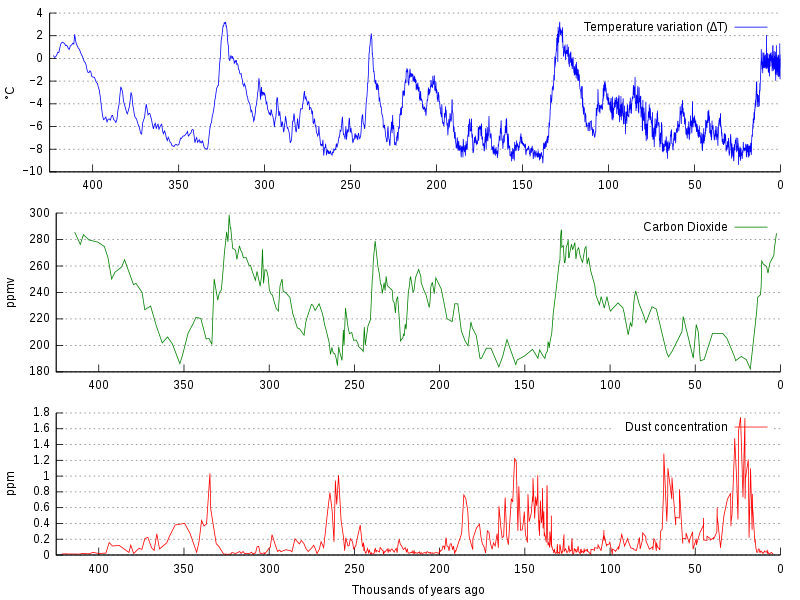
No, the "back to normal" effect from the last ice age ended about 8000 years ago. The warm interglacial peaks are actually very short, as can be seen in this temperature graph:
And the last 12000 years close up:
http://en.wikipedia.org/wiki/File:Holocene_Temperature_Variations.png
-
Re:The meaning of random
30 years is too short a period to be drawing conclusions. Looking at all of the current interglacial--back 10,000 years--makes more sense: http://smpro.ca/crunch/GISP2Civil.png
On that scale, these guys' record years are chump change. If the Mann Hockey Stick is an indicator that we're leaving the current cold spell and going back to normal temperatures, we can expect lots of "record years" for the next 200-500 years before it turns around again.Using several sources instead of one will give you a better picture of the global temperature. In particular, the +- 3-4C variance within just a few thousand years is something you'd never get globally. Ice ages are only a 10C dip.
-
Re:The meaning of random
30 years is too short a period to be drawing conclusions. Looking at all of the current interglacial--back 10,000 years--makes more sense: http://smpro.ca/crunch/GISP2Civil.png
Let me state quite clearly: it is not a question of taste or opinion what constitutes a too short period for drawing conclusions, it is a question of statistical significance and the level of acceptable certainty. The shortest time interval for statistically significant warming at p < 0.05 is about 15 years. The precise shortest time period depends on the given years of course. We're seeing statistically significant warming since 1996 for example.
The graph you linked is a local temperature measurement, it isn't the global average. For a much better overview please click here. Consider the fact though, that even though we had higher temperatures a couple of million years ago, we haven't had a civilization back then.Having walked my dogs in -20C weather this morning, it can't get warmer fast enough.
It might get even colder locally for you, if for example an oceanic current starts moving away from it's current path by a couple of hundred miles. By the way, the recent cold spell was the consequence of artic cold air being pushed down to Northern America and Europe while the Arctic warmed to unusually high temperatures. This might in fact happen a lot more often in the future.
-
Re:The world would be a better place...
If all of the above are attacks then what do you call it when one person physically assaults another person?
-
Re:The meaning of random
There are places in Europe below sea level. Dams and dikes are a practical solution. Building them around our coasts would create jobs. I never understood this whole "OMG we'll flood the coasts" screaming. If this is an issue then start lobbying Washington for funds to build dams.
That worked really awesomely in New Orleans.
And of course it's an entirely free proposition, that's dirt cheap, doesn't require reengineering ports, closing beaches with the resulting loss of tourism or anything like that. The US fortunately has a smoothly running system as shown by the exemplary mantenance records of the New Orleans levees.
And BTW, we did not have a problem resettling all the people from New Orleans on very short notice. Resettling the coasts would take years and is entirely doable on that time scale.
The main questions are whether we expect sea levels to continue rising, the time scale and the cheapest way to deal with it.Yes, indeed. Things went very smoothly.
It's very funny that you use the very thing I'd use to explain why it'd be a monumental mess to try to argue everything would be fine.
-
Re:The meaning of random
-
Re:The meaning of random
As others have pointed out, rising based on what? How do you know what the co2 and methane levels were 1000 years ago? 2000 years ago? 100,000 years ago?
Ice cores how do they work?
When we can't predict the weather accurately three hours from now, how exactly am I supposed to believe they can tell me precisely what effect we're having on the environment?
When you don't know the difference between weather and climate, how do you know what you're talking about?
-
Re:1.21GW
Some may prefer to use the phone and have the toast delivered?
https://secure.wikimedia.org/wikipedia/en/wiki/Mister_Ed
These solar cars and efficiency are a great thing and all, but sometimes I'd still like to see a competition with cars shooting flames out the back, Bat-mobile style...
-
Re:Probably Wrong but Clearly FalsifiableI don't have any specific sources, other than the original paper linked by TFA. For my statements about using trellis algorithm, try any books about coding theory. Unfortunately the wikipedia article on trellis is not very helpful.
The more general idea behind this is dynamic programming. If you have an equation of N boolean variables, you can brute force in 2^N. If you have M equations of 2^N variables, where equation share variables only with one or more neighbouring equations, you can determine solutions for every equation on its own in M*2^N steps and save those (partial) solutions. Then to find a solution that satifies all equations you just have to find a "path" through all equations from left to right. That path has M*2^N nodes. The edges of the graph connect solutions that do not collide (i.e. where variables overlapping between solutions take the same value). Since only neighbouring equations overlap in their variables, the number of edges per node is some (not too large) constant. Finding such a path is now straight-forward and polynomial effort. see also here.
So for the riplets in this paper N is 3, so 2^N is a constant, leaving no exponential in the computational cost function. I hoped other people could comment on their impression of the paper, but as this is
-
Re:Probably Wrong but Clearly FalsifiableI don't have any specific sources, other than the original paper linked by TFA. For my statements about using trellis algorithm, try any books about coding theory. Unfortunately the wikipedia article on trellis is not very helpful.
The more general idea behind this is dynamic programming. If you have an equation of N boolean variables, you can brute force in 2^N. If you have M equations of 2^N variables, where equation share variables only with one or more neighbouring equations, you can determine solutions for every equation on its own in M*2^N steps and save those (partial) solutions. Then to find a solution that satifies all equations you just have to find a "path" through all equations from left to right. That path has M*2^N nodes. The edges of the graph connect solutions that do not collide (i.e. where variables overlapping between solutions take the same value). Since only neighbouring equations overlap in their variables, the number of edges per node is some (not too large) constant. Finding such a path is now straight-forward and polynomial effort. see also here.
So for the riplets in this paper N is 3, so 2^N is a constant, leaving no exponential in the computational cost function. I hoped other people could comment on their impression of the paper, but as this is
-
Re:I would think...
-
Re:Human beings are closer to being an idea
If every part of anyone's body can be replaced, and even completely transfigured and upgraded for various other better parts, what is a human being?
A captain of the Ship of Theseus.