Slashdot Mirror
Domain: wikipedia.org
Stories and comments across the archive that link to wikipedia.org.
Stories · 7,048
-
Guitar, Studio Wizard Les Paul Dies At 94
beeshman noted that Les Paul has died. Paul was quite the hardware hacker of his day, innovating with guitar hardware, and later multi track recording. The Gibson Les Paul is one of the single most iconic instruments associated with Rock 'n Roll, and was of course played by Pete Townshend. Someday I'm going to get me one. -
Wikipedia Approaches Its Limits
Reservoir Hill writes "The Guardian reports that a study by Ed H Chi demonstrates that the character of Wikipedia has changed significantly since Wikipedia's first burst of activity between 2004 and 2007. While the encyclopedia is still growing overall, the number of articles being added has reduced from an average of 2,200 a day in July 2007 to around 1,300 today while at the same time, the base of highly active editors has remained more or less static. Chi's team discovered that the way the site operates had changed significantly from the early days, when it ran an open-door policy that allowed in anyone with the time and energy to dedicate to the project. Today, they discovered, a stable group of high-level editors has become increasingly responsible for controlling the encyclopedia, while casual contributors and editors are falling away. 'We found that if you were an elite editor, the chance of your edit being reverted was something in the order of 1% — and that's been very consistent over time from around 2003 or 2004,' says Chi. 'For editors that make between two and nine edits a month, the percentage of their edits being reverted had gone from 5% in 2004 all the way up to about 15% by October 2008. And the 'onesies' — people who only make one edit a month — their edits are now being reverted at a 25% rate.' While Chi points out that this does not necessarily imply causation, he suggests it is concrete evidence to back up what many people have been saying: that it is increasingly difficult to enjoy contributing to Wikipedia unless you are part of the site's inner core of editors. Wikipedia's growth pattern suggests that it is becoming like a community where resources have started to run out. 'As you run out of food, people start competing for that food, and that results in a slowdown in population growth and means that the stronger, more well-adapted part of the population starts to have more power.'" -
Encryption? What Encryption?
Slashdot regular Bennett Haselton writes with his take on the news we discussed early this morning about the UK government's prosecution of two people who refused to disclose their encryption keys: "Is it possible to write a program that enables you to encrypt files without drawing suspicion upon yourself if anyone ever seizes your computer? No; a program by itself, no matter how perfectly written, couldn't do this because you'd still attract suspicion just for possessing the software. You'd need a social element driving the program's popularity until it gets to the point where people no longer look suspicious just for having the program installed. Here are some theories on how that could happen — but it would be a high bar to clear." Hit the link below for the rest of Bennett's thoughts.Police in Britain have announced that two people have successfully been prosecuted under a UK law that forces defendants to give up their encryption keys and penalizes those who don't comply. Another UK woman's case had attracted attention two years ago, when the government demanded she give up her encryption keys after the police found encryption software on her computer, but the police say she was not one of the two defendant's charged. Is there a software solution to this problem — a way that people can encrypt files on their computers, without arousing the suspicion of law enforcement if the computers are seized?
File encryption, if properly implemented, is generally considered mathematically unbreakable. But to prevent suspicion falling on people just for encrypting files in the first place, requires a human solution as well as an engineering one. One way or another, some file encryption software would have to be in widespread use that has these two properties: (1) it's deployed on a large number of people's machines — not just a large absolute number, but a significant proportion of the total population, so that suspicion does not fall on people just for possessing the software — and (2) it should not be possible to tell the difference between machines where the users use the software regularly, and machines where the software has never been run. Then, and only then, would it be possible to use the encryption software on your machine, without anyone who seizes the machine having reason to think that you had ever encrypted anything at all.
(Of course, in a relatively free society, if law enforcement has probable cause to seize your machine in the first place, then they would presumably already have some evidence against you. But this would at least prevent police officers and judges from becoming more suspicious as a result of encryption software being present on your machine.)
Note that this is similar to the kind of problem that is normally solved with steganography, but by my reasoning, I don't think that using stego would actually gain anything in this situation. Whether you're talking about encryption software or stego software, if it's a program that not a lot of people have installed, then just by virtue of having it on your machine, you'll attract suspicion if your machine is seized. On the other hand, suppose you've cleared that hurdle and the software is installed on a lot of people's computers, so that just having installed it is not by itself grounds for suspicion. If it's stego, then you can embed the hidden data inside other images or videos, so that an intruder can't tell whether you've been using the software to hide anything (assuming the stego software is good enough that the intruder can't tell the images have been tampered with). But you could achieve the same thing with straight encryption software: just have every installation of the program create a "storage volume" file, where encrypted files will be stored. As long as a storage volume file with files embedded in it, is indistinguishable from a storage volume file that has never been touched, the presence of the storage volume file won't give you away.
I'm not actually aware of any encryption program that has that property: that for a given machine with the software installed, it's impossible to tell whether the software has ever been used to encrypt data. This is probably because this would normally not be a useful feature of an encryption program. The whole point of making it impossible to tell whether someone has used the program or not, is that people who have used the program would not attract undue attention to themselves as a result. But if the encryption program is only used by one thousandth of one percent of total Internet users anyway, then just the fact that a user has the program installed, would be enough to draw suspicion to the user if their computer is seized, so there's no benefit to concealing the fact that the program has been used. On the other hand, if the encryption program is installed on a significant proportion of users' machines anyway, then simply having the program installed is no longer grounds for suspicion. And that's when it would become a valuable feature for it to be difficult to tell whether the owner of the machine actually uses the encryption program or not.
This may be hard to implement correctly, and there are some tradeoffs that will have to be decided. For example, if the program creates a default "storage volume" file when it's installed, how big should that initial volume be? The problem with creating a small storage file initially and then letting it grow as encrypted files are added, is that this now makes it easy to tell who is using the program and who isn't — anyone whose storage file has grown beyond the default size, is using it to encrypt files (and is therefore a terrorist movie-downloading child pornographer, etc.). In order to avoid suspicion falling on people who use the program, the storage file would have to be the same size on everyone's computer. If you make it 1 GB, that wastes a lot of space on people's machines who aren't using it. On the other hand, if it's only 1 GB, it also means that users will only be able to store up to 1 GB of encrypted data — any more than that, and they'll have to expand the size of the storage file, thus calling attention to themselves if the machine is ever seized. And then, what about the fact that a large file which is created all at once, is normally not fragmented very much, but if the storage file is frequently modified, it is likely to become more and more fragmented — thus giving people a way to tell if the encryption program is being used frequently. (So you'd either have to deliberately create a very fragmented storage file by default on the first install, or create an unfragmented file on first install but then make sure to read and write from the file in a way that doesn't fragment it further.) I don't want to get too bogged down in implementation details. The point is just that you'd have to block all the possible ways that an intruder would be able to tell whether the software is used frequently — forget one thing, and you've given an intruder a way to identify people who are actually using the software to encrypt files.
A program called TrueCrypt achieves something close to this — TrueCrypt allows you to encrypt a storage volume with two different passwords, so that one password provides access to "innocent-looking" data, while the other password provides access to the data that you really want to keep secure. If someone is compelled to give up their password, they could provide only the password that unlocks the "innocent-looking" data — and there's no way, from examining the encrypted file, to tell that there is a second password guarding even-more secret data. (Of course, the "innocent-looking" data can't be truly innocent-looking, because it has to look like the kind of thing that someone would believe you might want to encrypt — so it should look suspicious enough that you would genuinely want to hide it, but not bad enough to get you in real trouble if you're forced to reveal it!) The Achilles heel of this scheme is that just having TrueCrypt on your computer in the first place, would at least signal to an intruder that you're encrypting files. And even if they can't prove that you might have another "super-secret password" guarding more private data on your encrypted volume, they would certainly suspect it, if they already had grounds to be investigating you and if they knew anything about how TrueCrypt works. To provide true plausible deniability of any encryption at all, you need a program that already exists on lots of people's machines, so that an intruder doesn't suspect anything when they find it on your computer.
(The same objection also applies to many other non-solutions to the problem, like using a Linux distro that encrypts your entire file system. Even assuming this would be within the technical means of the average person who wanted to do encryption, it's still going to look suspicious as long as the vast majority of people are not doing it.)
Which leads to the other half of the problem, which is getting the software widely deployed enough that it would not look suspicious for someone to have the program installed in the first place. Best of all for the purpose of avoiding suspicion, of course, would be for the program to come installed by default with a popular operating system. Windows XP and Vista have the built-in ability to encrypt folders, but anyone who seizes the machine can still see that you encrypted a folder, so this don't have the undetectability factor. Built-in deniable encryption of the kind that I'm describing, doesn't instinctively feel like the sort of thing that Microsoft would start bundling with its operating system. (Among other things, they might say that while companies often have business reasons for encrypting files, it's harder to think of a business case where employees would need to encrypt files and hide the fact that they were encrypting anything.)
Perhaps instead it could be bundled with a popular free software program beholden to no for-profit corporate masters. (My first thought was Firefox, but I was quickly told that Firefox was created specifically to strip out many of the features that had caused bloat in the original Mozilla project, and that any bundling of unnecessary tools would go against the whole ethos of the project.) Maybe a good place to include something like this would be the Google Pack — it's installed by lots of people, and currently doesn't have a file-encryption tool in the bundle. Beholden to for-profit corporate masters, yes, but ones that frequently declare "Don't Be Evil" and often seem to do cool stuff just to see what would happen.
Another possibility would be for a next-generation P2P program to bundle this capability with their software. This provides a nice dovetailing of interests — P2P users might want a way to hide the files that they've downloaded, while at the same time, intruders who seize the computer and found the P2P application installed, wouldn't necessarily suspect the owner of anything more than a little copyrighted file trading. "Well, he's got this NiftyP2P program installed, which comes with 'plausibly deniable' encryption, but most people use just NiftyP2P to download mp3 files and movies anyway. And I can't tell if he was actually using the encrypted file storage volume, because that's how 'plausibly deniable' encryption works. Is this the same guy who uploaded those subversive anti-government documents? I dunno."
Anyway, if you actually want to give people a way to run encryption software on their PCs, while ensuring that anyone who seizes their machine cannot tell that any encryption has been going on, these are the hurdles that you'd have to clear. I'm not sure whether this is better viewed as a blueprint for how to achieve this goal, or an argument for why it will probably never happen. There are lots of almost-solutions, like TrueCrypt with its ability to encrypt different sets of data into the same storage volume. But you still can't actually hide the fact that you're doing encryption in the first place.
(If you're willing to store your encryption software away from your computer, you could keep a steganography program on a CD or USB drive hidden in your house, and then whenever you need access to the encrypted data, plug in the program and use it to extract data that has been hidden in a large number of image or video files. That would achieve the goals I've outlined in the article: the ability to encrypt files, while still ensuring that anyone who seizes your computer won't be able to tell that you've encrypted anything. The problem is that it would require enough self-discipline to always return the CD or USB stick to its hiding place when you were done with it — and still, you'd have to hope that whatever authorities seize your computer, don't also search your house and find the CD or USB stick where you keep your stego software.)
Finally, risking the wrath of my civil-libertarian allies, I'll admit it may not actually be a positive thing for every citizen to be able to hide the fact from their local law enforcement that they're encrypting files on their computer. Many times if the police in a mostly-free country like the US or the UK seize a person's computer, they're trying to prevent real harm, and not every person with an encrypted file volume is a good guy. For some of the people who have left enough of an evidence trail that their computers get seized, it would be perfectly rational to view them with suspicion because of an encrypted volume found on their computer. But if you assume it's a worthwhile goal for people to be able to encrypt files without attracting suspicion, my argument is that the prerequisites in this article are necessary for that to work. At the moment it seems a long way off. But if someone created an encryption program with "deniability" — so that it was impossible to tell whether the program had ever been used after it was installed — and someone at Google thought "Hey, that's cool" and added it to the Google Pack, everything would change very suddenly.
-
Chevy Volt Rated At 230 mpg In the City
necro81 writes "General Motors, emerging from bankruptcy, today announced that its upcoming plug-in hybrid vehicle, the Volt, will have an EPA rating of 230 mpg for city driving (about 98 km/L). The unprecedented rating, the first in triple digits, is the result of a new (draft) methodology for calculating the 'gas' mileage for vehicles that operate primarily or extensively on electricity. The Volt, due out late next year, can drive approximately 40 miles on its Li-Ion battery pack, after which a gasoline engine kicks in to provide additional electricity to charge the battery. Running off the gasoline engine yields approximately 50 mpg. Of course, the devil's in the details, because the conversion of grid-based electricity to gasoline-mileage is imprecise." Now we know the meaning of the mysterious "230" viral marketing campaign. -
"Terminator Vision" Is Here For the iPhone
musefrog writes "The BBC is reporting that so-called augmented reality has arrived — in the UK at least. From the article: 'Via the video function of a mobile phone's camera it is now possible to combine a regular pictorial view with added data from the internet just as the fictional Terminator was able to overlay its view of the world with vital information about its surroundings. For example, UK-firm Acrossair has launched an application for the iPhone which allows Londoners to find their nearest tube station using their iPhone.' The page features an impressive video demonstrating AR in action." -
Airline Says It Owns the Word "Northwest"
Freshly Exhumed writes "Northwest Airlines, the major airline whose market branding is being phased out after it was acquired by Delta, charges that it has exclusive ownership of the common, geographically descriptive term northwest. The Minnesota-based airline is going after the operator of a small, Spokane Washington web site that provides tourist information for visitors to the Pacific Northwest. From the Seattle Post-Intelligencer, '[the site's owner] said he has so far spent more than $4,000 in the past few months to defend his site, and he's looking at thousands more going forward as he faces battles in the U.S., U.K., and Australia.' Presumably the Government of Canada will be the next Northwest target victim, what with their use of the term to name some of their Territories since 1870. I don't suppose Northwest can sue the world's cartographers, geocachers, boy scouts, etc. can they?" -
Yemenis Should Be Incensed At Websense
Slashdot regular Bennett Haselton writes "Websense, a US-based Internet-censoring software maker, claims not to sell to foreign governments that are censoring Internet access for all of their citizens. But the OpenNet Initiative reports that national ISPs in Yemen have been using Websense to filter Internet access for at least the past four years. Will Websense revoke their license? And what would happen then?" Update: 08/10 21:01 GMT by KD : Bennett adds, "After the story ran, Websense sent me this update." "Since we were informed about the potential use of our products by Yemeni ISPs based on government-imposed Internet restrictions in Yemen, we have investigated this potential non-compliance with our anti-censorship policy. Because our product operates based on a database system, we are able to block updated database downloads to locations and to end users where the use of our product would violate law or our corporate policies. We believe that we have identified the specific product subscriptions that are being used for Web filtering by ISPs in Yemen, and in accordance with our policy against government-imposed censorship, we have taken action to discontinue the database downloads to the Yemeni ISPs."The Internet censoring software maker Websense has a published policy on their website against allowing their software to be used for government-mandated censorship:
Websense does not sell to governments or Internet Service Providers (ISPs) that are engaged in any sort of government-imposed censorship. Any government-mandated censorship projects will not be engaged by Websense. If Websense does win a business and later discovers that the government is requiring all of its national ISPs to engage in censorship of the Web and Web content, we will remove our technology and capabilities from the project.
This supposedly differentiates the company from competitors such as Smartfilter (now owned by McAfee), which according to OpenNet Initiative reports, is used to censor the Internet in several African and Middle Eastern countries including Tunisia, Saudi Arabia, UAE, and Sudan. Websense once enthusiastically competed for the contract to censor Internet access in Saudi Arabia, but has now apparently ceded such markets to Smartfilter.
However, according to the ONI, the two national ISPs in the country of Yemen are using Websense to censor Internet access for all users. The researchers found that some sites are blocked in Yemen that are probably not on Websense's original filtering list, such as the Yemeni Socialist Party, as well as sites that are blocked under standard Websense categories, such as pornography, sex education materials, and "anonymizing and privacy tools" (presumably, proxy sites).
Websense declined to tell me whether they have ever revoked an ISP's license to use Websense after discovering that the ISP was using it in violation of their anti-government-censorship policy. They also declined to say whether they had any ISP customers in Middle Eastern countries, apart from Yemen. (For any Middle Eastern ISP using Websense, there's a high probability that they would be doing it as a result of a government mandated filtering policy, and hence in violation of Websense's stated rules.) But regarding the use of Websense in Yemen, Websense did reply to say simply, "We will look into the matter. If our software is being used in violation of our policy, we will take appropriate action." I think that if they were serious about preventing their software from being used for government censorship, they should have red-flagged any purchase from a national ISP in a country with one of the worst press-freedom ratings in the world, but better late than never.
There are only about 200,000 Internet users in Yemen, compared to over six million in Saudi Arabia, millions more in other censored Middle Eastern countries, and 300 million in Internet-censored China. (And even the Yemenis' Internet access is not filtered all the time, since the ONI report says that the number of concurrent licenses for Websense purchased by the Yemeni ISPs is less than the number of Yemeni Internet users, and when the number of concurrent users exceeds the number of licenses, all requests go through unfiltered!) So it would be a small step towards global liberation of the Internet, but still equivalent to de-censoring Internet access for every resident of Boise if the city had 100% broadband penetration, which is enough to justify putting the squeeze on Websense.
What exactly would happen if Websense did revoke their license for the Yemeni ISPs? They couldn't force the ISPs to uninstall the software, but they could stop allowing them to download further updates to the Websense blocked-site list. Most installations of Websense are configured to download updates to the list every day, to block the latest adult websites as well as to try and stay ahead of newly released proxy sites. Once the list updates stopped, all existing blocked websites would remain blocked, but newly created adult sites and proxy sites would be accessible, and the filtering would gradually become less and less effective. So it would be a concrete victory for Yemeni Internet users, and not just a symbolic gesture.
How would we know if Websense went through with it, anyway, if they refuse to confirm or deny that they have revoked the licenses for Yemen? The ONI declined to tell me how exactly they determined that Yemeni ISPs were using Websense. (Not that I mind; they could have obtained this information with the help of people whose jobs and freedom would be at stake if they were found out, in which case ONI would not be able to share their confidential sources.) Presumably the ONI could repeat their research in the future to determine if Websense were still being used. However, even if they can see that Websense software is still being used to censor the Internet, it may not be easy to tell whether the Yemeni ISPs are still downloading updates to the blocked-site list. My suggestion: Create a new proxy site and don't publicize it anywhere, but report it to Websense for blocking. Test a few days later to verify that it's blocked by Websense, but not by Smartfilter or other popular blocking programs. Then see if it's blocked in Yemen as well. If not, then hopefully that means that Websense cut them off.
And then what? Maybe the Yemeni ISPs will just continue using Websense with a frozen copy of the blocked site list, reasoning that most of the well-known adult sites that users are going to try to visit, are probably already on that list. Maybe they'll set up a shell company in another country, posing as an ISP requesting a legitimate copy of Websense, and buy a new list subscription that way. But it will still be worth it to press Websense into revoking their license, even if it only breaks Internet censorship in Yemen for a few months or a year. At that point, perhaps they'll just take their business to Smartfilter like almost every other Middle Eastern country that censors the Internet.
After all, we shouldn't pick on Websense too much, when Smartfilter is censoring national Internet access for about 100 times that many users in total. If Websense says they don't provide software to government censors, then we should hold them to that. But the real scandal isn't that American censorware companies provide filters to censoring governments while claiming not to, it's that American companies are doing it at all.
-
21st International Olympiad of Informatics Opens, In Bulgaria and Online
Kostadin Vodenicharov writes "The International Olympiad in Informatics is considered one of the most prestigious programming contests in the world. Currently the 21st IOI is being held in Plovdiv, Bulgaria (which was the country that also hosted the 1st IOI), from 8th to 15th August. High school students from all over the world have gathered to put their programming skills to the test. Everyone else who wishes to participate can do it in the online contest which will run in parallel with the real one and will present the same tasks to be solved. The competition itself is going to take place on Monday 10th August and Wednesday 12th August from 9:00 to 14:00 EEST (UTC+3)." -
21st International Olympiad of Informatics Opens, In Bulgaria and Online
Kostadin Vodenicharov writes "The International Olympiad in Informatics is considered one of the most prestigious programming contests in the world. Currently the 21st IOI is being held in Plovdiv, Bulgaria (which was the country that also hosted the 1st IOI), from 8th to 15th August. High school students from all over the world have gathered to put their programming skills to the test. Everyone else who wishes to participate can do it in the online contest which will run in parallel with the real one and will present the same tasks to be solved. The competition itself is going to take place on Monday 10th August and Wednesday 12th August from 9:00 to 14:00 EEST (UTC+3)." -
21st International Olympiad of Informatics Opens, In Bulgaria and Online
Kostadin Vodenicharov writes "The International Olympiad in Informatics is considered one of the most prestigious programming contests in the world. Currently the 21st IOI is being held in Plovdiv, Bulgaria (which was the country that also hosted the 1st IOI), from 8th to 15th August. High school students from all over the world have gathered to put their programming skills to the test. Everyone else who wishes to participate can do it in the online contest which will run in parallel with the real one and will present the same tasks to be solved. The competition itself is going to take place on Monday 10th August and Wednesday 12th August from 9:00 to 14:00 EEST (UTC+3)." -
Linux-Friendly, Internet-Enabled HDTVs?
mrchaotica writes "I'm in the market for a new HDTV (in the $1200-or-slightly-more range, as I won the extended-service-plan lottery and have a Sears store credit). Several of the TVs I've looked at have various 'Internet TV' features (here are Samsung's and Panasonic's). Some manufacturers appear to be rolling their own, while others are partnering with Yahoo (maybe in an attempt to create a 'standard?'). Moreover, these TVs also tend to run Linux under the hood (although their GPL compliance, such as in Panasonic's case, may leave something to be desired). Finally, it's easy to imagine these TVs being able to support video streaming services (YouTube, Netflix, Amazon, etc.) without a set-top box, but I don't know the extent to which that support actually exists. Here are my questions: 1) Is this 'Internet TV' thing going to be a big deal going forward, or just a gimmick? 2) Which manufacturers are most [open standard|Linux|hacker]-friendly? 3) Which TV models have the best support (or best potential and community backing) for this sort of thing?" -
Underground App Store Courts the Jailbroken
PainMeds writes "Apple's stepped-up and controversial rejections are helping to foster competition in the app store marketplace. According to an article by Wired, developers aren't taking AppStore rejection lying down, but are turning to the hacking community's repository system for the iPhone to launch an app store of their own. The 4-month-old Cydia store is yielding notably higher sales for a few application developers than Apple's AppStore, and is reportedly running on over 4 million Apple iPhone devices, with perhaps 350,000 connected at any one time. In this store, developers are distributing applications they've written that push the limits of Apple's normal AppStore policies, with software to add file downloads to Safari, trick applications into thinking they're on Wi-Fi (for VoIP), and enhance other types functionality. You'll also find the popular Google Voice application, which was recently rejected by Apple. Third party application development has been around since 2007, when the iPhone was originally introduced, and became so popular that O'Reilly Media published a book geared toward writing applications before an SDK was available. The Cydia store acts as both a free package repository and commercial storefront to third-party developers." -
Feds At DefCon Alarmed After RFIDs Scanned
FourthAge writes "Federal agents at the Defcon 17 conference were shocked to discover that they had been caught in the sights of an RFID reader connected to a web camera. The reader sniffed data from RFID-enabled ID cards and other documents carried by attendees in pockets and backpacks. The 'security enhancing' RFID chips are now found in passports, official documents and ID cards. 'For $30 to $50, the common, average person can put [a portable RFID-reading kit] together,' said security expert Brian Marcus, one of the people behind the RFID webcam project. 'This is why we're so adamant about making people aware this is very dangerous.'" -
HTML 5 Canvas Experiment Hints At Things To Come
An anonymous reader writes with an interesting and impressive demonstration of modern browsers' HTML 5 capabilities. "From the 9elements blog: 'HTML5 is getting a lot of love lately. With the arrival of Firefox 3.5, Safari 4 and the new 3.0 beta of Google Chrome, browsers support some great new features including canvas and the new audio/video tags. [...] We've created a little experiment which loads 100 tweets related to HTML 5 and displays them using a javascript-based particle engine.' The site warns "(beware: sophisticated browser needed)"; Firefox 3.5 seems to work fine. -
Murdoch Says, "We'll Charge For All Our Sites"
Oracle Goddess writes "In what appears to be a carefully planned suicide, Rupert Murdoch announced that his media giant News Corporation Ltd intends to charge for all its news websites in a bid to lift revenues, as the transition towards online media permanently changes the advertising landscape. 'The digital revolution has opened many new and inexpensive methods of distribution, but it has not made content free. Accordingly we intend to charge for all our news websites,' Murdoch said." -
Expedition To Explore an Alaska-Sized Plastic "Island"
Peace Corps Online writes "An expedition called Project Kaisei has departed bound for the Great Pacific Garbage Patch — a huge 'island' of plastic debris in the Pacific Ocean estimated to be the size of Alaska (some estimates place it at ten times that size). The expedition will study the impact of the waste on marine life, and research methods to clean up the vast human-created mess in the Pacific. The BBC quotes Ryan Yerkey, the project's chief of operations: 'Every piece of trash that is left on a beach or ends up in our rivers or estuaries and washes out to the sea is an addition to the problem, so we need people to be the solution.' The garbage patch occupies a large and relatively stationary region of the North Pacific Ocean bound by the North Pacific Gyre, a remote area commonly referred to as the horse latitudes. The rotational pattern created by the North Pacific Gyre draws in waste material from across the North Pacific Ocean, including the coastal waters off North America and Japan. As material is captured in the currents, wind-driven surface currents gradually move floating debris toward the center, trapping it in the region. 'You are talking about quite a bit of marine debris but it's not a solid mass,' says Yerkey. 'Twenty years from now we can't be harvesting the ocean for trash. We need to get it out but we need to also have people make those changes in their lives to stop the problem from growing and hopefully reverse the course.'" -
Goodbye Apple, Hello Music Production On Ubuntu
Adam Wrzeski notes a piece up at Create Digital Music by musician Kim Cascone (artist's bio) on switching from Apple to Linux for audio production: "The [Apple] computer functioned as both sound design studio and stage instrument. I worked this way for ten years, faithfully following the upgrade path set forth by Apple and the various developers of the software I used. Continually upgrading required a substantial financial commitment on my part. ... I loaded up my Dell with a selection of Linux audio applications and brought it with me on tour as an emergency backup to my tottering PowerBook. The Mini 9 could play back four tracks of 24-bit/96 kHz audio with effects — not bad for a netbook. The solution to my financial constraint became clear, and I bought a refurbished Dell Studio 15, installed Ubuntu on it, and set it up for sound production and business administration. The total cost was around $600 for the laptop plus a donation to a software developer — a far cry from the $3000 price tag and weeks of my time it would have cost me to stay locked-in to Apple. After a couple of months of solid use, I have had no problems with my laptop or Ubuntu. Both have performed flawlessly, remaining stable and reliable." -
Adjustable-Focus Glasses Can Replace Bifocals
Hugh Pickens writes "The NY Times reports that inventor Stephen Kurtin has developed glasses with a mechanically adjustable focus that he believes can free nearly two billion people around the world from bifocals, trifocals and progressive lenses. Kurtin has spent almost 20 years on his quest to create a better pair of spectacles for people who suffer from presbyopia — the condition that affects almost everyone over the age of 40 as they progressively lose the ability to focus on close objects. The glasses have a tiny adjustable slider on the bridge of the frame that makes it possible to focus alternately on the page of a book, a computer screen, or a mountain range in the distance. 'For more than 140 years, adjustable focus has been recognized as the Holy Grail for presbyopes,' says Kurtin. 'It's a blazingly difficult problem.' Each 'lens' is actually a set of two lenses, one flexible and one firm. The flexible lens (near the eye) has a transparent, distensible membrane attached to a clear rigid surface. The pocket between them holds a small quantity of crystal-clear fluid. As you move the slider on the bridge, it pushes the fluid and alters the shape of the flexible lens." -
Microsoft Redefines "Open Standards"
Glyn Moody writes "Microsoft is at it again: trying to redefine what 'open' means. This time it wants open standards to be 'balanced' — for them to include patent-encumbered technologies under RAND (reasonable and non-discriminatory) terms. Which just happens to be incompatible with free software licensed under the GNU GPL." -
Toyota Reveals A Humanoid Robot That Can Run
Peter writes "Toyota researchers have unveiled a new humanoid robot that can run at 7 km/h, which is faster than Honda's humanoid robot ASIMO. Toyota's robot can also keep itself balanced when pushed, as shown in the video." -
The Ethics of Selling GPLed Software For the iPhone
SeanCier writes "We're a small (two-person) iPhone app developer whose first game has recently been released in the App store. In the process, we've inadvertently stepped in it, bringing up a question of the GPL and free software ethics that I'm hoping the Slashdot community can help us clear up, one way or the other. XPilot, a unique and groundbreaking UNIX-based game from the early/mid nineties, was a classic in its day, but was forgotten and has been dead for years, both in terms of use and development. My college roommate and I were addicted to it at the time, even running game servers and publishing custom maps. As it's fully open source (GPLv2), and the iPhone has well over twice the graphics power of the SGI workstations we'd used in college, we decided it was a moral imperative to port it to our cellphones. In the process, we hoped, we could breathe life back into this forgotten classic (not to mention turning a years-old joke into reality). We did so, and the result was more playable than we'd hoped, despite the physical limitations of the phone. We priced it at $2.99 on the App store (we don't expect it to become the Next Big Thing, but hoped to recoup our costs — such as server charges and Apple's annual $99 developer fee), released the source on our web page, then enthusiastically tracked down every member of the original community we could find to let them know of the hoped-for renaissance. Which is where things got muddy. After it hit the App store, one of the original developers of XPilot told us he feels adamantly that we're betraying the spirit of the GPL by charging for it." Read on for the rest of Sean's question. "That left us in a terrible spot. We'd thought we were contributing to the community and the legacy of this game by reviving it, not stealing from them by charging for it — and we didn't think $2.99 was unreasonable (and, again, the source is available for free from our page). It never occurred to us that one of the original creators would feel that we were betraying their contribution. We've discussed the philosophical fine points of free-as-in-speech vs. free-as-in-beer with him, and have suggested a number of remedies — such as reducing the price (it's now $1.99), profit-sharing with previous contributors, making the game free at some point in the future (once we'd at least recouped our costs), or going 'freemium' (offering a fully-functional free version plus a paid version with enhancements we added ourselves, with both GPLed of course). But in each case, the bottom line is that this developer feels the app should be free-as-in-beer period, and anything less is a sleazy betrayal of anybody that made contributions under that license. Which is a shame, because we deeply respect his work on this game and would love for him to be on board with the port — but at the same time this was months worth of work and we honestly believe we're going about this in a reasonable way.
Obviously, one of us has a non-mainstream understanding of open source ethos, but it's become clear we can't come to a consensus on which of us it is, and whether the 'spirit of the GPL' should allow selling GPLed software (especially when one wasn't the original creator of the software, but a more recent contributor). The only way to determine that, it seems, is to poll the open source community itself.
We're determined to do the right thing by the GPL and the community, and we'd like to hear opinions on this. Remember, we're not talking about whether it's practical to base a business on GPLed software, nor the best business model for doing so, and certainly not whether the source must be distributed for free (obviously it must be), but just whether charging for the binary version of an enhanced/ported version of a GPLed app (while releasing the corresponding source for free) is an ethically defensible thing to do." -
Fewer Than 10 ET Civilizations In Our Galaxy?
Al writes "The Fermi Paradox focuses on the existence of advanced civilizations elsewhere in the galaxy. If these civilizations are out there — and many analyses suggest the galaxy should be teeming with life — why haven't we seen them? Carlos Cotta and Álvaro Morales from the University of Malaga in Spain investigate another angle by considering the speed at which a sufficiently advanced civilization could colonize the galaxy. Various analyses suggest that using spacecraft that travel at a tenth of the speed of light, the colonization wavefront could take some 50 million years to sweep the galaxy. Others have calculated that it may be closer to 13 billion years, which may explain ET's absence. Cotta and Morales study how automated probes sent ahead of the colonization could explore the galaxy. If these probes left evidence of a visit that lasts for 100 million years, then there can be no more than about 10 civilizations out there." -
Linguistic Clue Pushes Back Origin of "World's Oldest Computer"
Calopteryx points out a piece at New Scientist which suggests that the Antikythera mechanism may be even older than previously thought; an ancient Greek word on of the device's dials suggests the device may date to the early second century BC. The article is accompanied by a great animation of its (deduced) workings, too. -
Making a Game of Hardware Design
no-life-guy writes "Researchers at the University of Michigan have developed a web-game to harness the natural human abilities for electronic design automation (EDA). Arguing that people are still much better than computers in games of strategy and visualization, and that we'll do anything as long as it's fun, a group created FunSAT — a game where an average Joe gets to solve a Boolean satisfiability problem. Known as SAT, this problem is an important component in various hardware design tools from formal verification to IC layout to scheduling. The pilot version is a puzzle-like single-player Java app (akin to those addictive web-games), but the researchers envision that it can be extended to a multi-player (and, perhaps, replace WoW as the favorite past-time of the millions), so anybody can be a hardware designer. If anything, this is definitely a great learning tool." -
Alan Cox Quits As Linux TTY Maintainer — "I've Had Enough"
The Slashdolt writes "After a stern criticism from Linus, the long-time kernel hacker Alan Cox has decided to walk away as the maintainer of the TTY subsystem of the Linux Kernel, stating '...I've had enough. If you think that problem is easy to fix you fix it. Have fun. I've zapped the tty merge queue so anyone with patches for the tty layer can send them to the new maintainer.'" A response to a subsequent post on the list makes it quite clear that he is serious. -
AMD Spin-Off GlobalFoundries Gets First Non-AMD Customer
Vigile writes "Since the company was spun off in March, GlobalFoundries has struggled to answer how it will survive and compete against powers like TSMC and UMC in the global world of chip manufacturing. Part of that answer came today when they announced the company's first customer, excluding AMD. STMicroelectronics will be using GlobalFoundries' 40nm lower power process technology for future cell phone SoC designs in the second half of 2010. While one customer won't drive enough revenue to make the foundry completely independent, it is an important step in the right direction and could lead to other customers finally making the leap." -
Tetraktys
brothke writes "Imagine for a moment what his novels would read like if Dan Brown got his facts correct. The challenge Brown and similar authors face is to write a novel that is both compelling and faithful to the facts. In Tetraktys, author Ari Juels is able to weave an interesting and readable story, and stay faithful to the facts. While Brown seemingly lacks the scientific and academic background needed to write such fiction, Juels has a Ph.D. in computer science from Berkeley and is currently the Chief Scientist and director at RSA Laboratories, the research division of RSA Security." Read below for the rest of Ben's review. Tetraktys author Ari Juels pages 351 publisher Emerald Bay Books rating Excellent debut novel by Ari Juels reviewer Ben Rothke ISBN 978-0982283707 summary Intriguing cryptographic thriller The book, which might be the world's first cryptographic thriller, tells the story of Ambrose Jerusalem, a gifted computer security expert, still haunted by his father's death, a few months shy of his doctorate, who has a beautiful and loving girlfriend, and a bright future ahead of him. This is until the government gets involved and Jerusalem's plans are put on hold when the NSA asks him to join them to track down a strange and disturbing series of computer breaches.
Tetraktys, like similar thrillers, has its standard set of characters; from corrupt State Department and World Bank officials, a dashing protagonist with a long-suffering girlfriend, to mysterious and obscure terrorist groups. This terrorist group is in the book is comprised of followers of Pythagoras.
As to the title, a tetraktys is a triangular figure of ten points arranged in four rows, with one, two, three, and four points in each row. It is a mystical symbol and was most important to the followers of Pythagoras. While mainly known as the creator of the Pythagorean theorem, Pythagoras of Samos was an influential Greek mathematician and founder of the religious movement of Pythagoreanism. Those wanting more information can watch a video about the symbol.
As to the storyline, the NSA is trying to recruit Ambrose as they feel that the terrorists, who form a secret cult of followers of Pythagoras have broken the RSA public-key algorithm. Breaking RSA is something that is not expected for many decades, but if a revolution in factoring numbers were to occur sooner, RSA's demise could happen that much quicker. And if RSA was indeed broken by the antagonists, it would undermine the security of nearly every government and financial institution worldwide and create utter anarchy.
A good part of the book centers on the cult of Pythagoras. Its followers believe that truth and reality can only be understood via their system of numbers. The NSA needs Jerusalem's assistance as he is one of the few people who have the mathematical, classical and philosophical background to help them. It is he who ultimately connects the dots that the Pythagoreans have left, which leads to the books dramatic conclusion.
The book is a most enjoyable read and one is hard pressed to put it down once they start reading it. The reader gets a good understanding of who Pythagoras was and his worldview via Juels weaving of Pythagorean philosophy into the storyline.
While the book is not autobiographical, there are many similarities between Ambrose Jerusalem and Ari Juels. From identical initials, to their lives in events in Berkeley and Cambridge, to RSA and more.
For a first book of fiction, Tetraktys is a great read. As a novelist, Juels style approaches that of Umberto Eco, in that he weaves numerous areas of thought into an integrated story. Like Eco's works, Tetraktys has an arcane historical figure as part of it storyline, and an intricate plot that takes the reader on many, and some unexpected, turns. While not as complex and difficult to read as Eco, Tetraktys is a remarkable work of fiction for someone with a doctorate in computer science, not literature.
The book though does have some gaps, but that could be expected for a first novel. The reader is never sure what the Pythagoreans are really after or why they have resurfaced, and one of the characters is killed, for reasons that are not apparent. Readers who want more information can visit the Tetraktys web site.
As to the book's protagonist, Ambrose Jerusalem is to Juels what Jack Ryan is to Tom Clancy, meaning that his adventures are just beginning, and that is a good thing.
For those interested in a cryptographic thriller, Tetraktys is an enjoyable read. The book interlaces Greek philosophy, mathematics, and modern crime into a cogent theme that is a compelling read. And if the exploits of Ambrose Jerusalem continue, we may have found the successor to Umberto Eco.
Ben Rothke is the author of Computer Security: 20 Things Every Employee Should Know.
You can purchase Tetraktys from amazon.com. Slashdot welcomes readers' book reviews -- to see your own review here, read the book review guidelines, then visit the submission page. -
Rude Drivers Reduce Traffic Jams
BuzzSkyline writes "Traffic jams are minimized if a significant fraction of drivers break the rules by doing things like passing on the wrong side or changing lanes too close to an intersection. The insight comes from a cellular automata study published this month in the journal Physical Review E. In effect, people who disregard the rules help to break up the groups that form as rule-followers clump together. The risk of jamming is lower if all people obey the rules than if they all disobey them, according to the analysis, but jamming risk is lowest when about 40 percent of people drive like jerks." -
Finally, a True Green Laser
dusty writes "Remember those green lasers from Star Wars? Turns out that faking green lasers has been easy for years, but making true green laser diodes has been the stuff of science fiction. Until recently, that is. Now researchers from Japan have created the world's first true green laser diode. Until now, only red and blue laser diodes were available, and now with the addition of green, new TVs and projectors that are more efficient can be produced. And if you were wondering how green lasers pointers are already produced, it is a hack that involved doubling the frequency of an infrared laser. The new true green laser diodes have much higher efficiency than the current 6%, leading many to expect big time laser display breakthroughs in the near future. Ars Technica has a well-written article on this breakthrough." -
AT&T Blocks Part of 4chan
holdenkarau writes "Several news sources (Mashable, The Inquistr, etc.) are reporting that AT&T is blocking img.4chan.org in the southern United States. That server is used for the infamous /b/ board (the home of anonymous). TechCrunch calls the decision to block 4chan 'stupid,' noting that they may have 'opened perhaps the most vindictive, messy can of worms.' The Inquisitr suggests that 'The global internet censorship debate landed in the home of the free.' moot (who runs 4chan) asks users to call AT&T, while some others suggest more drastic action (like cutting AT&T fiber)." Update: 07/27 09:23 GMT by T : Readers' comments below suggest that a) the purpose of the block was to curtail the effects of a serious DDoS attack and b) that the block has now been lifted, at least for some regions. -
Ivan Krstić Says Negroponte's Wrong About Sugar and OLPC
Not many days ago, we mentioned ZDNet's interview with Nicholas Negroponte, in which Negroponte had some harsh things to say about Sugar and its connection to the slower-than-hoped uptake of the XO. Ivan Krstic (formerly head of the OLPC's security innovative subsystem) responded to Negroponte's claims, which he says are "nonsense." Among other things, he mentions that Sugar "was the name for the new learning-oriented graphical interface that OLPC was building, but it was also the name for the entire XO operating system, one tiny part of which was Sugar the GUI, and the rest of which was mostly Fedora Linux." -
Is Jupiter Earth's Cosmic Protector?
Hugh Pickens writes "Last Sunday, an object, probably a comet that nobody saw coming, plowed into Jupiter's colorful cloud tops, splashing up debris and leaving a black eye the size of the Pacific Ocean — the second time in 15 years that this had happened, after Comet Shoemaker-Levy 9 fell apart and its pieces crashed into Jupiter in 1994, leaving Earth-size marks that persisted up to a year. 'Better Jupiter than Earth,' say astronomers who think that part of what makes Earth such a nice place to live is that Jupiter acts as a gravitational shield, deflecting incoming space junk away from the inner solar system where it could do to humans what an asteroid apparently did for the dinosaurs 65 million years ago. 'If anything like that had hit the Earth it would have been curtains for us, so we can feel very happy that Jupiter is doing its vacuum-cleaner job and hoovering up all these large pieces before they come for us,' says Australian amateur astronomer Anthony Wesley, who first noticed the mark on Jupiter. But others say the warm and fuzzy image of the King of Planets as father-protector may not be entirely accurate. In 1770, Comet Lexell whizzed by the earth, missing us by a cosmic whisker after passing close to Jupiter. The comet made two passes around the Sun and in 1779 again passed very close to Jupiter, which then threw it back out of the solar system." -
Copyright Status of Thermodynamic Properties?
orzetto writes "I work at a research institute, and programming models of physical systems is what I do most of the time. One significant problem when modeling physical processes is finding thermodynamic data. There are some commercial solutions, but these can be quite expensive, and to the best of my knowledge there are no open source efforts in this direction. In my previous job, my company used NIST's Supertrapp, which is not really that expensive, but is written in Fortran, and an old-fashioned dialect at that. As a result, it is a bit difficult to integrate into other projects (praised be f2c), and the programming interface is simply horrible; worse, there are some Fortran-induced limitations such as a maximum of 20 species in a mixture. I was wondering whether it would be legal to buy a copy of such a database (they usually sell with source code, no one can read Fortran anyway); take the data, possibly reformatting it as XML; implement a new programming interface from scratch; and publish the package as free software. Thermodynamic data is not an intellectual creation but a mere measurement, which was most likely done not by the programmers but by scientists funded with our tax money. What are your experiences and opinions on the matter? For the record, I am based in Germany, so the EU database directive applies." -
Are RAID Controllers the Next Data Center Bottleneck?
storagedude writes "This article suggests that most RAID controllers are completely unprepared for solid state drives and parallel file systems, all but guaranteeing another I/O bottleneck in data centers and another round of fixes and upgrades. What's more, some unnamed RAID vendors don't seem to even want to hear about the problem. Quoting: 'Common wisdom has held until now that I/O is random. This may have been true for many applications and file system allocation methodologies in the recent past, but with new file system allocation methods, pNFS and most importantly SSDs, the world as we know it is changing fast. RAID storage vendors who say that IOPS are all that matters for their controllers will be wrong within the next 18 months, if they aren't already.'" -
Free Web Content a "Myth," Claims Barry Diller
BotScout writes "Following in the footsteps of other traditional media executives who just don't get it, Barry Diller, chairman and chief executive officer of IAC/InterActiveCorp, said web users will have to pay for what they watch and use, and that's that. The media and technology executive said it's 'mythology' to view the Internet as a system of free communications. 'It is not free, and is not going to be,' Diller said yesterday at the Fortune Brainstorm conference in Pasadena, California. Companies from Disney to New York Times Co. are seeking ways to extract revenue from the Internet. The latter recently said that it's considering a $5 monthly fee for access to its namesake newspaper's web site." -
IBM Seeks Patent On Digital Witch Hunts
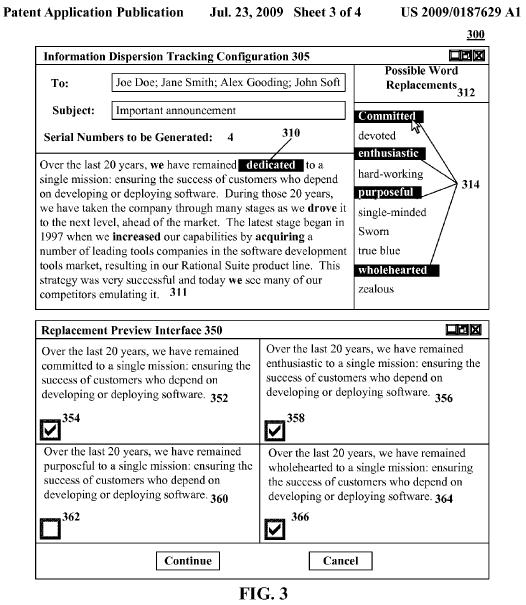
theodp writes "Should Mark Zuckerberg want to identify a snitching Facebook employee, Elon Musk wish to set a trap for loose-lipped Tesla employees, or Steve Jobs want to 'play Asteroid,' they'll be happy to know that a new IBM 'invention' makes it easier than ever to be paranoid. In a newly-disclosed patent application for Embedding a Unique Serial Number into the Content of an Email for Tracking Information Dispersion (phew!), Big Blue describes how it's automated the creation of Canary Traps with patent-pending software that makes ever-so-slight changes to e-mail wording to allow you to spy on the unsuspecting recipients of your e-mail." -
$2 Million NASA Power Beaming Challenge Heating Up
carstene writes "Qualification rounds for the NASA Centennial Challenge Power beaming contest are underway at the Dryden Flight Research Center. The contest uses a scale model of a space elevator as a race track. Entrants must build a robot to climb a cable, suspended by helicopter, 1 km into the sky without any on board energy storage. The teams are using high power laser beams to transmit power from ground stations to photovoltaic arrays on the robots. If a team can accomplish this at 5 meters per second average speed then they could win up to 2 million dollars. One day this technology could be used to power rovers in shadowed areas of the moon or to recharge electric UAV's in-flight or even a space elevator in the far future. A blog of the event can be found here. Full disclosure: I'm a member of the LaserMotive team that you can follow on twitter, or or via blog." -
$2 Million NASA Power Beaming Challenge Heating Up
carstene writes "Qualification rounds for the NASA Centennial Challenge Power beaming contest are underway at the Dryden Flight Research Center. The contest uses a scale model of a space elevator as a race track. Entrants must build a robot to climb a cable, suspended by helicopter, 1 km into the sky without any on board energy storage. The teams are using high power laser beams to transmit power from ground stations to photovoltaic arrays on the robots. If a team can accomplish this at 5 meters per second average speed then they could win up to 2 million dollars. One day this technology could be used to power rovers in shadowed areas of the moon or to recharge electric UAV's in-flight or even a space elevator in the far future. A blog of the event can be found here. Full disclosure: I'm a member of the LaserMotive team that you can follow on twitter, or or via blog." -
Stroustrup Says New C++ Standard Delayed Until 2010 Or Later
wandazulu writes "At the end of an article written by the creator of C++, where he talks about removing a feature from the new C++ standard, he drops a bombshell: The new C++ standard (typically referred to as C++0x) has been delayed until 2010 or later. What does this mean? No new C++ features like threads, proper enum classes, or hash tables. C++0x is dead, long live C++1x!" -
POWER7 To Ship In First Half of 2010
BBCWatcher writes "In CPU news, IBM says that its POWER7 servers will start shipping in the first half of 2010, on schedule or perhaps even a few months early if you believe Wikipedia. Moreover, upgrades from a wide variety of POWER6 models will be mere CPU swaps, with the upgraded servers keeping their same serial numbers. (Bean counters like that.) POWER7 sports up to 8 cores per die, 4 threads per core, a clock speed a Hertz or two above 4 GHz, 45 nm process manufacturing, on-chip DDR3, and up to 1,000 micropartitions per machine. IBM claims that POWER7 will offer about 256 Gflops per die and two to three times the performance per watt as POWER6. IBM wants to keep taking orders now for its POWER6 gear (duh), so its sales reps are allegedly ready and eager to deal on 6-cum-7 packages. And it looks like that cunning plan could work rather well given Sun's Rock CPU cancellation and HP's delay of Tukwila Itanium to 2010. (Is anybody still in the server CPU race except IBM, Intel, and maybe AMD?) In 2006, POWER7 won the contest for a DARPA supercomputing R&D grant of $244 million, so you could say that each US citizen is in for about a dollar already." -
Canadian Gov't Asks Public About New Copyright Law
Mike Lawrie writes "The so-called Canadian DMCA has had a long history. Historically, proposed legislation has favoured the views of CRIA, the Canadian arm of the RIAA almost completely. However, this time around the government is consulting the public before drafting the bill. They have launched a (Linux-based!) website designed to provide a public forum for discussion. Now is the time to speak up." -
NSA To Use Cloud Model For Intelligence Analysis
Hugh Pickens writes "Information Week reports that the National Security Agency is taking a cloud computing approach in developing a new collaborative intelligence gathering system that will link disparate intelligence databases geographically distributed in data centers around the country. The system will house streaming data, unstructured text, large files, and other forms of intelligence data, and analysts will be able to add metadata and tags that, among other things, designate how securely information is to be handled and how widely it gets disseminated. For end users, the system will come with search, discovery, collaboration, correlation, and analysis tools. The intelligence agency is using the Hadoop file system, an implementation of Google's MapReduce parallel processing system, to make it easier to 'rapidly reconfigure data' and for Hadoop's ability to scale. The NSA's decision to use cloud computing technologies isn't about cutting costs or seeking innovation for innovation's sake; rather, cloud computing is seen as a way to enable new scenarios and unprecedented scalability. 'The object is to do things that were essentially impossible before,' says Randy Garrett, director of technology for NSA's integrated intelligence program." -
First New Nuclear Reactor In a Decade On Track
dusty writes "Plans to bring online the first new US nuclear plant since 1995 are on track, on time, and on budget according to the Tennessee Valley Authority. TVA had one major accident with a coal ash spill of late, and one minor one. The agency has plans and workers in place to have Unit 2 at Watts Bar, near Knoxville, online by 2012. Currently over 1,800 workers are doing construction at the plant. Watts Bar #1 is the only new nuclear reactor added to the grid in the last 25 years. From the article: 'TVA estimates the Watts Bar Unit 2 reactor every year will avoid the emission of about 60 million metric tons of greenhouse emissions linked with global warming. ... TVA began construction of Watts Bar in 1973, but work was suspended in 1988 when TVA's growth in power sales declined. After mothballing the unit for 19 years, TVA's board decided in 2007 to finish the reactor because it is projected to provide cheaper, no carbon-emitting power compared with the existing coal plants or purchased power it may help replace.'" -
Negroponte Sees Sugar As OLPC's Biggest Mistake
griffjon writes "In an interview, Nicholas Negroponte claims that the biggest mistake OLPC made was the revolutionary Red Hat-based Sugar desktop environment — instead, he says, they should have built Sugar as an application that ran on a 'vanilla' Linux OS. Some disagree." -
Why the Photos On Wikipedia Are So Bad
Reservoir Hill writes "The NY Times has an article investigating why, unlike the articles on Wikipedia which in theory are improved, fact checked, footnoted, and generally enhanced over time, the photos that go with Wikipedia articles are so bad and in many cases there is no photo at all for even well known public figures. Few high-quality photographs, particularly of celebrities, make it onto on Wikipedia because Wikipedia runs only pictures with the most permissive Creative Commons license, which allows anyone to use an image, for commercial purposes or not, as long as the photographer is credited. 'Representatives or publicists will contact us' horrified at the photographs on the site, says Jay Walsh, a spokesman for the Wikimedia Foundation. 'They will say: "I have this image. I want you to use this image." But it is not as simple as uploading a picture that is e-mailed to us.' Recent photographs on Wikipedia are almost exclusively the work of amateurs who don't mind giving away their work. 'Amateur may be too kind a word; their photos tend to be the work of fans who happen to have a camera,' opines the Times's author. Ultimately the issue for professional photographers who might want to donate their work is copyright. 'To me the problem is the Wikipedia rule of public use,' says Jerry Avenaim, a celebrity photographer. 'If they truly wanted to elevate the image on the site, they should allow photographers to maintain the copyright.'" -
Why the Photos On Wikipedia Are So Bad
Reservoir Hill writes "The NY Times has an article investigating why, unlike the articles on Wikipedia which in theory are improved, fact checked, footnoted, and generally enhanced over time, the photos that go with Wikipedia articles are so bad and in many cases there is no photo at all for even well known public figures. Few high-quality photographs, particularly of celebrities, make it onto on Wikipedia because Wikipedia runs only pictures with the most permissive Creative Commons license, which allows anyone to use an image, for commercial purposes or not, as long as the photographer is credited. 'Representatives or publicists will contact us' horrified at the photographs on the site, says Jay Walsh, a spokesman for the Wikimedia Foundation. 'They will say: "I have this image. I want you to use this image." But it is not as simple as uploading a picture that is e-mailed to us.' Recent photographs on Wikipedia are almost exclusively the work of amateurs who don't mind giving away their work. 'Amateur may be too kind a word; their photos tend to be the work of fans who happen to have a camera,' opines the Times's author. Ultimately the issue for professional photographers who might want to donate their work is copyright. 'To me the problem is the Wikipedia rule of public use,' says Jerry Avenaim, a celebrity photographer. 'If they truly wanted to elevate the image on the site, they should allow photographers to maintain the copyright.'" -
Something May Have Just Hit Jupiter
The blog of Anthony Wesley, an Australian amateur astronomer, has what may be the first photos of a recent comet or asteroid impact on Jupiter, near the south pole. These photos are 11 hours old. The ones at the bottom of the page show three small dark spots in addition to the main dark mark. The Bad Astronomy blog picked up the story a few hours later — but cautions that what we're seeing may not be an impact event. This is all reminiscent of the closely watched impact of comet Shoemaker-Levy on Jupiter in 1994. -
Danish Expert Declares Vinland Map Genuine
MBCook writes "A Danish conservation expert named Rene Larsen has finished a 5-year study of the infamous Vinland Map and declared it genuine. 'All the tests that we have done over the past five years — on the materials and other aspects — do not show any signs of forgery,' he said at the press conference. He and his team studied the ink, the paper, and even insect damage. They believe that the ink, which was discovered in 1972 to contain titanium dioxide and thus supposedly was too new for the map to be genuine, was contaminated when sand was used to dry the ink." -
A GNU/Linux Distro Needing Windows To Install?
dgun writes "I recently put together a new PC. When I purchased the motherboard, I noticed that it came with an instant-on OS, a small GNU/Linux distro called Splashtop. I assumed that the OS was on a ROM chip on the motherboard. To my great annoyance, when I tried to boot to this OS, a message said that it was not installed. It turns out that motherboard comes with an install disk for this GNU/Linux OS — that you can only run from Windows, to install Splashtop on the hard drive. First of all, doesn't installing it on the hard drive defeat the point of having an instant-on OS? If I wanted to dual-boot a small GNU/Linux OS, there are plenty that I could choose from. Second, if distributing GPL'ed software by means that completely preclude it from being used without Windows is not a violation of the GPL, should it not be?" -
Brazil Demands Repatriation of UK Hazardous Waste
Peace Corps Online writes "BBC reports that Brazilian authorities are demanding the return of more than 1,400 tons of hazardous British waste found in about 90 shipping containers on three Brazilian docks. The waste, which includes syringes, condoms, and bags of blood, has been identified as being of UK origin from the names of British supermarkets and newspapers among the rubbish. Reports in the UK media say the waste was sent from Felixstowe in eastern England to the port of Santos, near Sao Paulo, and two other ports in the southern state of Rio Grande do Sul. The British government has launched an investigation into how and why the waste was sent to Brazil and the British Embassy in Brazil has said in a statement that it was investigating and would 'not hesitate to act' if it was found that a UK company had violated the Basel Convention on the movement of hazardous waste. Meanwhile Brazil is demanding the immediate return of the rubbish to the UK. 'We will ask for the repatriation of this garbage,' says Roberto Messias, head of the Brazilian environment agency. 'Clearly, Brazil is not a big rubbish dump of the world.'" Two UK companies named by Brazil as suspected exporters of the waste are owned by a Brazilian, based in the UK, who says that anything that was in the containers other than the expected recyclable plastic is a problem to take up with his suppliers.