Slashdot Mirror
Domain: wordpress.com
Stories and comments across the archive that link to wordpress.com.
Comments · 7,349
-
Re:record-shattering recording instruments
Are you sure you're not a 911 truther? http://slashdot.org/comments.p...
What is a "9/11 Truther"? And what does it have to do with climate change?
Why was your reply to a comment about climate change an attempt at character assassination?
As for Dumb Sci, I've been telling him for years to stop distorting my words and misrepresenting me out-of-context. But I have to ask again: why do you ask? What does it have to do with the subject at hand? Do you have a problem just addressing the subject without insulting people who may disagree?
In fact it's rather remarkable how amazingly similar you two are in that regard. Anyway:The UAH satellite record actually shows MORE warming than the land based measurements.
You already wrote that.
Either way, Tamino doesn't refute Christy's & Spencer validations of UAH emperature data sets.
Wrong. Tamino does make it quite clear, quite publicly that he disapproves of the adjustments made to UAH.
Shall we disregard UAH, land based measurements, tropospheric measurements, and only trust RSS?
What the hell are you talking about? I suggested no such thing. In fact I haven't any idea where that came from. It has nothing to do with anything I wrote.
He did in fact deride UAH and its adjustments recently. -
Re:Top 25 from my SSH honeypot--
Nice.
For what it's worth, wubao might mean this: https://en.wiktionary.org/wiki..., the second meaning of which looks like "secret". Someone, perhaps you, might have asked this question before, https://ewedaa.wordpress.com/2...
-
Data
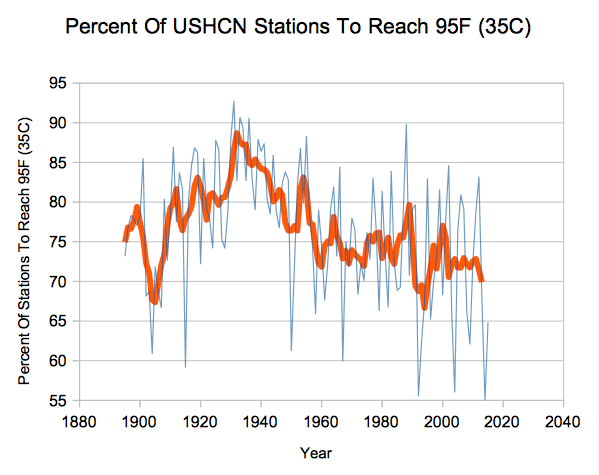
Percentage of USHCN Stations to reach 35 C
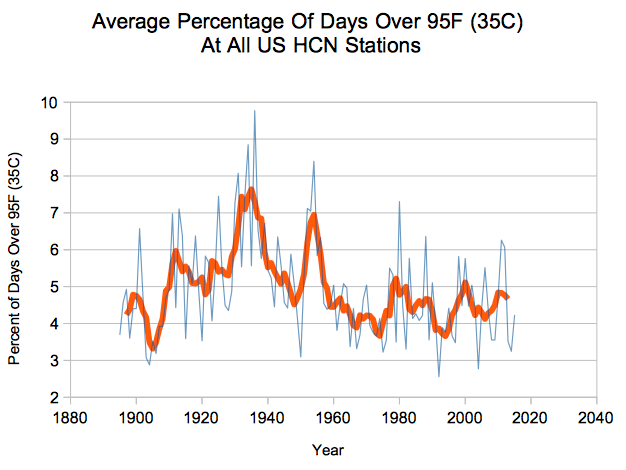
https://i2.wp.com/realclimates...Average Percentage of Days over 35 C for All USHCN Stations
https://i2.wp.com/realclimates...https://stevengoddard.wordpres...
The 1930s and 1940s were much hotter. This data is NOT in dispute.
-
Re:Deniers?
"When all else fails, watch the way the parties debate and assess their credibility from their actions."
I agree.
Watch anyone who dares suggest AGW is still open to question get savaged in ANY public forum - from how the OP phrased the question, I believe he/she's seen that.
Google Bjorn Lomborg - someone who says "Global warming IS happening, there are just many many other things that are more imperative" - and see how he's been raked across the coals.We've had 15+ years of prediction of doom from the Global Warming camp (a partial list at https://anotherslownewsday.wor... ), which are continually proven wrong, desperately quickly rationalized, explained away, then buried under the NEXT "forecast of doom".
Let's also review all the things that have been blamed on global warming: http://whatreallyhappened.com/... (it's hilarious, and fully linked)
I don't know if warming is happening. I don't believe anyone anymore either. I used to try to find raw sources, but I've been told dozens of times that I can't be expected to understand temp data and hell, it's probably been tweaked anyway. It's hard to imagine that 7 billion people busily generating heat and burning hydrocarbons wouldn't have SOME impact.
All I know is that the paleotemps seem to indicate very quick spikes of temperature and CO2 every 120k years or so for the last 2+ million years. (https://en.wikipedia.org/wiki/Paleoclimatology#/media/File:Vostok_Petit_data.svg)
The current spike looks EXACTLY like the others, and is coming pretty much right on time.For me, the AGW crowd has failed to explain in broad terms why something that's happened periodically, and is happening again, is somehow "THIS TIME" characteristically different than all the previous instances.
-
Re:Deniers?
Check out the satellite data for lower tropospheric temperature, and the balloon dataset for correlation.
Radiosonde (balloon) data and satellite data started diverging from each other around 2010 with the radiosondes showing greater temperature rise. Link.
-
Re:record-shattering recording instruments
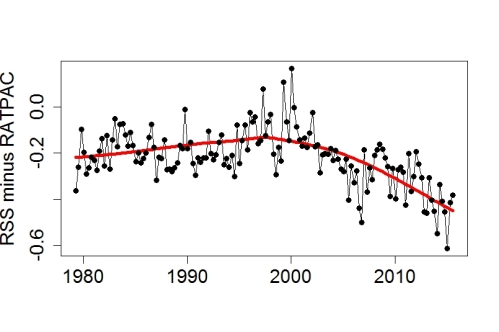
Well, I'm not sure how much time I should spend discussing this with someone who rejects radiative physics, believes that the twin towers were an inside job, and thinks that Obama faked his birth certificate, but... Here is radiosonde measurements minus the satellite data. Note the rapid divergence around 2000? Suddenly satellite data took a nose dive relative to the radiosonde measurements. What happened there? https://tamino.files.wordpress...
-
Re:And shine a light on them.
The Prophet Mohamed was a dick, by the way. And Muslims, Scientologists and Mormons are all idiots for following "religions" founded by cruel scam artists.
You left a few out:
https://upload.wikimedia.org/w...
-
Re:Deniers?
Here are the corrected vs uncorrected temperature reconstructions. There is really no difference in the trend between the two: https://climatecrock.files.wor...
Satellite models don't agree with each other let alone with the uncorrected surface trends: http://woodfortrees.org/plot/r...
and they don't agree with radiosonde data that takes actual measurements in the troposphere that the satellites are attempting to derive a temperature record for: https://tamino.files.wordpress...
-
Re:Deniers?
Here are the corrected vs uncorrected temperature reconstructions. There is really no difference in the trend between the two: https://climatecrock.files.wor...
Satellite models don't agree with each other let alone with the uncorrected surface trends: http://woodfortrees.org/plot/r...
and they don't agree with radiosonde data that takes actual measurements in the troposphere that the satellites are attempting to derive a temperature record for: https://tamino.files.wordpress...
-
Re:record-shattering recording instruments
Here are corrected and the unadjusted data side by side. Both tell the same story: https://climatecrock.files.wor...
-
Re:UNCLASSIFIED // RELIDO
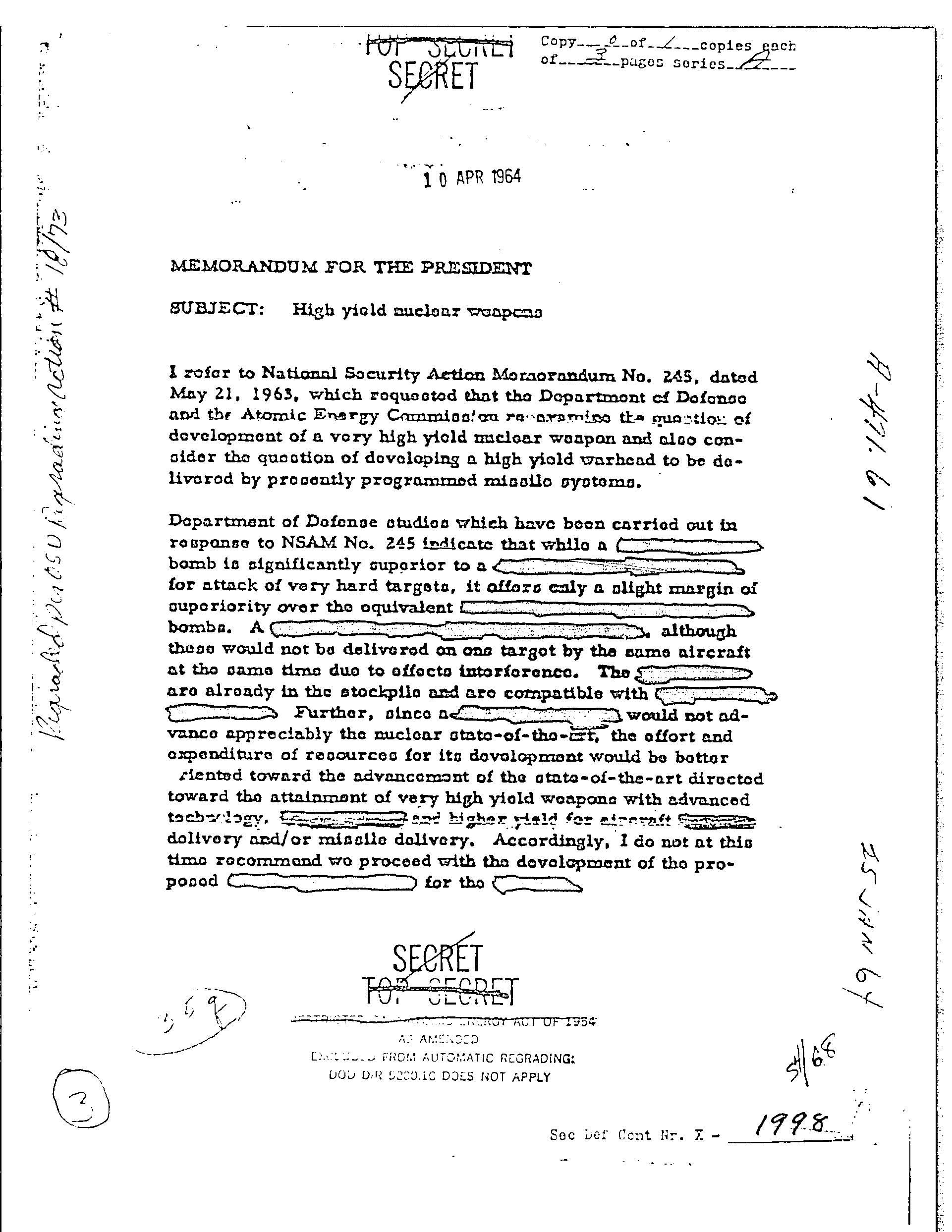
BUT, information that is declassified will have the original classification marking, but crossed out. In this case it is marked as unclassified, and there is no other classification marking.
http://www.archives.gov/resear...
Items are absolutely declassified after a certain amount of time, the national archives has a whole division dedicated to this activity.
Here is an example of a declassified document, you can see the classification of Top Secret is crossed out.
-
Re: This was _outlawed_ in the USA?
West end of Vancouver. It was a time of cops coming down hard on dissenters culminating in the gastown riots.
https://criminalizingdissent.w... -
Re:Why
PRT is a wonderful boondoggle for privileged middle-class snobs like you.
Privileged? I was born poor as shit, I was raised by a single parent... I'm a more-or-less white male, born in the first world, and who learned to read as a child... and that's pretty much the end. That's not inconsiderable, but calling me "privileged" like I'm unusually so is beyond ridiculous.
However, when it comes to cost-efficient, sensible urban transportation that actually helps people who need public transit, buses are the right choice.
You know, that's funny. Really, really funny. Because I grew up using buses, because my mother refused to own a car, in fact as far as I know she still can't drive at all. And I know personally how many hours of your day that consumes. I regularly had to spend an hour or even two on a bus to get to some shitty minimum wage job... and then just as much time to get back. Since most front doors are multiple blocks away from a bus stop, they are shit in inclement weather; you bundle up to get to the bus, then you overheat in the bus, then you get off again and have to walk some more. PRT can reasonably get closer to destinations than the bus.
Of course, they are cheap and unglamorous, so people like you don't support them.
I've been poor as fuck, mustard sandwiches and all that shit. I've ridden the bus. The bus is shit. That it is better than walking is not an endorsement.
Buses also don't need massive federal spending.
Bullshit, and also, bull fucking shit.
-
Re:Dream Chaser is sexy, just like the old Dyna-SoThat's because the Dream Catcher is an evolution of the NASA family of lifting bodies that includes the Dyna Soar. It is not a new design from scratch, it's the most recent spin on a concept that was developed by both the US and the USSR. Yes, design elements pioneered by in the USSR were copied by NASA for spaceplane use.
Sexy is meaningless for real space work. The lunar landing module was not sexy, it was practical. You want sexy, go and look at fantasy rocket designs for 1930 pulp science fiction magazine covers. Since space access is really important, dump the sexy and appreciate the practical. It gets you further.
-
I found an image of it!
https://bossip.files.wordpress...
It's their new system that is hacker proof. Every person using a military computer will have one of these with them
-
Re:The water?
Knife crime is now becoming a serial problem in the UK. They are looking into new measures of Knife Control, including possibly a registration of kitchen knives.
-
Re:That's exactly right
Since this is about nuclear: here's a cutaway of a "small" (180MW) reactor. This is just the reactor building, not all of the associated buildings, such as the (very large) turbine house, primary and backup support systems, power distribution infrastructure, and on and on. Again, that's a small reactor.
And that's the reason why we don't build small reactors. Most reactors built today exceed the gigawatt mark.
And it is also true for fossil fuel plants, and it would be true for reneweables if they weren't dependent on the landscape. That's square-cube law at work here. -
That's exactly right. Up'n Atom!
This is what people don't seem to get. They compare Fukushima to a single wind turbine failure and proclaim wind is safer. Um no, Fukushima's generation capacity was equivalent to about 7,000-10,000 wind turbines.
So much of the story is left untold, thank you for telling. No one ever seems to ask: What is good about Fukushima Daiichi?
Fukushima's first reactor went on-line in March 1971 [cite] and 5 others followed up to 1979. Without accounting for cumulative downtime (hard to find), let's keep it simple, cut everything here by a third if you like, I come up with a combined total of ~159.12 Gigawatt-years of electricity. That's ~636.5 million tons of coal [cite] that did not have to be expensively imported and burned to help resource-poor Japan become the industrial giant it is today. Think of it as ~1.8 trillion tons of CO2 [cite] that did not enter the atmosphere, if you like. That's just one nuclear power plant with reactors that are not big by today's standards. More stats, and the interesting observation on how the hysterical press of Japan does not necessarily reflect public opinion,
"A poll taken in February 2015 by the Mizuho Information & Research Institute of Japan asked whether or not the respondent would use nuclear-generated electricity if the costs were the same or less than they were that month, and 67% said âoeyesâ. Only 32% replied in the negative. This contrasts with a number of media polls with voluntary and hence non-representative participation, and the distortion is compounded by a 2012 news media survey finding that 47 of the 50 most popular press outlets in Japan said they were antinuclear."
Japans few nuclear plants have provided as much as ~30% of Japan's electricity and I am confident they will pass that figure once more. Nuclear has contributed greatly to the country's wealth in ways that no other energy source could have, or ever could. There is a great deal of hidden peril facing the entire human species that is a direct result of stalling the Industrial Revolution --- by sweeping nuclear energy under the rug. As Kirk Sorensen says so eloquently,
"Every time mankind has been able to access a new source of energy it has led to profound societal implications. Human beings had slaves for thousands of years, and when we learned how to make carbon our slave instead of other human beings, we started to learn how to be civilized people. Thorium has a million times the energy density of a cabon-hydrogen bond. What could that mean for human civilization? Once we've learned how to use it at this kind of efficiency, we will never run out. It is simply too common."
-
Re:OR....
Yeap, you are right. The simplicity just makes it easier to verify that it is accurate. How much confidence do you have in the terrestrial record?
More than in satellite data - because like you said it's easy to see that it's wrong. https://tamino.wordpress.com/2...
-
Nuclear reactors: not that complex
Correct: the systems shown in the cutaway diagram are not that complex. In fact, over the decades, more engineering has gone into the subsystems inside the tractor-trailer truck that's included in the picture; its engine, and electronic engine control system, and diesel exhaust scrubber, and even the design of its tire tread, to name a few examples.
-
Re:That's exactly right
These "X can't solve our energy" problems debates all generally come back to the concept of, "I personally can't imagine it". They see what vast scale of effort/material/etc it takes to build something, declare it impossible, and then declare something that they don't know as much about and haven't yet been overwhelmed by to be the solution.
Let's make it simple. If you're making hundreds of megawatts from something (let alone gigawatts), it's going to be mind-bogglingly huge and expensive, period. Doesn't matter whether you're talking about wind, water, solar, geothermal, nuclear, or whatnot - anything that can make and harness that much power is huge.
Since this is about nuclear: here's a cutaway of a "small" (180MW) reactor. This is just the reactor building, not all of the associated buildings, such as the (very large) turbine house, primary and backup support systems, power distribution infrastructure, and on and on. Again, that's a small reactor. And not only does all of that have to be built, but engineered to great precision, for the obvious reasons of the toxicity of what it's containing and the highly corrosive environment that it creates. Now think of how much you'd have to build to add new/replacement 3-4 terawatts. It's mind bogglingly vast.
But you know what, it's all mind bogglingly vast. 3-4 terawatts of dams is mind-bogglingly vast. 3-4 terawatts of wind turbines is mind-bogglingly vast. 3-4 terawatts of solar panels and the factories to churn them out is mind-bogglingly vast. And on and on and on. There's a reason why electricity production eats up such a large chunk of the planet's GDP - it deals in mind-bogglingly vast things. Some things take less material and more manpower, while others take more manpower and less material... and ultimately material itself equates to manpower. All of these things are captured in the construction cost figure, which amortized plus maintenance and operations costs yields the cost of the electricity. So one doesn't have to trust some sort of "I can't conceive of that, it's too big!" sense - they just need to look at what the power costs (undistorted by external factors). The market will pay for whatever is cheapest, and will build whatever factories or mines or whatnot that it needs to in order to make it happen.
Turnaround times are an issue, but they're not be-all end-all. Because even the longest turnaround times on projects are generally no more than a decade to a decade and a half. Climate change is an issue that needs to be approached over the course of decades. So even if the need to ramp up production of the projects' "dependencies" before the projects themself can commence, there's still plenty of time. IF there was confidence that that it's the best option.
Ultimately, however, since people can't see the future, nobody knows what's going to be cheapest. Different people have different views. Different countries offer differing market conditions and resources. So ultimately, no one solution is going to be taken up as the "be-all, end-all". Many routes will engage in parallel, and with each iteration, the data gleaned from earlier attempts will influence decisions as to what to make next.
But one thing is for sure: what ever is built, it's going to be mind-bogglingly vast. That's what we 7,4 billion humans do.
-
Re: Actual Reason
Since it is well known that capitalists try to put competitors out of business, thus restricting the supply of resources so that it doesn't grow as fast as population, what you say fits as a small part of what I wrote here
-
Re: Actual Reason
While the article is correct in pointing out the problem caused by unfair wealth distribution, the cause of the unfair wealth distribution is not China per se. It is the Law of Supply and Demand in action, whenever population grows faster than resource-production. Folks who say the world is not overpopulated tend to focus only on food production, but people need rather more things than just food, and all of them need to be produced at the rate population grows, for wealth distribution to stay fair. I've presented more details about that (and the reverse, that when resource production increases faster than population, wealth distribution goes the other way), here.
-
Re:Not according to satellites
Agreed. Here's what someone who knows a thing or two about climate and a whole lot more about statistics had to say about the "hiatus/no warming" almost 2 years ago
-
Why anomaly and not average?
FYI, honest question here. Why is NOAA so insistent on only releasing data by anomaly and not by actual temperature?
Because the average temperature isn't actually interesting, and not actually terribly useful.
If you want the global average temperature, just calculate the global average temperature of the baseline year, and add the anomaly relative to that baseline year. As should be obvious, the global average temperature is just a baseline shifting the whole curve up or down, and it's simplest to just subtract it out, unless there's some reason you want that absolute number-- and I can't think of any reason you would want that average number.
Different people calculate the average in different ways. The NASA data has the global temperature average in 2013 at 14.6 degrees Celsius-- that would be a good value to use. (If 2013 isn't your baseline year, subtract the anomaly for 2013 to convert to the baseline year you do use-- it's just a baseline shift; the whole curve shifts by the same amount.)
By only looking at the difference from the baseline, you leave out all of the errors that aren't there if you only are looking at the change in temperature at each location, not the absolute temperature.
https://www.ncdc.noaa.gov/moni...
https://notalotofpeopleknowtha...
http://ete.cet.edu/gcc/?/globa...
http://www.odlt.org/dcd/ballas... -
Re:I have an idea ...Google is your friend. Of course, this was already in the newspapers before google ever existed. However, if you google for computers in school a failure, you'll see plenty of stuff, such as:
Computer use at home linked to school failure, increased drug use
Ipad initiative failure
Why the computer is not dominating schools
Why has the computer failed in schools and universities - 20 years later, the "solutions" outlined at the end are still not workable, because, ironically, they need much more individual teacher input than was realized at the time.
There are no technology shortcuts for good educationThe history of electronic technologies in schools is fraught with failures.
Computers are no exception, and rigorous studies show that it is incredibly difficult to have positive educational impact with computers. Technology at best only amplifies the pedagogical capacity of educational systems; it can make good schools better, but it makes bad schools worse.
Technology has a huge opportunity cost in the form of more effective non-technology interventions.
Many good school systems excel without much technology.The inescapable conclusion is that significant investments in computers, mobile phones, and other electronic gadgets in education are neither necessary nor warranted for most school systems. In particular, the attempt to use technology to fix underperforming classrooms (or to replace non-existent ones) is futile. And, for all but wealthy, well-run schools, one-to-one computer programs cannot be recommended in good conscience.
How many schools can even afford one-on-one computer classes, even in the industrialized nations? Because it doesn't work when you try to do it in bulk, as if the kids were computers to be programmed.
A search for "double-blind experiment computer use in schools" doesn't produce anything apparently relevant. Why are there no hard data available on something that's gobbling up $10 billion a year out of school budgets? The simplest answer is, as always, follow the money.
-
Re:OK, next!
-
Re:OK, next!
-
Re:So...federal breakfast+lunch+dinner+... = fail?
Income inequality has not always grown. It did not grow in the postwar period (low- and middle-class incomes grew faster than high incomes). It's worth noting that this period covers the most rapid increase in overall wealth, prosperity and living standards in human history, precisely because of that.
Post-hoc, ergo propter hoc?
You're thinking in the short run, first of all. I could say that GDP has always grown (it has), and show you a chart. You could tell me it fell several times, notably in the 1930s (great depression) and in the 1945 post-war period. Look at the graph, though: GDP has always grown. In the long run, productivity grows.
Second, rapid increases in overall wealth, prosperity, and living standards did not occur *because* of middle-class recovery; they are a *symptom* of middle-class recovery. The war consumed resources, devoting production to destructive war efforts. Nylon and steel became scare because all labor available to produce steel was usurped to produce weapons of war. The common man could not get sliced bread because the steel for slicing machine blades wasn't available. Gasoline became scarce because there wasn't enough physical labor available to refine fuel for the war *and* for our domestic use.
During the war, a lot of women got man-jobs. There was still a labor shortage. A lot of workers were sent off to war, and our ability to produce shrank.
You think somehow, magically, the post-war period became about giving to the middle-class and not the rich, and that this simple shifting of income distribution drove our economy to new heights? The post-war period was about ending the anal rape of our economy and putting workers back to work. We got rich because we started building things again.
You have an incredibly distorted view of history *and* economics.
-
Re:So...federal breakfast+lunch+dinner+... = fail?
No I didn't.
You said: "No it's not and no it doesn't. Indeed, the whole point of it is to achieve the complete opposite result." That statement is semantically identical to: "It doesn't do that because we do it intending for it to not do that." Your *intent* doesn't mean your understanding is correct; I pour kerosene into my car engine intending to improve its longevity by cleaning the gunk out of it, and there are a lot of mechanics suggesting this as a method to clean your engine, but it could be a really good way to just destroy your engine (and some mechanics have suggested that it does exactly that).
Your progressive tax example is misleading because it uses a divide between the bottom 90% and the top 10%,
I believe the term you're looking for is "Illustrative," which means "Shows the mechanism in a more complex system by a simplified example." "Misleading" means "draws an incorrect conclusion."
and uses this as a basis of comparing to the Romans to (seemingly) make an argument that "things aren't so bad today".
It argues that things are different in some ways and similar in other ways. The Romans had a healthy society with an income gap; we have a bigger income gap and a healthier society. These aren't correlates; the wider income gap is not harmful because our wealth is higher, and a much wider income gap *today* (say, 70% of the money going to the top 10%, right now, without us being any more wealthy) would precipitate an economic collapse. An income gap such as we have today might have precipitated an economic collapse in Rome; I don't care to do the analysis, as I'd have to examine the finances of Rome and the standard-of-living at various class levels, which is hard since I don't have year-by-year Roman census data. IF the vulgar Roman class were poor enough, THEN moving more of their income to the rich would push them into a level of absolute poverty triggering a collapse of the workforce and consumer base.
Wealth and income distribution today is mind-bogglingly skewed towards the top fractions of a percent of the population, and is becoming increasingly more so over the last few decades
THIS IS A FALLACIOUS ARGUMENT. It's begging the question. Why is it mind-boggling? What is "skewed"? How is the increasing income gap different than the increasing income gap that occurred all throughout history?
Let's ask a bit more on that last one. The income gap across history has widened as GDP per capita has increased; does it seem significant that the income gap appears to have widened more quickly during a massive spike in productivity starting just after 1960? Is *everything* happening faster; and is every argument that the rich are suddenly taking more each year than they did before just ignoring that we are *making* more each year than before? Are we getting richer twice as fast, and the rich padding themselves with the lion's share they've always taken twice as fast in turn?
Your argument assumes a widening income gap is bad, and that a flatter income gap is good.
Now, why do you think a bunch of people sitting around doing nothing (a BIG) is less wasteful than the same bunch of people doing productive work (a jobs guarantee) ?
People doing productive work draw a cost. You have argued that "NUH UH IT'S FREE!" and "WELL WE JUST MAKE THE RICH PAY FOR IT LULZOR!" The rich are not a natural resource.
You're even stupid enough to argue that taxes are not for revenue. Let's just shut off all taxes, and see how the government pays for anything. You have no concept of economics and would pay $1,000 to save yourself $500, then claim being $500 poorer is better than missing out on such great saving!
-
Re:Glorious leader show us the way
Oblig Interview
-
Re:I support a BIG as well...
Federal poverty line is a bullshit number.
I did my calculations using the retail price of goods, plus risk reserves. A surprising amount of that is just extra cash thrown in because my calculations may be off, there may be a recession, prices may spike now and then (look at eggs), or people may occasionally spend irresponsibly (a monthly payment instead of lump-sum per year *really* provides a huge control for that particular risk, since you can only screw up one month; I do expect people to learn, readily, if they're not already fiscally-responsible accountants. They're poor, not retarded).
The Federal poverty line for a single individual is around $12k, and the numbers I give are well below that.
If you're on the bottom economic rung, an apartment/house of your own should not be expected.
224sqft. Enough for a 6'x9' bedroom (I actually spend much of my time in a room that size, with a futon, a computer desk, a 32 inch TV, video games...) and a 10'x9' common room, plus a bathroom and small kitchen tacked on. Low-income apartments have a median cost per square foot of roughly $1, although I've seen as low as 60 cents; with the risk reserve, I accounted $1.33/sqft.
That's for one individual, no room mates, no kids. If you've got a room mate (married?), you're getting twice the income. I pegged immigrants and families to a legacy public aid system, which doesn't support the adult population at all (except non-natural-born citizens) and so is much smaller--consequentially, less risk of abuse, so we can accept proportionally more fraud and focus on getting aid to families who need it. That means $1,100/month (in 2013) plus aid to feed and clothe your kids.
This is tied to the total income, and essentially to the per capita income, which always grows (GDP is the same number). You'll notice it's not a straight line; while there's a constant growth trend, the fluctuations are risk. That risk reserve thing I talked about? It's for that, too. In theory, as long as we don't dip below, say, 2013 (my established baseline), it continues to work without activating risk reserves; the minimum viable is a 2009 baseline.
By the by, being in the military counts as "Resident". On top of your military pay, you'd have the dividend going home to your spouse, or whatever you want to do with it. I advocate against paying citizens who don't live here; if a Chinawoman comes to Hawaii to birth a baby and then goes back to China, we shouldn't pay that kid money when he turns 18, having lived his life in China, living in China, working in China, having American citizenship. If he lives in America, well... he's a natural-born American and entitled to that money. Yes, I have thought of every possible risk--even the risks I can't name (most of which would just tank the economy anyway, so my answer is "nothing works then, so I haven't bothered").
Finances, economics, taxes... I've juggled too much money looking at this. I even wrote my own economic theories because the state-of-the-art was inadequate and couldn't explain a lot of economic behaviors. Can you believe nobody could explain why we have welfare systems, why welfare systems are possible *now* but not in 1750, or what causes Supply and Demand and scarcity? Like they could tell you prices increase when demand outpaces supply, but they couldn't tell you why supply wouldn't just increase to keep up with demand. (Hint: it's labor. Supply lasts as long as linear scaling; scarcity occurs when labor requirements scale superlinearly. That's part of why the per-capita incom
-
Re:I support a BIG as well...
Federal poverty line is a bullshit number.
I did my calculations using the retail price of goods, plus risk reserves. A surprising amount of that is just extra cash thrown in because my calculations may be off, there may be a recession, prices may spike now and then (look at eggs), or people may occasionally spend irresponsibly (a monthly payment instead of lump-sum per year *really* provides a huge control for that particular risk, since you can only screw up one month; I do expect people to learn, readily, if they're not already fiscally-responsible accountants. They're poor, not retarded).
The Federal poverty line for a single individual is around $12k, and the numbers I give are well below that.
If you're on the bottom economic rung, an apartment/house of your own should not be expected.
224sqft. Enough for a 6'x9' bedroom (I actually spend much of my time in a room that size, with a futon, a computer desk, a 32 inch TV, video games...) and a 10'x9' common room, plus a bathroom and small kitchen tacked on. Low-income apartments have a median cost per square foot of roughly $1, although I've seen as low as 60 cents; with the risk reserve, I accounted $1.33/sqft.
That's for one individual, no room mates, no kids. If you've got a room mate (married?), you're getting twice the income. I pegged immigrants and families to a legacy public aid system, which doesn't support the adult population at all (except non-natural-born citizens) and so is much smaller--consequentially, less risk of abuse, so we can accept proportionally more fraud and focus on getting aid to families who need it. That means $1,100/month (in 2013) plus aid to feed and clothe your kids.
This is tied to the total income, and essentially to the per capita income, which always grows (GDP is the same number). You'll notice it's not a straight line; while there's a constant growth trend, the fluctuations are risk. That risk reserve thing I talked about? It's for that, too. In theory, as long as we don't dip below, say, 2013 (my established baseline), it continues to work without activating risk reserves; the minimum viable is a 2009 baseline.
By the by, being in the military counts as "Resident". On top of your military pay, you'd have the dividend going home to your spouse, or whatever you want to do with it. I advocate against paying citizens who don't live here; if a Chinawoman comes to Hawaii to birth a baby and then goes back to China, we shouldn't pay that kid money when he turns 18, having lived his life in China, living in China, working in China, having American citizenship. If he lives in America, well... he's a natural-born American and entitled to that money. Yes, I have thought of every possible risk--even the risks I can't name (most of which would just tank the economy anyway, so my answer is "nothing works then, so I haven't bothered").
Finances, economics, taxes... I've juggled too much money looking at this. I even wrote my own economic theories because the state-of-the-art was inadequate and couldn't explain a lot of economic behaviors. Can you believe nobody could explain why we have welfare systems, why welfare systems are possible *now* but not in 1750, or what causes Supply and Demand and scarcity? Like they could tell you prices increase when demand outpaces supply, but they couldn't tell you why supply wouldn't just increase to keep up with demand. (Hint: it's labor. Supply lasts as long as linear scaling; scarcity occurs when labor requirements scale superlinearly. That's part of why the per-capita incom
-
Re:I support a BIG as well...
Federal poverty line is a bullshit number.
I did my calculations using the retail price of goods, plus risk reserves. A surprising amount of that is just extra cash thrown in because my calculations may be off, there may be a recession, prices may spike now and then (look at eggs), or people may occasionally spend irresponsibly (a monthly payment instead of lump-sum per year *really* provides a huge control for that particular risk, since you can only screw up one month; I do expect people to learn, readily, if they're not already fiscally-responsible accountants. They're poor, not retarded).
The Federal poverty line for a single individual is around $12k, and the numbers I give are well below that.
If you're on the bottom economic rung, an apartment/house of your own should not be expected.
224sqft. Enough for a 6'x9' bedroom (I actually spend much of my time in a room that size, with a futon, a computer desk, a 32 inch TV, video games...) and a 10'x9' common room, plus a bathroom and small kitchen tacked on. Low-income apartments have a median cost per square foot of roughly $1, although I've seen as low as 60 cents; with the risk reserve, I accounted $1.33/sqft.
That's for one individual, no room mates, no kids. If you've got a room mate (married?), you're getting twice the income. I pegged immigrants and families to a legacy public aid system, which doesn't support the adult population at all (except non-natural-born citizens) and so is much smaller--consequentially, less risk of abuse, so we can accept proportionally more fraud and focus on getting aid to families who need it. That means $1,100/month (in 2013) plus aid to feed and clothe your kids.
This is tied to the total income, and essentially to the per capita income, which always grows (GDP is the same number). You'll notice it's not a straight line; while there's a constant growth trend, the fluctuations are risk. That risk reserve thing I talked about? It's for that, too. In theory, as long as we don't dip below, say, 2013 (my established baseline), it continues to work without activating risk reserves; the minimum viable is a 2009 baseline.
By the by, being in the military counts as "Resident". On top of your military pay, you'd have the dividend going home to your spouse, or whatever you want to do with it. I advocate against paying citizens who don't live here; if a Chinawoman comes to Hawaii to birth a baby and then goes back to China, we shouldn't pay that kid money when he turns 18, having lived his life in China, living in China, working in China, having American citizenship. If he lives in America, well... he's a natural-born American and entitled to that money. Yes, I have thought of every possible risk--even the risks I can't name (most of which would just tank the economy anyway, so my answer is "nothing works then, so I haven't bothered").
Finances, economics, taxes... I've juggled too much money looking at this. I even wrote my own economic theories because the state-of-the-art was inadequate and couldn't explain a lot of economic behaviors. Can you believe nobody could explain why we have welfare systems, why welfare systems are possible *now* but not in 1750, or what causes Supply and Demand and scarcity? Like they could tell you prices increase when demand outpaces supply, but they couldn't tell you why supply wouldn't just increase to keep up with demand. (Hint: it's labor. Supply lasts as long as linear scaling; scarcity occurs when labor requirements scale superlinearly. That's part of why the per-capita incom
-
Re:So...federal breakfast+lunch+dinner+... = fail?
To "control" inequality of wealth doesn't mean to pay everyone the same.
I didn't say that, and I don't know where your autistic hyperfocus got that.
the current inequality is dangerous, and has reduced social mobility in the country.
False. The current income inequality is a normal consequence of growing wealth.
Unemployment was higher in the 1890s, the 1920s, and the 1980s; there was also the Great Depression, but that was a time of extreme economic illness, and does not exemplify a healthy economic state. The point is we're facing nothing more than the recurring cycle of wealth and employment.
The income gap has grown over time. It was larger in 1910 than it was in 1890; it was larger in 1950 than it was in 1920; it was larger in 1980 than it was in 1960; and it's larger now than it was in 1990. It has continued to grow steadily since the inception of man.
The rich upper class of the Romans were the Equestrians. At peak, the top 1% of Rome controlled 16% of the income; today, the top 1% control 20%. The top 10% control 48%, which shows a large disparity.
At its peak, Rome had about 25,000 Equestrians. Their elite represented 0.04% of Rome. Notice our Elite 1% control 20% of our income, and the top 10% control 48%; Scheidel and Friesen claim the top 10% of Roman society had 37% of income. So what's happened here?
Firstly, our top 10% represent people with $141,000 salaries.
Second, our society is a *lot* richer. The income distribution isn't that far off from Rome (I mean, top 10% have an extra 11% of the whole, and top 1% have 4% more of the whole), yet we have so much stuff they don't. Smart phones, supermarkets, powered automobiles, the Internet, global communications satellites, that sort of thing.
We've hardly lost social mobility. You can blame public efforts to get everyone an independent college education for much of that, but that's a wholly different argument requiring a completely different set of knowledge domains (it's also not as unintuitive). The real problems are at the bottom: jobs.
Addressing jobs is relatively easy. The growing income inequality makes progressive tax systems effective--and more effective over time. Even the fucking Romans knew this, which is why the Roman Republic implemented a progressive tax system. As the gap increases, the same percentage tax on the high earners draws in more of their dollars per dollar of income among the low earners. Essentially, you go to their door first, don't charge them any *extra*, but charge the next guy a bit less depending on how close to full your bucket-o-money is. I've written about this, even modeling the effect of a Citizen's Dividend (taken as a 17% flat tax on all AGI) against class-level take-home totals.
Reduce the cost of labor in this way and you create jobs. Why?
You make $60k, but you pay 33% in taxes and take home $40k. To pay you, we have to take a portion of the price paid for everything you produce (for your job) and use it to pay for the amount of time you spent making that 1 unit good. In short: the smallest cost of that good is the total pre-tax wages invested into producing the good.
Your tax rate drops to 11%. Well, now we start paying you $45k. Because your tax rate is 11%, you still take home $40k. That means you're not even one cent poorer, yet we pay you 25% less. Propagate this across the entire workforce involved in making that product and the thing you're making costs 25% less.
We can cut back the cost of that good to reach market demographics who don't have as much money. We'll make the same profit margin (e.g. 10%) or better, but move more units, thus making a larger profit. To make more units, we must hire more people. That creates jobs.
You might notice the odd effect that you're still bringing home $40k, but all the sh
-
Re:So...federal breakfast+lunch+dinner+... = fail?
Income inequality is always growing. It's not a real problem, and people are just looking to whine. Income inequality makes progressive tax systems possible and useful.
-
Re:So...federal breakfast+lunch+dinner+... = fail?
It doesn't reach the poverty line; it does cover the cost of living. I've known plenty of people who lived below the minimum wage; there's even some giant dbag on the internet who retired on $7,000/year because what the fuck.
I don't believe the modern economic climate makes that technically feasible. $10,000/year for a single individual, sure; $7,000, you're getting into "the market must adjust" territory.
I frequently push for a Citizen's Dividend which pays, in 2013 dollars, about $7,000/year. It's tied to the total income, so it automatically follows inflation, but ignores wealth: over time, the buying power income increases, so the standard-of-living provided goes up. Still, at the rate I provide, I don't expect people to go buy an 800sqft single bedroom apartment; I expect the market to say, "Oh HOLY shit! If we rent to ALL these people, we'll be richer than Warren Buffet in 3 years! We need to build new housing units to capture this market!"
HUD currently supports 4.8 million households, many families who would have two Dividend incomes (and, really, many of whom have jobs, but make very little; they would also receive the full Dividend). I expect a roll-out of a Citizen's Dividend as I describe to involve funding HUD minus X units per year, where X is the number of units landlords are able to profitably convert to appropriately-sized non-assisted units. Families will have, in 2013, $600 of (additional) housing (budgeted) income per month, plus EBT to cover childcare expenses (a minimized public aid system targeting children and immigrants; since it's smaller--all general welfare is removed from that system--risk of abuse and associated costs are diminished sharply, and we can focus more on getting the money to people who need it and just accept the cost of missing more abuse).
It's the best I can do. 600,000 homeless, 18 million starving children, 48 million starving Americans; I can make all that go away, but I can't put everyone in a luxury apartment. The worst case is livable.
Now I live somewhere where that is less than my rent and that's just moving between two similar sized towns in the UK.
I think this system might adapt to the UK, as well. It only works for wealthy countries--that is, it works for countries whose per-capita buying power is above a certain threshold. You can't rubber-stamp my system in Canada, England, Japan, Australia, New Zealand, and so forth; you'd have to use it as an example and try to fit your own system into the same transformation, carrying out the same assessment of the retail cost of each unit good and service, looking at transitional risks, at your social obligations (Social Security Retirement Benefits was a big one here), and so forth.
The difference in cost of living in the USA can be even larger.
When you're broke and unemployed, you tend to... okay, in the US, you tend to starve in the streets and sleep each night in your own piss with the rats to keep you warm.
When you have barely enough income to survive, you tend to move toward the ghettos. It kind of sucks. I know people who bicycled or bused to work 3 hours each way. At that level, I would have approximately zero criticism if they took the money and quit their jobs. Someone who lives a reasonable distance from my employer can mop the floor, or we can pay better money for that; if it's not worth SIX FUCKING HOURS of unpaid travel time to and from work every day for you to work for minimum wage, then you shouldn't do that. This isn't Uganda (where people walk 9 miles every day to fetch fresh water from the nearest river).
I want people to work; I don't want slaves. If they quit working because they can't work within 30 miles of where they can afford to live and they can't afford transportation, that's
-
Re:So...federal breakfast+lunch+dinner+... = fail?
It doesn't reach the poverty line; it does cover the cost of living. I've known plenty of people who lived below the minimum wage; there's even some giant dbag on the internet who retired on $7,000/year because what the fuck.
I don't believe the modern economic climate makes that technically feasible. $10,000/year for a single individual, sure; $7,000, you're getting into "the market must adjust" territory.
I frequently push for a Citizen's Dividend which pays, in 2013 dollars, about $7,000/year. It's tied to the total income, so it automatically follows inflation, but ignores wealth: over time, the buying power income increases, so the standard-of-living provided goes up. Still, at the rate I provide, I don't expect people to go buy an 800sqft single bedroom apartment; I expect the market to say, "Oh HOLY shit! If we rent to ALL these people, we'll be richer than Warren Buffet in 3 years! We need to build new housing units to capture this market!"
HUD currently supports 4.8 million households, many families who would have two Dividend incomes (and, really, many of whom have jobs, but make very little; they would also receive the full Dividend). I expect a roll-out of a Citizen's Dividend as I describe to involve funding HUD minus X units per year, where X is the number of units landlords are able to profitably convert to appropriately-sized non-assisted units. Families will have, in 2013, $600 of (additional) housing (budgeted) income per month, plus EBT to cover childcare expenses (a minimized public aid system targeting children and immigrants; since it's smaller--all general welfare is removed from that system--risk of abuse and associated costs are diminished sharply, and we can focus more on getting the money to people who need it and just accept the cost of missing more abuse).
It's the best I can do. 600,000 homeless, 18 million starving children, 48 million starving Americans; I can make all that go away, but I can't put everyone in a luxury apartment. The worst case is livable.
Now I live somewhere where that is less than my rent and that's just moving between two similar sized towns in the UK.
I think this system might adapt to the UK, as well. It only works for wealthy countries--that is, it works for countries whose per-capita buying power is above a certain threshold. You can't rubber-stamp my system in Canada, England, Japan, Australia, New Zealand, and so forth; you'd have to use it as an example and try to fit your own system into the same transformation, carrying out the same assessment of the retail cost of each unit good and service, looking at transitional risks, at your social obligations (Social Security Retirement Benefits was a big one here), and so forth.
The difference in cost of living in the USA can be even larger.
When you're broke and unemployed, you tend to... okay, in the US, you tend to starve in the streets and sleep each night in your own piss with the rats to keep you warm.
When you have barely enough income to survive, you tend to move toward the ghettos. It kind of sucks. I know people who bicycled or bused to work 3 hours each way. At that level, I would have approximately zero criticism if they took the money and quit their jobs. Someone who lives a reasonable distance from my employer can mop the floor, or we can pay better money for that; if it's not worth SIX FUCKING HOURS of unpaid travel time to and from work every day for you to work for minimum wage, then you shouldn't do that. This isn't Uganda (where people walk 9 miles every day to fetch fresh water from the nearest river).
I want people to work; I don't want slaves. If they quit working because they can't work within 30 miles of where they can afford to live and they can't afford transportation, that's
-
Re:So...federal breakfast+lunch+dinner+... = fail?
I fixed all that but nobody will listen.
-
Re:So...federal breakfast+lunch+dinner+... = fail?
While that's not valueless, it's not really the major problem. Everyone has some ideals about what the problem in every large system (welfare, education, American government) is, and they're all largely symptoms or tangential disturbances.
I happen to agree with an EBT system for children, while many of my contemporaries have this ridiculous idea that we should give $4,000/year to parents for *every* child they have, flat out. That's stupid: to ensure that only 3 in 1,000 fail to thrive, you'd have to supply more than enough money for almost 99.7% of the population. If you did that, popping out babies and neglecting your kids (hand-me-downs, replacing clothing less often, cheaper food, no concern for entertainment and thus their mental well-being) would be profitable. An EBT system carries some risks, and they're the same risks we face now; using an EBT system for child welfare is guaranteed not to make the situation worse.
In general, a Citizen's Dividend is the correct modern welfare system. It encourages work and job creation--two distinct things operating on different mechanisms. It encourages work by eliminating all welfare traps, as you collect the Dividend (tax-free!) regardless of your working income; it creates jobs by reducing the cost of labor, thus reducing the cost of products, allowing the price of products to come down, increasing the buying power per consumer (rather than just concentrating it in the hands of fewer consumers, as most technological advancement does), thus demanding more production, thus more jobs.
Providing finances and other living skills in base education is a good plan. It's not strictly required (you'd be surprised how quickly poor people learn to sit on coal and make diamonds), but it gives a universal advantage and provides stability; very few activities do that (free public college is a red herring in that regard: it provides cheap labor for business and causes an increase in unemployment and a decrease in worker power and ability of the common man to obtain employment).
You will *never* "break" the poverty and welfare cycle. We create wealth by reducing employment, and then recover employment by creating wealth. That is to say: we expend 40 hours per person just to make enough food to feed everyone, and all run around naked living in caves; then we invent farming and expend 20 hours per person to feed everyone, and half of everyone finds themselves unemployed. Those unemployed then start making clothes. Then we invent bronze knives, cut skins faster, work fields more effectively, and spend 20 hours doing all that, and half of everyone becomes unemployed. Then we invent mud huts and people get jobs as straw carpenters. Wash, rinse, repeat, and we're up to a society where we frequently go through rounds of layoffs and then every single person in the world buys a smartphone that's ten thousand times more powerful than the $75,000 computer system SGI sold to your employer in 1987.
In other words: if 30 hours of labor at minimum wage goes into that new Keureg you want to buy, it's going to cost at least $247.50. If we build a better factory and only use 10 hours of labor per machine, it's going to cost $82.50, and we're going to fire 60% of the workers running the factory. You might still pay $100--and we make a good 20% profit--but that's in contrast to paying $300 and we make the same profit margin selling you that machine. That extra $200 means you can buy other crap, which somebody has to make; so we make new things, and we hire those people we just laid off.
There's a gap. People lose their jobs, then get new jobs months or years later. We hit an equilibrium where people are gaining jobs as quickly as they're losing them and unemployment becomes stable. That's what welfare is for.
-
Re:Fighting Poverty..not new.
There are two ways to fix schools. First, by putting a blunt end to all poverty, thus reducing one external factor. The second is to fix the education curriculum.
Sadly, in my son's district, a school failing due to poverty is told they're failing because of "bad teachers" and the school is put into receivership.
Education--we're talking about real education, not workforce development (college) mislabeled as "education"--involves complex interactions between parents, students, teachers, administrators, and politicians. If the parents don't raise their kids right, they're difficult to teach--hence poverty impacting academic performance--and the schools require corrective strategies; if the schools don't have a good foundation for a curriculum, students fail to perform unless they get that advantage elsewhere (parents, home life); if the teachers don't teach the curriculum effectively, the students don't learn well enough; if the administrators don't provide correct curriculum guidelines, the teachers don't teach the right stuff, regardless of how effective they are; and if the politicians establish improper educational rules, the correct curriculum doesn't appear, and the administrators can't supply the teachers with what they need.
Everyone wants to blame someone else.
The teachers want to blame your kids for being dumb, the parents for being crappy parents, and the administration for forcing a curriculum that doesn't teach what they believe they need to teach. The administration wants to blame the teachers for teaching poorly and the politicians for not funding and defining good educational options. Politicians want to blame the administration for mismanaging funds and not developing a proper educational environment. Standardized tests get involved to show that teachers aren't teaching--by showing that students aren't learning.
Educators talk a lot about intelligence. They talk about students who are more intelligent, and how to manage classrooms with students of varying intelligence. Administrators create programs to segregate gifted students from idiots.
It's bullshit.
The term "Intelligence" isn't simply politically-incorrect; it's factually wrong. The correct term is "Intellectual Development". Why do poor people perform worse than middle-class kids with a better home life? Because they've developed terrible mental habits and do not have the tools to succeed! They have poor intellectual development, not weak poor-people moron brains.
Hold that in your head and think on this. Think really hard about this. I'm serious, concentrate. If we taught students effective study and thinking skills as the very first thing crammed down their necks in their educational careers, they would all perform better, and all show more tightly-grouped academic performance.
That means a student's poor performance is always *our* *fault*. We'll never get 100%, because there will always be those corner cases of severely bad home life or other poor social development which we *can* fix, but only at the expense of immense amount of time, effort, energy, and disruption to the classroom; in many of the absolute worst cases, we simply won't know how to approach the problem. That's acceptable: we always risk a level of failure. Statisticians like to go for the 3-standard-deviation number of 99.7%, so let's say 3 in 1,000 students fail instead of 250 in 1,000 (apparently 25% of high school students fail to graduate on a normal timeline in the US; 0.3% would not be embarrassing, don't bitch).
Imagine being a teacher, a parent, or a school system administrator. Even politicians speak from the platform of having to reach in and make all these incompetent fools do their jobs properly, not from any admission of personal failure.
So what can we do?
I don't have a plan. I have pieces. Reading strategies; mnemonics a
-
Re:BBC
the most famous example in recent history: the Savile coverup. Other famous examples: the priest and a small boy in relief with his cock hanging out above the main entrance to the BBC London headquarters at Broadcasting House (NSFW). Building 7 WTC falling on its own footprint twenty six minutes earlier than it actually did (1:17 in, it's RIGHT THERE as she's pointing to the spot where it "was"!).
-
Re:Hmpf. Probably 90% of the problems also apply .
If "Configurable via GUI" in Windows means you "add some arcane registry key via the registry editor", then *maybe*.
From a Windows fan's point of view, one key difference between the Windows Registry on the one hand and text configuration files (/etc and dotfiles) on the other hand is that the Registry is a database. This means it's more likely to be resilient to data entry errors. With text files, a syntax error usually invalidates the entire file, and there's nothing preventing the user from typing in a string where an integer is expected. Sure, the Registry's implementation is technically dubious, but switching to a more robust back-end like SQLite might fix that.
-
Re: Climatology
You made a claim, I've simply been asking for you to back up that claim. After MULTIPLE requests you finally respond with a single source. Something, but nothing near 'most models overstate climate change'.
So the content of this study is irrelevant
The author Patrick Michaels has been pretty thoroughly wrong about climate for a while now
link 1
link 2
Here's debunking of your two authors climate change opinions
here's another posting by your authors Watts Up With That
And here's another debunking.
So no I don't throw out the paper due to any preconceived ideas, I do tend to discount it because MULTIPLE SCIENCE professionals provide examples of why it's authors have been full of shit on this topic and are paid shills for the CATO institute - a well known political entity with obvious agendas to push.
Unlike you, science doesn't have agendas. Perhaps individual scientists, or 'people', do but science is data and it rules above all else.
Note the deepclimate article above, where it shows your authors clearly cherry picking which parts of a study to quote and what they leave out is the part about how it's easy to be disingenuous if you cherry pick data. Just WOW.
And one more thing - you perhaps noticed Ted Cruz claiming there's been no warming at all for the last 18 years. Funnily it does pan out that 1998 and 2015 are very similar in temps. What's that 18 year period though, seems like a random number right? Well that's the ONLY date range that shows his claim because 18 years ago was one of the hottest on record. -
Re:How the fuck did this slowness even happen?!
LOL, you're totally wrong!
LOL, "this originates in early days of APT"! LOL! NOPE!
LOL, "because it worked, nobody wanted to touch it later when the speed become an issue"! LOL! NOPE!
LOL, "because nobody wanted to risk breaking it"! LOL! NOPE!
It's hilarious how fucking WRONG you are! LOL!
-
Re:After 15 years of failure, not work.
-
Re: Climatology
Proof? A simple sanity check, comparing the ensembles to actual measured data is more than enough. The models run consistently hot. Of course they do. They're parametrized to run hot.
-
Half-baked "release"
For all those talking about a release of a compiler (but not yet including all modules and other support stuff), rather than the release of the language spec, this is a pretty half-baked "release". It sounds more like yet another dreary development pre-release such as we've been showered with for many years.
From the Rakudo announcement:
It passes the full set of language tests on selected architectures when the (quote) "moon is in the right phase".
"There is still plenty of work ahead for us to improve speed, portability, and stability."
"We do not claim an absence of bugs or instabilities."
"We do not claim the documentation is complete."
"We do not claim portability to many architectures."
"We do not claim that all downstream software will work correctly."Basically all they DO "claim" is that the language spec is finally, FINALLY stable, and there is a first developmental stab at implementing all of it.
Oh, and the release tag is a bunch of incomprehensible, impossible to remember or pronounce, Cyrillic characters impossible to post here or in any ASCII message. It's just symptomatic of the whole weird alien process associated with Perl 6 from the beginning. I have a lot of respect for a lot of the new stuff in Perl 6, but as a project it is just not very serious.
-
Some more information
The Perl 6 Architect writes about the 7-8 years work put in to get this far at https://6guts.wordpress.com/20...
"In the coming days, weâ(TM)ll also produce a Rakudo Star release â" which consists of the compiler along with documentation and a selection of modules â" and that will also have an MSI, to make life easier for Windows folks."
There will also be perl 6 speedups in a series of monthly releases next year.
A good starting point with download instructions and docs links is
http://perl6.org/downloads/Have fun!
-
The problem is, fusion probably isn't worth doing
At least DT fusion of thermal plasmas that are magnetically confined.
Most of the energy comes out as fast neutrons or gammas, and getting energy from those requires a large thermal conversion plant (steam generator).
Check out this link, where it is argued that direct electric conversion technologies will win on cost vs. thermal conversion plants:
https://matter2energy.wordpres...
Basically, fusion will always fail on economics. Unless someone comes up with a way to do fusion of species that produce energetic charged particles, which will allow direct conversion. And to do that, you probably need a non-equilibrium plasma, because equilibrium thermal plasmas that aren't optically dense: someone proved these cool faster via bremsstrahlung than they self-heat via fusions. And non-equilibrium plasmas, those are hard to sustain--nature abhors moving fluids that are of different velocities (or more generally, whose distributions are non-Maxwellian).
After learning these things I greatly fear that economical fusion just isn't going to happen--don't get me wrong, I'd love for someone to succeed at it and provide clean cheap energy--but I think the capital investment will always make fusion more expensive than alternatives.
--PM