Slashdot Mirror
Domain: xenoveritas.org
Stories and comments across the archive that link to xenoveritas.org.
Comments · 51
-
For me, ADVENTURE opened lots of doors...
[repost from April]
FORTRAN was -- for some still is-- the 'Perl' of scientific computing. Get it in and get it done... and it doesn't always compile down very tight, but always fast because for mainframe developers getting this language optimized for a new architecture was first priority.
At 15, the first real structured program I ever de-constructed completely while teaching myself the language, was the FORTRAN IV source for Crowther and Woods Colossal Cave Adventure, widely regarded as 'the' original interactive text adventure, a genre which would later go multi-user to become the MUD. Read about it here, or play it in Javascript.
FORTRAN IV and Dartmouth BASIC (I'll toss in RPG II also) were the 'flat' GOTO-based languages, an era of explicit rather than implicit nesting -- a time in which high level functions were available to use or define but humans needed to plan and implement the actual structure in programs mentally by using conditional statements and labels to JUMP over blocks of code. Sort of "assembly language with benefits".
Crowther's PDP-11 Adventure version was running on the 36-bit GE-600 mainframes of GEISCO (General Electric Information Services) Mark III Foreground timesharing system... this is in the golden age of timesharing and no one did it better than GE. It took HOURS at 300bps and two rolls of thermal paper to print out the source and data files, and I the Adventure code and data out on the floor and traced the program mentally, keeping a notebook of what was stored in what variable... I had far more fun doing this than playing the game itself.
Then the "real life" adventure began. I started poking around on the Mark III timesharing system, and found a way to jump out of my partitioned access and explore. What really helped was a collection of FORTRAN/77 system utilities written by an engineer working at GEISCO (this is General Electric, no relation to GEICO and the year is ~1980). Their development environment as well as the commercial systems were controlled by password protected accounts, each with file/user areas... BUT there was also this command line debugger that was able to write to memory regions beyond your own job, and if you were able to parse out memory structures (reading source for the utilities helped) you could "punch yourself in" to any user number (location), effectively changing identity to that of another user and seeing their files. Or examine the buffers containing character streams of other users' terminals in real time. It was fascinating and I soon had developed a suite of tools in F77 to assist in exploration of the system, leap-frogging onto the commercial file systems too. I kept the source encrypted by the F77 'SCRAM' function, decrypting it only to edit and compile. My cache of tools was stored "in" a user number that did not exist, you can think of it as a unpointed-to lost cluster of sorts. I was totally white hat about it, never prying into customer files (McDonald's etc.) and even wrote a summary of vulnerabilities and dropped it into one of their secure areas. I just wanted to be hired. Cat 'n mouse games ensued, even a trace and FBI phone tap. GEISCO originally thought I was a rogue employee but when they learned I was just a kid the heat was off, they were afraid of public embarrassment.
GE actually bought me a plane ticket to Rockville MD so they could pick my (now 18 year old) brain, and the matter was closed soon after. In the end I was not hired or even encouraged to apply and learned a valuable lesson about corporate culture, that it was not for me.
Some eight months after my little escapade, the 414 kids made national headlines and one of them even got his face on Newsweek magazine... and I am thinking to myself, I was there first.
Lots of peopl
-
FORTRAN, Adventure and adventures in hacking
Aside from BASIC and 8080/Z80, FORTRAN.
FORTRAN was -- for some still is-- the 'Perl' of scientific computing. Get it in and get it done... and it doesn't always compile down very tight, but always fast because for mainframe developers getting this language optimized for a new architecture was first priority.
At 15, the first real structured program I ever de-constructed completely while teaching myself the language, was the FORTRAN IV source for Crowther and Woods Colossal Cave Adventure, widely regarded as 'the' original interactive text adventure, a genre which would later go multi-user to become the MUD. Read about it here, or play it in Javascript.
FORTRAN IV and Dartmouth BASIC (I'll toss in RPG II also) were the 'flat' GOTO-based languages, an era of explicit rather than implicit nesting -- a time in which high level functions were available to use or define but humans needed to plan and implement the actual structure in programs mentally by using conditional statements and labels to JUMP over blocks of code. Sort of "assembly language with benefits".
Crowther's PDP-11 Adventure version was running on the 36-bit GE-600 mainframes of GEISCO (General Electric Information Services) Mark III Foreground timesharing system... this is in the golden age of timesharing and no one did it better than GE. It took HOURS at 300bps and two rolls of thermal paper to print out the source and data files, and I the Adventure code and data out on the floor and traced the program mentally, keeping a notebook of what was stored in what variable... I had far more fun doing this than playing the game itself.
Then the "real life" adventure began. I started poking around on the Mark III timesharing system, and found a way to jump out of my partitioned access and explore. What really helped was a collection of FORTRAN/77 system utilities written by an engineer working at GEISCO (this is General Electric, no relation to GEICO and the year is ~1980). Their development environment as well as the commercial systems were controlled by password protected accounts, each with file/user areas... BUT there was also this command line debugger that was able to write to memory regions beyond your own job, and if you were able to parse out memory structures (reading source for the utilities helped) you could "punch yourself in" to any user number (location), effectively changing identity to that of another user and seeing their files. Or examine the buffers containing character streams of other users' terminals in real time. It was fascinating and I soon had developed a suite of tools in F77 to assist in exploration of the system, leap-frogging onto the commercial file systems too. I kept the source encrypted by the F77 'SCRAM' function, decrypting it only to edit and compile. My cache of tools was stored "in" a user number that did not exist, you can think of it as a unpointed-to lost cluster of sorts. I was totally white hat about it, never prying into customer files (McDonald's etc.) and even wrote a summary of vulnerabilities and dropped it into one of their secure areas. I just wanted to be hired. Cat 'n mouse games ensued, even a trace and FBI phone tap. GEISCO originally thought I was a rogue employee but when they learned I was just a kid the heat was off, they were afraid of public embarrassment. They bought me a plane ticket to Rockville MD so they could pick my brain, and the matter was closed soon after. I was not hired.
Lots of people have played Colossal Cave Adventure over the years, but in my mind the game is synonymous with the Mark III timesharing system itself, that was the biggest cave of all.
I had write access to their entire network. What did I do with my "superpower"? Well for one thing, I scanned to find ALL copies of Colossal Cave Adventure on their system, there were about a dozen that had been
-
Perl of the timesharing age, a real Adventure!
FORTRAN was -- for some still is-- the 'Perl' of scientific computing. Get it in and get it done... and it doesn't always compile down very tight, but always fast because for mainframe developers getting this language optimized for a new architecture was first priority.
At 15, the first real structured program I ever de-constructed completely while teaching myself the language, was the FORTRAN IV source for Crowther and Woods Colossal Cave Adventure, widely regarded as 'the' original interactive text adventure, a genre which would later go multi-user to become the MUD. Read about it here, or play it in Javascript.
Crowther's PDP-11 version was running on the 36-bit GE-600 mainframes of GEISCO (General Electric Information Services) Mark III Foreground timesharing system... this is in the golden age of timesharing and no one did it better than GE. It took HOURS at 300bps and two rolls of thermal paper to print out the source and data files, and I laid it out on the floor and traced the program mentally, keeping a notebook of what was stored in what variable... I had far more fun doing this than playing the game itself.
FORTRAN IV and Dartmouth BASIC (I'll toss in RPG II also) were the 'flat' GOTO-based languages, an era of explicit rather than implicit nesting -- a time in which high level functions were available to use or define but humans needed to plan and implement the actual structure in programs mentally by using conditional statements and numeric labels to JUMP over blocks of code. Sort of "assembly language with benefits".
When real conditional nesting and completely symbolic labeling appeared on the scene, with good string handling, it was a walk in the park.
-
Re:Shameful behaviour
Yes. Apple are pushing the fourth generation iPad on their USA site and the iPad mini on all their other sites. That's the determining factor for whether the resize code is used.
Wrong. They're showing both the 4th gen iPad and the iPad mini on the US page. I know, because I just accidentally double-opened the page while double-checking and got one of each.
But wait, it gets better. When I wrote my original post, it was based off seeing the iPad Mini ad. It looks like this. Note that there's plenty of room at the footer to place an apology.
The iPad version actually takes up more vertical space than the iPad mini version! It looks like this. This one kind of cuts off the footer.
So, yes, they're being flat-out asses here. The fact that the same iPad mini resize code runs on every international site is probably more a factor that Apple runs two versions of the site: for the US, and for "everyone else."
-
Re:Shameful behaviour
Yes. Apple are pushing the fourth generation iPad on their USA site and the iPad mini on all their other sites. That's the determining factor for whether the resize code is used.
Wrong. They're showing both the 4th gen iPad and the iPad mini on the US page. I know, because I just accidentally double-opened the page while double-checking and got one of each.
But wait, it gets better. When I wrote my original post, it was based off seeing the iPad Mini ad. It looks like this. Note that there's plenty of room at the footer to place an apology.
The iPad version actually takes up more vertical space than the iPad mini version! It looks like this. This one kind of cuts off the footer.
So, yes, they're being flat-out asses here. The fact that the same iPad mini resize code runs on every international site is probably more a factor that Apple runs two versions of the site: for the US, and for "everyone else."
-
Re:The best part is
If you're in the terminal anyway, you can just edit it straight from the command line:
gconftool -s
And, yes, that is the way Windows lays out their window buttons.
-
Re:God save flash!
His experience in that video above was it didn't work - because the video he tried to view was Theora/OGG - which the iPad/iPhone don't support.
Having tried that demo in Safari, the reason it didn't work on the iPad was... uh...
Well, I have an idea. Based on my own HTML5 tests on my iPhone, the <video> element isn't actually implemented in the browser, instead you get a little "play" button which you can press to open the video in - well, a separate video player. Kind of like how videos work in the YouTube app, you get a video window which you can touch to display controls, including a "done" button to exit the video and go back to where you were. (Although my test page is using JavaScript to embed the video, so that might screw things up.)
I have no idea if this is how it works on the iPad, but if it works the same way, that would explain why it didn't work - because HTML 5 video isn't played embedded in the page, but in the "video" app. Kind of.
-
Re:nonsense
Comparing PS3 + Sony Software to Dell box + Microsoft software doesn't tell you how each individual component performs, comparatively. That much is true. But it does tell you something about how each system as a whole performs, compared to the other.
And even then, the PS3 loses to IE7. Badly.
I ran the SunSpider JavaScript benchmark on my PS3 and on a work laptop that was purchased before the PS3 was released.
The full results are here, but the overall times are 98 seconds for the PS3 and 35.5 seconds for IE7.
And that's ignoring the fact that the IE7 time includes 12 seconds worth of tests that the PS3 couldn't run. Two of the tests triggered a JavaScript error on the PS3, and one actually crashed it!
I don't know how far back you'd have to go to find a PC slow enough to tip the scales in the favor of the PS3, but you'd have to be looking at a pretty slow PC.
-
Re:Considering my general hatred of the Pidgin UI
Let's start with Pidgin's UI Sucks>
Follow that link to get this quote: it tries to closely follow the GNOME philosophy of "our users are morons."
Busted up laughing, as a KDE user I think that almost sums up how I feel about Gnome, oh except for the sharp stick in the eye after trying to get Gnome to do anything productive. -
Considering my general hatred of the Pidgin UI
Considering my general hatred of the Pidgin UI, no, I don't find this ridiculous.
Let's start with Pidgin's UI Sucks, which details some of the weird UI decisions made back around version 2.1. Fortunately they've fixed almost all the issues listed in that post.
More Pidgin Bashing is just a bug, so let's skip ahead to Pidgin's Crappy Formatting Icons which they have not fixed.
If I ever had the time to, I'd like to write a new UI for libpurple, Pidgin's backend. I have some ideas - but not enough time to actually learn how to use libpurple.
Maybe I can help with this fork, called... uh. Hm. The summary doesn't appear to mention it.
Ah, here we go: funpidgin.
-
Considering my general hatred of the Pidgin UI
Considering my general hatred of the Pidgin UI, no, I don't find this ridiculous.
Let's start with Pidgin's UI Sucks, which details some of the weird UI decisions made back around version 2.1. Fortunately they've fixed almost all the issues listed in that post.
More Pidgin Bashing is just a bug, so let's skip ahead to Pidgin's Crappy Formatting Icons which they have not fixed.
If I ever had the time to, I'd like to write a new UI for libpurple, Pidgin's backend. I have some ideas - but not enough time to actually learn how to use libpurple.
Maybe I can help with this fork, called... uh. Hm. The summary doesn't appear to mention it.
Ah, here we go: funpidgin.
-
Considering my general hatred of the Pidgin UI
Considering my general hatred of the Pidgin UI, no, I don't find this ridiculous.
Let's start with Pidgin's UI Sucks, which details some of the weird UI decisions made back around version 2.1. Fortunately they've fixed almost all the issues listed in that post.
More Pidgin Bashing is just a bug, so let's skip ahead to Pidgin's Crappy Formatting Icons which they have not fixed.
If I ever had the time to, I'd like to write a new UI for libpurple, Pidgin's backend. I have some ideas - but not enough time to actually learn how to use libpurple.
Maybe I can help with this fork, called... uh. Hm. The summary doesn't appear to mention it.
Ah, here we go: funpidgin.
-
Re:It was the Word overlay...
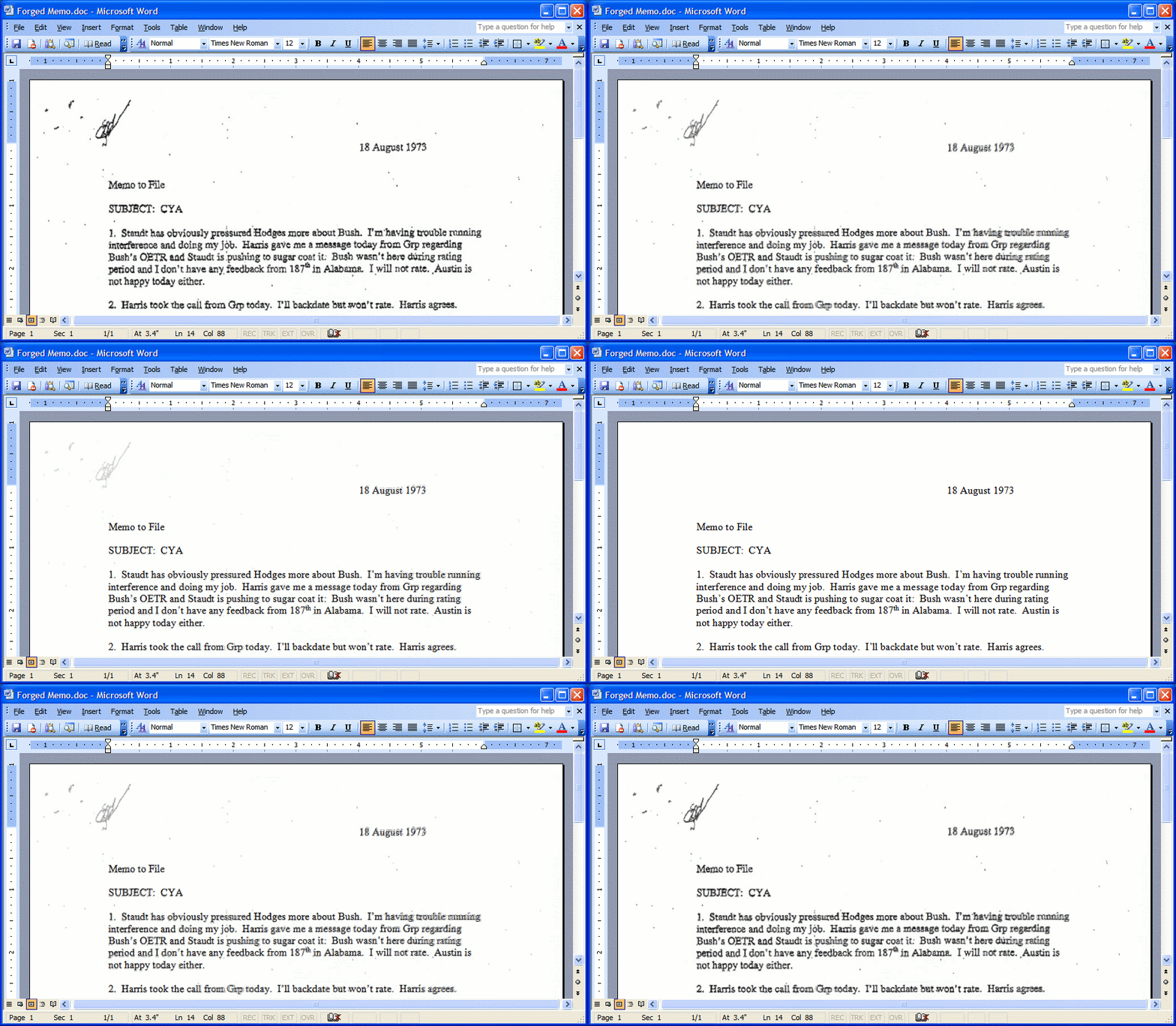
Well - almost exactly. (It also helps that I made a typo.) The problem comes with the superscript "th" being out of alignment. But if you then print it out and scan it back in it matches exactly. (Minus said typo.)
And for completeness, here's the original.
I'll accept that Dan Rather might not have noticed it was a forgery, but there's no way that anyone who'd be in a position to authenticate the document wouldn't notice. It's almost like he didn't do any fact-checking before going public with it...
-
Re:It was the Word overlay...
Well - almost exactly. (It also helps that I made a typo.) The problem comes with the superscript "th" being out of alignment. But if you then print it out and scan it back in it matches exactly. (Minus said typo.)
And for completeness, here's the original.
I'll accept that Dan Rather might not have noticed it was a forgery, but there's no way that anyone who'd be in a position to authenticate the document wouldn't notice. It's almost like he didn't do any fact-checking before going public with it...
-
Re:It was the Word overlay...
Well - almost exactly. (It also helps that I made a typo.) The problem comes with the superscript "th" being out of alignment. But if you then print it out and scan it back in it matches exactly. (Minus said typo.)
And for completeness, here's the original.
I'll accept that Dan Rather might not have noticed it was a forgery, but there's no way that anyone who'd be in a position to authenticate the document wouldn't notice. It's almost like he didn't do any fact-checking before going public with it...
-
Re:Most people already know Firefox
And Firefox works the same on Linux as it does on windows.
Not quite. It's similar (gee?), but there are differences. The biggest difference is the way Firefox under Linux handles the middle mouse button (although you can change that through about:config), but there are other minor changes like the Tools -> Options being renamed Edit -> Preferences. And not so minor changes like the order of OK/Cancel being reversed under Linux (or at least under GNOME?), and of course the file chooser is different.
So while Firefox under Linux is very similar to Firefox under Windows, they're not quite the same. Which actually makes adjusting to using it under Linux far more annoying than it otherwise would have to be. (Especially since it follows GNOME's messed up notion that people read buttons right to left in left to right lanugages.)
-
Re:Hardware?
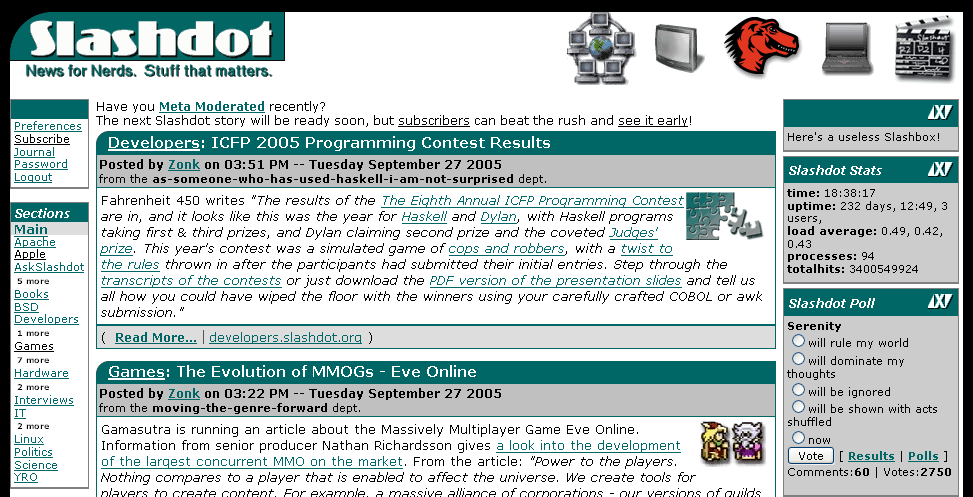
Assuming you're using Firefox 1.5 or higher (or Seamonkey 1.0 or higher?), I've created some CSS rules to make Slashdot use a Serif-style font and move the comment score below the title. I would have just copy-pasted the rules directly into the comment, but Slashdot's stupid broken <ecode> tag bravely mangled all attempts. So instead you'll have to live with a link to the rules on my personal site - no, I'm not spying on you.
(Why move the scores below the title and not next to the title? Because my attempt to move it next to the title didn't look quite as nice as I'd like thanks to the current setup. At some point in the future I may create a set of rules to move it to the right of the title, but it's going to be a long set of rules.)
-
Re:Hardware?
Assuming you're using Firefox 1.5 or higher (or Seamonkey 1.0 or higher?), I've created some CSS rules to make Slashdot use a Serif-style font and move the comment score below the title. I would have just copy-pasted the rules directly into the comment, but Slashdot's stupid broken <ecode> tag bravely mangled all attempts. So instead you'll have to live with a link to the rules on my personal site - no, I'm not spying on you.
(Why move the scores below the title and not next to the title? Because my attempt to move it next to the title didn't look quite as nice as I'd like thanks to the current setup. At some point in the future I may create a set of rules to move it to the right of the title, but it's going to be a long set of rules.)
-
Re:Most of the problem is the users
At this point, browsers warn people, operating systems warn people, firewalls warn people and virus scanners worm people, and they still just have to run that trojan software for whatever pointless whizz-bang effect it adds to their mouse cursor or emails.
Was "virus scanners worm people" a reference to the recent McAfee problem or just a typo?
Er, anyway, my actual point was that people are now so used to be warned about installing just about everything that they just click "yes" without thinking. When you go to Windows Update or Microsoft Update for the first time, Microsoft has a nice little picture explaining how to say "yes" to the warning dialogs that come up when it tries to install the update ActiveX control.
People are just so used to be annoyed by their computer that they mindlessly click through all the warnings anyway. The warnings don't really help, people don't bother understanding what they mean, and websites frequently include instructions on how to bypass them without explaining what the warning means. (I'll fix that someday. No, really...)
The only real solution is user education. Failing that, the clue-stick (also known as a "clue-by-four") is a fun, but ultimately useless, alternative.
-
Re:Free?
Done.
-
Re:Free?
Actually, it doesn't sound like a BitTorrent client at all. It sounds kinda like AIMster if you remember that thing. You add buddies from some network to the sidebar and you can trade files with each other through that sidebar.
It says "the power of BitTorrent" it says nothing about actually implementing the BitTorrent protocol. It sort of sounds like a "friends only" file trading network. However, since it doesn't actually exist yet, and the screenshots look faked (specifically this screenshot, the UI in the window is the Windows XP "Silver" color scheme, while the rest is using the default "Blue" color scheme), I'm not really all that impressed yet.
Although my personal favorite claim on that site is "Share your videos without uploading" - um, right...
My bet is that this is just Yet Another Proprietary File Sharing App - "free" as in "free beer" like you expect, but not as in free software.
If anyone wants an actual BitTorrent extension for Firefox, I'm in the middle of writing one. It's not complete yet (that pesky "downloading" bit is incomplete) but it'll be GPLed. (It looks like I should actually be able to implement the entire thing in JavaScript, meaning it'll be crossplatform without requiring native binaries. Although perhaps a bit slower than if native - but the magic of XPCOM mean that theoretically I can do both.)
-
Re:Well, that depends.
You can do a lot more with Firefox than just override the fonts. Using userContent.css , you can totally redo websites. For example, my Slashdot looks like this.
The CSS for that is on my blog.
(And, ironically enough, looking at those screenshots, I blanked out my username, and am now posting them under my username. I honestly can't remember why I did that.)
-
Re:Well, that depends.
You can do a lot more with Firefox than just override the fonts. Using userContent.css , you can totally redo websites. For example, my Slashdot looks like this.
The CSS for that is on my blog.
(And, ironically enough, looking at those screenshots, I blanked out my username, and am now posting them under my username. I honestly can't remember why I did that.)
-
Re:Selective enforcement
Someone has to actually report you to get your name changed. Since, for the most part, no one cares about your name on non-RP servers, people with names that violate the naming policy generally get away with it.
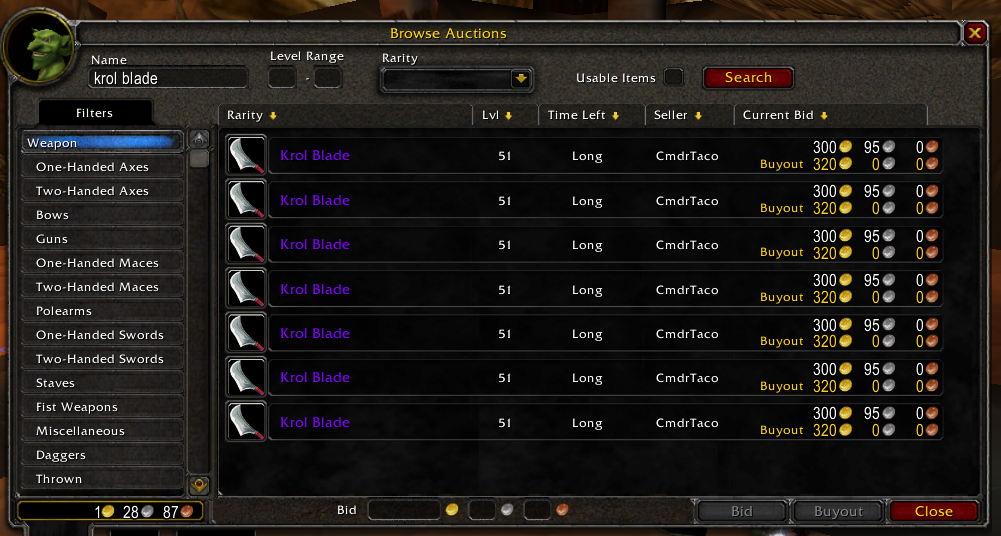
(Which means CmdrTaco ticked someone off, I wonder if it's because he was duping Krol Blades?
But, yeah, their naming policy is ridiculously strict on non-RP servers. I mean, I can see it on RP servers, you're supposed to be RPing. But on normal servers, it's a bit much.
-
Re:Selective enforcement
Someone has to actually report you to get your name changed. Since, for the most part, no one cares about your name on non-RP servers, people with names that violate the naming policy generally get away with it.
(Which means CmdrTaco ticked someone off, I wonder if it's because he was duping Krol Blades?
But, yeah, their naming policy is ridiculously strict on non-RP servers. I mean, I can see it on RP servers, you're supposed to be RPing. But on normal servers, it's a bit much.
-
Re:Bio Force Gun
The Rock recently did an interview on the Daily Show. He walked on with what he called the "Big F***ing Gun." (It may be on Comedy Central, but they still go through Standards and Practices before 1AM, I guess.) I've got some great pictures off my TV capture card of Jon Stewart with the BFG.
Only one I've actually uploaded so far is this one which is intended to be used as an avatar on various forums. (So it's 100x100, which is kinda postage-stamp sized.)
But, hey, Jon Stewart with the BFG. What more can you ask for?
-
Re:Dupe exists... sad farmers
You don't even need Photoshop. You can do that with macros. I had to split them into four macros due to the 255 char limit, but try these out:
f ace\\Icons\\INV_Sword_18"); getglobal(n.."Level"):SetText("51"); getglobal(n.."ClosingTimeText"):SetText("Long"); endThe end result? CmdrTaco is up to something! (Remember all real account names can't have mixed case - they're always with an initial capital and then all lowercase.)
Ironically enough, because that screenshot wasn't "faked" per se, and is really what the ingame interface would look like, comparing it with the "dupe proof" screen shot shows that the dupe screenshot was faked in Photoshop!
-
Re:New browser features
Why do I use Firefox over Opera? Extensions.
Firefox has a really, really cool extension mechanism. The simple JavaScript and XUL API (compared to, say, writing C plugins) makes writing extensions really easy. Once you figure out how to use XPCOM, you have a lot of power available.
I've gone looking (briefly) for ways to extend Opera and have found nothing. This is my personal reason for not using Opera. I like my extensions, even if some of them are of extremely limited use.
-
Re:Trailers
The very end of the file is the torrent. Just cut everything before the string "d8:announce" and, presto, you'll have the torrent. Exactly how you do that is up to you.
Or you can just use the torrents I extracted from the EXEs:
- E3 2005 Multiplayer Gameplay Trailer
- E3 2005 Single Player Gameplay Trailer
- E3 2005 Cinematics Trailer
Plus, for your viewing pleasure, the World of Warcraft trailers:
The actual files are all Divx AVIs, so you'll need to be able to play those, too.
-
Re:Trailers
The very end of the file is the torrent. Just cut everything before the string "d8:announce" and, presto, you'll have the torrent. Exactly how you do that is up to you.
Or you can just use the torrents I extracted from the EXEs:
- E3 2005 Multiplayer Gameplay Trailer
- E3 2005 Single Player Gameplay Trailer
- E3 2005 Cinematics Trailer
Plus, for your viewing pleasure, the World of Warcraft trailers:
The actual files are all Divx AVIs, so you'll need to be able to play those, too.
-
Re:Trailers
The very end of the file is the torrent. Just cut everything before the string "d8:announce" and, presto, you'll have the torrent. Exactly how you do that is up to you.
Or you can just use the torrents I extracted from the EXEs:
- E3 2005 Multiplayer Gameplay Trailer
- E3 2005 Single Player Gameplay Trailer
- E3 2005 Cinematics Trailer
Plus, for your viewing pleasure, the World of Warcraft trailers:
The actual files are all Divx AVIs, so you'll need to be able to play those, too.
-
Re:Trailers
The very end of the file is the torrent. Just cut everything before the string "d8:announce" and, presto, you'll have the torrent. Exactly how you do that is up to you.
Or you can just use the torrents I extracted from the EXEs:
- E3 2005 Multiplayer Gameplay Trailer
- E3 2005 Single Player Gameplay Trailer
- E3 2005 Cinematics Trailer
Plus, for your viewing pleasure, the World of Warcraft trailers:
The actual files are all Divx AVIs, so you'll need to be able to play those, too.
-
Re:Trailers
The very end of the file is the torrent. Just cut everything before the string "d8:announce" and, presto, you'll have the torrent. Exactly how you do that is up to you.
Or you can just use the torrents I extracted from the EXEs:
- E3 2005 Multiplayer Gameplay Trailer
- E3 2005 Single Player Gameplay Trailer
- E3 2005 Cinematics Trailer
Plus, for your viewing pleasure, the World of Warcraft trailers:
The actual files are all Divx AVIs, so you'll need to be able to play those, too.
-
Re:My proposal for the test page.
Worked fine for me, what problem did you have with it?
-
Make sure you *really* want to PROGRAM games...
You need to ask yourself one thing before starting to learn to program: Do you want to program games, or just make games? The two are different.
A lot of gamers wind up deciding "hey, I want to program video games!" at some point, without realizing that what they really want to do is make games. If you don't know anything about programming, then you should start by learning the basics of programming and forget making video games for a while. You need to understand the basics first, before you can start doing anything complicated.
If you really do decide to make video games, I'd highly suggest making a couple of really simple games first. Something like hangman, where you just take a list of words and make the user enter letters until they "guess" it. This will teach you the basics of keyboard input and graphical display without having to worry too much about speed or game mechanics.
I'd suggest starting with Java too - maybe grab Eclipse as your IDE, or just use a simple text editor. This solves the "cross-platform" part, and as long as you understand that you won't be creating Quake in it, you shouldn't be too disappointed. (You could, of course, also try using Mozilla.) It's similar enough to C and C++ that you'll should be able to pick up those if later you wind up making a game in C.
But based on your post, I'd suggest learning more about how to program in general first. Take some classes, if you can. Learn the basics. Learn about basic data structures. This will give you the ground-work you need to create a game, as well as help you determine if programming is really for you.
-
Re:Try thisActually... It does hold up.
I posted this somewhere else, but just compare the original (note: mirrored on my site) with a scanned copy I made. The copy is simply a retyped version of the memo that I printed to a laser printer and then scanned using a sheet-feeding scanner - similar to a fax machine.
They look like they're identical, including the 187th part. The only thing my copy's missing is the dust and dirt on the paper.
-
Re:Try thisActually... It does hold up.
I posted this somewhere else, but just compare the original (note: mirrored on my site) with a scanned copy I made. The copy is simply a retyped version of the memo that I printed to a laser printer and then scanned using a sheet-feeding scanner - similar to a fax machine.
They look like they're identical, including the 187th part. The only thing my copy's missing is the dust and dirt on the paper.
-
Re:Try thisActually... It does hold up.
I posted this somewhere else, but just compare the original (note: mirrored on my site) with a scanned copy I made. The copy is simply a retyped version of the memo that I printed to a laser printer and then scanned using a sheet-feeding scanner - similar to a fax machine.
They look like they're identical, including the 187th part. The only thing my copy's missing is the dust and dirt on the paper.
-
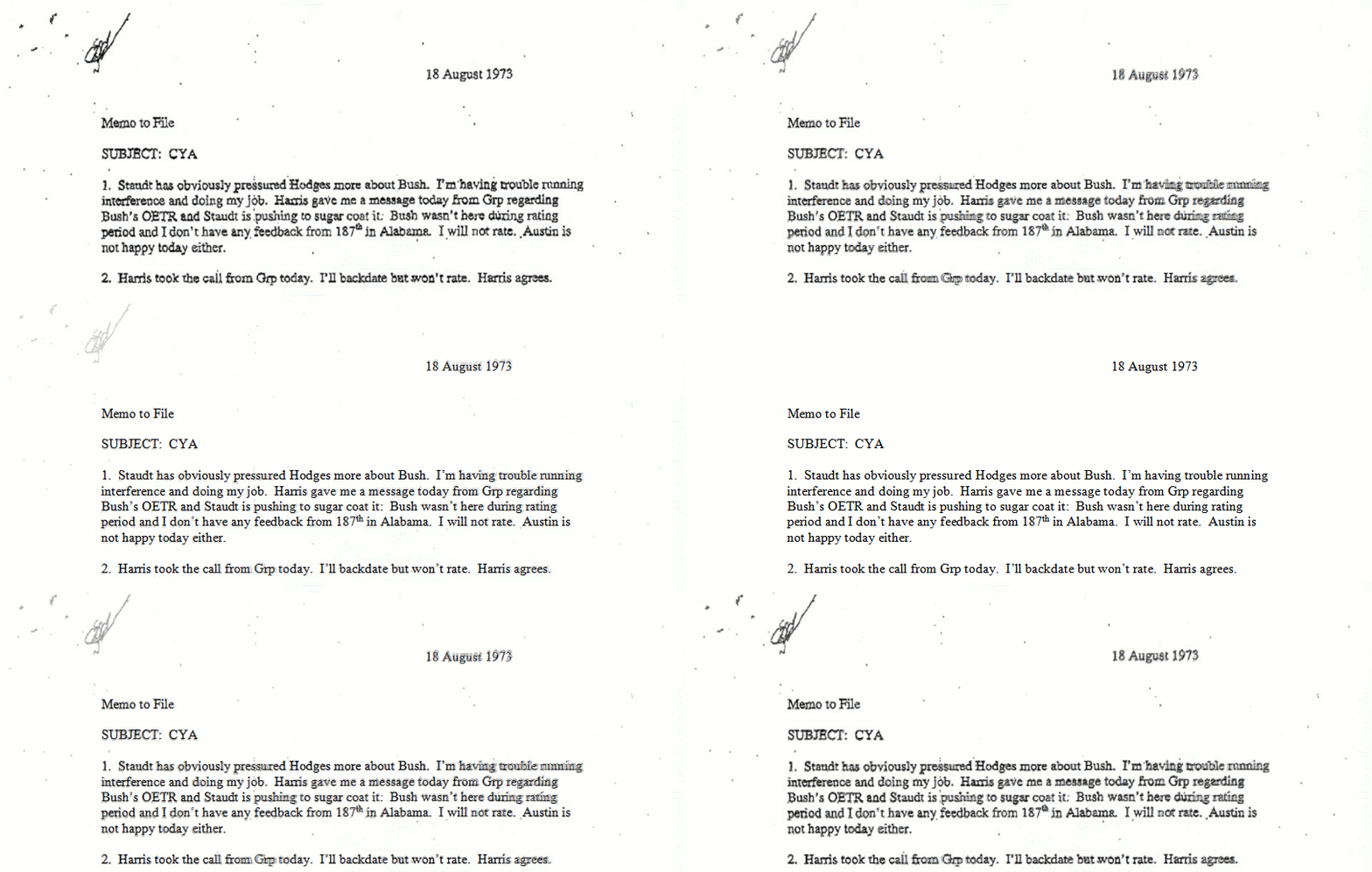
Re:Try thisI was curious about this, so I decided to check it out for myself. I retyped the memo into my copy of Word 2003, and printed out a copy.
I then scanned it back in and wound up with a document that looked surprisingly similar to the "original document." Specically, look at the "187th." It's practically identical.
Oh, and for added fun, try this animation I created showing a copy in Word fading in with the PDF. Note that the PDF is ever so slightly tilted, so things don't line up quite correctly after the first line. But the animation makes it very clear that the two are very similar.
Anyway, to sum up:
- Original document (mirrored on my site)
- Scanned copy I made - this is not an original, it is a copy I typed in Word, printed, and scanned back in to a PDF
-
Re:Try thisI was curious about this, so I decided to check it out for myself. I retyped the memo into my copy of Word 2003, and printed out a copy.
I then scanned it back in and wound up with a document that looked surprisingly similar to the "original document." Specically, look at the "187th." It's practically identical.
Oh, and for added fun, try this animation I created showing a copy in Word fading in with the PDF. Note that the PDF is ever so slightly tilted, so things don't line up quite correctly after the first line. But the animation makes it very clear that the two are very similar.
Anyway, to sum up:
- Original document (mirrored on my site)
- Scanned copy I made - this is not an original, it is a copy I typed in Word, printed, and scanned back in to a PDF
-
Re:Try thisI was curious about this, so I decided to check it out for myself. I retyped the memo into my copy of Word 2003, and printed out a copy.
I then scanned it back in and wound up with a document that looked surprisingly similar to the "original document." Specically, look at the "187th." It's practically identical.
Oh, and for added fun, try this animation I created showing a copy in Word fading in with the PDF. Note that the PDF is ever so slightly tilted, so things don't line up quite correctly after the first line. But the animation makes it very clear that the two are very similar.
Anyway, to sum up:
- Original document (mirrored on my site)
- Scanned copy I made - this is not an original, it is a copy I typed in Word, printed, and scanned back in to a PDF
-
Re:Try thisI was curious about this, so I decided to check it out for myself. I retyped the memo into my copy of Word 2003, and printed out a copy.
I then scanned it back in and wound up with a document that looked surprisingly similar to the "original document." Specically, look at the "187th." It's practically identical.
Oh, and for added fun, try this animation I created showing a copy in Word fading in with the PDF. Note that the PDF is ever so slightly tilted, so things don't line up quite correctly after the first line. But the animation makes it very clear that the two are very similar.
Anyway, to sum up:
- Original document (mirrored on my site)
- Scanned copy I made - this is not an original, it is a copy I typed in Word, printed, and scanned back in to a PDF
-
Re:Try thisI was curious about this, so I decided to check it out for myself. I retyped the memo into my copy of Word 2003, and printed out a copy.
I then scanned it back in and wound up with a document that looked surprisingly similar to the "original document." Specically, look at the "187th." It's practically identical.
Oh, and for added fun, try this animation I created showing a copy in Word fading in with the PDF. Note that the PDF is ever so slightly tilted, so things don't line up quite correctly after the first line. But the animation makes it very clear that the two are very similar.
Anyway, to sum up:
- Original document (mirrored on my site)
- Scanned copy I made - this is not an original, it is a copy I typed in Word, printed, and scanned back in to a PDF
-
Re:Try thisI was curious about this, so I decided to check it out for myself. I retyped the memo into my copy of Word 2003, and printed out a copy.
I then scanned it back in and wound up with a document that looked surprisingly similar to the "original document." Specically, look at the "187th." It's practically identical.
Oh, and for added fun, try this animation I created showing a copy in Word fading in with the PDF. Note that the PDF is ever so slightly tilted, so things don't line up quite correctly after the first line. But the animation makes it very clear that the two are very similar.
Anyway, to sum up:
- Original document (mirrored on my site)
- Scanned copy I made - this is not an original, it is a copy I typed in Word, printed, and scanned back in to a PDF
-
Re:Why am I still hearing this?Sure, Java Micro Edition can be small. Java Standard Edition has a base memory footprint of 4MB. No matter what you do, you have 4MB of crap that's only the base of the system. This does not include any of your code.
Not to mention that Java will always start with a base heap size of 2MB. Combined with the 4MB to store the base of the system, starting Java means that you will always lose 6MB of system memory allocated away to Java, not matter what the program does.
If the heap size ever grows, it will never be shrunk again. (In other words, if your app takes 64MB at some point, but then shrinks back to 4MB, the Java VM will still have 64MB allocated to it that it will never release back to the system.)
But don't take my word. Try it out for yourself. Compile that program and run it, and watch your memory usage.
-
Re:not even close!Yeah, about that script... it breaks Opera.
The problem is that Opera includes the string "MSIE" in their default user agent to maintain some kind of compatibility with scripts searching for MSIE. However, due to the brain-dead way IE allows you to support PNGs with alpha, (namely, creating a blank space to place the image over), Opera won't display anything for the image. This, not surprisingly, isn't that desirable, since Opera supports PNGs perfectly.
Instead of checking for MSIE, I find it's best to check for the existance of the "filters" collection on an object since Opera doesn't support it and as far as I know no browser other than MSIE does. So what you basically do is pick an element that you know will have filters and then see if the filters collection on it is null. Due to the way JavaScript works with properties on elements, browsers that don't support filters will instead report that the "filters" property is null, and IE will report that it's a collection.
Yes, <ecode> is broken, so no indentation, but here goes:
if (document.body.filters == null) {
This script works to detect if you're using MSIE and doesn't get "fooled" by Opera.
} else {
}You can see an example of where I used this script on my Final Fantasy XI Skillchains Tool - the page will display properly in Opera, MSIE, and Mozilla, with PNGs displaying alpha. (Note that I don't use the technique you use above, I actually replace the images during the onload event. Same basic idea.)
Oh, and while we're at it, the PNG rundown:
MSIE: Gamma broken when present, alpha broken
Mozilla: Perfect
Opera: Perfect
Konquerer: To the best of my knowledge, perfect
Safari: Gamma broken when absent -
Re:copy of comparison analysisThe site is slow, but you can still get through. I dunno if my site will be any better, but I still have like 39GB of transfer I can use that expires at the end of the month, so:
-
Re:The Popup Killer spreads the GospelAs an example of this I can point out my new site that creates a rather neat alpha-effect using a fixed background image. This works with Mozilla but not with IE. There's also a standards complaint Tetris-like game I've coded on the site, it works with Mozilla but not with IE.
And, because they're standards compliant, the alpha effect and the Tetris game both work in Opera too. But not in IE.
-
Re:The Popup Killer spreads the GospelAs an example of this I can point out my new site that creates a rather neat alpha-effect using a fixed background image. This works with Mozilla but not with IE. There's also a standards complaint Tetris-like game I've coded on the site, it works with Mozilla but not with IE.
And, because they're standards compliant, the alpha effect and the Tetris game both work in Opera too. But not in IE.
-
Re:Here's one...Speaking as someone who has left a 12-pack of Diet Vanilla Coke out in his car for a good 6 hours in 15 degree F weather, I can say the following:
It depends.
One of the cans had the bottom pop out like several people expect to happen. Most of the cans showed signs of the bottom starting to be pushed out, some were just fine though. Since I could no longer put the can with the bottom inverted down, I had to open and drain it and I can tell you that the pressure is indeed increased - soda spilled everywhere from that one.
The picture of the can lieing on the floor was my AIM buddy icon for a while...