Slashdot Mirror
Search
Search the archive with full-text matching across story titles, bodies,
and comments. Phrases are quoted; or, -word,
and parentheses behave as in a web search. Queries must be at least
3 characters.
Stories · 3,462
-
Google's I/O Developer Conference Starts May 7th At the Shoreline Amphitheater (theverge.com)
Twitter user Till Kottmann used a shortcut accidentally hidden in a puzzle Google tweeted out this morning to figure out that the company's next I/O developer conference will be taking place at the Shoreline Amphitheater in Mountain View, CA starting May 7th. The Verge reports: Typically, the I/O puzzle takes a little longer to solve. This year, Google tweeted out an enigmatic, 12-line block of tweet with an accompanying URL that led to a video with equally enigmatic voiced narration of said text, put to a string of cryptic images and some pleasant ambient music. It's not entirely clear what Google was going for here, but it's safe to say it was likely some form of programming puzzle that most standard Twitter users would not have been able to easily decode.
Duplex will certainly be a hot topic at this year's I/O, as well as the standard updates to Google Lens, Maps, and News, as well as the next version of Android. Hanging over the company's developer efforts this year, however, will be increased scrutiny around Google's plans to work with the US military, following backlash over its involvement with a Department of Defense drone project it has pledged to distance itself from, and the continued murkiness around its plans to launch a search product for the China market. -
Weird Orbits of Distant Objects Can Be Explained Without Invoking a 'Planet Nine' (space.com)
schwit1 shares a report from Space.com: The weirdly clustered orbits of some far-flung bodies in our solar system can be explained without invoking a big, undiscovered "Planet Nine," a new study suggests. The shepherding gravitational pull could come from many fellow trans-Neptunian objects (TNOs) rather than a single massive world, according to the research. "If you remove Planet Nine from the model, and instead allow for lots of small objects scattered across a wide area, collective attractions between those objects could just as easily account for the eccentric orbits we see in some TNOs," study lead author Antranik Sefilian, a doctoral student in the Department of Applied Mathematics and Theoretical Physics at Cambridge University in England, said in a statement.
The duo's modeling work suggests that the strength-in-numbers explanation does indeed work -- if the mass of the Kuiper Belt, the ring of bodies beyond Neptune, is a few to 10 times that of Earth. This is a pretty big "if," given that most estimates peg the Kuiper Belt's mass at less than 10 percent that of Earth (and one recent study put the figure at 0.02 Earth masses). But other solar systems are known to harbor massive disks of material in their outer reaches, Sefilian and Touma noted. And our failure to spot one around our own sun doesn't mean it doesn't exist, they stressed. The new study has been accepted for publication in the Astronomical Journal. -
Facebook Launches a Petition Feature (techcrunch.com)
Tomorrow Facebook will encounter a slew of fresh complexities with the launch of Community Actions, its News Feed petition feature. From a report: Community Actions could unite neighbors to request change from their local and national elected officials and government agencies. But it could also provide vocal interest groups a bully pulpit from which to pressure politicians and bureaucrats with their fringe agendas. Community Actions embodies the central challenge facing Facebook. Every tool it designs for positive expression and connectivity can be subverted for polarization and misinformation. Facebook's membership has swelled into such a ripe target for exploitation that it draws out the worst of humanity. You can imagine misuses like "Crack down on [minority group]" that are offensive or even dangerous but some see as legitimate. The question is whether Facebook puts in the forethought and aftercare to safeguard its new tools with proper policy and moderation. Otherwise each new feature is another liability.
Community Actions start to roll out to the US tomorrow after several weeks of testing in a couple of markets. Users can add a title, description, and image to their Community Action, and tag relevant government agencies and officials who'll be notified. The goal is to make the Community Action go viral and get people to hit the "Support" button. Community Actions have their own discussion feed where people can leave comments, create fundraisers, and organize Facebook Events or Call Your Rep campaigns. Facebook displays the numbers of supporters behind a Community Action, but you'll only be able to see the names of those you're friends with or that are Pages or public figures. -
Berkeley's Two-Armed Robot Hints at a New Future For Warehouses (axios.com)
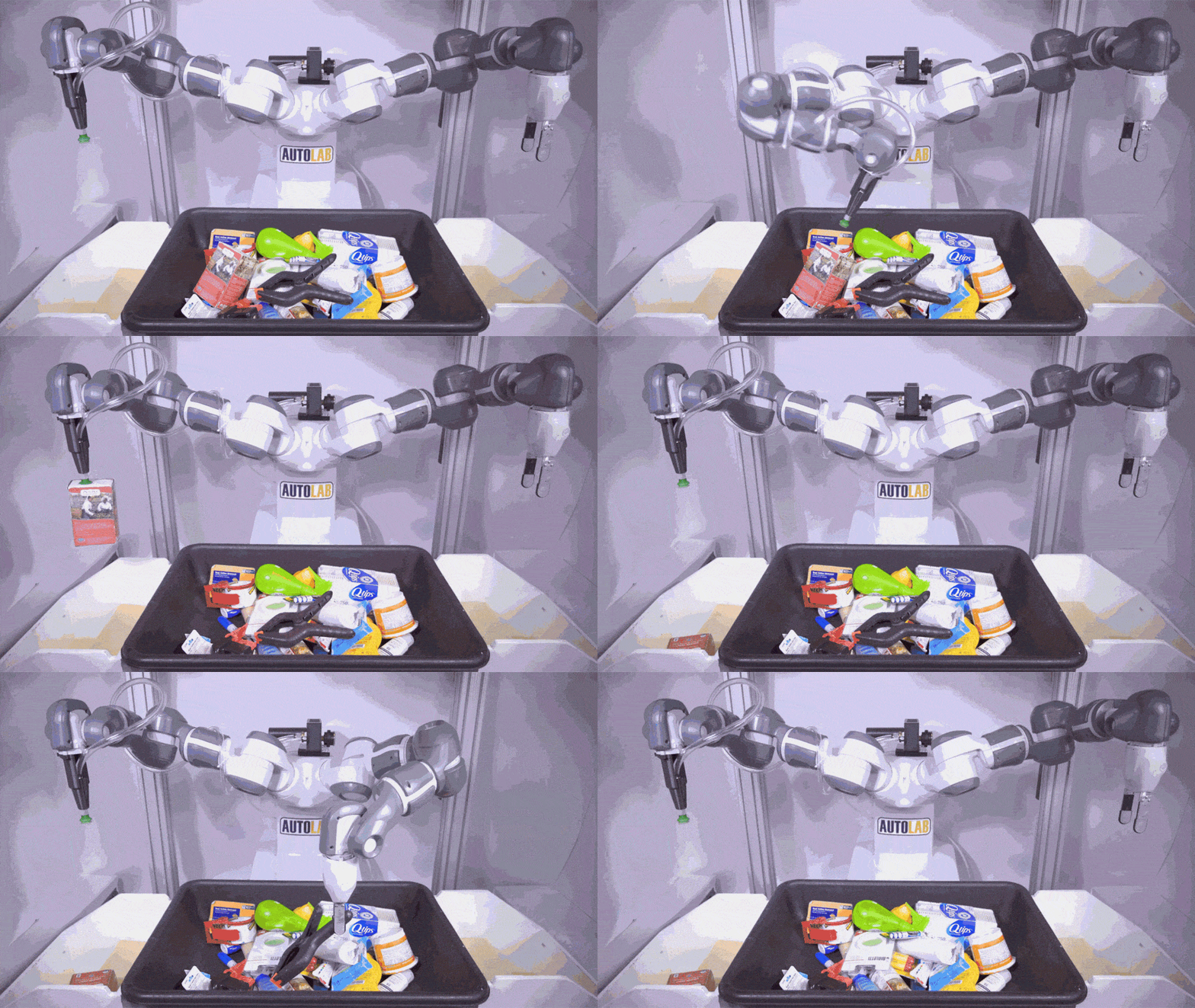
Pick up a glass of water, lift a fork: you automatically figure out the best way to grasp each object. Now researchers at UC Berkeley have developed a robot that makes similar calculation, choosing on the fly whether to grab an object with pincers or lift it with a suction cup. From a report: Berkeley's two-armed robot, seen in this video clip [GIF file], first considers the contents of a bin and calculates each arm's probability of picking up an object. Its suction cup is good at grabbing smooth, flat objects like boxes, but bad at porous surfaces like on a stuffed animal. The pincers, on the other hand, are best with small, odd-shaped items. The system learned its pick-up prowess not from actual practice, but from millions of simulated grasps on more than 1,600 3D objects. In every simulation, small details were randomized, which taught the robot to deal with real-world uncertainty. The bot can pick up objects 95% of the time, at about 300 successful pickups per hour, its creators write in a paper published this week in Science Robotics. Warehouse robots that can move around merchandise are highly sought after. Amazon is reportedly working on its own "picker" robots, as are several robotics companies.
-
Have Aliens Found Us? A Harvard Astronomer on the Mysterious Interstellar Object 'Oumuamua (newyorker.com)
On October 19, 2017, astronomers at the University of Hawaii spotted a strange object travelling through our solar system, which they later described as "a red and extremely elongated asteroid." It was the first interstellar object to be detected within our solar system; the scientists named it 'Oumuamua, the Hawaiian word for a scout or messenger. The following October, Avi Loeb, the chair of Harvard's astronomy department, co-wrote a paper (with a Harvard postdoctoral fellow, Shmuel Bialy) that examined 'Oumuamua's "peculiar acceleration" and suggested that the object "may be a fully operational probe sent intentionally to Earth's vicinity by an alien civilization." Loeb has long been interested in the search for extraterrestrial life, and he recently made further headlines by suggesting that we might communicate with the civilization that sent the probe.
Isaac Chotiner of The New Yorker has interviewed Loeb, who was frustrated that scientists saw 'Oumuamua too late in its journey to photograph the object. "My motivation for writing the paper is to alert the community to pay a lot more attention to the next visitor," he told Chotiner. An excerpt from the interview: The New Yorker: Your explanation of why 'Oumuamua might be an interstellar probe may be hard for laypeople to understand. Why might this be the case, beyond the fact that lots of things are possible?
Loeb: There is a Scientific American article I wrote where I summarized six strange facts about 'Oumuamua. The first one is that we didn't expect this object to exist in the first place. We see the solar system and we can calculate at what rate it ejected rocks during its history. And if we assume all planetary systems around other stars are doing the same thing, we can figure out what the population of interstellar objects should be. That calculation results in a lot of possibilities, but the range is much less than needed to explain the discovery of 'Oumuamua.
There is another peculiar fact about this object. When you look at all the stars in the vicinity of the sun, they move relative to the sun, the sun moves relative to them, but only one in five hundred stars in that frame is moving as slow as 'Oumuamua. You would expect that most rocks would move roughly at the speed of the star they came from. If this object came from another star, that star would have to be very special.
[...]The New Yorker: Hold on. "'Not where is the lack of evidence so that I can fit in any hypothesis that I like?' " [Bailer-Jones, of the Max Planck Institute for Astronomy, in Heidelberg, Germany, has identified four possible home stars for 'Oumuamua, and was asked to respond to Loeb's light-sail theory by NBC.]
Loeb: Well, it's exactly the approach that I took. I approached this with a scientific mind, like I approach any other problem in astronomy or science that I work on. The point is that we follow the evidence, and the evidence in this particular case is that there are six peculiar facts. And one of these facts is that it deviated from an orbit shaped by gravity while not showing any of the telltale signs of cometary outgassing activity. So we don't see the gas around it, we don't see the cometary tail. It has an extreme shape that we have never seen before in either asteroids or comets. We know that we couldn't detect any heat from it and that it's much more shiny, by a factor of ten, than a typical asteroid or comet. All of these are facts. I am following the facts.
Last year, I wrote a paper about cosmology where there was an unusual result, which showed that perhaps the gas in the universe was much colder than we expected. And so we postulated that maybe dark matter has some property that makes the gas cooler. And nobody cares, nobody is worried about it, no one says it is not science. Everyone says that is mainstream -- to consider dark matter, a substance we have never seen. That's completely fine. It doesn't bother anyone. But when you mention the possibility that there could be equipment out there that is coming from another civilization -- which, to my mind, is much less speculative, because we have already sent things into space -- then that is regarded as unscientific. But we didn't just invent this thing out of thin air. The reason we were driven to put in that sentence was because of the evidence, because of the facts. If someone else has a better explanation, they should write a paper about it rather than just saying what you said. -
WhatsApp Now Has More Monthly Active Users Than Facebook App (venturebeat.com)
Facebook's $19 billion bet on WhatsApp in 2014, when the messaging app had 450 million active users, is beginning to pay off. From a report: In recent months, WhatsApp has surpassed Facebook's own marquee app in popularity, according to industry estimates. In September of last year, WhatsApp for the first time had more monthly active users worldwide on Android and iPhone platforms than the Facebook app, research firm App Annie said today in its annual State of Mobile report. App Annie did not share specific figures but told VentureBeat that WhatsApp has maintained its lead over the Facebook app since September.
-
How Etsy Sellers and Big Business Make Money on Public Domain Art (vice.com)
"Some people have figured out how to turn reselling public domain content into side hustles," reports Motherboard: On Etsy, there are thousands of listings for downloadable prints and lithographs that are in the public domain. The concept is pretty simple: these merchants round up and download the most visually beautiful art in the public domain, and then sell prints on Etsy. But some of them don't even go that far and just sell digital files of the art. Then, the buyers can print out the prints at whichever size they want and use them as they please...
With that being said, there's also big companies like Walmart that are also trying to earn money off art in the public domain... Similarly, the Museum of Modern Art is selling "Red Canna" by Georgia O'Keeffe, which is now in the public domain, for $166.50 (on sale from $185). For the love of god, don't pay $166.50 for something you could download for free and print yourself for less than $16.
Of course, none of this is bad necessarily. The public domain exists in part so that people can give formerly copyrighted works new life -- sometimes an iconic painting simply needs to become a bedspread. But now that many new works are available for free, it's worth having a quick look around if you're thinking of buying vintage art. You might be able to get it for free elsewhere.
To be fair, the Museum of Modern Art is a non-profit -- and reportedly avoids all government funding. -
Taking the Smarts Out of Smart TVs Would Make Them More Expensive (theverge.com)
In a wide-ranging interview, Nilay Patel of The Verge speaks with Bill Baxter, chief technology officer of Vizio, about what the company thinks of some TV vendors adding support for Apple's AirPlay 2, and other things. A remarkable exchange on the business of data collection and selling: Nilay Patel: I guess I have a philosophical question. You guys are committed to low price points and you often beat the industry at those price points. Can you hit those price points without the additional data collection that TV does if you don't have an ad business or a data business on top of the TV?
Bill Baxter: So that's a great question. Actually, we should have a beer and have a long, long chat about that. So look, it's not just about data collection. It's about post-purchase monetization of the TV. This is a cutthroat industry. It's a 6-percent margin industry, right? I mean, you know it's pretty ruthless. You could say it's self-inflicted, or you could say there's a greater strategy going on here, and there is. The greater strategy is I really don't need to make money off of the TV. I need to cover my cost.
And then I need to make money off those TVs. They live in households for 6.9 years -- the average lifetime of a Vizio TV is 6.9 years. You would probably be amazed at the number of people come up to me saying, "I love Vizio TVs, I have one" and it's 11 years old. I'm like, "Dude, that's not even full HD, that's 720p." But they do last a long time and our strategy -- you've seen this with all of our software upgrades including AirPlay 2 and HomeKit -- is that we want to make things backward compatible to those TVs. So we're continuing to invest in those older TVs to bring them up to feature level comparison with the new TVs when there's no hardware limitation that would otherwise prevent that.
And the reason why we do that is there are ways to monetize that TV and data is one, but not only the only one. It's sort of like a business of singles and doubles, it's not home runs, right? You make a little money here, a little money there. You sell some movies, you sell some TV shows, you sell some ads, you know. It's not really that different than The Verge website.
Patel: One sort of Verge-nerd meme that I hear in our comments or on Twitter is "I just want a dumb TV. I just want a panel with no smarts and I'll figure it out on my own." But it sounds like that lifetime monetization problem would prevent you from just making a dumb panel that you can sell to somebody.
Baxter: Well, it wouldn't prevent us, to be honest with you. What it would do is, we'd collect a little bit more margin at retail to offset it. Again, it may be an aspirational goal to not have high margins on our TV business because I can make it up downstream. On the other hand, I'm actually aggregating that monetization across a large number of users, some of which opt out. It's a blended revenue model where, in the end, Vizio succeeds, but you know, it's not wholly dependent on things like data collection. -
Companies Are Now Offering Seven Figures For Hacks That Allow Spies, Cops To Steal Chat App Messages (vice.com)
Zerodium, a startup that buys and sells hacking tools and exploits to governments around the world, announced on Monday price increases for almost everything they are looking for, such as iOS remote jailbreaks and Windows exploits. "It said it will now pay security researchers $1,000,000 for exploits in WhatsApp, iMessage, and SMS/MMS apps for all mobile operating systems," reports Motherboard. From the report: Compromising the whole iPhone, sometimes referred to as remote jailbreaking or rooting the phone, can cost $2 million or more, and usually involves a series of bugs and exploits. The price increase shows that mobile devices in general are getting more and more secure, and thus harder to hack. That means that it's becoming increasingly hard for hackers to break into iOS and Android devices. That makes the life of folks like spy agencies and police departments harder too. That's where Zerodium and other similar companies, such as Azimuth and Crowdfense, come in: they act as intermediaries between security researchers and government agencies looking for tools -- often called zero-days -- to break into targets. Before today, Zerodium was willing to pay $500,000 for WhatsApp and iMessage exploits, according to an archived version of the company's site. These new prices are in line with the market, according to Maor Shwartz, who used to run a company that acquired and sold exploits to government agencies.
-
Netflix's New iTunes Billing Policy Will Curb a $256 Million Revenue Stream For Apple (venturebeat.com)
Early last year, Netflix allowed some iOS users in more than two dozen markets to bypass the iTunes payment method as part of an experiment. The streaming company is now incorporating the change globally, curbing a $256 million revenue stream for Apple. "According to new data compiled by Sensor Tower, Netflix grossed $853 million in 2018 on the iOS App Store," reports TechCrunch. "Based on that figure, Apple's take would have been around $256 million, the firm said." The new policy change allows Netflix to avoid paying the 15% levy that Apple charges on in-app subscriptions. From a report: "We no longer support iTunes as a method of payment for new members," a Netflix spokesperson told VentureBeat. Existing members, however, can continue to use iTunes as a method of payment, the spokesperson added.
The company did not share exactly when it rolled out the change globally, but a support representative VentureBeat spoke with pegged the timeframe as late last month. Additionally, the support rep added that customers who are rejoining Netflix using an iOS device, after having canceled payment for at least one month, also won't be able to use iTunes billing. The move, which will allow Netflix to keep all proceeds from its new paying iPhone and iPad customers, underscores the tension between developers and the marquee distributors of mobile apps -- Apple and Google. -
Marriott Says Hackers Stole More Than 5 Million Passport Numbers (cnet.com)
Marriott has downsized its original estimate on a major data breach, but the number of people affected is still historic. The hotel group announced Friday that it now believes hackers accessed the records of up to 383 million guests, following an investigation it conducted with a forensics and analytics team. In November, it had reported an estimate of as many as 500 million guests. From a report: Even at that lower figure, the Marriott incident remains one of the largest personal data breaches in history, more than double that of Equifax, which exposed the personal data of 147.7 million American. Data breaches have become a common issue for massive companies that collect and store information on millions of people. In 2018, tech giants like Facebook and Reddit have fallen victim to data breaches. Hackers look for poor protection that they can bypass to steal valuable details like Social Security numbers, birth dates, email addresses and credit card numbers.
-
Album Sales Are Dying as Fast as Streaming Services Are Rising (rollingstone.com)
In 2018, Best Buy decided to stop selling CDs, with the change partly brought on by record labels' increasing reluctance to even issue them. Both choices are symptoms as well as causes of a seemingly inevitable trend: Buying music is now going out of style nearly as fast as streaming music is rising. From a report: In 2018, album sales fell 18.2 percent from the previous year and song sales fell 28.8 percent, according to U.S. year-end report figures from data company BuzzAngle, which tracks music consumption. Meanwhile, total on-demand music streams, including both audio and video, shot up 35.4 percent. Audio on-demand streams set a new record high in 2018 of 534.6 billion streams, which is up 42 percent from 2017's 376.9 billion streams.
It's tricky to compare the specific unit numbers of sales to streams --since such a comparison would be pitting continuous playback of a certain piece of music against a one-time purchase of it -- but certain other milestones in the consumption market can help highlight just how much streaming is replacing physical sales and downloads in America. For instance: Even though total song downloads are still in the hundreds of millions, they're coming down in scale at the top. In 2018, there was not a single song that broke 1 million sales -- compared to 14 songs that reached that figure in 2017, 36 in 2016 and 60 in 2015. At the 2 million sales mark, two songs took that trophy in 2017, while five claimed it in 2016 and 16 songs made it in 2015, throwing the modest figures of this year's sales into even sharper relief. -
Video Games Now Account For More Than Half of UK Entertainment Market (independent.co.uk)
The video games sector now accounts for more than half of the entertainment market in UK, according to new figures. From a report: The Entertainment Retailers Association (ERA) said the gaming market's value rose to $4.85bn, more than double what it was worth in 2007. It now makes gaming a larger market than video and music combined for the first time. The figures show three games -- Fifa 19, Red Dead Redemption 2 and Call of Duty: Black Ops 4 -- each sold more than one million physical units in the UK across games consoles during 2018. ERA chief executive Kim Bayley said: "The games industry has been incredibly effective in taking advantage of the potential of digital technology to offer new and compelling forms of entertainment. Despite being the youngest of our three sectors, it is now by far the biggest."
-
Almost a Third of New Cars Sold In Norway Last Year Were Pure Electric (reuters.com)
An anonymous reader quotes a report from Reuters: Almost a third of new cars sold in Norway last year were pure electric, a new world record as the country strives to end sales of fossil-fueled vehicles by 2025. In a bid to cut carbon emissions and air pollution, Norway exempts battery-driven cars from most taxes and offers benefits such as free parking and charging points to hasten a shift from diesel and petrol engines. The independent Norwegian Road Federation (NRF) said on Wednesday that electric cars rose to 31.2 percent of all sales last year, from 20.8 percent in 2017 and just 5.5 percent in 2013, while sales of petrol and diesel cars plunged. The sales figures consolidate Norway's global lead in electric car sales per capita, part of an attempt by Western Europe's biggest producer of oil and gas to transform to a greener economy. For comparison, electric cars had a 2.2 percent share in China in 2017 and 1.2 percent in the United States, according to IEA data.
-
Lawrence Roberts, Who Helped Design Internet's Precursor, Dies at 81 (nytimes.com)
In late 1966, a 29-year-old computer scientist drew a series of abstract figures on tracing paper and a quadrille pad. Some resembled a game of cat's cradle; others looked like heavenly constellations; still others like dress patterns. Those curious drawings were the earliest topological maps of what we now know as the internet. The doodler, Lawrence G. Roberts, died on Dec. 26 at his home in Redwood City, Calif. He was 81. The New York Times: The cause was a heart attack, said his son Pasha. As a manager at the Pentagon's Advanced Research Projects Agency, or ARPA, Dr. Roberts designed much of the Arpanet -- the internet's precursor -- and oversaw its implementation in 1969. Dr. Roberts called upon a circle of colleagues who shared his interest in computer networking for help in creating the technical underpinnings of the Arpanet, integrating and refining many ideas for how data should flow. Dr. Roberts was considered the decisive force behind packet switching, the technology that breaks data into discrete bundles that are then sent along various paths around a network and reassembled at their destination. He decided to use packet switching as the underlying technology of the Arpanet; it remains central to the function of the internet.
And it was Dr. Roberts's decision to build a network that distributed control of the network across multiple computers. Distributed networking remains another foundation of today's internet. Dr. Roberts's interest in computer networking began when he was a graduate student at the Massachusetts Institute of Technology in the early 1960s. He paid close attention to the work of his longtime colleague, Leonard Kleinrock, who had done research on theoretical aspects of computer networks, analyzing the problem of data flow. Dr. Roberts also followed the ideas of J.C.R. Licklider, a prominent psychologist and predecessor of Dr. Roberts's at ARPA, who envisioned what he called an "intergalactic computer network." -
How Much Internet Traffic Is Fake? Turns Out, a Lot of It, Actually. (nymag.com)
Long-time Slashdot reader AmiMoJo shared this article from New York magazine: In late November, the Justice Department unsealed indictments against eight people accused of fleecing advertisers of $36 million in two of the largest digital ad-fraud operations ever uncovered... Hucksters infected 1.7 million computers with malware that remotely directed traffic to "spoofed" websites.... [B]ots "faked clicks, mouse movements, and social network login information to masquerade as engaged human consumers." Some were sent to browse the internet to gather tracking cookies from other websites, just as a human visitor would have done through regular behavior. Fake people with fake cookies and fake social-media accounts, fake-moving their fake cursors, fake-clicking on fake websites -- the fraudsters had essentially created a simulacrum of the internet, where the only real things were the ads.
How much of the internet is fake? Studies generally suggest that, year after year, less than 60 percent of web traffic is human; some years, according to some researchers, a healthy majority of it is bot. For a period of time in 2013, the Times reported this year, a full half of YouTube traffic was "bots masquerading as people," a portion so high that employees feared an inflection point after which YouTube's systems for detecting fraudulent traffic would begin to regard bot traffic as real and human traffic as fake. They called this hypothetical event "the Inversion...."
[N]ot even Facebook, the world's greatest data-gathering organization, seems able to produce genuine figures. In October, small advertisers filed suit against the social-media giant, accusing it of covering up, for a year, its significant overstatements of the time users spent watching videos on the platform (by 60 to 80âpercent, Facebook says; by 150 to 900 percent, the plaintiffs say). According to an exhaustive list at MarketingLand, over the past two years Facebook has admitted to misreporting the reach of posts on Facebook Pages (in two different ways), the rate at which viewers complete ad videos, the average time spent reading its "Instant Articles," the amount of referral traffic from Facebook to external websites, the number of views that videos received via Facebook's mobile site, and the number of video views in Instant Articles.
On Twitter the author also shared a Twitter thread by the Washington Post's director of advertising technology, who shares his own complaints about the ecosystem of online advertising. "The problem isn't just that the internet is full of fakery and bullshit and bad numbers and malfunctioning metrics and bullshitters and fraudsters. The problem is that all the fake shit is layered on top of other fake shit and it just COMPOUNDS itself... Like you get fake users, who get autoplay videos which no one is really watching....
"That's not even counting the entire ad campaigns that are fake where the product is just a bullshit excuse to collect data on you." -
Google Helps AI Learn To Book Flights on the Web (zdnet.com)
Researchers at Google's AI labs created a couple of novel neural networks that can succeed in navigating web forms, such as an online flight-booking site. Although baby steps at the moment, the program succeeds as well or better than some models trained using human demonstrations of pointing and clicking. From a report: In a new paper from the team, they trained a neural network to understand the structure of web pages and the choices it can make when filling out forms in an airline ticket booker, or interacting with a social media site. The work broadly employs the same category of machine learning as Google's Go-winning AlphaZero software, what is known as "reinforcement learning." In RL, a neural network develops strategies of steps to take at each stage of trying to solve a problem as it receives rewards for good choices. The researchers figured out a way to train a neural network without being given human examples of how to navigate an online booking form. The approach makes the task of learning webpages and social media networks more "scalable," they write, where the possible combinations of states and actions can reach into the tens of millions. The point is not necessarily to actually book a flight; it's more an exercise in how a neural network can find solutions to a problem with numerous variables, where human guidance, or "supervision," in training is infeasible.
-
Epic Games, the Creator of Fortnite, Banked a $3 Billion Profit in 2018: Report (techcrunch.com)
This year Fortnite became the world's most popular game, growing its parent company, Epic Games' valuation to $15 billion. It also helped the company pile up cash. Epic grossed a $3 billion profit for this year fueled by the continued success of Fortnite, TechCrunch reported Thursday, citing a person with knowledge of the business. From the report: Fortnite, which is free to play but makes money selling digital items, has popularized the battle royale category -- think Lord of the Flies meets Hunger Games -- almost single-handedly, and it has been the standout title for the U.S.-based game publisher. Founded way back in 1991, Epic hasn't given revenue figures for its smash hit -- which has 125 million players -- but this new profit milestone, combined with other pieces of data, gives an idea of the success the company is seeing as a result of a prescient change in strategy made six years ago.
-
'Two Years Later, I Still Miss the Headphone Port' (techcrunch.com)
An anonymous reader shares a column: I've been trying to figure out why the removal of the headphone port bugs me more than other ports that have been unceremoniously killed off, and I think it's because the headphone port almost always only made me happy. Using the headphone port meant listening to my favorite album, or using a free minute to catch the latest episode of a show, or passing an earbud to a friend to share some new tune. It enabled happy moments and never got in the way.
Now every time I want to use my headphones, I just find myself annoyed. Bluetooth? Whoops, forgot to charge them. Or whoops, they're trying to pair with my laptop even though my laptop is turned off and in my backpack. Dongle? Whoops, left it on my other pair of headphones at work. Or whoops, it fell off somewhere, and now I've got to go buy another one. I'll just buy a bunch of dongles, and put them on all my headphones! I'll keep extras in my bag for when I need to borrow a pair of headphones. That's just like five dongles at this point, problem solved! Oh, wait: now I want to listen to music while I fall asleep, but also charge my phone so it's not dead in the morning. That's a different, more expensive splitter dongle (many of which, I've found, are poorly made garbage). -
Artificial General Intelligence is Nowhere Close To Being a Reality (venturebeat.com)
Three decades ago, David Rumelhart, Geoffrey Hinton, and Ronald Williams wrote about a foundational weight-calculating technique -- backpropagation -- in a monumental paper titled "Learning Representations by Back-propagating Errors." Backpropagation, aided by increasingly cheaper, more robust computer hardware, has enabled monumental leaps in computer vision, natural language processing, machine translation, drug design, and material inspection, where some deep neural networks (DNNs) have produced results superior to human experts. Looking at the advances we have made to date, can DNNs be the harbinger of superintelligent robots? From a report: Demis Hassabis doesn't believe so -- and he would know. He's the cofounder of DeepMind, a London-based machine learning startup founded with the mission of applying insights from neuroscience and computer science toward the creation of artificial general intelligence (AGI) -- in other words, systems that could successfully perform any intellectual task that a human can. "There's still much further to go," he told VentureBeat at the NeurIPS 2018 conference in Montreal in early December. "Games or board games are quite easy in some ways because the transition model between states is very well-specified and easy to learn. Real-world 3D environments and the real world itself is much more tricky to figure out ... but it's important if you want to do planning."
Most AI systems today also don't scale very well. AlphaZero, AlphaGo, and OpenAI Five leverage a type of programming known as reinforcement learning, in which an AI-controlled software agent learns to take actions in an environment -- a board game, for example, or a MOBA -- to maximize a reward. It's helpful to imagine a system of Skinner boxes, said Hinton in an interview with VentureBeat. Skinner boxes -- which derive their name from pioneering Harvard psychologist B. F. Skinner -- make use of operant conditioning to train subject animals to perform actions, such as pressing a lever, in response to stimuli, like a light or sound. When the subject performs a behavior correctly, they receive some form of reward, often in the form of food or water. The problem with reinforcement learning methods in AI research is that the reward signals tend to be "wimpy," Hinton said. In some environments, agents become stuck looking for patterns in random data -- the so-called "noisy TV problem."