Slashdot Mirror
Search
Search the archive with full-text matching across story titles, bodies,
and comments. Phrases are quoted; or, -word,
and parentheses behave as in a web search. Queries must be at least
3 characters.
Stories · 3,636
-
AT&T Clarifies Data Limitations On "Unlimited" Data Plans
MojoKid writes "Several months ago, AT&T notified customers that it would begin throttling network speeds for users who exceeded a certain threshold, with the definitive throttle point defined as an imprecise "the top 5% of mobile data users." The company has issued a statement clarifying this policy after irate customers with unlimited data plans demanded to know what the cap was and how the company determined who should and shouldn't be throttled. The magic number is 3GB, which conveniently happens to be the maximum amount of tiered bandwidth AT&T will sell you. So why would AT&T want unlimited users to move to tiered pricing when its maximum tier is also set at 3GB? Simple — the amount of money the company makes on customers who exceed that 3GB limit. The fine print reads: 'If 3GB is exceeded, an additional 1 GB is automatically provided at a rate of $10 for each additional 1 GB.' Anyone using above 3GB on an unlimited plan is a customer who isn't paying enough for the privilege (from AT&T's perspective)."
-
Virginia High Court Rejects Case Against Climatologist Michael Mann
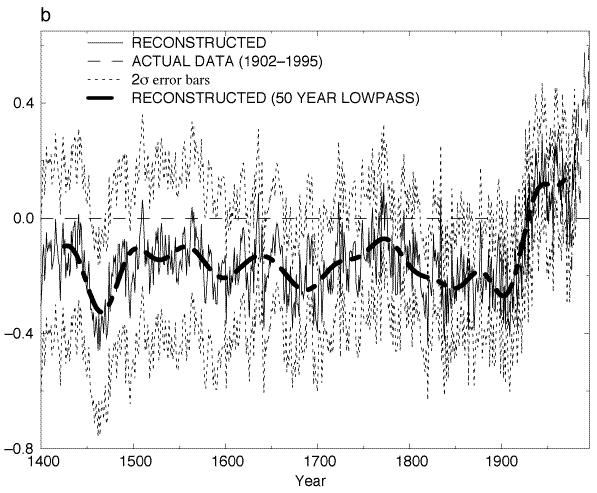
ananyo writes "The Virgina Supreme Court on Friday tossed out an investigation by the state's conservative attorney general, Ken Cuccinelli, into Michael Mann, the former University of Virginia climatologist whose work on the now-famous hockey-stick graph has become a lightning rod for climate skeptics. 'In a dense and conflicted 26-page ruling (PDF) covering a century and a half of case law — including references to kings as well as modern "functional incongruities" that divided the judges themselves — Virginia’s high court ruled that the university is not a "person" and thus is not subject to Cuccinelli’s demands under the state’s Fraud Against Taxpayers Act.' The 'climategate' scientist has been cleared of wrongdoing by a number of investigations."
-
Chevy Volt Meets High Resistance, GM Suspends Sales
Hugh Pickens writes "The Hill reports that GM has announced to employees at one of its facilities that it is suspending production of the Chevy Volt for five weeks and temporarily laying off 1,300 employees. Back when GM launched the beleaguered electric car, it boldly targeted sales of 10,000 in 2011 and 60,000 in 2012 but GM only sold 7,671 Volts in 2011 and just 1,626 so far this year. 'We needed to maintain proper inventory and make sure that we continued to meet market demand,' says GM spokesman Chris Lee. 'We see positive trends, but we needed to make this market adjustment.' Although President Obama promised he would buy a Volt 'five years from now, when I'm not president anymore,' the Volt has come under criticism from Republicans in Congress because of reports of its batteries catching on fire during testing. Ironically, the shutdown comes as gas prices are soaring, exactly the time when an electric car should be an easy sell." If it's still true that GM was taking a loss on every Volt sold, perhaps this is a blessing in disguise.
-
Is Poor Numeracy Ruining Lives?
Hugh Pickens writes "The BBC reports on how millions of people struggle to understand a payslip or a train timetable, or pay a household bill. Government figures show that almost half the working population of England have only primary school math skills, and research suggests that weak math skills are linked with an array of poor life outcomes such as prison, unemployment, exclusion from school, poverty and long-term illness. 'We are paying for this in our science, technology and engineering industries but also in people's own ability to earn funds and manage their lives,' says Chris Humphries. He is the chairman of National Numeracy, an organization seeking to emulate the success of the National Literacy Trust, which has helped improve reading and writing standards since it was set up nearly 20 years ago. The Department for Education wants the vast majority of young people to study math up to 18 within a decade to meet the growing demand for employees with high level and intermediate math skills. 'It is simply inexcusable for anyone to say "I can't do maths,"' adds Humphries. "
-
The Specter of Gasoline At $5 a Gallon
Hugh Pickens writes "The NY Times reports that gas prices are already at record highs for the winter months — averaging $4.32 in California and $3.73 a gallon nationally. As summer approaches, demand for gasoline rises, typically pushing prices up around 20 cents a gallon. But gas prices could rise another 50 cents a gallon or more, analysts say, if the diplomatic and economic standoff over Iran's nuclear ambitions escalates into military conflict or there is some other major supply disruption. 'If we get some kind of explosion — like an Israeli attack or some local Iranian revolutionary guard decides to take matters in his own hands and attacks a tanker — than we'd see oil prices push up 20 to 25 percent higher and another 50 cents a gallon at the pump,' says Michael C. Lynch, president of Strategic Energy and Economic Research. A sharp rise in the prices of oil and gas would crimp the nation's budding economic recovery would cause big political problems at home for President Obama, who is already being attacked by Republican presidential candidates over gas prices and his overall energy policies. On the other hand, environmentalists see high gas prices as a helpful step toward the development of alternative energy. Secretary Treasury Steven Chu notably said in 2008 'we have to figure out how to boost the price of gasoline to the levels in Europe' to make Americans trade in their 'love affair with the automobile' for a marriage to mass transit. In the meantime President Obama is in a bind because any success in tightening sanctions on Iran could squeeze global oil supplies, pushing up prices and causing serious economic repercussions at home and abroad."
-
Paypal Forces E-Book Publisher To Censor Erotic Content
hey! writes "On February 18 of this year, global giant payment processor PayPal sent eBook publisher Smashwords an ultimatum: if Smashwords didn't remove all eBooks with certain erotic content from its catalog in the next several days, PayPal would immediately stop handling payments. Smashword's TOS already precluded child pornography, but now PayPal wants them to also censor depictions of consenting, non-related adults acting out incest fantasies. Likewise, fantasy novels in which human characters transform into non-humans are affected if those characters have sex. ZDNet has a summary of the impact of these changes, which would among other things ban Vladmir Nabokov's Lolita. As outrage mounts, finger pointing is in full swing. Smashwords blames PayPal, and PayPal blames the banks it deals with. The crux seems to be that erotica buyers have a higher rate of 'chargebacks' — customers who buy stuff then demand their money back. Fair enough, but is a customer really more likely to return a book because it depicts one kind of fantasy between consenting adults vs. another? Perhaps the problem is just the quality of writing." Note: as you can probably tell from the summary, the linked articles (while factual in nature) discuss subjects that may not be suitable for workplace reading.
-
Yahoo Unfriends Facebook With Aggressive Patent Demands
theodp writes "'Hate to see something happen to that multi-billion IPO of yours,' is essentially the IPO-threatening message Yahoo sent to Mark Zuckerberg and Facebook investors on the eve of the social networking giant's IPO. Yahoo, unlike the Sopranos, is using IP as its muscle to collect its IPO-protection money: 'We must insist that Facebook either enter into a licensing agreement [for 10-20 Yahoo-owned patents] or we will be compelled to move forward unilaterally to protect our rights,' Yahoo explained in a statement alerting the NY Times to its demand. Yahoo issued a similar last-minute threat to Google on the eve of its 2004 IPO, prompting Google to pony up 2.7 million shares to settle Yahoo's patent lawsuit. BTW, should Facebook also be concerned that Amazon has been beefing up its PlanetAll social networking patents from the '90s, including the one issued Tuesday covering a Social Networking System Capable of Notifying Users of Profile Updates Made by Their Contacts?"
-
Spanish Company Tests 'Right To Be Forgotten' Against Google
suraj.sun writes with an excerpt from an article over at Ars Technica: "Los Alfaques, a bucolic campground near the Spanish town of Tarragona, isn't happy with Google. That's because searches for 'camping Alfaques' bring up horrific images of charred human flesh — not good for business when you're trying to sell people on the idea of relaxation. The campground believes it has the right to demand that Google stop showing 'negative' links, even though the links aren't mistakes at all. Are such lawsuits an aberration, or the future of Europe's Internet experience in the wake of its new 'right to be forgotten' proposals? Legal scholars like Jeffrey Rosen remain skeptical that such a right won't lead to all sorts of problems for free expression. But in Spain, the debate continues. Last week, Los Alfaques lost its case — but only because it needed to sue (U.S.-based) Google directly. Mario Gianni, the owner of Los Alfaques, is currently deciding whether such a suit is worth pursuing."
-
Proposed Video Copy Protection Scheme For HTML5 Raises W3C Ire
suraj.sun writes with this excerpt from Ars Technica: "A new Web standard proposal authored by Google, Microsoft, and Netflix seeks to bring copy protection mechanisms to the Web. The Encrypted Media Extensions draft defines a framework for enabling the playback of protected media content in the Web browser. The proposal is controversial and has raised concern among some parties that are participating in the standards process. In a discussion on the W3C HTML mailing list, critics questioned whether the proposed framework would really provide the level of security demanded by content providers. The aim of the proposal is not to mandate a complete DRM platform, but to provide the necessary components for a generic key-based content decryption system. It is designed to work with pluggable modules that implement the actual decryption mechanisms."
-
Is It Time For NoSQL 2.0?
New submitter rescrv writes "Key-value stores (like Cassandra, Redis and DynamoDB) have been replacing traditional databases in many demanding web applications (e.g. Twitter, Google, Facebook, LinkedIn, and others). But for the most part, the differences between existing NoSQL systems come down to the choice of well-studied implementation techniques; in particular, they all provide a similar API that achieves high performance and scalability by limiting applications to simple operations like GET and PUT. HyperDex, a new key-value store developed at Cornell, stands out in the NoSQL spectrum with its unique design. HyperDex employs a unique multi-dimensional hash function to enable efficient search operations — that is, objects may be retrieved without using the key (PDF) under which they are stored. Other systems employ indexing techniques to enable search, or enumerate all objects in the system. In contrast, HyperDex's design enables applications to retrieve search results directly from servers in the system. The results are impressive. Preliminary benchmark results on the project website show that HyperDex provides significant performance improvements over Cassandra and MongoDB. With its unique design, and impressive performance, it seems fittng to ask: Is HyperDex the start of NoSQL 2.0?"
-
Aging Eyes Blamed For Seniors' Health Woes
Hugh Pickens writes "Scientists have looked for explanations as to why certain conditions occur with age, among them memory loss, slower reaction time, insomnia and even depression looking at such suspects as high cholesterol, obesity, heart disease and an inactive lifestyle. Now Laurie Tarkan writes that as eyes age, less and less sunlight gets through the lens to reach key cells in the retina that regulate the body's circadian rhythm, its internal clock that rallies the body to tackle the day's demands in the morning and slows it down at night, allowing the body to rest and repair. 'Evolution has built this beautiful timekeeping mechanism, but the clock is not absolutely perfect and needs to be nudged every day,' says Dr. David Berson, whose lab at Brown University studies how the eye communicates with the brain. Dr. Patricia Turner, an ophthalmologist who with her husband, Dr. Martin Mainster has written extensively about the effects of the aging eye on health, estimate that by age 45, the photoreceptors of the average adult receive just 50 percent of the light needed to fully stimulate the circadian system, by age 55, it dips to 37 percent, and by age 75, to a mere 17 percent and recommend that people should make an effort to expose themselves to bright sunlight or bright indoor lighting when they cannot get outdoors and have installed skylights and extra fluorescent lights in their own offices to help offset the aging of their own eyes. 'In modern society, most of the time we live in a controlled environment under artificial lights, which are 1,000 to 10,000 times dimmer than sunlight and the wrong part of the spectrum,' says Turner. 'We believe the effect is huge and that it's just beginning to be recognized as a problem.'"
-
Samsung Spins Off Its Display Business
redletterdave writes "Samsung Electronics announced Monday that it will spin off its LCD business division to launch a new entity, provisionally called Samsung Display Co., set to go live on April 1, 2012. The new business will launch with about $668 million in capital, but Samsung plans to invest about $5.8 billion in 2012 to develop better displays. The move, which now awaits shareholder approval, has been rumored for months since Samsung's LCD business announced operating losses of $666 million in 2011, citing sluggish TV sales. The company's spin-off display business may eventually merge with Samsung Mobile Display, which makes the company's organic light-emitting diode (OLED) panels that are currently in high demand."
-
UK Government To Demand Data On Every Call, Email, and Tweet
judgecorp writes "The UK government is proposing a law that would require phone and Internet companies to store information on all communications, and hand it to the security services when required. The Communications Capabilities Development Programme (CCDP) abandoned by the last government is back on the table, proposed as a means to increase security, and likely to be pushed through before the Olympics in London, according to reports."
-
Human Rights Groups Push To Save Condemned Programmer In Iran
First time accepted submitter debiangruven writes "Human rights Groups are making one final plea to save the life of Canadian programmer, Saeed Malekpour, who was sentenced to death for writing a program to upload photos to the Internet. From the article: 'Malekpour's supporters have created Facebook pages and websites in his support dating to at least 2009. Amnesty International has requested on its website that concerned individuals write Iranian authorities inside and outside the country to demand that Malekpour not be executed."
-
Universities Agree To Email Monitoring For Copyright Agency
New submitter fish waffle writes "The universities of Western Ontario and Toronto have signed a deal with Access Copyright that allows for surveillance of faculty correspondence, defines e-mailing hyperlinks as equivalent to photocopying a document, and imposes an annual $27.50 fee for every full-time equivalent student to pay for it all. Access Copyright is a licensing agency historically used by most universities in Canada to give them blanket permission to reproduce copyrighted works, largely to address photocopying concerns that may extend beyond basic fair-use. Since the expiration of this agreement, and with recognition that many academic uses do not require copyright permissions or payments or are already covered under vendor-specific agreements, Canadian academic institutions have been united in opposing continuation of the agreement with the agency. Access Copyright has countered with a proposal for increased fees, and expansion of the definition of copyright to include linking and the need for online surveillance. In a strange breaking of ranks, the University of Western Ontario and the University of Toronto have capitulated and signed agreements that basically accede to the licensing agency's demands. The Canadian Association of University Teachers bulletin provides detailed background on the issue (PDF)."
-
How Companies Learn Your Secrets
Hugh Pickens writes "For decades, Target has collected vast amounts of data on every person who regularly walks into one of its stores. Now the NY Times Magazine reports on how companies like Target identify those unique moments in consumers' lives when their shopping habits become particularly flexible and the right advertisement or coupon can cause them to begin spending in new ways. Among life events, none are more important than the arrival of a baby, and new parents are a retailer's holy grail. In 2002, marketers at Target asked statisticians to answer an odd question: 'If we wanted to figure out if a customer is pregnant, even if she didn't want us to know, can you do that?' Specifically, the marketers said they wanted to send specially designed ads to women in their second trimester, which is when most expectant mothers begin buying all sorts of new things, like prenatal vitamins and maternity clothing. 'We knew that if we could identify them in their second trimester, there's a good chance we could capture them for years,' says statistician Andrew Pole. 'As soon as we get them buying diapers from us, they're going to start buying everything else too.' As Pole's computers crawled through the data, he was able to identify about 25 products that, when analyzed together, allowed him to assign each shopper a 'pregnancy prediction' score and he soon had a list of tens of thousands of women who were most likely pregnant. About a year after Pole created his pregnancy-prediction model, a man walked into a Target outside Minneapolis and demanded to see the manager. He was clutching coupons that had been sent to his daughter, and he was angry. 'My daughter got this in the mail!' he said. 'She's still in high school, and you're sending her coupons for baby clothes and cribs? Are you trying to encourage her to get pregnant?' The manager apologized and then called a few days later to apologize again but the father was somewhat abashed. 'It turns out there's been some activities in my house I haven't been completely aware of. She's due in August. I owe you an apology.'"
-
EU Court Rules Social Networks Cannot Be Forced To Police Downloads
arnodf writes "According to EU Observer, 'The European Court of Justice (ECJ) has struck the latest blow in the debate over internet policing, ruling on Thursday (16 February) that online social network sites cannot be forced to construct measures to prevent users from downloading songs illegally. The court, which is the highest judicial authority in the EU, stated that installing general filters would infringe on the freedom to conduct business and on data privacy. ... The case was brought before the ECJ by Sabam, the Belgian national music royalty collecting society, against social network site Netlog. In 2009, Sabam went to the Belgian Court of First Instance to demand that Netlog take action to prevent site-users from illegally downloading songs from its portfolio. It also insisted that Netlog pay a €1,000 fine for every day of delaying in compliance. Netlog legal submission argued that granting Sabam's injunction would be imposing a general obligation to monitor on Netlog, which is prohibited by the e-commerce directive.' In related news, Sabam is going to be prosecuted (Google translation of Dutch original) for 'forging accounts, abuse of trust, bribery, money laundering and forgery,' which took place from the early 90's till 2007"
-
Aderall Or Nothing: Anatomy of the Great Amphetamine Drought
pigrabbitbear writes "To prevent hoarding of materials and their potential for theft and illicit use, the Drug Enforcement Agency sets quotas for the chemical precursors to drugs like Adderall. The DEA projects the need for amphetamine salts, then produces and distributes the materials to pharmaceutical companies so that they can produce their drugs. But with the number of prescriptions for Adderall jumping 13 percent in the past year, pharmaceutical companies claim that the quotas are no longer sufficient for supplying Americans with their Adderall. The DEA contends that their quotas do, in fact, meet demands, and that any shortages arise from pharmaceutical companies selectively producing only certain, typically name-brand and more expensive versions of ADHD medications."
-
99.8% Security For Real-World Public Keys
An anonymous reader writes "If you grab all the public keys you can find on the net, then you might expect to uncover a few duds — but would you believe that 2 out of every 1000 RSA keys is bad? This is one of the interesting findings in the paper 'Ron was wrong, Whit is right' by Lenstra, Hughes, Augier, Bos, Kleinjung and Wachter. Quoting from the paper's abstract: 'We performed a sanity check of public keys collected on the web. Our main goal was to test the validity of the assumption that different random choices are made each time keys are generated. We found that the vast majority of public keys work as intended. A more disconcerting finding is that two out of every one thousand RSA moduli that we collected offer no security. Our conclusion is that the validity of the assumption is questionable and that generating keys in the real world for "multiple-secrets" cryptosystems such as RSA is significantly riskier than for "single-secret" ones such as ElGamal or (EC)DSA which are based on Diffie-Hellman.'" For a layman's interpretation of the research, the NY Times has an article about the paper. Update: 02/15 01:34 GMT by S : Security researcher Dan Kaminsky has commented on the paper, saying that while the survey work itself is good, it doesn't necessarily support the paper's thesis. He writes, "On the most basic level, risk in cryptography is utterly dominated, not by cipher selection, but by key management. The study found 12,720 public keys. It also found approximately 2.94 million expired certificates. And while the study didn’t discuss the number of certificates that had no reason to be trusted in the first place (being self signed), it did find 5.4M PGP keys. It does not matter the strength of your public key if nobody knows to demand it."
-
Hackers Hit Apple Supplier Foxconn
wiredmikey writes "Protests against Apple and Foxconn due to furor over reports about working conditions have gone digital. A group known as SwaggSec has successfully hacked computers at Foxconn, and posted the stolen data to The Pirate Bay website. News of the hack comes as protesters paid a visit today to Apple stores around the world to deliver petitions demanding the improvement of working conditions at factories run by Apple suppliers in China and other countries. In response to the attack, Foxconn reportedly took down a website that explains the services it offers to some of its partners, including Apple, Cisco and Acer."