Slashdot Mirror
Search
Search the archive with full-text matching across story titles, bodies,
and comments. Phrases are quoted; or, -word,
and parentheses behave as in a web search. Queries must be at least
3 characters.
Stories · 3,462
-
Android Overtakes Windows as the Internet's Most Used Operating System (betanews.com)
As expected last month, Android has surpassed Windows to become the world's most used operating system, according to the web analytics firm StatCounter. From a report: Usage figures published by StatCounter show that Android accounted for 37.93 percent of the worldwide OS Internet usage share in March. Windows is not far behind at 37.91 percent, but Android taking the lead is being described as a "milestone in technology history." The fact that Android is now topping the charts can be attributed to the fact that mobile devices are now used to connect to the Internet far more frequently than desktop computers and laptop. Coupled with declining PC sales, Windows is starting to lose out overall, although it still accounts for 84 percent of the worldwide desktop operating system market.
-
Steve Wozniak's Biographer Pranked By Woz's Mom? (groovypost.com)
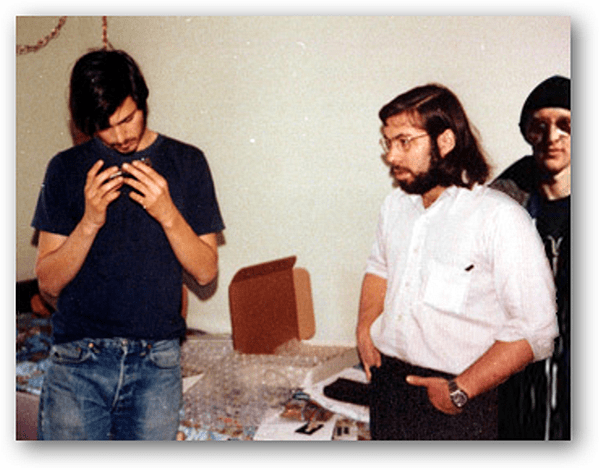
An anonymous reader writes: Gina Smith is the co-author of Steve Wozniak's 2006 biography. On the day that Steve Jobs died, she posted a poignant story Woz had shared about their early days in Silicon Valley, remembering how Jobs sold his Volkswagen van while Woz sold his calculator to raise funds to build the first Apple 1 computer kit.
The post includes a picture of 22-year-old Steve Jobs standing next to young Steve Wozniak. But there's also an unexpected figure in the background wearing a black ski hat and glasses. It's "tourist guy," the figure from a 9/11 meme whose stoic face was spliced into the background of everything from the explosion of the Hindenburg to the Kennedy assassination, and even into the original Star Trek and Quentin Tarantino's Reservoir Dogs. The picture is attributed to Margaret Wozniak. So does that mean Steve Wozniak's biographer got pranked by Woz's mom?
Interestingly, in 2011 the tourist guy actually apologized for creating the original fake World Trade Center image. "I assumed my friends would recognise me and call me to see if I was alright, but they didn't, they posted it on to other friends and suddenly it was all over the world... I am ashamed that even now the police still get calls about it." -
US College Grads See Slim-to-Nothing Wage Gains Since Recession (bloomberg.com)
The worth of a college degree is losing its luster in the US job market. From a report on Bloomberg: Wages for college graduates across many majors have fallen since the 2007-09 recession, according to an analysis by the Georgetown University Center on Education and the Workforce in Washington using Census bureau figures. Young job-seekers appear to be the biggest losers. What you study matters for your salary, the data show. Chemical and computer engineering majors have held down some of the best earnings of at least $60,000 a year for entry level positions since the recession, while business and science graduates's paychecks have fallen. A biology major at the start of their career earned $31,000 on an annual average in 2015, down $4,000 from five years earlier. "It has been like this for the past five, six years now," said Ban Cheah, a research professor at Georgetown who compiled the data. "It's a little depressing."
-
The Galaxy S8 Will Be Samsung's Biggest Test Ever (theverge.com)
An anonymous reader quotes a report from The Verge: You know what's coming tomorrow, you've known and waited for it for months now. Samsung's 2017 flagship smartphone, the Galaxy S8, will be officially announced, and one of the most critical periods in the company's history will begin. The phone Samsung launches on Wednesday will carry greater expectations and have to prove a lot more than usual. Even as the world's biggest smartphone maker, Samsung's mobile credibility was deeply shaken by the Galaxy Note 7 snafu, so it now needs to reassert its reliability while also rebooting its technological advantage. Vlad Savov provides a "rundown of the biggest challenges facing Samsung" in his report. While Samsung will need to nail the design and camera performance, as well as many other things, the most critical area will be the battery, given how the Note 7 was recalled due to battery issues. Even though that incident took place half a year ago, we are still faced with the consequences. Samsung is still trying to figure out what to do with the "recalled units" and people are still making bad jokes about "explosive Samsung news." If the Galaxy S8 is to have any battery issues whatsoever, the result could be catastrophic for the company. Though, Samsung is well aware of this and has likely packed "the most robust and durable batteries we've ever seen in a smartphone" inside the Galaxy S8 devices.
-
India's Silicon Valley Offers the Cheapest Engineers, But the Quality of Their Talent is Another Story (qz.com)
Ananya Bhattacharya, writing for Quartz: Bengaluru's startup ecosystem is what it is because of its engineers. With an average annual salary of $8,600, engineers in India's tech hub cost 13 times less than their Silicon Valley counterparts, according to the 2017 Global Startup Ecosystem Report. The city is home to the world's cheapest crop of engineers, with the average annual pay of a resident software engineer falling well below the global figure of $49,000. [...] However, the city's talent pool poses challenges in access and quality. For the most part, "engineers haven't been hired very quickly, experience is average, and visa success is low," the report says. "The quality and professionalism of resources is also questionable in many cases," Abhimanyu Godara, founder of US-based chatbot startup Bottr.me, which has a development team in Bangalore, said in the report.
-
Red-Light Camera Grace Period Goes From 0.1 To 0.3 Seconds, Chicago To Lose $17 Million (arstechnica.com)
The Chicago Department of Transportation announced a new policy earlier this week that will increase the "grace period" -- the time between when a traffic light turns red to when a ticket is automatically issued. The decision has been made to increase the time from 0.1 seconds to 0.3 seconds, following recommendations part of a recent study of its red-light cameras. Ars Technica reports: This will bring the Windy City in line with other American metropolises, including New York City and Philadelphia. In a statement, the city agency said that this increase would "maintain the safety benefits of the program while ensuring the program's fairness." On Tuesday, the Chicago Tribune reported that the city would lose $17 million in revenue this year alone as a result of the expanded grace period. Michael Claffey, a CDOT spokesman, confirmed that figure to Ars. "We want to emphasize that extending this enforcement threshold is not an invitation to drivers to try to beat the red light," CDOT Commissioner Rebekah Scheinfeld also said in the statement. "By accepting the recommendation of the academic team, we are giving the benefit of the doubt to well-intentioned drivers while remaining focused on the most reckless behaviors."
-
Spider Venom Might Protect Us From Deadly Strokes (arstechnica.com)
New submitter evolutionary writes: Apparently the Australian funnel-web spider's venom has amazing properties, if you can use it within 4.5 hours. From a report via Ars Technica: "Venom from the Australian funnel-web spider (Hadronyche infensa) contains a chemical that shuts down an ion channel known to malfunction in brain cells after strokes, researchers report Monday in PNAS. In cell experiments, the harmless chemical protected brain cells from a toxic flood of ions unleashed after a stroke strikes. In rats, the venom component markedly protected the rats' brains from extensive damage -- even when it was given hours after a stroke occurred. Researchers have years, if not decades, of work to figure out if their particular venom is safe and effective in humans. And very few potential therapies make the cut. But, this early study gives us reason to be somewhat optimistic: it follows years of research and hypotheses that such venom components and their ion channel-targets could be key to new stroke treatments -- which are desperately needed. The vast majority of strokes involve a blockage that stops or slows the flow of blood into an area of the brain (other strokes can be caused by hemorrhages.) This leaves brain cells without fresh blood and oxygen. To cope, the cells can switch to metabolic pathways that don't rely on oxygen. But this creates acidic conditions, and the pH outside of brain cells starts dropping fast -- a scenario called acidosis. In the acidic, oxygen-starved brain regions, brain cells become damaged and start dying off, causing irreparable damage. The only drug approved by the Food and Drug Administration to treat these types of strokes tries to restore blood flow by breaking up clots. But this drug is only used in about three to four percent of stroke victims because it has to be used within 4.5 hours of the stroke. It also comes with the risk of causing hemorrhages."
-
AMD Confirms It's Issuing a Fix To Stop New Ryzen Processors From Crashing Desktops (digitaltrends.com)
AMD says the company has been able to figure out why FMA3 code is causing system hangs on PCs using a new Ryzen desktop processor. From a report: Although AMD didn't provide a detailed report on the problem's root cause, the company said that BIOS changes will be distributed to motherboard manufacturers to resolve the issue. Customers are encouraged to keep an eye on their motherboard vendor's website for an update. "We are aware of select instances where FMA code can result in a system hang," the company said. "We have identified the root cause." AMD released three Ryzen-branded desktop processors at the beginning of March that plug into motherboards based on AMD's new AM4 socket. The trio of processors include the Ryzen 7 1800X, the Ryzen 7 1700X, and the Ryzen 7 1700. However, all three reportedly cause a hard system lock when running certain FMA3 workloads. The problem was replicated across all three processors and a variety of motherboards.
-
John Goodenough's Colleagues Are Skeptical of His New Battery Technology (qz.com)
Earlier this month, a research team led by John Goodenough announced that they had created a new fast charging solid-state battery that can operate in extreme temperatures and store five to ten times as much energy as current standard lithium-ion batteries. The announcement was big enough to have Google's Eric Schmidt tweeting about it. However, there are some skeptics, including other leading battery researchers. "For his invention to work as described, they say, it would probably have to abandon the laws of thermodynamics, which say perpetual motion is not possible," reports Quartz. "The law has been a fundamental of batteries for more than a century and a half." Quartz reports: Goodenough's long career has defined the modern battery industry. Researchers assume that his measurements are exact. But no one outside of Goodenough's own group appears to understand his new concept. The battery community is loath to openly challenge the paper, but some come close. "If anyone but Goodenough published this, I would be, well, it's hard to find a polite word," Daniel Steingart, a professor at Princeton, told Quartz. Goodenough did not respond to emails. But in a statement released by the University of Texas, where he holds an engineering chair, he said, "We believe our discovery solves many of the problems that are inherent in today's batteries. Cost, safety, energy density, rates of charge and discharge and cycle life are critical for battery-driven cars to be more widely adopted." In addition, Helena Braga, the paper's lead author, in an exchange of emails, insisted that the team's claims are valid. For almost four decades, Goodenough has dominated the world of advanced batteries. If anyone could finally make the breakthrough that allows for cheap, stored electricity in cars and on the grid, it would figure to be him. Goodenough invented the heart of the battery that is all but certainly powering the device on which you are reading this. It's the lithium-cobalt-oxide cathode, invented in 1980 and introduced for sale by Sony in 1991. Again and again, Goodenough's lab has emerged with dramatic discoveries confirming his genius. It's what is not stated in the paper that has some of the battery community stumped. How is Goodenough's new invention storing any energy at all? The known rules of physics state that, to derive energy, differing material must produce differing eletro-chemical reactions in the two opposing electrodes. That difference produces voltage, allowing energy to be stored. But Goodenough's battery has pure metallic lithium or sodium on both sides. Therefore, the voltage should be zero, with no energy produced, battery researchers told Quartz. Goodenough reports energy densities multiple times that of current lithium-ion batteries. Where does the energy come from, if not the electrode reactions? That goes unexplained in the paper.
-
In 18 Years, A College Degree Could Cost About $500,000 (buzzfeed.com)
An anonymous reader shares a report: People worried about college affordability today can at least take this to heart: it could get much, much worse. Tuition has been rising by about 6% annually, according to investment management company Vanguard. At this rate, when babies born today are turning 18, a year of higher education at a private school -- including tuition, fees, and room and board -- will cost more than $120,000, Vanguard said. Public colleges could average out to $54,000 a year. That means without financial aid, the sticker price of a four-year college degree for children born today could reach half a million dollars at private schools, and a quarter million at public ones. That's for a family with one kid; those with more could be facing a bill that reaches seven figures.
-
Tech Billionaires Invest In Linking Brains To Computers (technologyreview.com)
"To many in Silicon Valley, the brain looks like an unconquered frontier whose importance dwarfs any achievement made in computing or the Web," including Bryan Johnson, the founder of Braintree online payments, and Elon Musk. An anonymous reader quotes MIT Technology Review: Johnson is effectively jumping on an opportunity created by the Brain Initiative, an Obama-era project which plowed money into new schemes for recording neurons. That influx of cash has spurred the formation of several other startups, including Paradromics and Cortera, also developing novel hardware for collecting brain signals. As part of the government brain project, the defense R&D agency DARPA says it is close to announcing $60 million in contracts under a program to create a "high-fidelity" brain interface able to simultaneously record from one million neurons (the current record is about 200) and stimulate 100,000 at a time...
According to neuroscientists, several figures from the tech sector are currently scouring labs across the U.S. for technology that might fuse human and artificial intelligence. In addition to Johnson, Elon Musk has been teasing a project called "neural lace," which he said at a 2016 conference will lead to "symbiosis with machines." And Mark Zuckerberg declared in a 2015 Q&A that people will one day be able to share "full sensory and emotional experiences," not just photos. Facebook has been hiring neuroscientists for an undisclosed project at Building 8, its secretive hardware division.
Elon Musk complains that the current speeds for transferring signals from brains are "ridiculously slow". -
Raspberry Pi Becomes Third Best-Selling General Purpose Computer of All Time, Beating Commodore 64 (raspberrypi.org)
The Raspberry Pi has outsold the Commodore 64 by selling north of 12.5 million boards in five years, becoming the world's third best-selling general purpose computer. "The Commodore 64, had, until recently, the distinction of being the third most popular general purpose computing platform," Eben Upton told a crowd at the fifth birthday party. "That's what I'm here to celebrate," he said, "we are now the third most popular general purpose computing platform after the Mac and PC." The MagPi Magazine reports: The Raspberry Pi Model 3 is the best-selling Raspberry Pi. This chart shows that Raspberry Pi 3 has accounted for almost a third of all Raspberry Pi boards sold. The Model 3 sits next to its immediate predecessor, the Raspberry Pi 2B+ (which has the same board shape but a slightly slower CPU). These two boards account for over half of all Raspberry Pi boards sold. The rest of the sales are between older models. The original Model A accounts for just 2 percent of sales. So keep one if you've got it as they're pretty rare. We should point out, before the Commodore fan club arrives, that there are discrepancies in the total number of sales of the C64. The 12.5 million figure comes from an analysis of serial numbers. This article by Michael Steil explains in detail why the 12.5 million number is accurate. We hold it to be the most accurate analysis of Commodore 64 sales (other opinions are available).
-
Slashdot Asks: Is the Internet Killing Old and New Art Forms or Helping Them Grow? (nytimes.com)
The thing about the internet is that as it gained traction and started to become part of our lives, it caused a lot of pain -- bloodbath, many say -- to several major industries. The music industry was nearly decimated, for instance, and pennies on the dollar doesn't begin to describe what has happened to the newspapers. But things are starting to change, many observers note. As Netflix CEO Reed Hastings noted at the New Yorker Tech Festival last year, the internet is increasingly changing the way people consume content and that has forced the industries to innovate and find new ways to cater to their audiences. But some of these industries are still struggling to figure out new models for their survival. Farhad Manjoo, a technology columnist at The New York Times, argues that for people of the future, our time may be remembered as a period not of death, but of rejuvenation and rebirth. He writes: Part of the story is in the art itself. In just about every cultural medium, whether movies or music or books or the visual arts, digital technology is letting in new voices, creating new formats for exploration, and allowing fans and other creators to participate in a glorious remixing of the work. [...] In the last few years, and with greater intensity in the last 12 months, people started paying for online content. They are doing so at an accelerating pace, and on a dependable, recurring schedule, often through subscriptions. And they're paying for everything. [...] It's difficult to overstate how big a deal this is. More than 20 years after it first caught mainstream attention and began to destroy everything about how we finance culture, the digital economy is finally beginning to coalesce around a sustainable way of supporting content. If subscriptions keep taking off, it won't just mean that some of your favorite creators will survive the internet. It could also make for a profound shift in the way we find and support new cultural talent. It could lead to a wider variety of artists and art, and forge closer connections between the people who make art and those who enjoy it.
-
Secretary of State Rex Tillerson Allegedly Used Email Alias As Exxon CEO (arstechnica.com)
According to New York Attorney General Eric Schneiderman, Rex Tillerson used an email alias of "Wayne Tracker" to communicate with other Exxon executives about climate change while serving as CEO of Exxon Mobil. "New York Attorney General Eric Schneiderman has been leading an investigation of Exxon Mobil centered on whether the company misled investors by publicly arguing against the reality of climate change even though its executives knew the science was accurate," reports Ars Technica. "The investigation was triggered by news reports describing climate research the company undertook in the 1970s and 1980s, which affirmed the work of other climate scientists and showed that greenhouse gas emissions were causing climate change. Exxon buried that work and spent the next couple decades claiming that the science was unclear, although it has recently publicly acknowledged reality." From the report: The e-mails that were provided allowed the attorney general to figure out that Tillerson used the account between 2008 and 2015 at least, but it didn't appear on Exxon's list of accounts for which records were preserved. The letter also mentions 34 other e-mail accounts "specifically assigned to top executives, board members, or assistants" that the attorney general thinks should have been included. In a statement, an Exxon spokesperson explained, "The e-mail address, Wayne.Tracker@exxonmobil.com, is part of the company's e-mail system and was put in place for secure and expedited communications between select senior company officials and the former chairman for a broad range of business-related topics." The Office of the Attorney General's letter claims that "Exxon has continuously delayed and obstructed the production of documents from its top executives and board members, which are crucial to OAG's investigation into Exxon's touted risk-management practices regarding climate change."
-
This Is How the Number 3.14 Got the Name 'Pi' (time.com)
An anonymous reader shares a Time article: Ancient research on real numbers likely "didn't get improved upon until the age of Newton," says John Conway, mathematics professor emeritus at Princeton University who once won the school's Pi Day pie-eating contest. Sir Isaac Newton recorded 16 digits of pi in 1665, later admitting that he was "ashamed" of how long he had worked on the computations, as it meant that he had "no other business at the time," per the MAA. It was not until the 18th century -- about two millennia after the significance of the number 3.14 was first calculated by Archimedes -- that the name "pi" was first used to denote the number. In other words, the Greek letter used to represent the idea was not actually picked by the Ancient Greeks who discovered it. British mathematician William Jones came up with the Greek letter and symbol for the figure in 1706, and it was popularized by Swiss mathematician Leonhard Euler, Catherine the Great's mathematician, a few decades later. "Euler was a much better mathematician than the people who used [pi] before, and he wrote very good textbooks," says Conway. "He used it because the Greek letter Pi corresponds with the letter 'P'... and pi is about the perimeter of the circle."
-
Report: Up To 15% Of Twitter Accounts Are Bots (cbsnews.com)
A team of researchers claim they can identify Twitter account activity that's posted by bots through their new web portal -- "Bot or Not?" -- leveraging "more than a thousand features extracted from public data and meta-data." And it turns out there are a lot of bots. An anonymous reader writes: "A study released by the University of Southern California reports that roughly nine to 15 percent of Twitter accounts...are so-called bots controlled by software instead of humans," according to CBS News. "Twitter boasts 319 monthly active users meaning that this recent revelation equates to nearly 48 million bot accounts, according the university's high-end figure." CNBC adds that "The research could be troubling news for Twitter, which has struggled to grow its user base in the face of growing competition from Facebook, Instagram, Snapchat and others." In a 2014 SEC filing Twitter admitted that between 5 and 8% of their users were bots.
Twitter's response to this new report? "Many bot accounts are extremely beneficial, like those that automatically alert people of natural disasters ... or from customer service points of view." -
Seattle Tech Engineers Are More Loyal Than Those in San Francisco, Data Shows (geekwire.com)
An anonymous reader shares a report: Software engineers in Seattle stay at companies an average of six months longer than do their counterparts in San Francisco, according to data from online job search giant Indeed. That may seem like a small difference, but it's actually quite significant when compared to the total time engineers tend to stay with a company. In Seattle, they average 29 months while San Francisco devs stick around for about 23 months. Doug Gray, Indeed's senior vice president of engineering, shared that finding along with other statistics during an event on attracting tech talent, hosted by the Seattle Chamber of Commerce on Thursday morning. "That is another thing that we should be promoting here in Seattle, is that greater loyalty, which leads to the ability for someone to have an impact in their company, for them to actually have greater career development within that company," said Gray.Also see: Scraping By On Six Figures? Tech Workers Feel Poor in Silicon Valley's Wealth Bubble
-
Norway Says Half of New Cars Now Electric Or Hybrid (phys.org)
AmiMoJo quotes a report from Phys.Org: Norway, which already boasts the world's highest number of electric cars per capita, said Monday that electric or hybrid cars represented half of new registrations in the country so far this year. Sales of electric cars accounted for 17.6 percent of new vehicle registrations in January and hybrid cars accounted for 33.8 percent, for a combined 51.4 percent, according to figures from the Road Traffic Information Council (OVF). In February, those proportions fell slightly but remained high at 15.8 percent and 32 percent, respectively. While cars with combustion engines are heavily taxed, electric vehicles are exempt from almost all taxes. Their owners also benefit from numerous advantages such as free access to toll roads, ferries and parking at public car parks, as well as the possibility of driving in bus lanes.
-
Waze and Other Traffic Dodging Apps Prompt Cities To Game the Algorithms (usatoday.com)
KindMind writes: USA today reports that Waze and others are causing traffic planners to try to figure out how to gain control back. From the article: "While traffic savvy GPS apps like Waze and Google Maps have provided users a way to get around traffic, it has caused massive headaches for city planners. With highways frequently congested, navigation apps like Google Maps and Waze started telling drivers to hop off the freeway at Fremont's Mission Boulevard, cut through residential streets and then hop back on the highway where things were clearer -- much to the distress of the people who lived there. 'The commuters didn't live or work in Fremont and didn't care about our residential neighborhoods,' said Noe Veloso, Fremont's principal transportation engineer. Fremont instituted commute-hour turn restrictions on the most heavily used residential cut-through routes. The city also partnered with Waze through its Connected Citizens Program in order to share data and information, such as the turn restrictions, so that the app takes them into account. The result has been effective, but Veloso is worried the changes may simply reroute commuters into other neighborhoods."
-
Microsoft Browser Usage Drops 50% As Chrome Soars (networkworld.com)
An anonymous reader quotes Network World's report about new statistics from analytics vendor Net Applications: From March 2015 to February 2017, the use of Microsoft's IE and Edge on Windows personal computers plummeted. Two years ago, the browsers were run by 62% of Windows PC owners; last month, the figure had fallen by more than half, to just 27%. Simultaneous with the decline of IE has been the rise of Chrome. The user share of Google's browser -- its share of all browsers on all operating systems -- more than doubled in the last two years, jumping from 25% in March 2015 to 59.5% last month. Along the way, Chrome supplanted IE to become the world's most-used browser...
In the last 24 months, Mozilla's Firefox -- the other major browser alternative to Chrome for macOS users -- has barely budged, losing just two-tenths of a percentage point in user share. [And] in March 2015, an estimated 69% of all Mac owners used Safari to go online. But by last month, that number had dropped to 56%, a drop of 13 percentage points -- representing a decline of nearly a fifth of the share of two years prior.