Slashdot Mirror
Search
Search the archive with full-text matching across story titles, bodies,
and comments. Phrases are quoted; or, -word,
and parentheses behave as in a web search. Queries must be at least
3 characters.
Stories · 13,059
-
Firefox To Replace Menus With Office Ribbon
Barence writes "Mozilla has announced that its plans to bring Office 2007's Ribbon interface to Firefox, as it looks to tidy up its 'dated' browser. 'Starting with Vista, and continuing with Windows 7, the menu bar is going away,' notes Mozilla in its plans for revamping the Firefox user interface. '[It will] be replaced with things like the Windows Explorer contextual strip, or the Office Ribbon, [which is] now in Paint and WordPad, too.' The change will also bring Windows' Aero Glass effects to the browser." Update: 09/24 05:01 GMT by T : It's not quite so simple, says Alexander Limi, who works on the Firefox user experience. "We are not putting the Ribbon UI on Firefox. The article PCpro quotes talks about Windows applications in general, not Firefox." So while the currently proposed direction for Firefox 3.7 involves some substantial visual updates for Windows users (including a menu bar hidden by default, and integration of Aero-styled visual elements), it's not actually a ribbon interface. Limi notes, too, that Linux and Mac versions are unaffected by the change.
-
Delay, Renegotiation Sought For Google Books Settlement
Miracle Jones writes "The Google Books settlement has been removed from consideration by Google and the Authors Guild after the DoJ made it crystal clear that the settlement would not be ratified 'as is' due to foreign rights, privacy, and antitrust reasons. The October 7th 'fairness hearing' has been canceled, and the next step is a November 6th 'status hearing' where the plaintiffs will reveal changes to the new settlement, such as how they plan to make it more fair, legal, and inclusive, and whether or not they will need to notify all the members of the class action lawsuit (7 million writers or so) yet again as a result of the changes. Some people are very happy about this."
-
Published Google Docs To Appear In Search Engines
dotancohen writes "Google plans to make all published documents from Google Docs users crawlable, if the documents are linked from a public Web site. No official announcement appears to have been made, just a short blog post on the subject by a Google employee in a help forum. (One comment on the ghacks.net post linked above says that email was sent to the admins of Google Apps accounts.) There does not seem to be any way to make an individual document not crawlable; you can only un-publish it, at which point Web links to it will not work any more." The move makes sense from one point of view — Google is just making crawlable a document linked from another crawlable document — but it's likely to catch a lot of people by surprise.
-
Soviets Built a Doomsday Machine; It's Still Alive
An anonymous reader points out a story in Wired introducing us to the Doomsday Machine built by the Soviet Union in the 1980s — and that remains active to this day. It was called "Perimeter." The article explains why the device was built, and why the Soviets considered it to be something that kept the peace, even though they never told the US about it. "[Reagan's] strategy worked. Moscow soon believed the new US leadership really was ready to fight a nuclear war. But the Soviets also became convinced that the US was now willing to start a nuclear war. ... A few months later, Reagan... announced that the US was going to develop a shield of lasers and nuclear weapons in space to defend against Soviet warheads. ... To Moscow it was the Death Star — and it confirmed that the US was planning an attack. ... By guaranteeing that Moscow could hit back, Perimeter was actually designed to keep an overeager Soviet military or civilian leader from launching prematurely during a crisis. The point, [an informant] says, was 'to cool down all these hotheads and extremists. No matter what was going to happen, there still would be revenge. Those who attack us will be punished.'"
-
Micropayments For News — Holy Grail Or Delusion?
newscloud writes "Harvard's Nieman Journalism Lab sounds off on micropayments for news content, on the side of the argument that says they are a dangerous delusion: 'What does it mean for journalism? It could mean charging for different platforms, for early alerts, for special members-only access to certain premium or value-added content. But I'm pretty sure of one thing: It doesn't mean charging people fractions of a cent to read a news story, no matter how sophisticated the process.' The article provides good context on the debate over micropayments from a 2003 piece by Clay Shirky, to recent analysis and opinion by Masnick, Outing, Graham, and Reifman. Google's micropayment plans were recently discussed here."
-
Former Interplay Dev Talks "Disastrous" Old Star Trek Games
In a podcast recorded at PAX, a former Interplay developer named Thom Robertson talks about the problems he encountered while working on the company's Star Trek titles. In particular, he was the lead designer of the canceled Star Trek: The Secret of Vulcan Fury, and mentioned how incredibly ambitious initial plans for the game were. "Just one of the many reasons why that project was doomed to failure was because the team and the management had really no concept of exactly how expensive a proposition they were imagining when they set out to do it. I saw the plans. They were looking at four to six hours of created video, and they were planning on doing it at maybe a 1/20th of the budget of a Toy Story movie. Something did not connect." He also discussed how Interplay was "too close to Hollywood," and the problems they ran into while filming for Starfleet Academy The full podcast (MP3) is available from 1Up; Robertson's interview begins 42 minutes in.
-
Large-Scale Mac Deployment?
UncleRage writes "I've been asked to research and ultimately recommend a deployment procedure for Macs across a rather large network. I'm not a stranger to OS X; however, the last time I worked on deployment NetRestore was still king of the mountain. Considering the current options, what methodologies do admins adhere to? Given the current selection of tools available, what would you recommend when planning, prototyping, and rolling out a robust, modular deployment scenario? For the record, I'm not asking for a spoon-fed solution; I'm more interested in a discussion concerning the current tools and what may (or may not) have worked for you. There are a lot of options available for modular system deployment... what are your opinions?"
-
Using the Sea To Cool Your Data Center
1sockchuck writes "We haven't yet seen signs of the Google Navy of seagoing data centers that use the ocean for power and cooling. But data center developers are planning to use sea water air conditioning in a new project on the island nation of Mauritius in the Indian Ocean. Cold water from deep-sea currents would be piped ashore to be used in a heat exchanger for the data center facility. A similar system has been used to replace the chillers at Cornell University, which draws cold water from Lake Cayuga. The Cornell system cost $50 million, but has slashed cooling-related energy usage by 86 percent."
-
Barry White Music Gets Sharks in a Frenzy
Last month we ran a story about the Sea Life London Aquarium using Barry White music to convince their zebra shark Zorro to get romantic with their female shark. As crazy as it seems the plan worked, maybe too well. The aquarium is now warning guests about the shark's frisky frenzies as they are public, frequent and a little on the rough side. "We are absolutely delighted that Zorro is finally getting it together with his intended but the courtship rituals of the zebra shark can appear quite violent and some guests have been a little alarmed," says deputy curator Jamie Oliver.
-
DHS Ponders "Improving" Terrorism Alert System
An anonymous reader writes "The DHS's color-coded terrorism risk warning system has often been criticized on a number of grounds. However, it seems that at last DHS has taken note of these criticisms and is finally planning to fix one of its problems. Which one? Well, since the two lowest levels have never been used in the history of the program, the solution is obvious: just get rid of them! In the new system, the lowest level would be yellow, 'guarded,' representing 'A constant state of vigilance to protect against a terrorist attack.' While it's nice that they're at least no longer maintaining a pretense of it being for anything other than fear-mongering, I don't think this was the kind of change most people were hoping for."
-
Lawmakers Voice Support For NASA Moon Program
Matt_dk writes "Members of a key Congressional committee on Tuesday voiced support for NASA's Constellation program, designed to get astronauts back to the moon. The comments came a week after an expert panel said NASA's plans were not possible, given its current budget. The occasion was an appearance by Norman Augustine, head of a committee formed to consider the future of human space exploration. The Augustine committee sent a summary report to the White House last week saying NASA needs at least an extra $3 billion a year to implement the Constellation moon program. The report also included several alternatives to that program. At a feisty session on Tuesday, Congress was having none of those alternatives, starting just minutes into the two-hour hearing."
-
(Near) Constant Internet While RV'ing?
Neilio writes "What systems would Slashdotters recommend for staying connected while RV'ing across the US and Canada? While a 3G data plan seems obvious, the intrepid RV'er wants to get remote and into those parts of the coverage map that are usually gray (no coverage). But satellite can be expensive, includes high latency for VoIP and gaming, and requires a clear view of the southern sky. I've come across some intriguing products that use an amplified 2G/3G signal and bridge to WiFi, like WiFi In Motion, and CradlePoint's MBR1000 (I have no affiliation with either). Do folks have any experience with these, or can you recommend another approach (even homebrew)? While I am an electrical engineer by degree, you have to go back a few decades since I last expertly sported a soldering iron, so the less DIY the better. My wife and I now run a web-based business, so nearly daily connectivity is a must, no matter where we are."
-
T-Mobile Backs Off Plan To Charge $1.50 For Paper Bills
netbuzz writes "Following a torrent of customer complaints, bad publicity and the threat of a class-action lawsuit, T-Mobile has abandoned a plan announced this summer to charge any customer wanting a paper bill $1.50 per month. While the news is being cheered by many T-Mobile customers, it's not going to be as popular with others who praised the extra fee as an environmentally sound inducement to reduce paper use."
-
iPhone As a PC Game Controller
TechCrunch has an article about a startup called iMo, which aims to enable control of any PC game using an iPhone or iPod Touch. The idea is to reduce the need for gaming peripherals while you're on the move, and make motion-control available to more players. Quoting: "The system also features onscreen controls for the iPhone and iPod Touch, as not every PC game will benefit from using things like the accelerometer, obviously. This all works via both Bluetooth and WiFi connections between your device and your computer. The plan is to offer iMo in the App Store for $0.99; the first version should be available new in the App Store. And long-term, the company hopes to make it available on other mobile platforms as well, including Android. And ultimately, they'd love to include support for gaming consoles as well, like the aforementioned Wii, the PS3, and the Xbox 360."
-
AU Goverment To Break Up Telstra; Filtering News
benz001 writes "The Minister who has pushed the ridiculous broadband filter plan has at least won a few brownie points with yesterday's press conference, in which he promised to force Telstra to split its network and wholesale businesses. Australia's largest ISP, and the country's main infrastructure owner, will be given a chance to implement the structural separation voluntarily; if it does not, the Government will step in with legislation. Here is the Minister's official press release." And speaking of the filtering program, reader smash writes "After several years of debate and electioneering, some statistics on the Australian national web filtering effort have been disclosed. Apparently, the typical Aussie web surfer is 70 times more likely to win the national lotto than stumble across a blocked page. Additionally, despite the claim that the main aim of the filter is to block child pornography, only 313 of the 977 total sites blocked is on the basis of child porn. At $40M AU so far in taxpayers funds, the cost so far is around $40,900 per blocked URL. Government efficiency at work..."
-
Google Data Liberation Group Seeks To Unlock Data
Several sources are reporting that The Data Liberation Front, a new engineering group within Google, is trying make it easier for users to move their data in and out of Google products. They have already "liberated" about half of Google's offerings (including Blogger and Gmail) and have plans to liberate Google Sites and Google Docs in the near future. "In a blog post this morning, Data Liberation engineering manager Brian Fitzpatrick, uses a good analogy to explain why the company sees this is an important step: 'Imagine you want to move out of your apartment. When you ask your landlord about the terms of your previous lease, he says that you are free to leave at any time; however, you cannot take all of your things with you - not your photos, your keepsakes, or your clothing. If you're like most people, a restriction like this may cause you to rethink moving altogether. Not only is this a bad situation for you as the tenant, but it's also detrimental to the housing industry as a whole, which no longer has incentive to build better apartments at all. Although this may seem like a strange analogy, this pretty accurately describes the situation my team, Google's Data Liberation Front, is working hard to combat from an engineering perspective.'"
-
Students Take Pictures From Space On $150 Budget
An anonymous reader writes "Two MIT students have successfully photographed the earth from space on a strikingly low budget of $148. Perhaps more significantly, they managed to accomplish this feat using components available off-the-shelf to the average layperson, opening the door for a new generation of amateur space enthusiasts. The pair plan to launch again soon and hope that their achievements will inspire teachers and students to pursue similar endeavors."
-
Bethesda Sues Interplay Over Fallout License, MMO Plans
Bethesda Softworks has filed a complaint with the District Court of Maryland to forbid Interplay from selling older Fallout titles. The complaint alleges that Interplay failed to hold up its end of an agreement that required it to submit marketing and packaging details to Bethesda for approval. In addition to that, Interplay was supposed to initiate full-scale development of a Fallout MMO by April, 2009, gathering at least $30 million in funding to work on the game. "If Bethesda prevails, Interplay would lose the rights to develop the Fallout MMO. There is little to show for the progress of the Fallout MMO in public venues, although many speculate that a mysterious title called Project V13 is in fact the Fallout MMO."
-
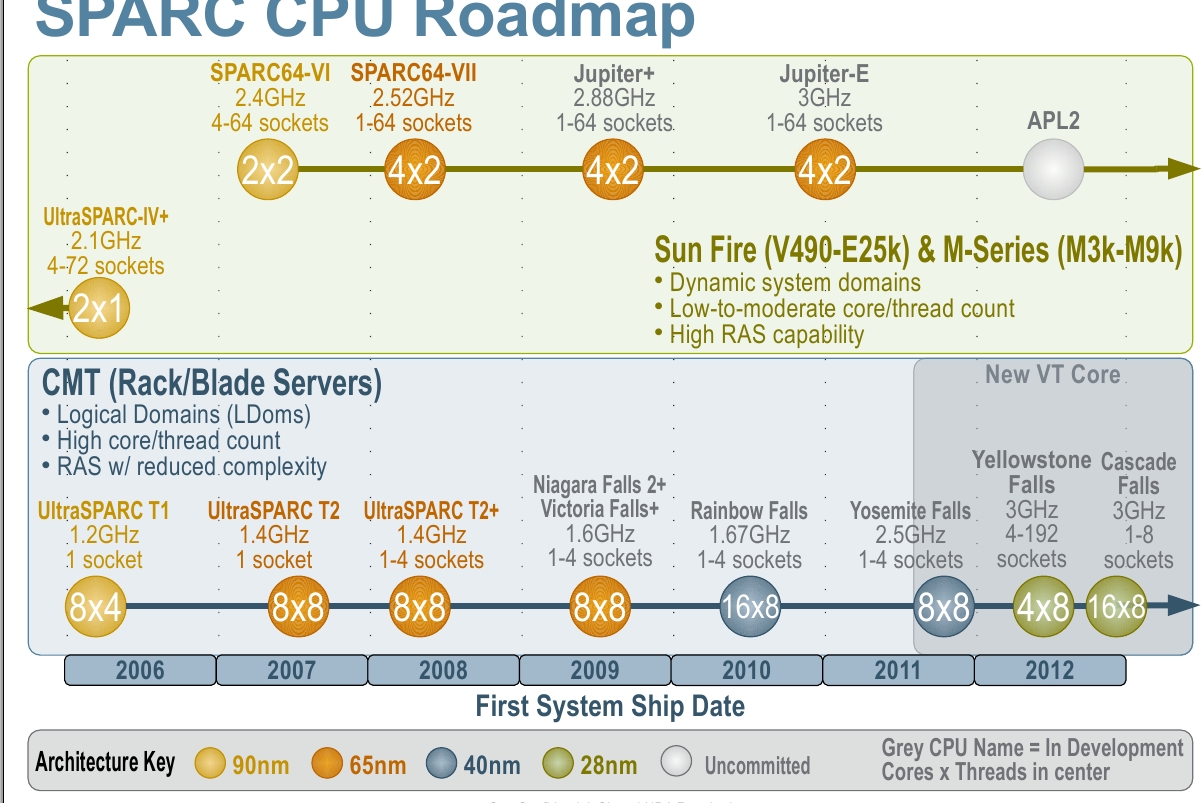
Sneak Peek At Sun's SPARC Server Roadmap
The folks at The Register have gotten their hands on Sun's confidential roadmap from June, which outlines the company's plans for SPARC product lines. The chart has some basic technical details for the UltraSPARC T-series and the SPARC64 line. The long-anticipated "Rock" line is not mentioned. "We can expect a goosed SPARC64-VII+ chip any day now, which will run at 2.88 GHz and which will be a four-core, eight-threaded chip like its 'Jupiter' predecessor. This Jupiter+ chip is implemented in the same 65 nanometer process as the Jupiter chip was, and it is made by Fujitsu, a company that is in the process of outsourcing its chip manufacturing to Taiwan Semiconductor Manufacturing Corp. ... not only has Sun cut back on the threads with [the 2010 UltraSPARC model, codenamed Rainbow Falls], it has also cut back on the socket count, keeping it at the same four sockets used by the T5440 server. And instead of hitting something close to 2 GHz as it should be able to do as it shifts from a 65 nanometer to a 45 nanometer process in the middle of 2010, Sun is only telling customers that it can boost clock speeds to 1.67 GHz with Rainbow Falls."
-
Engineer Makes Classic Cars From Beer Cans
55-year-old engineer Sandy Sanderson has come up with a series of classic car models that are made out of old beer cans. After he was badly injured in a motorcycle accident Sandy started the empty can project. So far he has made buggies, vans, roadsters and sports cars. Mr Sanderson said, "While I was off work, after the accident, I had the time to try making a racing car from drinks cans. I have always looked at the bottoms of cans and thought 'That would make a really neat half wheel.' The plans for each car take around three or four weeks to complete and then around 80 hours to build each one depending on how detailed they are. I actually don't drink much because I spill most of it."