 Slashdot Mirror
The 25th Anniversary of the BBS
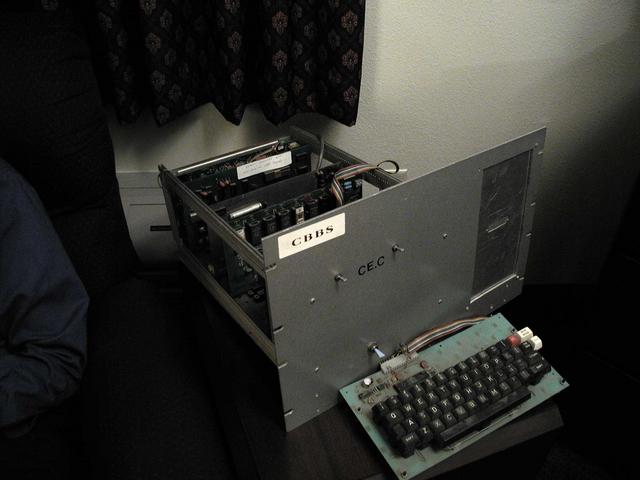
Jason Scott writes "25 years ago today, Ward Christensen and Randy Suess officially announced the creation of a little project they threw together with a 300 baud Hayes modem, a Z-80 based S-100 computer, and a phone line. They called it "Chicago Bulletin Board System" (CBBS) and it was the first dial-up BBS. From this beginning, BBSes grew into the many thousands and became an entire industry, and when the Internet started to mature with the World Wide Web, the users who had cut their teeth on BBSes moved over to it. So raise a toast to these two fellows for a quarter century of great online times."
A good list of still active BBS is available here
There's a growing sense that even if The Future comes,
most of us won't be able to afford it.
-- Lemmy
And don't forget to register at BBSmates to keep up with days gone by.
Message networks allowed people to communicate across the nation. It was USENET and email for non-internet folks. (This was before the internet was opened up.)
Fidonet was obe of my favorites as it forced the sysop to prove they could configure everything properly. It was open on systems run on all sorts of OS could join.
Later message networks used the QWK format which was much simpler.
Others like the RIME network used proprietary software, but allowed more control and file attachments.
Ah, those were the days.
Check out TextFiles.com.
I especially love the anarchy files. "Wahahhahah!" There's also great commentary about the whole BBS scene.
Hey all,
BBS's are still in use. For a start, radio amateurs using packet radio still use BBS systems like F6BBS. See http://www.f6fbb.org/.
1200 baud, ascii art, horrendous setup: it's all still there and in use today. I run a system and so do many other radio hams. Slow, primitive, but free, and I do not rely on the phone or cable company!
Cheers,
Michael VA3MVW
---
BDOS ERR ON A:>
So, at 6 characters per word, that would mean that you were a 300wpm typist. I remember outtyping 2400baud modems all the time, but you can't count it out exactly like that.
for one you vastly undercounted (9 bits/char not 10, remember 8N1 (normal) or 7E2 (compuserve)? 8 data bits, no parity, 1 stop bit or 7 data, even parity, 2 stop bit.
4 chars is a word, spaces are considered characters, so 'a a ' is just as much one word as 'four'.
but when I was outtyping 2400baud, it was on an ansi-enabled vt220 emulator, i could usually get a full line or two ahead of certain mail composers, and very easily get about 5 or 6 screen refreshes ahead of BRE. (I used to play 300 turns in about 7 minutes).
It's not too hard to outtype low-speed modems after you factor in control characters, remote echo, and line latency.
Yeah, I remember years ago, the big competitor to the x00 fossil driver was bnu.sys. (Generally, the BBS sysops I knew preferred x00 though.)
As I recall, x00 went on to support a few rather esoteric hardware configurations, including the Hayes ESP accelerator boards. (These were serial cards with a 16550 UART emulation mode, but also a native mode that allowed extremely high baud rates.) Basically, you could do x2, x4 and even x8 multipliers of the usual 115,000 BPS serial port limit. Those types of speeds weren't too useful for dial-up modems, but people using the first external ISDN modems appreciated them. Otherwise, your 128K ISDN circuit bottlenecked at the 115K max. of the serial port.
According the Ward himself, CBBS stands for Computerized Bulletin Board System. What Ward and Randy had in mind was replacing the cork bulletin board where members woud post buy,sell and trade notes at CACHE meetings with a computer version. It's also commnoly misnamed "Community."
/. when I tipped him off about a discussion with more incorrect information about MODEM vs. XMODEM.
Ward Christensen posted more history here on
There's some more history in an interview here.
Ward's a terrifically nice guy who also invented freeware when he gave away all of the useful utilities he wrote. Teh reason for that was more that he didn't want mess with accusations of competing with his employer than an early movement for Free Software.
Ever dream you could fly? Get up from the Flight Sim. I Fly
There is still an annual CBBS get together in Chicago every year. A number of the folks from those days still drop in on newsgroups like chi.general and chi.internet.
Randy is still around. He runs a CBBS successor called Chinet www.chinet.com.
BTW: Ward is also the fellow who invented XMODEM
We were working on a campaign to get into the Smithsonian. I'm pretty sure that I know who owns it, Roy Lipscomb. He bought it from Randy for $20 (? maybe less). Randy was using it to hold up a table. Hes not known for sentiment.
Like was common for hobbiests in those days, Randy built it from chips they salvaged from old mainframe boards. They would heat the back of the boards with a blowtorch to melt the solder and then slam it against a table to pop out the chips.
It didn't even have an OS in the beginning. There was not even CP/M in those days. The first versions of CBBS talked directly to the hardware. Later Ward rewote CBBS to run over CP/M.
Ever dream you could fly? Get up from the Flight Sim. I Fly
Yes, QWK was originally designed for offline messaging by regular users, but it eventually became used for echomail by some networks as well. The way it worked was crude compared to FidoNet technology, though. If I wanted my BBS to exchange mail with yours, I'd have a special account on your board (or vice-versa). My BBS would then call up yours, and using scripts would navigate through your offline mail system as a regular user would. The offline mail system would know, of course, that it's another BBS calling. But basically it was a hack on top of the typical QWK offline mail system.
There were several networks that were QWK based, mostly in North America (Zone 1), and mostly based on commercial BBS software like PCBoard. Since you were in Zone 3, this might explain why you never saw this used. As far as I know, the mechanism more or less relied on the fact that all PCBoard systems were effectively identical, perhaps with just different text for the prompts. PCBoard was pretty popular in North America. It was basically the software to run if you wanted to have a "professional" looking BBS, and many of the large commercial BBS's ran it (some others like Wildcat and MajorBBS were also popular among commercial boards).
Anyway, to get other BBS software to work as a hub on a QWK network wouldn't really be feasible since you'd basically have to emulate PCBoard. But it was possible with some hacking to join a QWK network even if you ran other software. I ran Telegard as my BBS software and ended up hacking up some terminal scripts that allowed me to join a QWK network as a node. The QWK technology was technically inferior to FidoNet technology in just about every way. It probably originated as a kludge when the developers of certain BBS packages wanted built-in echomail but were too lazy to bother implementing all of FidoNet's technical specs. This then became the most convenient option for sysops who were too lazy or stupid to figure out how to set-up a 3rd party echomail front end and "tossing" software.
Eventually some of the QWK networks began distributing their mail using FidoNet technology via gateways.
Lets not forget Ray Gwinn's SIO driver for OS/2 with fossil emulation for DOS apps.
Many of us began the battle against microsoft because we ran a BBS but only had one or two computers. If it wasn't for Ray, running a BBS on OS/2 would have been near impossible.
SIO/VSIO... rest in peace.
I don't read or respond to AC posts
Once again, the editors of Slashdot want you to think that the BBS is a product of days gone by. I'm here to remind everyone that those days never ended.
I've been running UNCENSORED! BBS since 1988 and it's still a hip, hot, totally-whats-happening hobby. The community is still there. The fun is still there. The comraderie is still there.
The only thing that isn't still there is the modem.
Slashdot likes to position itself as "what came after the BBS" but with the amount of volume a zillion users generate, you just can't replace the "folksy" feel of your favorite BBS. Get out there and BBS, folks!
Tired of FB/Google censorship? Visit UNCENSORED!