 Slashdot Mirror
The 25th Anniversary of the BBS
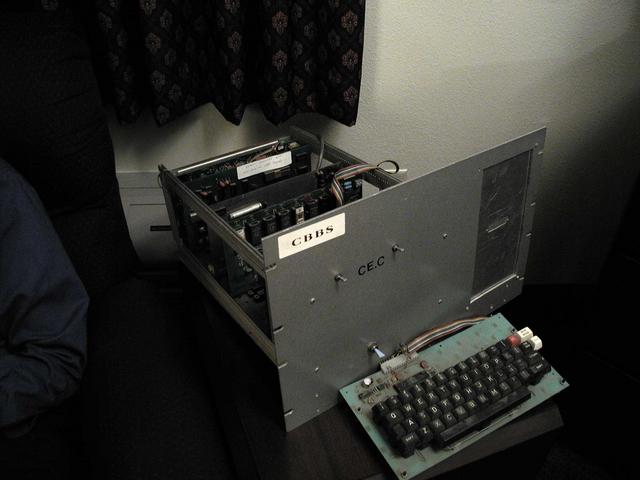
Jason Scott writes "25 years ago today, Ward Christensen and Randy Suess officially announced the creation of a little project they threw together with a 300 baud Hayes modem, a Z-80 based S-100 computer, and a phone line. They called it "Chicago Bulletin Board System" (CBBS) and it was the first dial-up BBS. From this beginning, BBSes grew into the many thousands and became an entire industry, and when the Internet started to mature with the World Wide Web, the users who had cut their teeth on BBSes moved over to it. So raise a toast to these two fellows for a quarter century of great online times."
Tradewars.
A good list of still active BBS is available here
There's a growing sense that even if The Future comes,
most of us won't be able to afford it.
-- Lemmy
And don't forget to register at BBSmates to keep up with days gone by.
Check here:
http://www.bbsdocumentary.com
In short, Jason Scott is making a film about the BBS and the important aspects it played in the world. It's an ambitious project, and I had a lot of fun doing my interview, and anyone who has something to say about the BBS experience is encouraged to help him out.
Jason is one heck of a cool dude...can't wait to see how this turns out.
// Agent Green (Ian / IU7 / KB1JQO)
// IEEE 802.3: All 10base Are Belong To Us
Not very long ago I set up a box with DR-DOS and RA and set up a small menu for a remote office that had trouble getting onto the internet and needed some drivers. I posted the drivers onto my "BBS", had them dial in, and presto the remote office was back on the VPN in no time. ;-)
That's the kind of skill that comes in handy when real shit happens.. and it was fun to look at the post-dotcom admins' faces
Learn from the mistakes of others. There isn't enough time to make them all yourself.
Message networks allowed people to communicate across the nation. It was USENET and email for non-internet folks. (This was before the internet was opened up.)
Fidonet was obe of my favorites as it forced the sysop to prove they could configure everything properly. It was open on systems run on all sorts of OS could join.
Later message networks used the QWK format which was much simpler.
Others like the RIME network used proprietary software, but allowed more control and file attachments.
Ah, those were the days.
Check out TextFiles.com.
I especially love the anarchy files. "Wahahhahah!" There's also great commentary about the whole BBS scene.
For anyone looking for that file they saw on a BBS 15 years ago, you may be able to find it here.
"Sic Semper Tyrannosaurus Rex."
I rememberm dialing into the Local High School BBS and just chilling, and playing games with other. who would have thought back then, those BBS'es would turn into this, what we know now.
it is kind of cool to think about
Cheers to the invention of the BBS!
---
The real fun with BBS's was tricking fellow users into accidentally typing +++
Another interesting fact I remember back in the day was being able to type faster than the 300 baud modems could send. Imagine that your fingers can transfer information from your brain to the computer, but the computer to computer connection can't keep up, granted this was before windows even. The idea of a personal computer has been around for ages and the computer to be used as a communication device is not a new idea.
The internet did not kill BBS's, BBS's simply became antiquated. Centralized file sharing was replaced by FTP and GOPHER (yes ... gopher ... I guess HTTP could be thrown in here too), message boards by Instant messengers (who remembers the beta versions of Mirabilis??) and the online community expanded to include every corner of the world not just the distance a spont was away to be too far because that would be "long distance" and cost an arm and a leg to get on.
Most BBS's, unless they had some money, had no more than 2 nodes, now it's not uncommon to see a website that gets hit with more than a million hits a day (putting their link on slashdot doesn't hurt).
The BBS was a prelude to the dial-up isp, and any BBS's that wanted to stay in business learned the wonderful ways of SLIP CSLIP and PPP ...
Am I really that old, geeze.
Ignore the "p2p is theft" trolls, they're just uninformed
"a 300 baud Hayes modem, a Z-80 based S-100 computer, and a phone line"
I dunno - the very same hardware has served Kuro5hin pretty well over the last 5 years! It if ain't broke, don't fix it!
I found a list of BBS systems in some computer magazine and I thought, 'Huh? What's this about?' So I dialed one, probably in the midwest, and the world of the BBS opened up to me. Wow, files! For free? Cool!
I later discovered a BBS in Petaluma, California run by Vern Buerg (His current web site, not the original BBS) and his wife Julie. That was the first time I began to use message boards, play football contests, make friends online. I hung around there most every day and understood the ability to create an online community.
The Web came along later and opened this concept up to the world. But in my mind it all began with the BBS and watching those text lines crawling across my screen at 300 baud. Oh yeah, and seeing FIDO show up in ASCII art. Cute doggie! :)
-----
I grew up on BBS's; I think I was 12 when I first started calling boards. Chinet was my first exposure to Unix, although I didn't really understand what it was, at the time. ("It looks like DOS.. except you can dial into it... weird!")
I like to think of myself as an "old timer" (most computer geeks I deal with weren't into BBS's/too young), but this really puts things in perspective for me - because I recently just turned 25, myself!
If you had told me, back when I was 15, that BBS's would be all but gone, yet everyone would own a computer - and be connected to one another - I'd have thought you were crazy. I can't wait to see what it's like 25 years from now!
CBBS was how IO first got on the 'net, back before there really was a 'net. I stayed with them, as Randy moved CBBA to a UNIX machine, and got hooked up for USENET news and email, and when he formed a small "net" with the authors of the conferrencing software, "Picospan", in Ann Arbor. Karl Denninger and Bill Vajk were also UNIX bitheads who were tied in there (Hi Bill!)
:(
There was a real sense of community back then. Most people knew each other, and hung out together, even having picnics and other get-togethers. The net has grown a lot since Ward came up with XMODEM, and oft-times I miss the friendly (and not-so-friendly) rivalries of the early days. I now live in Seattle, and though I use a small local ISP, I don't know a single person who uses it. It's grown so impersonal
I really hope that the early days can be documented, and hope that they can capture a sense of how alive it felt back then, how people would go out of their way to be helpful to total strangers (and believe me, we had quite a few who were totally strange, myself among them).
Lemon curry?
Back in the early 1990s, I was involved in a project called ZaMIR Transnational Network where we used BBSes to link peace groups in ex-Yugoslavia (crossing borders of nations that were at war at that time). There was even a BBS running in the besieged city of Sarajevo. Internet technology may be the ubiquitous thing now, but remembering our efforts at FoeBuD at that time, I'm still amazed what you could actually do with simple dial-ups.
Whiner: blah blah blah
Guru 1: This xyz BBS has a cute bug to gain system privileges...
Guru 2: Agree and talk about it but no details until the whiner starts reallllly begging to know the details. Then:
Guru 1: Ok type +++ (originally typed as ++ space bkspace +) followed by ATH and hit enter
Whiner: NO CARRIER
And of course being a busy BBS he would be kicked out for a jolly good time. The fun at the inept continued when we created variations on the ATH theme on the same victim :-)
---
Somtimes it's good to have a global scale, and sometimes it's good to be able to go have a beer where everyone knows your name.
The internet is like an planet sized mall. A BBS is like your neighborhood bar.
Yes, you and your friends can meet at a bar in the mall, but it *isn't* really the same thing.
I guess we just have to redefine "neighborhood" now.
There are certainly benifits to the "mall" model, I admit. I "know" people all over the world, whom I've never actually met, who I could call on to put me up on their couch for a couple of days if I needed it.
The flip side is that I, perhaps, know fewer in my own meat space neighborhood of whom I could ask this favor.
The world is different for "interneters" than it is for BBSers.
KFG
Hey all,
BBS's are still in use. For a start, radio amateurs using packet radio still use BBS systems like F6BBS. See http://www.f6fbb.org/.
1200 baud, ascii art, horrendous setup: it's all still there and in use today. I run a system and so do many other radio hams. Slow, primitive, but free, and I do not rely on the phone or cable company!
Cheers,
Michael VA3MVW
---
BDOS ERR ON A:>
I had a long, nostalgic evening going over all the old FidoNet stuff the other night. I used to run a Fido BBS (node 2:252/204) in 1991, when Fido was just reaching 10,000 nodes (and I thought that was massive!) Looking at Fido's nodelist, it hit a maximum of 37,000 nodes in 1995 then went into a decline. However, Fido still has 10,000 nodes!
:-)
Looking through a recent nodelist, I noticed quite a few familiar names from 1991. My BBS ran RA with BinkleyTerm as a front-end, and DesqView as the multitasker (on a 386 with 2.5MB RAM). I later put Linux on that machine (I started using Linux when distros didn't exist, it was just a boot/root disk, format the hard disk and cp -r from the root disk).
Aaah, the memories
Oolite: Elite-like game. For Mac, Linux and Windows
Yeah, I remember years ago, the big competitor to the x00 fossil driver was bnu.sys. (Generally, the BBS sysops I knew preferred x00 though.)
As I recall, x00 went on to support a few rather esoteric hardware configurations, including the Hayes ESP accelerator boards. (These were serial cards with a 16550 UART emulation mode, but also a native mode that allowed extremely high baud rates.) Basically, you could do x2, x4 and even x8 multipliers of the usual 115,000 BPS serial port limit. Those types of speeds weren't too useful for dial-up modems, but people using the first external ISDN modems appreciated them. Otherwise, your 128K ISDN circuit bottlenecked at the 115K max. of the serial port.
At age 8-9, LORD thought me about the birds and the bees through Violet!
According the Ward himself, CBBS stands for Computerized Bulletin Board System. What Ward and Randy had in mind was replacing the cork bulletin board where members woud post buy,sell and trade notes at CACHE meetings with a computer version. It's also commnoly misnamed "Community."
/. when I tipped him off about a discussion with more incorrect information about MODEM vs. XMODEM.
Ward Christensen posted more history here on
There's some more history in an interview here.
Ward's a terrifically nice guy who also invented freeware when he gave away all of the useful utilities he wrote. Teh reason for that was more that he didn't want mess with accusations of competing with his employer than an early movement for Free Software.
Ever dream you could fly? Get up from the Flight Sim. I Fly
There is still an annual CBBS get together in Chicago every year. A number of the folks from those days still drop in on newsgroups like chi.general and chi.internet.
Randy is still around. He runs a CBBS successor called Chinet www.chinet.com.
BTW: Ward is also the fellow who invented XMODEM
Quote from their site
BBS Simulator (Sim-BBS) is a BBS simulator game, your users get their own BBS, which they have to take care of, and upgrade as it gets bigger. They start with an 286 with 1 meg of ram, a 10 meg hard drive, and 10 non-subscribers. The have to Read their mail, and work on the board to increase their number of users. The goal is to be the biggest board, and to keep the users happy.
I'm not affiliated with groutySoft and I don't know how much bandwidth they have, so please be kind.
Jesus Christ, that was so long ago...
Yes, around 2003 years I think. Not sure about your BBS though.
Thanks, I'll be here all week...
Never, ever lose a file again. Ever.
We were working on a campaign to get into the Smithsonian. I'm pretty sure that I know who owns it, Roy Lipscomb. He bought it from Randy for $20 (? maybe less). Randy was using it to hold up a table. Hes not known for sentiment.
Like was common for hobbiests in those days, Randy built it from chips they salvaged from old mainframe boards. They would heat the back of the boards with a blowtorch to melt the solder and then slam it against a table to pop out the chips.
It didn't even have an OS in the beginning. There was not even CP/M in those days. The first versions of CBBS talked directly to the hardware. Later Ward rewote CBBS to run over CP/M.
Ever dream you could fly? Get up from the Flight Sim. I Fly
Yes, QWK was originally designed for offline messaging by regular users, but it eventually became used for echomail by some networks as well. The way it worked was crude compared to FidoNet technology, though. If I wanted my BBS to exchange mail with yours, I'd have a special account on your board (or vice-versa). My BBS would then call up yours, and using scripts would navigate through your offline mail system as a regular user would. The offline mail system would know, of course, that it's another BBS calling. But basically it was a hack on top of the typical QWK offline mail system.
There were several networks that were QWK based, mostly in North America (Zone 1), and mostly based on commercial BBS software like PCBoard. Since you were in Zone 3, this might explain why you never saw this used. As far as I know, the mechanism more or less relied on the fact that all PCBoard systems were effectively identical, perhaps with just different text for the prompts. PCBoard was pretty popular in North America. It was basically the software to run if you wanted to have a "professional" looking BBS, and many of the large commercial BBS's ran it (some others like Wildcat and MajorBBS were also popular among commercial boards).
Anyway, to get other BBS software to work as a hub on a QWK network wouldn't really be feasible since you'd basically have to emulate PCBoard. But it was possible with some hacking to join a QWK network even if you ran other software. I ran Telegard as my BBS software and ended up hacking up some terminal scripts that allowed me to join a QWK network as a node. The QWK technology was technically inferior to FidoNet technology in just about every way. It probably originated as a kludge when the developers of certain BBS packages wanted built-in echomail but were too lazy to bother implementing all of FidoNet's technical specs. This then became the most convenient option for sysops who were too lazy or stupid to figure out how to set-up a 3rd party echomail front end and "tossing" software.
Eventually some of the QWK networks began distributing their mail using FidoNet technology via gateways.
Lets not forget Ray Gwinn's SIO driver for OS/2 with fossil emulation for DOS apps.
Many of us began the battle against microsoft because we ran a BBS but only had one or two computers. If it wasn't for Ray, running a BBS on OS/2 would have been near impossible.
SIO/VSIO... rest in peace.
I don't read or respond to AC posts
When I was 9, way back in 1979, my dad bought a TRS-80 Model I. The next year we got the Expensive, I mean Expansion Interface and a 300 baud accoustic coupled modem. My dad signed up for CompuServe and Genie. I played games online and chatted with folks, but the first time it really hit me what a truely novel, powerful form of communication it was, was when we were trying to figure out how to fit a battery from an older RC car into a newer car my brother had just received for christmas. We went on CompuServe and posted a question in the RC forum, within hours we had several expert replies from around the country. I believe my reaction was "Whoa!" (said like Neo.)
We were also members of a software club (if I recall, there were no laws against software piracy back then. I know we didn't try to hide what we were doing.) that had a BBS. We would pitch in some $$, vote on what to buy, crack the protection and distribute it to the members.
Later on I got a Commodore 64. By then modems were 2400 baud and had modular jacks. I got heavily involved in the commodore BBS scene in Washington state. Most of the BBSs I used had one or at most two phone lines, so you would have to redial again and again. Getting the settings right to connect was a pain in a lot of cases. Connections would drop all the time, so dowloading large files was a crapshoot, as none of the BBSs I remember supported transfer resume.
I remember when AOL started up, I thought "Free? these guys will never last."
I saw home computers go from a weird/fringe hobbiest thing through full commercialization. I saw the online scene go the same route, then the Internet, and later, open source. By the time I got involved in open source in '94, I could see the handwriting on the wall, and I felt lucky to have found out about it before money drove the spirit out of it.
Ahh, the good ol' days, when only enthusiasts were online. S'why I read slashdot, as dumb as it can be at times, at least people here are passionate about computers.
- None can love freedom heartily, but good men; the rest love not freedom, but license. -- John Milton
Once again, the editors of Slashdot want you to think that the BBS is a product of days gone by. I'm here to remind everyone that those days never ended.
I've been running UNCENSORED! BBS since 1988 and it's still a hip, hot, totally-whats-happening hobby. The community is still there. The fun is still there. The comraderie is still there.
The only thing that isn't still there is the modem.
Slashdot likes to position itself as "what came after the BBS" but with the amount of volume a zillion users generate, you just can't replace the "folksy" feel of your favorite BBS. Get out there and BBS, folks!
Tired of FB/Google censorship? Visit UNCENSORED!
Thanks for remembering the 25th anniversary of CBBS - I think I might have not noticed, haha, had not Peter Zelchenko (son of one of the early co-sysops, "Alex Zell") decided to have it honored in Chicago with 2/16/2003 declared BBS day by Mayor Daley...which the city accepted, and was "thusly" declared. Anyway just a quick correction, which I see someone else posted, but it seems to proliferate. When Randy Suess & I came up with BBSs back in '78, there were only cork board and push pin ones, or those racks of 3x5 cards in the entryway to the grocery stores, or the "car for sale" type ones at some companies, etc. So we decided to "Computerize" the idea of having a place to post and read things. It was on a computer, so it was an application, or a system, or a program, or something...we chose "system". Thus was born CBBS - as the welcome message said from day 1, "Welcome to Ward & Randy's Computerized Bulletin Board System". Not "Chicago" (that implied we had enough forethought to think there might be ones in other cities, haha) and not Christensen, for it would never have happened without Randy Suess, ...
P.S. my thanks also to Jim Willing who ran a copy of CBBS in the northwest called CBBS/NW and kept CBBS alive for a long time, and to all the people who ran CBBS and made good suggestions.
P.S. these were innocent days - there were no viruses, and while we had users - even nasty users - attempting to mess with CBBS, only one person broke in - and that turned out to be physical security - it was a friend who visited Randy and left a message in a file on the floppy by accessing it locally, haha.
CBBS was certainly the most fun programming project ever - supported by the neat HW Randy Suess came up with - like resetting CBBS on EVERY phone call - a couple 555 timers cross-linked - the first ring hits reset, then an inhibitor 555 timer inhibits rings from resetting for the next "something" (20 sec?) - since CP/M loaded with 2 revs of the floppy, and CBBS with another few, it didn't take long for CBBS to issue the "answer" command to the modem, and thus stop the phone ringing and thus the resets before the 2nd 555 timed out. If CBBS glitched while loading, the 2nd 555 would time out and stop inhibiting reset and the next ring would reset and thus retry the reboot.
Early CBBS was very immature - with users' complaints shaping it - from sending trailing white space (VERY annoying at 110 or 300 baud), to packing down the message numbers (thus not being able to figure out where you left off).
My solution to the latter was to create 50 message files, each one storing messages whose last 2 digits "anded with FFFE" determined the file name - this means message xxx04 and message xxx05 would both be stored in the file messages.x04, etc.
Later I Hashed (by just adding their ascii values together) the user names and wrote them to a 1024 entry file so it could remember your last call, the high msg #, and support flags to allow a set of assistant operators, optional passwords, etc.
Many people thought CBBS was put up for file transfers - well, my original idea of a message system was to have users contribute articles for our club newsletter, but as it formed, a message system seemed more interesting, and file transfers were supported by only a few users such as myself to transfer new releases of the code via Xmodem, into the system which lived 30 miles away at Randy Suess' house (he wanted it "in the city" (Chicago) not out in the burbs where I lived). Not a bad idea.
I could go on forever, I had so much fun with the programming - originally running in perhaps 48K of memory including CP/M - maybe 20,000 lines of 8080 assembler.
CBBS lived into the early 90's (approx 93?) and received over a quarter million calls, on its one phone line! Thanks to Randy Suess for keeping it going all that while, even some sophisticated things like running the actual files off a unix share! It ran on a PC with a hacked up 8080 emulator, TSR's to handle interrupts I added to the code, etc. Fun fun fun!
Gee, I did go on forever. I promise I will stop!
Ward Christensen
Jason Scott is doing a great job of documenting the history..including some of the "bad guesses" at what CBBS stood for. I had forgotten it became "community" once in a while, too ;-)
Little known is that Randy Suess actually copyrignted the phrase CBBS, and drives around - or drove around - in a car with "CBBS" license plates (My licence plate is Xmodem, haha).
I think it would be sort of fun to put up some sort of CBBS emulator on the web, seed it with all the files I can scrounge up from - alas - happens to be 10 years ago that it died - and let it rip.
Many would say "this is dumb". But then I guess you could call a 3 year old dumb if compared to an adult. It was the infancy of the "microcomputer industry".
P.S. I would like to say one thing about "me" and the stuff I did you have commented on - lots of give-away-stuff (disk editor, including looping 1-line macros (search for blah blah at offset xyz and replace it with something and loop 12 times, etc), disk cataloging program, Xmodem, etc).
The thing I'd like to say is that I was not a genius, or even very smart - because back THEN I was programming in a VACUUM. There were not millions of people doing more than I was at the time. Anything I could think of, would not exist, so just writing it became quite easy. I didn't have to write very GOOD code, I didn't have to compete with brighter people - I just "lucked out" to have thought of some of the stuff before others did, have a good enough job to not want to try to make money off of it, etc.
Regrets? I regret that when the IBM PC came out, with its 160K floppies (My CP/M system had 1.2M floppies and an 8M hard disk), 16K of Ram (or whatever - compared to the 256K I had on my CP/M system), and a few hundred character per second screen scroll rate (I believe my CP/M system scrolled text at about 50,000 characters/sec - it used hardware to change the starting display line not a block move instruction)...I repeat, I regret NOT scrapping my investment in CP/M and porting my programs (Oh, forgot the famous "disassembler, with its - ahem - clever name: Resource) ... to the PC environment. As a result by the time I got a PC (after XT's came out, and I wanted to be "better" so got an external 15M drive (whooie!), all the bright aggressive programmers had started to saturate the market with their software. My disk utility? languished, as Peter Norton took over the helm of that ship; Commercial file transfer software became common, but some things like disk cataloging or disassembling never quite reached the stage they should... this "segment register stuff" made disassembly QUITE difficult compared to the simple linear 64K memory model of the 8080...
But I ramble...
I AM amused your comment got a "5", mine seem to get a "1". Working for IBM, a "1" is best, I'll just think of it that way ;-)
P.S. Just to ramble some more:
1. In 1974 I learned that "TTL" electronics, and an "8008" microchip could make a home computer, and wrote to Heathkit to suggest they "invent" the home computer. Their response "We already have an analog computer kit, why would we want a digital computer kit?".
2. In approx '78, I wrote to IBM saying that I'd had a "microcomputer" for 3 years by then, and thought IBM should commercialize the microcomputer by coming out with one. Got back an answer "we don't see a market for such a device".
Wish I'd pushed a bit!
Ward Christensen