 Slashdot Mirror
Gates: Microsoft IP Finds Its Way Into Free Software
Andy Tai writes "While speaking to financial analysts and commenting on the SCO lawsuit, Bill Gates made the claim that Microsoft's IP is also included in Free/Open source software. Without being specific, he said "There's no question that in cloning activities, IP from many, many companies, including Microsoft, is being used in open-source software. When people clone things, that often becomes unavoidable." Considering Microsoft's claims of ownership over technologies like CIFS, does this mean Microsoft may also launch SCO-style attacks against Free Software/Open Source?"
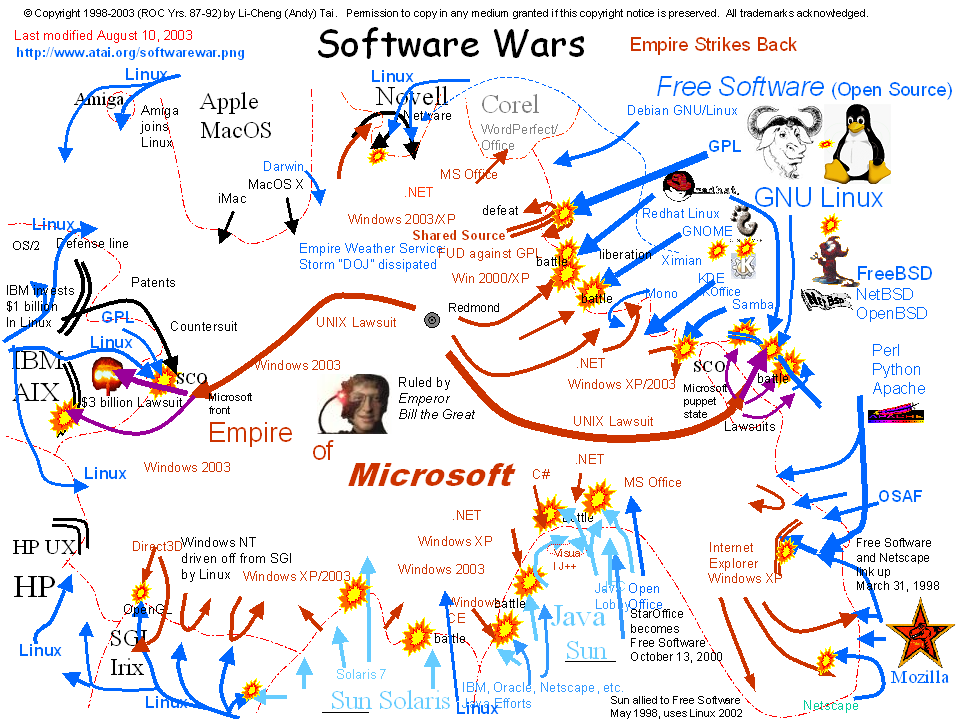
windows inet tools use BSD source, many use other open source libs [libpng, zlib, etc...] doesn't phase them. The fact that they rely on them for success...
But if someone copies a MSFT design element, omg, end of the world, OSS must die!
Hmm hypocrites!
Someday, I'll have a real sig.
Well, I guess this is the new FUD Wars. MS and its friends will be spreading this "Linux stole some copyrighted code/idea" propaganda to slow down adaptation of Linux. Strange that we didn't see it in a Halloween Document, this must be stuff they kept a tight secret about.
What time is it/will be over there? Check with my iPhone app!
There's no question that in cloning activities, IP from many, many open-source products, is being used in closed-source products. If people at SCO and Microsoft have access to source code, that kind of thing often becomes unavoidable.
I was wondering when the intellectual property attacks would come. It's really the only place open source is vulnerable. I'm really just surprised it took this long.
Any takers on a pool for how long before our good buddies at Microsoft start some legal action?
If we look back at the early suits involving Microsoft and Apple, there may be indicators of how this might turn out. In that case Apple was suing Microsoft for duplicating the look and feel of their GUI but Apple didn't win. I don't know the details of what MS is claiming but does this qualify as a bonafied legal precident?
Hay, if they clime open source stole some of their IP, then they'll just have to open up their source codes so we can see if they've stolen any GPL'ed code from OSS.
-----
One is born into aristocracy, but mediocrity can only be achieved through hard work.
and how do you know that Microsoft is actively poisoning OSS projects with MS code SPECIFICALLY so that it can legally destroy them? What do you know about project contributors other than their email addresses?
That was classic intercourse!
If you can't beat them, sue them.
Microsoft is seeing the end. The end is near and they are starting to prepare for it by using the courts as a an offense instead of building a better product. The only defense (instead of building a better product) is to sue the product thats beating the shit out of you and tie them up legally.
This exact thing is happening to me. I created a product that is better than my one competitor out there. I sell it for a fraction of the cost and it's better technology (of course it's based on Open Source). I've taken 20 - 30 new customers from my one competitor in the last six 5 months. Not bad.
Well, what does the competitor do? They pull a credit report on my company, start making "wild claims" (read: FUD) about me and the company to their existing customers, even went as far as changing their product to make it hard for their existing customers to leave. Recently, I'm hearing that they are using lawyers now to find out information about me and my company... It's an ugly world.
What am I going to do? hahaha. Ignore eveything and keep going on. I won't stop. They'll have to show up with the Sheriff's to pull me out of my office. My belief, this is not about winning a court case, it's about "killing the little guy by legally strangling them."
The days of innovation and competition are over.
But it's not just the code! That's where you're missing the most critical part of his claim. When you patent softare concepts, you're patenting every array of copying that can happen, and that's the sad part of the matter. Open Source, though only out there for non profit means (until you arrive at Redhat, and the such), has to be aware that it can't trample the rights of big companies, even if it's being sucked dry of all of it's code at the same time.
We live in a capitalistic world, and frankly, an attack like this should be expected. It's a great idea to have people working on open source software for the fun of it, but it has to be original ideas. OSS is like the product of a company. If it's created and it tramples the rights of others, then companies that have been trampled will have the right to come back and request damages from ANYONE that uses the software.
It's a frightening world out there for Open Source Software, but it's a real world. We need not just look past these claims as "Micro$oft hogwash" or anything of the sort. SCO and Microsoft might be making VERY valid points, and it's something the OSS community MUST watch out for.
I love Open Source Software, but I also respect the rights of others, however evil they might be.
From the article:
"One thing about the GPL is that you can't just license IBM Linux, or Red Hat Linux," Gates said. "The way the GPL works, if you license any Linux, you have to license all Linux."
What a bunch of crap. This is disinformation at its best.
- Linux is a Unix kernel clone.
- There is no such thing as Red Hat Linux or IBM Linux. There are IBM or RH distributions that make use of the Linux kernel
- Wtf does "licensing any Linux" and "licensing all Linux" means ? I'm assuming Gates mean licensing any Linux-based distro, in which case you adhere to whatever licensing terms the distro is released under, licensing terms which in turn are compliant with the GPL (since Linux is included).
That blurb from Gates means rigorously nothing whatsoever. But most people aren't even aware of what the GPL is, and when they quickly read something like that, they decude "uuh, Linux is dangerous to my business" or something. That's just ridiculous.
As much as I hate RMS' rants, flamewars and stubbornness, I must admit we need him more than ever today.
"A door is what a dog is perpetually on the wrong side of" - Ogden Nash
Even with microsoft, I doubt anyone will be taking these kinds of threats seriously without some kind of verifiable proof. The main purpose is to scare people who are unknowledgeable about opensource software into choosing something else. And it might even help opensource software because 'stealing' code is much easier behind closed doors...
We see it in TimeLine suits, the shafting of SpyGlass Systems, Blue Mountain Greeting Cards et al, the clone wars beteen MS-DOS and DR-DOS, the emBorgment of STAC Systems to settle yet another suit, and so on ad nauseum. Heck the company started by dumpster-diving for printouts of other people's software, and probably also had a copy of the Dartmouth BASIC source in hand while they wrote their 4K ROM BASIC (which they had already sold as pre-existing; ie, their first product was vapourware, the start of a long tradition). This is the company that copied the Mac interface right down to details like throwing away variable-sized elevators in order to look more Mac-like (and got sued for that one too).
This is a severe case of the event horizon casting aspersions about the kettle's colour! "Chutzpah" isn't a substantial enough concept for this, it isn't even in the running!
Got time? Spend some of it coding or testing
You know sometimes the future of linux seems pretty bad and sometimes it seems pretty good.
What MS and it's little buddy SCO fails to remember is one major fact:
There is no such thing as bad publicity.
Linux and other Free software developers have worked realy hard to keep things clean. This IP crap is the first for linux, but it isn't for free software in general.. Think BSD and the unix wars from the 70's and 80's. They distributed AT&T code, not thru theivery, but thru a twist of fate. So they just eliminated the code.
If any code is in linux, it's by accident or thru subtifuge by the rare unscrupulis developer.
People who develop for linux don't do it for the money and do it for the pleasure of it for the philosophical reasons. It is not to Linux advantage to steal code. Linux people can do better then that.
Don't forget that MS is going thru patent issues right now of it's own.
Once all this crap blows over, people won't remember: "Linux gained advantage over Microsoft in the server market. MS claims that they did this by possibly stealing from MS and other companies."
The will remember: "Linux gained advantage over Microsoft"
What delightfull fud
The good mr. Gates completely fails to identify the nature of the IP. He completely fails to identify how the IP is protecteted. And, He completely fails to explain how it got away from microsoft.
Lets consider the possibilities
1. Source code copying
The usual suspect. As always its much more likely that microsoft stole from the open source world than the other way around. You can completely discount the historical incidents and still come to this conclusion. Its just to easy for Microsoft to take something thats publicly available and hide it in its code bloat. OSS developers, would have to somehow purloin Microsfts source and include it into existing projects. NOT LIKELY
2. Look and feel
Microsoft more or less destroyed this argument in their lawsuit with Apple. Apple still owns Xerox Parc and is releasing Darwin under GPL.
3. The ever popular patent system
This is where the pain can come from. Our patent system is seriously broken. Between business method patents, Patents for devices that never get built and the ever popular overly broad but legal patent, are microsofts best weapon against OSS. The sheer cost of prosecuting a lawsuit makes it an effective weapon. On the other hand the organizations developing OSS in general have no assets, they have allready released the code to the world, and theres nothing to stop them from reorganizing in saner parts of the world (PGP excellent example).
As usual this type of action makes me happy I am an NRA member and support the 2nd ammendment to the hilt. The reason smaller government is best is because it belongs to whoever is willing to buy it.
We might not want to live in a world where the patent office "pushes innovation by ownership," but it's the reality of Capitalism. You can't turn off cash flow, or you essentially turn off innovation and invention.
Of course Open Source Software is the best example of my previous statement put to the test, but I can still hold to it, because even the best OSS people still have to go out and get jobs to make their OSS Lives work. I've seen examples of OSS projects failing all over the place becasue it costs money to even do OSS. The best place to look is the old Linux Router Project.
All I'm saying is, OSS is a very idealistic set of projects. Idealism is an awesome thing, but when it faces reality, it sometimes less than perfect.
Microsoft, and everyone else that has patent claims, has to be respected. It's part of the REALITY of our world today. If OSS software is unfairly stealing the work of Microsoft, then it's liable; I'm liable.
Microsoft speaking on copying others' features seems a bit absurd. Microsoft has made a living off other peoples' innovations. Now the only reason suits like the SCO vs Linux haven't come up with other OS's is because we can't see whats under the hood. Now, in fairness, maybe Linux developers have a right to view the OS code of any accusers of IP infrengement to make sure they haven't done the same thing. Such a rule might also make a company think twice about filing frivilious lawsuits to tarnish the reputation of open source OS's.
I do security
Got time? Spend some of it coding or testing
So, according to the Dear Leader, "The SCO suit is largely related to trademark and copyright." And what's the rest? Legally protected "IP" or "IP" in the FUD sense?
I have never had more respect for RMS stressing that the use of a generic concept such as "IP" is a bad idea!
Can they now close down the MS German office just like they did the SCO German office for making unsubstantiated claims?
I am not sure how smart this is for MS. I would think they would want to be distancing themselves from SCO at this point. SCO has obviously been manipulating the financial system by their outrageous and contradictory claims. If SCO is found guilty for pumping up its stock price by making claims about Linux IP, wouldn't MS then be in a difficult situation? Not even going into anti-trust issues . . .
Sdelat' Ameriku velikoy Snova!
If Trey manages to freeze FOSS out of the 'states, he's going to create the biggest brain-drain, and the biggest boost for non-US economies ever seen.
Got time? Spend some of it coding or testing
The thing about courts is that
a) intellectual property and business practices would be leaked. Like, if you lost a case to MS for some reason, and were losing your home as a result, why wouldn't you leak any trial documents you ran into.
b) MS could lose. I mean, if you got your case tried in Mississipi, it is all but guaranteed that jurists would side with the little guy over the big company - in fact that is more likely to be the norm nationwide.
Finally, courts are the last stop before violence erupts. The free market should work without undo courts. If there is a lot a more court activity than courts, then the country is a step closer to civil war.
This is my sig.
these rights are a recent fabrication - mostly by America - they did not exist when I entered the business 20 years ago in England.
Exactly. They didn't even exist here in America when I began programming.
Why should I recognise them now. I sure as hell didn't vote for them. Did you? I doubt it!
Nobody voted for them except the head of the patent office. It wasn't approved by congress at all.
-
- - You can't take something off the Internet! That's like trying to take pee out of a swimming pool.
Cough cough Mono.net cough cough
http://saveie6.com/
It is fairly clear that IP law in the U.S. is out of control. We have companies who spend millions foisting their ideas off on society then complaining thet their ideas are treated as part of the cultural background. We have companies that think it is possible to own the commons. We have legislators and judges agreeing with them (possibly for pay in some cases).
The quickly developing morass is expensive to navigate and makes real innovation nearly impossible. It is rapidly expanding to cover every aspect of life and technology.
What will the U.S. do when the time comes for a cost/benefit analysis and the result is that it is cheaper to leave the U.S. entirely? There are a number of countries out there with a much saner IP situation (even if only by virtue of not really considering IP at all) that would really love to expand their economy and influence by becoming the home of technological innovation.
Up until now, their lack of infrastructure has removed them from consideration. There will come a point where the cost of dealing with stupid U.S. style IP law will exceed the cost of building your own infrastucture in these countries. The decision to move will be a simple matter of economics. After all, corporations do not have patriotism, they know only cost and benefit (read profit).
Looking at history, the U.S. benefitted greatly from being on the other side of that equasion in it's first two centuries. The opportunities presented by a country where one could have a good idea and develop it into a reality free of a million rules and regulations and laws favoring the entrenched dinosaurs were enough to cause innovators and businessmen all over the world to pull up roots and move to the 'the land of opportunity'.
The same legal and economic forces can just as easily drive innovation and business elsewhere.
This Linux stuff is b*llsh*t. Let's get back to basics and support the GNU/HURD system. That's the only one that we should support and develop for. I am sure there will be somebody's body in a trunk or two in the future, but corporate assasinations won't solve the Microsoft problem. With them sitting on $40 bills and the George Bush Jr. puppet at their side we can never win. Let's bring up the HURD community and help out the free software foundation, they have given so much yet ask so little (please help their kernel). Thanks
There are two good reasons:
1) Claiming to own a copyright when you know you do not is fraud (i.e. a felony). So a Microsoft employee who claimed to be the author and right holder of code he contributed to a OSS project when he knew this code was not his...
1') So a civil case could easily turn very nasty for the employees who might be forced to indicate they were acting under orders
2) In real life, unlike SCO's pretend world you need to show intent. OSS projects make a good faith effort to avoid copyright enfringement and correct it aggresively when it occurs. That satisfies the law which requires either:
a) a policy of negligance
b) intent
to assign damages
3) Microsoft has generally won on the value front; i.e. what you get at a certain price. They have used the legal front only defensively. Very few of people's issues with Microsoft would exist if they were 20% and not 90% of the desktop market (for example you see much less pashion regarding IIS as being evil now that Apache exists and is strong). SCO otoh has less than 1% and is hated.
Microsoft isn't stupid. They have in general a good reputation.
Excellent point. I worked at IBM until a few years ago, and we cross-licensed with a lot of other companies. Including, I think, Microsoft.
> I'm not sure that, say, RSA encryption would *ever* have been developed without a patent system to provide encouragement
I don't know. I suspect some computer scientist or mathematician would have developed it just for the fun, fame, intellectual challenge, tenure, and/or research grants. Maybe not as quickly, though.
Laura
Take a binary editor to Microsofts earlier products and you will find they are including all sorts of code which they did not license. Older IE versions are explicitly good examples of this.
As an SA I have long suspected this would be one of Microsofts key issues in porting to other platforms. They are using libraries to which they do not own the rights and cannot port.
A coincidence maybe but it are exactly those functions which never ended up in their ported products and has caused the prime differentiation between MS products on Windows vs other platforms.
But nobody cares, well nobody significant anyway.
He's almost certainly talking about SAMBA. Microsoft probably (I haven't checked) has patents on several aspects of the SMB protocol and the NT Domain system. SAMBA would then reimplement these patents without a license. Therefore, Microsoft IP (patents) could very well be in open source software (SAMBA) without authorization.
To my knowledge, Microsoft has not moved on this issue. They probably see SAMBA as still being too small a fish. It wouldn't be profitable for them to sue a few developers into bankrupcy, but if a big company with deep pockets banks on SAMBA, they might reconsider.
In the interim, Microsoft spreading vague FUD on the issue is cheap and very beneficial to their bottom line.
----
Open mind, insert foot.
Damn... all this and openpatent.org seems to have been inactive for a few years now.
Haha, as somebody who has seen code that almost certainly resembles the innards of Windows (MIDL output, MFC etc) I can tell you that in no way, shape or form could people ever mix the two up. All you have to do to sniff out Microsofts code is look for moronic types like LPVOID, INT, and parameter names like "lpszStr". Fortunately the horror of Hungarian notation is nowhere to be found on Linux (phew!)
The United States is dying to lose it's share of the world economy. All this innovation by litagation only hampers real technology growth and invention. You'll see other nations like China rise more quickly than they would have since the USA is busy trying to run itself into the ground while making quatertly profits go up 1%. It's a lot easier to hit a nonmoving target. All China has to do is play catch up in that case.
Hell look at the politics going on the two major parties are doing the same thing by constantly blocking and recalling each other, and not actually getting any work done.
I think Microsoft has already lost the battle, and peaked at 90% of the market. Microsoft has no room for growth and they only lose money if they sue basicly not for profits.
"Regularly I hear from algorithm inventors who want to patent their new cool algorithm and then sell it. This business plan has absolutely zero percent chance of succeeding. I recommend that people give their cryptography away, and use the PR benefit to make a living. If the IDEA patent holders did that, they would be much better off."
He says the one exception was the Diffie-Hellman patent on the concept of public-key cryptography...but that idea was one of those "eureka" moments, and I suspect Diffie would have published it even if he hadn't been able to get a patent. He wasn't just in it for the money anyway, and his investment consisted of thinking a lot.
The text only refers to Microsoft IP. Remember that Microsoft owns Xenix and SCO bought rights to distribute it.
If billg wants to start FUD wars, he will loose.
SCO is dead. I predict it will not last 18months, even if they are right and there is SCO code in Linux. You don't get too far in buisness by sueing your customers. Example: RIAA will find out here too - I am NEVER going to buy a piece of music from the affiliates of the RIAA. I will never listen to radio stations that plays songs from affiliates of the RIAA. Like I will never buy software from SCO.
If Microsoft starts getting litigious with it's customers (virtually all Linux users are also Windows users) it will suffer the same fate.
Bill, listen here - don't even hint at litigation with Linux users, just create better solutions where you can for a good price - heck start the Microsoft Linux distro and charge what you charge for WinXP ! Add some proprietary database and a few extra tools and you'll grab 90% of the "free software" market. If however, you feel like killing MS, then start suing or even barely hint at sueing your customers.
patents you come up with don't do your company any good against their competitors. They just keep anyone else from entering the arena.
This sounds like it could be an OSS killer, since OSS would probably have a hard time entering into cross-licensing agreemants, and certainly hasn't yet. So the questions that arise in my mind are:
"that's not encryption - it's a new perl script that I'm working on..." - from some Matrix parody
I think I have heard something about Xerox getting into that fight as well. I think they sued Apple because the Apple had copied Xerox originally. Anybody out there remember this case?
Honesty is the best policy, but insanity is a better defense.
Free software terrifies them because they can't steal it, buy it out or otherwise break it. If stuff "just works" Microsoft's revenues would be drastically reduced. Hardware dongles are the only thing that can stop free software from taking over every funciton their poor quality software now performs. The things that makes free software work, trust co-operation and sharing are all the things that wreck Microsoft's revenues. Make no mistake, they are fighting for their lives.
We must fight harder for something more important, our values. They are using billions of dollars to convince us all to be paranoid jerks. Their latest advertisments promise us all our dreams come true, higher learning, business sucess, love and happiness, all if we simply "submit" to their hard working M$'s IP. It's part of the same song they have always sung. The message of free software is that you can do it yourself and that people will help you the same way you help others.
Friends don't help friends install M$ junk.
People do not usually come to a complete stop at stop signs, particularly when they can see that nothing is coming. This is because people have realized that in general they will not be caught for only slowing, and that there is a limited increase in hazard when creeping a stop sign. This creates an environment in which it becomes essentially legal to run stop signs, in that there is little fear of that particular law.
It is less legal to run stop lights, although they are covered by the same law, because there has been more enforcement, and because safety dictates that more caution be used at those intersections with lights. But whether those laws pertain to you in a given instance depends entirely on whether you obey and whether a gunman is present to enforce his will on you.
Bill Gates is attempting to propagate the perception that OSS is breaking the law. That this is immoral, innacurate or irrelevant is not likely to be important to him in his situation. He and SCO are writing future laws into the perceptions of ill-informed politicians and citizens.
Okay, that is finally it. I have been holding onto this idea for too long. In a way, I am surprised that I have not seen or read anything like this idea, but here it goes:
What about Open Source/Free Software code having been used by Micro$oft?
Given what is known about Micro$oft, it is reasonable to suspect that Micro$oft has used Open Source/Free Software code to enhance its software.
What do you we know about Micro$oft? We know:
Given all this, it seems more than reasonably likely that Micro$oft has unlawfully appropriated Open Source/Free Software code into its operating system and tools.
This brings me to the question:
If they did use GPL'd code, is the Micro$oft now required to Open Source all of the code that depends on the appropriated code? In this case, Micro$oft might finally be able to acurately claim that Open Source/Free Software is "viral".Can the Open Source/Free Software community receive a billion dollars from Micro$oft, as SCO is asking from IBM? (A billion dollars would go a long way for the EFF :)
Micro$oft may be using its closed source approach to conceal illegal activities. It seems it is time for the Open Source/Free Software community to ask Micro$oft to demonstrate that their code is free of taint before they can continue to accuse Open Source/Free Software programmers of "stealing" code.
Is this a case of the pot calling the kettle black? Or worse, the pot calling the white porcelain cup black?
All data is speech. All speech is Free.
You my friend are a moron.
Your idiocy is painfully apparent in your statement
"Some Company, Inc." makes HUGE improvements to your code, adding a bunch of new features, and fixing some outstanding bugs, increasing performance by 20%."
If the company makes such huge improvements should they not be allowed to sell it? HELLO? ANYBODY HOME? You don't walk into the grocery store and demand that all your groceries be free do you?
How on earth do you expect "Some Company Inc" to pay it's software developers?
Nobody loses anything from having BSDL code out there. If people want to use the free version they still will. If they really need the extra features they'll pay of it. Can you imagine how much more they'd have to pay if "Some Company Inc" had to code the BSDL portion as well?
Nobody loses from BSDL code.
Take your ignorance elsewhere.
If IBM shoots a warning-shot across Gate's bow, he'd be insane not to bow to their wishes. IBM is the God of research. They can pretty much out-match anyone in an IP pissing contest, including Microsoft.
Recall the IP fuss that Intel got into recently over the Itanium? Microsoft vs IBM would not look pretty.
~Dalcius
Rome wasn't burnt in a day.
[fade back to true reality]
- You write "Project Foo".
- You release "Project Foo" under the GPL License.
- You host "Project Foo" on your web/ftp server for download.
- "Some Company, Inc." looks at "Project Foo", and sees that by using it, they can save some development costs, and speed up their time to deliver a similar project being written in-house. But are they going to use your code? Hell no.
- "Some Company, Inc." reverse-engineered your code
- "Some Company, Inc." makes HUGE improvements to your idea, adding a bunch of new features, and fixing some outstanding bugs, increasing performance by 20%.
- "Some Company, Inc." then creates "SuperWidget 5.0" using your code inside it, and it becomes their sole proprietary flagship project.
- The only way to obtain "SuperWidget 5.0" is through a very expensive licensing agreement, $10,000 per copy, and no, you don't get the source.
Yes, "Your" version of the code is still available on "Your" web/ftp server. Your code is now 20 features and 50 bugs behind "SuperWidget 5.0". Nobody can benefit from "Your" code with these new features, because nobody knows about your code. Those programmers in Some Company Inc. probablly got family to feed.BSD is just as free as GPL except BSD gives the everybody else free beer and GPL gives YOU free beer.
The objective of Granting IP rights is to not suppress competition and innovation but rather to help promote it.
When the machinery stops functioning in the proper manner then it's OK to ignore the machinery.
As thing are, the Patent office doesn't have the means to toss out foolish patents like swinging sideways on a swing.
A great deal of IP in software is invalid... not IP right assignment protectable, especially software patents, and even business methods.
You cannot patent natural law, physical phenonmenon or abstract ideas... and that just the basic three. It follows on that mathmatical algorythims are also not IP protectable, etc...
he reason why such things are being granted such rights is because of nothing more than the given offices of governmenyt that do such IP rights granting are in it for the money as is teh legal system.
Neither the legal system of the offices bof the givernment really don't have any power over the natural forces of physics... and that includes teh physics of abstraction creating and use.
It just a matter of time that people begin understanding that such IP rights are along the lines of claiming the world is flat.
It's all about economy and computer technology is not supposed to be an industry with power over all other industries, as it is evolving to be by the greedy, but an industry of assisting other industries to be productive.
There is the direct values you can see the greedy produce at the unseen expense of it's taxation of productivity and financial resources that would other wise more directly benefit the people of the world. I.E. Many countries are converting to Linux because of the productive value they can use the software to help them achieve. It has become clear that they do not need to pay companies like MS when there are plenty enough of the people willing and able to produce compariable value assisting tools.
Choice..... that's the problem companies like SCO and MS are faced with in their old style business, as is the music and entertainment industry.
The church and kingdoms tried to suppress the people with the flat world concept....
Now we have what is becomming old style business trying to suppress the peoples choice.
The (Free)BSD license must be changed. It's no secret that ms is using code from BSD in their 2000/XP code base. While the ability to do so shouldn't change, the BSD team should do what it can to prevent sco/ms type actions.
One of the sco leeches has already stated that they will be looking at BSD next.
The BSD code should be changed, where they revoke license rights if the company using any BSD code either instigates, or supports another company instigating, sco type tactics. They can lay out a roadmap of sorts, where prior to any lawsuit, prior to any contacts by any attorneys, the company's (who adopted the BSD code) engineers will show all code in question to BSD, or to any affected entity, and will be given ample opportunity to replace the code, suggest a mutually agreeable alternative, delete the code, or take some other action that the parties can agree upon. And if they do take the case to court, the complaining party must agree to refund attorney's fees if they lose all, or even part of their case.
Refunding attorney's fees even if they only lose part of their case is important because it makes sure the complaining company's case is damn solid, which in turn will give the affected company/entity more motivation to come to an agreement with the complaining company.
It's up to BSD to do this. Not the linux kernel maintainers. It is the BSD code which can be (and is) adopted by proprietary companies for use in their own code. And they are permitted to not reveal the source code. That's why ms is using BSD code, and why they are getting their OS's to some semblence of stable (they have many miles, and years to go).
So what say you BSD?
Nobody loses from BSDL code.
except the user who needs to make changes to some company, inc's code to adapt it to their needs.
i think the main dofference between the GPL and the BSD license is this: the BSD license aims at the code being adopted by as many developers as possible, presumably to further interoperability between all products that incorporate their code (apparently they couldn't think of cases like what MS did to kerberos). the GPL, othoh, tries to ensure the end user's ability to modify any code they get according to his needs
different objectives, different forms of free licences
Take your ignorance elsewhere
take your inability to understand the issues elsewhere
The fact is that the nebulous concept of I.P. is so pervasive that you could say the same thing about any piece of software. You could claim that Microsoft's Operating Systems contain the I.P. of thousands of companies and individuals out there and you'd be right. And of course they've lost court cases on these very issues.
Just another case of the pot calling the kettle black.
issue is money! You might still turn the GPL
propriatory, provided you the copyright holders
agree in lieu of payment. So blank statements
that GPL code (or any other license) cannot be use in propriatory software
is not always true. With bsd, a company does
not have to pay you a dime, with GPL they have
offer dollars to the owners.
The option is usually there, they question really
is do you steal the code without pay, or do
you want to pay (when possible).