 Slashdot Mirror
Goodbye, Galileo
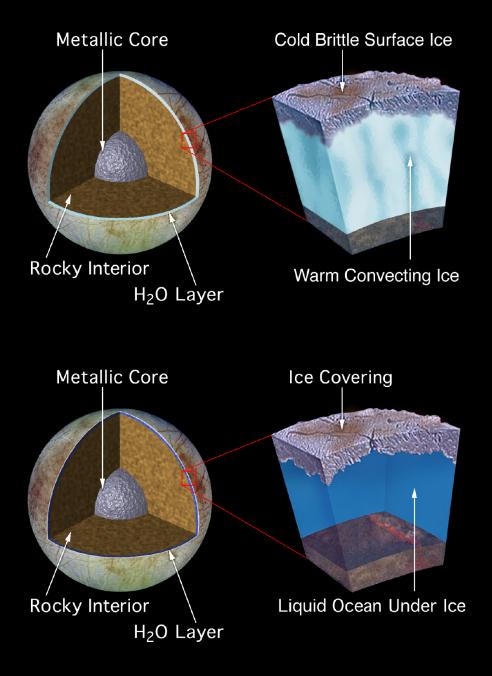
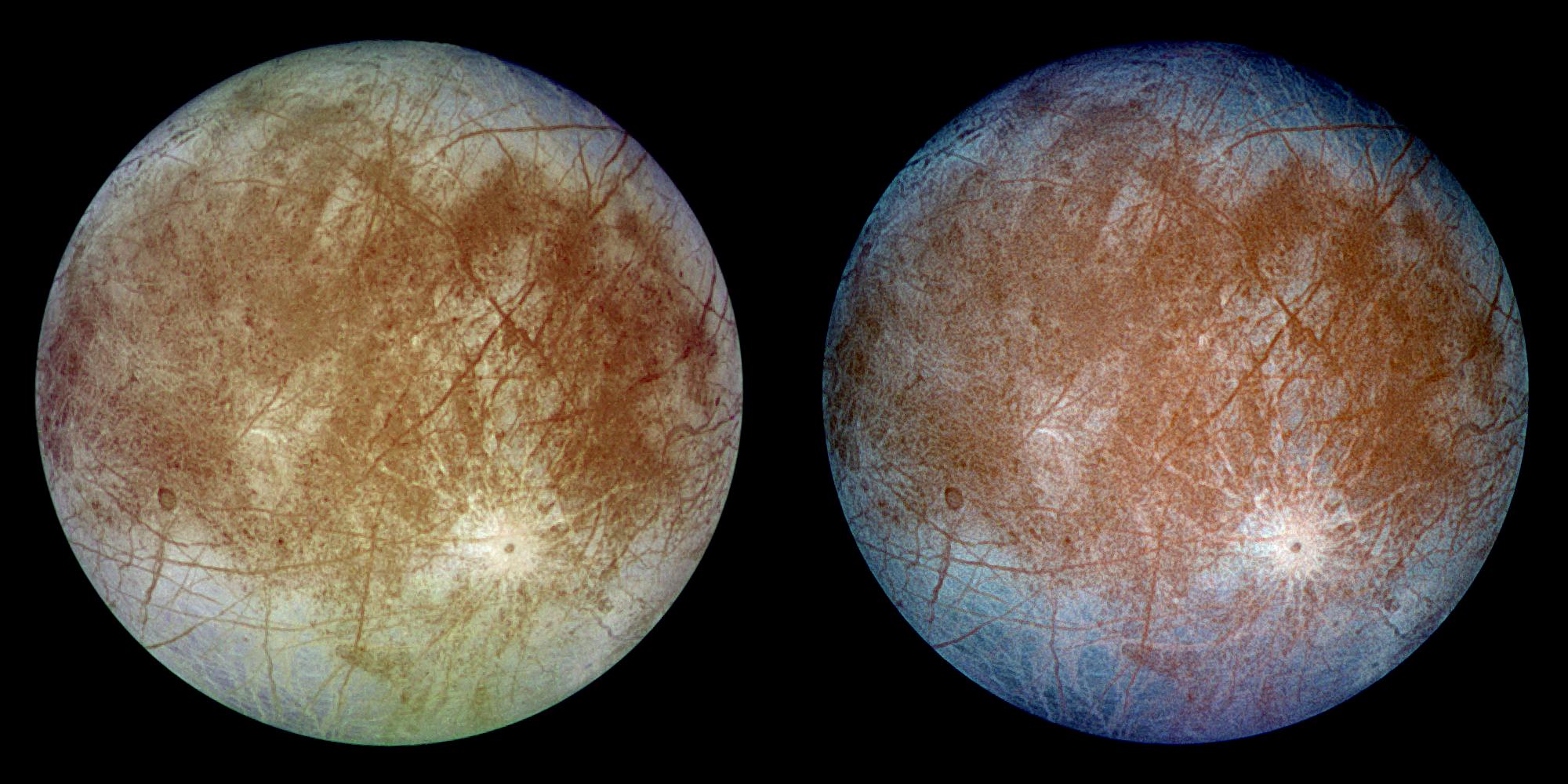
deglr6328 writes "On the 21st of this month the Galileo Space Probe, which has been orbiting Jupiter for nearly eight years, will plummet fatefully into the crushing pressures and searing heat of that planet's interior. The spacecraft's 14 year journey has brought the discovery of, among other things, the first moon orbiting an asteroid, the first remote detection of life on earth when Carl Sagan used data from an onboard infrared spectrometer to observe the spectral signature of Oxygen in our atmosphere, it has caught snowflakes of Sulfur Dioxide as it flew through the plume of an erupting volcano on Io, snapped pictures of comet Shoemaker-Levy 9 as it smashed into Jupiter's atmosphere and most importantly, provided proof a >60 Km deep ocean on Europa with hints of oceans on Callisto and Ganymede(listen to Ganymede's eerie sounding plasma wind). And all this with scarcely more computing power than a late '70s video game and a maximum data transfer rate of ~120 bits/s over a distance of more than 600 million Km. In a mission spanning three decades, the Galileo space probe has answered many of humanity's questions about space and presented us with the knowledge to ask many more which will be answered by the next generation of Jovian explorer. Goodnight Galileo."

but I would rather have a replica of this space probe in schools/colleges than any number of sports trophies. The amount of hard work and dedication required to do things like this should inspire our youths, instead of their current role models (kobe bryant, et al.)
later,
epic
"Im drowning here, and you're describing the water!"
The reason that it sounds so "eerie" is because it is recorded with a receiver whose channels are harmonically related. A true wideband recording would sound quite different. This is true of the similar Voyager plasma recordings as well.
all this with scarcely more computing power than a late '70s video game
When it comes to real engineering, the fewer resources you need to meet your goals, the better of a job you did. Throwing in larger processors just to you can brag about the power of a Beowulf cluster of those is just a poor job.
Less is more.
This month's issue of popular science has an article also. Click.
Dropping the spacecraft into the planet just seems wrong! It's like flushing a dead goldfish down the toilet!
So long Galileo! We salute you!
*flush*
It promised a lot, then with the failure of the high-gain antenna, it delivered a lot less than expected.
Both Voyagers sent us a lot less data but the data was publicised much more energetically.
Since the probe has been plauged by malfunctions for some time I agree it is time to let it go. Bye bye...
Galileo was not cheap. Neither were the Pioneers or the Voyagers. Look at the return on the investment, though.
NASA has not made a good argument for cheaper = better. The Hubble Space Telescope was flawed when it went up and spent the first three years of its lifespan doing very little compared to its design. We have lost several probes headed Mars. Quality has not been top priority at NASA, and until it is, we're going to continue to see failure after failure, I'm afraid. Galileo wasn't perfect, with deployment problems of its high-gain antenna, but it did not fail entirely, and it did not require humans in suits to go play with it for it to work right. We need that kind of engineering again.
We need to build them like we used to.
Do not look into laser with remaining eye.
If Galileo is the spark that lights up the gas giant Jupiter, turning it into a second sun, that will be the last straw. We will then have no choice but to make safety the number one priority at NASA.
"maximum data transfer rate of ~120 bits/s"
;)
About the same as all those links will have in 5 minutes
This comment does not represent the views or opinions of the user.
...does anyone know the URL for the Ganymede Dep't of Intellectual Property?
From the article: "Obliteration is precisely what nasa intends for the spacecraft. The reason is that Galileo may still harbor some signs of life on Earth: microorganisms that have survived since its launch from the Kennedy Space Center, in Florida, in 1989. If the orbiter were left to circle Jupiter after running out of propellant (barring an intervention, this would likely happen within a year), it might eventually crash into Europa, one of Jupiter's large moons. In 1996, Galileo conducted the first of eight close flybys of Europa, producing breathtaking pictures of its surface, which suggested that the moon has an immense ocean hidden beneath its frozen crust. These images have led to vociferous scientific debate about the prospects for life there; as a result, nasa officials decided that it was necessary to avoid the possibility of seeding Europa with alien life-forms." But I always thought it would be great to colonize another planet with earth's bacteria. :)
But really, wouldn't doing something like that possibly help to set the stage (a ways off) in the future, when we can send a manned crew out towards Jupiter. Just think if we sent hundreds of probes containing simple life like bacteria, maybe we could help to create a more hospitable place. Of course, then you have to worry about the pesky part about it being mostly ocean(frozen nonetheless).
One less satellite to gain intelligence and come back looking for its creator.
Here is the transcript of the last Galileo probe to "land on" Jupiter:
Time Event
________ _____
11:04 a.m. Coast timer initiates probe operation
12:46 p.m. Orbiter flyby of Io (~1000 km) (No imaging or spectral data collected)
2:04 p.m. Energetic Particles Investigation (EPI) begins measuring trapped radiation in a region previously unexplored.
5:04 p.m. Probe entry and data relay
5:05:52 p.m. Pilot parachute deployed
5:05:54 p.m. Main Parachute deployed
5:06:02 p.m. Deceleration module jettisoned
5:06:06 p.m. Direct scientific measurements begin
5:06:15 p.m. Radio transmission to orbiter begins
~5:08 p.m. Visible cloud tops of Jupiter reached
5:12 p.m. Atmospheric pressure the same as Earth's sea-level pressure
5:17 p.m. Second major cloud deck is encountered (uncertain)
5:28 p.m. Water clouds entered (uncertain)
5:34 p.m. Atmospheric temperature equal to room temperature on Earth
5:46 p.m. Probe enters twilight
6:04 p.m. End of baseline mission. Probe may cease to operate due to lack of battery power, attenuation of signal due to atmosphere, or being crushed.
6:19 p.m. Orbiter ceases to receive probe data (if still transmitting)
7:27 p.m. Ignition of Galileo main engine (49 minute duration) to insert into Jovian orbit
In other similar stories, they always mention the small trickle of data that these crafts can return. I always wonder if this represents some physical limitations, or just the state of technology at the time of the probe. If they had more communications potential, they could return all kinds of data, images, even video. Anyone know of background info on space communications?
How do the new probes compare to these old ones in terms of communications capabilties? What sort of xfer rates can new ones support?
What are the limiting factors in space communications? Is it the power of the transmission, under the power limitations of the craft?
Holy crap. That is the dumbest thing I've ever read. First, Jupiter is HUGE. I mean *really* huge. Bigger than you can conceive! To be more specific, Jupiter is around 4.18591697 x 10^27 pounds (thank you Google Calculator). Yes, that's 4185916970000000000000000000 pounds for you folks that don't understand scientific notation.
Now, Nasa is planning on plunging 34 pounds of Plutonium into the planet. That's 3.4 * 10^1 pounds. Hmm... 10^1 versus 10^27. Do I need to say more? I mean... honestly, this is friggin' ridiculous!
Foolish Earthling. Totally unprepared for the effects of time travel.
Actually after looking at the link, that wasn't such a bad processor: 6.4 mhz, 16 bit addressing (even with an 8 bit data bus) and 16 general purpose registers. That's way ahead of the average 70's CPU - I was expecting it to be something far less powerful (more like a type of Z80).
Science does make money for schools. When we get a grant for doing science, the department and/or the university gets a cut. So if a lab gets a $600,000 grant, they'll probably actually get to see only $200,000-$300,000 of it or so, depending (greatly) on the university. For instance, in the grant administration booklet for my university it looks like 49% of a grant goes directly to the university for "Facilities and Administration." Then there are another 70 pages of crud I'm not going to look at which nibbles away the grant further. Given an article in the student paper last year saying with pride that the football team was now one of the few in the country to be so profitable as to hit the break-even point and my university's perverse overspending on athletics and consistent underfunding of maintenence and faculty pay (2nd lowest in the country, baby!), I imagine "Facilities and Administration" is simply a euphanism for "Athletics Department."
If you just look at a university's budget and see X income from grants and Y from ticket sales and etc., and expenditures X/2 for research and 2Y for athletics (after all, only men's football and basketball programs ever have a hope in hell of ever reaching the break even point--sad but true for now) then athletics are just a drain on the university. But I'm not so blinded by my intense hatred of the Athletics Department to say that it doesn't bring in money--it just does so in a very roundabout way. Private donations are very important to the survival of the university. People might donate becuase of a sense of pride in the university or out of nostalgia, but while academic research doesn't rank high on most people's minds for either of these two things, the old football and basketball teams often do. Similarly, a good sports program may grease the wheels a bit for what little funding we get through the state. How much income from private donations and the state can be indirectly attributed to athletics is very hard to say. Does it surpass research grants? Probably at some universities. But it is worth noting that there are schools that do just fine without athletics and still get piles from grants, the state, and private donations.
Galileo was supposed to be launched from the shuttle. When Challenger happened, it delayed Galileo for years. It's design phase started in late seventies, building took the early eighties but it had to be put to storage until they could find the launch equipment. This delay is also one of the reasons why Galileo cost this much. It isn't cheap to build one of these babies, let alone the clean room storage area.
It's interesting to note that Galileo's successor (the Jupiter Icy Moons Orbiter) will use Ion propulsion powered by a nuclear reactor. I believe that this is a first time a spacecraft has been nuclear powered. The Deep Space 1 mission proved that Ion thusters (which operated off of electricity provided by solar panels) were a faster and more efficient method of propulsion, especially over very long distances such as for exploration outside of our solar system.
See the pdf on the fission technology
Also, engineers are trained to downplay risks. They consider a risk of one in a million insignificant. But to a layperson who has seen the results of thousands of environmental accidents where the risk was supposedly very low, one in a million seems quite possible.
That is the one the stupidest views on 'risk' I've heard. Risk is risk. One in a million IS low! 'results of thousands of environmental accidents' What the hell is he talking about it? It doesn't matter how many accidents you've seen, it matters how many accidents you seen compared to the number of things you've tried. *That* is an esitmation of risk. I don't understand the point this guy is trying to make.
Even worse:
Of course, how can we get anyone to be concerned about the possible harmful effects of dumping our radioactive waste on other worlds when modern science condones illness, cancer, and even deaths if they advance a technology or turn a profit. Our culture has made it OK to release a drug if the side effects "only" kill two percent of the users under certain circumstances.
(idealist alarm rings) There is no such thing as a world without risk. If your risk of dying in a car accident is WAY more than one in a million, but does that mean we should outlaw driving?? Does this person not get in their car? You trade some level of risk to _actually_ do something.
On top of this, what does the guy advocate we do? The plutonium has to go somewhere. Do you store enough fuel to launch it out of the solar system? Isn't that still 'pollution?' I'm sorry but the basis for the argument is a *little* weak.
Cool link from an insurance company that shows different levels of risk.
Galileo will be Europe's own global navigation satellite system, providing a highly accurate, guaranteed global positioning service under civilian control. It will be inter-operable with GPS and GLONASS, the two other global satellite navigation systems. A user will be able to take a position with the same receiver from any of the satellites in any combination. By offering dual frequencies as standard, however, Galileo will deliver real-time positioning accuracy down to the metre range, which is unprecedented for a publicly available system. It will guarantee availability of the service under all but the most extreme circumstances and will inform users within seconds of a failure of any satellite. This will make it suitable for applications where safety is crucial, such as running trains, guiding cars and landing aircraft. The first experimental satellite, part of the so-called Galileo System Test Bed (GSTB) will be launched in late 2004. The objective of this experimental satellite is to characterize the critical technologies, which are already under development under ESA contracts. Thereafter up to four operational satellites will be launched in the timeframe 2005-2006 to validate the basic Galileo space and related ground segment. Once this In-Orbit Validation (IOV) phase has been completed, the remaining satellites will be installed to reach the Full Operational Capability (FOC) in 2008. The fully deployed Galileo system consists of 30 satellites (27 operational + 3 active spares), positioned in three circular Medium Earth Orbit (MEO) planes in 23616 km altitude above the Earth, and at an inclination of the orbital planes of 56 degrees with reference to the equatorial plane. Once this is achieved, the Galileo navigation signals will provide a good coverage even at latitudes up to 75 degrees north, which corresponds to the North Cape, and beyond. The large number of satellites together with the optimisation of the constellation, and the availability of the three active spare satellites, will ensure that the loss of one satellite has no discernible effect on the user.
Wow. 6.5 milihertz. You're right. That IS something.