 Slashdot Mirror
Goodbye, Galileo
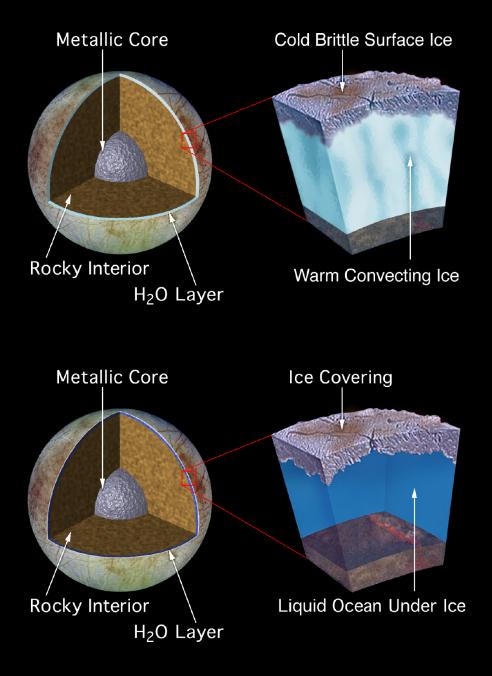
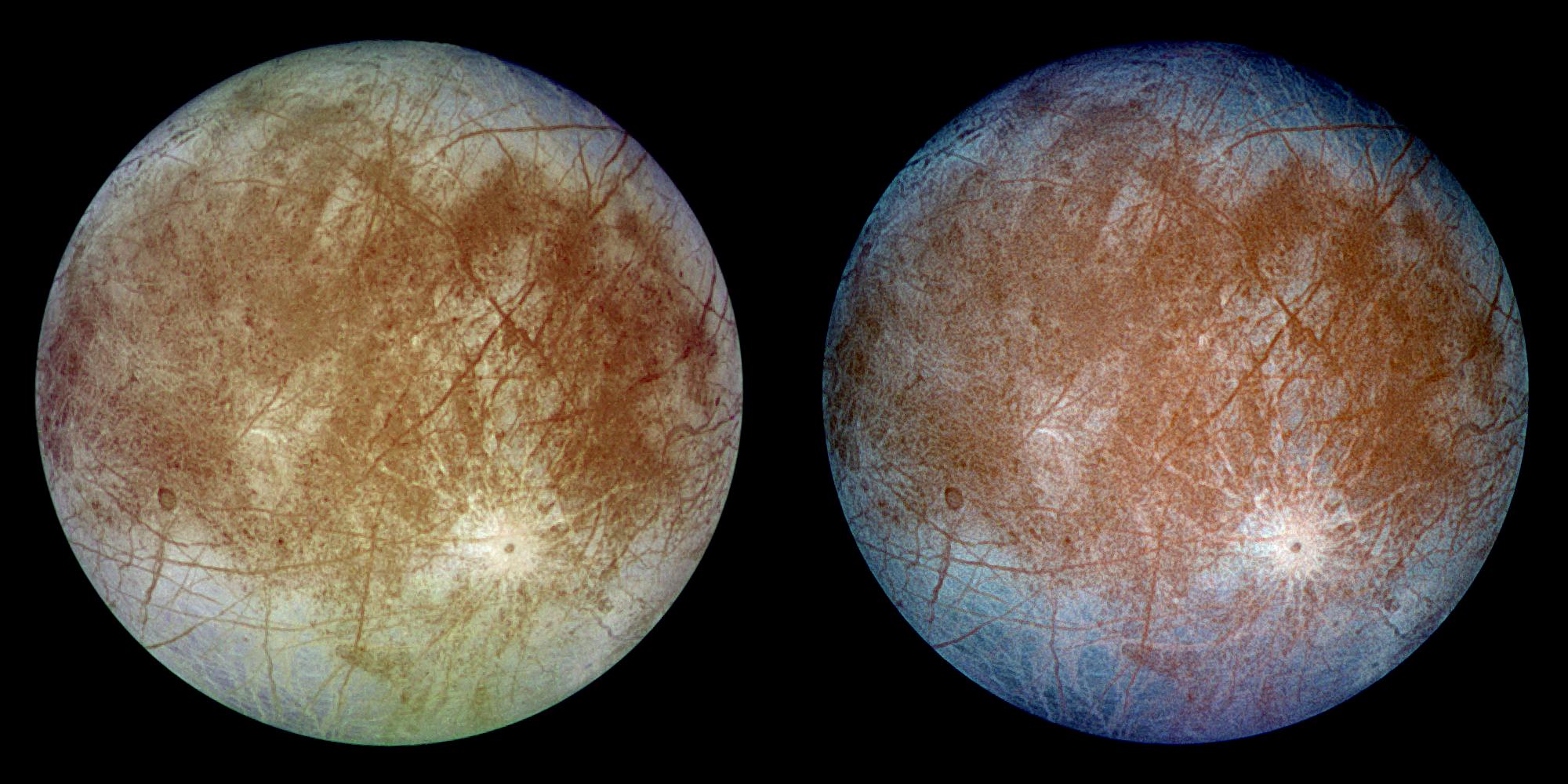
deglr6328 writes "On the 21st of this month the Galileo Space Probe, which has been orbiting Jupiter for nearly eight years, will plummet fatefully into the crushing pressures and searing heat of that planet's interior. The spacecraft's 14 year journey has brought the discovery of, among other things, the first moon orbiting an asteroid, the first remote detection of life on earth when Carl Sagan used data from an onboard infrared spectrometer to observe the spectral signature of Oxygen in our atmosphere, it has caught snowflakes of Sulfur Dioxide as it flew through the plume of an erupting volcano on Io, snapped pictures of comet Shoemaker-Levy 9 as it smashed into Jupiter's atmosphere and most importantly, provided proof a >60 Km deep ocean on Europa with hints of oceans on Callisto and Ganymede(listen to Ganymede's eerie sounding plasma wind). And all this with scarcely more computing power than a late '70s video game and a maximum data transfer rate of ~120 bits/s over a distance of more than 600 million Km. In a mission spanning three decades, the Galileo space probe has answered many of humanity's questions about space and presented us with the knowledge to ask many more which will be answered by the next generation of Jovian explorer. Goodnight Galileo."

but I would rather have a replica of this space probe in schools/colleges than any number of sports trophies. The amount of hard work and dedication required to do things like this should inspire our youths, instead of their current role models (kobe bryant, et al.)
later,
epic
"Im drowning here, and you're describing the water!"
The reason that it sounds so "eerie" is because it is recorded with a receiver whose channels are harmonically related. A true wideband recording would sound quite different. This is true of the similar Voyager plasma recordings as well.
all this with scarcely more computing power than a late '70s video game
When it comes to real engineering, the fewer resources you need to meet your goals, the better of a job you did. Throwing in larger processors just to you can brag about the power of a Beowulf cluster of those is just a poor job.
Less is more.
This month's issue of popular science has an article also. Click.
Dropping the spacecraft into the planet just seems wrong! It's like flushing a dead goldfish down the toilet!
So long Galileo! We salute you!
*flush*
Bitterly disapointed, Carl Sagan was never able to detect intelligent life on our planet!
http://en.wikipedia.org/wiki/Signature_bloc
It promised a lot, then with the failure of the high-gain antenna, it delivered a lot less than expected.
Both Voyagers sent us a lot less data but the data was publicised much more energetically.
Since the probe has been plauged by malfunctions for some time I agree it is time to let it go. Bye bye...
Galileo was not cheap. Neither were the Pioneers or the Voyagers. Look at the return on the investment, though.
NASA has not made a good argument for cheaper = better. The Hubble Space Telescope was flawed when it went up and spent the first three years of its lifespan doing very little compared to its design. We have lost several probes headed Mars. Quality has not been top priority at NASA, and until it is, we're going to continue to see failure after failure, I'm afraid. Galileo wasn't perfect, with deployment problems of its high-gain antenna, but it did not fail entirely, and it did not require humans in suits to go play with it for it to work right. We need that kind of engineering again.
We need to build them like we used to.
Do not look into laser with remaining eye.
This has already been said. Parent fails it!
This article almost made me cry.
Treehugger? Treehugger... Treehugger!
If Galileo is the spark that lights up the gas giant Jupiter, turning it into a second sun, that will be the last straw. We will then have no choice but to make safety the number one priority at NASA.
Sounds to me like the whole moon is infested with Paradroids.
(For the youngin's, here, here, and here.)
Aim for Jupiter...and within!
"maximum data transfer rate of ~120 bits/s"
;)
About the same as all those links will have in 5 minutes
This comment does not represent the views or opinions of the user.
Isn't it "memories fade in time like tears in rain"?
A blog like any other.
...does anyone know the URL for the Ganymede Dep't of Intellectual Property?
There's also a bit of dissention currently about the decision to crash the probe. Apparently, there's enough plutonium on board (34 pounds!) that we'll be donating to the Jovian depths.
I'm not sure I like that idea.
The cure for cancer is coming: Reovirus
From the article: "Obliteration is precisely what nasa intends for the spacecraft. The reason is that Galileo may still harbor some signs of life on Earth: microorganisms that have survived since its launch from the Kennedy Space Center, in Florida, in 1989. If the orbiter were left to circle Jupiter after running out of propellant (barring an intervention, this would likely happen within a year), it might eventually crash into Europa, one of Jupiter's large moons. In 1996, Galileo conducted the first of eight close flybys of Europa, producing breathtaking pictures of its surface, which suggested that the moon has an immense ocean hidden beneath its frozen crust. These images have led to vociferous scientific debate about the prospects for life there; as a result, nasa officials decided that it was necessary to avoid the possibility of seeding Europa with alien life-forms." But I always thought it would be great to colonize another planet with earth's bacteria. :)
But really, wouldn't doing something like that possibly help to set the stage (a ways off) in the future, when we can send a manned crew out towards Jupiter. Just think if we sent hundreds of probes containing simple life like bacteria, maybe we could help to create a more hospitable place. Of course, then you have to worry about the pesky part about it being mostly ocean(frozen nonetheless).
Ironically, Galileo Galilei spent his own last eight years under close house arrest. To pile on the irony, he spent the last five of them blind, in part because he was prevented from consulting a doctor. Maybe these past eight years of clear vision can help make up for that in a small way. But I doubt it.
geez. what a complment, thanks! :-)
- "Hear that?! The percolations are imminent! Cease your ingress!"
One less satellite to gain intelligence and come back looking for its creator.
Here is the transcript of the last Galileo probe to "land on" Jupiter:
Time Event
________ _____
11:04 a.m. Coast timer initiates probe operation
12:46 p.m. Orbiter flyby of Io (~1000 km) (No imaging or spectral data collected)
2:04 p.m. Energetic Particles Investigation (EPI) begins measuring trapped radiation in a region previously unexplored.
5:04 p.m. Probe entry and data relay
5:05:52 p.m. Pilot parachute deployed
5:05:54 p.m. Main Parachute deployed
5:06:02 p.m. Deceleration module jettisoned
5:06:06 p.m. Direct scientific measurements begin
5:06:15 p.m. Radio transmission to orbiter begins
~5:08 p.m. Visible cloud tops of Jupiter reached
5:12 p.m. Atmospheric pressure the same as Earth's sea-level pressure
5:17 p.m. Second major cloud deck is encountered (uncertain)
5:28 p.m. Water clouds entered (uncertain)
5:34 p.m. Atmospheric temperature equal to room temperature on Earth
5:46 p.m. Probe enters twilight
6:04 p.m. End of baseline mission. Probe may cease to operate due to lack of battery power, attenuation of signal due to atmosphere, or being crushed.
6:19 p.m. Orbiter ceases to receive probe data (if still transmitting)
7:27 p.m. Ignition of Galileo main engine (49 minute duration) to insert into Jovian orbit
every so often we send a shuttle up, and sometimes it explodes/etc. Why can't we just send some more probes like this? The whole crap with sending people up just doesn't work - we're not getting any better at it. We should instead just send unmanned flights. Imagine the cost savings.
Yeah, the ISS is a great dream...but...what's the point? Zero gravity labs can be mimiced here on earth far cheaper and safer. Sending one shuttle up has an extremely HUGE environmental impact. In mere moments a search brought up some decent points about further problems/inefficiencies. The technology of today is, in theory, much higher than what we had years and years ago. Its time we took our current system, did something like sell it to the chinese (they'll get it anyway, we might as well make the money), and build something with technology newer than 30 years ago. They still use 386 cpu's in the damn thing. Its time to put the entire fleet to rest, and stop paying to maintain it. Just because the cold war is over doesn't mean we don't need to do more than send people up and watch them explode - we need to still push the envelope.
I'm adding you to my friend-list :)
Treehugger? Treehugger... Treehugger!
Yeah -- someday, when we start harvesting diamonds from the erstwhile core of Jupiter, some of it will be radioactive with all that plutonium we dumped in!
In other similar stories, they always mention the small trickle of data that these crafts can return. I always wonder if this represents some physical limitations, or just the state of technology at the time of the probe. If they had more communications potential, they could return all kinds of data, images, even video. Anyone know of background info on space communications?
How do the new probes compare to these old ones in terms of communications capabilties? What sort of xfer rates can new ones support?
What are the limiting factors in space communications? Is it the power of the transmission, under the power limitations of the craft?
neat i'll do the same
- "Hear that?! The percolations are imminent! Cease your ingress!"
Dude, I did a lot of other stuff too. People just don't appreciate enough :(
Actually, if you will notice, this post came BEFORE the other one. That leads me to conclude that the OTHER one is copied.
Stewey
There are 10 kinds of people in the world. Those who understand binary and those who don't.
Haha. Great.
:D
Will you marry me?
Treehugger? Treehugger... Treehugger!
It's patriotism, as true patriotism (and true belief) can only be external, on the outside. The recital is a ritual. It's not directed at you who recites it but at the state - you show the state that you are patriotic and loyal to it, even if you actually don't believe it (you just do it because you're told to - "the law is the law"). The state knows, of course, that you don't actually mean what you say, but it's always wise to check those who either don't recite the 'prayer' or are a bit too eager (the true believers are always the ones who are suspicious).
Hell is not other people; it is yourself. - Ludwig Wittgenstein
It's mission spanned three decades? Uhm. 1989-2003 = 14 years. Three decades = 30 years. Galileo was active is less than half of three decades, and its useful mission was even less of that. Yeah, 1989-2003 technically means 80's, 90's, and 00's, but calling that "three decades" is assinine, misleading, and vaguely dishonest.
Parent is not really Galileo, but a fake. Note the low UID. The real Galileo is this one.
Send it back to Earth
Um...how? That would require a truly ridiculous amount of delta-vee, and it's pretty much out of gas.
It doesn't have the fuel to make the return trip to Earth (much less fuel for braking into Earth orbit once it got back here!)
It would be really cool to see it in the Air & Space Museum, though. Well, except for all the latent radiation.
Liberal (adj.): Free from bigotry; open to progress; tolerant of others.
Oh yeah, that's brilliant. The only human life left on the planet will be colicky babies and Sterno-drinking winos.
Huuuuuge longshot, feel free to shoot it down:
Really, really intricate slingshotting. Jupiter has enough moons that, concievably, you could just whip that sucker around until you hit a suitable trajectory to make it back to Earth.
It would take a shitload of calculus, and hundreds of years, but... Hey, got a better idea?
Bowie J. Poag
But thats how Earth is now, anyway. :)
Bowie J. Poag
You forgot about Andromida Strain... Oh that was a intentional grab of space bugs!
"but I would rather have a replica of this space probe in schools/colleges than any number of sports trophies. The amount of hard work and dedication required to do things like this should inspire our youths, instead of their current role models" We could start a replica project for it, and make Galileo scooters to probe the neighbourhood! Hey, if people do it with the Star Trek Enterprise, so can we!! http://story.news.yahoo.com/news?tmpl=story2&u=/03 0905/170/562a3.html&e=5&ncid=1756
E, si muove!
"Slapping people is fun." - Starla Grady
Why is there a space shuttle when launching stuff by rocket arguably is cheaper and when we can have such ubercool projects such as galileio! More money to the scientists, less to the politicians!!
Of those to whom much is given, much is required.
That's 60,000 meters. Glad I could help.
========
Together, we will drive the rats from the tundra.
If you know another way to get an atmosphere with lots of molecular oxygen, we'd love to hear it.
There was no oxygen atmosphere on Earth before life. Oxygen is the most abundant element here, but because it's so fond of oxidising things, you don't find it free unless some active process is constantly pumping it out. Like, green plants that need carbon to grow and found a handy source. Venus, for instance, has a carbon dioxide atmosphere, because there are no plants to convert it. Leave oxygen in the presence of most anything else and it'll all get bound up.
So yes, seeing oxygen in a planetary atmosphere is a strong indicator of life there. Seeing it in a so-called planetary nebula, not so much, but that's a whole different environment (and it's notable that even that oxygen will be bound up well inside a million years).
I doubt it. It's very deep in a biiig gravity well right now; the "suitable trajectory" probably does not exist.
Karma sacrifice time:
Right, except for the fact that it would never be able to escape from the Jovian system, let alone get back here?
Why don't you use the excellent program called "units"?
console -> units
(or if u'r on windows, then cygwin -> units)
^_^
Sneaky, twisted little bugger. He copied an earlier comment and then "someone" anon posted to the earlier comment and said it was a copy-paste dup and pointed to this as the original.
Check out the orignal and look at the first comment and then look at the post I'm replying to. Check the dates/times carefully.
Also note that an anon is already posted in this thread pointing out the problem, but already is modded down. Hopefully my extra point allows a few more people to see what's going on...
haha :)! dude, you better watch out, I like guys!
;P
You've probably heard about this.
If you happen to live in Canada near Ottawa, then maybe I'll consider asking my girlfriend if she doesn't mind
Treehugger? Treehugger... Treehugger!
Anybody else listen to that and go "HEY! That sounds like seagulls!"
Buy Steampunk Clothing Online!
I was going to point out that its Jovians too :)
Frankly, I think people should have more respect; what would you feel like if someone crased 34lbs of plutonium into your back yard!
Ripping an new rectum in the fabric of spacetime.
My god, it's full of stars!
or more topical
My god, it's full of SARS!
"maximum data transfer rate of ~120 bits/s"
Let see. 120 bits/sec for 8 years... thats about 28 gigabytes of data. Not that bad.
-larsch
Agreed, but the Pioneers and Voyagers were out there early and were sending back spectacular photographs, which is what the public gets enthused about. By the time Galileo was there, that'd been done several times, so the public was less interested. And they probably don't care at all about the geology of the moons or the make-up of the atmosphere.
I don't know that we should expect anything else.
I'm turning 40 on Sept 21st. Does anyone know a more exact time for the plunge that I can make out a toast in memory of this wonderful machine?
I'm in a Unix state of mind.
Glad to be of help.
Ok, when a dead president's birthday rolls around we all take a day off work and cook hot dogs in the back yard with the kids.
Dammit, this is far more worthy! I say we all take a moment out of our lives on the 21st and declare it a one-time national engineering/geek/space/technologist holiday; get our our barbies; relax a bit and pour yourself a glass of bubbly and toast the good folks at NASA.
Results like these pose once more the question if manned flights ( with the risk of human life loss ) are really -necessary- at this point in time, or if remote controls ( and "remote presence" ) technologies are enough to conduct the operations and experiments...
[...] it has caught snowflakes of Sulfur Dioxide as it flew through the plume of an erupting volcano on Io, snapped pictures of comet Shoemaker-Levy 9 as it smashed into Jupiter's atmosphere
Yes, but what about the attack ships on fire off the shoulder of Orion and the C-beams glittering in the dark near the Tannhauser gate?
Time to die
If the probe had been a human instead of a lump of hardware, Hollywood would be fighting for the fim rights. Unwanted as a child, shuffled from unwilling carer to unwilling carer, finally sent onto its career by a distinctly second rate route. Suffered a dreadful injury as a result of it early-life neglect. But despite all this, triumphed against the odds and earned unimaginable scientific wealth. Now on its deathbead, surrounded by grieving friends and relatives.
Which raise the question: where is its successor? Hollywood will need the sequel: "Galileo II: The return to Jupiter".
But seriously, this one probe, seriously broken, seems to have done more good science than ISS is ever likely to do. And yet the successor has been canned for lack of funds. While not absoultely anti ISS, it does seem that value-for-money has got a bi distorted. Even on the emotional level, the human achievement of fixing and reprogramming the crippled spacecraft is something to be proud of.
Consciousness is an illusion caused by an excess of self consciousness.
http://www.cyberspaceorbit.com/JUPFULLx.htmc le summary- galileo may cause jupiter to ignite into second sun.
arti
granted, some scientists thought the first nuke test might ignite the earth's atmosphere at the time and this led to some heated (no pun intended) internal debate according to richard feynman. of course our atmosphere isn't made from hydrogen and helium, or contain seas of liquid or metallic hydrogen. a little 2010 anyone?
Science does make money for schools. When we get a grant for doing science, the department and/or the university gets a cut. So if a lab gets a $600,000 grant, they'll probably actually get to see only $200,000-$300,000 of it or so, depending (greatly) on the university. For instance, in the grant administration booklet for my university it looks like 49% of a grant goes directly to the university for "Facilities and Administration." Then there are another 70 pages of crud I'm not going to look at which nibbles away the grant further. Given an article in the student paper last year saying with pride that the football team was now one of the few in the country to be so profitable as to hit the break-even point and my university's perverse overspending on athletics and consistent underfunding of maintenence and faculty pay (2nd lowest in the country, baby!), I imagine "Facilities and Administration" is simply a euphanism for "Athletics Department."
If you just look at a university's budget and see X income from grants and Y from ticket sales and etc., and expenditures X/2 for research and 2Y for athletics (after all, only men's football and basketball programs ever have a hope in hell of ever reaching the break even point--sad but true for now) then athletics are just a drain on the university. But I'm not so blinded by my intense hatred of the Athletics Department to say that it doesn't bring in money--it just does so in a very roundabout way. Private donations are very important to the survival of the university. People might donate becuase of a sense of pride in the university or out of nostalgia, but while academic research doesn't rank high on most people's minds for either of these two things, the old football and basketball teams often do. Similarly, a good sports program may grease the wheels a bit for what little funding we get through the state. How much income from private donations and the state can be indirectly attributed to athletics is very hard to say. Does it surpass research grants? Probably at some universities. But it is worth noting that there are schools that do just fine without athletics and still get piles from grants, the state, and private donations.
I have always wondered about NASA being able to create a set of intra-solar system repeaters that they would send out into space, and have them simply repeat signals back from our spacecrafts. That means we could still pick up signals from such spacecrafts as Voyager and Pioneer spacecrafts by having the repeaters send them back to Earth.
As well, this would eliminate the need for high-gain antennas of the likes of what Galileo needed... they could do with a smaller antenna that would need to reach the repeater, and would decrease overall mission risk.
Unlike most people here, I actually got the reference.
I read your book you magnificent science-fiction-writing bastard!
What's that in Librarys 'O Congress?
Fran
:):):)
1st 1st Poster of the new Millennium!
It's interesting to note that Galileo's successor (the Jupiter Icy Moons Orbiter) will use Ion propulsion powered by a nuclear reactor. I believe that this is a first time a spacecraft has been nuclear powered. The Deep Space 1 mission proved that Ion thusters (which operated off of electricity provided by solar panels) were a faster and more efficient method of propulsion, especially over very long distances such as for exploration outside of our solar system.
See the pdf on the fission technology
Oxygen is the most abundant element here
Actually it's Nitrogen (around 70% or something)
Well, it took a strain, but I managed to get the reference as well. 2010: Andromeda Two wasn't it? ;)
Isn't that how life was started on earth? :)
Saying your OS is the best because more people use it is like saying MacDonalds make the best food
"I've seen things you people wouldn't believe. Attack ships on fire off the shoulder of Orion. I watched C-beams glitter in the dark near the Tannhauser gate. All those moments will be lost in time, like tears in rain. Time to die." --Roy Batty, Blade Runner
They say the first thing to go is your penis. Well, it's either that or your brain. I forget which...
Close, The Andromeda Strain
I've had enough abrasive sigs. Kittens are cute and fuzzy.
With 34 pounds of plutonium crashing into our jovial planet Jupiter, with the velocity and mass to find near center, pressure, we may have our second sun. Credit to A. C. Clark 2010 Space odyssey for the Idea yet we may not need a couple of million monoliths. I feel a milion to one odds in outer space is very small. We should'nt leave our little poops along the way of our space exploration. Are we being watched by our LGMs? most likly and I can see them shaking their heads and saying "What a bunch of multi-colored earth trash"
I eat my grapes at room temperature, cuz the cold ones hurt my teeth
This wouldn't work for the same reason that you using a shopping cart to do a 'slingshot' maneuver off earth wouldn't, not enough energy.
Err, no. There is a lot of nitrogen, but there's a lot more oxygen. The 78% figure for nitrogen is in the gaseous atmospheric form of N2 (whereas oxygen (O2) has 21%).
On the other hand, apart from the masses and masses of oxides present in the earth's makeup, there's a fair amount of water (H20) around on the planet, which is far denser than the atmosphere... There's a fair amount of nitrogen around too, lots of organic compounds have N in them, but lots also have O in them, so that probably roughly balances...
I'd say there was probably more iron than oxygen though - AFAIR(emember), most of the Earth's core is iron, hence the magnetic field...
Simon
Physicists get Hadrons!
Galileo will be Europe's own global navigation satellite system, providing a highly accurate, guaranteed global positioning service under civilian control. It will be inter-operable with GPS and GLONASS, the two other global satellite navigation systems. A user will be able to take a position with the same receiver from any of the satellites in any combination. By offering dual frequencies as standard, however, Galileo will deliver real-time positioning accuracy down to the metre range, which is unprecedented for a publicly available system. It will guarantee availability of the service under all but the most extreme circumstances and will inform users within seconds of a failure of any satellite. This will make it suitable for applications where safety is crucial, such as running trains, guiding cars and landing aircraft. The first experimental satellite, part of the so-called Galileo System Test Bed (GSTB) will be launched in late 2004. The objective of this experimental satellite is to characterize the critical technologies, which are already under development under ESA contracts. Thereafter up to four operational satellites will be launched in the timeframe 2005-2006 to validate the basic Galileo space and related ground segment. Once this In-Orbit Validation (IOV) phase has been completed, the remaining satellites will be installed to reach the Full Operational Capability (FOC) in 2008. The fully deployed Galileo system consists of 30 satellites (27 operational + 3 active spares), positioned in three circular Medium Earth Orbit (MEO) planes in 23616 km altitude above the Earth, and at an inclination of the orbital planes of 56 degrees with reference to the equatorial plane. Once this is achieved, the Galileo navigation signals will provide a good coverage even at latitudes up to 75 degrees north, which corresponds to the North Cape, and beyond. The large number of satellites together with the optimisation of the constellation, and the availability of the three active spare satellites, will ensure that the loss of one satellite has no discernible effect on the user.
Well, it took a strain, but I managed to get the reference as well. 2010: Andromeda Two wasn't it? ;)
:)
I'm an idiot, aren't I?
I've had enough abrasive sigs. Kittens are cute and fuzzy.
...couldn't light up Jupiter, the measley small amount of fissionable fuel onboard Galileo won't stand a chance.
We'll get right on it once we figure out how to hit my car with this hammer hard enough to get it to the west coast. Do you think they packed enough fuel in this thing to accelerate it back to earth and then slow it down to relative speeds for it to catch orbit? I think not. These things are engineered for one-way missions.
"Sometimes, I think Trent just needs a cup of hot chocolate and a blankie." -Tori Amos on Nine Inch Nails
On the 21st of this month the Galileo Space Probe, which has been orbiting Jupiter for nearly eight years, will plummet fatefully into the crushing pressures and searing heat of that planet's interior.
And isn't September 21st the first day of Fall? How appropriate.
Want to improve your Karma? Instead of "Post Anonymously", try the "Post Humously" option.
Another great thing about the typical /. nerd, there is one thing they ALL know. When you see a reference to something you dont understand, just cut and paste it into google, and bingo, an instant explanation.
To delve a little further into the stereotype, another reason most of the commentary seems to come from intelligent and educated folks is for a (obvious) reason. Nerds tend to be intelligent and educated. Part of the education process, is learning that there ARE other systems of measurement in use in this world, and pretty much everybody in the engineering world knows, the metric system is predominant in this world, and it's REAL reason for being so is because it is SLIDE RULE FRIENDLY. If you know how to shift decimals, and wiz the ruler back and forth a bit, metric makes a LOT more sense than any system that has no common basis with anything.
So I guess the real question becomes...
If one is not sure how to convert 60KM to a 'more understanding' measurement in thier head, and incapable of plugging it into google, to let google do the hard work for you, have you possibly mistaken /. for www.rednecks.us ?
k, i'm gonna go crawl back under my rock and slip into some asbestos clothing now.....
I find it amazing how some of the spacecraft humans have launched have gone beyond the call of duty and provided us with enormous amounts of information, while some have been smashed to bits due to miscalculations before their journey really began.
What can we learn from this? Maybe that we should keep sending crafts into outer space and, overall, things still work out to the benefit of mankind?
JIMO, or Jupiter Icy Moons Orbitor, is the planned successor to Galileo. It will carry with it a nuclear electric propulsion plant. With this much power on board, the spacecraft will not only be able to get to Jupiter much more quickly, it will be able to bounce powerful radar waves off of Europa and measure the thickness of Europa's icy crust.
Nuclear power in space is important, and will allow us to get to other planets quickly.
This is my sig.
"So yes, seeing oxygen in a planetary atmosphere is a strong indicator of life "
the reverse isn't necessarily true - if you don't see oxygen then it doesn't imply that life is absent. life forms can be based on other fuel-cycles.
Google Calculator
There are 10 kinds of people in the world; those that understand binary and those that do not.
The slashdot article mentions the Gallileo's mission lasting "3 decades". However, as the nasa.gov link states, Galileo was launched in 1989, 14 years ago. The author must be confused with Voyager I and II, which were launched in the 70's.
Craig Steffen
http://www.craigsteffen.net
So after all these years he's still being pressured by big, pompous gas-bags? When will the guy get a break?
thanks! a very cool program! d
stereoscopic multimedia pioneer view3d.tv
Well, I submited this, but the periodical referenced didn't have enough geek cred. Nonetheless, the article actually has a lot of technical detail. Check it out.
grammar-lesson free since 1999. (rescinded - 2005)
It's worth pointing out that although the reason the high gain antenna failed was because it didn't unfold properly, the reason that it had to unfold in the first place was more related to politics.
Galileo had to be designed to fit into the shuttle cargo bay, and then propel itself out of orbit after being let loose and placed into space, because various political heavyweights had decided that the shuttle should be used to launch it. Making the antenna foldable added even more complexity to an already incredibly complex machine. Having the launch delayed due to Challenger exploding just added to the complexity of the whole operation, and the antenna failed.
The Cassini probe, later launched to Saturn, was designed with a fixed antenna that didn't need to unfold, and launched from the top of a much more suitable rocket. It hasn't suffered anywhere near the same sorts of problems because it simply doesn't have as much complexity that can potentially break.
It's a pity that probes like Galileo, and other space objects like Mir couldn't have been pushed out to space, rather than destroyed. In a few decades time when we have decently fast travel within the solar system, the Smithsonian will be really disappointed that we didn't try and leave these things somewhere where we could pick them up again later.... Oh well....
The New Yorker article on the same subject (the Galileo probe, that is) kept me awake for two hours after I finished it in bed... Goodbye, Galileo.
I also want to note that I think this is probably the first time Slashdot has ever referenced a Philip Roth book... Goodbye, Columbus.
Compared to science, sports requires very little intelligence. That's why sports are so popular. They appeal to the less than average, average and above average. Science only appeals to the above average. To joe sixpack, science is elitist. Sports are not. It really is that simple.
Stick Men
narrow was my view .. I was thinking about atmosphere only.
Elton John rededicates his song "Candle in the Wind" to the Galileo space probe, superceding it's dedication to Marilyn Monroe and Princess Diana. Early reports suggest the lyrics of the chorus may be modified to say "And it seems to me you lived your life / Like a candle in plasma wind."