 Slashdot Mirror
Goodbye, Galileo
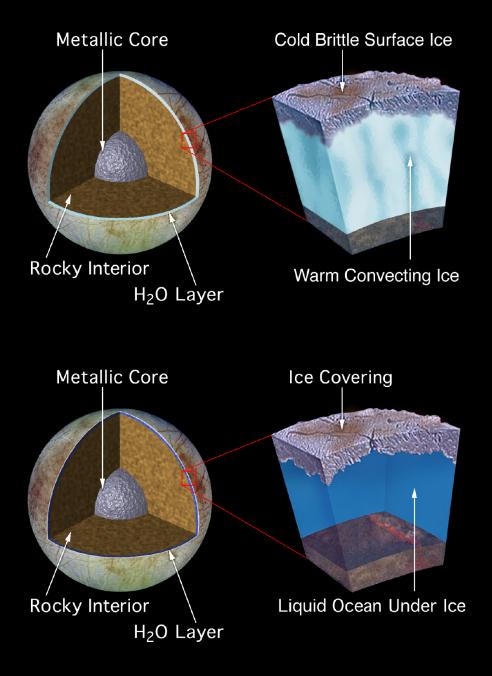
deglr6328 writes "On the 21st of this month the Galileo Space Probe, which has been orbiting Jupiter for nearly eight years, will plummet fatefully into the crushing pressures and searing heat of that planet's interior. The spacecraft's 14 year journey has brought the discovery of, among other things, the first moon orbiting an asteroid, the first remote detection of life on earth when Carl Sagan used data from an onboard infrared spectrometer to observe the spectral signature of Oxygen in our atmosphere, it has caught snowflakes of Sulfur Dioxide as it flew through the plume of an erupting volcano on Io, snapped pictures of comet Shoemaker-Levy 9 as it smashed into Jupiter's atmosphere and most importantly, provided proof a >60 Km deep ocean on Europa with hints of oceans on Callisto and Ganymede(listen to Ganymede's eerie sounding plasma wind). And all this with scarcely more computing power than a late '70s video game and a maximum data transfer rate of ~120 bits/s over a distance of more than 600 million Km. In a mission spanning three decades, the Galileo space probe has answered many of humanity's questions about space and presented us with the knowledge to ask many more which will be answered by the next generation of Jovian explorer. Goodnight Galileo."

but I would rather have a replica of this space probe in schools/colleges than any number of sports trophies. The amount of hard work and dedication required to do things like this should inspire our youths, instead of their current role models (kobe bryant, et al.)
later,
epic
"Im drowning here, and you're describing the water!"
The reason that it sounds so "eerie" is because it is recorded with a receiver whose channels are harmonically related. A true wideband recording would sound quite different. This is true of the similar Voyager plasma recordings as well.
all this with scarcely more computing power than a late '70s video game
When it comes to real engineering, the fewer resources you need to meet your goals, the better of a job you did. Throwing in larger processors just to you can brag about the power of a Beowulf cluster of those is just a poor job.
Less is more.
This month's issue of popular science has an article also. Click.
Galileo was not cheap. Neither were the Pioneers or the Voyagers. Look at the return on the investment, though.
NASA has not made a good argument for cheaper = better. The Hubble Space Telescope was flawed when it went up and spent the first three years of its lifespan doing very little compared to its design. We have lost several probes headed Mars. Quality has not been top priority at NASA, and until it is, we're going to continue to see failure after failure, I'm afraid. Galileo wasn't perfect, with deployment problems of its high-gain antenna, but it did not fail entirely, and it did not require humans in suits to go play with it for it to work right. We need that kind of engineering again.
We need to build them like we used to.
Do not look into laser with remaining eye.
If Galileo is the spark that lights up the gas giant Jupiter, turning it into a second sun, that will be the last straw. We will then have no choice but to make safety the number one priority at NASA.
"maximum data transfer rate of ~120 bits/s"
;)
About the same as all those links will have in 5 minutes
This comment does not represent the views or opinions of the user.
One less satellite to gain intelligence and come back looking for its creator.
Here is the transcript of the last Galileo probe to "land on" Jupiter:
Time Event
________ _____
11:04 a.m. Coast timer initiates probe operation
12:46 p.m. Orbiter flyby of Io (~1000 km) (No imaging or spectral data collected)
2:04 p.m. Energetic Particles Investigation (EPI) begins measuring trapped radiation in a region previously unexplored.
5:04 p.m. Probe entry and data relay
5:05:52 p.m. Pilot parachute deployed
5:05:54 p.m. Main Parachute deployed
5:06:02 p.m. Deceleration module jettisoned
5:06:06 p.m. Direct scientific measurements begin
5:06:15 p.m. Radio transmission to orbiter begins
~5:08 p.m. Visible cloud tops of Jupiter reached
5:12 p.m. Atmospheric pressure the same as Earth's sea-level pressure
5:17 p.m. Second major cloud deck is encountered (uncertain)
5:28 p.m. Water clouds entered (uncertain)
5:34 p.m. Atmospheric temperature equal to room temperature on Earth
5:46 p.m. Probe enters twilight
6:04 p.m. End of baseline mission. Probe may cease to operate due to lack of battery power, attenuation of signal due to atmosphere, or being crushed.
6:19 p.m. Orbiter ceases to receive probe data (if still transmitting)
7:27 p.m. Ignition of Galileo main engine (49 minute duration) to insert into Jovian orbit
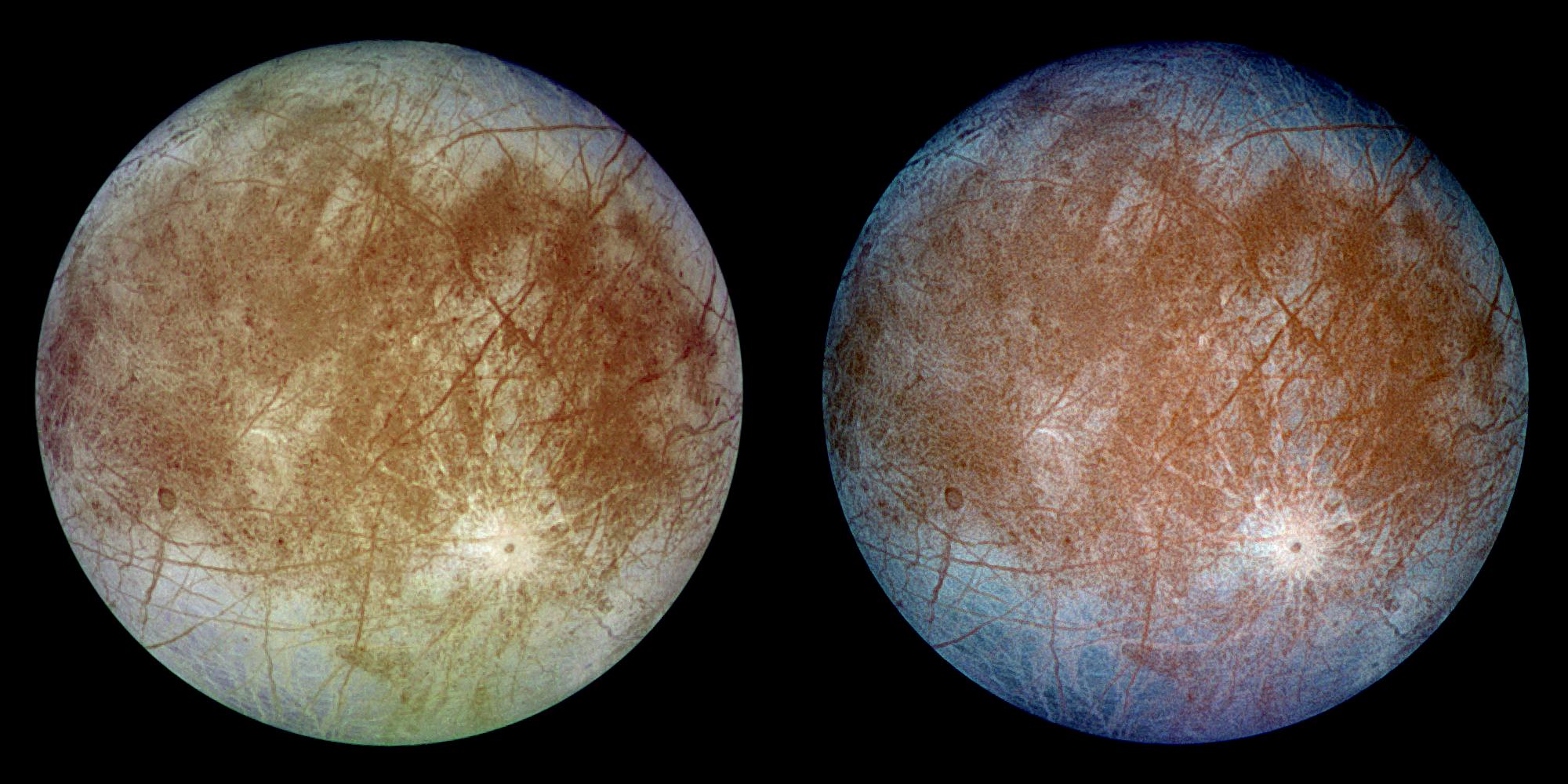
If the orbiter were left to circle Jupiter after running out of propellant (barring an intervention, this would likely happen within a year), it might eventually crash into Europa, one of Jupiter's large moons. In 1996, Galileo conducted the first of eight close flybys of Europa, producing breathtaking pictures of its surface, which suggested that the moon has an immense ocean hidden beneath its frozen crust. These images have led to vociferous scientific debate about the prospects for life there; as a result, nasa officials decided that it was necessary to avoid the possibility of seeding Europa with alien life-forms. And so the craft has been programmed to commit suicide, guaranteeing a fiery, spectacular end to one of the most ambitious, tortured, and revelatory missions in the history of space exploration.
That's why they are ditching it in said manner.
Every form of communications, from talking to someone in the next cubical to receiving pictures from interplanetary space probes, is bound by Shannon's Theorem, which describes the relationship between a channel's bandwidth and signal-to-noise ratio and how much information you can communicate on that channel.
Galileo was equipped with a high-bandwidth communications link capable of doing a much better job with image transmission, but its antenna failed to deploy. Because higher-bandwidth channels have a higher noise floor, a consequence of Shannon's Theorem is that higher-bandwidth wireless communications requires higher effective radiated power. Without the high-gain antenna, the normal image-transmission link was useless. As a result, the project engineers had to reconfigure a low-power, low-bandwidth auxiliary link to do the same job.
It was actually really cool (and really lucky) that they could do that at all.
Galileo was supposed to be launched from the shuttle. When Challenger happened, it delayed Galileo for years. It's design phase started in late seventies, building took the early eighties but it had to be put to storage until they could find the launch equipment. This delay is also one of the reasons why Galileo cost this much. It isn't cheap to build one of these babies, let alone the clean room storage area.