 Slashdot Mirror
Star Trek Legacy Review
Since late last month, I've been playing with the Xbox 360 title Star Trek Legacy. The fact that it is not a great game should be no surprise. Despite some entertaining plot elements, the title's gameplay leaves a lot to be desired. What is confusing, and troubling, is that this is just the latest in a long line of disappointing Trek games. Looking back on the history of Star Trek gaming, games like Elite Force or A Final Unity stand out from a disturbingly large field of titles that over-promise and under-deliver on the well-loved Trek universe. Why is it so hard to make a good Trek game? Why do developers keep trying and failing? Why is there a Vulcan leading the Borg? Read on for consideration of each of these questions, and a review of Star Trek Legacy to boot.
As so often happens with a Trek title the premise, at least, is compelling. Commanding a task force of up to four ships, you follow a fairly coherent plot from the "Enterprise" era all the way through to the time of Jean-Luc Picard and Benjamin Sisko. You can choose between a number of ship classes to include in your fleet, and gameplay consists of real-time ship-to-ship battles. The actors who portrayed the captains in the various eras make a return, offering their vocal talents and a feel of authenticity to the proceedings.
What sounds like a can't-miss formula, though, inevitably flies past the target at full impulse. Ship and fleet control is the most notable failure, and results in individual combat moments requiring more effort than feels right. I found fleet combat most frustrating, as it is so variable how your actions are interpreted. When you begin a mission, all four of your ships are taking orders from you at the same time. Selecting a enemy for combat (by hitting the right shoulder button and cycling through the available options) is intuitive and quick. When all four ships are following your orders, this results in a focused barrage that effectively neutralizes targets. The problem comes when ships begin 'thinking' on their own.
It was never clear to me what prompted this, though I know that giving individual ships orders via the overhead tactical display (available via the 'select' button) always 'broke up' the fleet's command. This is problematic, as the 2D overhead display is the best way to keep track of the action on the sometimes dauntingly large 3D space maps Legacy uses. Indeed, the z-axis is used in the game (unlike in the show), making it hard to keep track of enemy ships on occasion. These are challenges, though, to be overcome: the frustration sets in when order-less ships choose to sit dead in space and absorb phaser hits without retaliating. That's some extremely poor decision-making on the part of the AI, and can mean the difference between success and failure in a large and frantic naval battle.
Another, subtle frustration is the pathing your friendly ships use when circling a target. While sometimes ships do 'the right thing' and orbit their prey at an appropriate range, trying to keep weapons locked on the target at all times, that's not always a given. Often, ships locked onto a target attempt something I can best refer to as a 'strafing run', where they move directly at a target, allowing firing on the enemy for a brief period of time, before overshooting and swinging around for another pass. Overshot on targets can sometimes be quite some distance, resulting in a long delay between assaults on enemy ships. This style of attack is particularly frustrating when attacking immobile targets like space stations and asteroids, as AI-controlled ships tend to fly right into their prey and sort of bounce off. Given the finicky targeting you're allowed to use, this greatly reduces an AI-controlled ship's effectiveness against such a target. In a pitched battle, which is almost all of them, it just becomes frustrating to have to keep so many balls in the air.
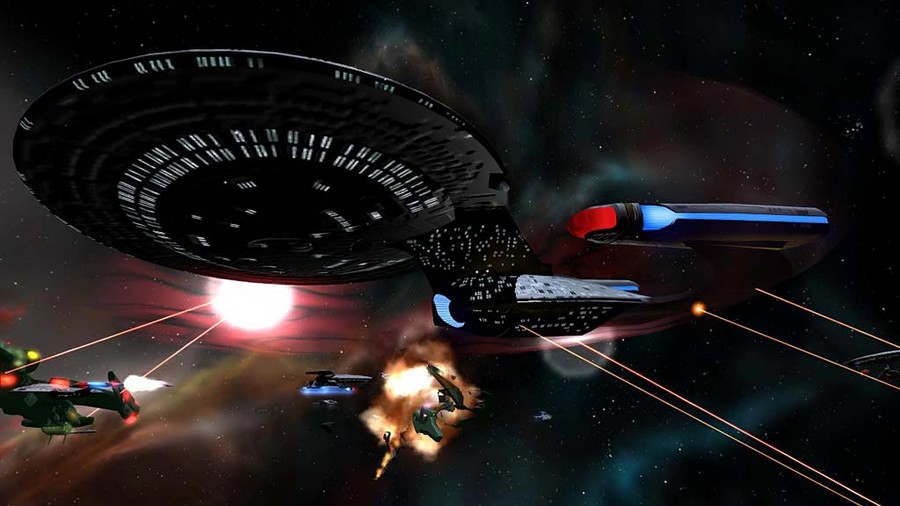
That's a shame, too, because combat is actually a lot of fun when things are moving in the right direction. It's extremely easy to jump from ship to ship within your fleet, simply by pressing one of the four directions on the D-pad. This can (generally) allow you to keep all four of your ships active and flying straight. Weapon use is as simple as right trigger for phasers, left for photons. The game does a good job of informing you when weapons can be used, both via visual HUD elements and vocal alerts. Legacy also does a great job of switching up who you're fighting, and what exactly you're doing in combat. Sending away teams onto a space station in the middle of a pitched battle, for example, or using a sensor scan to detonate an explosive keeps you on your toes and stops things from getting overly monotonous.
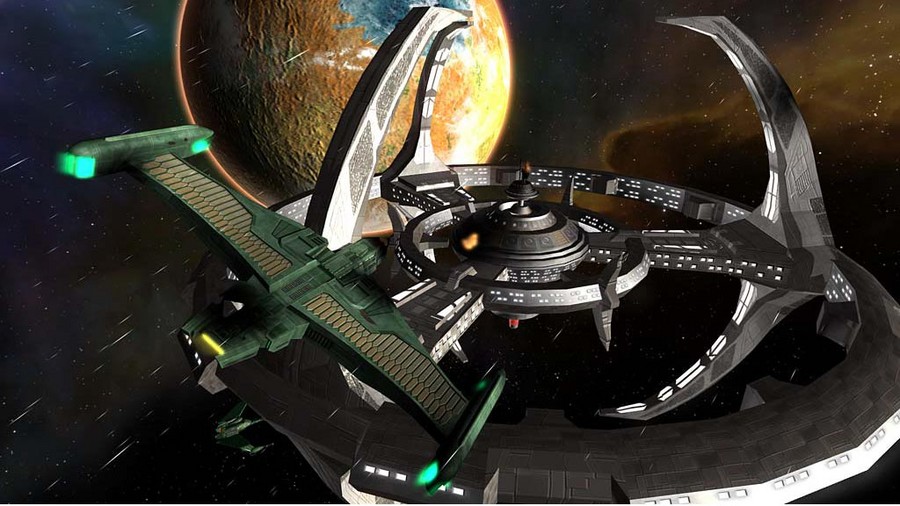
The plot that strings these combat elements together is all the Trek you can stand, and more, crammed into a disappointingly short timespan. There is time travel, Klingons, Romulans, Borg, and one very weird Vulcan. The plot itself is explained in detail in a comic included as an 'extra' on the game's main menu. To give you a horrible taste, it mentions V'ger, from the first Star Trek movie, in connection with the Borg's origin. Looking back on the whole story from the last mission gives you an 'ohhh' moment, but it's not that great a payoff for the amount of time you spend in the dark. Just the same, overall the story is coherently told and entertainingly written. The dialogue written for the captains is especially entertaining; even the stuff written for Shatner (who, predictably, gets the most 'screen time') is enjoyable in a scenery-chewing kind of way. Getting to hear Avery Brooks intone new lines as Benjamin Sisko was especially enjoyable, and the role DS9 gets to play near the game's end allowed me to forgive a lot of smaller oversights.
Visually, Legacy is a competent 360 title. It's certainly not Gears-pretty, but the ships are all well modeled, and it's hard to make space look ugly nowadays. Ships and stations explode nicely, though larger objects tend to look a little odd when breaking apart. Audio effects use official FX from the show, and the score consists of forgettable Trekesque tracks that back the game's sometimes-tense moments adequately.
Star Trek: Legacy, then, allows the dedicated Trek fan to experience ship-to-ship combat in a way that's never quite been captured so well before. Trekkies are sure to appreciate that new experience, as well as the vocal work of the actors-turned-captains. As a game, though, Legacy leaves a lot to be desired. Gamers are going to find the inexact fleet control and inept AI frustrating, with some missions being bang-your-head-against-the-desk annoying. The first Next Generation-era mission, Revelations, is particularly hair-pulling, and makes the lack of in-level save points sorely missed. If the lack of a new Trek show on TV is leaving you anxious, I would readily recommend Legacy as a balm to your Trekkish needs. Likewise, the game might be worth a rental of you're a 360 gamer who has already tired of Gears of War. It's just not that great a game otherwise, and can readily be given a miss for other, better games.
This leaves us with the question I posed above, though: Why is it so hard to make a good Star Trek game? It could be the difficulty of making licensed games satisfying to players outside of the 'fan' population ... but Star Wars titles like Knights of the Old Republic and Jedi Academy transcend fandom as truly great gaming experiences. Heck, even Spider-Man 2 is a better game than any Trek game I've played, and Spidey's history with gaming is a lot shorter than Star Trek's. Given the dialogue and narration-heavy storytelling that Star Trek uses, it is possible that the Trek universe just isn't a good fit for videogames? What does the lackluster performance of these latest Bethesda titles mean for future trek games? Star Trek Online, specifically, seems to have a Herculean task before it. How do you bring a license that's never seemed to be quite right for gaming to one of the most finicky of all genres, the MMOG?
What do you think? What would it take to make a great Trek game? Are there any Trek games that you think have really succeeded? What will Star Trek Online need to include in order to satisfy you?
- Title: Star Trek Legacy
- Publisher: Mad Doc Software
- Developer: Bethesda Softworks
- System: 360 (PC)
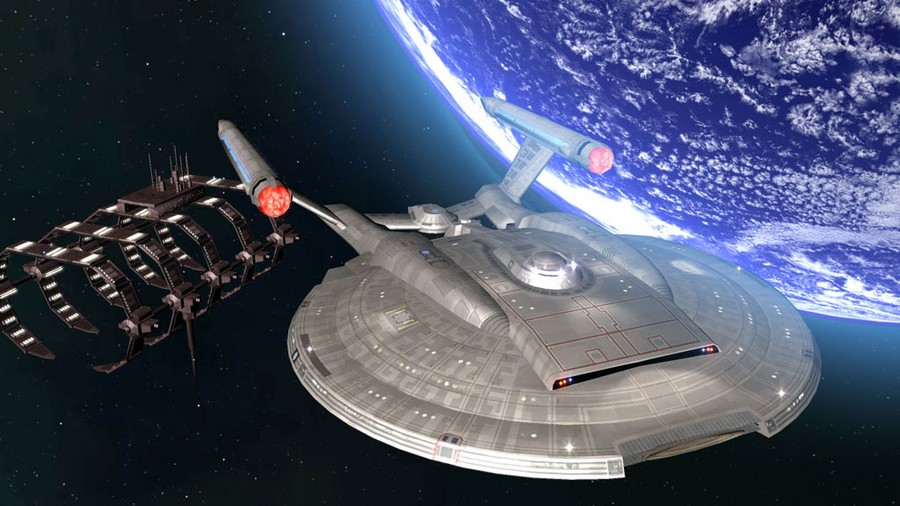
As so often happens with a Trek title the premise, at least, is compelling. Commanding a task force of up to four ships, you follow a fairly coherent plot from the "Enterprise" era all the way through to the time of Jean-Luc Picard and Benjamin Sisko. You can choose between a number of ship classes to include in your fleet, and gameplay consists of real-time ship-to-ship battles. The actors who portrayed the captains in the various eras make a return, offering their vocal talents and a feel of authenticity to the proceedings.
What sounds like a can't-miss formula, though, inevitably flies past the target at full impulse. Ship and fleet control is the most notable failure, and results in individual combat moments requiring more effort than feels right. I found fleet combat most frustrating, as it is so variable how your actions are interpreted. When you begin a mission, all four of your ships are taking orders from you at the same time. Selecting a enemy for combat (by hitting the right shoulder button and cycling through the available options) is intuitive and quick. When all four ships are following your orders, this results in a focused barrage that effectively neutralizes targets. The problem comes when ships begin 'thinking' on their own.
It was never clear to me what prompted this, though I know that giving individual ships orders via the overhead tactical display (available via the 'select' button) always 'broke up' the fleet's command. This is problematic, as the 2D overhead display is the best way to keep track of the action on the sometimes dauntingly large 3D space maps Legacy uses. Indeed, the z-axis is used in the game (unlike in the show), making it hard to keep track of enemy ships on occasion. These are challenges, though, to be overcome: the frustration sets in when order-less ships choose to sit dead in space and absorb phaser hits without retaliating. That's some extremely poor decision-making on the part of the AI, and can mean the difference between success and failure in a large and frantic naval battle.
Another, subtle frustration is the pathing your friendly ships use when circling a target. While sometimes ships do 'the right thing' and orbit their prey at an appropriate range, trying to keep weapons locked on the target at all times, that's not always a given. Often, ships locked onto a target attempt something I can best refer to as a 'strafing run', where they move directly at a target, allowing firing on the enemy for a brief period of time, before overshooting and swinging around for another pass. Overshot on targets can sometimes be quite some distance, resulting in a long delay between assaults on enemy ships. This style of attack is particularly frustrating when attacking immobile targets like space stations and asteroids, as AI-controlled ships tend to fly right into their prey and sort of bounce off. Given the finicky targeting you're allowed to use, this greatly reduces an AI-controlled ship's effectiveness against such a target. In a pitched battle, which is almost all of them, it just becomes frustrating to have to keep so many balls in the air.
That's a shame, too, because combat is actually a lot of fun when things are moving in the right direction. It's extremely easy to jump from ship to ship within your fleet, simply by pressing one of the four directions on the D-pad. This can (generally) allow you to keep all four of your ships active and flying straight. Weapon use is as simple as right trigger for phasers, left for photons. The game does a good job of informing you when weapons can be used, both via visual HUD elements and vocal alerts. Legacy also does a great job of switching up who you're fighting, and what exactly you're doing in combat. Sending away teams onto a space station in the middle of a pitched battle, for example, or using a sensor scan to detonate an explosive keeps you on your toes and stops things from getting overly monotonous.
The plot that strings these combat elements together is all the Trek you can stand, and more, crammed into a disappointingly short timespan. There is time travel, Klingons, Romulans, Borg, and one very weird Vulcan. The plot itself is explained in detail in a comic included as an 'extra' on the game's main menu. To give you a horrible taste, it mentions V'ger, from the first Star Trek movie, in connection with the Borg's origin. Looking back on the whole story from the last mission gives you an 'ohhh' moment, but it's not that great a payoff for the amount of time you spend in the dark. Just the same, overall the story is coherently told and entertainingly written. The dialogue written for the captains is especially entertaining; even the stuff written for Shatner (who, predictably, gets the most 'screen time') is enjoyable in a scenery-chewing kind of way. Getting to hear Avery Brooks intone new lines as Benjamin Sisko was especially enjoyable, and the role DS9 gets to play near the game's end allowed me to forgive a lot of smaller oversights.
Visually, Legacy is a competent 360 title. It's certainly not Gears-pretty, but the ships are all well modeled, and it's hard to make space look ugly nowadays. Ships and stations explode nicely, though larger objects tend to look a little odd when breaking apart. Audio effects use official FX from the show, and the score consists of forgettable Trekesque tracks that back the game's sometimes-tense moments adequately.
Star Trek: Legacy, then, allows the dedicated Trek fan to experience ship-to-ship combat in a way that's never quite been captured so well before. Trekkies are sure to appreciate that new experience, as well as the vocal work of the actors-turned-captains. As a game, though, Legacy leaves a lot to be desired. Gamers are going to find the inexact fleet control and inept AI frustrating, with some missions being bang-your-head-against-the-desk annoying. The first Next Generation-era mission, Revelations, is particularly hair-pulling, and makes the lack of in-level save points sorely missed. If the lack of a new Trek show on TV is leaving you anxious, I would readily recommend Legacy as a balm to your Trekkish needs. Likewise, the game might be worth a rental of you're a 360 gamer who has already tired of Gears of War. It's just not that great a game otherwise, and can readily be given a miss for other, better games.
This leaves us with the question I posed above, though: Why is it so hard to make a good Star Trek game? It could be the difficulty of making licensed games satisfying to players outside of the 'fan' population ... but Star Wars titles like Knights of the Old Republic and Jedi Academy transcend fandom as truly great gaming experiences. Heck, even Spider-Man 2 is a better game than any Trek game I've played, and Spidey's history with gaming is a lot shorter than Star Trek's. Given the dialogue and narration-heavy storytelling that Star Trek uses, it is possible that the Trek universe just isn't a good fit for videogames? What does the lackluster performance of these latest Bethesda titles mean for future trek games? Star Trek Online, specifically, seems to have a Herculean task before it. How do you bring a license that's never seemed to be quite right for gaming to one of the most finicky of all genres, the MMOG?
What do you think? What would it take to make a great Trek game? Are there any Trek games that you think have really succeeded? What will Star Trek Online need to include in order to satisfy you?
You need Kirk in a fist fight with a torn shirt and some scantily clad lady aliens. It's that simple, defy authority, destroy property and take people's clothes off.
It also has to be delivered on-time and on-budget.
Best Slashdot Co
Because Trek is ultimately about dialogue and not action.
Tension is created through plot devices and not physical violence.
And because Trek is about large (non-nimble) vessels.
Add fast action and its no longer "Trek".
Keep it "Trek" and it's just not that fun as a video game.
------ The best brain training is now totally free : )
Star Trek: 25th Anniversary was _excellent_. It felt like playing episodes of the old series. The puzzles were logical and TREK STYLE. The best Star Trek game I've ever played. The sequel, Judgment Rites, was not nearly as good but still, shares the place of second best Trek game with Elite Force.
'Once scientists, even the dim-witted social scientists, get muzzled, the Western Civilization is finished.' - oldhack
Why is it so hard to make a good Trek game? Why do developers keep trying and failing?
Maybe if they made a game based on Kirk banging green chicks, they would succeed.
Why is it so hard to make a good Trek game? Why do developers keep trying and failing?
What's odd is that it is possible to make a good, licensed game. Take KOTOR for xbox, as an example.
However, most studios seem to see a content license as a "get out of work free" card, and expect that the game will sell on name recognition alone, regardless of whether or not it's any good.
Push Button, Receive Bacon
Star Trek would probably translate better into an adventure game series (like Space Quest) since the shows revolve far more around talking (philosophy) than battling foes (action). Star Wars and Spider Man involve a lot more action. There's no shortage of villians that need to be killed in those series where in Star Trek it's all about negotiation/talking with very little death.
In short, if you want a good Trek game they're going to need to switch game genres to match the show genre more closely.
Work Safe Porn
That's not the problem. As the submitter mentioned himself, although most Trek games are horrible, there were some winners, such as A Final Unity. It might, however, restrict it to some genres. You take the Star Trek universe, and make a game where you just take ships back and forth and shoot at each other, and you're eliminating 90% of what makes trekkies like Trek. I can say the same thing about making a shooter out of it, which is why I for one didn't like Elite Force.
The problem is that no one seems to like adventure games anymore. Why can't we have more games like Judgment Rites and Final Unity? Star Trek episodes, although they do contain some action which should not be ignored, are mostly about solving puzzles and making choices that influence the outcome of some event. That's what gamers do in adventure games, and that's why every trek gamer remembers A Final Unity as being so great.
Warning: Opinions known to be heavily biased.
Super Star Trek anyone?
God I loved that game from the moment I checked out the floppy from the local library...
The article asks for an example of trek games that succeeded. The best, or at least, most enjoyable and replayable one I've found was written 20 years ago.
It was a PC game called 'Begin:Tactical Starship Combat'. It ran first in 80x20 text and later in EGA, but unlike most trek games of the time (which were variants of the old "You're in a 'sector' with 12 quadrants. Press P for phaser" theme from the PDP-11 days, this one put you in charge of a ship (or a fleet) with detailed systems, a need to excercise tactics (instead of just pounding on a 'Fire all' button), and clever (or at least difficult) AI.
You gave it commands using a quasi-english that you could shorten. "Pursue Krager at warp 6" could become "purs kr 6" for instance, as long as it was distinct enough.
Phasers, torpedos, warp engines that could overheat, especially when they had taken damage (limiting your performance or making you sacrifice repair times for temporary speed), power systems management, shield management, all sorts of details but you weren't FORCED to micromanage 'em.
Ship battles could be 1x1, or massive fleets. You can play hide & seek with a Romulan warbird, or escort a convoy and protect it against Orions.
I made a web page about it a couple years ago, and there's a Yahoo groups with a few hundred people that STILL play it today. Someone has even hacked together a multiplayer version with clever use of assembly and a debugger.
THIS is the kind of game that works with trek. It puts the player in the game as themselves, not as Kirk or Archer or Picard. The original Toy Story didn't have Barbie because Mattel was worried that Barbie on film wouldn't match the Barbie that kids have in their imagination. The same thing applies to Star Trek games. If the game doesn't let someone really feel like they're in control of things, or uses so many graphics that it gets into uncanny valley territory, then it'll disappoint at some level.
Keep it simple while keeping it flexible. Configurable complexity, less graphics, more monkey.
Here's a page I made about the game, with screenshots and downloads.
http://hallert.net/misc/begin/begin.html
I've played hundreds of hours of a little known turn based Trek game called Birth of the Federation. I wouldn't say it was successful, (the company went out of business), but my friends and I have had many long nights battling as the different races. It is by far my favorite trek game.
I dunno, I always thought the best Trek game was Netrek :) It definitely made time in the computer lab go by much faster.
And that's the 360 version. The PC version is just appalling, and barely usable out of the box. At least wait for them to add configurable controls. Yes, you read that right.
If you were blocking sigs, you wouldn't have to read this.
The 360 version is actually _not_ as buggy as the PC version, from what I've read. It just doesn't fix the fundamental design flaws.
Plausible conjecture should not be misrepresented as proof positive.
If by success you mean longevity, Netrek has been around since the early 70s.
- None can love freedom heartily, but good men; the rest love not freedom, but license. -- John Milton
The one great star trek game I've seen was the one I planed in high school and in college - on a VT100 terminal connected to a mainframe, with the little tic-tac-toe like grid showing you where your ship was.
Star Trek was always more about naval battles, but in space, than a star fighter games like Star Wars.
Can anyone name a good naval game where you controlled destroyers and battleships? There are next to none and what do exist are almost always bad.
What i think could do a good Trek game for naval combat would be to focus on the more "fighter"-types ships of the latest shows. We would have more fun maneuvering some kind of shuttle that can only fire in front of itself than maneuvering a huge and slow ship that can fire anywhere it faces because the guns/phasers are mounted on turrets.
If you want to focus on story, do an adventure game, or a game that focus on the characters themselves and not the "ships" like Legacy does. Or put BIG cutscenes between missions, like Origin did with their Wing Commander series.
As far as the difficulty of making a decent Trek computer game goes, there are at least two major problems. The first of these also had a hand in sinking the show itself.
a) The single most overwhelming problem (which has also hamstrung *every* series and film after TOS) is the question of how much you should try and simply appeal to the established fanbase vs. how much you should try and do outreach to new audiences/go in new directions. Rick Berman's inability to balance this issue was, more than anything else, the single main thing which killed Voyager and Enterprise in the end. With Voyager to a large degree he simply ended up adopting an attitude of, "screw the base," and focused purely on trying to draw new audience, whereas with Enterprise he tried to appeal more to the base at times, but was still unable to balance the issue. I think also the problem is that a balance isn't really possible...you basically have a scenario where the earlier/more conventional series had a philosophical basis of fairly heavy pacifism on the one hand, but where there was a transition period during DS9 in particular where violence started being incorporated more and more as a regular part of the show, until you got to the level of around fifth to seventh season Voyager which regularly had episodes that played like low-budget versions of the Lethal Weapon movies in space. Elite Force in particular was able to use that to its' advantage, and that alone is probably the main reason why that's been one of the only two Trek games (the other having been A Final Unity) that could be called an unqualified success.
Looking at it now, I think the lesson is that because each series had such a fundamentally different approach to the issue of violence, in a game or movie you can't mix series. If you're going to do a Voyager game for instance, you can make an FPS and have it as violent as you want. A Voyager game also wants a heavily postmodern, gritty, and also fairly multi-ethnic feel, with adolescent sexual angst between Tom and BE'lanna, comic relief from the Doctor, Chakotay doing his stereotypical Red Man schtick, and lots of Janeway's trademark moral ambiguity and gleeful abuse of authority.
A TNG game on the other hand *has* to be something like A Final Unity; an almost entirely non-violent puzzle-solver. A TOS game could have some degree of violence, but it has to be 60s oriented and cowboyish in nature, which means unarmed fisticuffs for the most part. The Utopian/"universal peace" vibe doesn't have to be as strong for a TOS game as for TNG either, but a certain amount of it doesn't hurt. I thought Starfleet Academy got it right in terms of having an Andorian as one of the students, as well. That sort of unobtrusive in reference helps to keep the autistic geek base happy, and won't upset normal audiences *too* much if it isn't overdone. Of all of these, DS9 is probably the trickiest to get right, which probably also explains why it hasn't been done successfully in a game. A DS9 game could have a certain amount of violence, but it needs to be kept restrained a subtle way. (Odo's restrained use of martial arts with carefully and clearly performed hand strikes are a good example of what I'm talking about, here) The idea with DS9 is that of a society which has traditionally been pacifist, but which is in the process of discovering that violence is something of a necessity on the basis of self-defense. The seventh season episode, "The Siege of AR-558," is probably the best example of what I'm talking about, there.
b) I get the feeling that in some cases, game design houses possibly (if only subconsciously) had the attitude that because they were doing a Trek game, it probably wasn't going to achieve more than cult popularity anywayz, and so therefore there wasn't much point in making sure that it was a truly quality game. If you're going to do a strongly character/story oriented Trek game, then yes, there is a fairly strong possibility that you're not going to hold much appeal outside the base. Howe
What's to apologize for? When TOS series was still on the air, everybody (audience, writers, critics) agreed that Spock/Nimoy was the #1 babe magnet for the show. Women found the whole supercool hyperlogical scientist schtik thoroughly sexy. And when they started do scripts where he had to battle his inner illogical human, it just got more intense.
Or maybe you're apologizing for the image of Kirk with the torn shirt. Well, most video games with benefit from a little honest homoeroticism...
Whenever people mention good Trek games, no one seems to mention DS9: The Fallen Anyone that has actually played it, however, tends to acclaim it! Startrek-gamers gives it extensive praise in their history of Star Trek gaming.
.ocx files it warns you about when you try to start it in XP).
;) (I haven't tried myself since I'm running AMD64 on my main Linux install, which, umm, doesn't make cross-platform emulation that easy, heh).
Honestly, I was taken with the game from the moment I played the demo. Granted, I played the demo far after it had come out (as far as I can tell it wasn't nearly as well publicized as it could have been). But when I did! Even just the level of detail in the weather they had added (realistic snow falling, Sisko leaving footprints on the ground) was pretty impressive, especially for the time, and in general it had a solid and true-to-Trek feel to it in contrast to the glitchy, floaty and "mod tacked on to a game engine" nature of most licensed games. And there was a level editor! Yes, that's right, even the demo includes the brilliant UnreadEd package for creating one's own levels. Naturally this has led to some rather impressive fan-made expansions to the game, Convergence being perhaps the most notable. Alas, the oldskool UnrealEd 1 is a bit tricky to get working with newer versions of Windows, but I have it working just fine on my XP SP1 comp (the trick is compatibility mode combined with a working 98 install somewhere that you can copy missing
And hey, with everyone buying Macs nowadays it's worth noting that it was officially ported to the Mac long ago (from the official website, "OS 8 or higher (NOTE Runs in OS 9.1 emulation mode in OS X)"). And of course the game is old enough that running it under one form of emulation or another isn't too taxing on a system...in other words, yeah, I'd bet it'll run on Linux
I'd recommend anyone who enjoyed DS9, or just feels like playing a well-made Star Trek game, to at least give the demo a chance. It's free-as-in-beer, after all, and to a large degree the openness of UnrealEd and it's access to the scripting underneath the game makes it closer to free-as-in-speech than most games. And keep your eyes out in bargain bins, it shouldn't be too expensive if you find a copy! (I found my copy really cheap years ago already in an EB games store while I was visiting Monroe, Michigan.)
I remember sigs. Oh, a simpler time!
IMHO, "ohhh" moments are the biggest reason Star Trek is unsalvagable. Too many people who write for the Trekverse think they have to explain some stupid little detail from TOS or the early movies. In fact, most of the issues that "need" resolving are there because the premise kept changing (remember the United Earth Space Probe Authority?) or because the writers didn't even understand the premise (the author of "Balance of Terror" obviously didn't know that the show was about interstellar travel, and probably didn't even understand the word "interstellar").
When they resurrected Star Trek back in 1979, they made the very logical decision to simply abandon the details of the Trekverse that were there for no compelling reason, such as making all the aliens look like humans in weird makup. But then literal-minded fans insisted on an "explanation" for the Klingon Head Ridge Mystery and other such bullshit.
Face it trekkies, Star Trek is dead — and you killed it.
Star Trek: 25th Anniversary and Star Trek: Judgement Rites are, for my money, the best Trek games ever made. And quite possibly the only good ones. Outside of having all the original crew voicing the CD-ROM, the games were well-designed and brilliantly written to fit in with the TOS mythos. They were *clearly* designed by fans doing everything they could to be true to the show. Yes, the ship-to-ship combat was a little clunky, but all they had to work with was Wing Commander 1-era technology.
Bush: He's Liberal in all the wrong ways.
See the only Star Trek game I liked was Starfleet academy, it had for the time really good graphics (there stil lnot that bad), the movie sequences added to the game and while much of the game was flying around firing things there was a lot of decision points which did effect the gameplay, you could effect your teams scores, an extra mission opened up if you took anouther route, sometimes you would have to destroy someone if you said the wrong thing in negotiations. There was a sequel known as Klingon Academy but i never saw it in the shops.
As most people here have said Star Trek lends itself much more to that style of gameplay, one where you have a mystery to solve and that mystery might be solved by increasing power to your sensors, or by blowing the ship out of the sky. I think thats why so many trekkie games fail, Star trek is as much (if not more) about morality, investigations and story than just blowing things up.
The PC version has got to be the worst game I've ever played, and it is a reminder why it is prodent to read reviews before buying. When I first installed the game, I completely lost mouse functionality within moments of playing. I found out that this was fixed, along with a completely nonfunctional multiplayer, via the 1.1 patch that was released at virtually the same time as the game itself. Unfortunately the control scheme is poorly documented (the manuals and the in-game tutorial are both woefully inaccurate) and is unworkable. For example, pointing towards a target and holding the "F" key brings up a menu that allows you to interact with that target (i.e. scan, tractor beam, etc). Unfortunately the "F" key doubles as the "goto" command, so when you release the "F" key to dismiss the menu, the game will then initiate a goto command. Even worse, this usually overrides whatever command you selected on the menu, making the menu mostly useless. The controls are not customizable, gamepads are not officially supported, and the developer up to this point has refused to change this. The AI is horrible and there are all kinds of glitches with visuals. One of the most annoying ones is that sometimes, though my ship is the Enterprise, I get voiceovers from a different ship, while that other ship's voiceovers are those that should have been used for the Enterprise. In summary: Legacy for the PC is very poor quality.
I'm going to the casino. Don't gamble.
As for `as close to operating a real starship in combat', well, a starship in the Star Trek universe, maybe. Beyond that, we shall see.
The Elite Forces games were pretty run-of-the-mill FPS games -- not bad, but not great.
Actually, I sort of liked Star Trek Armada -- it was your basic RTS -- in space -- but it was fun.
Bridge Commander was sort of fun. Not great, but not bad.
Ok, it seems I liked a lot of the Star Trek games. I guess that makes my opinions suspect ...
Possibly the closest attempt at 'operating a real starship in combat' - while still remaining playable - is Attack Vector. Designed by one of the guys who was heavily involved in SFB (even worked for them for a while). Although, it too is a board game :(
Based on Newtonian movement and real physics. Even got a favourable review from the editor of SciAm.
Plays pretty fast, though not on the level of SFC :)
Maybe I'm weird, but I thought Birth of the Federation was a reasonably good turn-based strategy game.
"[Regarding the 'cloud,'] ownership was what made America different than Russia." -- Woz