Slashdot Mirror


In Progress: Fastest Sea Rise In At Least 2800 Years (www.cbc.ca)

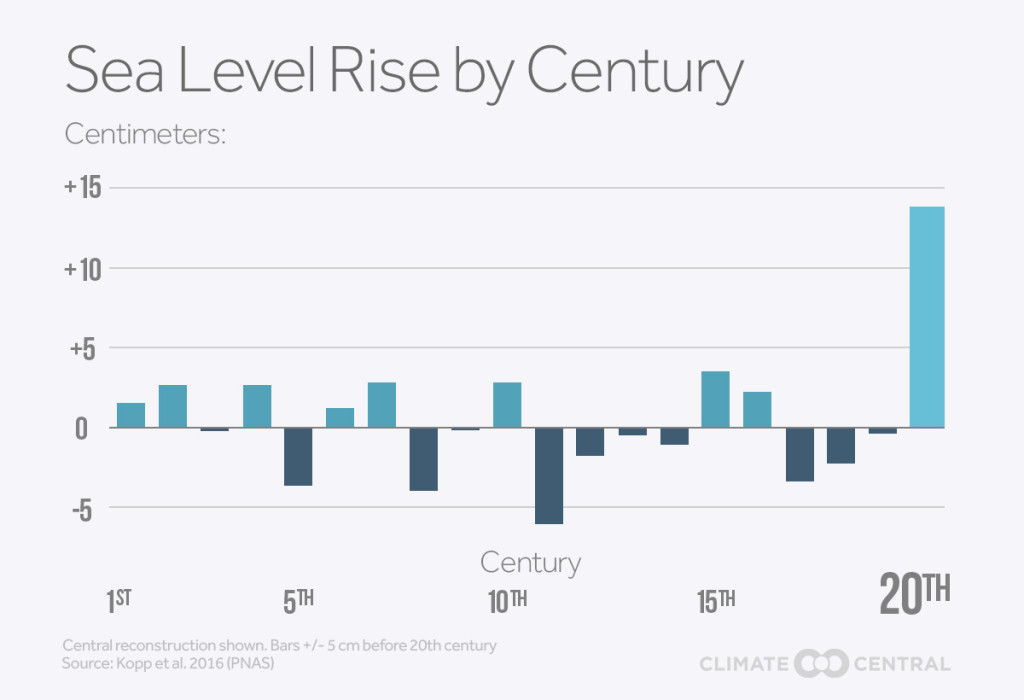
Layzej writes: A new study finds that sea levels on Earth are rising several times faster than they have in the past 2,800 years and are accelerating. Co-author Stefan Rahmstorf explains that the fact that the rise in the 20th century is so large is a logical physical consequence of man-made global warming. This is melting continental ice and thus adds extra water to the oceans. In addition, as the sea water warms up it expands. The data from the past can also be used for future projections, using a so-called semi-empirical model calibrated with the historically observed relationship between temperature and sea level. With the new data, this results in a projected increase in the 21st century of 24-131 cm, depending on our emissions and thus on the extent of global warming.
386 of 520 comments (clear)

  1. Non-believers by danbert8 · · Score: 3, Insightful

    All those people buying and living in coastal houses don't seem to believe in climate change I guess. The ocean is rising, yet prices remain sky high for anything near the coast...

    --
    Yes it's an anecdote! Were you expecting original research in a Slashdot comment?
    1. Re:Non-believers by unimacs · · Score: 4, Insightful

      The insurance companies who've been raising premiums in coastal areas sure do.

    2. Re:Non-believers by MightyMartian · · Score: 4, Insightful

      The actuary tables don't lie. Insurance companies have accepted AGW for years now, no matter how much Big Oil and the Koch's try to deny it.

      --
      The world's burning. Moped Jesus spotted on I50. Details at 11.
    3. Re:Non-believers by Flea+of+Pain · · Score: 1

      May I be the first to say...this story floats my boat.

      --
      Do not argue with an idiot. He will drag you down to his level and beat you with experience.
    4. Re:Non-believers by Kormoran · · Score: 2

      Humans rarely think long term, even when doing a long term deal. Our reptile brain thinks "if something goes wrong I'll escape", and our mammalian brain thinks "omigosh it's so cool!"... and even if your neocortex is strong enough to win the fight, your wife has already bought that! No match! :-D

    5. Re:Non-believers by Anonymous Coward · · Score: 1

      The actuary tables don't lie. Insurance companies have accepted AGW for years now

      Everybody lies when there's additional profits involved

    6. Re:Non-believers by mtippett · · Score: 3

      If they are still issuing policies, then it is accepted as a risk. This matches TFA in that there are a number of scenarios, the "likelihood" of an event due to Climate Change has definitely increased, but not the extent that people are uninsurable.

      In areas where it is a certainty (earthquakes in California, Floods in other parts of the country), the insurance companies step back and don't insure.

    7. Re:Non-believers by avandesande · · Score: 1

      What is the insurance policy time frame, one year? They aren't worried about rising oceans.

      --
      love is just extroverted narcissism
    8. Re:Non-believers by unimacs · · Score: 1

      Yeah, there's a strong desire to live near water and people will pay huge a lot of money in order to do so, even if they know the area is prone to flooding. My family is a perfect example. I grew up in a home where sandbagging once every decade was just part of the deal. Many Springs my mother would fret over every rain storm. It cost my parents relatively little to build there in the late 50's when the water level was much lower, but over time the property taxes and insurance costs have skyrocketed.

      The floods come more often now, the last one being a couple of years ago. At one point there were 1/2 dozen pumps running 24 hours a day to keep the water (mostly) on the other side of the sand bag walls. My brother has lived there for the past 7 years even though he can't afford it. Not even close. Far more aggravation than I'd be willing to put up with but it's a beautiful place four out of every five years.

      A lot of other people that have homes in those areas are just plain wealthy and will just collect the insurance, declare their losses and move on if they need to.

    9. Re:Non-believers by unimacs · · Score: 5, Insightful

      But it's the free market right? If all these insurance are over charging wouldn't other companies swoop in with lower premiums and steel all the business? Why don't they? Because they're genuinely afraid of they big payouts they'll increasingly have to make.

    10. Re:Non-believers by Opportunist · · Score: 1

      Insurance companies are never afraid. They have statistics and rely on them.

      The creepiest form thereof are the life tables.

      --
      We used to have a Bill of Rights. Now, with the rights gone, all we have left is the bill.
    11. Re:Non-believers by Opportunist · · Score: 2

      Anything can be insured. If you pay a premium that trumps the value of your home, I insure you a home built in the path of an oncoming tsunami.

      --
      We used to have a Bill of Rights. Now, with the rights gone, all we have left is the bill.
    12. Re:Non-believers by Opportunist · · Score: 1

      Corporations are not evil. They want to make money. Same with insurances. If the risk rises, so does the premium. Simple math.

      Simple market economy also dictates that it's not a huge conspiracy, since if the risk wasn't real and just a ruse, you'd easily find an insurance company that could undercut the competition.

      --
      We used to have a Bill of Rights. Now, with the rights gone, all we have left is the bill.
    13. Re:Non-believers by unimacs · · Score: 1

      Higher water levels and warmer temps mean that flood damage due to storms is increasingly likely.

    14. Re:Non-believers by Opportunist · · Score: 1

      Whether we're a minor or major factor in it is moot, what matters is what can we do to slow it?

      Fuck, who cares who broke the vase, what matters is who cleans up the mess?

      --
      We used to have a Bill of Rights. Now, with the rights gone, all we have left is the bill.
    15. Re:Non-believers by rbrander · · Score: 4, Interesting

      You're thinking "Rising Oceans" are like a bathtub filling up. It's more like a statistical increase in flooding events. Exactly what insurance companies are leery of.

    16. Re:Non-believers by gstoddart · · Score: 5, Insightful

      When the responses are on the order of "how do we know the vase is broken?" or "prove the vase wouldn't have broken on its own" ... there are people who are trying to say "there is no mess, and even if there was a mess you can't prove it was us".

      You don't think those companies paying to fund stuff which says "nope, not happening" want to muddy the waters long enough to keep up profits for a while?

      I mean, when Exxon scientists identified climate change decades ago, and when Exxon spent huge amounts of money denying climate change, you can bet your ass that the denial of this comes entirely from corporate interests who don't want the source of their profits impacted, and they don't really give a crap how it affects everyone else.

      Corporations are, collectively, sociopaths. The longer they can convince you either there is no mess or that they nothing to do with it, the longer they can keep making huge sums of money.

      The people denying it's happening have a vested interest in misdirection and deception for as long as they can. Nobody has any other reason to deny it's happening other than the money they're going to make.

      This is the standard bullshit of the PR game ... keep publicly lying about it to confuse the issue, and pay to discredit the facts to support their own narrative. Complete and utter sociopaths with no regard for anything but themselves.

      --
      Lost at C:>. Found at C.
    17. Re:Non-believers by Ol+Olsoc · · Score: 4, Insightful

      The actuary tables don't lie. Insurance companies have accepted AGW for years now, no matter how much Big Oil and the Koch's try to deny it.

      Around 10 years ago, I sat in on a presentation by an insurance company exec who made an incredibly compelling case for the monetary cost of the global warming. Complete with facts and figures. Oddly enough, I haven't heard a lot of deniers cherry picking those numbers.

      --
      The shepherds did so well protecting the flock that the sheep no longer believed that wolves existed.
    18. Re:Non-believers by Ol+Olsoc · · Score: 1

      But it's the free market right?

      No. They're angling for government swag. After all, if I can blame climate change for my poor business choices, then maybe I can get a piece of the several hundred billion dollars of public funds being spent over the next few years.

      So it's really good to get someone who knows. Care to debunk the insurance companies numbers? I'm pretty certain it will be a breeze for you.

      --
      The shepherds did so well protecting the flock that the sheep no longer believed that wolves existed.
    19. Re:Non-believers by phantomfive · · Score: 3, Insightful

      The actuary tables don't lie

      Asking an insurance company if something might increase risk is like asking a tobacco company if cigarettes prevent cancer. Huge monetary incentive there.

      --
      "First they came for the slanderers and i said nothing."
    20. Re:Non-believers by Ann+O'Nymous-Coward · · Score: 1

      Ah, but that's exactly why corporate spindoctors and their denialist sheep lie so hard about humanity not breaking that vase; they "think" that would absolve them of any responsibility to clean it up.

    21. Re:Non-believers by Ol+Olsoc · · Score: 1

      What is the insurance policy time frame, one year? They aren't worried about rising oceans.

      Actually, they are. Insurance companies deal in figures, anf they have tables with things like 10 25 50 100 year floods and disasters like hurricanes and tornados, and actuarial tables with likelyhood of death for insured individuals that they call into play when determining costing of policies.

      And they darned well are concerned about rising ocean levels. Given the nature of the areas near the ocean like flat land and not much rise, a small rise in sea level, especially coupled with a high tide, can make a huge difference in hurricane damage.

      --
      The shepherds did so well protecting the flock that the sheep no longer believed that wolves existed.
    22. Re:Non-believers by slashping · · Score: 2

      Insurance companies care about this kind of shit, which has nothing to do with hurricanes: https://www.washingtonpost.com...

    23. Re:Non-believers by irrational_design · · Score: 1

      Not just coastal houses, but any low lying areas like all of South Florida.

    24. Re:Non-believers by ShanghaiBill · · Score: 2

      No. They're angling for government swag.

      Government bailouts only happen when the storm/flood/whatever is on TV. Once the problems become common enough, they will no longer be newsworthy, and the handouts will stop. People are always willing to help, until they realize their taxes are going up. Then they realize that apathy and victim blaming is much cheaper. This is known as Compassion Fatigue.

    25. Re:Non-believers by slashping · · Score: 1

      A lot of people didn't believe in the dot-com bubble either.

    26. Re:Non-believers by Anonymous Coward · · Score: 1, Interesting

      Do you know the difference between inference and observation?

      Observation: Seeing a broken vase, looking around and finding a golf ball in the room, a broken window, and a note from an asshole taped to your front door saying "Sorry I sliced straight into your house. Hope nothing in there was worth more than $5. Here's $6 to cover the damages just in case there was."
      Inference: "The asshole broke it with a golf ball!"

      Guess what? The vase was broken when the cleaning lady knocked it over. You can throw all the cute tirades over golfing assholes that you'd like. We've heard it all a million. fucking. times. but that doesn't mean the asshole broke your vase. He IS an asshole. He busted the window. He COULD have broken the vase, had the cleaning lady not done it first, but jumping to the conclusion that He Done It is bad science.

      Blaming shit on global warming is a climatologist's way of saying "I'm through researching this shit. Let's call it a day"
      Blaming shit on evolution is a biologist's way of saying "I'm through researching this shit. Let's call it a day"
      Blaming shit on extra dimensions is a physicist's way of saying "I'm through researching this shit. Let's call it a day"

      It's possible that the assessment is correct -- but the argument excuses the lack of actual research and asking difficult questions, which is intellectually criminal. Are sea levels rising that fast only because of "anthropogenic global warming"? Is that their final fucking answer? I can come up with at least 3 other major contributors. Who the fuck cares about that, though? They tagged it as "Global Warming" so their zealots will swarm around them, defending their "findings" to their very deaths, screeching and cursing those demonic, evil corporations, and thanking their scientific priesthood for yet another burnt offering on the altar of "science". Two idiots that can't read a data graph to save their lives said sea levels rising was due to man-made global warming -- better spill some blood in their defense!!!

    27. Re:Non-believers by jellomizer · · Score: 1

      The oceans are still at sea level. It is just natural sinking of the continental plates. As the core of the earth cools the earth will shrink, Thus causing the plates to sink further down.

      This was pure sarcasm. I sure hope this doesn't become some sort of lame scientific evidence.

      --
      If something is so important that you feel the need to post it on the internet... It probably isn't that important.
    28. Re:Non-believers by PatientZero · · Score: 1

      In areas where it is a certainty (earthquakes in California, Floods in other parts of the country), the insurance companies step back and don't insure.

      Hmm, someone should really tell these guys they're doing it wrong.

      --
      Freedom to fear. Freedom from thought. Freedom to kill.
      I guess the War on Terror really is about freedom!
    29. Re:Non-believers by Feyshtey · · Score: 1

      So if it's not a man-made phenomenon, do you suggest that we engineer a way to stop the Earth from doing exactly what it has, and will continue to do naturally?

      If it's bad to cause it, isnt it equally bad to try to stop it?

      --
      "But we have to pass the bill so that you can find out what is in it,..." - Nancy Pelosi
    30. Re:Non-believers by GuB-42 · · Score: 1

      Well you don't need climate change for people to be stupid.
      There are places that are regularly flooded, it makes the news every time and yet, people still build and buy. And it's not like there is a historic city or something, just fishermen huts built on stilts, you can't get more obvious.

    31. Re:Non-believers by turkeyfish · · Score: 3, Insightful

      The interesting aspect of this is that so far buyers don't seem to recognize that what each successive buyer will be both accepting more risk, hence paying more and more for insurance, on a property that will be worth less when it comes time to sell. Coastal property is very much now like milk and other perishable items. It has a sell by date stamped on it. Its just that the dates are of relatively longer duration, on the order of a few generations.

      Given human nature, this musical chairs nature of the coastal property business won't make itself evident to most for another 25-50 years or so. By then with higher temperatures and hence more energy and moisture in the air and consequently more violent and more frequent storms this risks will be apparent to most. However, given that the wealthy are the primary buyers of coastal real estate, form them it's more a question of disposable income. Also for them, it is likely that much if not nearly all of these costs will be passed on to taxpayers and consumers generally, as the buy politicians to shift the tax burden from the wealthy onto the poor and the dwindling middle class and they simply pass the costs on in the form of higher prices in the businesses that they own and control.

      The biggest impact will be in cities like Miami and parts of New Jersey, and large stretches of the Eastern Seaboard and Gulf of Mexico, where the elevations are so uniformly low over considerable expanses. There all properties will be effected and both rich and poor will be forced to migrate elsewhere. The rich should be ok as they may already have property elsewhere or resources that they can use to purchase other properties even as their seaside properties become worthless. The poor on the other hand will be forced to face conditions similar to those now faced by indigents in Bangladesh, too poor to stay and too poor to move. This will probably be the big unexpected aspect of sea level rise, the political and economic instability that it creates by making so many to lose it all, with little political or economic recourse. Subsequent generations will suffer disproportionately on the individual level as families that might once have had property that could be passed onto subsequent generations in the form of inheritance will be left with greatly diminished inheritance.

      What few recognize is that given free energy considerations and the consequent fact that once a carbon dioxide molecule is generated from fossil fuels, it stays essentially as a permanent fixture in the atmosphere for on average about 100 years. Given the fact that it thus accumulates, the process is exponential, but the consequences time-lagged so that we have yet to experience the effect of carbon dioxide put into the atmosphere over the past 50 years, an amount far greater than the previous 50. If one extrapolates from previous geological periods and looks at rates of sea-level rise at various locations, one sees spurts of rising over very short time periods, several meter rises over a hundred year period in some cases (remember that 5+ inches/100 year is a global average). Consequently, there is far more "coastal property" than most people recognize.

      Unfortunately for those on in the US living on the Western Atlantic, the effects of Greenland ice melt on sea level rise will be greatest there rather than immediately adjacent to Greenland because of the fact that the oceans are in motion and the differential between isostatic adjustment and water mass position forces the maximum peaks southward, but primarily over the Western rather than Eastern Atlantic Ocean. Consequently, those rising tides will be flooding Wall Street within the next few hundred years with near certainty. That's a lot of expensive real estate that will need to be liquidated (in more ways than one) in a relatively short period of time.

    32. Re:Non-believers by turkeyfish · · Score: 4, Insightful

      Having experienced Katrina I can assure you that insurance companies will simply ignore the law with relative impunity. Remember, it's a lot cheaper to simply buy yourself a few politicians, prosecutors, judges, and regulators than actually pay out massive claims during a major storm event.

    33. Re:Non-believers by khallow · · Score: 1

      Care to debunk the insurance companies numbers?

      What is there to debunk? It's a bunch of unsupported claims.

    34. Re:Non-believers by turkeyfish · · Score: 2, Insightful

      Yes exactly. You're analogy is kind of like the American voter who consistently votes for candidates who don't believe in government and then complain when the government doesn't work. Yes, a lot like putting your head into the cog of a giant machine and having it crushed. Admittedly, one does hear the screams of anguish.

      Too bad that as the heads explode, they fail to recognize that the guy they were counting on to turn the crushing machine off, was really busy speeding it up to benefit the guy who owns the crushing machine and is eager to profit by selling more crushing machines.

      Ironic that with all that freedom, so many choose to use it to be stupid.

    35. Re: Non-believers by Namarrgon · · Score: 1

      More supported, or less, than your own?

      --
      Why would anyone engrave "Elbereth"?
    36. Re:Non-believers by turkeyfish · · Score: 1

      "it is not hard to grow food"

      Obviously, you haven't done a lot of farming. Tending an orchard and accepting the fact that some years produce reduced harvests makes farming rather different than just going to the supermarket.

      In 100-200 years with soil temperatures rising, glacial meltwater a thing of the past, it is going to be very much harder to grow food. Glacier meltwater that permit rivers to flow year around and consequently provide water available to irrigate crops during the summer months will no longer be available for irrigation. LIkewise, more and more arable land is lost to other activities. This is a major driver of the current riots in India. People who used to rely on agriculture and agricultural production are being displaced by national and multinational corporations building out into the outskirts of New Dehli that used to support a predominantly agricultural economy and population. Soon it will be more than rogue elephants sneaking into gardens and farms to steal the produce, it will be millions of displaced and hungry persons with no other recourse.

    37. Re:Non-believers by turkeyfish · · Score: 1

      Interestingly those that sell insurance for boats will not sell policies that cover certain areas. For example, given the dangerous conditions at the mouth of Knysna Estuary in South Africa no insurance policy in the world will cover damage to your vessel if you attempt to transverse the mouth of the estuary. The risk is all yours.

    38. Re: Non-believers by Namarrgon · · Score: 1

      The problem with your cute analogy is that there is no cleaning lady. She's on holiday this month. We looked everywhere - no cat, no earthquakes, no car driven through the front wall, no other causes we can identify anywhere that could have remotely the same effect. Just the golf ball.

      So now we have people telling us the cleaning lady must have decided to unexpectedly come in & break the vase instead of going on vacation, even though there's no other signs anywhere that she was here, despite a thorough search. It couldn't possibly have been the golf ball. We love golfing! Golf balls are awesome, and would never break windows.

      --
      Why would anyone engrave "Elbereth"?
    39. Re:Non-believers by turkeyfish · · Score: 1

      What you fail to see is that markets don't actually work that way. The reason is that insurance companies can effectively buy politicians and judges and insurance industry regulators to insure that in many cases insurance policies can be manipulated after they are written and signed to so that the payout for what has been indemnified is vastly different from what is actually stated on the policy. Having experienced Hurricane Katrina and how the legal system handles such situations, I can assure you that the system doesn't work like it does on insurance company commercials.

      There is no place worse to be caught between your lawyers and insurance company lawyers in a process run by people who are more than happy to see "justice" be carried out on the behalf of the insurers to whom they are beholden for their jobs.

    40. Re: Non-believers by Ol+Olsoc · · Score: 2

      More supported, or less, than your own?

      I love discussing things with shallow. He can invalidate an entire scientific issue with one sentence.

      Why do so many people who are just plain wrong speak with such great authority?

      --
      The shepherds did so well protecting the flock that the sheep no longer believed that wolves existed.
    41. Re:Non-believers by vtcodger · · Score: 1

      Strictly speaking, it's weather those folks living in coastal houses don't believe in. Reality is that if the place that house was built in was under 4 feet of water during the great storm of 1854, it'll probably be under 4 feet of water come the next great storm. Maybe a bit more than four feet as even the severest critics of "climate science" concede at least a few inches a century of sea level rise.

      --
      You can't see ANYTHING from a car, You've got to get out of the goddamned contraption and walk...Edward Abbey
    42. Re:Non-believers by turkeyfish · · Score: 1, Insightful

      Electric cars, ships, and planes, and manufacturing plants powered completely by the wind and the sun are probably the most urgently needed commodity.

      The tragedy is that given the exponential nature of the global warming problem, if we don't see a major shift to such commodities in the next 25-50 years, there will be nothing that humans can do to stop the increased warming that will occur after that, even if we never burn fossil fuels afterwards, because several large positive feedback mechanisms not included in current climate models will come to dominate the global climate system.

      These positive feedbacks include Arctic amplification due to dramatic increase in albedo of the Arctic, release of huge stores of carbon trapped in permafrost, release of huge stores of carbon trapped in methane clathrates, and release of carbon from peat bogs and rainforests as soils dessicate and decomposition dominates carbon fixation from photosynthesis. These sources are so large that they dwarf what humans could do to lower carbon dioxide levels. Of course, the effects on total carbon dioxide will be additive in any event.

      Few notice, but the trend in oceanic environments are not good, as the sea warm more and more phytoplankton and zooplankton move northward to physiologically optimal zones leaving behind the equivalent of photosynthetic deserts. Tropical marine ecosystems are now collapsing everywhere on the planet as the Earth shifts toward a new oceanic/atmospheric thermal equilibrium.

    43. Re:Non-believers by mtippett · · Score: 1

      Note quite, the commercial insurance companies have stepped back. CAE is a government managed and mandated organization. Outside of CAE you it is almost impossible to get Earthquake Insurance.

      http://www.earthquakeauthority...

      Note that in the last few years, the CAE has moved from unreasonably expensive to reasonable. This thread has got me rethinking :).

    44. Re:Non-believers by turkeyfish · · Score: 1

      Nothing in your rant will in anyway alter the reality that as the planet warms, thermal expansion of the seas will result. Sure you, can kill all those climatologist and oceanographers bringing the bad news, just as you can kill all those biologists that note that the rate of current warming (about 35 times faster than occurred during the great Permian mass extinctions) will likely lead to mass extinction of entire ecosystems in the very near very near future (order of several hundreds of years), but killing the messengers won't alter the fact that the news is bad.

      Unless we can get past our personal ideologies and personal economic circumstances, whether you sit in the board rooms of Wall Street or live in a home extending out over the ocean in Lagos, Nigeria the outcome is going to be the same, very bad indeed for Homo sapiens everywhere, regardless, of creed, color, religion, nationality, political party, personal wealth, or age.

    45. Re: Non-believers by khallow · · Score: 1

      More supported, or less, than your own?

      Exactly. Now do you have something relevant to add?

    46. Re: Non-believers by khallow · · Score: 1

      I love discussing things with shallow. He can invalidate an entire scientific issue with one sentence.

      When something is so painfully wrong that it can be defeated with one sentence, then why use two?

    47. Re: Non-believers by Ol+Olsoc · · Score: 3, Insightful

      I love discussing things with shallow. He can invalidate an entire scientific issue with one sentence.

      When something is so painfully wrong that it can be defeated with one sentence, then why use two?

      A wise man once told me, any idea that can be dealt with in a nutshell, belongs in one.

      As well, your circular arguments are not convincing anyone but yourself.

      --
      The shepherds did so well protecting the flock that the sheep no longer believed that wolves existed.
    48. Re:Non-believers by tnk1 · · Score: 1

      The dot-com bubble was evident to anyone, like me, who sat in a presentation by some doofus who was hired as VP of Finance and who informed us that we needed to grow by sixteen times, every year, to make our market valuation what it needed to be to stay afloat. So let's get out there and sell!

      Oddly enough, that was the only business I made a substantial amount on stock options on. Not very oddly, it also had an IPO and promptly crashed a year or two later.

      The housing bubble was also evident to me when they were building houses which sold for $800k which would have been big townhouses if they were just a meter closer to one another. Needless to say, people who bought those laughable properties have been underwater ever since. They might climb out of it if they stay there for 20 years and wait for inflation to bring the prices back up.

      No, many people *knew* there was a bubble. I'm hardly an oracle of finance and I knew it. What they really believed is that they could take their money and run fast enough so it wouldn't pop while they were exposed. Some people made a ton of money, some people like me made a modest amount of money, and many others got burned.

    49. Re:Non-believers by hey! · · Score: 2, Interesting

      In Tracy Kidder's book House, he interviews a carpenter who talks about stairs. The carpenter claims that if you were to play a slow motion film of people walking up stairs you'd see that the soles of their feet clear the top of each stair tread by a couple of millimeters. They take the first step and then instinctively lift each foot by no more than they absolutely have to clear each step. That's why it's critically important to get the height of the first step right; if it's just a little bit off the stairway will forever after be tripping people up, but they won't know why because the difference is imperceptible.

      There's something like that when it comes to buying land in a floodplain. The past performance of flood control structures is like that first step on the stairway; it sets peoples' expectations to future performance. But those structures introduce a discontinuity into a gradually increasing water level. The water may have come within an inch of the seawall top a half dozen times in the last year, but an inch is as good as a mile. But if the sea level rises an inch, well that doesn't sound like much but a lot of people will notice.

      --
      Post may contain irony: discontinue use if experiencing mood swings, nausea or elevated blood pressure.
    50. Re:Non-believers by riverat1 · · Score: 1

      We were more concerned about storms and erosion than something that is so tiny scientists are still arguing if it is happening. Where I live just south of Charleson, SC, I have never heard of someone losing property to sea level rise, but I have probably seen over ten thousand homes within a couple of blocks of the ocean damaged by storms. The actuaries I worked with didn't give a damn about something that doesn't cost us money.

      In most cases the first damage you see from sea level rise will be storm surges reaching places they've never reached before. But the inexorable rise of sea level means than in 100-150 years most of south Florida will be abandoned and the Everglades will be history.

    51. Re:Non-believers by Fragnet · · Score: 1

      Oh for fuck's sake. What is wrong with your brain? The clue was in the summary, using a semi-empirical model, we produced a massive pile of utter bollocks.

    52. Re:Non-believers by riverat1 · · Score: 2

      Unfortunately for those on in the US living on the Western Atlantic, the effects of Greenland ice melt on sea level rise will be greatest there rather than immediately adjacent to Greenland ...

      Oddly enough the effect of Greenland's melting ice will actually be a relative reduction in sea level around Greenland because of the reduction in gravitational attraction from the ice sheet.

    53. Re:Non-believers by Fragnet · · Score: 1

      More profit for them.

    54. Re:Non-believers by vel-ex-tech · · Score: 1

      That impressive. String theory and evolution in a climate change discussion.

      Would you care to share your alternate hypotheses?

      Not that I really care fuck all for ocean levels. I'm over 700 ft above sea level from where I'm posting this comment, and my goal is the mile high city as soon as financially feasible.

    55. Re:Non-believers by Opportunist · · Score: 1

      When my house is on fire, I try to put it out. I don't ask whether it was me, my neighbor or the volcano next door that set it on fire. That's something I can start worrying about when my house is no longer burning to the ground.

      --
      We used to have a Bill of Rights. Now, with the rights gone, all we have left is the bill.
    56. Re:Non-believers by Opportunist · · Score: 1

      Only because it's near impossible to even remotely estimate the damage they can do.

      --
      We used to have a Bill of Rights. Now, with the rights gone, all we have left is the bill.
    57. Re:Non-believers by Opportunist · · Score: 1

      All depending on the premium. I'll even insure you that if you fork over enough money that I could pay for a meltdown.

      --
      We used to have a Bill of Rights. Now, with the rights gone, all we have left is the bill.
    58. Re:Non-believers by AthanasiusKircher · · Score: 2

      The actuary tables don't lie

      Asking an insurance company if something might increase risk is like asking a tobacco company if cigarettes prevent cancer. Huge monetary incentive there.

      There are a few major problems with this comparison. First, insurance is a competitive marketplace in most areas, so customers do "shop around." If one company has a reputation for offering rates 10-20% lower than every one else in an area, that sort of thing "gets around," and people switch. (If you own a home, you probably receive offers almost weekly in the mail for this sort of thing.)

      Second, home insurance is a product that most people NEVER use for its intended purpose. That's why in many areas you often pay only a few hundred dollars per year to insure a house that costs hundreds of thousands of dollars. You don't need to look at actuarial tables to do the math there -- most people will never cash in on home insurance policies, and that's generally a good thing.

      But think about what that means for a second: that means there's no way for customers to evaluate the product except on a cost basis. Just about all home insurance companies have equal (generally trending somewhat negative) reviews, if you go looking online. And most people will never actually use the product, so the only thing they tend to shop for is cost, rather than "quality" or "service" or whatever.

      Which means that home insurance companies have a strong incentive to keep prices somewhat low. And if the market became artificially inflated as you assume, any other company who had actuarial tables that indicated they could still make a profit at significantly lower cost could come in and take those customers away.

      Of course insurance companies make a profit. But as long as there's more than one company willing to offer you a quote on your house, chances are they are somewhat basing it on their actual risk. And if there's only one company willing to offer you insurance, well, that's proof in itself that the risk on your property is probably extremely high.

    59. Re:Non-believers by vel-ex-tech · · Score: 1

      Is there a Powerpoint (*shudders*) or other materials you could link to? (Or search terms I might try? Name of insurance company if you recall and would care to share?)

      I'm not doubting one bit, but it would be an interesting perusal nonetheless.

    60. Re: Non-believers by Namarrgon · · Score: 1

      [citation needed]

      --
      Why would anyone engrave "Elbereth"?
    61. Re: Non-believers by Namarrgon · · Score: 1

      Do you? At least actuaries are accountable for their claims, and have well-sourced science and statistics to back them up.

      I just find it amusing how it seems corporations will naturally move towards efficient & effective service to stay competitive, except when they're lying, money-hungry bastards that are only in it for themselves, and the sole criteria for which it will be today is whether their conclusions agree with your own.

      --
      Why would anyone engrave "Elbereth"?
    62. Re:Non-believers by Ol+Olsoc · · Score: 1

      Is there a Powerpoint (*shudders*) or other materials you could link to? (Or search terms I might try? Name of insurance company if you recall and would care to share?)

      I'm not doubting one bit, but it would be an interesting perusal nonetheless.

      It was quite a long time ago, but here is Munich RE, a re-insurer company http://www.munichre.com/en/gro... Interestingly enough, they first warned of the impact of global warming on insurance in 1973.

      --
      The shepherds did so well protecting the flock that the sheep no longer believed that wolves existed.
    63. Re:Non-believers by dryeo · · Score: 1

      Actually you'd be stupid to try to put out the house fire if triggered by the volcano next door. Luckily it is usually obvious if the volcano next door is erupting.

      --
      https://en.wikipedia.org/wiki/Inverted_totalitarianism
    64. Re:Non-believers by clovis · · Score: 2

      The insurance companies who've been raising premiums in coastal areas sure do.

      Insurance companies do not set the flood insurance rates. Flood insurances is subsidized and rates are set by the National Flood Insurance Program (NFIP), in other words, the federal government.
      The rates as set by the NFIP and are artificially low.
      My house on a coastal island (hurricanes about every 8 years) was at 11 feet above sea level and 200 feet from the water. This was a house that was guaranteed to be destroyed, and the premiums were set a level that would cover the cost of the house in 400 years.

      The reason for the recent raises have nothing to do with climate change or rising sea levels. It's due the the fact that the rates have historically been set ridiculously low, and congress is attempting to set them closer to reality.

      https://en.wikipedia.org/wiki/...

    65. Re:Non-believers by david_thornley · · Score: 1

      How are insurance companies supposed to benefit from screwing up? Wouldn't it be better to make good business choices (like setting appropriate rates) and make money than to screw up, lose money, and hope for a bailout?

      --
      "When you have eliminated the unacceptable, whatever is left, however improbable, must be the truthiness" - Holmes
    66. Re:Non-believers by shutdown+-p+now · · Score: 2

      Of course they're not qualified! That's exactly why they ask experts, just as you have recommended.

      And the results of those inquiries are reflected in their rates.

    67. Re:Non-believers by david_thornley · · Score: 1

      What's really interesting about insurance companies is that their business depends on them making good risk predictions. If they peg the risk higher than other companies, they won't get business. If they underestimate it, they're in deep trouble. Insurance companies are the risk estimators that have to put their money where their mouth is, regardless of politics or anything else.

      Since this is the main business of insurance companies, they're going to get the best scientific advice they can.

      --
      "When you have eliminated the unacceptable, whatever is left, however improbable, must be the truthiness" - Holmes
    68. Re:Non-believers by david_thornley · · Score: 1

      I'm about as high as you are above sea level, and I'm not worried about moving. If all the land ice in the world were suddenly melted and dumped into the sea, I wouldn't get flooded. There's a whole host of other bad things about this situation, but I'm not going to get flooded.

      --
      "When you have eliminated the unacceptable, whatever is left, however improbable, must be the truthiness" - Holmes
    69. Re:Non-believers by david_thornley · · Score: 1

      Let's assume a storm comes along with surges X feet above mean sea level. Wait a bit, and we'll raise the sea level by a foot. The storm's identical twin comes along, and the storm surge is a foot higher than the last one. That's likely to cause a lot of flooding.

      --
      "When you have eliminated the unacceptable, whatever is left, however improbable, must be the truthiness" - Holmes
    70. Re:Non-believers by david_thornley · · Score: 1

      The ideal insurance business model doesn't drive me to another insurance company, but fairly assesses the risk and ads enough onto the premiums for a reasonable profit. It's much better to get reasonable amounts of money out of oodles of people than exorbitant amounts out of a few.

      --
      "When you have eliminated the unacceptable, whatever is left, however improbable, must be the truthiness" - Holmes
    71. Re: Non-believers by khallow · · Score: 1

      Do you? At least actuaries are accountable for their claims, and have well-sourced science and statistics to back them up.

      Reading the abstract of that paper is quite educational:

      One view of the potential impact of climate change on insurance is that the industry would be able to absorb any increase in catastrophe costs through gradual increases in premium. Referring to the latest IPCC report, the Actuaries Institute submission to the Senate Inquiry, as well as analysis conducted by a number of climatologists on the potential impact of climate change on catastrophe modelling, we examine the potential impact of climate change on various natural perils. We consider the latest climate science in each case, and the uncertainties inherent both in the science and also the impact on catastrophe forecasts and home insurance pricing and affordability. Lastly, we consider the potential for abrupt changes in climate, and the role of the actuary.

      In other words, the projection though no doubt well-sourced is no more accurate than the models that it is based off. And we have reason to believe that IPCC models of extreme weather are deeply broken.

      I just find it amusing how it seems corporations will naturally move towards efficient & effective service to stay competitive, except when they're lying, money-hungry bastards that are only in it for themselves, and the sole criteria for which it will be today is whether their conclusions agree with your own.

      Then you don't understand my position. Here, the efficient and effective service is milking the public teat and exploiting public hysteria over climate change.

    72. Re: Non-believers by khallow · · Score: 1

      A wise man once told me, any idea that can be dealt with in a nutshell, belongs in one.

      Exactly. And my one liners address many such ideas and how broken they are.

      As well, your circular arguments are not convincing anyone but yourself.

      Circular argument implies I'm assuming something and then proving what I just assumed. You need to learn what fallacies mean. And it's worth noting here that when you've come to an erroneous conclusion, it's not circular logic to figure out what errors of reasoning led to that conclusion.

    73. Re:Non-believers by sl149q · · Score: 1

      Insurance companies have accepted that they can justify charging more money for policies.

    74. Re:Non-believers by khallow · · Score: 3, Insightful

      In Tracy Kidder's book House, he interviews a carpenter who talks about stairs. The carpenter claims that if you were to play a slow motion film of people walking up stairs you'd see that the soles of their feet clear the top of each stair tread by a couple of millimeters. They take the first step and then instinctively lift each foot by no more than they absolutely have to clear each step. That's why it's critically important to get the height of the first step right; if it's just a little bit off the stairway will forever after be tripping people up, but they won't know why because the difference is imperceptible.

      I heard this before, It's bullshit. There are plenty of examples of stairs which are grossly uneven and off by far more than a couple of millimeters and people don't have trouble climbing them. Classic examples are outdoor stairs which go up hills and mountains (like Mount Fuji in Japan).

      There's something like that when it comes to buying land in a floodplain. The past performance of flood control structures is like that first step on the stairway; it sets peoples' expectations to future performance. But those structures introduce a discontinuity into a gradually increasing water level. The water may have come within an inch of the seawall top a half dozen times in the last year, but an inch is as good as a mile. But if the sea level rises an inch, well that doesn't sound like much but a lot of people will notice.

      A floodplain is a river feature. A seawall is an ocean-based structure. You're thinking of a levee which is the corresponding river-based structure to a seawall.

      And for a well built seawall, overlapping the wall is not all or nothing. The seawall still reduces flooding and the damaging effects of wave action on whatever is behind the wall even when the wall is overlapped.

    75. Re:Non-believers by dave420 · · Score: 1

      It's not bullshit. People accept that steps cut into hillsides are irregular. Staircases in houses are expected to be, and assumed are, regular.

    76. Re:Non-believers by ultranova · · Score: 1

      Victim blaming not only *is* cheaper, but it's also the right thing to do to someone who makes a conscious and knowledgeable effort to be a victim of an event that is not a crime.

      So does this mean someone who died in a plane crash deserved it for being foolish enough to board the plane in the first place?

      I also blame the idiot that sticks his hand into a machine with large moving parts and loses it, assuming nobody else pushed them in there. And I am apathetic towards them.

      Are you still apathetic when you get to support him since he now only has one arm and thus a reduced capacity to work? Or perhaps you'll leave him to fend for himself and are indifferent when he does so by selling heroin to your kids? But maybe we'll get lucky and he'll die quietly, so we merely suffer the economic loss of one producer and consumer.

      And I like it.

      Something being a pleasant fantasy doesn't mean it's a good idea. Lots of people seem to have trouble comprehending that. I suspect that's the next great challenge democracy faces: common people coming to terms with the fact that they are in charge, and either act like adults or suffer the consequences.

      --

      Forget magic. Any technology distinguishable from divine power is insufficiently advanced.

    77. Re:Non-believers by Barsteward · · Score: 1

      this is what happens if you don't get out soon enough http://www.dailymail.co.uk/new...

      --
      "The hands that help are better far than lips that pray." - Robert Ingersoll (1833-1899)
    78. Re:Non-believers by dave420 · · Score: 2

      The insurance companies collate data from many sources, including the scientific literature available. Their very existence hinges on them getting it right. This is not difficult to understand, regardless of how much you might want it to not be true.

    79. Re:Non-believers by dave420 · · Score: 1

      That would make a lot of sense if you had absolutely no reliance on any goods or services offered by anyone else. As that is not the case, you and your lifestyle are still at risk of being affected by rising sea levels even if you are far away from the sea. The fact you are using the internet on a computer is a great demonstration of this - rising sea levels can affect the companies from which you get your computers and your internet connection.

    80. Re: Non-believers by Eunuchswear · · Score: 1

      Why do so many people who are just plain wrong speak with such great authority?

      DK. Too dumb to know he's dumb.

      --
      Watch this Heartland Institute video
    81. Re:Non-believers by khallow · · Score: 1

      It's also worth noting here that people's steps don't clear a step by a couple of millimeters nor do carpenters make steps that precise. There's a lot here that's foolish once one considers the statement in question.

    82. Re: Non-believers by khallow · · Score: 1

      milking from government teat is no more efficient or effective as government is efficient or effective.

      Maybe you should think about that. The business is not the government. Lockheed Martin was quite efficient at acquiring $400 billion for the F-35 contract while the US government was not similarly efficient at getting a world-class fighter jet for the money spent.

      For example, it takes money to maintain all that public hysteria, and money to lobby government to let you milk its teat. Isn't that your other complaint about climate change? That so much money is spent on "research" that keeps people scared?

      It's not the insurance company's money. And coming up with hysterical studies that just so happen to coincide with the interests and ideologies of the power-builders in government is cheap lobbying.

    83. Re: Non-believers by Ol+Olsoc · · Score: 1

      Why do so many people who are just plain wrong speak with such great authority?

      DK. Too dumb to know he's dumb.

      As long as they are happy, I suppose.

      But I just love the arguments :

      Him: That's just stupid!

      Me: Why is it stupid?

      Him: I don't have to tell you because it's so stupid!

      When I was a young'un learning on my C-64, I could have written a cute little BASIC program encompassing the whole argument.

      --
      The shepherds did so well protecting the flock that the sheep no longer believed that wolves existed.
    84. Re:Non-believers by FlyHelicopters · · Score: 1

      Yes, basically the US Government is the insurance company of last resort.

      The same thing was done after 9/11, in return for accepting millions of dollars per family, the 9/11 victims agreed to not sue everyone into oblivion. The thinking is that no society good is gained from having multiple companies pushed into bankruptcy for an event that was largely beyond their control.

      http://money.cnn.com/2011/09/0...

      The average was $2 million paid for each death and $400k for injury, but the amounts varied based on the income of the person hurt or killed.

      ---

      If we had a serious nuclear meltdown that caused widespead damage, no private company can come in and clean it up, it becomes a job of the government to do that.

      Just accepting that makes it easier to move forward. But I would support payments from nuclear power companies to the government to compensate them for that risk.

    85. Re:Non-believers by FlyHelicopters · · Score: 1

      Fuck, who cares who broke the vase, what matters is who cleans up the mess?

      Two points:

      1. One of the issues that the "deniers" have (they aren't all deniers, BTW) is that part of the "solution" is massive wealth transfer. This is steeped in politics and many people feel that the true goal is wealth transfer, not fixing climate change.

      2. It is possible that it isn't possible to "clean up the mess". We may well be beyond the point of no return.

    86. Re:Non-believers by Ferretman · · Score: 1

      Agreed....if DeCaprio or Al Gore were to sell and move away it would be more meaningful for the Cause.

      Ferret

      --
      Sic gorgiamus allos subjectatos nunc
    87. Re:Non-believers by FlyHelicopters · · Score: 2

      Unless we can get past our personal ideologies and personal economic circumstances, whether you sit in the board rooms of Wall Street or live in a home extending out over the ocean in Lagos, Nigeria the outcome is going to be the same, very bad indeed for Homo sapiens everywhere, regardless, of creed, color, religion, nationality, political party, personal wealth, or age.

      I disagree actually... it'll be fine for the top 10% of the people on the planet, it is those on the bottom 50% that'll be totally screwed. But it has always been this way.

      Major climate change is clearly coming. Why might be beside the point now. Stopping it is likely no longer possible, adaptation is what we should be working towards. That, and far fewer people.

      It would help a lot if we could get the world's population to back around 2 billion...

    88. Re:Non-believers by FlyHelicopters · · Score: 1

      Better to let it burn to the ground.

      Actually, sometimes you should let it burn to the ground, and fire fighters do that sometimes depending on the situation and what is nearby.

      Beyond a given point, the building is lost, and with fire that happens way early. Most buildings that catch fire enough to need multiple fire fighters to put out end up demolished in the end anyway and rebuilt from scratch, so risking fire fighters lives to stop the fire if there is no surrounding risk is foolish.

      Spray water around the building and let it burn itself out.

    89. Re:Non-believers by FlyHelicopters · · Score: 1

      When my house is on fire, I try to put it out.

      Only to a very limited extent however... If it is seriously on fire, you focus on getting you and your loved ones out...

      The building is replaceable, you are not...

      When the fire fighters show up, depending on the situation, they might just let it burn to the ground, rather than fighting it. Their primary interest will be to protect lives and near by structures, but generally if the fire is enough to have them called out, the building is lost.

      It'll get demolished anyway at the end of the day and rebuilt from scratch. Risking lives to save a doomed building if it isn't threatening anyone is stupid.

    90. Re:Non-believers by FlyHelicopters · · Score: 1

      Electric cars, ships, and planes, and manufacturing plants powered completely by the wind and the sun are probably the most urgently needed commodity.

      Yes... 20 years ago...

      Sadly, I think we're past that point now.

      Consider this: Even if the entire world-wide manufacturing capacity for car production was instantly changed to electric cars tomorrow. Poof, at the snap of your fingers... it would still take 27 years to replace every vehicle on the road with an electric car.

      Is that likely to happen? Is it likely to happen in 20 years?

      I strongly suspect that we won't see 50% EV production even in 2050, much less sooner.

      ---

      TL;DR - We are well past the point where we can stop this, and the forward existing momentum means that even if we all took it seriously tomorrow, I still don't think we could stop it. Now consider that a whole lot of people don't take it seriously.

    91. Re:Non-believers by Opportunist · · Score: 1

      Ok, bad example. Change that volcano for something that momentarily causes my house to catch fire but isn't going to put me in harm's way when I try to put it out.

      --
      We used to have a Bill of Rights. Now, with the rights gone, all we have left is the bill.
    92. Re:Non-believers by Opportunist · · Score: 1

      The problem with this is that we can't rebuild the Earth once it's been burned to the ground. I don't have a spare one, do you?

      --
      We used to have a Bill of Rights. Now, with the rights gone, all we have left is the bill.
    93. Re:Non-believers by angel'o'sphere · · Score: 1

      In our times I would most certainly expect that steps are accurate to *1* millimeter.

      Considering that everything involved are industrial made parts, I find it pretty difficult to be more inaccurate, how should that in "normal work" happen?

      However, I doubt that "myth" is true. Plenty of old buildings have so old stairs that they are wearing out (even stone stairs, particularly those made from sand stone), old steps are off by half a centimeter or more.

      --
      Cost free eBook I read (by iBook/Kobo/Amazon/ObookO/Gutenberg etc.): "The Green Odyssey" by Philip Jose Farmer.
    94. Re:Non-believers by angel'o'sphere · · Score: 1

      It would help a lot if we could get the world's population to back around 2 billion...
      Only if the people we cull would be mainly north american, european and Chinese (just for the sheer mass of them).

      Killing the rest of the planet instead, that is where most of the population is and where we still have population growth: had no effect at all on global warming

      As long as we can not make our population net CO2 zero, there is no point at all in killing anyone. As long as we produce CO2 the temperature will increase.

      --
      Cost free eBook I read (by iBook/Kobo/Amazon/ObookO/Gutenberg etc.): "The Green Odyssey" by Philip Jose Farmer.
    95. Re:Non-believers by angel'o'sphere · · Score: 1

      's due the the fact that the rates have historically been set ridiculously low, and congress is attempting to set them closer to reality.
      This is for "ordinary" insurance and insurance companies. We are talking about "re-insurance" companies. This are those that insure the risk of ordinary insurances.

      Consider you would found an insurance company tomorrow. E.g. in houses. Till end of the year you have sold 100 policies. Most of them will even have payed 8 or 10 month premiums. Now you look at your account and figure: oops, I can not even pay one single customer if his house burns down. Because those 100 customers did not pay enough during the year. So, you seek to insure yourself. That is what re-insurance companies do.

      The "Muenchner Rueck" happens to be the biggest reinsurance company on the planet.

      And their rates are not defined by governments or corruption.

      --
      Cost free eBook I read (by iBook/Kobo/Amazon/ObookO/Gutenberg etc.): "The Green Odyssey" by Philip Jose Farmer.
    96. Re:Non-believers by angel'o'sphere · · Score: 1

      Wait a bit, and we'll raise the sea level by a foot. The storm's identical twin comes along, and the storm surge is a foot higher than the last one
      Unfortunately that is a laymen interpretation and: wrong.

      You have a high tide of lets say 6 feet, the storm amplifies it by a factor of 1.75, so the storm flooding will be 10.5 feet instead of the ordinary tide of 6 feet.

      Now we have a sea level rise of 1 feet, so the base line is no longer 6 but 7 and the same storm hits you, the result will be a 12.25 feet flood, not a 11.5 one ...

      So a foot in sea level rising will result in two or three or more feet rising under worst combined conditions: spring tide, storm towards land etc.

      --
      Cost free eBook I read (by iBook/Kobo/Amazon/ObookO/Gutenberg etc.): "The Green Odyssey" by Philip Jose Farmer.
    97. Re:Non-believers by FlyHelicopters · · Score: 1

      No, but I was responding to the example given...

      Regarding Earth, there is talk about what we *should* do and then there is talk about what we are *likely* to do.

      One of the biggest mistakes I see are people who only want to talk about what we *should* do, when it is so very unlikely to happen.

      Accepting humanity as it is, rather than as we wish it was, will go a long way towards moving forward to solutions rather than fighting over the small print.

    98. Re:Non-believers by FlyHelicopters · · Score: 1

      Killing the rest of the planet instead, that is where most of the population is and where we still have population growth: had no effect at all on global warming

      You're assuming that this should be some type of "punishment" for those who emitted a lot of CO2.

      That type of thinking is exactly why nothing is getting done. Too much talk of "compensation payments", wealth transfer from rich to poor nations, etc. That type of thinking stops a lot of people's interest really fast, regardless of the merits of the underlying argument.

      That issue came up over and over at COP21. It is one of the primary roadblocks to progress. Yea, some of us put out more CO2 than others, oh well, crap happens. We're sorry, but that's the past, it is done. The more you demand "justice" the more won't get done. Just accept it and move on towards solutions.

      I'm ok to spend my tax dollars building clean energy in the US, I'm NOT ok to spend my tax dollars building clean energy in other countries. Stop asking for money for the poor nations and we can start moving forward.

      As long as we can not make our population net CO2 zero, there is no point at all in killing anyone. As long as we produce CO2 the temperature will increase.

      I am not at all convinced that we're going to see a net CO2 at zero anytime in our lifetimes, or even our children's lifetimes, unless we have some event that cuts the population way back.

      Even if the overall CO2 output slowly goes down, the number of people rising out of poverty and the growth in total population numbers means CO2 will just keep going up.

    99. Re:Non-believers by khallow · · Score: 1

      In our times I would most certainly expect that steps are accurate to *1* millimeter.

      Considering that everything involved are industrial made parts

      Then expect to be disappointed. First, everything involved is not industrially made parts. Second, a lot of it is put together by hand. Third, nobody is checking for those tolerances except in unusual cases. And fourth, a lot of stuff is put together by unrelated contractors.

    100. Re: Non-believers by khallow · · Score: 2
      I see you're not listening. I'll just summarize my views. Let's start once again with your earlier observation:

      I just find it amusing how it seems corporations will naturally move towards efficient & effective service to stay competitive, except when they're lying, money-hungry bastards that are only in it for themselves, and the sole criteria for which it will be today is whether their conclusions agree with your own.

      The resolution to this apparent conundrum is that businesses are rather efficient and effective at pursuing their interests, but not at doing anything that isn't relevant (or made relevant, such as via customer or regulatory action) to those interests. For example, spending taxpayer money efficiently usually runs counter to the business's interests since it usually means less revenue for themselves.

      In the case of the insurance company example, an officious document supporting the climate change propaganda, which incidentally costs peanuts, allows them access to a huge amount of funds allegedly assigned to "climate change" and related activities - both directly via the private profit, public risk mechanisms of shoving costs and liabilities onto the public, but also via the government creating and supporting risk-free profit opportunities (all insurers are investment companies, let us remember).

      What I find particularly bizarre is your insistence that somehow businesses are being inefficient/ineffective to the pursuit of their interests completely counter to real world observation. Lockheed Martin scores $400 billion in revenue, but that somehow can be ignored because they have a lot of revenue and maybe could have done better, if they had sold something low tech and less complicated? What low tech item are they going to get $400 billion for that someone won't undercut? Ball point pens? It's time for you to start thinking here.

    101. Re: Non-believers by khallow · · Score: 1

      Him: I don't have to tell you because it's so stupid!

      Straw man argument, That never happened. It's been a long series of fallacies and zero-content posts from you. In this entire thread tree, there has only been one attempt at a serious counterargument by Namarrgon.

      What am I supposed to do, Ol Olsoc? You and several others have posted page after page of bullshit, innuendo, and fallacy. There is nothing to debate.

    102. Re:Non-believers by david_thornley · · Score: 1

      I'm not seeing this. If we've got a high tide mark of six feet above mean sea level, why wouldn't this be the same with a higher sea level? In any case, if we're agreed that a one-foot rise in sea level produces at least a one-foot rise in storm surge, the argument stands.

      --
      "When you have eliminated the unacceptable, whatever is left, however improbable, must be the truthiness" - Holmes
    103. Re:Non-believers by stoatwblr · · Score: 1

      "People accept that steps cut into hillsides are irregular"

      When my wife drags me off around various buddhist temples I invariably trip over the first few staircases until the wetware processes the factor that the steps are different heights and noticeably so.

      There's a good point. People make a lot of assumptions about stuff in the real world which might be good enough for the local neighbourhood but don't scale beyond it.

    104. Re:Non-believers by stoatwblr · · Score: 1

      "If we had a serious nuclear meltdown that caused widespead damage"

      That's a big IF. Chernobyl was a dangerous design and Fukushima was a clusterfuck of management not listening to safety consultants before the event plus trying to pretend it wasn't happening afterwards (the hydrogen explosions were a direct result of trying to avoid venting shortlived radioactives to atmosphere and is specifically against safety protocol, but the number of fuck-ups that happened up to that point defies all sense of logic. Japanese refusal to ask for assistance when in deep shit didn't help (this is the same reason JAL123 had no survivors. When US observers flew over the site they saw some but the japanese refused to let them land+rescue and by the time japanese teams arrived they were all dead.)

      In all likelihood the worst-case scenario for a USA meltdown is another TMI - some radioactive steam venting and then board the thing up for 40 years until it's safe to dismantle (TMI is being dismantled at the moment)

      MSRs would be a lot safer (no radioactive steam/steam explosion risk), but even with current systems the biggest risk is public panic, not radiation exposure.

      The relevance of nukes to this discussion: Going nuclear is the only viable long-term solution to stop putting CO2 in the atmosphere. Windmills and PV might just be able to match current gross electrical demands but electrical generation only accounts for 1/4 of carbon use worldwide so you need to move to a more-electric environment AND cater to all the poorer economies whose energy demands will rise to match developed countries - which means that you don't just need 4-5 times as much generation capacity, you need 20-30.

    105. Re:Non-believers by Opportunist · · Score: 1

      I don't know what we're going to do. But what I'm going to do is dig in on my hill and defend it against those that try to escape the flood.

      --
      We used to have a Bill of Rights. Now, with the rights gone, all we have left is the bill.
    106. Re:Non-believers by FlyHelicopters · · Score: 1

      Going nuclear is the only viable long-term solution to stop putting CO2 in the atmosphere.

      I know this, you know this, but it sure seems like a whole lot of other people don't want to hear it...

      So we'll keep burning dead dinos and heating up the place...

      This is one reason why I'm not selling my SUV any time soon, it wouldn't change the outcome and I'm not going to torpedo my way of life to make someone else who isn't living in reality happy.

    107. Re:Non-believers by FlyHelicopters · · Score: 1

      Funny... :) You'd run out of bullets long before the fleeing crowd runs out of people. :)

    108. Re: Non-believers by Ol+Olsoc · · Score: 1

      Circular argument implies I'm assuming something and then proving what I just assumed. You need to learn what fallacies mean. And it's worth noting here that when you've come to an erroneous conclusion, it's not circular logic to figure out what errors of reasoning led to that conclusion.

      No, sorry, your idea of circular argument is incorrect. Circular argument is a logicall fallacy in which a person begins with what they are ending with. https://en.wikipedia.org/wiki/...

      Allow me to document it for you. When you were asked to debunk the insurance industries numbers regarding global warming in this part of the thread by me: Ol Olsoc: Care to debunk the insurance companies numbers?

      khallow : What is there to debunk? It's a bunch of unsupported claims.

      further:

      "When something is so painfully wrong that it can be defeated with one sentence, then why use two?"

      "Exactly. And my one liners address many such ideas and how broken they are."

      No evidence, no anything, circular arguments that are the equivalent of a third grader standing on the sidewalk and calling grownups cacaheads. No, actually for all your sound and fury, you signify nothing. I sincerely hope that you are just an internet troll, and don't actually believe that you are adding one thing any way or another to the conversation. Because of that isn't the case, I feel rather sorry for you.

      --
      The shepherds did so well protecting the flock that the sheep no longer believed that wolves existed.
    109. Re: Non-believers by khallow · · Score: 1
      And your post is typical of the poor reasoning skills often found on Slashdot. Notice what you wrote:

      Care to debunk the insurance companies numbers?

      and

      A wise man once told me, any idea that can be dealt with in a nutshell, belongs in one.

      There's nothing to discuss here. I'm not going to scour the web looking for the alleged insurance company numbers. Provide them and then we can discuss them. I'm not going to care about some "wise man" saying that means nothing.

    110. Re: Non-believers by Namarrgon · · Score: 1

      the projection though no doubt well-sourced is no more accurate than the models that it is based off

      Naturally, though those same sources have been through rigorous peer review, and have been widely accepted by most fellow experts in the field. Again I'm not seeing you cite any evidence like peer-reviewed studies finding those models to be "deeply broken" - only the usual unsourced claims cribbed from the standard rabble of denialist blogs. Plenty of studies supporting them, though. And of course real life.

      you don't understand my position

      Unsurprisingly, since it's a position you've adopted with no actual evidence. Despite your use of the present tense, you've not shown any examples of said industry "milking the public teat" over climate change (though I can provide many examples of e.g. fossil fuel industries milking away).

      --
      Why would anyone engrave "Elbereth"?
    111. Re: Non-believers by Namarrgon · · Score: 1

      I think you're confusing me with the AC. Not the same person.

      --
      Why would anyone engrave "Elbereth"?
    112. Re: Non-believers by khallow · · Score: 1

      the projection though no doubt well-sourced is no more accurate than the models that it is based off

      Naturally, though those same sources have been through rigorous peer review, and have been widely accepted by most fellow experts in the field. Again I'm not seeing you cite any evidence like peer-reviewed studies finding those models to be "deeply broken" - only the usual unsourced claims cribbed from the standard rabble of denialist blogs. Plenty of studies supporting them, though. And of course real life.

      A key bit of evidence is that the IPCC backpedaled significantly from the Third Assessment Report to the Fifth Assessment Report. For example, here's a collection of weak remarks from the IPCC's latest report on the connection to extreme weather.

      Now, let's look at your links. The first link is to a computer model description with no actual data to support the model aside from what they used in the first place. Second, you link to a single bit of extreme weather. One point is not evidence. These two examples show common fallacies associated with extreme weather claims. First, conflating a model with reality. Second, confirmation bias. Even in the complete absence of global warming, we would expect to continue to see "strongest ever" storms.

      you don't understand my position

      Unsurprisingly, since it's a position you've adopted with no actual evidence. Despite your use of the present tense, you've not shown any examples of said industry "milking the public teat" over climate change (though I can provide many examples of e.g. fossil fuel industries milking away).

      Assertions aren't automatically true. Let's look at recent actions that SunCorp Group, the sponsor of the original research claiming elevated claims payouts from certain unproven models of extreme weather, is seeking a huge rate hikes in flood insurance for certain locations that had payouts in recent years:

      Suncorp has confirmed that new policies will not be offered in Emerald and Roma - two of the towns worst affected by recent years of flooding.

      Existing policyholders face hikes of up to 10-fold.

      Suncorp has a reputation for being the only insurer left in some towns abandoned by southern-based companies who are wary of massive payouts.

      But Suncorp chief executive Mark Milliner said Queensland's biggest insurer had taken $4 million in premiums in Emerald and Roma in the past two years and paid out $150 million in claims.

      Notice the bolded paragraph? Right there we have my original assertion, an insurance company rationalizing after-the-fact rate hikes for making bad risk decisions. They also got burned by recent drought in Australia.

      While the outlook is challenging for life insurance, Suncorp says relatively benign weather has so far kept general insurance claims around $25 million below expectations.

      However, drought conditions, particularly in north-west Queensland, have resulted in an increase in loan loss provisions, and the bank's holdings of impaired assets rose to $485 million.

      I haven't yet figured out what Suncorp's investments are in. But right here we have a reason for the research article - to CYA in a couple of significant losses which otherwise would reflect poorly on management.

    113. Re:Non-believers by whit3 · · Score: 1

      In our times I would most certainly expect that steps are accurate to *1* millimeter. Considering that everything involved are industrial made parts

      Then expect to be disappointed. First, everything involved is not industrially made parts. Second, a lot of it is put together by hand. Third, nobody is checking for those tolerances except in unusual cases.

      No disappointment is expected.

      Onsite carpenters would RARELY make their own staircases; it's faster to order from a millwork shop, and time is money. Millwork shops have excellent measurement compliance: the windows and doors all fit, just as the stairs do. Don't believe, either, that nobody is checking; architects DO inspect, and the owner usually doesn't pay until the architect is satisfied.

    114. Re:Non-believers by TheRealLifeboy · · Score: 1

      Anecdotal. Do you have an analysis and explanation from Insurers?

      I thought not.

    115. Re:Non-believers by unimacs · · Score: 1

      If you have a genuine intellectual curiosity about the subject, information is pretty easy to find. Here's one link: http://www.smithsonianmag.com/...

      If you've already made up your mind, then it doesn't really matter what sort of evidence I provide.

    116. Re:Non-believers by khallow · · Score: 1

      Why I should believe this when I can visually inspect buildings and see that they aren't being built to millimeter precision?

    117. Re:Non-believers by hey! · · Score: 1

      This may well be true. But people *do* expect that the past is a guide to the future, or that if it's not change will be continuous not discrete.

      --
      Post may contain irony: discontinue use if experiencing mood swings, nausea or elevated blood pressure.
    118. Re:Non-believers by hey! · · Score: 1

      Seriously, you're just nitpicking.

      (1) the point is people expect stairs to be consistent to some tolerance. We can argue about what that tolerance is, but the precise figure is irrelevant.

      (2) if you're going to be nitpicky, well physician heal thyself. A floodplain is a land area prone to flooding; in some lexicons it refers specifically to riparian floodplains, but the term "coastal floodplain" is also used in coastal planning to refer to areas that are flooded by ocean storm surge by FEMA and other agencies.

      I used the word "seawall" to give people something concrete to visualize; it has nothing to do with my point but if you prefer you can picture a beach berm, coastal bluff, marsh margin or causeway. The protective "structure" needn't be engineered or built; it merely has to protect what is behind it.

      --
      Post may contain irony: discontinue use if experiencing mood swings, nausea or elevated blood pressure.
    119. Re:Non-believers by khallow · · Score: 1

      (1) the point is people expect stairs to be consistent to some tolerance. We can argue about what that tolerance is, but the precise figure is irrelevant.

      I disagree. That argument was about that alleged precision. I think there's a very simple explanation. There's probably an interest at stake. Maybe the video maker owned a millwork and was pushing this myth to sell product.

    120. Re:Non-believers by khallow · · Score: 1

      There are two other obvious rebuttals. First, carpet. Millimeter precision with a centimeter of variable obstruction/friction material?

      And second, people don't walk with millimeter precision. If we were walking with clearances of two millimeters, we would be flat on our faces all the time.

    121. Re:Non-believers by FlyHelicopters · · Score: 1

      Stop taking resources from those nations, stop destabilizing their governments, stop using them, stop polluting their air and water, and you can stop caring about them.

      You don't get to decide when I can stop caring about them. They need to take care of themselves at some point.

      Just like people upriver can stop worrying about those downriver when they stop pissing in the river.

      The people upriver may well not worry about the people downriver in the first place.

      You may not like it, but you won't get the people upriver to care just by telling them they should, because YOU said so.

      You're not the arbiter of such things.

    122. Re: Non-believers by Namarrgon · · Score: 1

      Very first quote from your blog link:

      “Overall, the most robust global changes in climate extremes are seen in measures of daily temperature, including to some extent, heat waves. Precipitation extremes also appear to be increasing, but there is large spatial variability"

      Thus, more extreme heat waves and floods, at least in some areas. But who wants their information filtered through a biased agenda (apart from denialists)? If you read the source itself, you can see they state very plainly that we're seeing "a decrease in cold temperature extremes, an increase in warm temperature extremes, an increase in extreme high sea levels and an increase in the number of heavy precipitation events in a number of regions" (emphasis theirs), and that, globally, heatwaves, extreme precipitation, and extreme sea level events are all increasing.

      Second, don't know what you were reading, but the link I provided was not a description of a computer model, it was a "meta-analysis of the literature on projected future extreme weather events", as the introduction plainly describes itself. It analysed the conclusions of multiple studies, providing a good summary of the current scientific opinion. And guess what? It finds increases in strength and frequency of the most intense cyclones, more droughts and heatwaves, more severe thunderstorms and heavy precipitation events.

      And the storm I linked to? Sure, a single datapoint of weather. But ask yourself - in a stable system, what would be the likelihood of a record-breaking, strongest-ever cyclone being recorded just as you were claiming that extreme weather increases were all "hysteria"? After all, events that exceed all previously-recorded events should become increasingly less likely as time goes by - and yet we're seeing new records set every year, breaking records set only a year or two earlier. How many more record-breaking datapoints do you need to make an increasing trend? (hint: ask the scientists, read the meta-analyses, and stay away from the denialist blogs).

      Re: Suncorp, rate hikes are a reasonable and rational response to insuring areas with increased and increasing risk. Since you mention Emerald, the 2008 flood events there were described at the time as a "1 in 100 years event". Then in 2010 they were hit by an even worse flood, which got worse still over the next month of torrential rain - prompting experts to decry how the Emerald locals had continued building more houses in what was all-too-clearly now a flood-prone area. No surprise that insurance companies wanted nothing further to do with the place.

      But this still has nothing to do with the assertion of yours that I was challenging, where you claimed they were "angling for government swag", and "sucking on the public teat".

      --
      Why would anyone engrave "Elbereth"?
    123. Re: Non-believers by khallow · · Score: 1

      Thus, more extreme heat waves and floods, at least in some areas. But who wants their information filtered through a biased agenda (apart from denialists)? If you read the source itself, you can see they state very plainly that we're seeing "a decrease in cold temperature extremes, an increase in warm temperature extremes, an increase in extreme high sea levels and an increase in the number of heavy precipitation events in a number of regions" (emphasis theirs), and that, globally, heatwaves, extreme precipitation, and extreme sea level events are all increasing.

      What are the numbers to back those opinions? And the link I provided lists a considerable amount of waffling on this matter.

      but the link I provided was not a description of a computer model, it was a "meta-analysis of the literature on projected future extreme weather events"

      Ok, how does that differ from what I said? The projected future extreme weather events are determined via computer program.

      Re: Suncorp, rate hikes are a reasonable and rational response to insuring areas with increased and increasing risk.

      What makes you think the risk increased? Insurance exists in the first place because such risks exist.

      prompting experts to decry how the Emerald locals had continued building more houses in what was all-too-clearly now a flood-prone area

      This is the issue that gets ignored in the discussion of insurance companies and their alleged exposure to climate change. More people are building in flood-prone areas. That doesn't require anyone to provide them with cheap flood insurance, but Suncorp did.

      And the storm I linked to? Sure, a single datapoint of weather. But ask yourself - in a stable system, what would be the likelihood of a record-breaking, strongest-ever cyclone being recorded just as you were claiming that extreme weather increases were all "hysteria"?

      About 5% each year. There's a century of records and three regions with which to generate record breaking storms with crudely 1% chance per year per region. Then there are at least three different ways to generate a "strongest-ever" number (size, wind speed, and pressure).

      But this still has nothing to do with the assertion of yours that I was challenging, where you claimed they were "angling for government swag", and "sucking on the public teat".

      Sorry, I wasn't able to determine Suncorp's investment choices or what support they're getting from the Australian government (or for that matter, any other government).

    124. Re: Non-believers by Namarrgon · · Score: 1

      What are the numbers to back those opinions?

      Why don't you try looking in the IPCC report itself? Not like it isn't full of citations to peer-reviewed studies to back up every single one of the statements in the executive summary. Go to the source, like I keep saying.

      how does that differ from what I said?

      Because it's a meta-review of all available studies, and not a description of a model? The studies being reviewed may well involve computer models, but the study I actually linked to, doesn't. You're just trying to hand-wave away a whole body of work because it involves methods you don't fully understand (regardless of how well understood and accepted those methods are by actual experts in the field).

      What makes you think the risk increased?

      Flood insurance in Emerald has been offered for decades at least, so the (prior) risks were reasonably well understood from experience. Then they had a "one-in-100-year event", which though unlikely was of course possible. But to then have an even stronger event just two years later? The chances of that are vanishingly remote - unless the contributing factors are worsening, making events like that a lot more likely in the future than previously thought. Thus, the risks have been re-evaluated (dramatic increase), and premiums raised accordingly.

      More people are building in flood-prone areas.

      That is indeed the point. Emerald wasn't a flood-prone area, according to the last century's records - but now it is.

      About 5% each year.

      That would be a reasonable assessment of the chance if extreme weather events were increasing.

      Sure, you could say that it was 5% likely that you'd see a storm of that strength in that year. But the next year a storm that strong would no longer be record-breaking, would it? You'd need an even stronger storm to break the new record - which would be more unlikely, exponentially so, as you moved further and further away from the centre of a normal distribution. Each year, the chance of a record-breaking storm should decrease.

      Unless it's not a normal distribution any more. If climate change is increasing the likelihood of extreme weather events, as all the literature is confirming, then the peak of the probability distribution is being steadily skewed towards the extreme end - and new events stronger than anything we've seen before are becoming more likely each year.

      I wasn't able to determine Suncorp's investment choices

      Then why cite them as an example? Were you just assuming they would prove your point? Must have been a disappointment when they didn't.

      --
      Why would anyone engrave "Elbereth"?
    125. Re: Non-believers by khallow · · Score: 1

      Why don't you try looking in the IPCC report itself? Not like it isn't full of citations to peer-reviewed studies to back up every single one of the statements in the executive summary. Go to the source, like I keep saying.

      No, this is an argument from obfuscation. Provide an argument with evidence or you're wasting my time. I also note you can look in this IPCC report yourself. Why don't you do that and then get back to me? That research isn't going to vanish just because you're the one doing the work instead of me.

      But I'll actually read that research and evaluate it. There are plenty of unscientific or even dishonest ways that research can invalidate itself. The IPCC doesn't care too much about that, but I do.

      Then they had a "one-in-100-year event", which though unlikely was of course possible. But to then have an even stronger event just two years later?

      It's still 1 in 100 or perhaps more often. Just because someone says something is a 1 in 100 event doesn't mean it actually is. Further, we need to recall that there are a lot of places in Australia. Some place is going to have a genuine 1 in 100 event or two, given a few years and enough such places.

      That would be a reasonable assessment of the chance if extreme weather events were increasing.

      There are multiple scenarios including some running counter to your hypothesis where that is a reasonable assessment. That's why it's not evidence. Evidence distinguishes between hypotheses.

      Unless it's not a normal distribution any more. If climate change is increasing the likelihood of extreme weather events, as all the literature is confirming, then the peak of the probability distribution is being steadily skewed towards the extreme end - and new events stronger than anything we've seen before are becoming more likely each year.

      It should be a warning sign to you that even these relatively simple hypotheses haven't been demonstrated. My view is that there's probably a slight increase in frequency and severity of extreme weather, but that extreme weather has become a grievously abused and exaggerated subject for propaganda purposes.

      Sure, you could say that it was 5% likely that you'd see a storm of that strength in that year. But the next year a storm that strong would no longer be record-breaking, would it? You'd need an even stronger storm to break the new record - which would be more unlikely, exponentially so, as you moved further and further away from the centre of a normal distribution. Each year, the chance of a record-breaking storm should decrease.

      No, it's not exponential. For example, if we're measuring a sequence of independent events, then for N such events, the probability of the last one being record breaking in a single way is 1 in N, even if the previous year was also a record breaking year. Now, if you have more information, like say the previous record was huge and far less probable than 1 in (N-1), then you would have a lower probability.

    126. Re:Non-believers by toddestan · · Score: 1

      I've never heard of firefighters intentionally not trying to put out a fire like that. If no lives are at risk, they certainly won't put themselves at risk, but they'll still stand back at spray water at the building. The only times I can think of are:
      1. They simply don't have enough resources to both fight the fire and protect the surrounding structures/area, so they prioritize the latter.
      2. The owner hasn't paid up in the case of rural areas outside of city-based fire coverage.
      3. It's an abandoned building and they figure it's better to let it burn completely down than leave a burnt out (and potentially dangerous to explorers) shell of a building standing. Detroit has been doing things like this.

    127. Re:Non-believers by FlyHelicopters · · Score: 1

      I've never heard of firefighters intentionally not trying to put out a fire like that.

      Well, they do...

      http://www.firerescue1.com/fir...

      http://www.cleburnetimesreview...

    128. Re:Non-believers by nobodie · · Score: 1

      I'm getting too old. I remember when Bob Sears (no relation to sears and Roebuck) was faced with a mistake he made on a bid he had estimated and put his name on. It would have meant a loss of about $50,000 on a 1.15 million dollar project-- basically all the profit and a little more. He talked the the owner, the architect and finally came to me ( the project manager) and said: I'm going to eat the loss. Make damn sure we do everything the best you can do. Keep standards up and don't try to cut corners. I'll make it back up to you later (I worked on a salary + 10% of net profit contract). I agreed with him and both of us (as well as my men who I would normally share out 10% of my 10%) understood and agreed. It is a matter of honor.

      So, those of you who chase the bucks, go to it. "Speed on brother" (as my dad used to say) "Hell ain't half full."

      Jesus, this makes me feel old, but I refuse to give up my honor and chase the bucks just for the sake of having more shit to muck around in.You all go right ahead as you were.

      --
      Subversion of spatial scale luxury decoration ideas.
    129. Re: Non-believers by Namarrgon · · Score: 1

      Provide an argument with evidence or you're wasting my time.

      Yeah, I've been doing that. But you've dismissed all the studies' conclusions and refused to even look at the data backing those conclusions. Then you have the gall to demand I give you more evidence or I'm wasting your time, when you've shown not the slightest interest in looking at the evidence I've already found for you.

      I can see that you firmly believe any studies that might disagree with you must be tainted somehow. Pointless offering more evidence; you'll just hand-wave that away too. Good luck with those iron-clad beliefs.

      --
      Why would anyone engrave "Elbereth"?
    130. Re: Non-believers by khallow · · Score: 1

      Yeah, I've been doing that. But you've dismissed all the studies' conclusions and refused to even look at the data backing those conclusions.

      You mentioned only one such study and it was a bunch of extrapolations off of computer models whose accuracy is unknown, but probably exaggerated. The study doesn't claim what you think it claims.

      And let us remember just because there is a bunch of scholarly writing, peer review, or citations doesn't mean that there is a solid scientific argument backed by evidence.

      For me, there has been a universal problem with the IPCC reports that everyone including you demonstrate. Namely, no one who uses the IPCC reports as primary support can find anything in there. My view is that these assessment reports are merely the embodiment of argument from authority, monoliths of obfuscation to intimidate the ignorant.

    131. Re:Non-believers by angel'o'sphere · · Score: 1

      Because wind "amplifies2 the level and does not simply "rise" it.

      --
      Cost free eBook I read (by iBook/Kobo/Amazon/ObookO/Gutenberg etc.): "The Green Odyssey" by Philip Jose Farmer.
    132. Re:Non-believers by angel'o'sphere · · Score: 1

      I never saw anything that is less accurate then a millimeter. (A millimeter is quit "huge")

      However I live in Europe ...

      --
      Cost free eBook I read (by iBook/Kobo/Amazon/ObookO/Gutenberg etc.): "The Green Odyssey" by Philip Jose Farmer.
    133. Re:Non-believers by angel'o'sphere · · Score: 1

      You're assuming that this should be some type of "punishment" for those who emitted a lot of CO2.

      And why do you assume such nonsense?

      I'm ok to spend my tax dollars building clean energy in the US, I'm NOT ok to spend my tax dollars building clean energy in other countries.
      Your choice. I happy pay my tax money for stuff that is useful for mankind. After all "Who is responsible to to do the difficult stuff?" ?? Those who can!! Third world countries could not a few years ago ... and now they are installing wind and solar quicker than any first world nations. However many first world corporations still prefer to abuse the corruption there and sell nuclear or coal or oil in the hope to put blame on them, rip them off, and make unethical revenues.

      Why you are against using your tax power in helping smaller nations, is beyond me. Sounds very unethical and unchristian. Perhaps you rather have the brown ones die to air pollution and blame them of not reducing CO2 exhaust, so you have an excuse not to reduce yours? Sorry, that argument made no sense. The planet is to small for that.

      --
      Cost free eBook I read (by iBook/Kobo/Amazon/ObookO/Gutenberg etc.): "The Green Odyssey" by Philip Jose Farmer.
    134. Re:Non-believers by FlyHelicopters · · Score: 1

      Your choice.

      Yes, it is...

      I happy pay my tax money for stuff that is useful for mankind.

      That is true as well. The challenge is that we often have a single set of tax laws that don't take our own specific desires into account. So I lobby our elected representatives to not do this and you lobby them to do this.

      The result of which shows up in a dysfunctional Washington where nothing seems to be happening.

      After all "Who is responsible to to do the difficult stuff?" ?? Those who can!!

      Perhaps, but there is more than one way to skin a cat. Be careful what you wish for.

      I have posted before that one of our problems is that we have too many people in the world. A lot of AGW could be solved if we got the world's population back down to 2 billion or so. Of course, since I don't want that to be MY people, it needs to be, as you put it, a whole lot of brown people.

      You would call it racist, but it really isn't (you used the term brown people first after all). It is just natural selection at work. The West ended up on the top of the food chain and invented almost everything of the past few hundred years, so we won that battle. The Chinese are fine, they can stay (at a greatly reduced number), but most of the people living near the equator or south of it need to go.

      You would call the above horrible, and maybe it is. But it is another way to skin the cat. In all your chest thumping to "solve AGW", you likely aren't stopping to consider that there are ways to solve it that you would not be happy with. The above is one example.

    135. Re: Non-believers by Namarrgon · · Score: 1

      ...accuracy is unknown, but probably exaggerated. The study doesn't claim what you think it claims.

      Says the guy who never even looked at it. You want numbers; where are the numbers backing your claims? Only got blog pages to "cite"?

      no one who uses the IPCC reports as primary support can find anything in there.

      Here are a handful of the many studies I found with 10 minutes of browsing through IPCC AR5 WG1 Chapter 2.6:

      Heatwaves
      Donal et al 2013: Updated analyses of temperature and precipitation extreme indices since the beginning of the twentieth century
      Choi, G., et al., 2009: Changes in means and extreme events of temperature and precipitation in the Asia Pacific Network region

      Precipitation
      Allan, R. P., and B. J. Soden, 2008: Atmospheric warming and the amplification of precipitation extremes
      Pryor, S. C., J. A. Howe, and K. E. Kunkel, 2009: How spatially coherent and statistically robust are temporal changes in extreme precipitation in the contiguous USA?

      There are many more, on many areas. E.g. intense tropical storm frequency? Try Kossin et al 2007. All the pretty graphs, tables, and citations to peer-reviewed studies you could ever want - if you can be bothered to take a look.

      Claims of "obfuscation" are pure bullshit. You obviously haven't checked for yourself, because you've already decided that nothing you want to see is going to be there (and heaven forbid that new data might pop your worldview bubble!).

      --
      Why would anyone engrave "Elbereth"?
    136. Re: Non-believers by khallow · · Score: 1
      Excellent. Now, read your links. The two papers on temperature show relatively strong correlations between CO2 concentration and nightly lows. For example, from the second temperature paper:

      Averaged over the APN region, annual frequency of cool nights (days) has decreased by 6.4 days/decade (3.3 days/decade), whereas the frequency of warm nights (days) has increased by 5.4 days/decade (3.9 days/decade). The change rates in the annual frequency of warm nights (days) over the last 20 years (1988â"2007) have exceeded those over the full 1955â"2007 period by a factor of 1.8 (3.4).

      But not a similar thing for daily high temperatures.

      However, normalization of the extreme and mean series shows that the rate of changes in extreme temperature events are generally less than that of mean temperatures, except for winter cold nights which are changing as rapidly as the winter mean minimum temperature. These results indicate that there have been seasonally and diurnally asymmetric changes in extreme temperature events relative to recent increases in temperature means in the APN region.

      The two precipitation papers you quote just show that there is a vague correlation between temperature and rain. For example, the second paper states:

      Century-long precipitation records from stations in the contiguous USA indicate an increased frequency of rainy days over the past century and some evolution in the probability distributions of precipitation amount.

      Moving on, you wrote:

      There are many more, on many areas. E.g. intense tropical storm frequency? Try Kossin et al 2007. All the pretty graphs, tables, and citations to peer-reviewed studies you could ever want - if you can be bothered to take a look.

      This paper shows no significant trends in tropical storm intensity one way or another over a recent 25 year period.

      In conclusion, this is typical of extreme weather research and a lot of other climate research. There are a few things which have a strong correlation with global warming, but most of it does not.

    137. Re: Non-believers by Namarrgon · · Score: 1

      Excellent, you've read (and selectively quoted from) a couple of abstracts. Small steps.

      You'll note that the papers do in fact confirm the claim of increasing temperature events, both days and nights. You point out that the rate of increase of warm extremes is less than the rate of increase of average temperatures, which would indicate the presence of a mitigating negative feedback (i.e. not simple enough to be 100% directly correlated to CO2) - yet they are still on the increase, and faster in more recent times. Is that what you intended to point out?

      And yes, a "vague correlation" between increasing temperatures and "increased frequency of rainy days" is found. Because, you know, temperatures and heavy rainfall events are both observed to be increasing. As I claimed. And Allan & Soden 2008 makes it even more clear, right in the abstract:

      These observations reveal a distinct link between rainfall extremes and temperature, with heavy rain events increasing during warm periods and decreasing during cold periods.

      It then goes on to point out that, while this is predicted by our climate models, if anything they've been too conservative, because the warmer temperatures are amplifying rainfall extremes even more than expected.

      [Kossin et al] shows no significant trends in tropical storm intensity one way or another

      Correction; while it says globally the trends are as yet uncertain (due mostly to insufficient early data in some areas), there are still definite increasing trends in better-observed areas (like the Atlantic). From the conclusion:

      Given these limitations of the data, the question of whether hurricane intensity is globally trending upwards in a warming climate will likely remain a point of debate in the foreseeable future. Still, the very real and dangerous increases in recent Atlantic hurricane activity will no doubt continue to provide a heightened sense of purpose to research

      This is confirmed by Elsner et al 2008, which further notes that the strongest hurricanes have been steadily getting even stronger, with wind speeds in these hurricanes observed to be increasing in all ocean basins, not just the Atlantic.

      There are a few things which have a strong correlation with global warming, but most of it does not.

      So now your objection is no longer "temperature/precipitation/etc events are not increasing" [since as shown earlier, they are], but "they aren't increasing as fast as CO2 and/or temperatures"? If so, I'm not sure why you think this is required - positive & negative feedbacks in the system will always mean rates of increase will vary all over the map. Nobody ever claimed that everything would neatly follow the CO2 or temperature graphs in lockstep, only that the trend for all these things is increasingly upwards. Which, recalling the topic at hand, is being very carefully noted by insurance actuaries.

      --
      Why would anyone engrave "Elbereth"?
    138. Re: Non-believers by khallow · · Score: 1

      So now your objection is no longer "temperature/precipitation/etc events are not increasing" [since as shown earlier, they are], but "they aren't increasing as fast as CO2 and/or temperatures"?

      Of course not. My objection has always been that the harm from global warming has been exaggerated intentionally and not. Extreme weather is merely an extreme example of this bias. Humanity has bigger problems than global warming (such as poverty, desertification, and habitat destruction) and it's time we set our priorities to that reality.

    139. Re:Non-believers by angel'o'sphere · · Score: 1

      I have posted before that one of our problems is that we have too many people in the world. A lot of AGW could be solved if we got the world's population back down to 2 billion or so. Of course, since I don't want that to be MY people, it needs to be, as you put it, a whole lot of brown people.
      Your logical error is thinking that killing some brown people helps. It won't. The industrial nations would still put to much CO2 into the air.

      but most of the people living near the equator or south of it need to go. Why? They produced the least amount of CO2 ... and it won't increase any time soon. Most nations there are already on a very high level. E.g. New Zealand, Australia. Nations that might increase CO2 output further are India (very likely), China (likely but they work on stopping that) and Africa as a continent.

      You simply seem not to grasp that the majourity of CO2 is produced by what is USA, EU and a few other industrialized nations. China and India together (having the hugest increase last decade) are not even half of that yet.

      So your idea of getting rid of a part of the population, solves nothing, except giving the rest 30 years more time, if at all.

      --
      Cost free eBook I read (by iBook/Kobo/Amazon/ObookO/Gutenberg etc.): "The Green Odyssey" by Philip Jose Farmer.
    140. Re:Non-believers by FlyHelicopters · · Score: 1

      Your logical error is thinking that killing some brown people helps. It won't. The industrial nations would still put to much CO2 into the air.

      Sure it will, you just don't want it to be true... Their increasing output is a serious problem and it has to be stopped. Nothing the EU and USA do will make any difference if the bottom 3.5 billion people in the world join the 20th Century and start emitting serious levels of CO2.

      You simply seem not to grasp that the majourity of CO2 is produced by what is USA, EU and a few other industrialized nations.

      You are mistaken, you might try looking up the numbers... The EU is about 10%, the USA is about 15% of the world's CO2 output. So between both you have 25% of the world's CO2 output. China is another 25%, and the rest of the world is the other 50%.

      You could cut the USA and EU to zero, and it wouldn't make a lick of difference, the rest of the world will increase their output over the next 25 years by more than our current total output. What we do means nothing, the real threat is the developing nations.

      ---

      You are a perfect example of the problem with AGW, you think that somehow if the USA and EU just installs enough solar panels, all will be well with the world. What you fail to understand is that you could snap your fingers and the EU and USA could vanish tomorrow, and it would have only a minor impact on CO2 levels over the next 50 years.

      We are not the problem, the developing world is. The USA and EU could probably cut their CO2 output by 50% by 2100 if they really pushed hard for it, but why bother when the developing nations will just replace it and more?

      AGW is here to stay, we simply will have to accept the new world and the changes that come with it, because avoiding it will be impossible short of some type of event that kills 75% of the world's population.

    141. Re:Non-believers by angel'o'sphere · · Score: 1

      Nothing the EU and USA do will make any difference if the bottom 3.5 billion people in the world join the 20th Century and start emitting serious levels of CO2.

      But they are not :D

      Those countries are first of all not going to industrialize like China did and secondly they are all installing solar and wind power.

      In what backyard do you live?

      You are mistaken, you might try looking up the numbers... The EU is about 10%, the USA is about 15% of the world's CO2 output. So between both you have 25% of the world's CO2 output. China is another 25%, and the rest of the world is the other 50%.
      How do you come to that brain dead numbers? China is since 2012 (or was it 2010?) a bit above USA. USA and Europe together are far above 50% of global CO2 output. Then comes India and China.

      "The rest of the world" (with another 2 billion people) produces perhaps 10%. "Killing them" because they could perhaps want to increase, too, is utter nonsense. E.g. most of those countries are already at their max. I just was in Thailand, no idea how they even could increase their CO2 output. They basically only can decrease it. And for plenty of countries it is just the same.

      Just because they where considered 3rd world 30 or 50 years ago does not make them so. In plenty of regards Thailand is more advanced than Germany. E.g. Internet connection.

      The problems in the so called "3rd world" is not technology or money but politics, corruption and clans.

      Ofc we can not avoid AGW ... it is happening since 30 years already, but we can limit it.

      --
      Cost free eBook I read (by iBook/Kobo/Amazon/ObookO/Gutenberg etc.): "The Green Odyssey" by Philip Jose Farmer.
    142. Re: Non-believers by FlyHelicopters · · Score: 1

      Now you know why you have to care about what the rest of the world does.

      I can care all I like, my caring isn't going to change it.

      What I *DO* hear from the rest of the world is "give us lots of money", which isn't going to happen.

      The rest of us may have more long term agendas.

      You may have any plans you like, you're not in charge. The people with the money have no interest in giving half of it to the third world.

      Hency why treaties like Montreal, Kyoto, handle the problems of the rest of the world with genuine interest and concern, not assholery.

      Those treaties don't fix the problem however. COP21 won't fix anything either...

      Oh sure, you can say, "but, but, it's a start!" Yea, yea, it is, but it won't be even remotely enough.

      What WOULD be enough, isn't going to be done. Why do you find that so hard to accept?

    143. Re:Non-believers by FlyHelicopters · · Score: 1

      Ofc we can not avoid AGW ... it is happening since 30 years already, but we can limit it.

      Good luck with that... How is that "hope and change" working out for you?

      Seriously, that is what you sound like. When it comes to the rubber hitting the road (and the money having to be spent), you're kidding yourself. Those of us who have worked hard for our money have no interest in giving half of it to those who have not.

      Clearly we shouldn't be burning so much CO2, but we are and that won't change within our lifetime. There are lots of things I'd like to see happen in our world, but wanting them doesn't make them happen.

      Welcome to reality...

    144. Re:Non-believers by angel'o'sphere · · Score: 1

      Those of us who have worked hard for our money have no interest in giving half of it to those who have not.
      The rest of the planet is working similar hard, likely harder.

      No idea what you want to say.

      but we are and that won't change within our lifetime.
      Of course it will change in our lifetime. I'm only 50, and don't plan to die soon. Germany will be CO2 net zero in 20 years.

      There are lots of things I'd like to see happen in our world, but wanting them doesn't make them happen.
      Wrong semantic. Doing nothing, won't make them happen. Or in other words: doing nothing means the others do the "hard work".

      --
      Cost free eBook I read (by iBook/Kobo/Amazon/ObookO/Gutenberg etc.): "The Green Odyssey" by Philip Jose Farmer.
    145. Re:Non-believers by FlyHelicopters · · Score: 1

      Of course it will change in our lifetime. I'm only 50, and don't plan to die soon. Germany will be CO2 net zero in 20 years.

      I doubt it, but we'll see.

      In any case, they perhaps can afford it, if they really want to. Won't change anything, since the total planet's numbers are the only ones that count, and they can't afford to do it for everyone.

    146. Re:Non-believers by Burz · · Score: 1

      You are the type of idiot who thinks -- that when any group or nation blazes a trail and shows a workable alternative to the world -- it "means nothing". That driving down the prices / upping the volume of the needed hardware is futile.

      You are a bored white guy techie-bro who wants his culture -- still dominant in power and stature from emitting the lions share GHGs to date -- to assume a disposition of neglect waiting for "some type of event that kills 75% of the world's population."

      That is some fantasy YOU have, to think we in the west are suckers and that developing countries care any less about having planet they live on screwed up.

      Screw you and the pigs you rode in with.

  2. *Grabs Popcorn* by Scottingham · · Score: 1

    Not much else I can do really.

    Except maybe eat as much sushi / seafood I can before it all goes tits up.

    1. Re:*Grabs Popcorn* by DaHat · · Score: 1

      I'd focus on eating land-based foods for now (like the popcorn)... as with sea levels rising there will be less arable land for agriculture, thus forcing us into either becoming vegetarians or primarily eating what comes from the sea which will suddenly have a far greater production area.

      Mental note: Eat steak & baked potato tonight while I still can.

    2. Re:*Grabs Popcorn* by rickb928 · · Score: 1

      Not that a warming climate would both render some land too hot for agriculture, and some newly arable...

      Net loss? Any credible studies that claim that? This can be done by postulating warming and guessing at the impact.

      --
      deleting the extra space after periods so i can stay relevant, yeah.
    3. Re:*Grabs Popcorn* by danbert8 · · Score: 1

      Well unless you consider that a warmer climate will increase the total arable land for agriculture... A net positive? How much of the earth's surface is currently not used for agriculture because it is too cold? Also, most areas near the ocean aren't used for agriculture anyway... Farms are usually well inland.

      --
      Yes it's an anecdote! Were you expecting original research in a Slashdot comment?
    4. Re:*Grabs Popcorn* by rbrander · · Score: 1

      The assumption of net loss arises from the problem that "arable" land is about more than climate; it's got to be good land. Land that has grown extensive plant life for a long time has a different soil chemistry than taiga and tundra. Just giving it more heat is not going to turn it into a garden.
      Broadly, destruction is easier than construction. The land becoming too dry to farm is lost; the land that is becoming more farmable will take hundreds or thousands of years for its soil chemistry to change as more plants grow on it gradually. The time of transition will always be a time of loss even if the end-state is more arable land.

    5. Re:*Grabs Popcorn* by irrational_design · · Score: 1

      You don't need to worry about potatoes. You can grows those anywhere - even on Mars! I know its true since I saw a documentary about it last year.

    6. Re:*Grabs Popcorn* by Gr8Apes · · Score: 1
      Logically
      • you shrink the land = less arable land.
      • Areas heat up = less arable land of the already reduced land.
      • Some areas heat up of the much smaller set of land and become arable.

      Without doing calculations it appears that yes, there would be less net arable land as much of what is settled and arable is along coasts with a few exceptions.

      --
      The cesspool just got a check and balance.
    7. Re:*Grabs Popcorn* by Gr8Apes · · Score: 1

      There are studies that indicate large swaths of currently highly arable land in the N American continent will become desert along with the Sahara increasing in size. I'd say the warming of land in the northern America/Europe/Asian continents won't help much in the short run or long runs, since they are currently relatively dry as well. No, I haven't looked at what the climate change predictions are for rainfall in those areas.

      --
      The cesspool just got a check and balance.
    8. Re:*Grabs Popcorn* by Ol+Olsoc · · Score: 1

      Well unless you consider that a warmer climate will increase the total arable land for agriculture... A net positive? How much of the earth's surface is currently not used for agriculture because it is too cold? Also, most areas near the ocean aren't used for agriculture anyway... Farms are usually well inland.

      Let us take teh nationalistic approach.

      You down with the idea that your country might become unable to support itself?

      --
      The shepherds did so well protecting the flock that the sheep no longer believed that wolves existed.
    9. Re:*Grabs Popcorn* by Layzej · · Score: 2
      It looks like it depends which path we follow and where we live.

      It is found that the total global arable land area is likely to decrease by 0.8–1.7% under scenario A1B and increase by 2.0–4.4% under scenario B1. Regions characterized by relatively high latitudes such as Russia, China and the US may expect an increase of total arable land by 37–67%, 22–36% and 4–17%, respectively, while tropical and sub-tropical regions may suffer different levels of lost arable land. For example, South America may lose 1–21% of its arable land area, Africa 1–18%, Europe 11–17%, and India 2–4%. - http://iopscience.iop.org/arti...

    10. Re:*Grabs Popcorn* by dunkelfalke · · Score: 1

      Plants don't need just warmth, they also need sunlight for photosynthesis. There is less of it in northern latitudes. Also due to the warmth there will be more water vapour in the air, thus more clouds - even less sunlight.

      --
      "It's such a fine line between stupid and clever" -- David St. Hubbins, Spinal Tap
    11. Re:*Grabs Popcorn* by danbert8 · · Score: 1

      No country is self sufficient anymore. And the trend is toward globalization. I am all for getting my food from Canada and Russia if that's where the food is grown most efficiently.

      Also, crop yields continue to go up on a per area basis. GMOs are a solution if arable land shrinks as is dropping corn based ethanol as a fuel...

      --
      Yes it's an anecdote! Were you expecting original research in a Slashdot comment?
    12. Re:*Grabs Popcorn* by danbert8 · · Score: 1

      Actually there is the same amount of total sunlight, it's just at a different angle. Regardless, plants grow just fine in greenhouses in Alaska today. Those extra hours of sunlight in the summer (when you grow crops anyway) more than make up for the angle difference.

      --
      Yes it's an anecdote! Were you expecting original research in a Slashdot comment?
    13. Re:*Grabs Popcorn* by danbert8 · · Score: 1

      You mean the massive forests in Canada and Russia that are too cold and remote to farm today? It's not just tundra I'm talking about, even though tundra is a lot of potentially productive organic soil just waiting to be unfrozen...

      Also, less land for agriculture isn't necessary a death knell anyhow. GMOs have been increasing crop yields per area for years and can continue to do so. Yields will also go up with a higher CO2 concentration. As long as "organic" farming doesn't keep increasing in trendiness around the world, we have no fear of running out of agriculture to support the population. Another big savings on agriculture would be to stop turning corn into auto fuel...

      --
      Yes it's an anecdote! Were you expecting original research in a Slashdot comment?
    14. Re:*Grabs Popcorn* by Ol+Olsoc · · Score: 1

      No country is self sufficient anymore. And the trend is toward globalization. I am all for getting my food from Canada and Russia if that's where the food is grown most efficiently..

      Great Britain took the same attitude before WW2. Check your history to see how that almost turned out.

      --
      The shepherds did so well protecting the flock that the sheep no longer believed that wolves existed.
    15. Re:*Grabs Popcorn* by riverat1 · · Score: 1

      I'd focus on eating land-based foods for now (like the popcorn)... as with sea levels rising there will be less arable land for agriculture, thus forcing us into either becoming vegetarians or primarily eating what comes from the sea which will suddenly have a far greater production area.

      Mental note: Eat steak & baked potato tonight while I still can.

      With the ocean acidification that's occurring I wouldn't count on an increase in ocean productivity making up for any loss in land productivity.

    16. Re:*Grabs Popcorn* by riverat1 · · Score: 1

      Well unless you consider that a warmer climate will increase the total arable land for agriculture... A net positive? How much of the earth's surface is currently not used for agriculture because it is too cold? Also, most areas near the ocean aren't used for agriculture anyway... Farms are usually well inland.

      There are areas of the Mekong Delta and the Ganges/Brahmaputra Delta in Bangladesh where sea level rise is already affecting agriculture.

    17. Re:*Grabs Popcorn* by riverat1 · · Score: 1

      There's a bit less of sunlight because it has to travel further through the atmosphere the nearer to the poles you get. Other challenges to agriculture nearer the poles could be differences in growing seasons, particularly for some crops the time between the last frost and the first frost and for perennial crops the coldness of the winters.

    18. Re:*Grabs Popcorn* by david_thornley · · Score: 1

      Not nearly as badly as it looked at the time. The Germans were never close to closing down shipping in the North Atlantic. (They were able to shut down shipping to Murmansk for part of the year.)

      --
      "When you have eliminated the unacceptable, whatever is left, however improbable, must be the truthiness" - Holmes
    19. Re:*Grabs Popcorn* by dunkelfalke · · Score: 1
      --
      "It's such a fine line between stupid and clever" -- David St. Hubbins, Spinal Tap
    20. Re:*Grabs Popcorn* by danbert8 · · Score: 1

      Great Britain is hardly analogous to the US. In addition to being vastly larger in area and natural resources, the whole not being an island thing really helps.

      --
      Yes it's an anecdote! Were you expecting original research in a Slashdot comment?
    21. Re:*Grabs Popcorn* by dave420 · · Score: 1

      The new land will have terrible soil. Absolutely terrible, useless soil. It's been mostly scraped away by the glaciation that occurred above it, meaning that all you have now is some rocky ground with warmth and sunshine. Plus now there is less albedo, meaning the Earth is absorbing more heat, and will now get warmer even quicker. I hope there wasn't any frozen methane in parts of the ground not covered by glaciers, as that will sublimate into the atmosphere and increase warming even further. Rinse. Repeat. Suffer all the way. Oh yeah, and the newly-available land has no history of farming. No farming communities, no infrastructure, nothing. So that will have to be built up. Plus when the areas of land suitable for farming cross national borders, international tensions will undoubtedly flare up from time to time as a once-supplier of grain/food will gradually become only a consumer.

      That is just a taste of the difficulties to be expected. It's not as simple as you seem to think.

    22. Re:*Grabs Popcorn* by Ol+Olsoc · · Score: 1

      Not nearly as badly as it looked at the time. The Germans were never close to closing down shipping in the North Atlantic. (They were able to shut down shipping to Murmansk for part of the year.)

      Notice I said almost. Lucky for GB that there were people willing to get their shipping industry shot up.

      There is a lesson in that - never pass off your basic needs to everyone else.

      --
      The shepherds did so well protecting the flock that the sheep no longer believed that wolves existed.
    23. Re:*Grabs Popcorn* by Ol+Olsoc · · Score: 1

      Great Britain is hardly analogous to the US. In addition to being vastly larger in area and natural resources, the whole not being an island thing really helps.

      Do you even think my comment was about the respective sizes of the US versus the Britiish Isles? That's not even wrong. The point is there became very dependent upon another country for survival based on some bad decisions. How do you figure the early 40's would have turned out for them if the lend/lease program didn't exist?

      GB got some 31.4 billion (in 1940's dollars) of aid. Obviously not all food, but these young ladies were happy for their bacon and eggs https://en.wikipedia.org/wiki/... The point is that once you decide you no longer have to produce basic items like food, you now become all that much less independent.

      --
      The shepherds did so well protecting the flock that the sheep no longer believed that wolves existed.
    24. Re:*Grabs Popcorn* by FlyHelicopters · · Score: 1

      Yea, but the world is very different in 2016 than it was in 1940...

      The US is large and has massive resources that GB doesn't have. And we have nuclear weapons, which they didn't have.

      Laugh at that all you like, but it does change things. The world will never again be the same as it was during the world wars, due to nuclear weapons.

    25. Re:*Grabs Popcorn* by angel'o'sphere · · Score: 1

      As long as "organic" farming doesn't keep increasing in trendiness around the world
      Organic farming produces the same amount of food that "technology" farming does, with less pollution and less costs and more profit to the farmers.

      --
      Cost free eBook I read (by iBook/Kobo/Amazon/ObookO/Gutenberg etc.): "The Green Odyssey" by Philip Jose Farmer.
    26. Re:*Grabs Popcorn* by Ol+Olsoc · · Score: 1

      Yea, but the world is very different in 2016 than it was in 1940...

      The US is large and has massive resources that GB doesn't have. And we have nuclear weapons, which they didn't have.

      Laugh at that all you like, but it does change things. The world will never again be the same as it was during the world wars, due to nuclear weapons.

      So are you just having fun pointing out near irrelevancies, or do you actually believe that it makes good sense to get rid of food and basics production and get everything from other countries? Sounds like a strategic failure to me.

      --
      The shepherds did so well protecting the flock that the sheep no longer believed that wolves existed.
    27. Re:*Grabs Popcorn* by david_thornley · · Score: 1

      I'm standing by what I said: the Germans were never close. They looked awfully threatening at times, but what they accomplished was not nearly what they needed to. There was a lot of "if this goes on" when there wasn't any obvious reason why it wouldn't, but it never got really close to success. They sank a lot of ships, and killed a lot of brave men, but in 1940 there were simply too few U-boats, and in 1942 and 1943 they were operating against increasing Allied ASW capabilities. The big sinkings in early 1943 cost the Germans a lot of subs, and they weren't able to keep it up.

      The US submarine warfare campaign against Japan was far more strategically successful.

      --
      "When you have eliminated the unacceptable, whatever is left, however improbable, must be the truthiness" - Holmes
    28. Re:*Grabs Popcorn* by FlyHelicopters · · Score: 1

      So are you just having fun pointing out near irrelevancies

      I don't consider them to be irrelevant...

      Russia took over part of another country, Turkey shot down a Russian fighter-bomber, yet no one has gone to war...

      Turkey is protested by NATO, Russia is a nuclear power. Lots of words will be tossed around, but none of us are going to war because it would just end very badly.

      So my point is correct, the world today will never again be like it was in 1940, so using comparisons to GB in WWII are pointless because everything has changed.

    29. Re:*Grabs Popcorn* by dave420 · · Score: 1

      The crops humans tend to live off do yield more weight with increased CO2, but their nutritional value is less, meaning you will have to crunch numbers before claiming CO2 = more food.

    30. Re:*Grabs Popcorn* by angel'o'sphere · · Score: 1

      I am all for getting my food from Canada and Russia if that's where the food is grown most efficiently.
      And the rest of the educated people demand: we want local food. for plenty of reasons.

      So you believe GMO foods can indefinitely increase their yield?

      --
      Cost free eBook I read (by iBook/Kobo/Amazon/ObookO/Gutenberg etc.): "The Green Odyssey" by Philip Jose Farmer.
  3. Re:So it was rising faster 3000 years ago? by hort_wort · · Score: 1

    Maybe they're referring to Noah's flood?

  4. Three more orders of magnitude to go! by Anonymous Coward · · Score: 1

    Only a few more orders of magnitude to go to be significant on a 4.5 BILLION year-old planet.

  5. I Have Some Beach Front Property In Arizona by zenlessyank · · Score: 1

    I will sell you.....oh wait.

    1. Re:I Have Some Beach Front Property In Arizona by bobbied · · Score: 1

      I will sell you.... .oh wait.

      How many millions of years before it reaches Arizona at 8 cm a century.

      --
      "File to fit, pound to insert, paint to match" - Aircraft Maintenance 101
    2. Re:I Have Some Beach Front Property In Arizona by KGIII · · Score: 1

      I don't have the equipment so I just used my GPS. Where my house in Florida is, is just about 27' higher than the water - and I'm right on the beech, it's a steep angle here and a bit of a bluff. So, it probably won't be millions (I'm too lazy to do the math but it's about 800 cm and a few more, say 820 cm). So, in 1000 years it might be under water but it's likely to be at risk from storm surges sooner than that if, of course, the trend continues. I have no idea about Arizona and I'm way too lazy to Google. And that's assuming the water will actually be *able* to rise that much.

      --
      "So long and thanks for all the fish."
    3. Re:I Have Some Beach Front Property In Arizona by riverat1 · · Score: 1

      In the 20th Century sea level rise was more on the order of 23 cm and it's likely to be at least twice that in the 21st Century. The lowest elevation in Arizona is 72 feet so it will probably take between 500 and 1000 years for the sea to reach there.

  6. yeah by argStyopa · · Score: 4, Interesting
    --
    -Styopa
  7. Re:The situation is indeed dire by Feyshtey · · Score: 1, Troll

    The universe doesn't give a flying fuck about climate scientists either. Or whether you "save" the planet, for that matter.

    --
    "But we have to pass the bill so that you can find out what is in it,..." - Nancy Pelosi
  8. Re:So it was rising faster 3000 years ago? by Anonymous Coward · · Score: 2, Informative

    They could only examine data for the last 3000 years, and the last 200 years of that were inconclusive. It seems that this means the data is less exact the further back in time you look, which is not surprising. And while the sea level has risen and fallen in the past, it was over a much longer time scale.

    What is alarming knowledgeable people now is that the rate the sea level is increasing indicates that this phenomenon is influenced by man, and that it is going to cause severe problems in some number of years. How big or small that number is, and what can we do to influence it favorably are really the only things left to debate, unless you're going to cherry pick the set of science and facts that you're willing to believe.

  9. Re:The situation is indeed dire by gstoddart · · Score: 4, Insightful

    You do realise the universe doesn't give a flying fuck about what you think about Climate scientists.

    Pretty much this. And, moreover, the universe doesn't give a crap about our continued existence, and won't take any special steps to save us.

    The problem is we're an exceedingly short-sighted species, and the near term profits of corporations are pretty much driving this process, and they'd rather have big executive bonuses now than give a fuck if there's a habitable planet down the road.

    I figure the only people actively denying climate change stand to make money from the status quo. Pretending it's not happening pretty much has no rational basis in anything else, because it doesn't otherwise benefit anybody.

    --
    Lost at C:>. Found at C.
  10. Re:So it was rising faster 3000 years ago? by rickb928 · · Score: 1

    "rate the sea level is increasing indicates that this phenomenon is influenced by man"

    Lost me there. What's the correlation?

    --
    deleting the extra space after periods so i can stay relevant, yeah.
  11. Probably didn't rise faster 3000 years ago by Layzej · · Score: 1

    So it was rising faster 3000 years ago?

    it’s not that seas rose faster before that – they probably didn’t – but merely that the ability to say as much with the same level of confidence declines. - https://www.washingtonpost.com...

  12. Part of the science CPC buried in Canada by WillAffleckUW · · Score: 3, Interesting

    this research was actually completed during the Harper Regime in Canada, but was intentionally silenced until now.

    It is as bad as people have been telling you.

    Oh, and if you're a billionaire, you could snap up all the coal firms in the world right now for $150 million and just sit on the coal, because we need to keep all fossil fuels in the ground, unless you want your waterfront home to be underwater.

    Cheap, really.

    --
    -- Tigger warning: This post may contain tiggers! --
    1. Re:Part of the science CPC buried in Canada by U2xhc2hkb3QgU3Vja3M · · Score: 1

      Maybe we could ask Tim Cook and/or Apple to buy them out as part of their environmental program.

    2. Re:Part of the science CPC buried in Canada by WillAffleckUW · · Score: 1

      I see you're in denial. There's a cure for that.

      --
      -- Tigger warning: This post may contain tiggers! --
    3. Re:Part of the science CPC buried in Canada by WillAffleckUW · · Score: 1

      nobody cares about anything outside the US.

      try reading next time.

      --
      -- Tigger warning: This post may contain tiggers! --
    4. Re:Part of the science CPC buried in Canada by KGIII · · Score: 1

      Oh, and if you're a billionaire, you could snap up all the coal firms in the world right now for $150 million and just sit on the coal, because we need to keep all fossil fuels in the ground, unless you want your waterfront home to be underwater.

      Cheap, really.

      Slashdot has seemingly eaten your citation for that $150 million comment. Perhaps you can repost it along with links to where someone who might be interested could buy all these coal assets. I am not a billionaire or even close to it but I've got a couple of dollars and a lot of people I call friends. 'Cause if I can buy up all the coal firms for $150 million then I'd probably be pretty interested in talking to a few friends. Oh, you won't like the outcome but we'd certainly be interested in buying it. I'll start making phone calls tonight if you've got a citation for that.

      I checked Google, by the way. Err... I'm not actually seeing anything close to that? I'm thinking you're at least one, maybe two, orders of magnitude off. 'Cause, you know, if it's *only* 150 million USD then I think I might be able to scrounge that up. Or have you not seen a train lately?

      --
      "So long and thanks for all the fish."
    5. Re:Part of the science CPC buried in Canada by Boronx · · Score: 1

      " you could snap up all the coal firms in the world right now for $150 million " Is this some kind of joke? I don't get it.

  13. Re:Blame Global Warming! by danbert8 · · Score: 1

    Global warming? THANKS OBAMA!
    Obama President? Global warming!

    --
    Yes it's an anecdote! Were you expecting original research in a Slashdot comment?
  14. Re:The situation is indeed dire by war4peace · · Score: 1

    The main difference between humans and other animals is that humans have a much greater power to fuck things up for good... which they of course wield.

    --
    ...gis sdrawkcab (usually not responding to ACs; don't bother posting as AC)
  15. and 4000 years ago by rubycodez · · Score: 4, Insightful

    it was rising faster than it is now. It was those middle eastern goat herders and their SUVs!

    https://en.wikipedia.org/wiki/...

    1. Re:and 4000 years ago by slashping · · Score: 1

      So, exactly how many mm/year was it rising 4000 years ago ? I don't think that little image is very helpful to determine that.

    2. Re:and 4000 years ago by phorm · · Score: 1

      Right, so we should just help it right along then, because obviously there's no current man-made contribution.

      SUV's for everyone! Burn Telsa and all Priuses!

    3. Re:and 4000 years ago by T.E.D. · · Score: 1
      That was the end of a cold pulse during the last glaciation (Ice Age). At the time...

      In North America, the ice covered essentially all of Canada and extended roughly to the Missouri and Ohio Rivers, and eastward to Manhattan. In addition to the large Cordilleran Ice Sheet in Canada and Montana, alpine glaciers advanced and (in some locations) ice caps covered much of the Rocky Mountains further south

      Sea levels were *far* lower then, due to all the ice. So this is just what it looks like when all that utterly ridiculous amount of ice starts to melt. So that was the reason then. What's the reason today?

    4. Re:and 4000 years ago by Anonymous Coward · · Score: 1

      Good point...the fact that something happens naturally is proof that it never happens artificially. It is well known that because lightning causes forest fires, people don't.

    5. Re:and 4000 years ago by Geoffrey.landis · · Score: 2

      it was rising faster than it is now.

      I think you mean 14 thousand years ago, not four thousand. The graph you posted shows the sea level rise 4 thousand years ago was about 3 centimeters per century-- a same rate that is pretty much constant for several thousand years. The link in the summary ( http://www.realclimate.org/ind... ) says since 1993 the rate has been 30 centimeters per century.

      --
      http://www.geoffreylandis.com
    6. Re:and 4000 years ago by Xyrus · · Score: 1

      You posted a link to graph that a) doesn't show what you claim and b) doesn't include the spike we've seen over the past couple decades.

      There were actually two separate papers published on sea level rise, pretty much back to back. Both of them are a hell of a lot more convincing than you than a random idiot posting a random graph that neither shows what you claim nor includes recent data in the figure.

      --
      ~X~
    7. Re:and 4000 years ago by Tablizer · · Score: 1

      It was that darned Moses parting seas. Voters failed to address Global Mosesing.

    8. Re:and 4000 years ago by rubycodez · · Score: 1

      you are responding to a joke post. I think the random idiot here has been identified.

    9. Re:and 4000 years ago by rubycodez · · Score: 1

      You are claiming the sea is going to suddenly rise feet, instead of over significant fraction of a century? People are going to sit in the lawn chairs for decade as the sea covers them to their knees?

  16. Put your money where your pie-hole is by Tablizer · · Score: 2

    Skeptics should buy up flat beach-front properties if they truly think it's a hoax.

    If it is a hoax, the land value will go back up when the hoax is exposed and they'll be jillionaires. If it's not a hoax, the fools get what they deserve.

    1. Re:Put your money where your pie-hole is by phantomfive · · Score: 4, Interesting

      The land value hasn't gone down at all in response to global warming.

      --
      "First they came for the slanderers and i said nothing."
    2. Re:Put your money where your pie-hole is by BradleyUffner · · Score: 2

      Skeptics should buy up flat beach-front properties if they truly think it's a hoax.

      If it is a hoax, the land value will go back up when the hoax is exposed and they'll be jillionaires. If it's not a hoax, the fools get what they deserve.

      At 8 cm per century, sea level rise will NEVER directly affect anyone living today that owns a beach-front home.

    3. Re:Put your money where your pie-hole is by Tablizer · · Score: 2

      It wasn't going down in the first place due to global warming.

      I believe it's because the inequality (growing 1%). Beach front property is a luxury item and a status symbol. Like a Jaguar, it doesn't have to last 20 years to serve that goal.

      I suspect the property values would be much higher if not for GW; it's just been masked by other issues.

    4. Re:Put your money where your pie-hole is by aaarrrgggh · · Score: 1

      Maybe not everywhere, but there are clear examples of locations where beach front property no longer warrants the premium it once had, especially on storm-facing frontages.

    5. Re:Put your money where your pie-hole is by phantomfive · · Score: 1

      link please. This one doesn't count

      --
      "First they came for the slanderers and i said nothing."
    6. Re:Put your money where your pie-hole is by Layzej · · Score: 2

      At 8 cm per century, sea level rise will NEVER directly affect anyone living today that owns a beach-front home.

      Seas rose about 14 centimeters (5.5 inches) from 1900 to 2000. The current rate is about 34 centimeters per century. It will be much higher by the end of the century. It's the second derivative that you need to be concerned about. Especially for places like Miami that are already flooding at high tide.

    7. Re:Put your money where your pie-hole is by Xyrus · · Score: 1

      The land value hasn't gone down at all in response to global warming.

      Have you check the insurance premiums for low lying coastal real-estate? There's even insurance companies refusing to cover said real-estate as the risk is too high.

      Now don't you think a savvy insurance company seeing that wouldn't swoop right in and collect all the free money because, you know, sea level rise and global warming aren't happening? Doesn't seem to be the case though. Wonder why.

      Furthermore, since global warming and sea level rise isn't happening, one would be left to wonder why the US military has been considering long term plans to move Naval bases, production facilities etc. That's a lot of time and resources to be wasting for something that's just "made up". Why can't they just keep things where they are and use that money to buy new toys?

      Doesn't it seem odd that the military and major sections of commerce and industry seem to be taking this climate change thing seriously while you, random internet person, are not. Maybe you're just that smart, but the odds really aren't in your favor.

      So in the meantime, I will continue following the scientific developments in this area, along with chemistry, physics, thermodynamics, etc. and you can follow...well whatever bizzaro nonsense you and people like you follow.

      --
      ~X~
    8. Re:Put your money where your pie-hole is by phantomfive · · Score: 1

      Now don't you think a savvy insurance company seeing that wouldn't swoop right in and collect all the free money because, you know, sea level rise and global warming aren't happening? Doesn't seem to be the case though. Wonder why.

      You don't really wonder, you are just saying that. Your mind is already made up.
      The reason low-lying coastal real estate has high insurance premiums is because storms destroy the property.

      --
      "First they came for the slanderers and i said nothing."
    9. Re:Put your money where your pie-hole is by Tablizer · · Score: 1

      Prove it! I can say the same about you. It's speculation either way. Market prices are determined by a myriad of factors, mostly hidden in the undeciphered neurons of buyers. Unless you have a reliable mind reader, it's speculation versus speculation. U B in the same boat, CriticBoy!

    10. Re:Put your money where your pie-hole is by Tablizer · · Score: 1

      As I understand it, the rising will also be uneven because of changes in the ocean flow. The south-eastern coast of US is expected to see more rising than average, for example.

    11. Re:Put your money where your pie-hole is by Layzej · · Score: 1

      I had thought that land subsidence was largely responsible for regional differences, although it looks like you are right that other factors may be involved:: Interannual variability in northeast Atlantic sea level records exhibits a clear relationship to the air pressure and wind changes associated with the north atlantic oscillation, with the magnitude and sign of the response depending primarily upon latitude (Andersson, 2002; Wakelin et al., 2003; Woolf et al., 2003) - https://www.ipcc.ch/publicatio...

    12. Re:Put your money where your pie-hole is by riverat1 · · Score: 1

      Hell, if I owned prime beachfront property I'd happily sell it for top dollar to some fool who thinks sea level rise will never affect it.

    13. Re:Put your money where your pie-hole is by david_thornley · · Score: 1

      And, of course, storms were just invented....wait....we've had storms for a long time, so if premiums have to go up it's not because storms exist, but because they're more destructive, which is what you'd expect if the sea level were rising.

      --
      "When you have eliminated the unacceptable, whatever is left, however improbable, must be the truthiness" - Holmes
    14. Re:Put your money where your pie-hole is by Layzej · · Score: 1

      Largely what you are seeing is houses becoming uninsurable. State governments are swooping in with your money to rebuild and cover these folks. I doubt you will see many people abandon their homes as long as you are willing to rebuild for them. We've basically borked the market with socialism - and it's red states like Florida that are the worst offenders.

      But since you asked, this article mentions hectares of farmland lost to rising sea levels in some county or other and also talks about abandoned houses and impacted infrastructure. How many times can they rebuild that darned parking lot before they realize that it's probably not a prime location for cars at this point?

    15. Re:Put your money where your pie-hole is by aaarrrgggh · · Score: 1

      The place I am intimately aware of is a very small real-estate market where I am interested in making a purchase, so I don't want to give up too much detail on that one. I can make some generalizations though:

      Undeveloped land on the ocean front used to carry a 100% premium per acre to land across the street. Houses used to carry a 300% premium on the ocean. In the last three years, only one of 5 listed homes sold on the ocean side, and at a 35% premium to a similar home up the mountain a little bit. Land transactions on the water have fallen off a cliff so to speak, and what was once sold for $5MM is now on the market for half that and hasn't moved in 9 months.

      You can see similar things in costal Oregon and northern California, but I don't have the same level of detail (or interest) there.

    16. Re:Put your money where your pie-hole is by phantomfive · · Score: 1

      Land transactions on the water have fallen off a cliff so to speak,

      In California, literally.

      --
      "First they came for the slanderers and i said nothing."
    17. Re:Put your money where your pie-hole is by phantomfive · · Score: 1

      The article you linked to says that the land is sinking.

      --
      "First they came for the slanderers and i said nothing."
    18. Re:Put your money where your pie-hole is by Layzej · · Score: 1

      "As the seas rise, a slow-motion disaster gnaws at America’s shores." Land subsidence doesn't actually mitigate sea level rise. It compounds it.

    19. Re:Put your money where your pie-hole is by phantomfive · · Score: 1

      Which one would you say is more important to the areas mentioned in that article, land subsidence or ocean rise?

      --
      "First they came for the slanderers and i said nothing."
    20. Re:Put your money where your pie-hole is by Layzej · · Score: 1

      Ocean rise accounts for 2/3 and subsidence 1/3. It is the combination of the two that is important. Especially given the second derivative of the first.

    21. Re:Put your money where your pie-hole is by phantomfive · · Score: 1
      Yes, the second derivative is worth paying attention to.

      Ocean rise accounts for 2/3 and subsidence 1/3.

      Where did you get that information?

      --
      "First they came for the slanderers and i said nothing."
  17. Re:Vice City refugees headed for your neighborhood by Opportunist · · Score: 1

    I asked 2 years ago, but the offer still stands.

    Wonder whether as many would take it as did back then...

    --
    We used to have a Bill of Rights. Now, with the rights gone, all we have left is the bill.
  18. Re:The situation is indeed dire by MightyMartian · · Score: 1

    Except it isn't a small amount of energy at all.

    --
    The world's burning. Moped Jesus spotted on I50. Details at 11.
  19. Correlation between rising temps and rising sea? by Layzej · · Score: 1

    Ice melts when heated. Water expands when heated. It is not a coincidence that sea level rise is accelerating along with the rise in global mean surface temperature and the decline of the cryosphere. As the summary states, it is a logical physical consequence.

  20. Re:The situation is indeed dire by PopeRatzo · · Score: 4, Informative
    --
    You are welcome on my lawn.
  21. private insurers jump ship, governments jump in. by Layzej · · Score: 1

    The government is stepping in where insurers have bailed. This is socialism: "As the crisis mounts, hard hit states such as Florida and Louisiana are increasingly stepping up as insurance companies check out, providing coverage for residents dropped by their insurers." http://www.scientificamerican....

  22. Re:The situation is indeed dire by rbrander · · Score: 1, Informative

    There's no penetrating you guys' defense shields.

    Cautious prediction == "nothing to worry about, no reason to even put it in the news".

    Un-cautious but still quite possible prediction == "alarmism, ignore".

    They'd been making the cautious predictions for 25 years when Gore's presentation caught on. The cautious predictions of the 1980's and 1990's have all been exceeded by this point.

  23. Re:I hope it's true... by Ann+O'Nymous-Coward · · Score: 2

    Uh, if they drowned, then that'd be ironclad proof that it ISN'T nonsense.

    Gotta love that denialist LOLgic.

  24. Re:private insurers jump ship, governments jump in by mtippett · · Score: 2

    Exactly. My original comment wasn't naysaying, it was responding to the actuary tables.

    When the actuaries say it isn't a good business, then we should be *very* worried. The government support of their communities balances their existence and economic activity against the cost of rebuilding - even though the rebuilding won't last.

  25. Re:The situation is indeed dire by slinches · · Score: 1

    To that I ask "small in relation to what?"

    Compared to the total solar irradiance it has to be small or we'd be dead already. Although, it probably is large in comparison to our electrical power generation capacity.

    --
    Knowledge Brings Fear
  26. more sea water? by danda · · Score: 1

    Google: Expanding Earth. Peter Woodhead. And all shall be revealed.

  27. Science Denial on Slashdot... by tekrat · · Score: 5, Insightful

    What's funny is that this is *Slashdot* -- where I actually come here for the comments, usually because Slashdot is inhabited by geeks, techs, programmers, scientists; i.e; People that should know a thing or two. Usually the discourse here is insightful and thought-provoking...

    And then comes a global warming post, and all the science deniers come out of the woodwork. You see posts as dumb as "It's snowing right now out my window -- global warming is a myth!"

    This is directed to all the deniers -- what are you people *doing* here on Slashdot? Do you actually work in the technology field and yet deny actual science?

    We *KNOW* there's too much CO2 in the atmosphere and we KNOW that it traps heat, so, what precisely are you denying?

    Or has Fox News tainted your perception of the world so thoroughly that when something comes up that clashes with your ideology you stick your fingers in your ears and scream "LALALALAL I can't HEAR you!" when presented with FACTS?

    Seriously, I don't understand why someone who denies science is on Slashdot -- why not also talk about how Black Holes are a myth, why we can't go beyond a 4Ghz CPU speed because God says so, and solving complex math is forbidden by the Bible? Maybe you'd prefer Slashdot articles on Ghosts, Chemtrails, UFOs and Bigfoot?

    --
    If telephones are outlawed, then only outlaws will have telephones.
    1. Re:Science Denial on Slashdot... by Mike+Van+Pelt · · Score: 3, Insightful

      Personally, I have been advocating phasing out coal in favor of nuclear for over 40 years. The vast majority of people who claim to be oh so very very concerned about CO2, on the other hand, have been among those obstructing nuclear for over 40 years. Warming is their chickens coming home to roost. Unfortunately, those chickens are crapping all over those of us who do not deny arithmetic, too.

      "I am not so much pro-nuclear as I am pro-arithmetic." -- Stuart Brand

    2. Re:Science Denial on Slashdot... by MightyMartian · · Score: 4, Informative

      First off, labeling anyone that disagrees with you as a "science denier" is neither insightful nor thought provoking so you might remove the plank from your eye before criticizing the specks in others.

      It is when you're talking to a science denier.

      How would you treat an anti-vaxxer or someone who denies evolution?

      We do not *KNOW* there's too much CO2 in the atmosphere. We are, at this moment in planetary history, at all time lows for atmospheric CO2. Historically we should be around the average of about 1600-1800ppm. Around 280ppm we would see plant life began to die off. We are damn lucky to be rebounding now. Yes, CO2 traps heat. We rarely hear about the way it does that is a logarithmic effect. The impact of going from 500 to 600 ppm is far lass than the effect of going from 300 to 400.

      So what if it is logarithmic. That doesn't mean trapped heat magically doesn't do anything at all. We are observing substantial changes in the ocean, not just sea level rise, but in the actual chemical composition as absorbed CO2 messes up pH levels. And we are also observing higher ocean temperatures, and lower atmospheric temperatures.

      As to planetary history, what the fuck difference does that make? Humans didn't exist in the Jurassic, and human civilization only developed in the last 10,000 years, not in the last 100 million years. Significant changes in climate will have, and are already having significant changes on rain belts.

      Trying to dismiss AGW by appealing to the fallacious view that it only counts when it is big increases is to betray intense ignorance of an entire discipline. What you're arguing is the equivalent of a Creationist saying "yeah well, we can only observe microevolution!"

      --
      The world's burning. Moped Jesus spotted on I50. Details at 11.
    3. Re:Science Denial on Slashdot... by slashping · · Score: 1

      We are, at this moment in planetary history, at all time lows for atmospheric CO2. Historically we should be around the average of about 1600-1800ppm.

      Yes, as the sun is getting brighter, a very slow feedback due to increased rock weathering reduces the CO2. Historic CO2 values of 1600-1800 ppm, combined with a modern bright sun would make the earth really hot.

    4. Re:Science Denial on Slashdot... by wkwilley2 · · Score: 1

      I've been down-modded more times than I care to mention but I'll say it again.....

      When the data NOAA keeps has been altered, by NOAA no less, and we've only been keeping weather related data for the past 200 years, how in anyone's right mind can we assume we have found Global warming, wait no AGW, wrong again, Climate Change?

      I'm not saying I'm right, but there is money to be had by convincing people that we're on the brink of impending doom.

      --
      Have you ever fallen asleep at the keybhanusdiog?
    5. Re:Science Denial on Slashdot... by slashping · · Score: 1

      People can have good or bad reasons for not wanting nuclear solutions to the CO2 problem, but that doesn't mean the CO2 problem doesn't exist.

    6. Re:Science Denial on Slashdot... by avandesande · · Score: 1

      Many topics turn into 'meta discussions' because they have been argued to death- so people will make trollish or off the wall statements just to try uncover something new.

      --
      love is just extroverted narcissism
    7. Re:Science Denial on Slashdot... by wronkiew · · Score: 1

      It does mean that the set of people who believe that the problem is real AND that it is worth fixing is extremely small. The vast majority seem to have ulterior motives.

    8. Re:Science Denial on Slashdot... by Geoffrey.landis · · Score: 1

      Personally, I have been advocating phasing out coal in favor of nuclear for over 40 years. The vast majority of people who claim to be oh so very very concerned about CO2, on the other hand, have been among those obstructing nuclear for over 40 years. Warming is their chickens coming home to roost. Unfortunately, those chickens are crapping all over those of us who do not deny arithmetic, too.

      "I am not so much pro-nuclear as I am pro-arithmetic." -- Stuart Brand

      Repeating what I have posted previously when the topic has come up, many of the environmentalists worried about the climate do advocate nuclear power.

      James Hansen, for example, is probably the most well known person warning about climate change. He is strongly in favor of nuclear power. He stated: ..continued opposition to nuclear power threatens humanity’s ability to avoid dangerous climate change.
      We call on your organization to support the development and deployment of safer nuclear power systems as a practical means of addressing the climate change problem.... in the real world there is no credible path to climate stabilization that does not include a substantial role for nuclear power

      http://grist.org/news/more-nuk...
      http://dotearth.blogs.nytimes....
      http://www.takepart.com/articl...
      http://www.ucsusa.org/nuclear-...

      --
      http://www.geoffreylandis.com
    9. Re:Science Denial on Slashdot... by MightyMartian · · Score: 1

      I mean "higher atmospheric" temperatures

      --
      The world's burning. Moped Jesus spotted on I50. Details at 11.
    10. Re:Science Denial on Slashdot... by Idou · · Score: 1

      Personally, I have been advocating phasing out coal in favor of nuclear for over 40 years

      Maybe simply advocating is not enough?

      --
      Sdelat' Ameriku velikoy Snova!
    11. Re:Science Denial on Slashdot... by Dixie_Flatline · · Score: 1

      Oh, I love the deniers here on slashdot. It brings out the actual scientists, and it gives me insight on some important science and what the current tropes are in the denier community. I've got a minor in Earth and Atmospheric science, and I'm not at a high enough level to synthesize a lot of the arguments myself, but I'm able to discern between science and non-science fairly readily, and follow up on good leads so I can verify some of the arguments.

      It's actually an interesting opportunity to learn a lot of climate science more deeply.

    12. Re:Science Denial on Slashdot... by Xyrus · · Score: 2

      First off, labeling anyone that disagrees with you as a "science denier" is neither insightful nor thought provoking so you might remove the plank from your eye before criticizing the specks in others.

      What would you call someone who denies thermodynamics? Or relativity? Or evolution? I'm not talking about skeptics or being skeptical. I'm talking about flat out 100% "I don't care how much evidence you have" denial?

      A skeptic is someone who reviews the research and asks insightful relevant questions about that research. Every professional scientist is skeptical by nature. That's why they're scientists. They see something and say, "I wonder how that works?" and proceed to study, observe, model, so on and so forth.

      A science denier is someone who quite simply denies science. They don't care how something works. They don't care about the data, the observations, or anything else. God itself could come down before them, tell them the science is correct, and they would still deny it. They don't provide models or research or analysis. They post graphs, cherry pick information, cook up conspiracy theories, and so on. But actual science, they provide none.

      Second, the posts you describe as "dumb" are generally a sarcastic shot at those that carried on about how Katrina was the new norm or every other weather event that was some kind of proof of AGW. It's a sarcastic point so it may not translate well into online fora but if you've been around here much you know it's rather common.

      No they aren't. The tired rhetoric of "the scientists said X was gonna happen and it didn't. LOLWTF Al Gore." is a common oft repeated argument that, of course, is completely unsubstantiated. There's the peer reviewed science. Anything else is speculation, opinion, or in the case of the media, over-hyped nonsense.

      I have degrees in chemistry and computer engineering. I work the technology field and consult with many companies and government agencies that revolve around environmental issues. If you want to whip it out and compare, I'm sure I'll stack up.

      We do not *KNOW* there's too much CO2 in the atmosphere.

      And you're a chemist?

      The rise of humanity took place in climate X. Our modern society depends on climate X. We now have increased insolation by adding addition greenhouse gases to the atmosphere, which leads to climate Y.

      The fact that we are changing global climate from X to Y means there is too much CO2 (and other greenhouse gases). All it takes is a slight shift in global climate patterns and our lush arable lands (of which there are very few) become barren dust bowls. Throughout human history, even regional shifts have wiped out civilizations.

      And of course, that says nothing about current life forms going extinct who can't handle the rapid shift in climate.

      We are, at this moment in planetary history, at all time lows for atmospheric CO2.

      No we aren't. The paleoclimate record shows that CO2 levels have been lower, and that the rise of humanity occurred during several thousand years where the CO2 level ranged from 250 ppm to 280 ppm. Ice cores going back 800,000 years show a regular fluctuation between 180ppm-300ppm.

      Historically we should be around the average of about 1600-1800ppm.

      Where the hell are you getting your information? The only time CO2 levels were even close to that level was the Eocene/Olicene and prior periods some 40-50 million years ago.

      Around 280ppm we would see plant life began to die off.

      Well, "chemist", again you are incorrect. Plant life does just fine at 280 ppm. That's what CO2 levels were in the 1850's, and I'm pretty sure humans had been doing agriculture for quite some time before that (and lower CO2 levels).

      We are damn lucky to be rebounding now. Yes, CO2 traps heat. We rarely hear about the way it does

      --
      ~X~
    13. Re:Science Denial on Slashdot... by Billly+Gates · · Score: 1

      Personally, I have been advocating phasing out coal in favor of nuclear for over 40 years. The vast majority of people who claim to be oh so very very concerned about CO2, on the other hand, have been among those obstructing nuclear for over 40 years. Warming is their chickens coming home to roost. Unfortunately, those chickens are crapping all over those of us who do not deny arithmetic, too.

      "I am not so much pro-nuclear as I am pro-arithmetic." -- Stuart Brand

      You do know it takes lots of dirty coal energy to make those plutonium rods reactor grade so you are not really carbon free either with this

    14. Re:Science Denial on Slashdot... by MightyMartian · · Score: 1

      So how did the alligators do at farming?

      And nobody said organisms wouldn't adapt. But when you talk about disrupting agriculture and aquaculture than billions rely on, yeah that's a big deal.

      YOu're just desperate to find a way to deny that CO2 traps energy in the lower atmosphere. It's rather pathetic, like how a Creationist will try to find any way to deny that species evolve into other species. Same mindset, pathetic cowardice driven by a pathetic childlike inability to deal with reality.

      --
      The world's burning. Moped Jesus spotted on I50. Details at 11.
    15. Re:Science Denial on Slashdot... by phantomfive · · Score: 1
      How would you treat an anti-vaxxer or someone who denies evolution?

      Generally explain it to them. Help them see through their misconceptions.

      --
      "First they came for the slanderers and i said nothing."
    16. Re:Science Denial on Slashdot... by Mike+Van+Pelt · · Score: 1

      And I have certainly not said that the CO2 problem does not exist. (See... advocating phasing out coal for 40 years.) But it does seem to indicate that some of the people talking about CO2 and climate change have other issues besides CO2 and climate that are really what's driving them.

    17. Re:Science Denial on Slashdot... by Mike+Van+Pelt · · Score: 1

      Exactly... Hansen is one of the few exceptions to the general consensus of arithmetic denialism.

    18. Re:Science Denial on Slashdot... by KGIII · · Score: 1

      Well, only the first one. After that, they've got electricity from the power plant.

      --
      "So long and thanks for all the fish."
    19. Re:Science Denial on Slashdot... by riverat1 · · Score: 1

      We do not *KNOW* there's too much CO2 in the atmosphere. We are, at this moment in planetary history, at all time lows for atmospheric CO2. Historically we should be around the average of about 1600-1800ppm. Around 280ppm we would see plant life began to die off. We are damn lucky to be rebounding now. Yes, CO2 traps heat. We rarely hear about the way it does that is a logarithmic effect. The impact of going from 500 to 600 ppm is far lass than the effect of going from 300 to 400.

      If that's true then how did we make it through the last several ice ages (glaciations) when CO2 levels dropped down under 200 ppm and yet plants and megafauna managed to survive?

    20. Re:Science Denial on Slashdot... by riverat1 · · Score: 1

      There have been no repeatable experiments that show that atmospheric CO2 causes warming. Methane, very much yes, but not CO2. The jury is still out on whether it ends up blocking more heat than it can trap. It *has* been shown that warming causes an increase of atmospheric CO2, which would cause a feedback loop if CO2 also caused warming. A feedback loop that we've seen no evidence of ever actually happening.

      How do you account for the fact that the rate of CO2 rise in the atmosphere is a little less than half the rate of human emissions of CO2 from burning fossil fuels? Where is all that CO2 going if it's not responsible for the rise in atmospheric CO2?

    21. Re:Science Denial on Slashdot... by riverat1 · · Score: 1

      Nuclear's biggest problem to overcome is the fact that it's very expensive compared to most other means of producing power.

    22. Re:Science Denial on Slashdot... by riverat1 · · Score: 1

      When current models have past data put into them, they fail to correctly predict.

      Right there I pegged you as someone who doesn't know what they're talking about. Climate models don't use past data as input in any way. Any observations as simply something to compare model output to.

      Physics dictates it should read cooler than me, not warmer, and it's not very far away, temps don't vary that widely that quickly.

      Ever hear of the lapse rate, how the air gets cooler as you rise in elevation?

    23. Re:Science Denial on Slashdot... by countach · · Score: 1

      It is difficult to get a man to understand something, when his salary depends on his not understanding it.

    24. Re:Science Denial on Slashdot... by drinkypoo · · Score: 1

      We do not *KNOW* there's too much CO2 in the atmosphere.

      False. Check in with oceanic acidification for your attitude adjustment.

      We are, at this moment in planetary history, at all time lows for atmospheric CO2.

      Irrelevant since that's what we want for our convenience, also, it has persisted for quite some time now. Remember, if CO2 gets much higher it starts causing problems with mammals. Relatively small increases in proportion lead to anxiety, trouble performing tasks, etc.

      --
      "You're right," Fisheye says. "I should have set it on 'whip' or 'chop.'"
    25. Re:Science Denial on Slashdot... by n3r0.m4dski11z · · Score: 1

      At least coal in the atmosphere will be gone in thousands or tens of thousands of years. Nuclear waste on the otherhand? THAT is a crime on future generations! "A 1000-MW nuclear power plant produces about 27 tonnes of spent nuclear fuel (unreprocessed) every year." And there currently is zero method for safe disposal of this waste.

      Sure some reactors can use nuclear waste as fuel, but those aren't the ones americans are building or keeping going.

      The answers are solar wind and tidal. The sun puts out as much power as we would ever ever need.

      Nuclear will seem as quaint as gas powered lighting in 100 years and a million times more dangerous than lead pipes were.

      --
      -
    26. Re:Science Denial on Slashdot... by shutdown+-p+now · · Score: 2

      We tried. Unfortunately, it doesn't work, because they have deeply held political and/or ideological beliefs that are directly contradicted by the evidence that we present, and so the evidence gets rejected.

      Also, in the age of the Internet, finding and validating such evidence generally isn't hard, especially for something that is so widely known to begin with. So the default assumption shifts from ignorance to malice. I'm not going to take time explaining a flat-earther why they're wrong, when evidence to the contrary is available on every corner. Same thing here.

    27. Re:Science Denial on Slashdot... by phantomfive · · Score: 1

      We tried. Unfortunately, it doesn't work,

      You're not good at explaining, improve that skill. Probably because you are condescending and don't respect the person you are trying to teach.

      --
      "First they came for the slanderers and i said nothing."
    28. Re:Science Denial on Slashdot... by shutdown+-p+now · · Score: 2

      I didn't try to explain you why you're wrong on this subject. I explained to you why no-one is interested in explaining to you why you're wrong on this subject any more.

      Of course, no-one really owes you an explanation, anyway. I didn't even owe that one; I just did it out of the kindness of my heart.

    29. Re:Science Denial on Slashdot... by david_thornley · · Score: 1

      How would you treat an anti-vaxxer or someone who denies evolution? Generally explain it to them. Help them see through their misconceptions.

      Do you ever have any success doing that? I haven't. Someone who has rejected science and reason isn't going to be convinced by science and reason.

      --
      "When you have eliminated the unacceptable, whatever is left, however improbable, must be the truthiness" - Holmes
    30. Re:Science Denial on Slashdot... by david_thornley · · Score: 1

      Are you aware that the raw data has to be adjusted to be comparable with later data? If you start taking measurements with a thermometer in a given place in 1850, and a city builds up around it, the measurements are going up faster than actual warming. How about the fact that people have been noticing weather for more than two centuries? The fact that, with detailed temperature stats for two centuries, we can calibrate other, natural, ways to measure temperature?

      --
      "When you have eliminated the unacceptable, whatever is left, however improbable, must be the truthiness" - Holmes
    31. Re:Science Denial on Slashdot... by phantomfive · · Score: 1

      Do you ever have any success doing that?

      Yes. You're probably not respecting the intellect of the person you are talking to, and that's why you can't convince them.

      --
      "First they came for the slanderers and i said nothing."
    32. Re:Science Denial on Slashdot... by phantomfive · · Score: 1

      I didn't try to explain you why you're wrong on this subject.

      I know. Your first paragraph was admission that you suck at convincing people of things.
      That's good. The first step to recovery is admission. Keep it up and you'll be recovered in no time.

      --
      "First they came for the slanderers and i said nothing."
    33. Re:Science Denial on Slashdot... by SuperKendall · · Score: 1

      See: Climate "Scientists" and theories that do not in any way match observed data. Why, that must mean the data needs further "adjustment"! It cannot possibly be our models of what CO2 do in the atmosphere may be woefully incomplete and misleading!

      --
      "There is more worth loving than we have strength to love." - Brian Jay Stanley
    34. Re:Science Denial on Slashdot... by FlyHelicopters · · Score: 1

      The answers are solar wind and tidal. The sun puts out as much power as we would ever ever need.

      I have yet to read any reasonable explanation for how we could obtain the vast majority (> 90%) of our total power needs from solar, wind, etc.

      I have heard "hand waving" about "future storage technologies", and those sound nice, call me when they exist. The ones that exist today would not be nearly enough.

      As for the sun putting out all the power we would ever need, be careful fighting "sustained growth", you'll lose that fight in the end. There is a fixed limit to the amount of power hitting the Earth every day, I can see a situation in which we need more than that.

    35. Re:Science Denial on Slashdot... by FlyHelicopters · · Score: 1

      It is when you're talking to a science denier.

      No, the OP above you was correct.

      How would you treat an anti-vaxxer or someone who denies evolution?

      Well first I'd start off seeing the world in more than black and white.

      Calling people anti-vaxxers is your first problem.

      I don't, for one second, doubt the effectiveness of vaccines. I also don't think they are a major source of complications, the vast majority of people who take them benefit and suffer no serious problems.

      My children are still not vaccinated. The risk today in 2016 against them getting polio is now smaller than the risk of them having a complication from the vaccine. So I'm playing the odds.

      Yes, I'm fully aware this only works because millions of other people were vaccinated before me. But these are my kids and I care about them more than I do about "millions of strangers".

      If I lived in a place or a time when polio was a threat, I'd vaccinate in 2 seconds without question.

      ---

      TL;DR - not everyone who decides to not vaccinate is an "anti-vaxxer", there is gray area in the middle. The same is true of climate change.

      Example: I don't deny climate change, I accept that mankind is a part of it. But I'm not getting rid of my 3 ton SUV that gets 12 mpg either, because I also understand that won't change the outcome. I am open to talking about solutions that will, but my own personal actions won't make a difference on their own.

    36. Re:Science Denial on Slashdot... by Layzej · · Score: 1

      No, he's right. Some people are motivated to reject the science. You can bring that horse to water, but you cannot make him drink. http://ngm.nationalgeographic....

    37. Re:Science Denial on Slashdot... by MightyMartian · · Score: 1

      At least you've admitted your a denialist, though for some reason you don't like to use that word. I think it's a good sort of word, because it adequately describes simpering evil morons like yourself.

      --
      The world's burning. Moped Jesus spotted on I50. Details at 11.
    38. Re:Science Denial on Slashdot... by FlyHelicopters · · Score: 1

      At least you've admitted your a denialist

      No, you didn't even bother reading what I wrote, did you?

      Or you don't care and want to call people names I guess.

      Anyway, as long as you have the attitude that you do, nothing is going to change.

    39. Re:Science Denial on Slashdot... by david_thornley · · Score: 1

      I've never made a dent in anyone who wasn't open to the theory of evolution. I've managed to explain some other things to people, although I've never spent long enough with an anti-vaxxer to make a decent try. I'm glad you've had some success there.

      --
      "When you have eliminated the unacceptable, whatever is left, however improbable, must be the truthiness" - Holmes
    40. Re:Science Denial on Slashdot... by phantomfive · · Score: 1

      I've never made a dent in anyone who wasn't open to the theory of evolution.

      Start by explaining natural selection. Be sure to make them feel comfortable that the theory of evolution doesn't mean god doesn't exist.

      --
      "First they came for the slanderers and i said nothing."
    41. Re:Science Denial on Slashdot... by david_thornley · · Score: 1

      I've never gotten a creationist to admit the possibility of evolution to begin with, no matter how carefully and respectfully I explain. I've got a biologist friend who thinks that evolution was God's way of creating new things, and that God guided it, and I'm perfectly OK with that, but it seems to be too great a leap for the creationists I've talked to.

      If you've had better luck, great. I can only describe my own experiences.

      --
      "When you have eliminated the unacceptable, whatever is left, however improbable, must be the truthiness" - Holmes
    42. Re:Science Denial on Slashdot... by phantomfive · · Score: 1

      no matter how carefully and respectfully I explain.

      You're probably not being respectful. You probably look down on the for being creationist, and probably also for being stupider than you (and frankly, they probably are stupider than you).

      --
      "First they came for the slanderers and i said nothing."
    43. Re:Science Denial on Slashdot... by david_thornley · · Score: 1

      You know, if I were that obnoxious when trying to explain things, I'd never change anyone's mind. You're assuming that my lack of success is because of me, and are telling me what I was doing wrong without having any knowledge of how the conversations actually went. Why don't you be respectful here and assume that I am telling the truth until proven otherwise?

      --
      "When you have eliminated the unacceptable, whatever is left, however improbable, must be the truthiness" - Holmes
    44. Re:Science Denial on Slashdot... by phantomfive · · Score: 1

      You know, if I were that obnoxious when trying to explain things, I'd never change anyone's mind.

      That's true, you are correct.

      --
      "First they came for the slanderers and i said nothing."
  28. odd remark by fyngyrz · · Score: 1

    From TFS:

    In addition, as the sea water warms up it expands

    ... melting ice from continental blocks pours into the sea... I would imagine such water, having recently changed state from ice, is colder than the sea, not warmer than it, and so the net effect would be to reduce the temperature of the water it hits.

    Not saying the seas aren't warming from other factors, but it seems counter-intuitive to assume that adding glacial / ice meltwater would be a factor for sea temperature increase.

    Perhaps I'm missing something here.

    --
    I've fallen off your lawn, and I can't get up.
    1. Re:odd remark by Layzej · · Score: 1

      Not saying the seas aren't warming from other factors, but it seems counter-intuitive to assume that adding glacial / ice meltwater would be a factor for sea temperature increase.

      They are not saying that one is the result of the other. Rather the oceans are warming for the same reason that the ice is melting. https://www.nodc.noaa.gov/OC5/...

    2. Re:odd remark by Anonymous Coward · · Score: 2, Interesting

      Maybe it's this. Salt water remains liquid at lower temperatures than fresh water. So the melted ice water could still be warmer than the ocean it's pouring into.

    3. Re:odd remark by riverat1 · · Score: 1

      From TFS:

      In addition, as the sea water warms up it expands

      ... melting ice from continental blocks pours into the sea... I would imagine such water, having recently changed state from ice, is colder than the sea, not warmer than it, and so the net effect would be to reduce the temperature of the water it hits.

      Not saying the seas aren't warming from other factors, but it seems counter-intuitive to assume that adding glacial / ice meltwater would be a factor for sea temperature increase.

      Perhaps I'm missing something here.

      One interesting artifact of ocean temperatures lately is a cold blob off the south of Greenland that is thought to be at least partially a result of meltwater from Greenland.

    4. Re:odd remark by l0n3s0m3phr34k · · Score: 2

      It doesn't mix, it "caps" the warmer sea water and totally jacks with ocean currents. The system and the science is very complex; the freshwater can also lead to ocean acidification and dead zones.

    5. Re: odd remark by bloodstar · · Score: 1

      The volume of water coming from continental ice caps Greenland, Antarctica), will increase the volume of the ocean in a 1:1 ratio. We're not talking about melting sea ice. It would be like taking an ice cube and setting on top of a funnel over a glass of water. The ice melts and flows into the glass. Raising the level of water. Incidentally, it also cools the water, but because the volume change of water is a very small fraction compared to the volume change from the melting ice. For comparison, the average ocean depth is about 3000 meters, if the entire Greenland ice cap suddenly melted and flowed into the ocean, it would raise the ocean by ~2 meters or so. So you're looking at a 0.015

      --
      "The bass, the rock, the mic, the treble. I like my coffee black, just like my metal" - Mindless Self Indulgence
    6. Re:odd remark by TapeCutter · · Score: 1

      almost certainly colder than the ocean

      I don't think it's anywhere near certain. The melt water is pretty close to pure drinking water, the ocean is salt water. Salt water can be colder than the icebergs floating in it and still remain liquid. However, you may be right, the melt water may indeed be colder than the local part of the ocean it is flowing into but overall the ocean is getting warmer and deeper. The simplest way to observe the height rise is to watch the barnacles over a number of years, they don't give a fuck about politics they just crawl up their rock to match the prevailing tidal zone. The simplest way to observe the temperature rise is to look at coral bleaching or Arctic sea ice cover.

      What makes precise sea level rise difficult to predict in practice are "climate feedbacks" - eg: lost ice cover increases the rate of warming because the ice cover reflects much of the sunlight whereas water or rock will absorb most of it as heat. This is why the model in TFA is "partially empirical", we don't know all the feedbacks in detail so we turn to geological proxies to approximate their overall influence.

      Finally there is no realistic mathematical model available for modelling the disintegration of a large ice sheet/glacier. Because of this climate models generally assume glaciers and ice sheets melt at the edges in an orderly manner, whereas we know for a fact they can collapse in a catastrophic manner and have done so many times in the distant past.

      --
      And did you exchange a walk on part in the war for a lead role in a cage? - Pink Floyd.
    7. Re:odd remark by Gadget_Guy · · Score: 1

      In addition, as the sea water warms up it expands

      ... melting ice from continental blocks pours into the sea... I would imagine such water, having recently changed state from ice, is colder than the sea, not warmer than it, and so the net effect would be to reduce the temperature of the water it hits.

      Not saying the seas aren't warming from other factors, but it seems counter-intuitive to assume that adding glacial / ice meltwater would be a factor for sea temperature increase.

      The quote doesn't say that the melting ice warms the sea, but points out that there are two factors in why the oceans rise. Most of the ocean is not near the melting ice caps, so the rising temperature of all the water will result in the entire mass expanding. The same physical reaction that warms the ice and causes it to melt also affects the rest of the water on the planet.

      The ice that melts into the sea will have a cooling effect on the local area, but it doesn't stay as ice so it too will continue warming and expand.

    8. Re:odd remark by david_thornley · · Score: 1

      Not necessarily. It takes a lot of heat to melt water, and so adding energy to frozen water does not necessarily raise the temperature.

      --
      "When you have eliminated the unacceptable, whatever is left, however improbable, must be the truthiness" - Holmes
    9. Re:odd remark by angel'o'sphere · · Score: 1

      You are missing the immense difference in amount of ocean water versus the little bit of water that pours into the ocean from melting glaciers.

      Think about a glass of tea that is full till just below the brim. Now add 1mm cold water to that 90C hot tea ... the tea will still be more or less 90C hot.

      On top of that: we are talking about oceans that are about 4C or 10C "warm" (cough cough) in northern or southern moderate zones and melting water coming from rivers that is ... well, roughly the same temperature.

      --
      Cost free eBook I read (by iBook/Kobo/Amazon/ObookO/Gutenberg etc.): "The Green Odyssey" by Philip Jose Farmer.
    10. Re:odd remark by stoatwblr · · Score: 1

      "It takes a lot of heat to melt water"

      Putting it in context:

      The energy required to turn a kilogram of ice at 0C to a kilogram of water at 0C is close to the same amount of energy as it takes to heat that kilogram of water from 0C to 80C

      When the amount of ice pouring into the sea around the antarctic starts tapering off (and when ice stops forming in the arctic), things can get very bad, very quickly thereafter - but long before that we'll probably see an anoxic oceanic event - these go hand in hand in geological records with CO2 spikes and it looks like one may already be starting.

  29. Re:The situation is indeed dire by Ol+Olsoc · · Score: 1

    You do realise the universe doesn't give a flying fuck about what you think about Climate scientists.

    People who don't understand science, but do understand politics, disagree. Today, we can take a vote on the laws of physices and repeal them if they aren't convenient.

    The effects of CO2 in the atmosphere have been know for over a century, and the physics makes it clear the higher the concentrations, the more energy will be trapped in the lower atmosphere. If you have an explanation as to where that energy is going that doesn't involve heating then be my guest and provide it. Otherwise, quit being a fucking retard.

    They never will. Take pity on the deniers. All they have left is cherry picking old and now updated data that is now the equal of declaring a typo the refutation of AGW. Their boat is getting very small indeed, as they approach the credibility level of flat earthers. I've asked for the science that proves the breakdown of the energy storing effects of the so called greenhouse gases at a global level, all I get back is hockey sticks and the satellite versus balloon inconsistencies, which have long been correlated - even by the scientist who brought up the discrepancy.

    Otherwise, it's crickets all the way down.

    --
    The shepherds did so well protecting the flock that the sheep no longer believed that wolves existed.
  30. Re:The situation is indeed dire by Ol+Olsoc · · Score: 1

    The universe doesn't give a flying fuck about climate scientists either. Or whether you "save" the planet, for that matter.

    That is quite true. You driven off any cliffs lately because you don't believe theere is a cliff there?

    --
    The shepherds did so well protecting the flock that the sheep no longer believed that wolves existed.
  31. Re:The situation is indeed dire by Ol+Olsoc · · Score: 1

    the minute amount of extra energy won't really matter though, that's the point. The sea won't rise two feet in one day, and those "poor natives" on islands essentially at sea level were going to be under water anyway in 400 years if not the next 75. alarmist nonsense like the impossible scenarios Al Gore presented just hurt the cause of doing anything meaningful about pollution

    Tell us - how much is that "minute amount of extra energy"? Whatever handy unit of measurements, and don't spare us the big words.

    --
    The shepherds did so well protecting the flock that the sheep no longer believed that wolves existed.
  32. Fair deal by Impy+the+Impiuos+Imp · · Score: 1, Insightful

    The past century also saw unprecedented increases in general health, wealth, and longevity, amount of calories per person, and per dollar.

    More than a fair trade. What went before was no friend of humanity, and any significant effort to trash what brought us these unprecedented benefits should be very carefully thought out.

    The difference between, say, North and South Korea shows government's effect can be magnitudes worse than rising seas over 300 years (where we can less predict tech in 100 years than 1900 could today's.)

    --
    (-1: Post disagrees with my already-settled worldview) is not a valid mod option.
    1. Re:Fair deal by AmiMoJo · · Score: 1

      With hindsight we would never have put lead in petrol, or used so many CFCs. With hindsight, we wouldn't have burnt so much coal and oil and gas. Aside from climate change, people were dying from the smog. Sorry, are dying from the pollution.

      There are alternatives, but we didn't correctly evaluate the cost/benefit ratio of the available options.

      --
      const int one = 65536; (Silvermoon, Texture.cs)
      SJW, n: "Someone I don't like, and by the way I'm a fuckwit" - AC
    2. Re:Fair deal by shutdown+-p+now · · Score: 1

      We don't know if the deal was fair or not, because we haven't yet paid the full price for it.

      With coal and oil, we had essentially found a credit card that we assumed was unlimited, or at least close enough for any practical purposes, and we've been using it to buy all kinds of stuff. A lot of it was useful stuff that made our lives better, no doubt about that. A lot of it was excessive luxuries. A lot, outright waste.

      But we're only now starting to get the first bills for all those purchases. What the final one will look like, remains to be seen.

    3. Re:Fair deal by Impy+the+Impiuos+Imp · · Score: 2

      Two have said what you said. It is retreaded 1970s Chicken Little warnings. A religious warning,"But what if we go to hell?!?!?"

      In an economically free society, advancement keeps ahead of any downsides. This is the counterintuitive result of Julian Simon's theory that made successful predictions, destroying the 1970s precursor predictions of your statements.

      Actual measurements show you are, and will be, wrong. The measurements: actual well being, like calories per person. The context, N vs. S Korea i.e. economically controlled vs. free.

      I throw in the bit about today less able to predict 2100 tech than 1900 today's to show what any global ameliorate on effort should not get in the way of.

      --
      (-1: Post disagrees with my already-settled worldview) is not a valid mod option.
    4. Re:Fair deal by shutdown+-p+now · · Score: 1

      Most assertions that you've made in your comment are ideological beliefs ("in an economically free society, advancement keeps ahead of any downsides"), not hard data.

      We do have data that indicates that we have a major problem.

      We don't yet know the exact magnitude of that problem.

      To assert that somehow, by "magic of the free markets" or whatever, the problem will be solved, is wishful thinking.

  33. Re:The situation is indeed dire by Layzej · · Score: 1

    The Earth is gaining the equivalent of about 4 nuclear bombs a second (or about 7,409,177,820,267,687 kitten sneezes a second if you prefer SI units (or about 2.5 × 10^14 joules per second if you prefer real SI units)). I'm not sure how that compares to electrical power generation capacity...

  34. Warming is all over [Re:odd remark] by Geoffrey.landis · · Score: 2

    From TFS:

    In addition, as the sea water warms up it expands

    ... melting ice from continental blocks pours into the sea... I would imagine such water, having recently changed state from ice, is colder than the sea, not warmer than it,

    You might think so. But seawater freezes at a lower temperature than freshwater ice, so, no, the seawater can be liquid while the ice is solid despite the fact that they are both at the same temperature.

    and so the net effect would be to reduce the temperature of the water it hits.

    Almost right. Added cold water would cool down warmer seawater. On the other hand, the warmer seawater will heat up the added cold water. Since they are at almost the same temperature to start with, the net effect cancels out, and what you get is simply the added volume of the added water.

    Not saying the seas aren't warming from other factors, but it seems counter-intuitive to assume that adding glacial / ice meltwater would be a factor for sea temperature increase.

    The thermal expansion due to warming and the added glacial melt water are two different effects. The warming isn't due to the added glacial meltwater. The warming occurs globally, even at places thousands of miles away from glaciers. Even if glaciers didn't melt at all, warming would still cause thermal expansion.

    --
    http://www.geoffreylandis.com
    1. Re:Warming is all over [Re:odd remark] by phantomfive · · Score: 4, Informative

      It's worth mentioning also that plate tectonics move faster than the sea-level rise.

      --
      "First they came for the slanderers and i said nothing."
    2. Re:Warming is all over [Re:odd remark] by dbIII · · Score: 1

      That adds another complication and why an average is taken.
      Also it's just as well. The Atlantic is getting wider at about 20mm per year. If the sea was rising at 20mm per year we would be so screwed.

    3. Re:Warming is all over [Re:odd remark] by dave420 · · Score: 1

      Not really, unless you are appealing to people's notions of plate tectonics being slow to allude to rising sea levels also being nothing to worry about...

    4. Re:Warming is all over [Re:odd remark] by phantomfive · · Score: 1

      Yeah, actually, sea level rise of 3mm a year is nothing to worry about.

      --
      "First they came for the slanderers and i said nothing."
    5. Re:Warming is all over [Re:odd remark] by angel'o'sphere · · Score: 1

      It is certainly "interesting" but not relevant for the discussion :D

      Unless you want to say that at certain places in the world the coast is sinking faster than the water is rising ... so you measure an amplified "rising effect" which is in fact only a dropping coast line/dropping continental shelf.

      --
      Cost free eBook I read (by iBook/Kobo/Amazon/ObookO/Gutenberg etc.): "The Green Odyssey" by Philip Jose Farmer.
    6. Re:Warming is all over [Re:odd remark] by angel'o'sphere · · Score: 1

      3mm per year means In 1000 years that is 3 meters.

      Considering that the last two thousand years, or more easily to phrase: since roman times, we had not a 2 meter increase then I find it quite interesting that in the next two thousand years the sea level will minimum rise by 6 meters. That excludes any amplification from feed back loops.

      --
      Cost free eBook I read (by iBook/Kobo/Amazon/ObookO/Gutenberg etc.): "The Green Odyssey" by Philip Jose Farmer.
    7. Re:Warming is all over [Re:odd remark] by phantomfive · · Score: 1

      It is certainly "interesting" but not relevant for the discussion

      It puts the size of the ocean effect into perspective.

      --
      "First they came for the slanderers and i said nothing."
    8. Re:Warming is all over [Re:odd remark] by phantomfive · · Score: 1

      If CO2 is causing the rise in ocean levels at the current rate, then there won't be 2000 years of rising oceans at that speed, because the increase in temperature is logarithmic. Going from 400ppm to 600ppm will have a much smaller effect than from 200ppm to 400ppm.

      --
      "First they came for the slanderers and i said nothing."
    9. Re:Warming is all over [Re:odd remark] by angel'o'sphere · · Score: 1

      I only made a simple lay man example :D

      And no "because the increase in temperature is logarithmic." it is not, it is exponential. The effect is just the opposite. It is not exponential in itself, in itself it is linear, a no brainer. However due to feed back effects like more methane and more water vapor in the atmosphere it is increasing exponentially.

      --
      Cost free eBook I read (by iBook/Kobo/Amazon/ObookO/Gutenberg etc.): "The Green Odyssey" by Philip Jose Farmer.
    10. Re:Warming is all over [Re:odd remark] by phantomfive · · Score: 1
      The increase in CO2 might be exponential as you can see here, but it's likely to level off as new technologies come online (electric cars by 2030, fusion by 2100, solar is already viable to some degree). The effect is logarithmic, as you can see from this equation.

      However due to feed back effects like more methane and more water vapor in the atmosphere it is increasing exponentially.

      The feedbacks are one of the most controversial and least verified parts of the AGW hypothesis.

      --
      "First they came for the slanderers and i said nothing."
    11. Re:Warming is all over [Re:odd remark] by angel'o'sphere · · Score: 1

      I stand corrected, CO2 increase influences temperature logarithmic. However two points:
      1) The formula makes not much sense, left side is delta temperature in Farenheit, the right side is "watt / m^2" ... so it must be a layman's formula for some approximation?
      2) the formula is based on "ppm" ... with the current values of ppm and future values we are in the area of a ln function where it is more or less linear. For future estimations of the planet temperature it is irrelevant if the increase is linear or based on ln.

      The feedbacks are one of the most controversial and least verified parts of the AGW hypothesis.
      I disagree. We know what is going to happen, and actually it is already happening e.g. in Alaska. We only don't know how much Methane gets released and how strong the influence of albedo changes is. Which means we have no idea how strong the amplification effects are. But we know: they are happening and will continue to happen. See e.g. http://www.bbc.com/news/scienc...

      --
      Cost free eBook I read (by iBook/Kobo/Amazon/ObookO/Gutenberg etc.): "The Green Odyssey" by Philip Jose Farmer.
    12. Re:Warming is all over [Re:odd remark] by phantomfive · · Score: 1

      left side is delta temperature in Farenheit,

      The left side is change in Forcing, not Farenheit.

      --
      "First they came for the slanderers and i said nothing."
  35. Re:The situation is indeed dire by wkwilley2 · · Score: 1

    All my mod points would belong to you if I had any left.

    --
    Have you ever fallen asleep at the keybhanusdiog?
  36. Living near sea level at an ocean is silly right? by brainchill · · Score: 1

    I don't mean to be coy here but this is not a problem for anyone that does even the smallest amount of planning when they are searching for a place to live or work. This whole phenomenon is really only an issue for someone that chooses to live/work at or below sea level up against an ocean. Surely nobody is that stupid right? ;) Idiots build population centers in places like NYC, New Orleans, and the SF Bay area and then other stupid people decide that it's a good idea to live there despite the fact that just a large tidal surge could destroy their homes, businesses, livelihoods, etc ....

  37. 1.6 watts per square meter by Geoffrey.landis · · Score: 1

    the minute amount of extra energy won't really matter though, that's the point. The sea won't rise two feet in one day, and those "poor natives" on islands essentially at sea level were going to be under water anyway in 400 years if not the next 75. alarmist nonsense like the impossible scenarios Al Gore presented just hurt the cause of doing anything meaningful about pollution

    Tell us - how much is that "minute amount of extra energy"? Whatever handy unit of measurements, and don't spare us the big words.

    The best estimate for the current radiative forcing due to anthropogenic trace gasses, according to the IPCC AR4, is 1.6 Watts per square meter (with a range of uncertainty from 0.6 to 2.4). http://news.mit.edu/2010/expla...

    Whether that is "tiny" or not depends on what you call "tiny". For comparison, the average solar insolation at the top of the Earth's atmosphere 340 Watts per square meter, so it's small compared to the solar radiative forcing. On the other hand, the Earth's surface area is half a quadrillion square meters, so if you want to call that "large", you can do that, too.

    --
    http://www.geoffreylandis.com
    1. Re:1.6 watts per square meter by Ol+Olsoc · · Score: 1

      the minute amount of extra energy won't really matter though, that's the point. The sea won't rise two feet in one day, and those "poor natives" on islands essentially at sea level were going to be under water anyway in 400 years if not the next 75. alarmist nonsense like the impossible scenarios Al Gore presented just hurt the cause of doing anything meaningful about pollution

      Tell us - how much is that "minute amount of extra energy"? Whatever handy unit of measurements, and don't spare us the big words.

      The best estimate for the current radiative forcing due to anthropogenic trace gasses, according to the IPCC AR4, is 1.6 Watts per square meter (with a range of uncertainty from 0.6 to 2.4). http://news.mit.edu/2010/expla...

      Whether that is "tiny" or not depends on what you call "tiny".

      That is 800 Terawatts of extra energy stored in the atmosphere.

      At this point we are at around 1.8 watts per square meter of radiative forcing. Let's go with rounding and call it 1000 Terawatts.

      Here's more recent data: http://www.esrl.noaa.gov/gmd/a...

      That's pretty significant in my book.

      --
      The shepherds did so well protecting the flock that the sheep no longer believed that wolves existed.
    2. Re:1.6 watts per square meter by Geoffrey.landis · · Score: 1

      At this point we are at around 1.8 watts per square meter of radiative forcing. Let's go with rounding and call it 1000 Terawatts.

      Here's more recent data:

      http://www.esrl.noaa.gov/gmd/a...

      Nice link, thanks.

      --
      http://www.geoffreylandis.com
    3. Re:1.6 watts per square meter by rubycodez · · Score: 1

      compared with the base year of 1750 AD. maybe not significant at all over longer time spans

    4. Re:1.6 watts per square meter by rubycodez · · Score: 1

      the big words are "compared to the very very rough estimate of what it was in the year 1750"

      you're welcome

    5. Re:1.6 watts per square meter by Ol+Olsoc · · Score: 1
      Okay, why would 1000 Terawatts of radiative forcing not be significant?

      I see that number as extraordinary, you see it as meh. Why am I so wrong? Why are the scientists who do this for a living wrong?

      --
      The shepherds did so well protecting the flock that the sheep no longer believed that wolves existed.
  38. Re:How Dare you. by slashping · · Score: 1

    What actual scientific proof ? Judging from that graph, sea level wasn't rising all that quickly 4000 years ago. Most of the ice melt stopped 8000 years ago, because all the big ice sheets were gone. This century sea level rise started to accelerate again due to AGW.

  39. Surf's up by WaffleMonster · · Score: 3, Funny

    This is awesome news. A bigger ocean means more room for fish and assorted sea creatures.

    1. Re:Surf's up by penguinoid · · Score: 1

      A bigger ocean means more room for fish and assorted sea creatures.

      They're already hogging 70% of our land. I say we reverse those numbers, get Trump to build a great big wall around one of the oceans, and then pump all the other oceans into it.

      --
      Don't waste your vote! Vote for whoever you want, unless you live in a swing state it won't matter anyways
    2. Re:Surf's up by Boronx · · Score: 1

      How will Ocean pay for Wall?

    3. Re:Surf's up by penguinoid · · Score: 1

      How will Ocean pay for Wall?

      Presumably, with about 40,000,000,000 acres of real estate.

      --
      Don't waste your vote! Vote for whoever you want, unless you live in a swing state it won't matter anyways
  40. Re:The problem with this story.... by Layzej · · Score: 2
    Here's tropospheric temperature trend as measured by the UAH satellite reconstruction: http://woodfortrees.org/plot/g...

    You will notice a large increase over the period. Satellites measure the troposphere though. That isn't really what sea level responds to. Take a look at ocean heat content over the period: https://www.nodc.noaa.gov/OC5/... .

  41. Some places better, some worse [Re:*Grabs Popcorn] by Geoffrey.landis · · Score: 1

    Logically

    • you shrink the land = less arable land.

    Coastal land is lost. How much of the agricultural land of the Earth is coastal? Well, some of it is. But it's not clear that the total effect is large.

    Areas heat up = less arable land of the already reduced land.

    Not at all clear. Some northern areas that were formerly tundra and taiga may warm up enough to add to the arable land-- Canada and Siberia and Finland, get ready to be breadbaskets of the world! Some areas that were suitable for one type of crop will switch to a different, warmer climate crop. More notably, rainfall patterns may shift, and some farmlands will become deserts.

    The net effect is very unclear.

    Some areas heat up of the much smaller set of land and become arable.

    Right. Except that it's only an assertion that this is "much smaller"

    Without doing calculations it appears that yes, there would be less net arable land as much of what is settled and arable is along coasts with a few exceptions.

    Without doing calculations, nothing of the sort is obvious, because you have to do the calculations.

    In any case, the big wild card is the changes in rainfall patterns. This is much harder to model than the overall temperature. Overall temperature is easy: it's little more than just thermal accounting. Rainfall patterns-- these are hard.

    --
    http://www.geoffreylandis.com
  42. Re:Some places better, some worse [Re:*Grabs Popco by slashping · · Score: 1

    Canada and Siberia and Finland, get ready to be breadbaskets of the world!

    Unlikely. The low angle of the sun means a lot less photosynthesis. Also, a lot of that land will turn into swamps.

  43. It's a matter of time scale [Re:Non-believers] by Geoffrey.landis · · Score: 1

    All those people buying and living in coastal houses don't seem to believe in climate change I guess. The ocean is rising, yet prices remain sky high for anything near the coast...

    It's a matter of time scale. That link in the article about the "Fastest sea rise in at least 2800 years" quotes a rate, since 1993, of 30 centimeters per century.

    you know, most people buying beachfront property just aren't worried about the property value a hundred years from now.

    --
    http://www.geoffreylandis.com
    1. Re:It's a matter of time scale [Re:Non-believers] by countach · · Score: 2

      You say that, but it's like a 100 year lease. While 100 years might seem a lot, you'll notice when your $100,000 lease is only worth $80,000 in 20 years, instead of $150,000 like most property going up in value.

    2. Re:It's a matter of time scale [Re:Non-believers] by dave420 · · Score: 1

      It's also the increase in storm surges, which definitely will affect the property well within 100 years. Ignorance is bliss, I guess...

  44. Blame the fucking fish by coinreturn · · Score: 2

    They're always peeing in the ocean!

  45. Long enough growing season by Geoffrey.landis · · Score: 1

    Canada and Siberia and Finland, get ready to be breadbaskets of the world!

    Unlikely. The low angle of the sun means a lot less photosynthesis.

    No, crops are mostly grown in the summer, when the sun is high in northern latitudes. The sun angle may be trivially lower than at a more temperate places, but it's still high enough, and the extended day length more than makes up for it.

    Also, a lot of that land will turn into swamps.

    Some will, some won't.

    --
    http://www.geoffreylandis.com
    1. Re:Long enough growing season by riverat1 · · Score: 1

      Anything that is currently permafrost is unlikely to become arable land in less than several human lifetimes.

  46. Re: Correlation between rising temps and rising se by rickb928 · · Score: 1

    And you wrote that with the unwritten assumption that this is caused by man.
    That's the correlation I dispute, but clearly you accept it.

    --
    deleting the extra space after periods so i can stay relevant, yeah.
  47. Re:Complain to India and China by Geoffrey.landis · · Score: 1

    It's their emissions output that is on the rise, not the U.S.'s. Any climate agreement that doesn't include them is a bad agreement.

    Yep-- that's why climate agreements are international.

    If just one country could solve the problem by itself, it wouldn't be a hard problem.

    Also, it's pretty amazing the output level of CO2 from airliners traveling to climate conferences. You'd think they'd use teleconferencing.

    Airline emissions are a pretty tiny part of the total. Transportation produces about 34% of carbon emissions, and of that, aircraft are about 9%-- overall, just not the big driver.
    http://www.c2es.org/docUploads...

    --
    http://www.geoffreylandis.com
  48. Re:The situation is indeed dire by Ann+O'Nymous-Coward · · Score: 1

    Ah, good old tone policing. Pity you didn't have anything non-fallacious to say.

  49. Re:Haven't seen it. by Geoffrey.landis · · Score: 1

    Of course they also said that the sea levels were going up to 100ft by now, and haven't seen that either.

    Bullsh!t. No one in the world, not even the the very alarmist of alarmists, ever predicted "100 feet of sea level rise by now." Did not happen.

    The IPCC predictions are for about 0.5 meters by 2100.

    https://www.ipcc.ch/pdf/assess...
    https://www.ipcc.ch/pdf/unfccc...

    --
    http://www.geoffreylandis.com
  50. New York to be underwater... but not by 2020 by Geoffrey.landis · · Score: 1

    I remember this being said over and over again when I was in grade school decades ago.

    Yep, the greenhouse effect has indeed been known and understood for decades.

    Exactly how close is New York to being underwater today?

    Back when you were in grade school, they were saying that if carbon dioxide emissions continued to rise, the streets of New York would be a meter or so under water sometime around the year 2100.

    So how close is New York to being underwater? We are now two decades closer to the 2100s.

    --
    http://www.geoffreylandis.com
    1. Re:New York to be underwater... but not by 2020 by cirby · · Score: 1

      Back when you were in grade school, they were saying that if carbon dioxide emissions continued to rise, the streets of New York would be a meter or so under water sometime around the year 2100.

      So how close is New York to being underwater? We are now two decades closer to the 2100s.

      Sorry, but a couple of decades ago, the leading AGW scientists were telling us that parts of NYC would be under water by 2009, not 2100 a rate of several meters per century.

      James Hansen, in 1988/89, said (while looking at an NYC road) that it would be underwater in 20 years. Which means 2009. The oceans are an inch or so deeper than they were then - and the rate is actually slowing down, not accelerating.

      A lot of those guys said the oceans would rise multiple meters by 2100. Now, the most-probable predictions say as much as 1 THIRD of a meter. About a foot. Which is what the article says is the low end - but going from past AGW predictions, the "low estimate" is probably somewhere above the actual measured number, just like temperatures.

    2. Re:New York to be underwater... but not by 2020 by NicholasD123 · · Score: 1

      I believe the date was supposed to be 2015... http://www.breitbart.com/big-j... and if can stomach the video, you get to watch the two 'experts' who made this prediction. Sadly, both somehow are still 'respected'.

  51. Re:Some places better, some worse [Re:*Grabs Popco by Gr8Apes · · Score: 1

    Logically

    • you shrink the land = less arable land.

    Coastal land is lost. How much of the agricultural land of the Earth is coastal? Well, some of it is. But it's not clear that the total effect is large.

    Yes, and new coastal land will be created in some areas, meaning more land lost than merely what goes under water. Salt water inflows will penetrate to some distance inland, greatly affected by soil type and geography. In low-lying areas, like river deltas, that has been shown in the past to have relatively large effects (Nile river delta for instance over the millenniums)

    Areas heat up = less arable land of the already reduced land.

    Not at all clear. Some northern areas that were formerly tundra and taiga may warm up enough to add to the arable land-- Canada and Siberia and Finland, get ready to be breadbaskets of the world! Some areas that were suitable for one type of crop will switch to a different, warmer climate crop. More notably, rainfall patterns may shift, and some farmlands will become deserts.

    The net effect is very unclear.

    I'm not mixing effects nor off-setting one effect with other effect(s). My focus is on 1 fact at a time. Will there be less arable land from the current arable land? That answer is "yes". I'll repeat what I said here:

    There are studies that indicate large swaths of currently highly arable land in the N American continent will become desert along with the Sahara increasing in size.

    Those same studies indicate other deserts will likely increase in size as well, especially in the tropical areas

    Some areas heat up of the much smaller set of land and become arable.

    Right. Except that it's only an assertion that this is "much smaller"

    I'll continue my quote:

    I'd say the warming of land in the northern America/Europe/Asian continents won't help much in the short run or long runs, since they are currently relatively dry as well. No, I haven't looked at what the climate change predictions are for rainfall in those areas

    Without doing calculations it appears that yes, there would be less net arable land as much of what is settled and arable is along coasts with a few exceptions.

    Without doing calculations, nothing of the sort is obvious, because you have to do the calculations.

    In any case, the big wild card is the changes in rainfall patterns. This is much harder to model than the overall temperature. Overall temperature is easy: it's little more than just thermal accounting. Rainfall patterns-- these are hard.

    That is something we agree on. Predicting rainfall for even the next few days is hard, much less 30+ years in the future with rising temperatures. Even that rise is rather difficult to predict. There is one theory I read a while ago that our greenhouse effect will actually result in a brief and sudden ice age. The rationale is that large portions of the continental ice sheets suddenly (within the space of a few years or a decade or two) all hit the ocean and create large disruptive cooling effects, completely screwing up the weather until a new pattern stabilizes. If we could predict the future, we wouldn't have a lottery.

    --
    The cesspool just got a check and balance.
  52. Re:The situation is indeed dire by vtcodger · · Score: 1

    What you say is quite true. CO2 is a greenhouse gas and it almost certainly causes warming. HOWEVER, if you do a bit of research, you will find that was hashed out by Ahrennius, Angstrom et al about a century ago. After some frank and open discussion, they settled on a value of slightly over 1 degree C per doubling of CO2. That was apparently insufficiently frightening for modern "climate science" which has used much higher values to create elaborate General Circulation Models that predict that we are all gonna die if we do not change our sinning ways. Note that the GCMs have yet to make a single remotely accurate prediction and that a tropospheric hot spot that they confidently predict can't be found either by radiosondes or by orbiting Microwave Sounding Units.

    --
    You can't see ANYTHING from a car, You've got to get out of the goddamned contraption and walk...Edward Abbey
  53. Re: Correlation between rising temps and rising se by Layzej · · Score: 1

    And you wrote that with the unwritten assumption that this is caused by man.

    It was unwritten by me but you could find it written in the scientific literature. See for instance Tett et al. 2000, Meehl et al. 2004, Stone et al. 2007, Lean and Rind 2008, Huber and Knutti 2011, Gillett et al. 2012, and Jones et al. 2013.

    In case you think I am only showing articles that support my position you could look to the worlds leading scientific organizations such as the AGU: ("Humanity is the major influence on the global climate change observed over the past 50 years." ) or the Royal Society ("There is strong evidence that the warming of the Earth over the last half-century has been caused largely by human activity") - https://en.wikipedia.org/wiki/...

    Or you could look to studies on the scientific consensus which find that about 95+% of scientists who have studied this issue agree that humans are largely responsible for warming over the last 50 years (see for example J. Cook, et al 2013, W. R. L. Anderegg 2010, P. T. Doran & M. K. Zimmerman 2009, or N. Oreskes 2004

  54. Re:New York to be underwater by 2020 by pecosdave · · Score: 1

    When I was in the first and second grad there were projections of moving the nations capital to Houston and that Mexico was going to be upset about all the illegals fleeing into their country due to the icecaps migrating south.

    It was the early 80's.

    --
    The preceding post was not a Slashvertisement.
  55. Re:The situation is indeed dire by riverat1 · · Score: 1

    It seems to me the hysterics reside on your side of the issue who always take the worst case scenario as an absolute prediction. The rate of sea level rise has consistently outpaced the IPCC predictions/projections since the first report in 1992.

  56. Re:.6 to 2.4 is not a consensus by riverat1 · · Score: 1

    The average lifetime of a particular CO2 molecule in the atmosphere may be only a few years but the effect of increased carbon in the carbon cycle and therefore increased carbon dioxide in the atmosphere is in the thousands of years. That is unless we do something to actively remove CO2 from the atmosphere we're stuck with the increased levels of CO2 for thousands of years.

  57. Re:The situation is indeed dire by riverat1 · · Score: 1

    Note that the GCMs have yet to make a single remotely accurate prediction ...

    And yet the temperature rise remains within the 95% uncertainty range of the GCMs. I'd like to see you point out some technique that does better than the GCMs.

  58. Re: Correlation between rising temps and rising se by riverat1 · · Score: 1

    Do you dispute the infrared radiation absorption characteristics of CO2? If not then how do you propose that an increase of CO2 in the atmosphere doesn't cause warming?

  59. Re:The situation is indeed dire by KGIII · · Score: 1

    The 1970s were an interesting times. Yes, yes I can dance like Travolta. Well, no... I'd break a hip these days.

    At any rate, to the point!

    I dated a girl named Nature. She was not that bright but she sure was handy. She was easily fooled. Also, we did discuss children.

    Okay, so it wasn't a very good point. Except, you can fool nature. Given a few more years, some more alcohol or coke, and a little bit more insanity and I'd surely have been able to fool Mother Nature too.

    --
    "So long and thanks for all the fish."
  60. Re:I don't believe in blue. by vel-ex-tech · · Score: 1

    2+2=4

    I'm not so sure about that! I just did 2+2 and got 11!

    Then again the last time I went to measure the ratio of a circle's circumference to its diameter, I got exactly 1! But then most of the other quantities I'd been familiar with turned irrational....

    I'd better not tell about the time I divided by zero and obtained a meaningful result. Things really got strange! (Not to be confused with surreal numbers!)

    /ducks

  61. Re:GIGO... by riverat1 · · Score: 1

    No, what your read is that the amount of sea level rise was 22% less than it would have been without the additional land storage. But there's a limit to how much can be stored on land and how long it will stay there.

  62. Re:Living near sea level at an ocean is silly righ by KGIII · · Score: 1

    I have a house in Florida, it's right on the coast and this message is typed to you from there. My *home* is in the NW mountains of Maine. I will always have water, food, energy. Well, always meaning for as long as I am alive. Yes, yes I did give this sort of thing serious consideration when deciding where to retire.

    --
    "So long and thanks for all the fish."
  63. Re:Because that's their job? by riverat1 · · Score: 1

    If I could use my mod points in this discussion I'd give you a +1 Funny.

  64. Re:private insurers jump ship, governments jump in by dryeo · · Score: 1

    Socialism is the people owning the means of production, not transferring money from the people to capitalists, a goal of many a capitalist. The smart capitalist uses his capital to write or influence the writing of the rules in such a way that he ends up with more capital.

    --
    https://en.wikipedia.org/wiki/Inverted_totalitarianism
  65. Rising plus Falling equals ? by gordguide · · Score: 1

    Just a comment so that everyone understands that melting ice involves two opposite results.

    If the ice was on land, then when it melts the oceans rise in level. Example: A glacier in Alaska or Greenland.
    If the ice was on water then when it melts, the oceans fall in level. Example: An iceberg near Newfoundland.

    The opposite is also true: if glaciers increase in size (you remove water from the atmosphere, water that cannot fall on the ocean anymore) then ocean levels fall; if icebergs form to a greater extent than they melt (both normally happen in an annual cycle in the North and South polar regions, and are happening today) then ocean levels rise (frozen water contains air which makes it float partly above, not in, the oceans).

    And it then should be obvious that a certain combination of warmer temperatures and melting ice causes the two to cancel each other. *

    * Note that I'm not saying this is likely, just that it's one of a certain number of possible outcomes.

    1. Re:Rising plus Falling equals ? by david_thornley · · Score: 1

      Sea ice is irrelevant to sea level. An iceberg displaces water equal to its mass, which means that when it melts it turns into the same volume of water that the berg displaced. You can test this with a glass of water and an ice cube.

      --
      "When you have eliminated the unacceptable, whatever is left, however improbable, must be the truthiness" - Holmes
  66. Re: Correlation between rising temps and rising s by rickb928 · · Score: 1

    Since oceans are warming, some of that heat assumes to be in the atmosphere is there instead.

    --
    deleting the extra space after periods so i can stay relevant, yeah.
  67. 0.6 to 2.4 *is* a consensus by Geoffrey.landis · · Score: 1

    Just saying if we could all walk back the rhetoric it would be better. .6 to 2.4 is a ginormous range.

    That's correct. And that is the consensus. The consensus includes large error bars.

    Really, that's part of the way you know it's science: science has error bars.

    --
    http://www.geoffreylandis.com
  68. "predictions" by asking random strangers by Geoffrey.landis · · Score: 1

    The breitbart blog just links this blog: http://newsbusters.org/blogs/s...
    That blog has a transcript. The transcript gives the source of the predictions:

    We are launching an interactive web game which puts participants in the future and asks them to report back about what it is like to live in this future world. The first stop is the year 2015.
    ...So the producers actually work with those people that send in their ideas into the website. And then we're just hoping that the goal is ultimately get these ideas very soon.

    That's it: the "predictions" are whatever some random visitor to the "interactive web game" decides to write about the year 2015.

    That's not what I'd call "experts".

    --
    http://www.geoffreylandis.com
  69. Re:The situation is indeed dire by vtcodger · · Score: 1

    > And yet the temperature rise remains within the 95% uncertainty range of the GCMs.

    You're asserting that one chance in 20 (well OK, one chance in 10 of you consider only the lower sideband) is proof of correctness? Let me ask the Jon Stewart question. "Are you insane?"

    > I'd like to see you point out some technique that does better than the GCMs.

    Sure. Try Y=mX+b with m around 1.5C per century. Seriously. Try it.

    --
    You can't see ANYTHING from a car, You've got to get out of the goddamned contraption and walk...Edward Abbey
  70. Re: Correlation between rising temps and rising s by riverat1 · · Score: 1

    Over 90% of the heat increase from anthropogenic global warming goes into the oceans. Have you checked changes ocean heat content lately? It doesn't take much of a change in the amount going into the oceans to have a drastic effect on atmospheric temperatures. The current El Nino (an ocean phenomenon) is one reasons (but not the only reason) why atmospheric temperatures are so high now.

  71. Re:The situation is indeed dire by riverat1 · · Score: 1

    The 95% confidence range or 2 sigmas of standard deviation is a statistical standard in many sciences. I suspect if you check 2015 (and 2016 once we know what it is) against the GCM ensemble output you'll find them very close to the mean.

    Sure. Try Y=mX+b with m around 1.5C per century. Seriously. Try it.

    Anyone can do a curve fit. Your technique has no physical basis unlike GCMs.

  72. Re:Blame Global Warming! by david_thornley · · Score: 1

    Obama should never have gne for the extreme dependency on carbon-based fossil fuels in the late 1800s.

    --
    "When you have eliminated the unacceptable, whatever is left, however improbable, must be the truthiness" - Holmes
  73. Elementary physics, latent heat of fusion by Morgaine · · Score: 1

    When water and ice are in equilibrium at 0C, adding heat melts some more ice, and there is no overall increase in temperature, it remains at 0C.

    As expected, ice in the north and south of the planet is melting, the sea level is rising, but there is relatively little change in sea surface temperatures because the 0C meltwater circulates and slowly mixes with the rest of the water in the oceans, and so keeps the temperatures everywhere from rising too fast. That won't last forever though, since the ice will eventually run out.

    If there were no ice on the planet, temperatures would rise roughly 80 times as fast. The latent heat of fusion (that means melting in this context) of water ice is 79.8 calories per gram (334 kJ/kg) , which means that you need about 80 calories to melt 1g of ice at 0C and turn it into 1g of water at 0C. If instead you were to apply those 80 calories to 1g of water at 0C, the water temperature would rise to 80C.

    The latent heat of fusion of our planet's ice is (briefly) saving our bacon.

    --
    "The question of whether machines can think is no more interesting than [] whether submarines can swim" - Dijkstra
  74. They did quite well by SuperKendall · · Score: 1

    So how did the alligators do at farming?

    Do you think alligators thrive in swamp or wasteland? Why apparently they lived in an ecosystem thriving with plant life, which means they did quite well at farming you brain-dead zombie. Why are you unable to make even the simplest cogent point without thinking through major details of what you are saying?

    --
    "There is more worth loving than we have strength to love." - Brian Jay Stanley
  75. Stupidity, Defined by SuperKendall · · Score: 1

    I wonder what the definition is of the word "Begin". Hmm.

    --
    "There is more worth loving than we have strength to love." - Brian Jay Stanley
    1. Re:Stupidity, Defined by riverat1 · · Score: 1

      Toche. But I wonder how he justifies the statement. I've seen a few studies about the effect of increased CO2 on plant growth but I've never seen any on how much reduced CO2 inhibits plant growth. In most real world situations CO2 level is not the governing factor in plan growth.

  76. The answer is no by SuperKendall · · Score: 1

    You clearly didn't consider the facts entirely - any tiny loss made up of seaweed making inroads in river deltas (which you can still grow around BTW, there are a number of plants with high salt tolerance).

    But even if it killed everything in 30 miles of a river, the vast increase in aria be land with a longer northern growing season makes up for it by several orders of magnitude.

    It's only common sense that more energy into a system means more life. That's what life does best.

    --
    "There is more worth loving than we have strength to love." - Brian Jay Stanley
    1. Re:The answer is no by bingoUV · · Score: 1

      It's only common sense that more energy into a system means more life. That's what life does best.

      For this, fire will have to be included in the definition of "life". Also, the nuclear fusion reaction fields like the body of the Sun.

      Generally accepted definitions of life do not include those, but general acceptance can change over time.

      --
      Bingo Dictionary - Pragmatist, n. A myopic idealist.
    2. Re:The answer is no by Gr8Apes · · Score: 1

      You clearly didn't consider the facts entirely - any tiny loss made up of seaweed making inroads in river deltas (which you can still grow around BTW, there are a number of plants with high salt tolerance).

      You're missing part of the point - hundreds of square miles of arable land were lost when the Mediterranean sea level rose. More is being lost as the levels rise. This is just one very fertile area, true, but it is a main one for roughly 100M people.

      But even if it killed everything in 30 miles of a river, the vast increase in aria be land with a longer northern growing season makes up for it by several orders of magnitude.

      This is an excellent example of "Truth by Blatant Assertion" (TBBA). For starters, note that vast areas of highly productive arable land in the US, for instance, will likely become desert or arid resulting in significantly less production. Weather patterns further north are currently not exactly pro-agriculture even if things warmed up. The tundra areas especially are relatively dry. It is only supposition that there will be increases of arable land that will offset the known losses that will occur. Even if there were significant increases in the far northern hemisphere, it doesn't help the hundreds of millions (billions?) that don't live in there and will be unlikely to be able to move there.

      It's only common sense that more energy into a system means more life. That's what life does best.

      Apparently your common sense is broken. See Venus for starters.

      --
      The cesspool just got a check and balance.
  77. Re: I don't believe in blue. by dave420 · · Score: 1

    It's OK that you don't understand the science. Clearly that's the case otherwise you wouldn't have thought it wise or prudent to post such an admission of ignorance for the world to see. Hint: There has been warming, and you are repeating nonsense someone told you.

  78. Re:The situation is indeed dire by vtcodger · · Score: 1

    No offense, but you seem to have your test a bit backwards. If you are testing what I think you are -- the mean and standard deviation of results from an ensemble of models -- What you are testing is whether or not to reject reality. And you are (grudgingly) concluding is that there is a small chance that reality is valid so you'll keep it for now. Not an appropriate case for 2 sigma I think.

    Note also that there is a BIG difference between the use of an ensemble of models and the use of a bunch of Monte Carlo runs on a single, agreed upon, standard model. The former is what seems to be being used. The latter would be much less problemetic.

    If observations do drift outside the 2 sigma for the ensemble of models, is it your plan to formally reject reality?

    BTW, the claim that a linear fit has no physical basis isn't right either although I'll give you that it should be a fit to the logarithm of the CO2 concentration and we should look up exactly what dT/dCO2 Arrhenius et.al. settled on. For the relatively short timeframe currently being used the log thing won't make much difference. It will if one projects centuries out.

    --
    You can't see ANYTHING from a car, You've got to get out of the goddamned contraption and walk...Edward Abbey
  79. Re: I don't believe in blue. by Eunuchswear · · Score: 1

    Riiiight. Now let us all know when you change your religion because the satellites haven't shown warming in 17 years....

    Dummy, you've got cherry picking wrong 17 years ago was 1999. You want 1998.

    Going with your 1999 date we get: UAH Trend since 1999: 0.166 +/- 0.171 C/decade (2sigma)

    It's just possible that there has been no warming since 1999, but it's more likely than not that there has been warming.

    Of course this is all nonsense for the reasons you well know -- satellite "temperatures" don't really measure temperature, cherry picked periods and so on.

    --
    Watch this Heartland Institute video
  80. Sea level rise contributes to storm surges by Layzej · · Score: 1

    Bingo. "Sea level rise is like a set of stairs. The 12-inch increase in New York Harbor over the last century means we’ve already gone up one step. When a coastal storm occurs, the surge caused by the storm’s winds already has a step up, literally. For Sandy, that meant greater coastal flooding in New York and the surrounding region than we would have experienced a century ago. Continuing to climb the staircase of sea level rise means we’ll see greater extent and greater frequency of coastal flooding from storms, even if storms don’t get any stronger." - https://www.climate.gov/news-f...

  81. Re:The situation is indeed dire by FlyHelicopters · · Score: 1

    figure the only people actively denying climate change stand to make money from the status quo. Pretending it's not happening pretty much has no rational basis in anything else, because it doesn't otherwise benefit anybody.

    Plenty of people accept climate change, while at the same time getting the concept that fixing it isn't nearly as simple as you think.

    It is quite possible that we're already past the point of no return and nothing we do is going to help. The problem is massive and global and isn't something that a few changes in a few countries are going to fix.

  82. Millions vs. Hundreds by SuperKendall · · Score: 1

    Hundreds of acres is nothing compared to millions of acres GAINED.

    Do you truly not understand the size of the Earth, more specifically the size of all continental mass in the northern hemisphere?

    --
    "There is more worth loving than we have strength to love." - Brian Jay Stanley
    1. Re:Millions vs. Hundreds by Gr8Apes · · Score: 1

      hundreds of square miles

      Hundreds of acres is nothing compared to millions of acres GAINED.

      Do you truly not understand the size of the Earth, more specifically the size of all continental mass in the northern hemisphere?

      I do, but do you understand measurements? To make it easy for you: 640 acres per square mile. I merely said hundreds because that's what a quick search revealed as minimum losses over the last millennia or two for 1 specific location that happens to be a very rich arable area surrounded by a lot of substandard agricultural land. The actual losses are much much higher. The sea level changes being discussed for the next 50 years could well match that damage, and note that the NPR story is stating that currently arable land is already suffering salt infusion with those affected farmers having no where to go.

      --
      The cesspool just got a check and balance.
  83. Sea levels are actually dropping (source cited) by Not-a-Neg · · Score: 1

    Source: http://www.scientificamerican....

    Nothing to worry about, unless you live in Australia, but drop bears are probably more worrying than sea level drop anyways.

    --
    -==- Buy a Mac and leave me alone!
  84. Re:The situation is indeed dire by riverat1 · · Score: 1

    The 2 sigma test encompasses the natural variability of the system 95% of the time. If the observations fall out of that range for short periods it's not unexpected.

    The reason to use an ensemble of models is that modeling climate is a complex task and different models have different strengths and weaknesses. The Coupled Model Intercomparison Project which is the source of the ensembles helps researchers explore those differences and improve the models.

    Your linear formula may fit the curve for relatively short periods but it's still just curve fitting.