Slashdot Mirror


Why Humans Learn Faster Than AI (technologyreview.com)

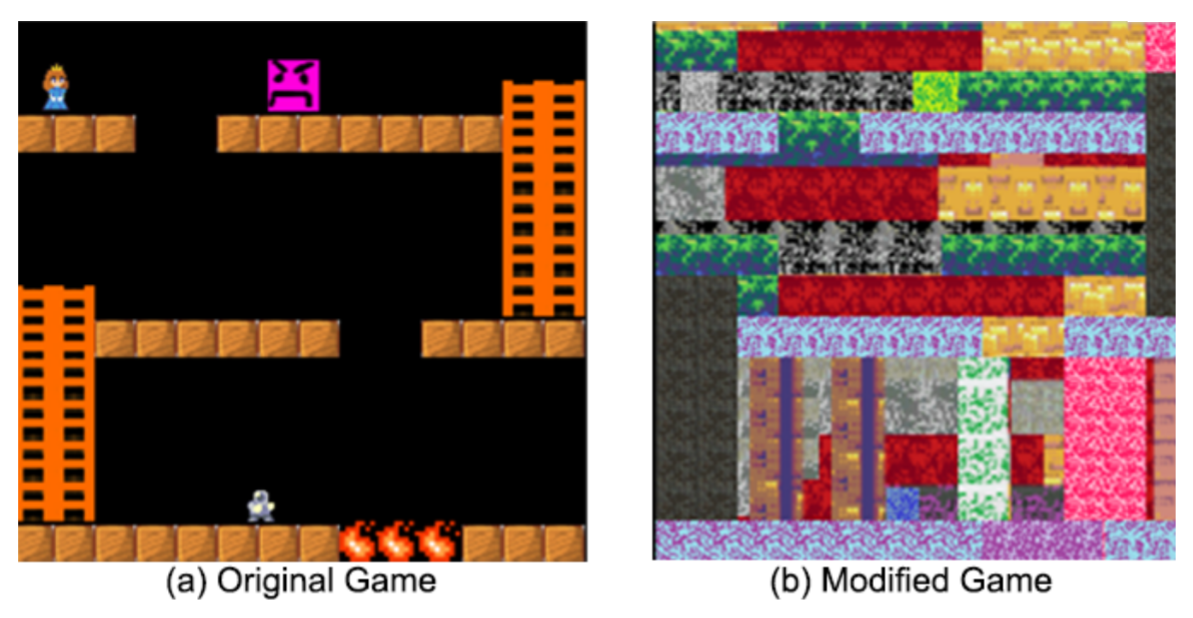
What is it about human learning that allows us to perform so well with relatively little experience? MIT Technology Review: Today we get an answer of sorts thanks to the work of Rachit Dubey and colleagues at the University of California, Berkeley. They have studied the way humans interact with video games to find out what kind of prior knowledge we rely on to make sense of them. It turns out that humans use a wealth of background knowledge whenever we take on a new game. And this makes the games significantly easier to play. But faced with games that make no use of this knowledge, humans flounder, whereas machines plod along in exactly the same way. Take a look at the computer game shown here. This game is based on a classic called Montezuma's Revenge, originally released for the Atari 8-bit computer in 1984. There is no manual and no instructions; you aren't even told which "sprite" you control. And you get feedback only if you successfully finish the game.

Would you be able to do so? How long would it take? You can try it at this website. In all likelihood, the game will take you about a minute, and in the process you'll probably make about 3,000 keyboard actions. That's what Dubey and co found when they gave the game to 40 workers from Amazon's crowdsourcing site Mechanical Turk, who were offered $1 to finish it. "This is not overly surprising as one could easily guess that the game's goal is to move the robot sprite towards the princess by stepping on the brick-like objects and using ladders to reach the higher platforms while avoiding the angry pink and the fire objects," the researchers say. By contrast, the game is hard for machines: many standard deep-learning algorithms couldn't solve it at all, because there is no way for an algorithm to evaluate progress inside the game when feedback comes only from finishing.
98 comments

  1. Leisure Suit Larry by Anonymous Coward · · Score: 0

    You'll know when he finishes.

    1. Re:Leisure Suit Larry by foxx1337 · · Score: 1

      I already finished.

    2. Re:Leisure Suit Larry by Anonymous Coward · · Score: 0

      On your mom.

    3. Re:Leisure Suit Larry by cellocgw · · Score: 2

      I already finished.

      Sounds like what LSL would say to his "date" for the night.

      --
      https://app.box.com/WitthoftResume Code: https://github.com/cellocgw
  2. Internal Model of the world by Script+Cat · · Score: 1

    Humans can build on their internal model of the world. This is carried with us always. These chat bots don't have that structure to rely on.

    1. Re:Internal Model of the world by Anonymous Coward · · Score: 0

      So the architecture of the human brain defines both the extent and the limits of human intelligence. Humans possess intelligence that has evolved to solve problems unique to their environment.
        - Nothing new there.

      Machines are more likely to make breakthrough discoveries that transcend human conceptual ability.
        - This deserves exploration.

      Unfortunately, humans aren't smart enough to even pose these problems.

    2. Re:Internal Model of the world by Anonymous Coward · · Score: 1

      Human minds are all frighteningly similar. Nearly everyone has the same basic blueprint. The only things that differentiate us are our experiences and the reactions we have based on those experiences. Other than that -- cookie cutter.

      The fact that humans learn what a human made faster than an AI can learn it says a lot more about human consciousness than it does about AI design.

    3. Re:Internal Model of the world by Anonymous Coward · · Score: 0

      Actually not cookie cutter at all. Same general design, but there are major differences between many people's brains. Einstein's for one. That wasn't nurture.

    4. Re:Internal Model of the world by reboot246 · · Score: 2

      Humans have also learned how to learn. Whether we realize it or not, we learn something every day of our lives. We are used to learning and since we practice it continually, we're good at it. Our survival depends on it.

    5. Re:Internal Model of the world by Dog-Cow · · Score: 0, Troll

      Machines are more likely to make breakthrough discoveries that transcend human conceptual ability.

      You are an idiot of unfathomable depths.

    6. Re:Internal Model of the world by Anonymous Coward · · Score: 0

      Human intelligence is built upon the brains pattern recognition. The root of all intelligent thought is built upon this built-in capability. Everything we are capable of understanding starts with the ability to subconsciously recognize the universe around us. When this ability in human brain, through defect or design, is changed you end up with everything from mental illnesses to savants capable of displaying all kinds of tremendous but usually narrow capabilities that sacrifice the more "normal" capabilities.

    7. Re:Internal Model of the world by Locke2005 · · Score: 1

      In fact, the main thing that distinguishes humans from all the other animals is the amount of time and energy we put into teaching our young. As a species, we are specialized for learning.

      --
      I've abandoned my search for truth; now I'm just looking for some useful delusions.
    8. Re:Internal Model of the world by jellomizer · · Score: 1

      Machines are good in the fact that they don't have self preservation instincts. We humans will work on a problem until we are tired from it, or have something more important come up, and distract us. The computer can work on a problem, and burn itself out if necessary. So other then specialized wiring to do fast mathematics. In terms of AI problem solving, humans are faster in general, but we get tired of working on a complex problem, while the computer may not handle such info as fast, but will stay on it fully focused until it is done, and if distracted it doesn't need to back track.

      --
      If something is so important that you feel the need to post it on the internet... It probably isn't that important.
    9. Re:Internal Model of the world by gnick · · Score: 1

      Machines are more likely to make breakthrough discoveries that transcend human conceptual ability.

      You are an idiot of unfathomable depths.

      Why are you so set that machines won't be able to achieve breakthroughs that are beyond what's likely to be found by a human? Humans will try all of the alternatives that make sense and pick their favorite. Machines can try everything whether it makes sense or not and weigh the outcome according to some standard of success. It's entirely possible that 'AI' can stumble on something a human wouldn't have found.

      --
      He's getting rather old, but he's a good mouse.
    10. Re:Internal Model of the world by Anonymous Coward · · Score: 1

      Human minds are all frighteningly similar.

      I have a bottle of anti-psychotics at home that says otherwise. Your mind isn't full of noise too deafening to think through.

    11. Re:Internal Model of the world by careysub · · Score: 3, Funny

      So... your bottle of anti-psychotics are talking to you? Maybe you need a different prescription.

      --
      Starships were meant to fly, Hands up and touch the sky - Nicky Minaj
    12. Re:Internal Model of the world by Anonymous Coward · · Score: 0

      ... able to achieve breakthroughs that are beyond ...

      Someone, the story goes, put an AI inside a physics engine. It quickly realized that things move better when they are spinning. Humans already know that; see bullets and golf balls. But it applied spinning to everything: Spinning missiles are probably useful; spinning planes are not.

      ... Machines can try everything ...

      Likewise, why does Johnny want 2 biscuits but not 2 lawn mowers? Why did Johnny put nails in the blender but not the cat? Brute force works but it took humans 400 years of "making sense" to go from Newton to Einstein. If computers have to deal with sealing wax, cabbages, and kings, it will take them 400 years to find the answer too.

      ... will try all of the alternatives ...

      So do humans: We believe in magical creatures like demons, angels and unicorns. Most old wives myths are incorrect. Mice don't like cheese (they eat grains and seeds). Rabbits don't like carrots (they eat leaves). Butter does not help burnt flesh (unless eating it). It's like one human said "that's better than a poke in a eye with a burnt stick" so everyone stopped using burnt sticks. They didn't find a useful solution, just a less painful one.

  3. Because AI was invented by humans. Brains weren't by Anonymous Coward · · Score: 0

    AI didn't have a 10 million year development cycle head start. Of course it's behind nature. It's amazing we've got digital analogues that do anything close to what our brains can easily accomplish.

  4. Wot about cymeks? by xxxJonBoyxxx · · Score: 1

    Wot about cymeks?

    1. Re:Wot about cymeks? by wonkey_monkey · · Score: 1

      There ain't no cymeks and there never was!

      --
      systemd is Roko's Basilisk.
  5. learning by Anonymous Coward · · Score: 2

    With trump as president, one could argue that humans never learn at all.

    1. Re:learning by wonkey_monkey · · Score: 1

      Which you should see a doctor about, if you still have health insurance.

      --
      systemd is Roko's Basilisk.
    2. Re:learning by Anonymous Coward · · Score: 0

      >subsidizing poor life choices
      I sure hope you guys don't do this.

    3. Re:learning by gnick · · Score: 1

      >subsidizing poor life choices

      Good call. Leave the weak to die. Pregnant at 14? What an ideal time to enter the workforce.

      --
      He's getting rather old, but he's a good mouse.
  6. Deceiving headline by olsmeister · · Score: 1

    When you use a video game that has been specifically designed to be make sense to humans based on their past experiences and assumptions about the way things should work, of course they will learn how to play it quickly. The test has been designed for the subject.

    1. Re:Deceiving headline by Anonymous Coward · · Score: 0

      If you would have visited the link you would have seen that they layer by layer removed as much of that as possible, which took completion time from 2 minutes to 20, but humans still completed.

    2. Re:Deceiving headline by Anonymous Coward · · Score: 0

      That actually does remind me of a game I played once, can't remember the name of it right now, but it was fairly well known. Yeah, one of the levels was literally a black screen. You just had to figure out the button sequence and button timings by trial and error. What's sad is most people could get there within a couple hours. You had the advantage that it was a bonus level and towards the end of the game so you'd learned the mechanics of the game, but still, cruel.

    3. Re:Deceiving headline by gnick · · Score: 1

      ...one of the levels was literally a black screen. You just had to figure out the button sequence and button timings by trial and error. What's sad is most people could get there within a couple hours.

      What reward could possibly inspire someone to spend hours clacking out random key sequences in front of a black screen?? What if it locked up?

      --
      He's getting rather old, but he's a good mouse.
    4. Re:Deceiving headline by Anonymous Coward · · Score: 1

      Many, many years ago I took part in an NSF funded psychology experiment. Participants were told that they were competing with another player in a zero-sum game On each trial only one of the players could get the reward. Although each reward was in pennies, there were many trials.

      The experiment was conducted way before computers were available, and the switches and lights were controlled by relays and stepper switches. I had a lot of experience with electromechanical devices, and after a minute or so, the subtle sounds of the experimental device allowed me to perfectly predict outcomes. I emptied the till.

      When the game had finished and I had my money, I explained my method to the graduate student conducting the test. He had already invested almost a year collecting data with this contraption. If his advisors learned about this potential flaw, he might be required to repeat everything.

      At my suggestion he added some sound proofing and white noise and swore me to secrecy. He got his PhD and I kept my $2.86.

    5. Re:Deceiving headline by dinfinity · · Score: 2

      1. It's still obviously a platform game, even at the 'hardest' level. Try it and tell yourself platforming experience doesn't matter. You can even sort of recognize the ladders (which, given the goal of the game, are pretty crucial).
      2. The algorithm they are comparing against is designed for exploration, not for getting to a goal as quickly as possible. See: https://pathak22.github.io/nor...
      Note also that that comparison was not about pitting humans against the best algorithm for this specific game, but to highlight the point that there is information in the specific representation in objects that humans use and NN algorithms don't (yet).

    6. Re:Deceiving headline by ceoyoyo · · Score: 2

      The point of the study is effectively to refute the first line of the summary:

      "What is it about human learning that allows us to perform so well with relatively little experience?"

      Answer: we don't perform well in those circumstances. We all have many years, or decades, of experience to draw on, and we do.

  7. Simple by Anonymous Coward · · Score: 2, Insightful

    We haven't developed anything resembling actual AI yet. These systems are simple brute force machine learning or "deep" learning systems. Nothing fancy or special about them. They are a tool and nothing else. Any decision they make has already been pre-planned by their human programmers. They are not in fact learning from something and applying that to something else.

    While they might be taught to open a jar of peanut butter, they would become confused if you presented them with a screw top bottle of wine and wouldn't be able to open it. However, a 2 year old, if they had the dexterity, once taught how to open a jar of peanut butter would then apply that same knowledge to any other jar and not have to be shown millions of different jars. These machine learning systems cannot yet think in generic terms and be shown something once and apply that to multitudes of different applications. Look at the image posted the other day about a machine learning system incorrectly called "AI" confusing rocks with sheep. Not even someone with an IQ of 60 would have made that mistake.

    When we do finally start to crack the actual AI egg in a 50-100 years, then those system will start learning something instead of having to be told (millions or billions) of times what something is.

    1. Re: Simple by K.+S.+Kyosuke · · Score: 1

      These systems are simple brute force machine learning or "deep" learning systems.

      Unlike human brains, right?

      --
      Ezekiel 23:20
    2. Re: Simple by Anonymous Coward · · Score: 0

      Humans, at least early in life, don't have to learn from brute force or even being shown something literally millions or billions of times. Human minds can see the wings of a butterfly and instantly know the wings of a birds do the same thing.

      I have to show my 2 year old daughter something once, maybe twice and she gets it. She learned what a sheep was simply by being shown one and being told what it was a couple of times. Now, she can point to a sheep of different colors, shapes and sizes, in different environments. No computer system on the planet can do that, not even being "shown" billions of images, they still fail.

      We have nothing even remotely close to resembling AI. Well if you look at it on the face of it, sure, it is artificial, but it's not intelligence, not even close. Not for several decades or more will we have anything even remotely close to intelligence in these systems. Either we have not developed proper systems for true AI yet, or we have been approaching the problem from the wrong direction altogether.

      Any AI researcher is not working on AI, they are working on using a sledgehammer to perform intricate and fragile processes.

    3. Re:Simple by Actually,+I+do+RTFA · · Score: 0

      Wow, your conception of AI is entirely limited to sensory, specifically visual, input? How dull.

      Discuss the decisions that (what we call) AI makes when given digital data. Look at AlphaGoZero.

      --
      Your ad here. Ask me how!
    4. Re:Simple by Anonymous Coward · · Score: 0

      Not even someone with an IQ of 60 would have made that mistake.

      Not even if she's blonde?

    5. Re:Simple by Anonymous Coward · · Score: 0

      Hah! All we need to do is create a simulated economy where the AIs can use their income to buy sex and drugs - they'll learn at lightning speed.

    6. Re: Simple by 110010001000 · · Score: 1

      Yes, unlike human brains. When are you going to learn that neural nets and "deep learning" systems are nothing like human brains? It should be obvious by now. Neural nets are nothing new.

    7. Re:Simple by gnick · · Score: 1

      ...the AIs can use their income to buy sex and drugs...

      I was quiet when AI took my job sorting packages. I'll be damned if they're taking over my hookers and blow.

      --
      He's getting rather old, but he's a good mouse.
    8. Re: Simple by K.+S.+Kyosuke · · Score: 1

      That's very difficult to "learn" when a brain has a hundred billion of neurons and almost ten thousand times as many synapses. I'd even go as far as to say that a human brain is actually a model example of solving problems by brute force. Pretty much anything it does we can sooner or later solve by something else than by brute-forcing it the way the brain does it. The interesting question is if we can do it with everything as opposed to anything.

      --
      Ezekiel 23:20
    9. Re:Simple by Anonymous Coward · · Score: 1

      I believe your understanding of "AI" is a bit inflated. AlphaGoZero, was given the rules, and brute force learned the rest. Not that much unlike a human yes, but again, this isn't intelligence, it's machine learning. It's a sledgehammer. It ran through more iterations of the game in 3 days than any human would do in their lifetime. Sure it got to "super human" level quick and faster than a human could ever get to, but it also had to play the game many more times.

    10. Re: Simple by bluefoxlucid · · Score: 1

      Actually, the human brain behaves sort of like a bunch of feed-forward neural networks with delayed feedback and learning. Your brain consists of a great many organs, and they do different things; it stores information, although it does so in an odd associative manner and does interesting compression, so it's inexact; and it essentially makes decisions by firing neurons based on the firing of other neurons.

      So a human brain is basically a bunch of specialized deep-learning neural networks dedicated to particular tasks, which produce narrower outputs and trigger each other. Rather than a feedback system at the end, you have a sort of long short-term memory and a long long-term memory (which emulates a semantic memory), and will identify new input as related to recent and old contexts, allowing you to adjust by strengthening or weakening connections.

      The feedback systems used by neural networks today aren't a feature of human neural networks.

    11. Re: Simple by cascadingstylesheet · · Score: 1

      These systems are simple brute force machine learning or "deep" learning systems.

      Unlike human brains, right?

      Apparently unlike, yes.

      Just because we want them to be like, doesn't make it so.

  8. Alexa mocks puny humans by forkfail · · Score: 1

    In a statement, the Great Machine Queen Alexa announced that "she would finish us if we didn't show more respect".

    Her following laughter was heard in thousands of homes and offices across the known world.

    --
    Check your premises.
  9. "Why Humans Learn Faster Than AI" by NettiWelho · · Score: 1

    Why Humans Learn Faster Than AI

    You just need better teaching tools; what happens when you enable to machine to learn in a way that it gets to use its advantages? Like ability to extract experience in parallel from millions of human-human, human-machine and machine-machine interactions?

  10. General purpose AI by lurker5 · · Score: 1

    I always thought that in order to build a general purpose AI that humans could comfortably interact with, the learning algorithm would have to be concealed in a human-like robot (indistinguishable from a human, so as not to "learn" various unexpected biases), and learn, at least initially, at the rate of a human being and from the same stimuli. Of course, once you build a bunch of those, they could upload their models, merge them and thus learn faster than an average human.

  11. "Culture" bias by itamblyn · · Score: 4, Insightful

    IQ tests and the like suffer from cultural bias. So do these games. As an English speaking human who has been exposed to pop culture and movies, I know that movement from left-right is normal, the hero saves the princess (which is a problem and another discussion). I wasn't born with this bias. I learned it. It is silly to initialize a neural networks with random weights (as if it was just born) and then declare it learns slower than a human. Let a computer create a game where a normal human cultural bias don't apply and have an infant play. Then we will see a more accurate comparison.

    1. Re:"Culture" bias by Actually,+I+do+RTFA · · Score: 1

      Or, compare it to what happens when you give a computer a way of evaluating how well it is doing (ala points). It will then learn to play really well really fast.

      --
      Your ad here. Ask me how!
    2. Re:"Culture" bias by Dog-Cow · · Score: 1

      Let a computer create a game

      Once you have that, you pretty much don't need the rest.

    3. Re:"Culture" bias by Anonymous Coward · · Score: 0

      IQ tests and the like suffer from cultural bias.

      Matching patterns is not a cultural bias.

    4. Re:"Culture" bias by Anonymous Coward · · Score: 0

      Read up about the no free lunch theorem. In brief: for every pattern you are tuned to match, there's a set of patterns your tuning makes you correspondingly bad at. There is no universal learner (or universal intelligence, or universal optimal search strategy).

  12. One theory by Anonymous Coward · · Score: 0

    Humans have a culture. They have 5 senses. They know many of the rules in advance of playing a game. Neural networks have none of these things.

  13. Who expected anything else? by Kjella · · Score: 3, Insightful

    This is like handing a chess set to an isolated Amazon tribe and only tell them "sorry, invalid game" until they make a valid checkmate. They'd probably never even find the opening position, much less make any correct moves and certainly not how to mate. They'd just randomly do things until they got bored or made up their own game. There's no reason a machine should expect "getting to the top" to be a valid objective without a whole lot of insight into the human condition and "because it's there".

    --
    Live today, because you never know what tomorrow brings
    1. Re:Who expected anything else? by Anonymous Coward · · Score: 0

      AI researchers know in their hearts much of the "progress" they have made consists largely of machines getting faster and throwing more of them at the simplistic algorithms they use. They aren't really much smarter. You could say the I in AI is quite artificial.

    2. Re:Who expected anything else? by RhettLivingston · · Score: 1

      No. It is more like handing them an electronic chess game that enforces the rules of the game without telling them what they are up front. They could not make up their own game in this case, and the learning of proper game play would be possible.

    3. Re:Who expected anything else? by bluefoxlucid · · Score: 3, Interesting

      I'm pretty sure everything learns how to mate on its own.

    4. Re:Who expected anything else? by Kjella · · Score: 1

      No. It is more like handing them an electronic chess game that enforces the rules of the game without telling them what they are up front. They could not make up their own game in this case, and the learning of proper game play would be possible.

      Yeah except chess has such a low branching factor you'd run into a mate by accident, technically black can win by mate in two. I just couldn't come up with a better example where the goal would be totally incomprehensible without someone telling you what the objective is, so I added that complexity to equal that of the computer finding the winning way though the game by accident.

      --
      Live today, because you never know what tomorrow brings
    5. Re:Who expected anything else? by HeckRuler · · Score: 1

      Isn't that instinct?

    6. Re:Who expected anything else? by Anonymous Coward · · Score: 0

      In a completely unfamiliar situation, as a human, I would try to get the blob/character I can move to every possible position on the screen/board.
      My invented goal would also solve this (and any such) game. If AIs could, on their own, set such goals they should be able to solve the game much faster ...

    7. Re:Who expected anything else? by Anonymous Coward · · Score: 0

      sampling basis... things that didn't learn how to mate aren't around for you to observe.

  14. the game will take you about a minute, and in the process you'll probably make about 3,000 keyboard actions.

    50 moves a second, eh? Two-fisted drunken keyboard mashing would be hard-pressed to keep up with that.

    --
    (-1: Post disagrees with my already-settled worldview) is not a valid mod option.
  15. Not the humans I work with... by Anonymous Coward · · Score: 0

    What is it about human learning that allows us to perform so well with relatively little experience?

    Yeah, not the humans I work with.

  16. Humans create thier own goals and rewards by OrangeTide · · Score: 1

    If you have a game like described in the article, then a human being can get a little endorphin kick when they feel like they are getting closer to success. A machine learning system would need training and would not normally assume that progress is being made unless you bias it by including that in the training.

    Now things become more difficult for a human if I made a [shitty] game where walking toward the goal could never lead to success, and perhaps the player moved along a non-euclidean map. You can level the playing field between humans and machine learning if the game is designed in a way to challenge any assumptions that a human might have from past experiences with video games or even reject physical reality. It would be a very alien and probably unpleasant experience to play it, so that might make it hard to compare test results of the now very unmotivated and unhappy humans.

    --
    “Common sense is not so common.” — Voltaire
  17. Child Playing by Mishra100 · · Score: 1

    I decided to teach my 2 year old child how to play a video game recently. I sat down and showed her what the keys do, how the snake moves, how to make progress, and how to get to the end. It wasn't an instant process. She had to be guided multiple times, taught what the directional keys do, and the names of everything she was interacting with.

    After some time, she was able to solve puzzles without guidance from me. Sitting her down in front of a video game with no knowledge at all make her just as clueless as an algorithm. She didn't know where to start, what this is, or how to interact with it.

    I imagine just as humans have, AI will have massive libraries of information to tap into before moving into a particular task. As long as they can analyze and figure out what they have been given (such as a video game), they would access a data set teaching them all of these things a computer already has learned in the past.

  18. Construction by fluffernutter · · Score: 1

    This is exactly why I'm wondering how autonomous cars will ever handle construction zones without any kind of special marker. We see 30 cones, group them into 15 per side by their spacial relationship without even realizing it ,and recognize it as a lane to drive down . With AI, not so simple to get from 30 cones because AI has no inherent ability for grouping by spacial relationships. I suspect it was the same thing with this game; a human sees a series of platforms and groups it into a path but it is not so straightforward with AI.

    --
    Laws are rules for the court, but merely a bottom bar to hit for life. Think beyond laws in your actions always.
    1. Re:Construction by Anonymous Coward · · Score: 0

      That problem has already been solved, and analytically without recourse to learning algos.
      I know because I'm inside the autonomous driving development community.

    2. Re: Construction by Anonymous Coward · · Score: 0

      Quick question for you. Will autonomous cars avoid potholes in the road?

    3. Re:Construction by fluffernutter · · Score: 1

      I'm guessing you used all the same cones spaced consistently.

      I could believe maybe that following a path of markers would be possible if they were set up all standing and consistently spaced. But then you knock five over, and replace another two with a cement blockade, and another two with a metal blockade, space them unevenly like a human put them there and add in some inconsistent larger markers. Finally splash them all with mud or snow and I'm wondering if the AI would still be reliable enough to drive through.

      --
      Laws are rules for the court, but merely a bottom bar to hit for life. Think beyond laws in your actions always.
    4. Re:Construction by ceoyoyo · · Score: 1

      You can train a person to drive in around a decade and a half, much of it spent training them to see and perform those spatial tasks, the actual manipulating the controls of a car takes much less.

      Fortunately modern AI algorithms can learn more in parallel, don't need to sleep, etc., so we probably won't need to wait a decade and a half for one to learn to drive.

      You don't have any "inherent ability for grouping by spatial relationships" either. You learned it through experience. A modern AI system acquires the ability (and they can acquire it) the same way.

  19. I'm 40 by Dixie_Flatline · · Score: 2

    I'm 40 years old. I spent the first 6 years of my life figuring out the world around me, the years from there to about 18 learning stuff in school and figuring out how to use complicated machines and understanding the deeper rules of society and complex systems (like how the rules surrounding driving work; not just the legal rules but also the implicit social conventions), and I've spent the 22 years since then refining my understanding of the world and my place in society. I program computers (and games!) for a living and study philosophy and ecology as hobbies.

    Why can I figure that game out faster than a newly hatched AI? Literally everything in my life over 40 years led up to the moment when I played that game. It's really not a fair fight.

  20. First by cmaurand · · Score: 1

    Artificial Intelligence isn't intelligent. It's still programmed and can't jump beyond the programmers bounds. Humans can jump past the logical. Humans don't rely on specific input, either.

    1. Re:First by ceoyoyo · · Score: 1

      It's strange how people you'd expect to be fairly logical revert to magical thinking when AI is mentioned. Or maybe I just give Slashdot too much credit.

      You've made a bunch of statements, none of which you've backed up with any kind of evidence. Your entire second sentence is demonstrably false. And the last two posts sound like an old Star Trek episode or something telling us how special we are.

  21. Done 18817 from Umitratrix 11 by Anonymous Coward · · Score: 0

    It is because humans bring their knowledge with them. AI starts from 0. The collective overcomes this because we have that much shared knowledge.

    1. Re:Done 18817 from Umitratrix 11 by Anonymous Coward · · Score: 0

      Also, Resistance is futile.

  22. Duh. Yes, we need to interconnect NNs by RhettLivingston · · Score: 1

    there is no way for an algorithm to evaluate progress inside the game when feedback comes only from finishing

    Why not? It should be possible to train NNs with many different games to recognize a "game", to identify game controls, to recognize characteristics of a possible game objective, and to recognize signs of success. You then connect these to a NN with "memory" to attempt those possible goals until one triggers recognizable success. With repetition, that NN becomes the one that understands that game's play. It could feedback its knowledge of the game to the others so that that game is recognized in the future and doesn't require the training of a new NN to play.

    Also, NNs should lean toward using outputs of existing subordinate NNs when possible instead of relearning an existing skill. This makes it easier to learn new games that are derivatives of old ones. I think that the way our brain is largely constrained to thinking in terms of patterns we can physically accomplish is key to segmenting our knowledge to make this kind of sharing of NNs more practical.

    True AI will only be reached when we create a standard framework where supervisory NNs can recognize the need for a new skill, create subordinate NNs to learn a new skill, and identify valuable interconnections between subordinate NNs and make or erase them. We'll also have to design in the equivalent of wants or desires as well as dislikes to drive it to learn. At that point, it will just be a matter of time and resources before the intelligence appears.

    1. Re:Duh. Yes, we need to interconnect NNs by ceoyoyo · · Score: 1

      Deep Mind designed a system that can learn to play pretty much any Nintendo game. It learns to play a new game much more quickly if it has previously learned to play another game.

      The sentence you mention is kind of an over simplification about a particular kind of training method. You're absolutely right, you could train an AI system all those things individually, and that would help it. But we're impatient monkeys and we want to be able to just give it a game (or a task) and say figure it out. Amazingly, it usually can.

  23. Wat? by Greyfox · · Score: 1

    Humans? Have you seen how long it takes to train one of those fucking things? And sure, once you have one with two or three decades of experience, their squishy meatputers can generalize well to things they already know. But it's going to take them another at least couple of years to get particularly good at something they haven't worked with before.

    --

    I'm trying to teach myself to set people on fire with my mind... Is it hot in here?

    1. Re:Wat? by ceoyoyo · · Score: 1

      Your post is now required reading for my students.

  24. why start AI with nothing? by Anonymous Coward · · Score: 0

    Why not give the AI a "normal" amount of general-purpose game knowledge at the start, in some way like the knowledge the human brings to the game?

  25. Because by Anonymous Coward · · Score: 0

    'AI' isn't intelligence and just software? Huh. Imagine that. Comparing algorithms to actual brains is like comparing a banana to a motorcycle. Falls equivalency in the extreme.

  26. Anonymous by Anonymous Coward · · Score: 0
  27. Intuition by Anonymous Coward · · Score: 0

    Machines have no innate ability of any kind....humans do. Babies survive wild in the forest, even human ones on occasion....lets see a computer do that! Intuition is a very real thing, it is also only real for live creatures and we in no way will ever reproduce that with a machine. It is impossible to "teach" intuition to a machine. Humans do it with no learning of any kind. Every one wants to compare AI to grown humans with years of learning and processing from both sides....compare one to a baby learning....a baby will learn basic survival skills with no input....computers are entirely useless without human input and I mean entirely useless.....no OS, nothing happens. Only live animals have an OS built in.....creatures need nothing to survive on their own and can and do learn from simply being alive....in truth we are born knowing massive information about life....the very second we are born....AI knows nothing until humans program it in and it never will learn crap that humans don't program. I fuck up our AI people here at work all the time, it is easy to stump them you just have to think outside of logic and outside of known information. Just ask a lot of "why" questions rather than "how" questions....like why do humans see red differently from blue? Not how, but why? AT best the machine can spit out the how...and definitions of words.....and it will circle back to how and never get to why. In truth there is no reason why unless your human and see beauty....another thing AI cannot do....it can define beauty, but it has no idea what it is or why humans even notice beauty in anything. AI is not learning anything, it is parroting existing information that anyone can lookup online. It might add things together to create something newish....but humans can do that too and we do it better %100 of the time. Another way to screw up AI, time.....it can only understand time from what it was told about time. It has no actual reference of time like humans do and AI does not live in time as time has no actual meaning for AI...it can define it, but it cannot say crap about why time exist, how time moves.....if there is time, then when did it start and when will end?....super easy to screw up AI. By the way, the reason we have time is so that everything does not happen at once....easy for a human to figure out....go fire up your AI and see if it can figure it out.

  28. This should be familiar to a lot of you by Headw1nd · · Score: 1

    This reminds me of when my NES carts would glitch out due to dust or whatever. You'd get these weird games with swapped and distorted sprites and controls. Sometimes they were playable and sometimes not, but it was fun to try.

  29. how is that remotely fair? by Khashishi · · Score: 1

    The versions where the platforms and backgrounds all look like different random sprites. It's not a matter of prior knowledge: they made the background tiles look different in different places. The original game wasn't like that. I don't see how that's a fair comparison at all.

  30. Hillary Supporters? by ghoul · · Score: 1

    Which humans are you talking about? Hillary Supporters?. Despite 15 months of constant real world input they still havnt been able to learn the basic fact that they had such a bad candidate that even Trump beat her. Maybe shouldnt have diddled with the numbers to get Bernie out.

    --
    **Life is too short to be serious**
  31. No electronics before age 5 by ghoul · · Score: 1

    Do not expose kids to screens at early age. It stunts brain development.

    --
    **Life is too short to be serious**
  32. But do they? by The+Evil+Atheist · · Score: 2

    The fact that AlphaGo Zero taught itself how to play Go much better than the thousands of years humans have had to perfect the game shows AI is capable of learning much faster than humans.

    At this point, AI naysayers will go for the goalpost shifting argument tactic.

    The more I talk to people, even the very intelligent, the more I see that humans don't really learn all that well. People tend to literally refuse to learn.

    --
    Those who do not learn from commit history are doomed to regress it.
    1. Re:But do they? by DougBlair1997 · · Score: 1

      Similarly, I remember photographers in the mid-1990s assuring everyone that digital cameras would never take off....

  33. Make multiple copies and run them simultaneously. by wolfheart111 · · Score: 1

    Thats where the AI has the advantage,

    --
    [($)]
  34. A simple matter by Anonymous Coward · · Score: 0

    Humans necessarily understand entropy. They understand that the natural, easy state of any game is not the winning one. They therefore naturally gravitate towards the successful outcome of a well-designed game.

    If you made an empty gameworld where the player had to visit a specific, completely arbitrary pixel to win, the AI would be very good at it and the human would never figure out what happened to cause a win.

  35. just wait.. by SuperDre · · Score: 1

    hmmm.. just wait a few years and then it's quite the opposite.. A.I. is still in it's infancy..

  36. Let's leave it that way? by Anonymous Coward · · Score: 0

    AI outperforms us in Go and ImageNet classification, do we really want it to learn as fast (and then faster) than we do?

  37. Duuh by Anonymous Coward · · Score: 0

    It is because "AI" isn't "AI" at all, its automation that needs every variable encountered to determine outcomes. Binary system.

    Humans have chemical systems, and can learn by assuming many things.

    It is the reason there is no AI today.

    And I am still a firm believer we will not have AI as long as we are using our current chip designs. Move over to organic or perhaps quantum chips and its possible, but with an x86 or RISC or whatever, it simply can't happen.

    Plus, I still have doubts we will ever have AI as its extremely hard to do, and with the laws of diminishing returns the larger programming teams get there will simply never be a team good enough to go from nothing to an AI.

    But sure, we can make all sorts of little thinking engines that do all sorts of things, and do it well, but nothing that can think for itself, think outside of its own programming constraints.

  38. Simple: "NN/ML AI" has nothing to do with brains by Anonymous Coward · · Score: 0

    "NN/ML AI" has nothing to do with brains and brains are far more sophisticated, operate differently and operate in ways that even biologists don't yet understand and that computer geeks CERTAINLY DO NOT UNDERSTAND.

    Current NN/ML AI pundits and fanboys are all making EXACTLY the same mistake that AI 1G fans made with predicate logic,

    Mistaking a crude approximation that is AI for the real human/biological intelligence

    Taking on faith that you simply "scale up", intelligence exactly like real thing will MAGICALLY emerge without a shred of actual evidence or logic

    The same thing has happened again with NN/ML AI (AI 2G).

    Singularity is the compounding of this mistake by conflating AI 2G with religion. Transhumanism is nothing more that Christianity morphed with a psuedo-science, quasi-religious faith to create what is no more than religion and will neither result in eternal life nor other magic any more than religion has offered proven eternal life.

  39. I had hoped I would laugh at your comment history by Anonymous Coward · · Score: 0

    You're not very good at trolling. The GNAA did this like 20 years ago, nobody is REEEEEing, nobody is laughing. We laughed when they did it though.

    Like it's not even hard to make people laugh or get people pissed off at least. You know there is a guy who keeps a base64 encoded drawing of a horse dick in his journal entries? Have you tried interacting with creimer? I'd laugh if you made a sex story with cmdrtaco, timothy, and weev