Slashdot Mirror
Domain: abb.com
Stories and comments across the archive that link to abb.com.
Comments · 41
-
Re:Come on, not that "Terminator" BS again...
In my mind, industrial robot are still the most dangerous piece of hardware you'll ever work with, period.
I programmed welding robots for a few years in the 90's, and I agree. Close calls are common. I once got very close to breaking a coworker's arm with a robot, except that I released the deadman switch in time.
Do you want to hear something even scarier? Robot compagnie like ABB are actually working to make their robot appear less dangerous : http://www.abb.com/cawp/seitp2...
"We want to lower the fear of robot because it affects our sales". Can you freaking believe it? If you got an operator working with a robot, you have to make it clear that if he doesn't respect the safety procedure or the robot speed/strength, he "will" endanger himself. Robot "are" dangerous.
What it'll be next? Dress him as a Teddy Bear so children will want to hug him?
-
RobotStudio
Probably not what you are looking for with your budget, but in regards to answering your question "Is it possible to program a robot using pure software simulation?"
Yes: http://new.abb.com/products/robotics/robotstudio -
Re:Lenz's law
It's not rubbish - I can hardly believe the squad of anti-tech knuckle-dragging objectionistas we have here.
http://new.abb.com/tosa
Flash charging is happening, and it's getting better all the time.
Flash charging on the run seems a little silly now, but why don't all you plodders want nice things?These constant bleats about "I can't drive around the planet without stopping in an EV so I'm keeping my 4-ton diesel SUV" are just noisy neo-luddites to be ignored at every opportunity. They'll die away of natural causes soon enough.
-
Re:Why not both?
Well, here you have 350 kV / 700 MW thyristor converter. It's easy to find, because it's pretty big.
http://new.abb.com/systems/hvd...
https://en.wikipedia.org/wiki/... -
Re:Cost nothing to run?
Oh, it was tried long before that. ABB tried similar technology in the 2000 time frame.
While it sounded great in theory it didn't bear out in practical tests and the technology was shelved.
P.S. No-one in a commercial setting tests developed technology for 5-10 years any more. That kind of money down the drain for no return on investment hasn't been generally available in industry for several decades (and when it was, it was mostly the defence industry that could afford such extravagances).
-
Batteries - Not just for generation imbalance
Everything that needs to be known about the concept of electrical storage has been known for a LONG time. The Hawkens Electrical Guide published in 1914 has a good easy to understand explanation of how to float a battery on a DC power distribution system.
CHAPTER XLV STORAGE BATTERY SYSTEMS.
The reason the battery system described in Hawkins is not used for utility power except in rare cases is economics.The Golden Valley Electric Association would not have considered such a large backup battery unless it was the economic solution for a power supply problem. As stated in the link at temperatures of -50F there are unique considerations needed to stabilize the grid.
Battery Energy Storage System (BESS) - Golden Valley Electric Association Fairbanks Alaska 40 MW for 7 minutes. This system is a combination of a static var Static VAR compensator, that can perform as a 4 quadrant inverter. This arrangement is effective for solving many power system stability problems, not just a generation imbalance.
Technical Description from Wind PowerAs battery technology improves there will be economic solutions for far less extreme situations.
-
Re:Keynote speaker
Why would any respected organization or individual response to this guy's drivel. Plenty out there to read, that is credible and provide a glimpse at some of the issues. Here's some stuff to start with to give you a sense of what needs to be considered, not overlooked. https://www.nae.edu/Publicatio... http://www05.abb.com/global/sc...
-
Re:so much for environmentally friendly
I think volvo, and most people, forget that the benefit of fuels (solid, liquid, or gaseous) is that they are very cheap to transport. Electricity, on the other hand, is insanely expensive to transport. Think about a 10% loss for every major hop. The middle of the road in a large city is likely 4 major hops from the power plant. That takes 100 down to 65. That's up to a 35% total loss.
These numbers clearly came from a questionable source. (perhaps your backside?) The PDF available here indicates a transmission and distribution loss of between 6% and 8% for the United States power grid.
-
Re:I guess it depends
Electricity is not something we can efficiently transport from places where it's abundant to places where it's needed. Unused excess electricity is a waste.
A 2000km HVDC line loses about 5% of its energy to heat. 95% efficiency over 2000km lines seems pretty efficient.
-
Re:What could possibly go wrong?
Reactive losses *are* losses. They heat the wires. Reactive reserves for phase stabilization can help get that back under control, but they don't undo the losses already in the wires. Reactive losses are a well known issue with submarine AC cables and limit their length.
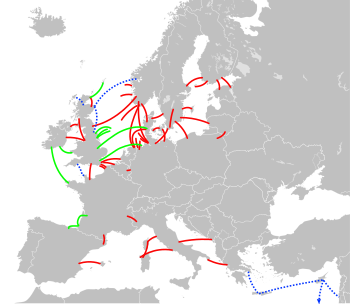
DC not only is viable, as the person below you notes, it's already *in use*. The majority of new long-distance high power links being strung up in Europe (red=existing, green=under construction, blue=proposed), and a number in North America as well, are HVDC. Learn about it. Conversion is now efficient and no longer nearly as expensive using modern thyristor-based digital converters. Long-distance HVDC links are much more efficient than long-distance AC links.
Enough of this "I'm pontificating about a subject I've never read about" nonsense.
-
Home Advantage
IBM seems to be getting off easy. $10 million for hundreds of thousands of dollars in bribes covering multiple incidents over an extended period of time.
ABB, with headquarters in Zurich was recently fined $58 million for only two, relatively small, bribe incidents.
http://www.abb.com/cawp/seitp202/b7aa479846d0fe19c12577ae0017bfa0.aspxThe circumstances suggest favoritism for home team players.
.
-
It has a shitolad of sunlight though...
And a shitload of empty desert that can be used to harvest solar power.
But more importantly - Libya is right smack in the middle of the shortest route for transportation of electricity from North Africa to Europe.
Electricity should start flowing from North Africa to Europe by 2020. By 2050, North African and European renewable sources should provide 100% of EU and NA power needs.
Transported by HVDC transformers like the ones Siemens built for China along the link like the one Abengoa Group will build for Brazil.
Abengoa Group will also build the Solana Generating Station in Arizona - to the tune of 2 billion dollars. -
Re:Except places where the sun don't shine ... muc
That figure likely does not include the losses incurred when generating the very high voltage DC from AC and converting it back to AC for consumption.
I've toured the Dalles dam and the Celilo power station - very impressive. Rectifiers that stand 20 feet tall with sci-fi looking knobs and disks, straight out of 50's movies.
http://en.wikipedia.org/wiki/Pacific_DC_Intertie
http://www.abb.com/cawp/gad02181/c1256d71001e0037c1256b8000371e41.aspx
-
Industrial Robotics Manufacturers ...
-
There are non-low-cost exhibits like that...
There is an exhibit in China Science and Technology Museum that also draws pictures. This is made of four ABB robots, so perhaps the cost is a bit more.. =)
Sorry, I could not find any representative pictures what this exhibit draws.
-
Re:What's that widget?
Looks like a cable termination inside a switching station.
http://www04.abb.com/global/gad/gad02007.nsf/0/BB71704EAD5AFA9AC12574F90052BE30/$File/Termination_SOT242_244-1_244-3_PB_Kabeldon_720.jpg for a similar picture.
-
Re:A couple visions for the future
Actually you don't need superconductors for this. High-voltage direct current transmission lines are very well capable of delivering electricity with high efficiency across long distance without superconductors. Existing projects, like the Quebec-New Englad transmission line are capable of carrying >2GW of electrical energy over distances of >1100km. This is far more than even the largest photovoltaic power plant can generate today.
-
Re:Wired BS
Note that the article you link to calls them transformers for HVDC links.
Yikes! I didn't notice that. After some googling I found out a couple of things:
1) China is apparently building both HVAC and HVDC projects, so both kinds are being made for them. Jeez, what *isn't* China building right now?
2) HVDC has advantages over HVAC which is why it seems to be overtaking the use of HVAC. According to this pdf, HVAC deployment around the world is almost stagnant:
3) There *are* HVAC transformers out there that go as high as 1000kV (apparently India has some of these), but there are few of them
4) I obviously used the wrong picture, didn't check the fine print, and since UHVAC or just UHV, where U=ultra, transformers are very rare the only picture of one I could find was on page 9 of this Siemens pdf file:
http://www.ptd.siemens.de/070201_AC1000kV_GRIDTECH.pdf
Its an 800kV HVAC xformer that they say can be upgraded to 1000kV. If size impresses you, you may want to take a look at that one, its *much* bigger than the 800kV HVDC transformer in the first pic.
Unfortunately there doesn't seem to be much info out there that is not in PDF files, and for some reason that Siemens file doesn't render quite right for me in my PDF viewer. There *seems* to be parts of that slide-show like report thats talking about 1200kV HVAC, but the transformer page (9), only mentions 800kV-1000kV, and parts of the text in the report aren't rendering for me, so even after a lot of googling, I still don't know for sure what the biggest HVAC transformer in the world is rated at. Bottom line, AFAICT: 1000kV or 1200kV for HVAC and 800kV for HVDC. Wow.
-
Re:why has every f***ng RC car to be called robot?
-
Re:Electric Gas Cans?
As uncle poster points out, oil isn't used in America to generate electricity, so it helps reduce oil imports dramatically as well. I wouldn't count "green" power out. Enhanced geothermal, for example, could provide all the power we need, just not as cheaply as dirty coal. If we're willing to pay around $0.20/KWh, rather than $0.10/KWh, there are many ways to provide green alternative energy, including solar, geothermal, wind, and nuclear. Solar alone is projected to reach 23GW/year of production capacity, or around 10 nuclear plant equivalents per year, and rising exponentially. Building a HVDC power grid has already been done in Brazil... imagine Brazil leading the US in such a useful technology, and they built it in 1987!
-
Re:Superconductors = almost no heat
And, no, long distance transmission lines are most decidedly NOT DC in the U.S.
I think you're wrong about this--maybe not the majority of the lines, but there ARE some HVDC lines in the US. Example:
http://www.abb.com/cawp/seitp202/A4CA486DE1BF9C18C1257368002B05E1.aspx
-
Re:Big valves are still used today
Don't forget High-Voltage DC (HVDC) power transmission. The technology was invented using giant mercury-arc valves (a history lesson in themselves) and is now carried out in most places using strings of thyristors in series. There's an 800-mile link in the West from Bonneville Dam, WA to Sylmar, CA that has a capacity of 3000 megawatts at a million volts DC (plus and minus 500kV.) The website of ABB http://www.abb.com/ (one of the pioneers in this technology) has lots of interesting info. It is amazing what they were able to do with those mercury arc tubes. I talked to a guy who used to maintain stuff at the Sylmar station and he said there was a guy who would disassemble the tubes and repair the grids and anodes. (The cathode was the pool of Hg.) He was said to be able to weld a beer can! I bet he would make good friends with the French guy... Sadly, the demise of the mercury tubes was simply that due to the age of the system, parts were less and less available (not to mention the ever-growing hysteria about the presence of Hg.) How I would have loved to see that system in operation! Thyristors are cool to look at, but like most solid state stuff, it just sits there and looks the same whether it is running or not.
-
Re:WTF??
I'm not sure what you mean by capacity to move it around - doesn't electricity just loose strength over long distances unless the wires are made of pure gold or silver or somesuch?
Power transmission over long distance is a science. If you take a course in circuit fundamentals and learn Ohm's law, you can calculate the power lost in a transmission system. All wire has resistance.. True. Current in the wire converts some power to heat making the wire warmer.. True. How much is lost?? That is the time to do the math.
If you feed 120 volt power from the circuit breaker at home on a 12 guage wire to the far end of the house and lose 5 volts to the AC drawing 15 Amps, then the power into the wire is 120 X 15 or 1800 Watts (Volt-Ampers for those watching reactive power). At the AC we still have 15 Amps, but only 115 Volts for a power of 1725 watts. Along the way we lost 75 watts heating the wire. Transmission lines use high voltage so the volts drop is a much smaller portion of the percent drop. For example, if we use that same piece of wire and use the same 15 Amps, but hang it on insulators and feed it 220,000 volts, now the power in is 3,300,000 watts. The same 5 Volt drop is counted for a voltage out of 219,995 volts out at 15 amps for a power delivered of 3,299,925 watts for a loss of the same 75 watts. A loss of 75 watts on delivery of 3 MegaWatts isn't bad. Increasing the power over 20 Amps will still trip the breaker, overheat the wire, or start a fire. This is the capacity they talk about. The delivery is effecient as a percentage lost along the way.
The wire does have a maximum safe aperage that it can carry.
"When the SC upgrade program is completed some years into the 21:st century, the maximum current carrying capability over the Intertie AC lines has been raised from 1,800 Amperes to 2,700 Amperes.
"
Often the moving of power and it's loss along the way saves money by not requiring extra generation capacity near a location of high demand.
Central and Southern California for example has very little cheap power sources. The Columbia river on the other hand is a cheap source in the Spring an early Summer with the spring rains and summer snow melt. You can either sell the power, or simply let the water go over the spillway of the dam.
The alternative to provide power to Central and Southern California is to burn Natural gas. Your choice.. move cheap power and take the loss, or use expensive fuel to generate power locally.
Take a look at the Pacific Intertie. It includes several sets of High Tension AC transmission lines and the DC Intertie. Notice they all go from North to South.
http://www02.abb.com/GLOBAL/GAD/GAD02181.NSF/viewunid/C1256D71001E0037C1256B7D00349F7A/$file/PACIFIC+MAP+608x700.jpg
http://www.abb.com/cawp/gad02181/c3e8e6cc588aa8c3c1256d8800402284.aspx
Capacity is much like an outlet in your house. You can only get so much power from an outlet before you pop the circuit breaker or overheat the wire at the risk of causing a fire.
"The Intertie includes three AC lines and one HVDC line. Together, they comprise the largest single electricity transmission program in the United States. The Intertie is capable of transmitting up to 7,900 MW - 4,800 on AC and 3,100 on DC."
In the case of the Pacific Intertie, the limit is 7,900 MegaWatts.
If California has power plants shut down, then has a heatwave, the demand for power for air conditioning can exceed the ability of the lines to transfer power and you have either rolling blackouts, brownouts, or tripped circuits resulting in blackouts.
This is what happened when Enron was pushing for de-regulation. They had a regulated sell price for power. They had rising fuel prices. They pushed for de-regulation so they could set pric -
Re:WTF??
I'm not sure what you mean by capacity to move it around - doesn't electricity just loose strength over long distances unless the wires are made of pure gold or silver or somesuch?
Power transmission over long distance is a science. If you take a course in circuit fundamentals and learn Ohm's law, you can calculate the power lost in a transmission system. All wire has resistance.. True. Current in the wire converts some power to heat making the wire warmer.. True. How much is lost?? That is the time to do the math.
If you feed 120 volt power from the circuit breaker at home on a 12 guage wire to the far end of the house and lose 5 volts to the AC drawing 15 Amps, then the power into the wire is 120 X 15 or 1800 Watts (Volt-Ampers for those watching reactive power). At the AC we still have 15 Amps, but only 115 Volts for a power of 1725 watts. Along the way we lost 75 watts heating the wire. Transmission lines use high voltage so the volts drop is a much smaller portion of the percent drop. For example, if we use that same piece of wire and use the same 15 Amps, but hang it on insulators and feed it 220,000 volts, now the power in is 3,300,000 watts. The same 5 Volt drop is counted for a voltage out of 219,995 volts out at 15 amps for a power delivered of 3,299,925 watts for a loss of the same 75 watts. A loss of 75 watts on delivery of 3 MegaWatts isn't bad. Increasing the power over 20 Amps will still trip the breaker, overheat the wire, or start a fire. This is the capacity they talk about. The delivery is effecient as a percentage lost along the way.
The wire does have a maximum safe aperage that it can carry.
"When the SC upgrade program is completed some years into the 21:st century, the maximum current carrying capability over the Intertie AC lines has been raised from 1,800 Amperes to 2,700 Amperes.
"
Often the moving of power and it's loss along the way saves money by not requiring extra generation capacity near a location of high demand.
Central and Southern California for example has very little cheap power sources. The Columbia river on the other hand is a cheap source in the Spring an early Summer with the spring rains and summer snow melt. You can either sell the power, or simply let the water go over the spillway of the dam.
The alternative to provide power to Central and Southern California is to burn Natural gas. Your choice.. move cheap power and take the loss, or use expensive fuel to generate power locally.
Take a look at the Pacific Intertie. It includes several sets of High Tension AC transmission lines and the DC Intertie. Notice they all go from North to South.
http://www02.abb.com/GLOBAL/GAD/GAD02181.NSF/viewunid/C1256D71001E0037C1256B7D00349F7A/$file/PACIFIC+MAP+608x700.jpg
http://www.abb.com/cawp/gad02181/c3e8e6cc588aa8c3c1256d8800402284.aspx
Capacity is much like an outlet in your house. You can only get so much power from an outlet before you pop the circuit breaker or overheat the wire at the risk of causing a fire.
"The Intertie includes three AC lines and one HVDC line. Together, they comprise the largest single electricity transmission program in the United States. The Intertie is capable of transmitting up to 7,900 MW - 4,800 on AC and 3,100 on DC."
In the case of the Pacific Intertie, the limit is 7,900 MegaWatts.
If California has power plants shut down, then has a heatwave, the demand for power for air conditioning can exceed the ability of the lines to transfer power and you have either rolling blackouts, brownouts, or tripped circuits resulting in blackouts.
This is what happened when Enron was pushing for de-regulation. They had a regulated sell price for power. They had rising fuel prices. They pushed for de-regulation so they could set pric -
Re:approach
http://www.sailwx.info/shiptrack/shiplocations.phtml
With the help of GPS, some small Azipods from
http://www.abb.com/cawp/seitp161/d9b2b9b6ef1f600cc1256fdf003b2929.aspx
(hey, maybe they will be willing to sponsor a LINUX-controlled craft?)
and some backing from other sources and I'm sure this can be done. After all, it's not as if Omega or LORAN are the navigation sources. -
Re:TestingI can't confirm anything you're saying.
You could start by looking at some professional systems. Search for "testing" at their site. -
Not really "News"
This isn't really news. My company reported near record profits in the fourth quarter last year. How did that affect R&D (where I work)? It resulted in layoffs, cancelled projects, and further outsourcing of development efforts to India in early March.
I would propose that the primary source of this outsourcing is businesses who don't recognize software development as a core business, and so don't care so much about quality engineering practices or products that work. There are exceptions, of course, but I know that my company doesn't consider software to be essential to their profit model. As long as the software isn't losing money, they really don't care. They sure aren't willing to make the investment to really generate money with quality software. -
cost and practicality
I used to work for one of the major UK network operators and have done dozens of small to medium underground and cable jobs. Admittedly the UK electricty system is different to the US, but the basic principles are the same.
One of the main issues is the voltage of the line - anything up to 33kV and it is about the same cost as to go overhead as underground. At 132kV and above Overhead gets a lot cheaper
The main reason for going overhead are:
1)Overhead towers and conductor are basically low cost simple material but in a large quantity - cable on the otherhand is very expensive to manufacture (around 3x cost)
2)Installation costs are a lot cheaper to go overhead. Tower spans lengths tend to be around 200-300m (yards)where as cable needs a trench around 1.3m deep and 3m wide excavating from a to b which is very expensive in terms on manpower and equipment needed.
3) finding faults and inspecting the towers is easy to do with helicpoter fly-by's
The main reason for going underground are
1) practicalilty - running an overhead line through a town center is geenrally considered bad planning practice and inccurs complaints from local residents
2) security - the main cause of fault on an electrical network are due to things touching or damaging overhead lines - trees falling down, geese flying into them, ice storms, hurricanes etc.. - underground cables generally don't get damaged (unless some idiot puts a JCB bucket through them)
as a final thought there is some evidence starting to emerge that HV transmission lines *are* responsibl;e for childhood lukemia. There is no medical evidence as to why but there is a very high correlation between instances of lukemia and children who lived within 200m of a 275kV or 400kV line. This area is stil very uncelar though
With regard to using DC systems the main reason is cost. DC systems let you use fewer and smaller cables *but* you need large AC/DC DC/AC convertor stations at each end which are hugely expensive. DC systems are fairly popular in places like Norway and Sweden which has a big expanse of area and long distances between power stations and cities. Also i think china is preparing to invest a lot of money in HVDC.
ABB is currently the leader in this market, check out
http://www.abb.com/hvdc -
Re:I've seen this simulated, it isn't pretty.
The problem is that modern large scale farming is the process of converting energy resources into food, so when the oil runs out we'll have a fun problem with food production to deal with too. (Approximately 30% of China's total energy consumption is currently in farming and fertilizer production).
http://www.abb.com/global/gad/gad02077.nsf/lupLong Content/88FAFE9ECA2143D1C125702300325D5B -
Amen
I sell thousands of products from major manufacturers (ABB, Tyco, Flowserve, and others). Every single one of my manufacturer's gets castings and machined parts from China. I deal in heavy industry-type items. Valves, piping, pumps, etc.
The parent post is dead-on. Back in the early to mid-90's, the castings and machining was sub-par out of China. Nowadays, that is NOT the case. The products coming from China are excellent. World-class, in fact. And guess who's jobs those used to be? Yep. Americans.
Apparently, it's a hard sell to say "I am worth $50/hour", when the company can go to China and pay much less -- with the same quality. Go figure.
The only downside is the delivery times. It takes time to get that stuff in from China and as such, the JIT (just in time) model, blows up. But who cares if you can sell it at 40% less than it takes to make it here stateside. -
Re:EMR from high tension power lines?
We're already using DC for high power long haul transmission as it's more economical to do so in many cases. It's really the voltage that provides the saving. The reason we use AC is that it could easily be stepped up (and down again) to the required voltages by use of a transformer. Today we can do that using e.g. power semiconductors (or generate and use high voltage directly). So, they've already beat you to it, no carbon nano-tubes necessary.
-
Wireless sensors used in automation environments
Link to ABB press release
I've actually seen one of those demoed in reality. Quite interesting seeing a sensor, not connected to anything, giving of useful information to a control system... -
Re:"Electrical current", eh?
The longest land based transmission line is in the Congo at 1700 km, running at 500 KV DC. For the rest of us, that's 1,056 miles. So basically, we'd need 25x the longest transmission line ever built to date... so we could carry less energy than building one medium size fossil fuel plant on the ground.
Now there are several tricks to power transmission. One, raise the voltage and lower the current, and you'll have less heating of the line, as temperature is proportional to current and resistance. Needless to say, this would incredibly complicate your anchoring system on earth. Next, current flows on the surface of a wire, so transmission lines are actually bundles of smaller "threads" wound together in parallel. This evenly distributes the energy, reducing the net resistance of the "wire".
For a wire that long, you have to work with the old RCLG formulase for losses across the line... reactive charging losses and resistive heat losses. The line would be so long that the voltage would decay long before you'd reach the other end, and no power could be transferred. -
Industrial Robots
Of industrial robots, I know that KUKA uses Windows 95, and now Windows XP in their robot controllers.
At one time ABB also used windows in what they called the "top hat", which was little more than an industrial Win 95 laptop supported above the controller. I am not sure if their new products have changed.
The third major player is Fanuc. I worked for these guys for a little over 4 years. They use thier own OS.
Working with the Windows-based robots has had some issues (BSOD, etc.), and I think it would be nice to have some of these running Linux. All the Win portion is used for is/was the GUI, anyway, so the real path execution is handled separately. Perhaps some of the industry heavies are considering Linux already...
-
Re:Batteries remain a big problem
ABB has a version of an inductive cage which provides power to wireless sensors around a robot.
It has been developed using bluetooth, then modified for power-conservation and better realtime characteristics. It stays longer in hibernation then sends important sensor data on several of the bluetooth bands for a higher probability of success with less time for link negotiations.
Their "standard" is called WISA (Wireless interface for sensors and actuators), here's an article in swedish, though the magnetic power solution appears to be norwegian. -
Re:It's the combination of nationalism and capital
DC?
Thank you Mr Edison. We'll call you if we need you.
Yeah, I mean it's not as if there's any research being done in this, or any manufacturers of power systems building these things.
As if any serious energy company would even consider such a thing! -
Re:Better Linkheh, contrary to what you may think, not everyone has heard of industrial automation companies.
hey kids, want to learn about the exciting world of automation? Here's a few links! Offtopic? Who cares!?
Omron
GE Industrial Systems or GE Fanuc
Rockwell Automation
Phoenix Contact
ABB
Nachi
Wieland
In case you're wondering, this is what I do for a living... And right now I'm very bored... Time to go home soon. Soon... soon...
-
Nanotech is the future
I truly believe that nanotech will bring us way better stuff in the future. I read an article about ABB a while ago (I tried to find the article again... but failed) about their efforts in this area. They're doing R&D on lowering the resistance in conductors. They believed they would have products ready in five to ten years. I searched the ABB website to see if they had a press release or something, and this is the only article in English I found. It's an interesting article since it mention other potential (besides their line of business) technological breakthroughs by using nanotech.
-
Nanotech is the future
I truly believe that nanotech will bring us way better stuff in the future. I read an article about ABB a while ago (I tried to find the article again... but failed) about their efforts in this area. They're doing R&D on lowering the resistance in conductors. They believed they would have products ready in five to ten years. I searched the ABB website to see if they had a press release or something, and this is the only article in English I found. It's an interesting article since it mention other potential (besides their line of business) technological breakthroughs by using nanotech.
-
One thing they forgot
Percy Barnevik's $150 million retirement fund payed by ABB at the same time the compay's reporting a $1 billion dollar loss..
It stirred up quite the debate here in Sweden -
Correction about ABB
Only one half of ABB originates from Switzerland.
ABB was formed in a merger between ASEA (Sweden) and Brown-Boweri(Switzerland)
Of course, since it is (or at least has been) sucessful both Switzerland and Sweden claim that it is "their" company.
Latly the company has recieved much publicity due to some shady business regarding two of the ex CEO's retirement benefits (they "voluntarily" paid back $80M last week after a public flogging in the world press).
They are also plagued by huge asbestos claims they inherited due to the acquisition in 1989 of the US power generation company, Combustion Engineering.