Slashdot Mirror
Domain: aes.org
Stories and comments across the archive that link to aes.org.
Comments · 50
-
What is Ampex?
For you youngsters wondering "What is Ampex?", here's a "folksy" history of the early days of the company.
-
Re:Exactly? Umm, no.
That xiph.org video is great for theory, but not in practice. The Digital-Audio converters introduce their own inconsistencies in conversion. Not to mention the steep low-pass filter that needs to be used to remove the aliasing frequency (which is less steep at higher sampling frequencies). These create a noticeable difference in sound quality between CDs and high resolution formats.
Don't believe me? Studies show that people *can* hear a difference between 16 bit 44.1/48k and high resolution audio:
http://www.aes.org/e-lib/brows...
I worked in a recording studio in the late 1990's, and I was disappointed at the time hearing the sound quality of a mixdown from multitrack to 16bit, 44.1 DAT (the standard for mixdowns at the time). Quite a bit of the original sound was lost in conversion.
As for vinyl vs. CD quality, I think the difference is more subjective; both formats have their faults. For me, vinyl tends to have a clearer sound in the high frequencies, while CDs have better low frequency reproduction. Since most of the music I listen to doesn't need solid low frequencies, I like listening to vinyl better. Overall though I would prefer digital files in high resolution format (24 bit, 96k or higher), but since most music can't be bought at that quality, vinyl is the best substitute.
-
Re:iTunes and Google Play etc;
Here you go:
http://www.aes.org/e-lib/brows...
"...Results showed a small but statistically significant ability of test subjects to discriminate high resolution content, and this effect increased dramatically when test subjects received extensive training..."
Regarding Bluetooth on a portable, I agree 24bit/96k is useless. But for folks using a portable with high quality plug-in headphones (particularly with an external DAC) it may be desirable.
-
Re:PS Now gets this fundamentally WRONG
>> All of those are audibly transparent, ie. indistinguishable from CD-quality audio (or "hi-res" snake oil).
Even if you believe that high-rate lossy compression sounds as good as CD, most true audiophiles laugh at CD. I know of at least 3 people that buy vinyl and swear its significantly better-sounding than CD.
Well, then you know at least 3 people who are blithering idiots.
"Hi-res" audio is indistinguishable from a CD-quality version of the same master, it has been shown in tests several times.
-
Re:A gift for the stupid and uneducated
24-bit is pointless for playback.
I guess the jury is still out on this one: http://www.aes.org/blog/2016/7... The paper itself is a free download: http://www.aes.org/e-lib/brows...
-
Re:A gift for the stupid and uneducated
24-bit is pointless for playback.
I guess the jury is still out on this one: http://www.aes.org/blog/2016/7... The paper itself is a free download: http://www.aes.org/e-lib/brows...
-
Re:Seriously...music off YouTube...?
Who said anything about salesman?? Oh wait, you keep bringing up non sequiturs.
You also keep assuming that the conclusions that the "BAS study" is true:
âoeAudibility of a CD-Standard A/DA/A Loop Inserted into High-Resolution Audio Playbackâ
http://www.aes.org/e-lib/brows...The results are inclusive as these two people point out:
The BAS Study Revisited
http://www.realhd-audio.com/?p...and
Conclusive "Proof" that higher resolution audio sounds different
http://www.whatsbestforum.com/...Which are linked in this thread:
http://www.computeraudiophile....Instead of criticizing others for your ignorance it would behoove you to spend some researching the topic instead of spouting dogma.
-
Re:Monster[TM] Ethernet cables aren't good enough
your complete disregard for double-blind testing betrays your complete lack of knowledge and experience in this field.
Haha! I'm well aware of the different listening tests, and I am an expert. They are all subjective tests... they are by definition and in common industry terminology, and you're just making a fool of yourself.
You won't find one expert who calls listening tests objective. All academic or industry papers involving listening test will have "subjective" in there. eg. http://www.aes.org/e-lib/brows...
-
Re:OMFG, what an idiotic post
i) Yes, unless it qualifies
Look moderately hard at:
Patent No. 6,266,674
Filed... Mar 16, 1992
Issued Jul. 24, 2001Did they patent the original adventure game (created c. 1975-76)?
Dropping a gold coin or more is clearly a user
defined label for navigating a data structure.
Game after game would play a tune...
Recall the interface for Marble Madness Atari Games c.1984.
http://www.aes.org/aeshc/pdf/f... -
Re:Nah...
>"And don't even get me started on the tube mythologies."
What do you mean? In the end, a tube is just a gain device, like a transistor. Given a distortion spec, one can just as much build a tube amp to match it as a solid state one. There are both SS and tube audio amps that achieve distortion levels in the part-per-million level. Multiple gain stages are required in either case to get very low distortion; the real fault in most consumer tube amps is not the use of tubes, but the use of circuits that are too simple — that's the audiophile fetishist fault. Indeed, a single (constant current source loaded) vacuum triode is more linear a voltage gain device than any single transistor. If you use as many tubes as transistors, you can easily match the low distortion levels of the SS design. Tubes have specific benefits including removing thermal memory distortion (modulation of gain device parameters by the temperature changes caused by varying power dissipation). See for example this AES paper:http://www.aes.org/e-lib/brows... With transistor designs, to deal with the issue you need to add more devices to even out the power dissipation at least in the differential pair input and the VAS, and in the case of chip power amps, add compensation for the effect of the output stage thermal dissipation affecting the previous stages. Then there's the issue that transistor gain curve is exponential whereas the tube's is power-of-two, which makes the distortion profiles of a tube and an SS amp that achieve the same THD quite different, with more of the THD in the tube case caused by lower order and even harmonics — the very ones that the human auditory system masks anyway (psychoacoustics what ultimately matters, and there is interesting research and AES papers on more relevant metrics than THD/IM). Tube's problem is simply one of practicality in regards to their size and the need for filament power. Other issues can all be dealt with. For example, in terms of typical speakers, the low impedance has been traditionally solved with transformers, which introduces phase nonlinearities and some hysteresis effects, so they add distortion. But this is unnecessary. One elegant solution is the replacement of the output transformer with a switching impedance converter that operates far above the audio band; see D. Berning's patent (I think it expires soon). While the converter is an active SS state, it has no gain and no distortion in the audio band. Another solution is to directly couple tube output to electrostatic speakers, which have very high impedance. A third solution is to use hybrid circuits with both SS and tube stages. It's possible to get the best of both worlds there. Here's a great hybrid circuit that achieves a few ppm THD for 1500 kV p-p output for electrostatic headphones:http://headwize.com/?page_id=7... Note especially the hybrid third-fourth gain stage. One reason the amp gets such low distortion with only moderate NFB is that the third stage transistor's nonlinearity, in the operating range, is roughly inverse to the final tube stage's nonlinearity. -
Re:Typical
Dr. Bose did a lot of groundbreaking research back in the day. And, yes, nobody wastes $100M in audio research the way Bose does.
The problem is that none of that is reflected (heh heh) very well by their product line. You can't prove anything from a one-off sample in their office. The real key to home audio isn't cost no object performance; it's bang for the buck in real-world production. And it's there that Bose's products are sketchy, and the way they sue anyone who measures that fact should set off a warning light. All the money going into R&D is part of the problem--that's overhead that doesn't fund itself unless it's turned into product innovation. And it didn't in this particular case; the most fundamental patent in this lawsuit set is one Bose purchased , not developed. Not exactly a high point in Bose R&D history.
I'd like to discuss the lack of innovation in Bose audio products in objective terms, but their very deep flaws prevent that from even being possible. They don't use the standard measurements for speakers everyone else in the industry does. Their theater products ignore the THX specifications everyone else adopted. That pattern is everywhere at Bose. You can either believe in the ancient Bose mythology of not measuring speakers, or you can agree that the concrete numbers every other audio researcher in the world uses are important. Read some papers by Dr. Floyd Toole if you want to find out about reflected sound from someone in the speaker manufacturing R&D business who moved past the 60's.
Dr. Bose was a smart dude, but smarter than every other researcher put together? That's a very special breed of arrogance. I'll take the side of scientific consensus, thank you.
-
Re:Depends on the source
Unfiltered 44.1 signal in a 96kHz chain is an INVALID signal.
Here's a reference if you want to know what they did:
-
Re:MP3 killed Hifi
True, though the selection of "difficult" material doesn't fit neatly into "classical stuff or electronica" like you suggest. And of course, 320kbit MP3 usually works pretty well on both of those.
(It's also true that some extremely trained listeners can beat chance in distinguishing 320kbit mp3s from originals. But this is only barely true.)
More usefully, it's nice having uncompressed audio so you can do things to it without noticeable degradation, as many activities involve an encoding step, and MP3 isn't designed for tandem encoding.
-
Re:An exercise for the reader
So where along the spectrum does something like this fall? http://www.aes.org/e-lib/browse.cfm?elib=7497
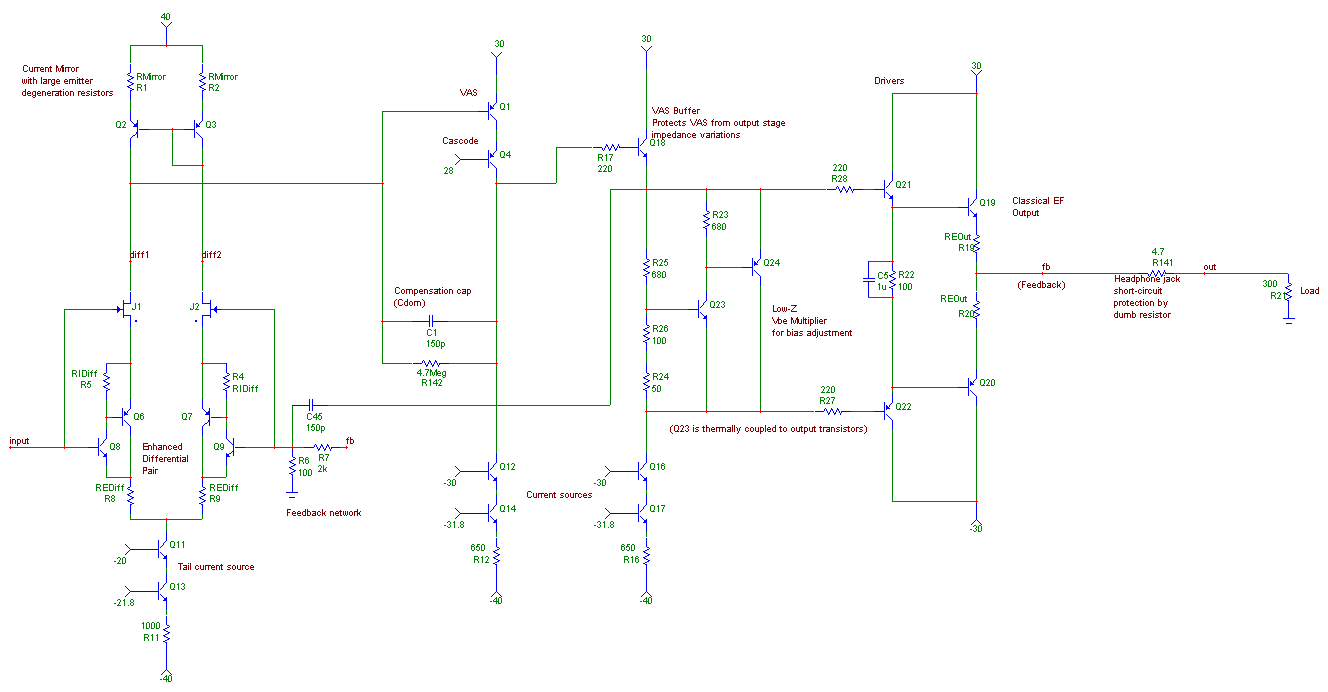
At first hand it seems implausible that something like this will matter. It doesn't show up in standard THD measurements (though it does show up in Hawksford-style pseudorandom filtered noise measurements). Yet later a few things came out: 1) it's a rediscovery of an effect that was initially confirmed decades ago in tube circuits (though the time constant in tubes is much bigger, far below concern audio frequency), 2) other people measured it, and 3) people built amplifiers that minimize the effect by minimizing variation in power dissipated across the primary gain devices (for example http://peufeu.free.fr/audio/memory/img/complete-schem-1.gif ). In discrete circuits it's not likely to be audible, but one wonders if it might be audible in ICs, especially given the tight thermal coupling between sensitive input stage and high power output stage in the same package. Given this, though we don't know, a perceptible effect to some ears is at least plausible. Just because no one has performed an ABC/HR test to confirm it doesn't mean we should dismiss it.
I guess my point is that it's too easy to make an error when seeing an "interesting idea and no data" and dismissing it. A cursory examination and making a quick call on whether a perceptible effect is audible is bound to lead to sometimes throwing out a baby or two with the bathwater. -
Re:An exercise for the reader
I mean subscription. http://www.aes.org/e-lib/subscribe/
-
Re:lol wut
Preringing is what the linear-phase oversampling filter in the DAC chip in the player creates. Which is also the place to fix it, by putting an apodizing filter there, and some semiconductor manufacturers do exactly that (Wolfson Micro, etc.). Dolby's approach makes no sense--they oversample 2x during mastering (needed or the apodizing filter doesn't work) and then you have to store twice the data. Why? If the DAC is doing it, then you can just feed it the usual 44.1 or 48 k. Moreover, since the DAC's filter usually oversamples by 8x to allow simpler analog filters post-DAC, it can do the apodizing much better anyway. Once again Dolby takes legit technology and implements it poorly into a lousy gimmick to sell. Instead of reading dumb marketing material and even dumber article summary on slashdot, read some peer reviewed papers discussing preringing and apodizing filters, say http://www.aes.org/e-lib/browse.cfm?elib=12992
-
Re:Apodizing Filter
Apodizing filters in audio were introduced a few years ago in DAC chip oversampling filters by Wolfson Micro. They are still FIR filters, with a compensation that allows one to smoothly set the amount of preringing reduction (really, shift to postringing so the filter can be continuously varied between linear phase and something similar to minimum phase). What's more interesting is that preringing outside the usual audio band still seems to be perceptible; follow the references in the paper http://www.aes.org/e-lib/browse.cfm?elib=12992
-
Re:Worthless gimmick with no audible benefits
The article summary is misleading. You should have done more digging before posting here, such as reading the peer-reviewed research that deals with the topic in question: http://www.aes.org/e-lib/browse.cfm?elib=12992
The issue at hand is removing artifacts on the reconstruction side, specifically, preringing, which audible outside the audio band (the ear uses a very narrow fourier transform window and is highly sensitive to preresponses; follow the references in the paper). Of course, Dolby is way late to this as I remember a major semiconductor manufacturer adding apodizing filters exactly for this reason to their DAC chips years ago. Dolby's approach is also stupid as this technique should be performed purely by the digital OS filter on the DAC side. Instead, Dolby does it during mastering, so that now you need to store 96 kHz data... and this way the apodizing is not nearly as effective than on the DAC side where audio usually is oversampled 8x rather than 2x (normally done so slow-rolloff analog filter can be used to remove the HF images and prevent them from causing nonlinear effects and intermodulation in the subsequent analog electronics). -
Re:You can prefectly represent anything up to Fs/2
The primary mechanism of ultrasound perception seems to be bone conduction: http://en.wikipedia.org/wiki/Ultrasonic_hearing and also see http://ieeexplore.ieee.org/iel5/5286202/5291232/05291285.pdf?arnumber=5291285 and there were some other related studies showing ultrasound that is not necessarily consciously perceptible does affect perception of music. In any case, for this article the 96 kHz thing is a red herring. The audible difference is due to the use of filters other than the usual symmetric FIR filters which cause preringing in reconstruction. Of course, Dolby is way late to the game here, as a few major semiconductor manufacturers added apodizing filters to their DAC chips years ago after people realized preringing was audible even outside of the usual audio band. See the paper on apodizing filters and preringing: http://www.aes.org/e-lib/browse.cfm?elib=12992
-
Re:You cant hear it anyway.
Here is a link to the original paper by Dr. Peter Craven where he mathematically proves that an apodizing filter can make audible improvements in sound reproduction.
http://www.aes.org/e-lib/browse.cfm?elib=12992
Unfortunately it's behind a paywall. but take my word for it's a pretty impressive piece of work.
Most people, whose sensibilities are not trained to the point where they are discriminating enough won't likely notice the difference. However the fact of the matter is the differences are measurable, the principle is based on sound math, and the results are in the perceptible audio spectrum.
Peter Craven made several important contributions to digital recording. He and Michael Gerzon did a lot to push forward the early development of surround sound technology, and made other significant contributions to the process of digital recording. In particular their work on dithering has had a big impact in improving the quality of CD recordings.
http://en.wikipedia.org/wiki/Michael_Gerzon
http://www.aes.org/e-lib/browse.cfm?elib=5872
-
Re:You cant hear it anyway.
Here is a link to the original paper by Dr. Peter Craven where he mathematically proves that an apodizing filter can make audible improvements in sound reproduction.
http://www.aes.org/e-lib/browse.cfm?elib=12992
Unfortunately it's behind a paywall. but take my word for it's a pretty impressive piece of work.
Most people, whose sensibilities are not trained to the point where they are discriminating enough won't likely notice the difference. However the fact of the matter is the differences are measurable, the principle is based on sound math, and the results are in the perceptible audio spectrum.
Peter Craven made several important contributions to digital recording. He and Michael Gerzon did a lot to push forward the early development of surround sound technology, and made other significant contributions to the process of digital recording. In particular their work on dithering has had a big impact in improving the quality of CD recordings.
http://en.wikipedia.org/wiki/Michael_Gerzon
http://www.aes.org/e-lib/browse.cfm?elib=5872
-
Re:You cant hear it anyway.
Here is a link to the original paper by Dr. Peter Craven where he mathematically proves that an apodizing filter can make audible improvements in sound reproduction.
http://www.aes.org/e-lib/browse.cfm?elib=12992
Unfortunately it's behind a paywall. but take my word for it's a pretty impressive piece of work.
Most people, whose sensibilities are not trained to the point where they are discriminating enough won't likely notice the difference. However the fact of the matter is the differences are measurable, the principle is based on sound math, and the results are in the perceptible audio spectrum.
Peter Craven made several important contributions to digital recording. He and Michael Gerzon did a lot to push forward the early development of surround sound technology, and made other significant contributions to the process of digital recording. In particular their work on dithering has had a big impact in improving the quality of CD recordings.
http://en.wikipedia.org/wiki/Michael_Gerzon
http://www.aes.org/e-lib/browse.cfm?elib=5872
-
Re:You cant hear it anyway.
Here is a link to the original paper by Dr. Peter Craven where he mathematically proves that an apodizing filter can make audible improvements in sound reproduction.
http://www.aes.org/e-lib/browse.cfm?elib=12992
Unfortunately it's behind a paywall. but take my word for it's a pretty impressive piece of work.
Most people, whose sensibilities are not trained to the point where they are discriminating enough won't likely notice the difference. However the fact of the matter is the differences are measurable, the principle is based on sound math, and the results are in the perceptible audio spectrum.
Peter Craven made several important contributions to digital recording. He and Michael Gerzon did a lot to push forward the early development of surround sound technology, and made other significant contributions to the process of digital recording. In particular their work on dithering has had a big impact in improving the quality of CD recordings.
http://en.wikipedia.org/wiki/Michael_Gerzon
http://www.aes.org/e-lib/browse.cfm?elib=5872
-
Re:P2P had no effect on music sales?
They could also raise the sampling rates 10x and quadruple the bitrate, it would mean huge files that would blow every analog recording away.
16 bit 44.1khz recordings are transparent to the human ear. No one can distinguish high res audio from 16/44 audio under blind conditions.
-
Re:The article writer is a deaf idiot
There are lots of double blind tests. Most that mean anything are between CD quality and above. No difference found after a year plus of testing. If you want to hear some differences in what's left out when items are compressed A refutation of the validity of double-blind audio tests The main point would be that a well mastered CD is better than a poorly mastered 192kHz/24 bit recording, and the same goes for a poorly mastered CD vs a 192 encoded well mastered piece. However, when the original quality material is of like quality, many can tell the differences until they get to CD quality. After that, a smaller segment can tell. What's been destroying music is the large group of folks who've never heard anything that wasn't put through a pipe filled with a wet sponge first. If that's all you've been exposed to, even the clear trill of a bird might sound unpleasantly harsh in its clarity.
-
Re:The article writer is a deaf idiot
Double blind test or gtfo. The peer reviewed research says you can't hear it. Talk is cheap, show us some data.
-
How audiophiles can fool themselves
Audiophiles are not known for using controlled, double-blind testing. That's a problem, because you can actually control a lot about how you hear things. In short, if you expect something to sound different, you can actually hear a difference; not imagine you hear a difference, actually hear a difference.
JJ Johnston gave a presentation, Why Do We Hear What We Hear?. (PowerPoint, but LibreOffice should open it just fine.) If you look at slides 14 and 16 you will see him explaining the above points.
With double-blind testing, the audiophile will not be able to tell the difference between a $2 cable from monoprice.com and a $1000 cable from some audiophile scam web site. Without the double-blind, a confident audiophile will hear differences that favor the expensive cable.
The crazy thing, and I'm not making this up, is that some audiophiles claim that double-blind testing "doesn't work". They claim that you introduce errors that mask the superiority of the expensive equipment.
P.S. If you would like to have quality audio gear, and you would like to see the gear tested scientifically, you have to check out the NorthWest AV Guy blog. He bought a $1000+ DAC/amplifier that audiophiles like and that tests well objectively, and then he designed a very inexpensive headphone amp that in double-blind testing cannot be distinguised from the expensive one... and he open-sourced the design; you can build one if you like, or buy one pre-built. He uses professional test gear, and for example he showed that the Sansa Clip really is a good-sounding media player (which plays Ogg Vorbis and FLAC, by the way). Check it out. (And NWAudioGuy, if I ever meet you in person, I'll buy you lunch or something.)
steveha
-
How to measure loudness
Since this is Slashdot, I'll share some details on the problem of measuring loudness.
Loudness is difficult to measure objectively, because loudness is what a human experiences when listening to audio. Intensity, on the other hand, is easy to measure; just get a sound level meter.
Why is loudness different than intensity? Because the human auditory system contains a natural filterbank that divides incoming audio up into multiple bands, and then applies an exponential scaling function to each band. Old books and papers call these bands critical bands; I think the more modern concept is ERBs.
For sounds that hit only one band, such as a pure sine tone, the intensity of the sound is a good approximation of loudness. But sounds that hit multiple bands scale roughly linearly in the number of bands hit. I'll give an example.
If you generate a pure sine tone at power level X, and then generate two sine tones each at power level X/2, then the measured intensity will be identical. However, if the two sine tones are in different bands, the loudness will be nearly double.
So, as a rule of thumb, the more frequency bands a given sound hits, the louder it is at any given power level. Something that sounds like white noise will be louder than something that sounds like a clear bell tone or a single flute note.
The people who make commercials know how to game the system. I'm pretty sure that there were already limits on measured intensity of commercials, but that wasn't enough to solve the problem.
Imagine you are driving along, listening to a radio show. Maybe talk radio, maybe NPR, whatever. You have the "volume control" knob on your car radio set to a comfortable listening level. The radio show only has audio at typical human speech frequencies, and isn't trying to sound loud. Now comes the commercial, which smears its audio all over the spectrum; it puts processing on the voice, with reverb and stuff. "Sunday Sunday Sunday-y-y-y!!!! M-m-monster truck demolition derby!!!" or whatever. It's not your imagination, it really is louder. But a sound level meter might say it's the same as the radio show content, or only slightly higher intensity level.
The company for which I work (DTS) has a solution to the problem called "Neural Loudness Control", and there is a white paper available that really goes into detail about this stuff, so you don't need to stop with my lame explanation. NLC has a full "loudness model" that approximates the human auditory system when computing a loudness metric; but it also can operate in a mode that follows the new standard.
Also, here's a PowerPoint presentation by JJ Johnston about loudness vs. intensity.
So the new standard, 1770, is a pretty easy-to-calculate approximation of loudness. You apply two filters: one that simulates the transfer function of an average human head, and the "RLB weighting curve"; then compute mean-square energy on the result. This is simple enough that nobody really has an excuse in the 21st Century that it would be hard to comply.
I'm a little worried that it is too simple, and there might be ways to trick it. For example, it doesn't seem to handle audio that is smeared across multiple bands to make it sound louder. But I'm not actually working in the area of loudness measurement, and from what I've heard, 1770 works okay for most stuff. It's better than no standard.
And on the gripping hand, 1770 is the law now.
steveha
-
Re:Why not...
AAC, developed by Dolby,
Incorrect. AAC was developed in an MPEG standards process. It was mostly based on the work of James D. Johnston ("JJ") who worked for Bell Labs at the time.
Basically, AAC started out as "PAC", which was JJ Johnston's follow-on to MP3. See slide 5 of this presentation (PowerPoint format, sorry, but LibreOffice Impress does open it):
http://www.aes.org/sections/pnw/ppt/jj/pac_history.ppt
JJ was quite unhappy with some of the compromised in MP3, compromises that were forced upon him by the standards process. PAC was his improved coder, which didn't include the parts he didn't like from MP3. PAC won the "bake-off" between prospective coders; it was enough better than the others that MPEG reconsidered their "backward compatible" strategy and decided to go ahead with "non-backward compatible" (NBC).
The Wikipedia page on AAC makes strangely little mention of JJ Johnston and his contributions, but if you look at the footnotes you will notice "J D Johnston" being frequently mentioned, especially in conjunction with the patents involved.
JJ is a good guy who deserves more credit than he gets on Wikipedia.
steveha
-
Re:nope, he wasn't part of Philips
Well, early Laserdiscs were totally analogue, but digital audio eventually dominated. And the CD didn't start digital audio recording - PCM was discovered in the 1930s and we've had recorders since around 1970. Worthwhile historical overview.
Whether CD is more like laserdisc or more like DVD depends on how you weight the differences (purpose, physical structure, manufacturing technique, modulation, encoding / error correction, data structure, etc.), of course. And LD too 's just pits and lands.
-
Re:Phirst phoast
And that is why, at a recent AES conference there was a great little speech given about how Audio is the only industry that eats its young. If it doesn't matter to the average consumer how it sounds, than we will progressively get worse and worse quality audio considered passable. It's sad enough that people are preferring the sound of MP3s and most have never heard music on anything better than crappy cheap earbuds or, at best, a poorly configured home theater system, yet they claim to love their music. If I had a nickel for every time I've sat someone down in front of a decent quality sound system (think $500 system, counting receiver and speakers or receiver and headphones) and played them an album that they, "know inside and out" and they find something new that they've heard before, I would be able to afford the amazing speakers that a friend works with. Let's be honest, as long as people consider iTunes 128 kbps AAC to be, "High Quality" and 256 kbps AAC to be, "Highest Quality" with 128 MP3 being acceptable, it doesn't matter how expensive your soundcard is, it won't sound good.
Why does it matter? If the listener is happy, who cares. Oh yeah, by the way, $500 is far from impressive. What, did you pick up a home theatre in a box deal? If you run a $3000 rig a home for music and $1000 setup in your car and can't stand the sound from your ear buds, maybe you are just being a pretentious asshole. Even better, if you are as familiar with sound quality as you posture to be, you would know, and accept, the difference. Instead, you take the side that you know better than everyone else. Thanks, very helpful. "Loving music" has fuck-all to do with sound quality. I suppose those who enjoyed the early days of radio didn't love their music?
-
Re:Phirst phoast
And that is why, at a recent AES conference there was a great little speech given about how Audio is the only industry that eats its young. If it doesn't matter to the average consumer how it sounds, than we will progressively get worse and worse quality audio considered passable. It's sad enough that people are preferring the sound of MP3s and most have never heard music on anything better than crappy cheap earbuds or, at best, a poorly configured home theater system, yet they claim to love their music.
If I had a nickel for every time I've sat someone down in front of a decent quality sound system (think $500 system, counting receiver and speakers or receiver and headphones) and played them an album that they, "know inside and out" and they find something new that they've heard before, I would be able to afford the amazing speakers that a friend works with. Let's be honest, as long as people consider iTunes 128 kbps AAC to be, "High Quality" and 256 kbps AAC to be, "Highest Quality" with 128 MP3 being acceptable, it doesn't matter how expensive your soundcard is, it won't sound good. -
Re:I've conducted my own blind tests...
Here's one such study conducted by the Audio engineering society:
-
Re:A true innovator
Mod parent way up.
Les Paul was a great talent, but it was in fact Ross Snyder at Ampex who came up with the idea of Sel-Sync (recording in sync with previously recorded tracks), and it was Ampex engineers such as Mort Fujii who actually made it work. Multiple tracks on the same tape already existed, but the ability to record multiple passes in sync with each other did not.
Les did end up paying $10,000 for that machine though! -
Re:A classic problem
I'd be curious to know if(at least for the more valuable data) it would be possible/practical to build a sort of general purpose reader for obsolete media.
By the time a given medium is obsolete, and reader hardware for it is no longer available, magnetic sensor technology will presumably have advanced considerably from where it was when the medium was originally designed. Thus, it seems like it should be possible to build a magnetic sensor that can detect the magnetic structure of a tape with resolution better than the original purpose built hardware. From that, you'd work in software to duplicate the original read process. This would be an analog of that, with optical reading of a mechanically recorded medium.
I suspect that such a project would be quite expensive, so they would have to be very interesting data to make it worthwhile. -
Re:Digital Artifacts..
CD quality is already overkill: http://www.aes.org/e-lib/browse.cfm?elib=14195
-
Re:Show me the quality
The masses have been happily accepting convenience over quality for decades: cassettes vs vinyl, VHS vs Laserdisc, and 16Bit/44.1KHz CD's are still considered high quality when most albums have been recorded at 24 bit
It's the same reason a McDonald's burger is still considered food: it's easier not to care. -
Re:Vista's missing features
I use it daily, not just for email and presentations but I actually write code on it.
I'm glad you changed the defaults. Out of the box, Vista is unsuitable for presentations. We found that out the hard way, We were doing a presentation using the brand new laptop in the field. There was no internet connection. We used a projector as the second monitor (Presentation mode/dual monitor). About 20 minutes into the presentation while playing a DVD, the movie playback stopped and the player minimised leaving a blank desktop. WTF???? We got up and checked the laptop screen for errors. There is an update for Acrobat Reader. It was a prompt to check for updates!
Since you do presentations, I can only assume you turned UAC prompts off as they are incompatible with live presentations.
Annoying one user is a bother. Shutting down the presentation is reason to use something else reliable for the task.
Speed isn't the only problem. The default configuration is unsuitable for presentations and live DAW recording.
Other software provides multitrack latency in the 1-3 mS range. Vista requires a huge buffer with no guarantee of under/over run glitches and low jitter. Lots of memory may provide a better buffer but at the cost of latency. A 500 mS buffer is OK for simple recording, but it is totaly unsuitable for layering in another track. (Playing background track while recording lead or vocal tracks)
"The authors explain why current popular computer architectures are not suited to these new tasks,"
http://www.aes.org/e-lib/browse.cfm?elib=8182
"While the software may function adequately with onboard soundcards for basic editing and production, better fidelity and greatly enhanced multitrack performance will accompany the use of one of the large number of boxes or cards that are made specifically to handle audio for DAW software. These devices generally add monitoring and mixing software along with multiple digital or analog inputs and outputs. They can communicate with the computer and software via the internal protocols in the Mac or PC OS, or may, as long as the software is compliant, work with another Steinberg-developed open, cross-platform protocol called ASIO. ASIO can enhance the communication between your software and I/O hardware, and some hardware and software manufacturers are now advertising "near zero latency monitoring" using ASIO."
http://radiomagonline.com/recording/radio_technology_fuels_creativity/index2.html
Vist and AISO is buggy.
http://www.bjorn3d.com/forum/showthread.php?t=19107
"So, I switched over the the AISO Multimedia Driver and that's when the latency kicked in. If I hit a key on my MIDI the delay was almost a full five seconds before the not would sound off." (Vista Home)
http://en.wikipedia.org/wiki/Audio_stream_input_output "ASIO bypasses the normal audio path from the user application through layers of intermediary Windows operating system software, so that the application connects directly to the soundcard hardware."
MS doesn't like it when you have direct access to unprotected audio streams..
"Sonars WDM/KS connects close to the Kernal layer but doesn't entirely bypass the WDM "Audio stack" while ASIO shouldn't go near it at all. It remains to be seen if the Vista that's released will prevent special drivers like ASIO, but since Steinberg have now gone to the trouble of releasing a 64bit ASIO spec, I should think Vista will be business as usual for most of us.
However, if the "audio stack" has been reworked, I hope someone from Cakewalk can say if WDM/KS will still be available under Vista. It will still be needed to bypass windows sound with whatever the normal Vista driver is." -
Re:Randi missed his target
Ah, but my point was that it doesn't make any perceptible difference so why bother?
Incidentally, Klipsch was quite interested in creating low distortion sound. Distortion is roughly proportional to the power input to any loudspeaker, so with less power you also get less distortion. If you're particularly interested in the subject you can purchase several relevant papers from the AES and IEEE.
http://www.aes.org/e-lib/browse.cfm?elib=2018
http://ieeexplore.ieee.org/xpl/freeabs_all.jsp?arnumber=1166350 -
Re:AAC "quality" irrelevant ...
More importantly the improved "quality" of 256 kb AAC over 256kb MP3 is largely hypothetical, few if any could tell the difference.
There are sites out there offering decent rewards (in the thousands of US$) to anyone able to tell the difference between 256kb MP3 and uncompressed audio in double-blind A/B tests (of course there are specifications on which version of LAME and options are used for the encoding). I just googled around and couldn't find the links, sadly; I'll see if I can dig it up later.
On a somewhat related note, the most recent edition of the Audio Engineering Society's journal includes the interesting study"Audibility of a CD-Standard A/D/A Loop Inserted into High-Resolution Audio Playback", E. BRAD MEYER AND DAVID R. MORAN, J. Audio Eng. Soc., Vol. 55, No. 9, 2007. It pretty conclusively demonstrated that 16/44 (normal CD quality) and 24/96 (Super Audio CD/HDCD quality) raw audio are also essentially indistinguishable (using a long-term double-blind testing with hundreds of trials including college students, subscribers and editors of a well-known audiophile magazine, and professional mastering engineers). It notably included long-duration testing as well--not just the typical "listen for a few minutes to A, then a few minutes of B and try to distinguish". It was possible for some listeners to pick up differences under extreme conditions (scaling up the audio and jacking up the decibel levels), but not under normal "listening to it played normally on high-end audio equipment" conditions.
That's not to say that your SACD collection is worthless, but it's the care that goes into mastering products aimed at an audiophile market rather than the extra bits that might make it sound better (meaning that it's unlikely to be any better than that well-done Mobile Fidelity or whoever "audiophile" mastering of a standard CD, unless better mastering sources are found or something like that). -
Re:Whirlpool
The patents (or lack thereof) have not had effects on cryptography endorsements before.
Yes they have. In particular the AES competition required that submitters adhere to certain restrictions regarding patents.
One of the more popular AES candidates in use is the 384-bit key-based cipher, Blowfish, which has a public domain specification and is very useful in slow key-rescheduling conditions.
Blowfish was never an AES candiate
.. Blowfish, which has a public domain specification and is very useful in slow key-rescheduling conditions.
I'm not even sure what you mean here. On the whole, a slow key-schedule is a bad idea. You want your key schedule to be as fast as possible. The reason for this is that a fast key-schedule means you can target more platforms with the cipher (such as smart cards et al).
If you want to slow down dictionary attacks there are better ways to do this. Repeatedly hashing the passphrase is more sensible since the number of hashes can be scaled to the platform speed. Stopping a brute-force of a smart card is a world different to brute-force of a PGP disk.
Blowfish on the whole is a poor design. Now that we have AES I would recommend that over anything else.
Simon
-
AAC is a standard...it's the Advanced Audio Codec, part of MPEG-4, and while not "open source" open, it's not proprietary, is available to anyone, and is as open as MP3. http://www.aes.org/publications/downloadDocument.
c fm?accessID=14703162000122117You seem to be confusing AAC with Fairplay, which is the digital rights management wrapper Apple places around AAC when music is purchased on the iTunes Music Store.
-
Re:Drivers?
http://www.digigram.com/digigram_news/latest_news
. htm?o=full&news_key=280
Digigram is making headway into Linux. I will be supporting these folks when I can, they make excellent sound cards. They were one of the few companies that didn't give me blank stares when I inquired about Linux support at the recent 114th AES (Audio Engineering Society) convention. -
You are the one who is uninformedWhy do you post when it is clearly you who is misinformed?
FACT: most people can hear up to at least 30 kHz. No, they cannot hear a pure sine wave at that frequency. But they can hear a difference if such frequencies are or are not present in the music. Moreover, almost all music contains such frequencies. No, not as pure sine waves. And it is not even the harmonics that cause the effect. Rather, because to duplicate the waveform transients, you must have the high frequencies. (Think Fourier.)
Yes, such transients are reproduced on vinyl. No, they are not reproduced on CD.
There are various controlled studies demonstrating these things. Since you are such an authority, I shouldn't need to give you references, but since I'm so magnanimous, I'll give a few anyway:
- M. L. Lenhardt et al., "Human ultrasonic speech perception", Science [sciencemag.org] 253: 82 [1991].
- T. Oohashi et al., "High-frequency sound above the audible range affects brain electronic activity and sound perception", AES Preprints [aes.org]
91: 3207 [1991]. - P. Mills, "The need for extended high-frequency bandwidth [westhost.com]" [1999].
Your final star'ed points are just dumb. You don't give any references, because of course you don't have any. Get a good turntable/arm/cartridge. The reverse of most of what you say is true. E.g. your claim of 60dB dynamic range is nuts: the range is over 100 dB. You are confusing the noise floor of a high-hiss record with dynamic range--but you can hear 20 dB into that noise, and a good record need not have high hiss. Vinyl has poor bass??? It's much better than CD. And so on.
- M. L. Lenhardt et al., "Human ultrasonic speech perception", Science [sciencemag.org] 253: 82 [1991].
-
Re:Yet another video app that ignores audio...Sorry, no... Ask anyone in the Society of Motion Picture and Television Engineers, The Audio Engineering Society, or the Society of Broadcast Engineers and they'll tell you that though it's only treated that way, sound is just as important as visuals, if not more so.
Come to think of it, you just did.
As for evidence, I was using the most mainstream one I can think of. Do you have any examples to refute it, such as a film with stunning visuals and sub-par sound?
-T
-
Re:wtf?lorax wrote:
Because most of the 'really well known' and yet APPROPRIATE standards bodies require you to be a member to submit or make changes to a proposed spec and it costs money to be a member.
Well, yes, that's probably true, but I think the hurdle is a bit lower than you would make it out to be.
I agree with the original question--the choice of the IETF seems a strange starting point. It would be nice to get them, but perhaps starting "smaller" would be easier.
For instance, there's the Audio Engineering Society, who have tons of published standards. Membership is $80. I'm betting Xiph could swing that.
Or there's the the IEEE, who charge a cool $132 per year.
Anyway, yeah they cost money, but come on, don't you think a hundred dollars US to get a standard published would be a decent investment? I imagine they could get the community to chip in. Hell, I'd kick in $10 if the standards body they joined said they had a chance of getting Ogg published as a standard.
adéu,
Mateu -
Re:wtf?lorax wrote:
Because most of the 'really well known' and yet APPROPRIATE standards bodies require you to be a member to submit or make changes to a proposed spec and it costs money to be a member.
Well, yes, that's probably true, but I think the hurdle is a bit lower than you would make it out to be.
I agree with the original question--the choice of the IETF seems a strange starting point. It would be nice to get them, but perhaps starting "smaller" would be easier.
For instance, there's the Audio Engineering Society, who have tons of published standards. Membership is $80. I'm betting Xiph could swing that.
Or there's the the IEEE, who charge a cool $132 per year.
Anyway, yeah they cost money, but come on, don't you think a hundred dollars US to get a standard published would be a decent investment? I imagine they could get the community to chip in. Hell, I'd kick in $10 if the standards body they joined said they had a chance of getting Ogg published as a standard.
adéu,
Mateu -
Re:Unfacts and FUDRegarding your comments, please consider....
1. You don't actually rebut my point.
2. Have you tried listening with a good turntable/tonearm/cartridge? Again, you avoid the main issue.
As for (B), since you are such an authority, I shouldn't need to give you references, but since I'm so magnanimous, I'll give a few anyway:- M. L. Lenhardt et al., "Human ultrasonic speech perception", Science 253: 82 [1991].
- T. Oohashi et al., "High-frequency sound above the audible range affects brain electronic activity and sound perception", AES Preprints
91: 3207 [1991]. - P. Mills, "The need for extended high-frequency bandwidth" [1999].
3. This is just point 2 again.
4. We agree here, I think. I was referring to analog equalizers (which seems to be what your original post was citing).
Your last comment seems an attempt to slip by the issues. My remark was hardly ad hominem (think about it). - M. L. Lenhardt et al., "Human ultrasonic speech perception", Science 253: 82 [1991].
-
SACD is inherently second-rateThe Audio Engineering Society held it's 109th conference at the end of last month. One of the papers presented at the conference was
"Why Professional 1-Bit Sigma-Delta Conversion is a Bad Idea", Stanley P. Lipshitz and John Vanderkooy, University of Waterloo
This is a mathematical proof that SACD (i.e. 1-bit sigma-delta conversion) is the wrong approach. It is better to stick with standard sampling technology--though with a greater sampling frequency and more bits/sample than used by CDs (i.e. DVD-Audio). Lipshitz and Vanderkooy are well-respected applied mathematicians.
The paper is available as AES preprint #5188, but at a charge. There is a brief write up about it in Stereophile at http://www.stereophile.com/shownews.cgi?860, which also discusses some related issues.
See also comment #211.
-
SACD is inherently second-rateThe Audio Engineering Society held it's 109th conference at the end of last month. One of the papers presented at the conference was
"Why Professional 1-Bit Sigma-Delta Conversion is a Bad Idea", Stanley P. Lipshitz and John Vanderkooy, University of Waterloo
This is a mathematical proof that SACD (i.e. 1-bit sigma-delta conversion) is the wrong approach. It is better to stick with standard sampling technology--though with a greater sampling frequency and more bits/sample than used by CDs (i.e. DVD-Audio). Lipshitz and Vanderkooy are well-respected applied mathematicians.
The paper is available as AES preprint #5188, but at a charge. There is a brief write up about it in Stereophile at http://www.stereophile.com/shownews.cgi?860, which also discusses some related issues.
See also comment #211.