Slashdot Mirror
Domain: anandtech.com
Stories and comments across the archive that link to anandtech.com.
Comments · 3,318
-
Re:How does this compare
Wrong. We discuss it. But when we start talking about price you people go back to this. Exactly this.
The i7-4770 costs 4+ times as much (currently if you pre-order) as the most expensive AMD A10 chip, which also arent even the fastest AMD chips available.
i7 4770k –$339
A10 5800k - $129.99
So we're looking at a chip that's 2.6 times the price, but 4 times the CPU performance.Price was brought up, so you responded by not mentioning price at all, and proceeded to compare the highest performing Intel chip ever with a mid-range AMD part.
No, the assertion that the intel chip was 4 times more expensive was brought up, and neglected to mention the context that the intel chip was also 4 times faster (and also greatly exaggerated the 2.6 times price). I merely noted that there's a reason for the intel chip being significantly more expensive – that it's significantly faster.
You're right, the AMD chip is indeed a mid range chip, and it should never even have been compared to the i7. Unfortunately, AMD has no chip that can reasonably be compared to the i7, so all the review sites chose the fastest CPU AMD has on offer that includes an IGP. If you want to push it a bit further, lets ignore the IGP completely, and take the fastest desktop chip AMD has on offer:
FX 8350 –$199.99
i7 4770k –$339
So, we're at 1.9 times the price, and around 1.8 times the performance (see here).
But, of course, we all know that price increases exponentially with performance when it comes to high end processors, so lets just scale back that intel part a bit:
FX 8350 –$199.99
i5 4670 –$213
So now we're at 1.06 times the price (effectively equal), but about 1.5 times the performance (see here).
If you really want to make the price war completely in intel's favour, then look at
FX 8350 –$199.99
i5 4570 - $192
Unfortunately Anand do not list this in their benchmarks, but it's the exact same die as the 4670, just clocked 6% lower, so we can extrapolate the result, and say that this i5 will be around 1.4 times the speed of the FX 8350 Oh, and by the way, it throws in a decent IGP, while the FX 8350 does not. It also consumes only 67% of the power under load, and that's including the IGP.So conclusion. Haswell is pretty effectively blowing AMD out of the water. The A10 5800 remains reasonably unscathed only because Haswell i3s have not yet been released. When the i3 4220 appears, I would fully expect the A10 to lose to it in every respect in the same way as the FX 8350 loses to the i5 3570 in pretty much all ways.
-
Re:How does this compare
Wrong. We discuss it. But when we start talking about price you people go back to this. Exactly this.
The i7-4770 costs 4+ times as much (currently if you pre-order) as the most expensive AMD A10 chip, which also arent even the fastest AMD chips available.
i7 4770k –$339
A10 5800k - $129.99
So we're looking at a chip that's 2.6 times the price, but 4 times the CPU performance.Price was brought up, so you responded by not mentioning price at all, and proceeded to compare the highest performing Intel chip ever with a mid-range AMD part.
No, the assertion that the intel chip was 4 times more expensive was brought up, and neglected to mention the context that the intel chip was also 4 times faster (and also greatly exaggerated the 2.6 times price). I merely noted that there's a reason for the intel chip being significantly more expensive – that it's significantly faster.
You're right, the AMD chip is indeed a mid range chip, and it should never even have been compared to the i7. Unfortunately, AMD has no chip that can reasonably be compared to the i7, so all the review sites chose the fastest CPU AMD has on offer that includes an IGP. If you want to push it a bit further, lets ignore the IGP completely, and take the fastest desktop chip AMD has on offer:
FX 8350 –$199.99
i7 4770k –$339
So, we're at 1.9 times the price, and around 1.8 times the performance (see here).
But, of course, we all know that price increases exponentially with performance when it comes to high end processors, so lets just scale back that intel part a bit:
FX 8350 –$199.99
i5 4670 –$213
So now we're at 1.06 times the price (effectively equal), but about 1.5 times the performance (see here).
If you really want to make the price war completely in intel's favour, then look at
FX 8350 –$199.99
i5 4570 - $192
Unfortunately Anand do not list this in their benchmarks, but it's the exact same die as the 4670, just clocked 6% lower, so we can extrapolate the result, and say that this i5 will be around 1.4 times the speed of the FX 8350 Oh, and by the way, it throws in a decent IGP, while the FX 8350 does not. It also consumes only 67% of the power under load, and that's including the IGP.So conclusion. Haswell is pretty effectively blowing AMD out of the water. The A10 5800 remains reasonably unscathed only because Haswell i3s have not yet been released. When the i3 4220 appears, I would fully expect the A10 to lose to it in every respect in the same way as the FX 8350 loses to the i5 3570 in pretty much all ways.
-
Re:Why would Intel care
Why would Intel care about raw CPU performance. They have no competition from AMD in CPU performance. The GPU performance may not be as good as A10, but it has improved and that's what matters for Intel.
What?
The GPU performance of the new high-end Iris Pro 5200 blows away the AMD A10. The mobile i7-4950 varies between 110% and 150% of the desktop A10-5800K... when AMD releases a mobile A10 for benchmark, it won't look pretty. Source: AnandTech: Intel Iris Pro 5200 Graphics Review: Core i7-4950HQ
-
Re:Performance per Watt
Anandtech tested it, idle power is down probably due to the new voltage regulator (FIVR) but active power.... 113% the performance for 111.8% so performance per watt is essentially unchanged. If what you need is CPU power then you're better off waiting for a IVB-E hex-core in Q3, in threaded applications a quad-core Haswell won't touch a hex-core Ivy Brigde - it's trailing Sandy Bridge hex-cores as well. If you're not interested in the graphics or battery life, it's a giant yawn.
That said, the GT3e graphics for mobile looks to carve out a solid niche in the notebook market, the R-series desktop processors (GT3e graphics, BGA only) is probably compelling for AIOs that don't have room for graphics upgrades anyway and the lower idle wattage should be good for all laptops with Haswell graphics. None of the processors launched now have the new idle states for ultramobile/tablets, so the effect of those we'll have to wait to see. Anandtech tested the i7-4950HQ and it was impressive how a 47W mobile chip consistently beat AMDs A10-5800 100W desktop APU in gaming benchmarks. Of course it's going to sell in a price range of its own, but AMD just lost the crown here.
As a CPU in a regular tower with discrete graphics it's at best incremental but I think the full launch lineup hit all of Intel's main competitors - it's threatening AMD and nVidia's low end discrete card sales, it's threatening AMDs APU sales and the lower idle power is promising for their lower power parts that will compete with ARM. They're just not winning much against the i7-3770K but then they're also fighting against themselves in that market, the FX-8350 is not even close. The 8-series chipset finally brings 6 SATA3 ports, so the main AMD advantage chipset-wise also disappeared.
-
Re:Transactional Memory support
But when it comes to general performance improvement it's rather disappointing. Looks like they have fine tuned the current architecture without actually adding something that increases the performance at the same rate as we have seen the last decades. To some extent it looks like we have hit a ceiling in increased performance with the current overall computer architecture and that new approaches are needed. The clock frequency is basically the same as for the decade old P4, the number of running cores on a chip seems to be limited too, at least compared to other architectures.
Even single-threaded performance, even if you normalize for identical frequencies, has increased since Core 2. That they have increased since Pentium 4 goes without saying. We do not see the same increases in instructions per second that we used to do, but we still have increases. This page (and the next) from Anandtech was quite illuminating.
-
Mod parent up
-
Re:Desktop is forgotten
This uses special 2D hardware you find in cell phone chips and some gaming (handheld or home) consoles. It offloads scaling, color space conversion, maybe rotation, JPEG decoding etc., maybe encoding the output of a digital camera; on a PC's graphics card you try using the video scaler but it's more limited and "fixed function".
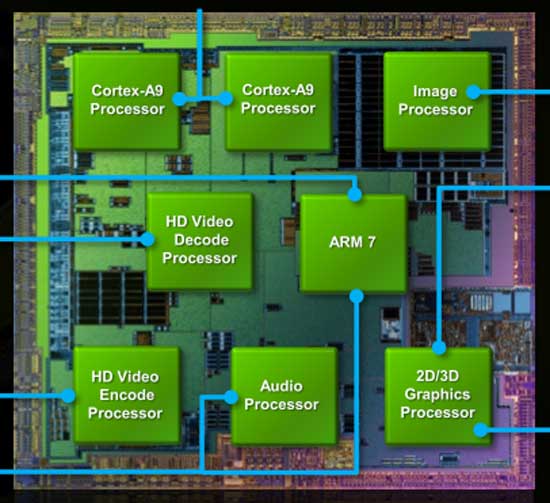
For instance you can look at "Video Display Controller" and "Image Processor" on these diagrams (not too sure about the first one)
http://images.anandtech.com/doci/3912/boxee-02.gif
http://images.anandtech.com/reviews/SoC/NVIDIA/Tegra2/tegra2blocki.jpgOn a PC they just send everything to OpenGL instead, which is more wasteful but because the computer is so powerful and can afford power to be wasted, the Wayland/Ubuntu/Gnome 3 devs think it is okay for you (of course it is disastrous if your OpenGL driver is not up to par, doesn't exist or if you want to run a desktop in a VM)
Intel Quicksync could probably be used, it's a kind of DSP you find in recent Intel CPUs but it's maybe not supported on Linux and Intel disables it on Celeron and Pentium (assholes). -
Re:Desktop is forgotten
This uses special 2D hardware you find in cell phone chips and some gaming (handheld or home) consoles. It offloads scaling, color space conversion, maybe rotation, JPEG decoding etc., maybe encoding the output of a digital camera; on a PC's graphics card you try using the video scaler but it's more limited and "fixed function".
For instance you can look at "Video Display Controller" and "Image Processor" on these diagrams (not too sure about the first one)
http://images.anandtech.com/doci/3912/boxee-02.gif
http://images.anandtech.com/reviews/SoC/NVIDIA/Tegra2/tegra2blocki.jpgOn a PC they just send everything to OpenGL instead, which is more wasteful but because the computer is so powerful and can afford power to be wasted, the Wayland/Ubuntu/Gnome 3 devs think it is okay for you (of course it is disastrous if your OpenGL driver is not up to par, doesn't exist or if you want to run a desktop in a VM)
Intel Quicksync could probably be used, it's a kind of DSP you find in recent Intel CPUs but it's maybe not supported on Linux and Intel disables it on Celeron and Pentium (assholes). -
Re:That's what is so funny to me
"The point is that an ARM processor can provide, say, 75% of the performance for 25% of the power compared to x86. "
http://www.anandtech.com/show/6529/busting-the-x86-power-myth-indepth-clover-trail-power-analysis
From the article: "Ultimately I don't know that this data really changes what we already knew about Clover Trail: it is a more power efficient platform than NVIDIA's Tegra 3."
This single data point doesn't mean 32nm Atom is more power efficient than any other ARM device, but it illustrates that the gap you imply is device-specific -- not inherent to the microarchitectures. There are going to be ARM devices that are more power efficient than Atom and Atom devices that are more power efficient than ARM.
-
Re:Partly about games?
Really? I've been looking and what I was able to find over the past 15 minutes is that both have what is likely the same AMD x86 8 core 1.6GHz processor, same generation AMD GPU, the same amount of memory (XBoxOne DDR3, PS4 DDR5), same 500GB disk space, same BluRay optical disk format, same 802.11n WiFi, similar cloud-based execution off-loading strategies (Azure vs Gaikai)...
Even in terms of MIPS, these new console CPUs are a fraction slower than the previous generation, even though their GPUs are orders of magnitude better than the previous generation.
Specs wise, they appear identical to each other aside from the Xbox being Windows 8 at it's core and Sony *likely* continuing down their Linux-ish roots.
The only differences appear to be in the form of the User Interface and Peripherals.
I am being completely honest here and would like to hear what would make the PS4 significantly more powerful than the XBoxOne as to help impact my purchasing decisions.
Whenever you want to talk about hardware, go to Anandtech. It turns out the GP was exactly correct. The PS4 GPU is 50% faster than the One: http://www.anandtech.com/show/6972/xbox-one-hardware-compared-to-playstation-4
I wonder whether that will translate to 50% higher framerates or more eye candy/resolution.
-
Re:hUMA
For gaming on a single GPU _ANY_ quad-core shows almost NO difference.
Obviously there are some exceptions such as Civ V which are heavily CPU bound, but 90% of all games are GPU bound.
http://www.anandtech.com/show/6934/choosing-a-gaming-cpu-single-multigpu-at-1440p
-
Re:Heh
What AMD has here is a successor to Brazos, and the primary competitor is Atom.
So AMD says, but Tom's Hardware disagrees:
So what about the Core i3-3217U, a 17 W processor? Surely that one is a more virile competitor, and not much more expensive than the Pentium. Core i3's on-die HD Graphics 4000 engine with its 16 EUs stomps all over the A4's 128 ALUs, despite the backing of AMD's capable Graphics Core Next architecture. Now, AMD claims that Kabini isn't meant to go up against Core i3. But we found notebooks with this exact CPU selling for as little as $360 on Newegg. It may turn out that the free market doesn't let AMD choose which Intel-based platforms its Kabini-based APUs contend with.
The cheapest laptop newegg sells that I could find was $250, so there's a good $100 range where Atoms, Celerons, Pentiums and AMD is battling it out - that's not much, really.
It also equals or beats an Ivy Bridge based Pentium in all measures except single threaded performance
Which is likely the part that matters in these laptops. I mean if you're trying to use these for serious number crunching you are using the wrong tool for the job. It's not like the single threaded performance is poor, it is horrible. Anandtech compared it to a i7-3517U, which is totally unfair price-wise (it's a $350 chip) but fair power-wise (it's a 17W chip). In cinebench single-threaded the Intel chip scored 1.24, the A4-5000 0.39 - that's a 3.18x performance lead with 2W higher TDP, 2.8x if you scale it to be equal. You're getting a not-quite-as-dog-slow-as-an-Atom ultra mobile laptop, but you're not getting anything fighting above it's league either.
-
Re:Just so you know
i740 was AGP only, because Intel was trying to use it as a lever to push people to Slot-1 away from Socket-7, to screw AMD over. Those cards were also notorious for only working in AGP slots that happened to talk to Intel chipsets, and Intel CPUs.
Yeah, I supported one of those products long ago - the Diamond Stealth II G460.
-
Re:Ok, great!
But can it play Crysis?
Yes, rhetorical question, I know.
But taking it seriously... The new Xbox GPU is said to be similar to the Radeon 7790. And according to Anandtech, that card can indeed handle Crysis in full HD at more modest settings at playable frame rates (though not a full 60 fps).
That said... who cares? Crysis is basically a benchmark masquerading as a game. It's amazing how much publicity Crytek got by hiring programmers who don't know how to optimize.
-
Re:Heat
Interesting, I was going off of this http://www.anandtech.com/show/6248/haswell-at-idf-2012-10w-is-the-new-17w
-
Re:SSD makers put in ram caches
Bungled my HTML. Here we go again:
" offers 256 MB of Samsung DDR2 SDRAM cache memory", just to re-iterate, SSD makers add RAM cache because RAM cache is faster.
That speed is after the RAM cache is through.
Don't believe me? Another benchmark. That's a random drive that I arrived at by entering "anandtech ssd review" into Google and picking the first link. It's not even the fastest drive in the charts on that page, by far.
The write speed they measured was 317 MB/s. The total amount of data written to the disk was over 100 GB -- so plenty to get past the RAM cache and to the actual SSD. If the 317 MB/s is limited by the RAM and not Flash speed, that means the Flash is even faster.
Don't like that benchmark or Anandtech? OK, here's one from Tom's Hardware. Measured the time do decompress a 50 GB folder. (Again, the RAM cache on the drive and your OS buffer cache (<8GB) isn't gonna save you.) The throughput during that test was ~300 MB/s. You can't get that if you're not writing that fast to the flash.
and benchmark scenarios that don't happen in the real world.
Fine, I'll give you a real-world scenario as best as I can. In a moment, I'll switch over to my Windows box and compile something on SSD and then on HDD. We'll see who wins.
-
Re:SSD makers put in ram caches
" offers 256 MB of Samsung DDR2 SDRAM cache memory", just to re-iterate, SSD makers add RAM cache because RAM cache is faster.
That speed is after the RAM cache is through.
Don't believe me? Another benchmark. That's a random drive that I arrived at by entering "anandtech ssd review" into Google and picking the first link. It's not even the fastest drive in the charts on that page, by far.
The write speed they measured was 317 MB/s. The total amount of data written to the disk was over 100 GB -- so plenty to get past the RAM cache and to the actual SSD. If the 317 MB/s is limited by the RAM and not Flash speed, that means the Flash is even faster.
Don't like that benchmark or Anandtech? OK, here's one from Tom's Hardware. Measured the time do decompress a 50 GB folder. (Again, the RAM cache on the drive and your OS buffer cache (and benchmark scenarios that don't happen in the real world.
Fine, I'll give you a real-world scenario as best as I can. In a moment, I'll switch over to my Windows box and compile something on SSD and then on HDD. We'll see who wins.
-
Re:Flash is slow to write
Except flash is very slow to write, so slow that Android won't let you write to flash on the foreground thread.
There are different grades of flash. SD cards and USB sticks are bad. Actual SSD drives that you use as a substitute for HDDs write faster than HDDs.
On Windows writes are done async the call returns before the write has completed and it doesn't slow you down as a result.
Point me to them
"While the Vertex 3 [pure SSD, no caching] is still a bit faster, you can't argue that Intel's SRT doesn't deliver most of the SSD experience at a fraction of the costâ"at least when it comes to individual application performance."
"Performance keeps going up. The maximized SRT system is now virtually indistinguishable from the standalone SSD system."
"I worried that Intel's SRT would only cache the most frequently used level and not improve performance across the board. I was wrong."
The story isn't entirely good -- after all, it's not a full-blown SSD -- but like I said, it's absolutely false to say that SSDs only help with boot time.
I've never seen anything real world other than a boot demo
Congrats on your ass-talking, considering that you just admitted that you have no information to support your claims.
The benchmarks I've seen treat the read times in isolation, but of course if its in RAM already, the read never happens, so the real world read time is zero and there's no much optimization possible on zero.
-
Re:osx?
I see that you don't really understand what Apple's Fusion Drive really is. In Intel's SRT the SSD drive acts like a cache for the HDD. I hope I don't need to explain what a disk cache is and how it works. In the Fusion Drive on the other hand both drives appear as a single logical volume with the space of both drives combined and the OS decides which files get stored on the SSD and which on the HDD. From the Ars Technica article I quoted:
In a caching solution, like Intel's, files live on the hard disk drive and are temporarily mirrored to the SSD cache as needed. In an enterprise auto-tiering situation, and with Fusion Drive, the data is actually moved from one tier to another, rather than only being temporarily cached there.
Those are two very different approaches.
-
Numbers may be subject to change..
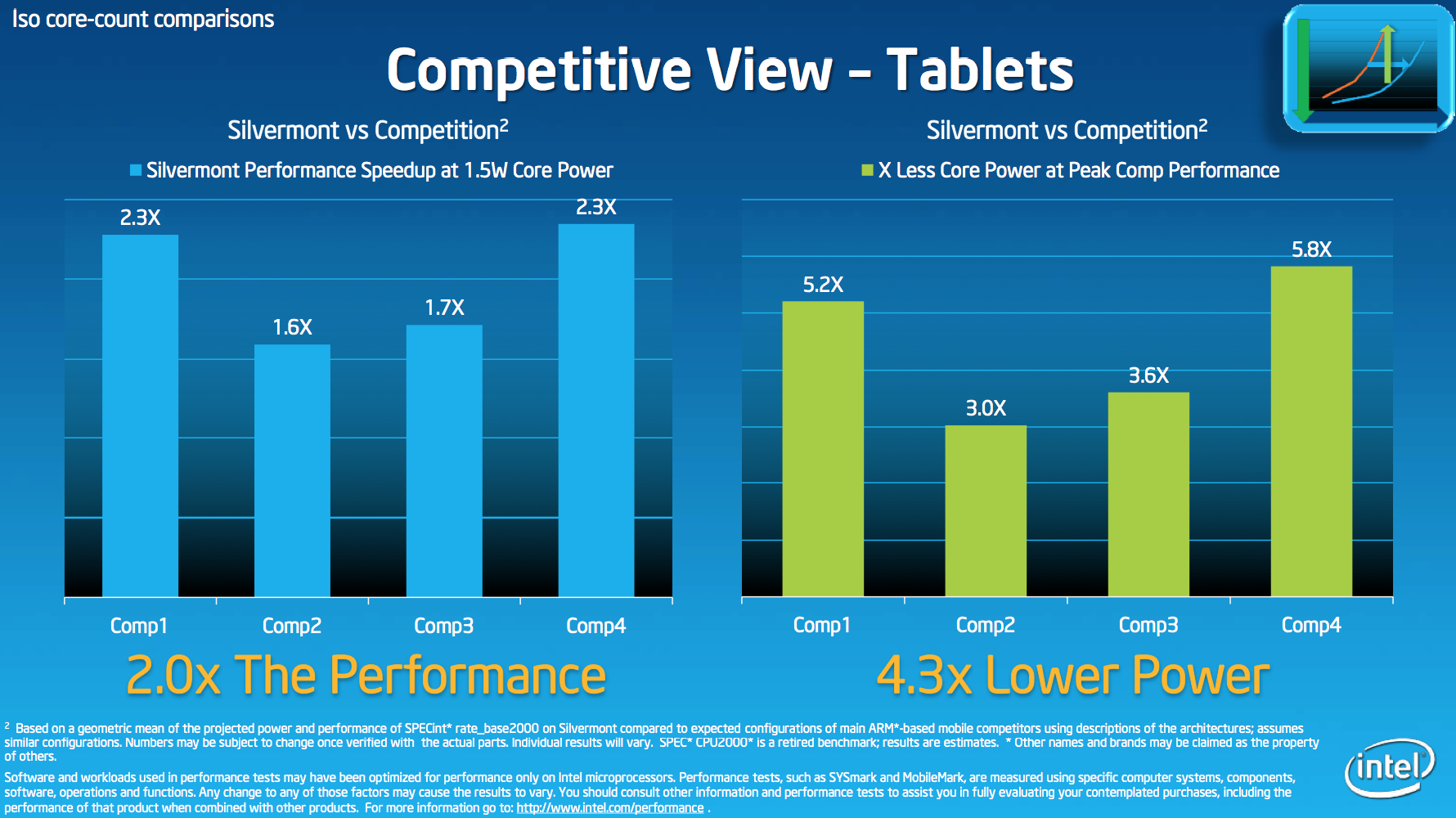
* Numbers may be subject to change once verified with actual the parts.
http://images.anandtech.com/doci/6936/Screen%20Shot%202013-05-06%20at%2011.16.42%20AM.png
So this is marketing pulling figures out of somewhere and posting them as the Ultimate Truth, without actually having the hardware to test them with?
-
Re:Run compute intensive tasks remotely
thank you CUDA and OpenCL
OpenCL-heavy tasks can be done on a compute server at home or in a data center, and you can SSH (or VNC or RDP or whatever) to use an application on a compute server from your laptop. The only real use case I see for carrying an OpenCL powerhouse with you, apart from running shaders in a high-detail 3D game, is for editing huge images or high-definition video in a vehicle or some other place with no Wi-Fi. One workaround is to downscale the video to low definition (e.g. 320x180), edit the low-definition video while away from the net, and then export the edit decision list (EDL) back to the compute server to render the result in high definition. I used to do that with AviSynth.
Running games at resolutions and detail levels that look better than doom
Games are the other reason for carrying a beefy GPU with you. But Skyrim looks better than Doom, Doom II, and Doom 3, and Skyrim runs playably on the HD 4000 at 720p medium.
There's a world of difference between having compute power on your machine and on a machine you have remote access to.
And there's a world of difference between running a game at 20-30 fps on medium at a sub-native resolution and running it as intended. -
Re:Now intel users can play 10 year old games :D
The high end part runs Dirt 3. Intel showed a demo running equally fast as a GT 650M: http://www.anandtech.com/show/6600/intel-haswell-gt3e-gpu-performance-compared-to-nvidias-geforce-gt-650m
-
Re:Amazing!
Actually, if you look at some Benchmarks You'll see that the current (Ivy Bridge) chips play current games at 30-40fps (even Crysis on pretty high detail settings). So you're looking at 60-100fps with Haswell's GT3e.
-
Run compute intensive tasks remotely
thank you CUDA and OpenCL
OpenCL-heavy tasks can be done on a compute server at home or in a data center, and you can SSH (or VNC or RDP or whatever) to use an application on a compute server from your laptop. The only real use case I see for carrying an OpenCL powerhouse with you, apart from running shaders in a high-detail 3D game, is for editing huge images or high-definition video in a vehicle or some other place with no Wi-Fi. One workaround is to downscale the video to low definition (e.g. 320x180), edit the low-definition video while away from the net, and then export the edit decision list (EDL) back to the compute server to render the result in high definition. I used to do that with AviSynth.
Running games at resolutions and detail levels that look better than doom
Games are the other reason for carrying a beefy GPU with you. But Skyrim looks better than Doom, Doom II, and Doom 3, and Skyrim runs playably on the HD 4000 at 720p medium.
-
Re:So....
Samsung is already working on a solution to that. Basically, instead of your employer having full run of the phone, all the employer stuff is put into a sandboxed instance of the OS. Your personal phone runs into another sandboxed instance. Like having two virtual machines running simultaneously, you can flip between the two. Your employer has full control over one, and you have full control over the other.
I'm a little skeptical of how well it'll work in practice (backups will probably be problematic). But if they can pull it off, it will eliminate the need to carry two phones just because your workplace wants full access and control. -
Current gen graphics from Ivy Bridge IGP
your alternative is to maintain a ridiculous and expensive beast of a PC where the video card alone costs more than a console.
Video card? What video card? Skyrim is playable without one now.
-
DDR, Guitar Hero, Wii Fit
You can install more than one game on a PC.
True, but you have to install a first game in order to install subsequent games. Someone who doesn't already own a wired Xbox 360 Controller isn't likely to be looking in the "controller friendly" section of Steam for games that play best with one. I'm told that the market of people who filter on the "controller friendly" field is minuscule, but I'd appreciate reliable reports to the contrary.
It's a little strange that you think the cost of a gamepad in relation to the games is something I PC gamer would think twice about.
Console games requiring a specialized accessory haven't tended to sell well unless the accessory is included with the game (or with its prequel). This is why Nintendo bundles the Balance Board with Wii Fit, Konami bundles the dance pad with Dance Dance Revolution, and Activision bundles the guitar with Guitar Hero. The trouble is that such bundles work only for retail disc games, while most of the industry is moving toward downloaded games.
This is a market where a mid range GPU can cost more than an entire console
You mention Skyrim, which technically doesn't need a discrete GPU anymore.
If you're a fan of using a controller, the PC supports it in a wide range of games
Say an indie game developer has developed a PC game that plays best with a gamepad and plays kinda-sorta well with a keyboard. Should the developer try publishing the game on one of the big download services? Or, as CronoCloud has recommended, should the developer wait until it has "paid its dues" by producing a couple successful touch-screen or mouse-driven titles?
especially those that also have console versions
From a gamer's point of view, the problem is that a lot of console games don't have PC versions at all. This leads gamepad fans to buy a console for its exclusives and then to keep playing on that console. Among games that support a gamepad, are more of them exclusive to consoles or exclusive to PCs?
-
Re:Is it worth it?
I would agree a $1K GPU is largely a waste for the majority however you are missing WHY someone would even spend $1,000 on a GPU in the first place.
Namely, I recently picked up a GTX Titan for a couple of reasons:
* I run all* my games at 120 Hz** so I can use LightBoost*** on my Asus VG248QE monitor. (I don't care about triple monitor 5760x1080)
* Since it is a single GPU chip I don't have to worry about microstuttering**** issues plague that ALL SLI / XFIRE cards.
* It only uses 250W***** under full load
* It is quiet even under full load
* It supports CUDA 5
* I've been tracking GPU performance & prices since 2000. GPU cards depreciate about $100/year. I expect my Titan to last 5 to 10 years before shitty mobile & laptop GPUs catch up. For my game dev I am NOT targeting the high end BUT the LOW end. I need the lowest common denominator to significantly rise.So before your smug comments you might actually want to TALK to a gamer and find out their _reasons_ instead of just dissing everything as some epeen -- those losers are the posers / fanbois.
Footnotes / References:
* Except for Path of Exile which crashes if you have LightBoost turned on !
** Anyone who says the human eye can't see more then 30 frames per second is full of shit -- they most likely have never even USED a 120 Hz monitor. There IS a difference between rendering at 30 Hz, 60 Hz, and 120 Hz.
*** Asus VG278H High Speed LightBoost Video http://www.youtube.com/watch?v=hD5gjAs1A2s
**** GPU stuttering
http://www.anandtech.com/show/6857/amd-stuttering-issues-driver-roadmap-fraps
http://www.pcper.com/reviews/Graphics-Cards/Frame-Rating-New-Graphics-Performance-Metric
http://www.pcper.com/reviews/Graphics-Cards/Frame-Rating-Part-3-First-Results-New-GPU-Performance-Tools
***** http://www.anandtech.com/show/6774/nvidias-geforce-gtx-titan-part-2-titans-performance-unveiled/15 -
Re:Is it worth it?
I would agree a $1K GPU is largely a waste for the majority however you are missing WHY someone would even spend $1,000 on a GPU in the first place.
Namely, I recently picked up a GTX Titan for a couple of reasons:
* I run all* my games at 120 Hz** so I can use LightBoost*** on my Asus VG248QE monitor. (I don't care about triple monitor 5760x1080)
* Since it is a single GPU chip I don't have to worry about microstuttering**** issues plague that ALL SLI / XFIRE cards.
* It only uses 250W***** under full load
* It is quiet even under full load
* It supports CUDA 5
* I've been tracking GPU performance & prices since 2000. GPU cards depreciate about $100/year. I expect my Titan to last 5 to 10 years before shitty mobile & laptop GPUs catch up. For my game dev I am NOT targeting the high end BUT the LOW end. I need the lowest common denominator to significantly rise.So before your smug comments you might actually want to TALK to a gamer and find out their _reasons_ instead of just dissing everything as some epeen -- those losers are the posers / fanbois.
Footnotes / References:
* Except for Path of Exile which crashes if you have LightBoost turned on !
** Anyone who says the human eye can't see more then 30 frames per second is full of shit -- they most likely have never even USED a 120 Hz monitor. There IS a difference between rendering at 30 Hz, 60 Hz, and 120 Hz.
*** Asus VG278H High Speed LightBoost Video http://www.youtube.com/watch?v=hD5gjAs1A2s
**** GPU stuttering
http://www.anandtech.com/show/6857/amd-stuttering-issues-driver-roadmap-fraps
http://www.pcper.com/reviews/Graphics-Cards/Frame-Rating-New-Graphics-Performance-Metric
http://www.pcper.com/reviews/Graphics-Cards/Frame-Rating-Part-3-First-Results-New-GPU-Performance-Tools
***** http://www.anandtech.com/show/6774/nvidias-geforce-gtx-titan-part-2-titans-performance-unveiled/15 -
Re:I'm not a computer scientist, and...
Yeah, it is not exactly an apples to apples comparison. I really should of specified that.
Thanks for the extra details. I'm sure where you are getting 6 x 32-bit from though? Are you confusing the 6 ROPs?
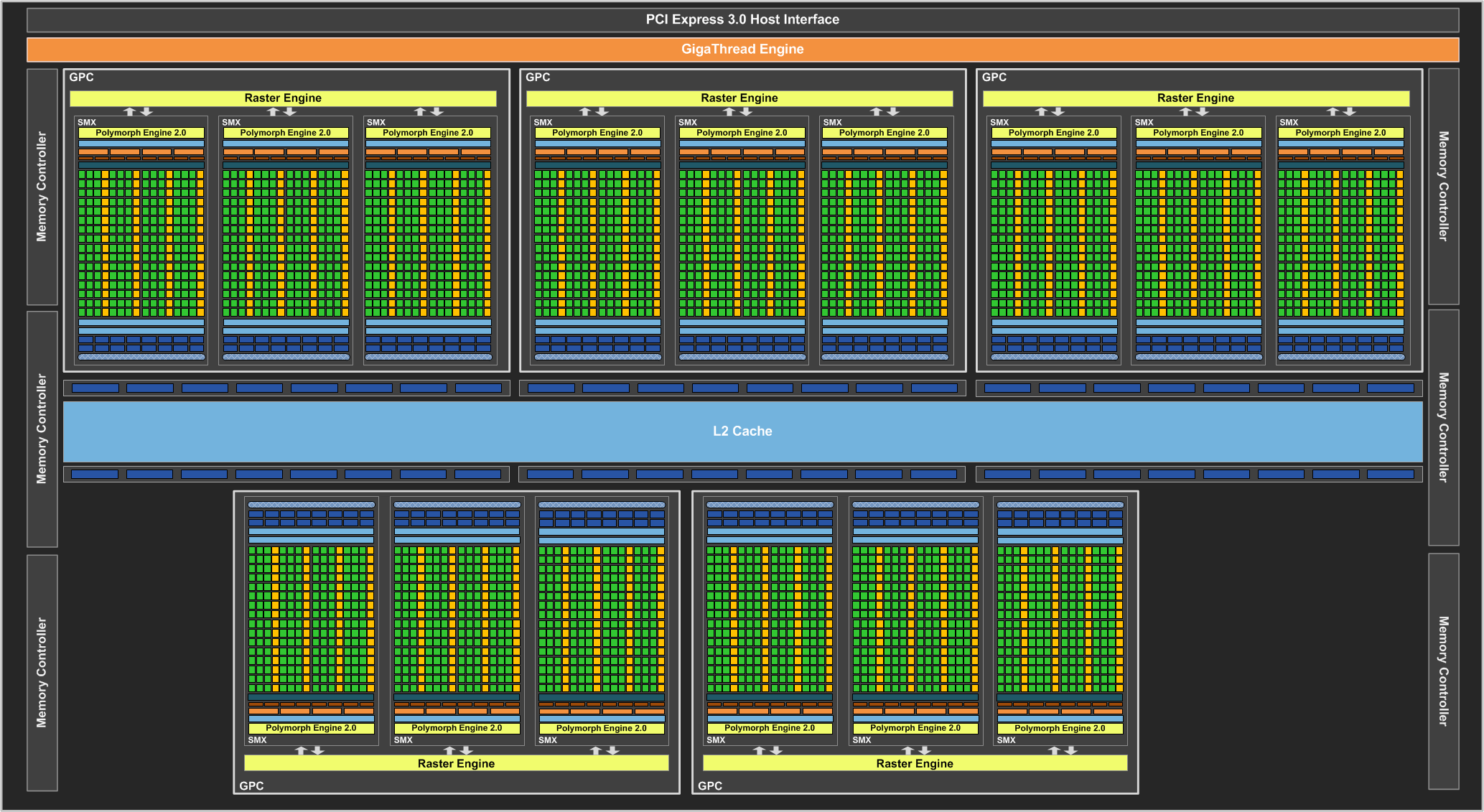
http://images.anandtech.com/doci/6760/GK110_Block_Diagram_FINAL2.pngI just got my Titan and was kind of surprised to see the 14 SMXes myself. Each SMX has 192 FP32 cores (12*16) which explains where the odd 2688 comes from: 14*12*16 = 14*192 = 2688.
GK110 is composed of 15 of NVIDIAâ(TM)s SMXes, each of which in turn is composed of a number of functional units. Every GK110 packs 192 FP32 CUDA cores, 64 FP64 CUDA cores, 64KB of L1 cache, 65K 32bit registers, and 16 texture units. These SMXes are in turn paired with GK110's 6 ROP partitions, each one composed of 8 ROPs, 256KB of L2 cache, and connected to a 64bit memory controller. Altogether GK110 is a massive chip, coming in at 7.1 billion transistors, occupying 551mm2 on TSMC's 28nm process
For Titan NVIDIA will be using a partially disabled GK110 GPU. Titan will have all 6 ROP partitions and the full 384bit memory bus enabled, but only 14 of the 15 SMXes will be enabled.
Reference
* http://www.anandtech.com/show/6760/nvidias-geforce-gtx-titan-part-1
-
Re:I'm not a computer scientist, and...
Yeah, it is not exactly an apples to apples comparison. I really should of specified that.
Thanks for the extra details. I'm sure where you are getting 6 x 32-bit from though? Are you confusing the 6 ROPs?
http://images.anandtech.com/doci/6760/GK110_Block_Diagram_FINAL2.pngI just got my Titan and was kind of surprised to see the 14 SMXes myself. Each SMX has 192 FP32 cores (12*16) which explains where the odd 2688 comes from: 14*12*16 = 14*192 = 2688.
GK110 is composed of 15 of NVIDIAâ(TM)s SMXes, each of which in turn is composed of a number of functional units. Every GK110 packs 192 FP32 CUDA cores, 64 FP64 CUDA cores, 64KB of L1 cache, 65K 32bit registers, and 16 texture units. These SMXes are in turn paired with GK110's 6 ROP partitions, each one composed of 8 ROPs, 256KB of L2 cache, and connected to a 64bit memory controller. Altogether GK110 is a massive chip, coming in at 7.1 billion transistors, occupying 551mm2 on TSMC's 28nm process
For Titan NVIDIA will be using a partially disabled GK110 GPU. Titan will have all 6 ROP partitions and the full 384bit memory bus enabled, but only 14 of the 15 SMXes will be enabled.
Reference
* http://www.anandtech.com/show/6760/nvidias-geforce-gtx-titan-part-1
-
Re:64 bit x86 worked out, but not for AMD
AMD smokes Intel in performance/price for most stuff that can be parallelized. It's only single thread performance where Intel wins.
On CPU prices alone, yes... but they're also struggling on performance/watt which translates into performance/$ both in power supply and cooling, which is a fair bit of the cost if you're running big, massively parallel jobs that engage all the cores over long periods of time. Anandtech simply summarized it like this:
Power consumption is also a big negative for Vishera. The CPU draws considerably more power under load compared to Ivy Bridge, or even Sandy Bridge for that matter.
Every dollar AMD loses on the power bill is of course another dollar Intel can charge extra for a more efficient processor.
-
PC slowdown started before Windows 8
The current slowdown in PC sales started well before Windows 8 was released to the public and oems. As someone who holds a little bit of money in AMD stocks, I followed their press releases and they were claiming some slowdown in spring of 2012. If you look at Intel's financials, they were also experiencing an inventory buildup of the latest and greatest ivy bridge CPUs and had to idle more 22nm fabs than usual just to keep their margins and income up. http://www.anandtech.com/show/6378/intel-q312-earnings-3-billion-profit-on-weakening-market-intel-to-idle-some-fab-capacity
The fact is that smartphones and tablets have replaced PC notebooks for some tasks like email, calendar/scheduling, and instant messaging. If a certain percentage of the population used a PC primarily for those things then they might delay upgrading their PC and instead get a smartphone. -
Re:No
If smart phones were built on x86 they would be the size of a football
Actually it would look like this...
Touchdown... I think you kicked Mr. Football field through the goal posts!!
-
Re:No
If smart phones were built on x86 they would be the size of a football
Actually it would look like this...
-
Re:My theory
Ram is still faster by magnitudes than SSD. ~6ms for HDD, ~60usec (1/100 HDD) for SSD, ~20nsec (1/3000 SDD) for DDR3-1333 given data at http://www.anandtech.com/show/6372/memory-performance-16gb-ddr31333-to-ddr32400-on-ivy-bridge-igp-with-gskill I've been telling my clients to upgrade ram, so now I need to tell them to upgrade to maximum ram and the HDD to an SSD.
-
Re:Let's predict the headlines of the future:
You've stumbled onto some something here...
AMD doesn't make Directx, never has never will.
It also sounds like TFA is trying to pimp TressFX.
You know what though, I'm going to say I HOPE there's no directx12 because directx 9 -11 aren't worth upgrading hardware for:
http://forums.anandtech.com/showthread.php?s=0b835fb5dd2f2d73098918d134f47441&t=2312514
-
PS3-class gaming with no GPU
Even in 2013, I believe people need to be disabused of the idea that (short of spending $5,000 on an insane system every year for a 12lb crazy ass laptop) there is really such a thing as a "gaming" laptop.
You might not be able to get PS4- or Durango-class gaming on a laptop, but PS3-class gaming is certainly attainable. In the past, Intel's "GMA" integrated graphics processor has been nicknamed "Graphics My Ass" compared to even a low-end AMD or NVIDIA GPU. But a year ago, a PC with an Ivy Bridge CPU was seen to run Skyrim at over 40 fps. If a PS3-class game runs that well on Intel graphics, think of how much better AMD's laptop GPUs will handle it.
-
Re:Sadly, no...
I don't think you know how things work in encryption these days...
You don't need the username/password information to encrypt things. iMessage and most of the communication of short messages between Apple devices and between Apple's cloud and the devices is based on the XMPP system which uses simple S/MIME to encrypt similar to how e-mail encryption works. It's end-to-end encryption. Could Apple build-in something to transfer the private keys from the client to the server and intercept it there - sure - but that would be 1) against the XMPP standard, 2) easily noticed and exploitable, 3) may even be illegal.
Where did you read that iMessage is using the S/MIME Encryption extension to XMPP or that it is using XMPP? I haven't seen anything to suggest this. I suspect this is simply that iMessage is properly using TLS/SSL connections to their servers making snooping difficult. They can probably still snoop by subpoenaing Apple for the records. According to wikipedia and other sources, the protocol is actually a binary protocol based on Apple Push Notification Service.
-
Re:Nvidia seems to screw you over: slower + worse
I'm sorry but you lost me, are you talking about the chips in TFA or some other chips? Because i have never heard a GPU referred to as a "multi-dsp-line chip" so you might as well have said "I wonder if the fleegal will be a good flimjam" for all the sense that sentence made.
Now if you are asking if some funky job you have can be done on a GP-GPU like the newer Nvidia and AMD chips? While I'm no expert in the new chips, especially the new Nvidia designs, preferring AMD, from the look of what I have seen it comes down to whether your code can be broken down in a way that will fit the new arch well. For a nice read on how at least AMD is doing it here you go it even has a code sample to show the difference between the old and new arches.
But the reason the older cards are faster than the new cards basically comes down to this: The old cards were great at graphics and ONLY graphics, but since mobile is hot and in mobile weaker chips with longer battery life is the order of the day what these new designs do is allow more of the load to be taken by the GPU. Now if all you wanted to do is game this is bad as you now have a weaker chip since its no longer focused totally on gaming, but it will be useful for more tasks besides just gaming as it will become easier with each rev to write agnostic code and have the APU split the load in such a way as to give you the quickest performance.
So I can see what they are going for, even though I love to game my GPU is gaming maybe 25% of the time at most, the rest of the time its just blowing power. the new chips will be shut down all the parts you don't need on the fly to drop power usage and on those jobs where the GPU could do it quicker it'll fire it back up, run the code, and then go back into a low power state.
Since I don't know anything about how CFD code is laid out you'll have to look a little deeper into the designs but the nice thing is since both are going Open-CL you will only have to write the code once and then run it on any of the new chips by either company. If you are not a gamer and just want to see if your code will run faster on a GP-GPU I'd suggest an HD7750, those are a good midrange/ upper midrange on performance and can be had for around $70 or so if you shop around. It would probably be the absolute cheapest you could get and still have enough performance to really see if it'll give your program a kick in the pants.
-
Anandtech Review
Why are hardware stories ever posted without a link to the Anandtech review? PCMag? Really? Anyway, here's the link to a review that's actually useful:
-
Re:Lets Compare the Surface Pro to the Google Pixe
-
Re:Eh, that's it?
Well the GS3 came 6 months before the iPhone 5, and as I said in my previous post it already has better specs.
Boldfacing your assertion does not make it true. Actual benchmark shows that iPhone 5 beats SG3 on CPU, and blows it out of the water on GPU.
-
Re:Energy Comparison
Did you miss this page or something?
-
Re:It's worse
Absolutely not true. Chrome for iOS almost certainly is not using the system provided WebKit since Google probably wants to provide their own JS implementation.
You should actually research your claims before throwing around words like "absolutely". Chrome for iOS does, in fact, use the system-provided WebKit, because that's the only thing that Apple will let you use - and, yes, it does mean that Chrome for iOS does not use V8.
There is also Opera Mini and several other browsers.
Opera Mini is allowed in the Store because it's not a full-fledged browser - in particular, it does not have a JavaScript interpreter; all JS is run on the server. JS is the real stumbling block for browsers - Apple doesn't allow any app that runs downloaded code in any way aside from their WebView. That's why projects like Pythonista don't give you the ability to download scripts, and you have to manually copy/paste the source code if you want that. The lack of JIT is the final insult, but not the most egregious by far.
All other custom browsers for iOS are also wrappers of the verison of WebKit that Apple provides.
-
Re:wtf?
Give it time; Intel originally expected this state of ubiquitous computing to happen for x86 by 2020 (5nm). Cedar Trail's SoC is 56mm^2, the same chip at 5nm would about 1.4mm^2. If they were specifically designing an SoC for size, they could get this a bunch lower.
http://www.anandtech.com/show/6253/intel-by-2020-the-size-of-meaningful-compute-approaches-zero
-
Re:A hard time keeping on the forefront?
http://www.anandtech.com/bench/Product/53?vs=288
You can get up to twice the performance of a Q6600 from a newer processor like the 2500K. Far Cry 2 on high in 1080p would go from very playable to too laggy to play. The benchmark also doesn't show Battlefield 3, which taxes CPUs very, very hard and benefits tremendously from modern CPUs.
It's not because you've not encountered an issue that issues do not exist. -
Re:A hard time keeping on the forefront?
For some, a $35 Raspberry Pi, $20 keyboard/mouse combo and a $120 monitor may be enough, but not everyone does only the web/e-mail/light word processing combo. While ARM system-on-a-sticks are fast enough to offer basic functionality where optimized, they don't have the raw power to crunch through things such as file compression. Even if you bothered, it would take more energy to complete the task on an ARM system than it would on x86 at the same power usage. ARM miiiight have a chance if they start cramming 8 or 16 cores on a chip at high clock speeds, but then programs will need to be (re)written to take advantage of it. This is all, of course, completely ignoring backwards compatibility.
All that aside, there is some talk about (forgive the random article found with a quick Google) ARM-based servers and I would LOVE to try one, but I see some pretty big hurdles for it to overcome. Massive parallelism like this often runs in to issues addressing memory (and keeping latency down while doing so). I'd certainly be interested in seeing the results, but I don't think I'm ready to hold my breath on it. Massive parallelism also, like I've said above, needs the programs to be optimized for that. Single-threaded tasks would simply crawl.
For you, yes, your metaphorical $500 used Ford Taurus is overkill if all you really need to do is take a bicycle down to the co-op for groceries every few days, but most other people need to drop the kids off at school, haul that old, broken stereo to the recyclers, etc. Your bicycle won't cut it.
Personally, I'm considering a Raspberry Pi with Rasbian to replace my laptop which never leaves my desk. The laptop is mainly used for web and e-mail tasks and a replacing a 85-100 watt laptop with a 10-watt Pi certainly makes sense, but I'm only considering it since I know I won't need it to do anything extraordinary (and the geek factor, of course).
In summary, I don't doubt you one bit. I agree with you completely. I'm sure you'd be fine with an ARM-based system. Some other people probably will be too, just not everyone. -
Because they are better and what about Haswell?
-
Re:Mo it is 7.5 time larger larger
They already have processors that easily handle the processing aspect, so I don't think that's really it. No, this is actually aimed at improving the quality of the video recorded. When you use a whole bunch of tiny, high-sensitivity sensors, you get a lot of noise in low-light conditions. You just aren't getting enough photons hitting each sensor to create a good signal - highly variable, noisy images are the result. You can overcome this somewhat by averaging a bunch of sensors together, but you're basically averaging a bunch of known bad data in hopes of creating good data, and the outcome is often much less than satisfactory. This doesn't matter so much in still photography, where you can just keep the shutter open a little longer to collect more photons, but in video there are limits to how long you can open your shutter for each frame.
By using larger sensors, each one is intercepting a lot more photons and given the same sensitivity constraints it will create a much better signal. Anandtech recently did an article relating to this, although they were looking at cell phone cameras and one company that is deliberately decreasing MP in exchange for larger sensors in order to improve image quality for stills and video (though it is a presentation one of their writers gave, and doesn't go into a whole lot of the theory of why fewer, larger sensors can give better results than more, smaller sensors).