Slashdot Mirror
Domain: anandtech.com
Stories and comments across the archive that link to anandtech.com.
Comments · 3,318
-
Available today, but uncommon
You can get this today, but it's not as flexible as you might wish:
- You currently can only get it in a high-end i7 laptop. Desktop and low-end laptop i7 chips don't have it.
- It's only active when the GPU is not used, so you need a discrete GPU in your system, and it has to be on all the time.
- You can't use this as system memory or whatever (as some of the other comments were hoping for.) All it ever stores are the flushed misses from the L3 cache.
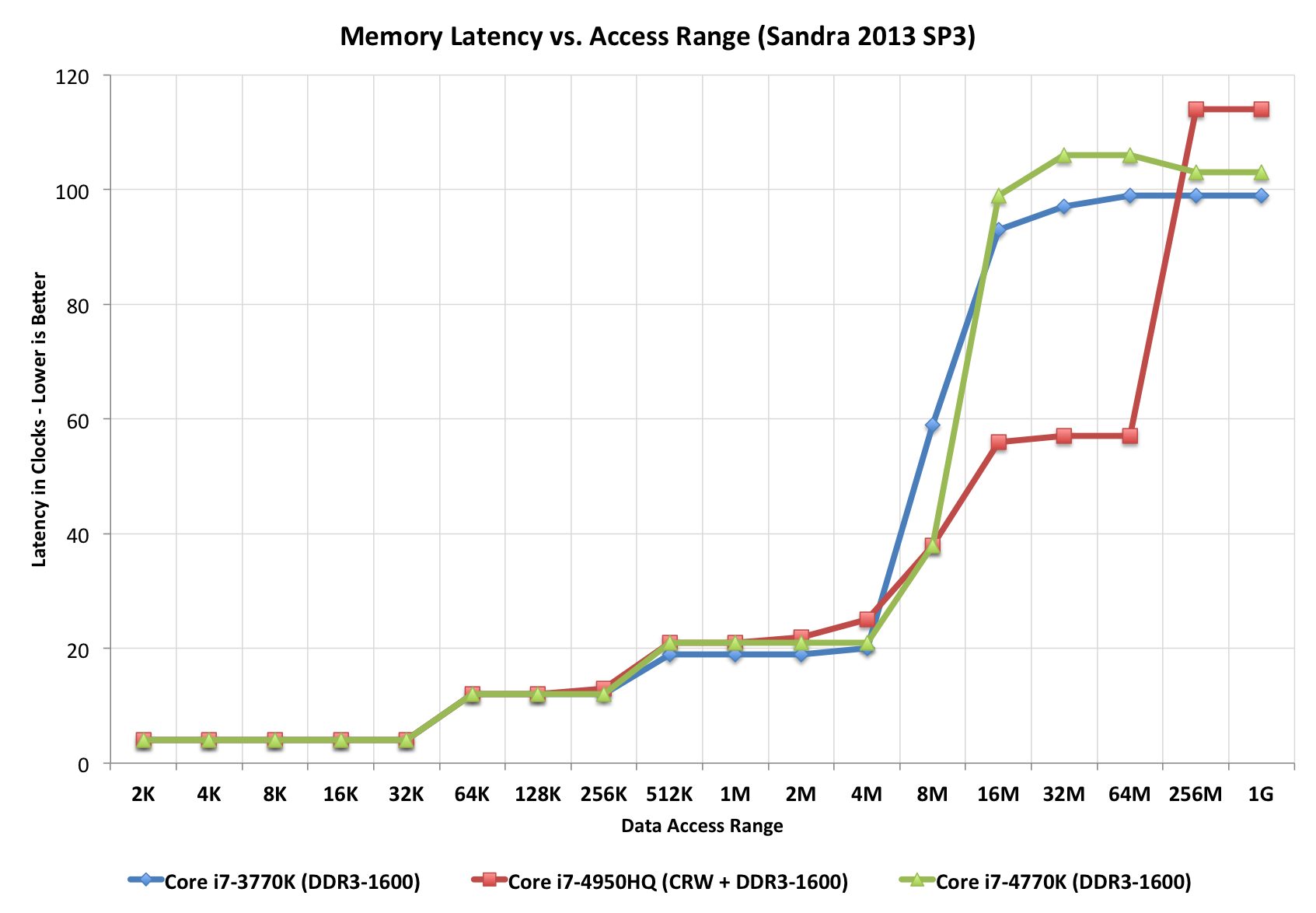
- It massively increases the memory working set, which can benefit some algorithms (e.g. physics simulations, software H.265 encoding) enormously. See graph over at Anandtech:
http://images.anandtech.com/doci/6993/latency.png
The high-end desktop chip is predictably left in the dust in the 8MB-128MB range. Whether this trumps its other advantages is probably only true for a few algorithms.I actually have it active in the Haswell laptop I'm typing this on, but it's an uncommon setup. To get one, go to the Apple store, select the highest-end Retina Macbook Pro (the only one that still has discrete graphics) and click the processor upgrade to 2.6GHz so that you end up with a i7-4960HQ (the 2.3 chip might have it too, not sure.) Then go to the Energy Saver Preferences and turn off Automatic Graphics Switching so that the discrete GPU is on all the time.
-
Re:Why only 128 MB?
Broadwell represents a miniaturization step from 22 to 14 nm structures. Why do they keep the capacity of the Crystalwell L4 cache at 128 MB? They could put twice that memory onto a die with the same area as the 22 nm Crystalwell version. Is the Crystalwell die for the Haswell CPUs so large and expensive that they have to reduce its size?
From Anandtech's article on Crystalwell:
There's only a single size of eDRAM offered this generation: 128MB. Since it's a cache and not a buffer (and a giant one at that), Intel found that hit rate rarely dropped below 95%. It turns out that for current workloads, Intel didn't see much benefit beyond a 32MB eDRAM however it wanted the design to be future proof. Intel doubled the size to deal with any increases in game complexity, and doubled it again just to be sure. I believe the exact wording Intel's Tom Piazza used during his explanation of why 128MB was "go big or go home". It's very rare that we see Intel be so liberal with die area, which makes me think this 128MB design is going to stick around for a while.
I get the impression that the plan might be to keep the eDRAM on a n-1 process going forward. When Intel moves to 14nm with Broadwell, it's entirely possible that Crystalwell will remain at 22nm. Doing so would help Intel put older fabs to use, especially if there's no need for a near term increase in eDRAM size. I asked about the potential to integrate eDRAM on-die, but was told that it's far too early for that discussion. Given the size of the 128MB eDRAM on 22nm (~84mm^2), I can understand why. Intel did float an interesting idea by me though. In the future it could integrate 16 - 32MB of eDRAM on-die for specific use cases (e.g. storing the frame buffer).
-
Even more to it than *that*...
According to the Reg (page 2) Power8 is going to have some sort of memory coherence function for accelerators. Allowing the GPU to be just another first-class processor with regards to memory could be a big win, performance-wise, not to mention making it easier to program.
The latest version of CUDA (version 6) has also just added features in the same area (unified memory mgmt). Anandtech has some more info about that.
This thing will be beast!
-
Re:Not Surprising for HP
Apparently the overheating is done by the charger, not the laptop. Given that the laptop is build around an ARM SoC with a TDP in the 4watt range, I'd hope that HP could find a way to keep that part cool...
-
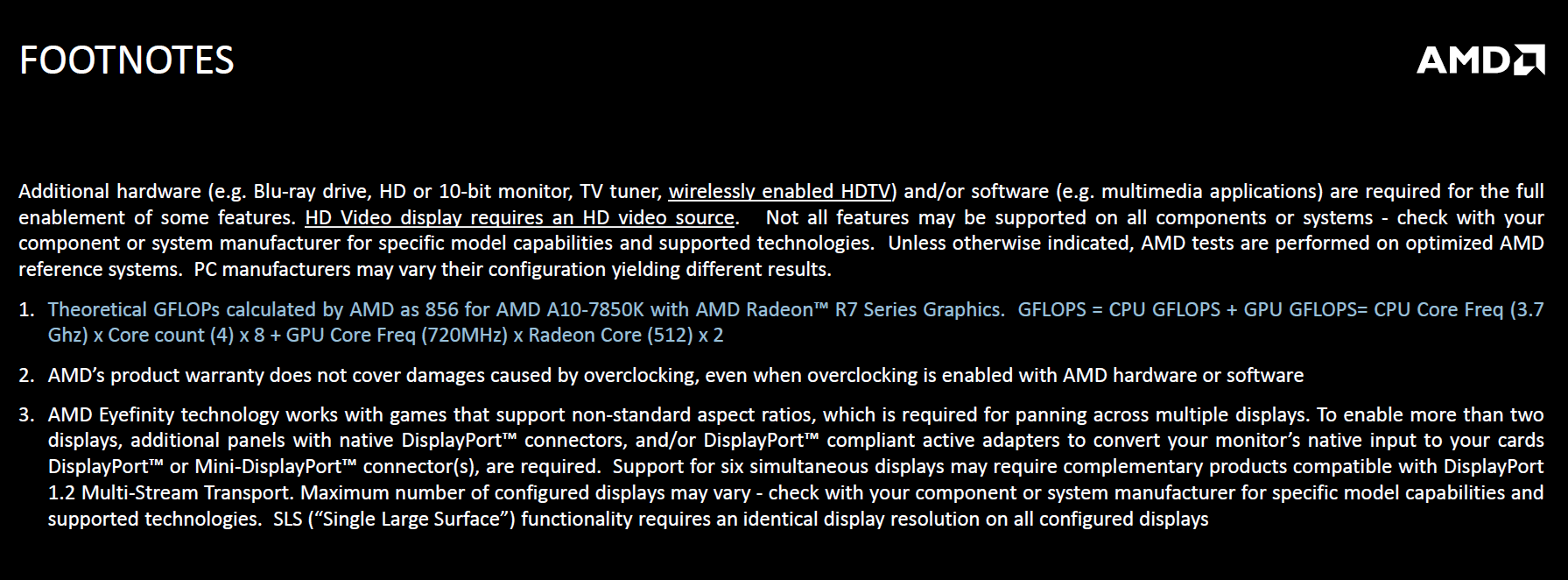
3.7GHz CPU + 720MHz GPU
Actually the clock speed for the 862GFLOPS figure is in the footnotes, see here: http://images.anandtech.com/doci/7507/amd_kaveri_specs-100068009-orig.png
So, even unintentionally, they are talking about clock speeds... -
Re:New phone almost as fast as month old phone
The physics test is quite telling and shows just how limited the low speed, dual core
The physics test seems to have little relevance to actual gaming performance since even against the Note III in offscreen tests the iPhone 5S was pretty much neck and neck on rendering rate.
http://www.anandtech.com/show/7376/samsung-galaxy-note-3-review/4
In that review the iPhone 5S won 4 of the 7 CPU tests that it was in. It won 3 of the 6 GPU tests measuring FPS rendering speed. In 2 of the tests that it lost it only lost by 1 fps, in the other offscreen test that it lost at it was 57 fps vs. 69 fps. Which means the 5S was only 5% slower than native refresh rate.
dual core? really? that is fucking ancient) CPU in the iPhone is.
And yet it beat the quad-core in both of the CPU tests. Can't even beat an "ancient" CPU? Pathetic...
-
Re:Keep In Mind
To add even in the offscreen test done by Anandtech here against the Note III it only lost by 1 fps in 2 of the tests as in another it was 12 fps behind. But, in the test it was 12 fps lower it was 57 fps to 69 fps which means that basically it was only 5% lower than screen refresh rate.
-
Re:um
I've had my 2560x1600 Dell 3007WFP for at least 4 years. Here's an article comparing it to an Apple 30" screen dated 2007.
-
Re:But, Slashdot said...
You must be a stupid MS hater because you can't understand this. http://images.anandtech.com/graphs/graph7478/59454.png
Not to mention that fact that the comparison is against ARM tablets running crippled OSes like iOS and Android whose headline application is Angry Birds, and not things like Visual Studio or Photoshop. -
Re:But, Slashdot said...
You must be the original AC or have a similar IQ since you clearly can't understand this.
-
Re:Sony Vaio Pro (Windows) vs. 2013 Macbook Air
The battery life per Watt-Hour of the Sony Vaio Pro 13 (Haswell, Windows 8) vs. 2013 Macbook Air (Haswell, OS X) are pretty similar, according to Anand's own tests
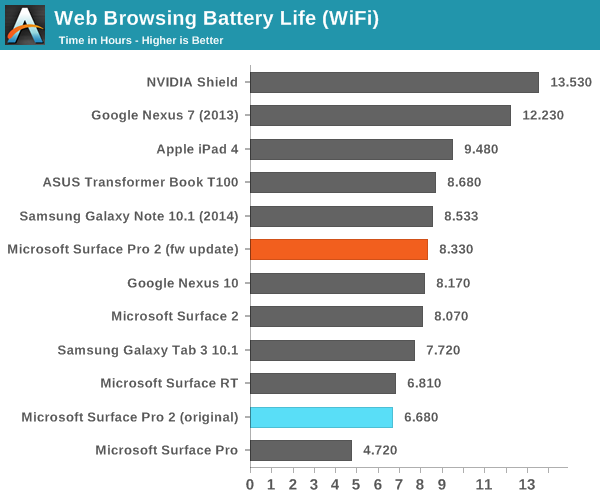
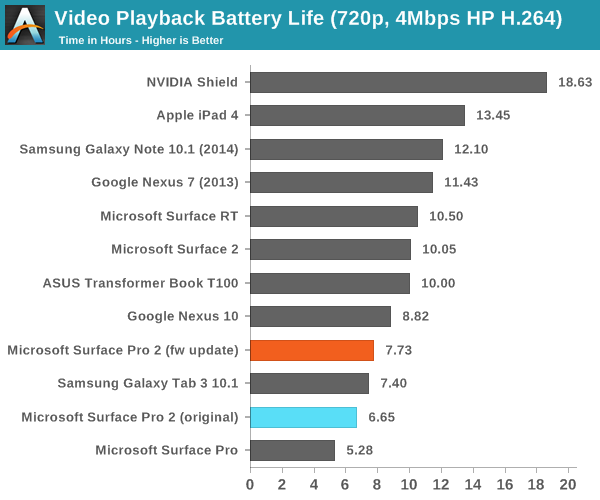
This morning I spotted an interesting update: Microsoft Surface Pro 2 Firmware Update Improves Battery Life:
Shortly after general availability of the Surface Pro 2, Microsoft pushed out a firmware update that allowed the Marvell WiFi solution to drive down to even lower power states. I spoke with Microsoft after the update went live and immediately re-ran both of our battery life benchmarks on the Surface Pro 2. The improvement is significant.
Also, and not to defend Microsoft here, but benchmarks of Windows running on a Mac, especially those about battery life, should always been taken with a grain of salt: the drivers provided by BootCamp are neither the latest, nor the better optimized. And don't get me started on the futility of comparing entirely different CPU architectures. Battery life on the Surface Pro 2 still lags far behind Android and iOS tablets?!? Quick, stop the press!
Last but not least: I'm a bit sad to see that Mr. Coding Horror himself has resorted to write something I've come to expect from less reputable authors.
RT.
-
Re:Why is this surprising?
The benchmark they used seems to run at the native screen resolution, so for slightly lower frame rate you get a much higher quality image.
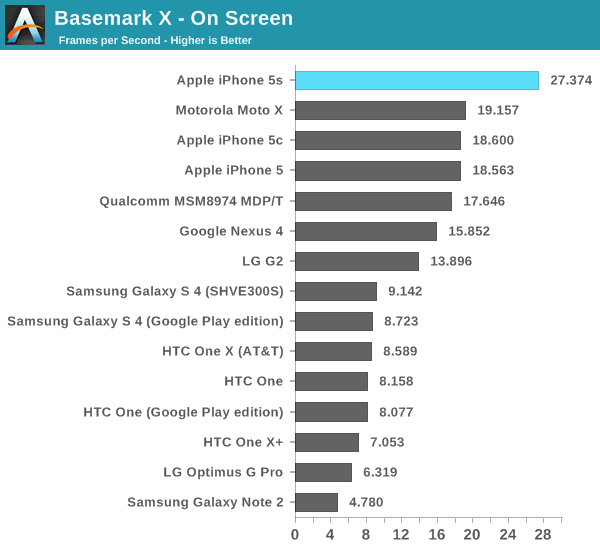
Nope, that 15.54 is the offscreen mode of Basemark X. Anandtech's benchmark using Onscreen mode had a value of 27.37.
-
Re:First hand experience
Interesting insight into the mind of an Apple buyer there. I note you use the word "surprising" a lot, as do Apple themselves in their marketing. You also don't quantify things like the time machine restore being "fast" - fast in comparison to what, and with how many apps and how much data? What does noiseless mean, presumably not 0db?
What I'm getting at is your impression of the machine is based entirely on your expectation of it. I'm not saying it isn't nice hardware, it is, but that is also the very definition of the Reality Distortion Field. The brand, the shiny retail space, the reassuringly high price that must mean it's made of better quality materials.
I'm not having a go at you personally, just pointing out how Apple operates, and why it's hard for the rest of us to take a "review"/anecdote like this too seriously.
First - this was not a review. This was list of impressions. For a review, I would need to compare it to something, go into technical details, measurements etc. This wasn't a review - and for what it was worth, I don't think the one in the original article was a good one either. I think this is a better example of a review, but it is of a different model. As of my use of "surprising", I used it twice. Once for the weight. Since I had just moved my old 27 inch iMac, I had a good comparison - and this was 1/3rd lighter for what is still basically a computer attached to a screen. Only the optical unit is really missing. This felt slightly surprising to my muscle memory. The second time was describing the sound, and my surprise there is that it is even coming close to "passable for some light use" given the speakers. This is hardly what Apple's marketing would aspire to
As for "quantify" that time machine being fast - it was a couple of clicks. After that, it took an hour or two - it was about a terrabyte of data (mostly RAW images and music files). I didn't hang around to find out, but the involvement for me was "fast". As for "noiseless", it means I have a really hard time hearing that it's one - I have to put my ear to the screen.
As for "what you're getting at", you're wrong. I don't buy retail (there aren't even any Apple stores around here), and of course lower price is better. I just happen to look at what I get for my money rather than always choosing the lowest price, and previous experience (my own and people I trust) will have an influence on my decisions.
-
Stability Performance
Cant seem to find the original nvidia vs ati render stuttering, but these will do.
http://www.anandtech.com/show/6857/amd-stuttering-issues-driver-roadmap-fraps
http://techreport.com/review/24022/does-the-radeon-hd-7950-stumble-in-windows-8/10I couldn't care less if this this the cheapest/fastest card on the planet.
Until AMD fix the core stuttering issues with their drivers, instead of just patching it for a AAA game now and then. I'am really not interested.Frame rate isnt everything, stability and consistent render times of those frames are. Yes, i have an ATI card and i'am regretting it.
-
Re:Not Really?
http://www.anandtech.com/show/7457/the-radeon-r9-290x-review/12
has the 290 on top of 780 sli -- in SLOW mode.
3840x2160 is the kind of resolution you want this card for. You don't need it for 1080p, so comparing there is silly.
-
Re:This is good news for me
It will be interesting to see what becomes of Mantle, but it does have the potential to greatly increase the performance of games that support it and extend the life of ATI cards. Being the owner of a 7950 I'm looking forward to seeing how much of a performance boost Mantle gives vs. DirectX. I believe Battlefield 4, which I plan to purchase, will be one of the first Mantle supported games when they patch in Mantle support in December, can't wait to try it out.
http://www.anandtech.com/show/7371/understanding-amds-mantle-a-lowlevel-graphics-api-for-gcn -
Re:I gotta admit
Most of the speed ups the A7 gets are from 64-bit code as it cleans up a lot of the architecture. 32-bit code works, but the speedup is minimal.
I'm extremely skeptical that there's much of any significant speedup for 64-bit code in general use (i.e. outside of specialized number crunching applications). If you look at Anandtech's iPhone 5S review where they ran a bunch of math-heavy benchmarks, the median speedup is only about 9%. The benchmarks recording the biggest improvements (AES, SHA1, DGEMM) showed huge speedups due to new hardware cryptographic instructions and vectorization, not from switching to 64-bit code.
My hunch is this is going to play out pretty much like 64-bit Windows. Yes there was a speedup, but only about 5%-15% on average, not enough of a performance boost for people to notice in everyday use. The real reason everyone switched to 64-bit was for the flat memory space addresses (>4 GB). It's better for code to be 64-bit, but the performance increase merits a mere footnote, while the flat memory space is a headliner. -
Sony Vaio Pro (Windows) vs. 2013 Macbook AirThe battery life per Watt-Hour of the Sony Vaio Pro 13 (Haswell, Windows 8) vs. 2013 Macbook Air (Haswell, OS X) are pretty similar, according to Anand's own tests: http://www.anandtech.com/show/7417/sony-vaio-pro-13-exceptionally-portable/4
Moreover, the Sony Vaio Pro has a higher-resolution screen than the MBA, which puts the Vaio at a disadvantage (because it drains the battery a little faster). So with highly-optimized Windows drivers, the battery life looks the same or even better for Windows.
The comparison to ARM is just stupid. Obviously battery life is better on ARM, at the cost of much lower performance. That's true for Windows and OS X both.
-
Nice slashvertisement
How about bringing up the fact that LG is cheating on benchmarks just like samung? http://www.anandtech.com/show/7384/state-of-cheating-in-android-benchmarks
How about bringing up the fact that the LG G2 is about half the performance of the 5s in benchmarks that aren't cheated?
http://images.anandtech.com/graphs/graph7335/58181.png
http://images.anandtech.com/graphs/graph7335/58170.png
Only companies worth buying from right now are Moto and Apple. -
Nice slashvertisement
How about bringing up the fact that LG is cheating on benchmarks just like samung? http://www.anandtech.com/show/7384/state-of-cheating-in-android-benchmarks
How about bringing up the fact that the LG G2 is about half the performance of the 5s in benchmarks that aren't cheated?
http://images.anandtech.com/graphs/graph7335/58181.png
http://images.anandtech.com/graphs/graph7335/58170.png
Only companies worth buying from right now are Moto and Apple. -
Nice slashvertisement
How about bringing up the fact that LG is cheating on benchmarks just like samung? http://www.anandtech.com/show/7384/state-of-cheating-in-android-benchmarks
How about bringing up the fact that the LG G2 is about half the performance of the 5s in benchmarks that aren't cheated?
http://images.anandtech.com/graphs/graph7335/58181.png
http://images.anandtech.com/graphs/graph7335/58170.png
Only companies worth buying from right now are Moto and Apple. -
Not always. Some LCD's refresh realtime (2ms lag)
High speed video of an LCD refresh occuring in real-time:
http://www.youtube.com/watch?v=hD5gjAs1A2sAlso, input lag is the whole chain, INCLUDING how long it takes to display.
See AnandTech's article:
http://www.anandtech.com/show/2803/7CRT's are only zero input lag at the top edge of the screen.
CRT's even have input lag for the bottom edge of the screen, because they have a finite frame transmission time (scanning from top to bottom).
Some gaming LCD's (certain BENQ and ASUS gaming LCD's) are the same way; they scan the pixels top to bottom in real time too (as seen in high speed video).We're talking about input lag from game engine to human eyeballs, so it WILL also include frame transmission time (From computer to display), including any display mechanisms (scanout). nVidia G-Sync solves the problem by using ultrafast frame transmission times (1/144sec, even when running at 60Hz, since G-Sync uses a dotclock for frame transmission/scanout times of 1/144sec) -- they clearly explained it in their video.
Now, strobing does add a minor input lag, but an average of less than one frame. (For LCD's with less motion blur than CRT"s, google "lightboost" -- John Carmack said he uses a LightBoost monitor)
-
Re:In English
Yup, it's called Panel Self Refresh (PSR)
http://www.anandtech.com/show/7208/understanding-panel-self-refresh
-
Re:Makes no sense.
NVidia would have to change the whole industry for this
We can't have one of the largest purveyors of video hardware influencing display standards now, can we?
NVidia isn't some startup. They put GPUs into millions of devices; desktops, laptops, tablets, consoles, phones, etc. When they offer a new technique for syncing video the world is going to have a look. That doesn't mean it must be accepted, but it won't be dismissed out-of-hand.
Besides, given an advanced bus like DisplayPort I suspect this might amount to a simple video-chip-to-display negotiation with a transparent fallback. DisplayPort devices can be Ethernet peers, among other things; they can coordinate anything they wish. So promoting a display connection to a new syncing technique should be transparent and non-disruptive for all hardware, past and future, without some brand new interface standard.
Turns out that's exactly what is happening. From Anandtech:
Meanwhile we do have limited information on the interface itself; G-Sync is designed to work over DisplayPort (since it’s packet based), with NVIDIA manipulating the timing of the v-blank signal to indicate a refresh. Importantly, this indicates that NVIDIA may not be significantly modifying the DisplayPort protocol, which at least cracks open the door to other implementations on the source/video card side.
-
Re:This will require Nvidia gear inside the monito
Interestingly, Nvidia will be providing the G-sync chips by themselves, allowing people to mod their monitor to install the chip on them. I'm not sure just how compatible this would be, but it might allow you to upgrade your existing monitors with G-sync support or get someone to do it for you, depending on your capabilities and willingness to risk your monitor.
-
Re:Bluetooth woes
The XBox 360 has a 3.5mm jack on the controller, for headsets to plug into.
You mean 2.5mm. The original Xbox had one of these too, but you had to use a doodad that connected through the memory card port in the controller. Kind of like how they forced you to purchase a remote control in order to watch DVDs. Also the original headset for the 360 was designed in such a way that it utilized a connector that prevented its use with anything other than a first party (or similarly designed third party) Xbox 360 controller.
The PS3 did not.
The PS3 instead supported standard USB headsets and Bluetooth headsets which are just as prevalent (if not more so, combined) than 2.5mm headsets. Also, this is in stark contrast to the Xbox 360's wireless headset, which used a proprietary RF interface. The only time, to my knowledge, that the Xbox 360 supported a USB microphone was in Rock Band and its sequels.
Then there's the storage drives. For the PS3 it was a 2.5" SATA drive hidden behind a little door, and could be easily removed and replaced. The Xbox 360 utilized 2.5" SATA drives as well, but hidden inside a proprietary case with a proprietary connector that was only to be replaced with other Microsoft manufactured drives. The 360 S *also* used 2.5" SATA drives, but in a different casing that made it entirely incompatible with the original 360 drives (both of which are sold at an exorbitant markup versus standard SATA drives), and to transfer data between drives you had to have a proprietary cable.
Then there was the proprietary Wifi adapter for the 360, and Xbox Live, which is necessary to play games online, be involved in party chats, use the web browser, and watch videos through other services you may already be paying for (including YouTube, Hulu Plus, Netflix, and Comcast's Xfinity among many others) which went from $45 per year to $60 per year (or from $8/mo to $10/mo).
So let's not get all high and mighty about which console manufacturer is better than the other. They all do it. That's what console gaming has become. And if you don't like it, your option is to either wait for Steam Machines or build yourself a PC, because that's the alternative.
-
Re:javas not dead!
No, I'm saying it performs as well as C++ in most cases. Virtual method handling is one example as to why, the JIT has a better view at execution time as to what can and can't be inlined, so it can inline much more than a statically compiled C++ program possibly can.
You realize that JIT is inherently limited to a tiny bit of program which it compiles? JVM cannot spend neither time nor RAM building a whole program tree and making global optimizations like compilers can. And by the way, if you think that compilers are limited to static analysis only - there's also profile-guided optimization.
Well that's precisely the problem you face if you don't have an explosion of optimised binaries, unless you want to accept that the JVM is going to optimise more efficiently. It's not just about compiling for different architectures, it's about the JIT automatically being able to optimise to take advantage of extensions, and other hardware that may be present too. It can optimise dependent on amount of RAM, cache sizes etc. - something that just isn't known when you compile a plain old generic C++ binary for, say, the generic x86 platform.
But there are a number of other things it can do better too - better loop vectorisation (as a result of better inlining of virtual functions) and more efficient heap allocations for example.
In theory, it could do that. But if you do a reality check, you'll find out that JVMs right now are pretty mediocre compilers that lack even basic optimizations. Again, everything that JVM does, can be done by a compiler, but not vice versa. Compilers have nearly unlimited time and can spend gobs of RAM analyzing the program. They can use profile-guided optimization, allowing you to gather stats from a compiled program and then recompile it to better account for runtime behavior - if needed.
Oh, and while we're at it, fine-tuning assembly with specific CPU in mind does not matter these days except for SIMD ops. Waiting for memory accesses dominates CPU time - and here Java is at inherent disadvantage because you cannot really control memory layout of your data."Server software does not [need to] have single-thread performance because it's more often I/O bound - that means that CPU vendors can get away with CPUs like Bulldozer or SPARCs that suck at IPC (instruction per clock) performance."
This is nonsense. It depends entirely on the application. A heavy load web server for example may not really be I/O bound in the slightest depending on the size and what it does. Bulldozer is designed for optimisation of performance per watt, you're again confusing cause and effect as to why some things are the way they are.
Before you call this nonsense, go read some analysis and check benchmarks.
"That's not a problem of Java, though, but all managed languages -
Really, the problem is simply that you don't understand managed languages. Your understanding of the optimisations performed by JIT compilers is clearly woefully inadequate to being making this sort of comment. Your comments on server applications just don't even make sense for the most part to the point I'm not even sure you have the slightest grasp of what sort of things servers commonly serve.
"Microsoft tried to build an OS which would be
This is just further nonsense. There was a Microsoft research project to try and build such a thing, and they did, and open sourced it. I don't know what you mean by "Now they are going native
-
Re:Next generation of the iWatch capability?
I think you are correct that the current leadership has not yet proven that they can innovate in the way that Mr. Jobs did. That said, the iPhone 5s is really a nice step forward, real-world tests are showing that the A7 really is a lot faster, and the fingerprint thingy is winning a lot of accolades. And, they've sold a hell of a lot of them. Nonetheless, the stock price is actually a bit lower than before the 5c/5s announcement.
The truth is that the stock price for a lot of companies, and Apple in particular, does not reflect the financial success of that company or the company's products. Just compare Amazon's numbers to Apple's and you'll get what I mean. Stock prices today are more driven by bets on where that price will be in 15 minutes (or 15 milliseconds), not how well the company will be doing in a few years. As such, stock prices for high-tech companies are not a valid way to measure the company's success in the marketplace. -
Re:If this was Apple...http://www.anandtech.com/show/7384/state-of-cheating-in-android-benchmarks
"With the exception of Apple and Motorola, literally every single OEM we’ve worked with ships (or has shipped) at least one device that runs this silly CPU optimization. It's possible that older Motorola devices might've done the same thing, but none of the newer devices we have on hand exhibited the behavior."
-
Re: I sure hope this means...
ARM is capable of performing at or near Jaguar levels.
That's something you are going to have to back up.
Comparison here. Okay, so the gap is a bit bigger than I remembered, but it's still in a similar ballpark. Unfortunately I couldn't find a more exhaustive comparison between them right now.
There's plenty of games out there already for iOS/Android so the architecture isn't a roadblock.
Plenty of games out there for 68K too. That does not mean it is as capable is x86. I do not care what games you play on your phone. They are not the same class as big PC games like Half Life. It is a simple fact that x86 has more raw power than ARM. There is no technical reason ARM could not be improved to a point that it is as powerful as x86 but it is not there now.
Architecture is a roadblock when one architecture provides serious performance gains.
Is Battlefield 3 on Tegra 5 capable enough for you?
-
Re: I sure hope this means...
There's nothing stopping NVIDIA creating a SteamBox using a Tegra with a massive GPU.
There's two things. First, no ARM core would keep up with it. Second, the IP for their massive GPUs is laden with agreeements with assholes like Microsoft.
I disagree. If 8 Bobcat derived cores can handle the PS4/XBox One, then a collection of high end ARM cores can handle a decent GPU (doesn't need to be Titan level). Also, NVIDIA already have their Kepler cores freed up for licensing so that won't be a roadblock for integrating with ARM.
-
Re:All of this and the benchmarks are still subpar
Battery life still behind the iPhone: http://images.anandtech.com/graphs/graph7376/58409.png
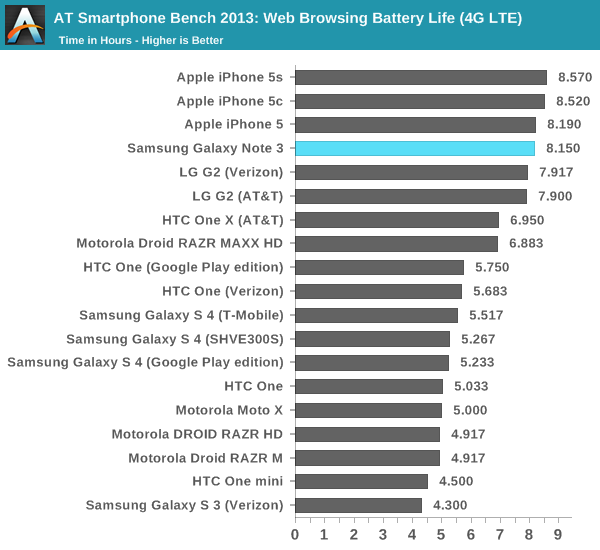
You are comparing a phone with a 4 inch screen, with a "phone" that has a 5.7 inch screen. You can't compare battery life when the screen is what uses up most of the power. If you want a huge screen you have to compromise on battery life (and many other things - seriously, the note is ridiculously big to use as an every-day phone).
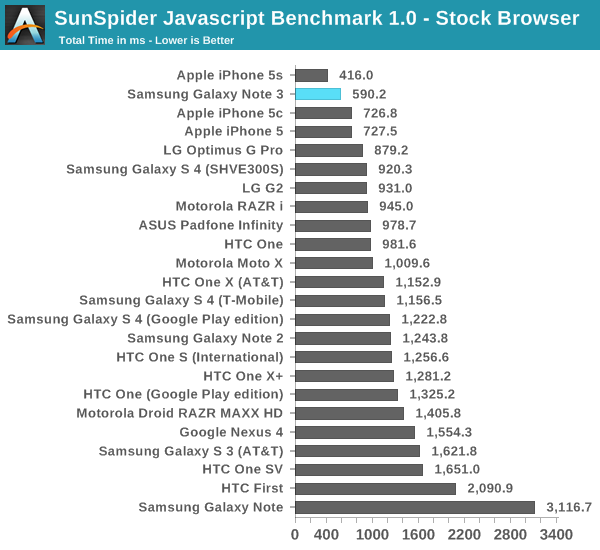
Browser speed still behind the iPhone: http://images.anandtech.com/graphs/graph7376/58440.png
I don't suppose Samsung can do much about that. It is quite possible that with the same CPU, an Android would still be slower than an iOS device. Sure, Google has made a fast Java VM, but it still is a Java VM, right? For example, I had a Nokia N9 running Meego/Maemo. It could run circles around Android phones with the same CPU.
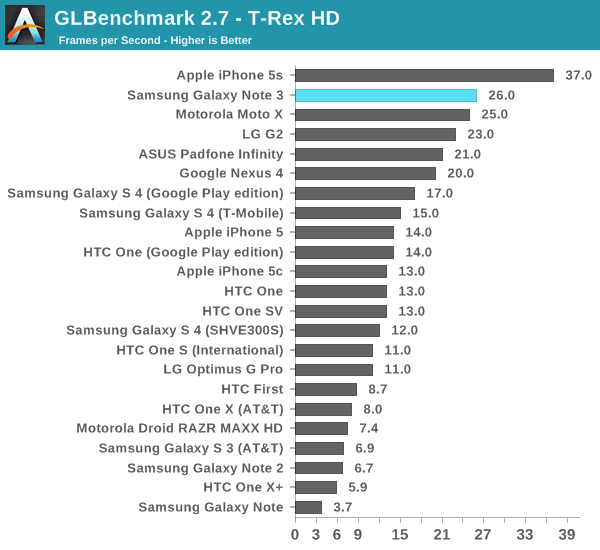
Graphics performance still behind the iPhone: http://images.anandtech.com/graphs/graph7376/58425.png
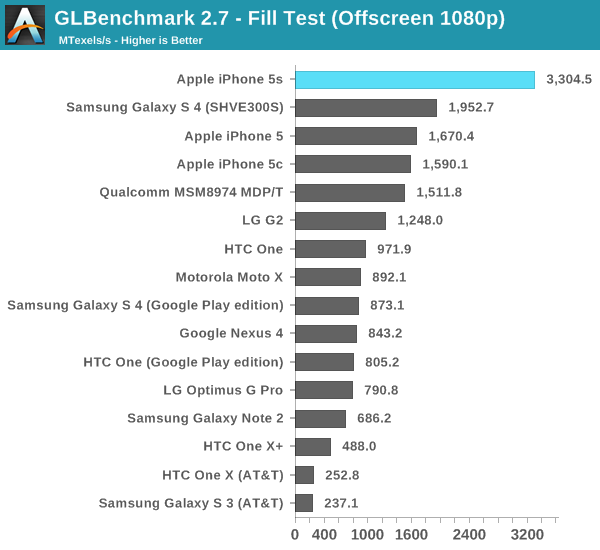
Ehm, this result (to which you cleverly linked directly - hiding the context) is ran in native resolution. The Note has almost 3x the iphone's resolution, so it would be pretty strange to come on top in fps. But in all the other GPU benchmarks which are ran at 1080p it does come on top of the iphone.
But in any case I personally prefer a phone that has a good battery life, it can fit in my hand and lets me do whatever I want with it. So that rules out the note and the iphone
-
Re:All of this and the benchmarks are still subpar
Battery life still behind the iPhone: http://images.anandtech.com/graphs/graph7376/58409.png
You are comparing a phone with a 4 inch screen, with a "phone" that has a 5.7 inch screen. You can't compare battery life when the screen is what uses up most of the power. If you want a huge screen you have to compromise on battery life (and many other things - seriously, the note is ridiculously big to use as an every-day phone).
Browser speed still behind the iPhone: http://images.anandtech.com/graphs/graph7376/58440.png
I don't suppose Samsung can do much about that. It is quite possible that with the same CPU, an Android would still be slower than an iOS device. Sure, Google has made a fast Java VM, but it still is a Java VM, right? For example, I had a Nokia N9 running Meego/Maemo. It could run circles around Android phones with the same CPU.
Graphics performance still behind the iPhone: http://images.anandtech.com/graphs/graph7376/58425.png
Ehm, this result (to which you cleverly linked directly - hiding the context) is ran in native resolution. The Note has almost 3x the iphone's resolution, so it would be pretty strange to come on top in fps. But in all the other GPU benchmarks which are ran at 1080p it does come on top of the iphone.
But in any case I personally prefer a phone that has a good battery life, it can fit in my hand and lets me do whatever I want with it. So that rules out the note and the iphone
-
Re:All of this and the benchmarks are still subpar
Battery life still behind the iPhone: http://images.anandtech.com/graphs/graph7376/58409.png
You are comparing a phone with a 4 inch screen, with a "phone" that has a 5.7 inch screen. You can't compare battery life when the screen is what uses up most of the power. If you want a huge screen you have to compromise on battery life (and many other things - seriously, the note is ridiculously big to use as an every-day phone).
Browser speed still behind the iPhone: http://images.anandtech.com/graphs/graph7376/58440.png
I don't suppose Samsung can do much about that. It is quite possible that with the same CPU, an Android would still be slower than an iOS device. Sure, Google has made a fast Java VM, but it still is a Java VM, right? For example, I had a Nokia N9 running Meego/Maemo. It could run circles around Android phones with the same CPU.
Graphics performance still behind the iPhone: http://images.anandtech.com/graphs/graph7376/58425.png
Ehm, this result (to which you cleverly linked directly - hiding the context) is ran in native resolution. The Note has almost 3x the iphone's resolution, so it would be pretty strange to come on top in fps. But in all the other GPU benchmarks which are ran at 1080p it does come on top of the iphone.
But in any case I personally prefer a phone that has a good battery life, it can fit in my hand and lets me do whatever I want with it. So that rules out the note and the iphone
-
Benchmarks are bad metrics
Benchmarks are problematic by their very nature in that they are typically predictable and a manufacturer can simply say they have tuned their product for a given application. Let me give a good example of this from a product that isn't made for consumer use just to make my point:
http://www.anandtech.com/show/7165/ocz-announces-zdxl-pcie-sql-accelerator-ssd-solution
This is a PCIE SSD product designed to boot server performance explicitly for Microsoft MS SQL Server. This product has been explicitly designed to make a given product that is quite expensive work faster.
Is this product cheating because it has been tuned just to give better results in one application? What if OCZ released a version of the product that was tuned to detect if it was working on MySQL, MS SQL Server and Oracle and optimize performance accordingly? What happens when someone tries to use it on another SQL database and get's less than stellar performance?
For the typical Slashdot car analogy think of Ferrari, they have been accused of cheating on car tests for many years by setting up their cars for the exact track they were about to be tested on. What would happen if Ferrari (or another manufacturer) tied their systems into the car's GPS?
Think of the Top Gear episode where the Nissan GTR knew it had just been driven onto a racetrack and turned off it's speed limiter. You could just as easily program the car to have optimal settings for that exact track and then populate in as many race tracks as you could. Is that cheating or is the manufacturer anticipating the potential needs of their customers and tuning their product accordingly?
If everyone playing the latest Call of Duty get's the same benefit when they buy their card, than can you really say it's cheating? Through the use of patches you can continuously upgrade the card to be optimized with the latest games.
-
All of this and the benchmarks are still subpar
Battery life still behind the iPhone: http://images.anandtech.com/graphs/graph7376/58409.png
Browser speed still behind the iPhone: http://images.anandtech.com/graphs/graph7376/58440.png
Graphics performance still behind the iPhone: http://images.anandtech.com/graphs/graph7376/58425.png
For a device this much larger and heavier, you would expect they could overclock the chipset and get more performance than this. -
All of this and the benchmarks are still subpar
Battery life still behind the iPhone: http://images.anandtech.com/graphs/graph7376/58409.png
Browser speed still behind the iPhone: http://images.anandtech.com/graphs/graph7376/58440.png
Graphics performance still behind the iPhone: http://images.anandtech.com/graphs/graph7376/58425.png
For a device this much larger and heavier, you would expect they could overclock the chipset and get more performance than this. -
All of this and the benchmarks are still subpar
Battery life still behind the iPhone: http://images.anandtech.com/graphs/graph7376/58409.png
Browser speed still behind the iPhone: http://images.anandtech.com/graphs/graph7376/58440.png
Graphics performance still behind the iPhone: http://images.anandtech.com/graphs/graph7376/58425.png
For a device this much larger and heavier, you would expect they could overclock the chipset and get more performance than this. -
Re:'MANTLE' was the game-changing announcement
Calm down, son. If you can't see from context of the thread or my paragraph that everyone in this thread is talking about Mantle and not hardware specs (i.e. brute forcing past the draw call issue), then there really is no hope or point in further educating you. The fact that you don't even understand that draw call limitations are CPU-bound and not (presently) GPU-bound shows how little you know of this subject. Now that you understand this is a CPU issue, where could you find a CPU that matched the computational throughput of a Cell processor or the SPU's guaranteed 5 cycle latency? Intel processors couldn't even come close at the time (the Core 2 was released in mid 2006, a few months before the PS3). Sure, the Core 2 could've done better than Cell in heavily branching code, but by many other measures (throughput, latency, etc...), the Cell is much better than the Core 2.
Anyway, it's clear that you don't understand even the basics of what's going on, I'll just leave this link for you to read over at Anandtech...if you know what's good for you.
-
Comparison with current CPUs
I was hoping to find a current review of the processor against current CPUs....
However, in AnandTech bench you can compare an AMD Athlon X2 4450e (2.3GHz - 1MB L2) with current CPUs. If you compare this to an Intel Core i7 4770K (3.5GHz - 1MB L2 - 8MB L3, one of the best CPUs right now), you can find that the Intel CPU is between 3 times faster and 9 times faster. Most of the times is about 6-7 times faster.
See http://www.anandtech.com/bench/product/37?vs=836
However, if you could compare an AMD FX-51 with an Pentium 66 Mhz (best CPU in September 1993), I think that the difference would be way greater.
CPU process is currently focused on efficiency and lower power. However, in the ARM field, you can still find progress in CPU performance.
-
Re:Ah slashdot bias..
Well, it is a bit cheaper than a (new) iPad, and those can't run legacy (in the sense you meant, which would here mean OS X) apps either. It also offers other advantages over an iPad, such as a full file browser, Windows networking support, a full desktop-mode web browser (including Flashplayer) in addition to the mobile-interface browser, and a standard (USB3, even) USB host port.
Your average person doesn't really care about any of those things. Those that do can get full Windows compatibility with the Surface Pro or an Atom based device like the ASUS Transformer T100
-
Re:Feeble minds.
The Anandtech link that rsborg posted alone is worth it's own
-
Re:Feeble minds.
The entry beating the A7 in many of those tests is a latest-gen desktop processing chip from Intel.
No. That Intel Bay Trail chip is part of the Atom family, intended for tablets and super-portable computers that require low power consumption.
You are right. The parent's post should read:
The iPhone 5S is the 2nd fast phone on the market.
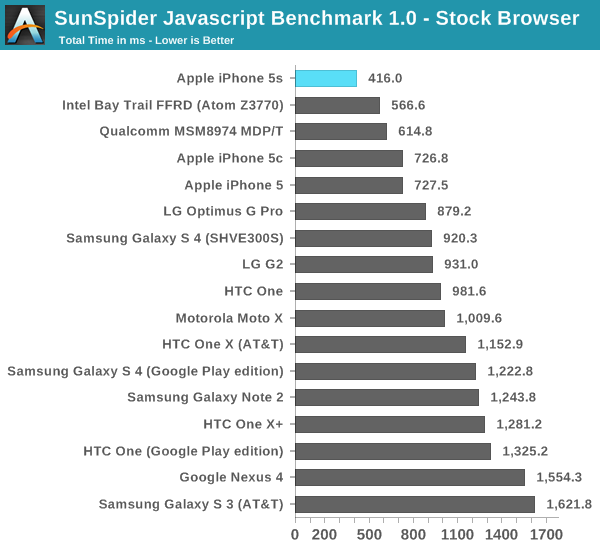
Educate yourself with the fact that, for now, it's the fastest phone [1] in the market. The entry beating the A7 in many of those tests is a latest-gen chip from Intel intended for tablets and super-portable computers that require low power consumption, and not really suitable for a cellphone.
http://www.anandtech.com/show/7335/the-iphone-5s-review
On the other hand, the basic message didn't change.
-
Re:Feeble minds.
The iPhone 5S is the 2nd fast phone on the market.
Educate yourself with the fact that, for now, it's the fastest [1]. The entry beating the A7 in many of those tests is a latest-gen desktop processing chip from Intel.
http://www.anandtech.com/show/7335/the-iphone-5s-review
And here, in my apparent ignorance (hey, it *was* blissful while it lasted!), I thought that my iPhone 5 was the fasted phone on the market: Mere perception? Apparently not.
-
Re:Feeble minds.
The iPhone 5S is the 2nd fast phone on the market.
Educate yourself with the fact that, for now, it's the fastest [1]. The entry beating the A7 in many of those tests is a latest-gen desktop processing chip from Intel.
-
Re:RISC (iPhone) vs. CISC (OSX)
Several journalists have made this mistake, such as the drivel posted here: Trusted Reviews
They seem to think that the register size being equal means that software written for them is somehow much more similar. In reality the CPUs and the software they run are no closer to each other than before. The main benefit of this move to the latest ARM CPU design is ironically much the same as the advantage brought by x86_64 - more registers are now available and some floating point operations are more efficient. This will translate into a small performance increase but it won't be night and day.
http://www.anandtech.com/show/7335/the-iphone-5s-review/4
Speedup in Geekbench (just from a re-compile): Integer gain between -25% (Dijkstra, heavy on pointers) and +825% (AES, uses new cryptographic instructions), geometric avarage +37%, median +9%; FP gain between 0% (Mandelbrot) and +195% (DGEMM, uses new DP-SIMD), geometric avarage +36%, median +21%
-
Re:That's what you get with duopoly
With the market turns into duopoly both the players no longer have the urge to bring new and innovative features into their new products.
If AMD doesn't get any more urges soon, it might end up being a monopoly. Here's Anandtech's take on the server market right now:
At the end of last year, AMD was capable of mounting an attack on the midrange Xeons by introducing Opterons based on the "Piledriver" core. That core improved both performance and power consumption, and Opteron servers were tangibly cheaper. However, at the moment, AMD's Opteron is forced to leave the midrange market and is relegated to the budget market. Price cuts will once again be necessary. Considering AMD's "transformed" technology strategy , we cannot help but be pessimistic about AMD's role in the midrange and high-end x86 server market. AMD's next step is nothing more than a somewhat tweaked "Opteron 6300". Besides the micro server market, only the Berlin CPU (4x Steamroller, integrated GPU) might be able to turn some heads in HPC and give Intel some competition in that space. Time will tell.
I think we all know FX-8350 is no match for Intel's high end in the desktop market either and they're struggling with power efficiency in the laptop market. AMD is exiting all the markets where they're exclusively competing with Intel and entering all the markets where they're competing with Intel and half a dozen ARM competitors. As the saying goes, out of the frying pan and into the fire. If those console sales don't start to kick up AMDs finances soon they're done for, because right now their business plans stink.
-
ARM vs x86
There is a good comparison of ARM vs x86 power efficiency at anandtech.com: http://www.anandtech.com/show/6536/arm-vs-x86-the-real-showdown
"At the end of the day, I'd say that Intel's chances for long term success in the tablet space are pretty good - at least architecturally. Intel still needs a Nexus, iPad or other similarly important design win, but it should have the right technology to get there by 2014."
(...)
"As far as smartphones go, the problem is a lot more complicated. Intel needs a good high-end baseband strategy which, as of late, the Infineon acquisition hasn't been able to produce. (...) As for the rest of the smartphone SoC, Intel is on the right track."The future for CPUs is going to be focused on power consumption. The new Atom core is two times more powerful at the same power levels than the current Atom core. You can see http://www.anandtech.com/show/7314/intel-baytrail-preview-intel-atom-z3770-tested:
" Looking at our Android results, Intel appears to have delivered on that claim. Whether we’re talking about Cortex A15 in NVIDIA’s Shield or Qualcomm’s Krait 400, Silvermont is quicker. It seems safe to say that Intel will have the fastest CPU performance out of any Android tablet platform once Bay Trail ships later this year.
The power consumption, at least on the CPU side, also looks very good. From our SoC measurements it looks like Bay Trail’s power consumption under heavy CPU load ranges from 1W - 2.5W, putting it on par with other mobile SoCs that we’ve done power measurements on.
On the GPU side, Intel’s HD Graphics does reasonably well in its first showing in an ultra mobile SoC. Bay Trail appears to live in a weird world between the old Intel that didn’t care about graphics and the new Intel that has effectively become a GPU company. Intel’s HD graphics in Bay Trail appear to be similar in performance to the PowerVR SGX 554MP4 in the iPad 4. It’s a huge step forward compared to Clover Trail, but clearly not a leadership play, which is disappointing." -
ARM vs x86
There is a good comparison of ARM vs x86 power efficiency at anandtech.com: http://www.anandtech.com/show/6536/arm-vs-x86-the-real-showdown
"At the end of the day, I'd say that Intel's chances for long term success in the tablet space are pretty good - at least architecturally. Intel still needs a Nexus, iPad or other similarly important design win, but it should have the right technology to get there by 2014."
(...)
"As far as smartphones go, the problem is a lot more complicated. Intel needs a good high-end baseband strategy which, as of late, the Infineon acquisition hasn't been able to produce. (...) As for the rest of the smartphone SoC, Intel is on the right track."The future for CPUs is going to be focused on power consumption. The new Atom core is two times more powerful at the same power levels than the current Atom core. You can see http://www.anandtech.com/show/7314/intel-baytrail-preview-intel-atom-z3770-tested:
" Looking at our Android results, Intel appears to have delivered on that claim. Whether we’re talking about Cortex A15 in NVIDIA’s Shield or Qualcomm’s Krait 400, Silvermont is quicker. It seems safe to say that Intel will have the fastest CPU performance out of any Android tablet platform once Bay Trail ships later this year.
The power consumption, at least on the CPU side, also looks very good. From our SoC measurements it looks like Bay Trail’s power consumption under heavy CPU load ranges from 1W - 2.5W, putting it on par with other mobile SoCs that we’ve done power measurements on.
On the GPU side, Intel’s HD Graphics does reasonably well in its first showing in an ultra mobile SoC. Bay Trail appears to live in a weird world between the old Intel that didn’t care about graphics and the new Intel that has effectively become a GPU company. Intel’s HD graphics in Bay Trail appear to be similar in performance to the PowerVR SGX 554MP4 in the iPad 4. It’s a huge step forward compared to Clover Trail, but clearly not a leadership play, which is disappointing." -
Re:Meh-be
The roomie I just moved in with was appalled when I discovered for her that her newly purchased notebook was actually a slower and worse-off computer than the laptop she was hoping to "upgrade" from. So we sent it back and now she has the credit and wants me to shop for her.
She kept mentioning the RT and liking it, but I warned her away and told her that tablets are still a developing technology, that it's in its awkward stages and next year she'll have something worth picking up. She said "okay, maybe next year it would be a good idea" but still seemed lost.
I'd like to say she has some good news when she gets home today, but the tablet isn't much better than the notebook. There's no removable media, not even a full-size SD slot?
I see these things as glorified palmtops. They're just slightly larger, but they fit the same niche -- something to pull out of your backpack or Euro-wallet at the airport or cafe and use within serious constraints on time and space. It's a useful gadget to complement a fully functioning PC at home, but IMHO it doesn't really qualify as a principal or "base" PC.
But oh, look: it's priced like a PC.
Scratching my head / not catching on.
Very interesting - the way you put it. If you read Anand and Brian's analysis of Baytrail / Silivermont performance, it pretty much lands up at half the CPU and a third of the GPU performance of a typical Core i5 that you would find in a slim notebook (Ultrabook). The crucial difference is of course that Baytrail consumes dramatically less power - about 2-3 watts (compared to 10-15 watts for a regular notebook CPU/GPU).
Reference: http://www.anandtech.com/show/7314/intel-baytrail-preview-intel-atom-z3770-tested/2
This power difference is crucial as it is low enough to be realistically used in a slate or iPad form factor. However, where it gets tricky is to determine if the performance tradeoff is worth it, especially if you are trying to do something meaningful - i.e. beyond simple surfing and answering emails.
There are two ways to look at this - firstly, Silvermont is about three times more powerful compared to the older Atom. So, if you are looking to replace an old Atom based Netbook, the answer is obvious - Silvermont will most certainly not suck in terms of netbook style usage, while still not heating up and keeping your family jewels safe. Personally, I think the best solution is a dual boot Silvermont that will boot Android and Windows 8.1 - it will let you use Android as a true tablet, and will let you use Windows 8.1 in a limited notebook way.
However, if you are looking at this as your primary computer replacement, I don't think Silvermont is going to cut it. You are better off with a Haswell. The dramatic power reduction in Haswell means that you can get a slim notebook that will still get you 8+ hours of battery life, almost rivaling an iPad. That is actually a game changer in itself if you think about it. This means that you can carry around a fairly lightweight and compact notebook with you and not bother lugging around chargers. In other words, you can carry it around like an iPad. Getting battery to last an entire work day or an entire school day is pretty cool! Something like the Macbook Air 13.
It would be super interesting if Intel came out with a version of Silvermont with beefier graphics (say, HD3000). I suspect that would be enough to support full HD meaningfully and to be a true viable notebook replacement.