Slashdot Mirror
Domain: arizona.edu
Stories and comments across the archive that link to arizona.edu.
Comments · 896
-
How does this qualify as extreme close up?
Looks pretty low resolution to me compared to NASA's HiRISE images from 2008. The wikipedia page has a link to a nice time magazine gallery and the Official HiRISE SiteGo ahead click on the 3374 × 3300 pixel image on this UCL page for an EXTREME closeup of Phobos.
So nice snap shots ESA, but hardly extreme...
-
Re:Disaster Area
The loudest noise of any kind at all was clearly the Big Bang (the universe supported sound waves before recombination). It came with a pretty cool light show, too.
For safety, I prefer viewing this performance from 13 billion light years away. At this distance, ear plugs are not necessary.
-
Re:When will they learn to dance?
Yeah, this in no way lessens the accomplishment of a robot actually learning to walk, but I figured it was half on-topic, half cool-as-hell so I'd post it
Yeah I was rather impressed with that myself and was curious to see what he was using for processing, sensors and etc... Apparently it was an Atom, maybe TFA said that but I'm not down with FOX links.
http://www.engineering.arizona.edu/news/story.php?id=114
I would of been much more impressed if he would of done this with something akin to AVR and read about it on Society of Robots instead of FOX but that's neither here nor there... -
UA Engineering's Press Release & Video
here's the link to UA Engineering's story w/ youTube video:
http://www.engineering.arizona.edu/news/story.php?id=86
or, cnet: http://news.cnet.com/8301-17938_105-10450394-1.html
mod this into the ground as flamebait, but why in the hell would one want to read about scientific achievement in an article posted on a cable "news" station's web site (read: all of the cable "news" stations are pure crap), let alone the one that serves as a megaphone for those most hostile to scientific achievement. Let's see, do I want some cable "news" douche to dumb down the info so as to allow it to be presented to me in a more palatable fashion? hmmm, that's a tough one...
What? you say the article linked in TFS wasn't dumbed down? Well, I must inform you that this is
-
Re:Shhhh!
reference: http://web.hwr.arizona.edu/~gleonard/2009Dec-FallAGU-Soot-PressConference-Backgrounder-Kargel.pdf
number of papers used in this one flawed report: none
hockey stick graphs created from this: none
papers from "hide the decline" subroutines: none
errors in raw data: none (this was a error in a projection, not an observation)
accurate papers based on flawed data: some, but not in this case.
Sorry, I gotta call BS. First of all, the hockey stick graph was on the front page of a major IPCC report and other papers as well. The author of the Hockey stick graph is all over the place. From Michael E Mann's Wiki page:
He was a Lead Author on the “Observed Climate Variability and Change” chapter of the Intergovernmental Panel on Climate Change (IPCC) Third Scientific Assessment Report (2001). He has been organizing committee chair for the National Academy of Sciences ‘Frontiers of Science’ and has served as a committee member or advisor for other National Academy of Sciences panels. He served as editor for the Journal of Climate and has been a member of numerous international and U.S. scientific advisory panels and steering groups.
CRU, the place where all those emails came from PROVIDED TEMPERATURE DATA TO THE IPCC! From HERE
The CRU maintains the repository for temperature measurements used by the Intergovernmental Panel on Climate Change (IPCC)
I'm sure I could find more, but I didn't have more than 2 minutes to spend on this.
-
Re:Shhhh!
reference: http://web.hwr.arizona.edu/~gleonard/2009Dec-FallAGU-Soot-PressConference-Backgrounder-Kargel.pdf
number of papers used in this one flawed report: none
hockey stick graphs created from this: none
papers from "hide the decline" subroutines: none
errors in raw data: none (this was a error in a projection, not an observation)
accurate papers based on flawed data: some, but not in this case. -
Re:Shhhh!
What's naive BS is thinking that you can produce a 2000+ page document and not have a typo here or there. If you want to cherry pick one typo out of a huge body of work (and a very small, rather unimportant claim that seems to have been added at the last moment; it was not in the first or second drafts) and disregard the entire body of work for that purpose, go ahead. Though, if you are actually interested in the science, here is what is actually going on with the glaciers, properly sourced and all.
And when you produce a 100% flawless, 2000+ page tome of information, let me know. -
Re:Milage? MPG?
Well according to http://seds.lpl.arizona.edu/~ssa/docs/Space.Shuttle/general.shtml#four the capacity of the fuel tank is 500,000 gallons, and the solid rocket boosters have about a million pounds of fuel. Assuming the fuel has a similar density to gasoline, that's another 162,000 gallons... Total of 662,000 gallons. The orbiter generally operates at about 190 miles above the surface of the earth, so it's a circle with a diameter of 8116 miles, so about 25,500 miles covered per orbit...
If you want to match current cars (around 30mpg highway), you'd need 779 orbits, which with an orbital period of 90 minutes, that's a mission of around 49 days. So yeah, I think your car gets better mileage than the shuttle...
-
Re:Climate change is a security threat
Once again, you're quoting amateurs who don't know what they're talking about. In this case, West Virginia Office of Miner's Safety chief engineer, Monte Hieb. Here's his webpage. Now, you might be asking yourself why you're getting your science data from a mine safety engineer. If not, you probably should!
Here's the huge blunders he makes in his numbers:
1) He only credits a small portion of the CO2 to anthropogenic emissions. Why? He doesn't say it, but one can only assume that it's because natural emissions are higher than anthropogenic emissions. The problem with this argument is that natural emissions of CO2 are nearly perfectly balanced with natural sinks of CO2; that's why CO2 levels have historically fluctuated by such small amounts on the order of thousands of years. We haven't had CO2 levels this high in at least the past 15 million years. Picture a half-full bathtub draining water at a constant rate, with water being added to it at the same rate. The level of the tub remains the same. Now start adding extra water -- even a small amount. The bathtub will steadily fill up. Our emissions are not matched by corresponding sinks.
CO2 levels in the atmosphere are very easily measured. Past levels are very readily measured from air bubbles trapped in ice cores. Here's what you see. That's the addition to the atmosphere that is not balanced out by a corresponding CO2 sink. The atmosphere's C13/C12 ratio changed 1/5th as much in the entire last glacial as it changed in the past 150 years (the C13/C12 ratio shows how much of our atmosphere is made of old, deep carbon rather than fresh surface carbon).
You should also know that Hieb faked this graph. Go compare his graph to the DOE's that he "cites". He adds a "natural" and "manmade" column that exists nowhere on his reference, thus making it sound like the DOE believes what he's trying to imply.
2) He does no calculations to determine his water vapor forcing. None of his references are primary sources, and in fact, one of them states that the elimination of CO2 entirely from our atmosphere would lower heat-trapping efficiency by 12% and elimination of water vapor would lower it by 36%. That said, all of his references for the "95%" number trace back, ultimately, to "Solar Radiation Absorption by Carbon Dioxide, Overlap with Water, and a Parameterization for General Circulation Models" (Ramaswamy, 1993). Please pay attention to the title. Solar radiation absorption. That is, incoming radiation, not outgoing. Here's the abstract. You probably don't have access to the full paper, but I do. The very first line is, "A proper representation of the absorption of solar radiation in the atmosphere is important to determine accurately the radiative fluxes and heating rates in weather forecasting and climate models." Got that? Solar, not re-radiated infrared from Earth's surface. The greenhouse effect is based on absorbing as *little* solar radiation as possible and as *much* re-radiated infrared as possible.
Want real references and numbers for the *total* greenhouse contribution? Here you go. For a more layman's version, here. These numbers all come from first principles.
I hate to dump on Hieb so hard for this, but this is what you get when you go to a coal mine safety engineer for science.
3) As has been mentioned to you before, and is something Hieb completely ignores, water vapor is not forcing. It's feedb
-
Re:Oink! Oink!
Apollo program resulted in computers (I guess that was a non-cost effective problem). If it wasn't for Apollo, NO ONE would fund the early silicon fabs. It would continue to advance at the pace of current fusion research.
False. Integrated circuits were first used for ICBM guidance, which is another robotic space technology.
If only Columbus, Magellan and all others that followed thought the same.
They didn't have remote probes. More importantly, their destinations were not in lifeless, uninhabitable, waterless vacuums.
In case you didn't get the memo, recently NASA has conclusive evidence of significant water-ice deposits on both the Moon and Mars. Oh and it's been generally known for a while now that Mars has an appreciable atmosphere, even the surface of the Moon technically isn't in a vacuum.;)
Going into space was always about *pushing* boundaries. You are NOT doing that with freaking robots!
Sure we are. For example, a mission to drill down into the liquid oceans of Europa would push plenty of boundaries (and would be totally impossible for humans anyway).
Impossible only if attempted by hand-tools alone.*eye roll* If you can get a robotic probe down to the any liquid ocean of Europa, it's only slightly more difficult to get a vehicle large enough to be crewed by one or more human beings. Furthermore, instead of drilling there is the option of melting your way down through the ice. If the vehicle in question also contains the main crew quarters it could take several days to melt its way through the ice with no impact on the crew. In fact, it might be better for them than sitting out on the surface, the ice will provide extra shielding against cosmic radiation. Getting back up is more challenging, but if the descent was a spiral rather than a straight vertical shaft the vehicle could just climb-out on treads.
But we don't have any data on *how* to survive someplace like the Moon.
So what? We don't need to know how to do that unless we find a valid reason have anybody live there. It's a waste of valuable resources to figure it out now.
Now I'm going to have to disagree with both of you. We do know how to survive on someplace like the Moon, in the short term at least. What we need to learn is how to thrive on the other worlds of the Solar System. As to a valid reason to have anybody live there, well usable surface area and resources on Earth are finite and evening ignoring the living area problem, recycling will not reach 100% for all materials in the foreseeable future. Furthermore, even draconian means of population control don't seem to be working all that well and are morally questionable even if they did, so we can't count on stabilizing the global population soon, if ever. As a result some time in the future people will want to live on other planets because it will allow them a standard of living higher than what they can get on Earth, even if there are extra challenges and dangers involved in doing so. If you have a hard time believing this then you must have slept through the part of your history classes dealing with the European settlement of the Americas.
-
Re:The answer is yes.
This is a perfect example of what I'm talking about.
You bring out examples of supposed flaws in global warming as a "gotcha" argument, but ignore the fact that each and every one of these arguments has been repeatedly debunked.
Again - you're ignoring rebuttals to denialist arguments, then pretending they don't exist. It's not that no-one's listening to your arguments, it's that they are scientific nonsense.
-
People! Punctuation is IMPORTANT!Google's language is called Go! (with an exclamation mark.) The preexisting language whose existence has been suddenly and rudely revealed is called Go without the exclamation mark. Since ! is the negation operator, the Google's language is Go (Not). People don't seem to realize the full implications of the name.
It originates from the paper by Dijkstra where he argued GoTo statements should be banned. That resulted in many structured programming languages main stream computer science. But what is not known is that the same paper spawned a new set of less well known languages based on "COME FROM" statement to avoid the "GO TO" statement. The Go! (pronounced Go-Not) language belongs to this little known branch. It is completely and entirely different from the plain old Go language.
Dont get me started on the Japanese chess game Go.
-
Re:How Much Damage?
You can use this site to get an estimate.
Wow...The Slashdot impact cratered the site.
-
Re:How Much Damage?
They really needed it 250-300 million years ago though. Tweaking the impact velocity to get roughly the right values according to the article, the calculator reveals anyone on the edge of the crater would be vaporized, ripped to shreds from the pressure wave, then pulverized by the earthquake and drowned by a subsequent tsunami.
Now, THAT is what I call having a bad day.
-
Re:How Much Damage?
Asteroid Impact Calculator. Handy thing to have bookmarked, in the event that the astronomers see the next one from far enough off.
It's impossible to be sure what the density and angle of incidence would have been in this case, as this sort of data isn't usually published. It's also impossible to be sure of composition, as that depends on where the asteroid was from. Thus, any results you DO get from the calculator are either meaningless (too much garbage in) or extreme values only.
Having said that, such calculators are fun when they find truly massive craters. The crater under the antarctic ice, for example, is so large that the Earth was unlikely to have ever been hit by something that big in the past 4 billion years. Antarctica is very modern, in comparison.
-
Re:Hardly noticeable if it impacted
It would certainly create an audible boom for miles and miles, but it looks like they're talking about the air blast in terms of actual damage, not in terms of people being aware of it. I suspect that something like that would have to be damn close to being able to shatter windows at ~9,500 feet. (the actual location you input is offset by a km, so it's slightly more than just 9k feet away)
-
Re:Hardly noticeable if it impacted
The OP said "typical data", not "oh that number is bigger bigger is better right". You've simulated it with an asteroid slightly more dense than pure iron, traveling at a highly unrealistic velocity. Using less bogus values (courtesy of this), you get much more reasonable results: a 3.7 kT airburst at 36 km in the air.
-
8980 meters, eh?
It would most likely bursts into a cloud of fragments at an altitude of 8980 meters. Minor local damage might occur if a larger fragment happens to hit a house.
Thanks for not rounding that off to "nine kilometers" or even "about 10 km" as some less mathematically-inclined contributors would have done. If you've laboriously and precisely calculated that 2009 AV is exactly 7.000 meters in diameter, has a density of 8.000 g/cm3 and will hit the atmosphere at a 45.00 degree angle at exactly 17.00 km/s, why give up that hard-earned precision in your result?
-
Re:How Much Damage?
As a nitpick, that's actually 40 kiloton equivalent (0.40 x 10^-1 megatons = 0.04 megatons = 40 kilotons). You don't get a 400 kiloton airburst until you go up to 15m diameter
-
Re:Hardly noticeable if it impacted
The airburst would unleash about 130 tons on TNT, about 10 times the size of the Hiroshima bomb.
-
Re:How Much Damage?
Apparently there's *much* more stuff to know before guestimating.
-
Re:How Much Damage?
You can use this site to get an estimate.
-
Re:How Much Damage?
It would most likely bursts into a cloud of fragments at an altitude of 8980 meters. Minor local damage might occur if a larger fragment happens to hit a house.
-
Hardly noticeable if it impacted
Seven meters just isn't all that big. According to the Earth Impact Effects Program using typical data: No crater is formed, although large fragments may strike the surface. The air blast at this location would not be noticed.
-
Re:NASAs first priority
If we can see objects like this coming we should be able to evacuate the impact site ahead of time.
Hm... up to 70km you say - that's quite unlikely, results would be quite devastating, even if you were 8000km away from the impact site (but depending on quite a few parameters of the object/impact).
Give this a try, maybe you'll reconsider: http://www.lpl.arizona.edu/impacteffects/
Sure but half way around the earth is 20000km, so evacuating a circle 10000km around the impact site doesn't seem impossible. Easier than moving everybody to the moon or mars, anyway. I am assuming we can give ourselves 20 or 30 years warning with good quality remote sensing.
-
Re:NASAs first priority
If we can see objects like this coming we should be able to evacuate the impact site ahead of time.
Hm... up to 70km you say - that's quite unlikely, results would be quite devastating, even if you were 8000km away from the impact site (but depending on quite a few parameters of the object/impact).
Give this a try, maybe you'll reconsider: http://www.lpl.arizona.edu/impacteffects/
Sure but half way around the earth is 20000km, so evacuating a circle 10000km around the impact site doesn't seem impossible. Easier than moving everybody to the moon or mars, anyway. I am assuming we can give ourselves 20 or 30 years warning with good quality remote sensing.
-
Re:NASAs first priority
If we can see objects like this coming we should be able to evacuate the impact site ahead of time.
Hm... up to 70km you say - that's quite unlikely, results would be quite devastating, even if you were 8000km away from the impact site (but depending on quite a few parameters of the object/impact).
Give this a try, maybe you'll reconsider: http://www.lpl.arizona.edu/impacteffects/ -
Re:NASAs first priority
If we can see objects like this coming we should be able to evacuate the impact site ahead of time.
Hm... up to 70km you say - that's quite unlikely, results would be quite devastating, even if you were 8000km away from the impact site (but depending on quite a few parameters of the object/impact).
Give this a try, maybe you'll reconsider: http://www.lpl.arizona.edu/impacteffects/ -
Amazon.com systematically deletes negative reviews
I can state this from personal experience. They systematically deleted most negative reviews of "The Courage to Heal" and similar books (reviews that followed ALL of Amazon.com's reader review guidelines and were concise, on-topic, free of obscenities and misspellings, and made specific reference to the book's contents) while leaving up all positive reviews and only a few token negative reviews that were short and nonspecific. As a result, the "average user ratings" on Amazon.com should be considered biased and misleading and the selection of written reviews that survives should be considered biased and unrepresentative as well. The Amazon.com "user reviews" feature exists to help Amazon sell more books by selectively filtering and presenting user-generated reviews that serve that purpose, not to actually help its customers make an informed choice based on accurate information. See "Gaming the System: A Case Study Manipulation of Online Consumer Reviews" by Bruce Fulton at http://www.u.arizona.edu/~bfulton/ierposter/overview.html for a rigorous analysis of including statistical analysis of the bias their selective censorship of reviews introduces. Amazon.com is like a bookstore in Lake Wobegon where most of the books are above average!
-
Re:Gratuitous Global Warming Comment
No true believers are required.
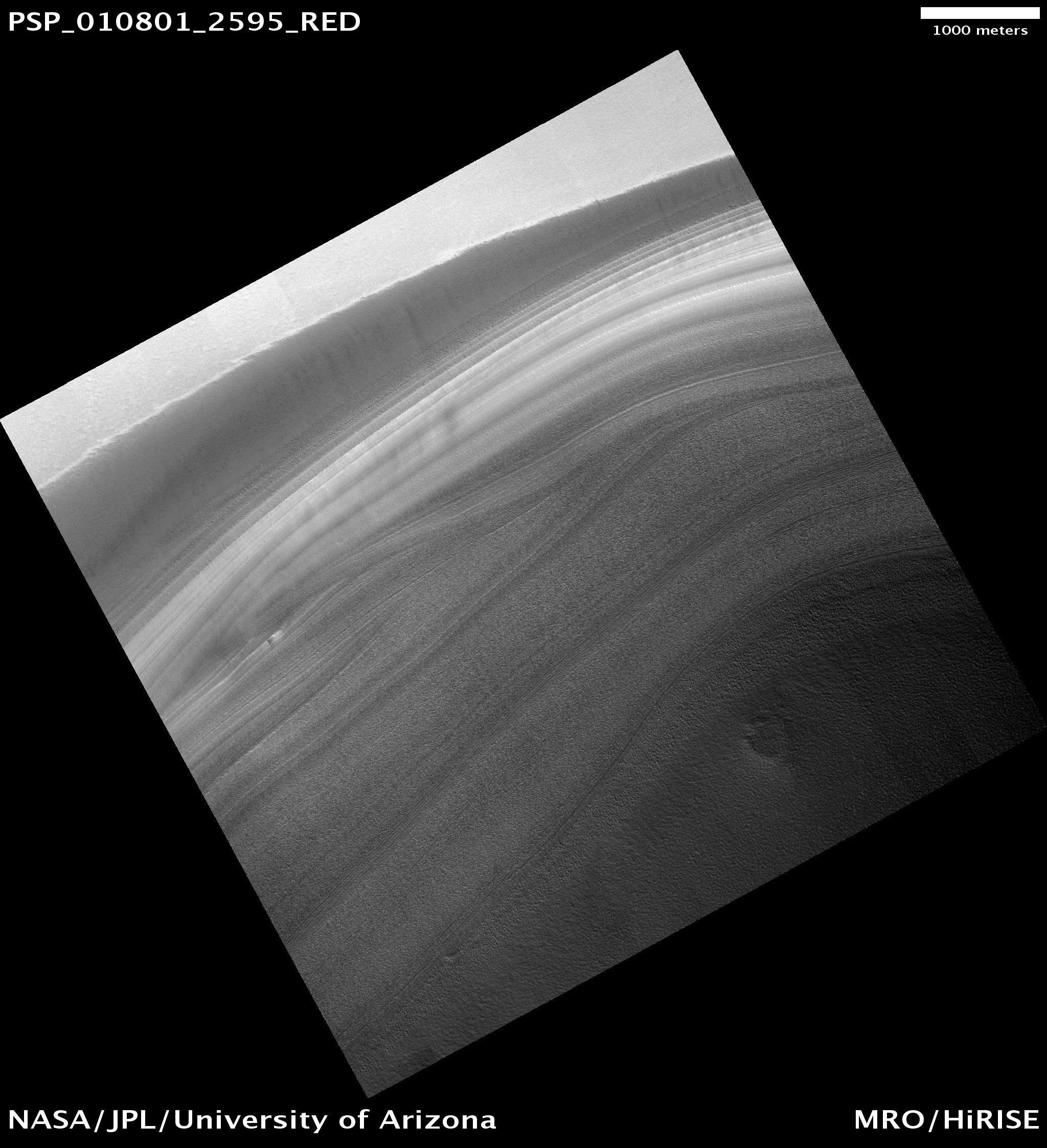
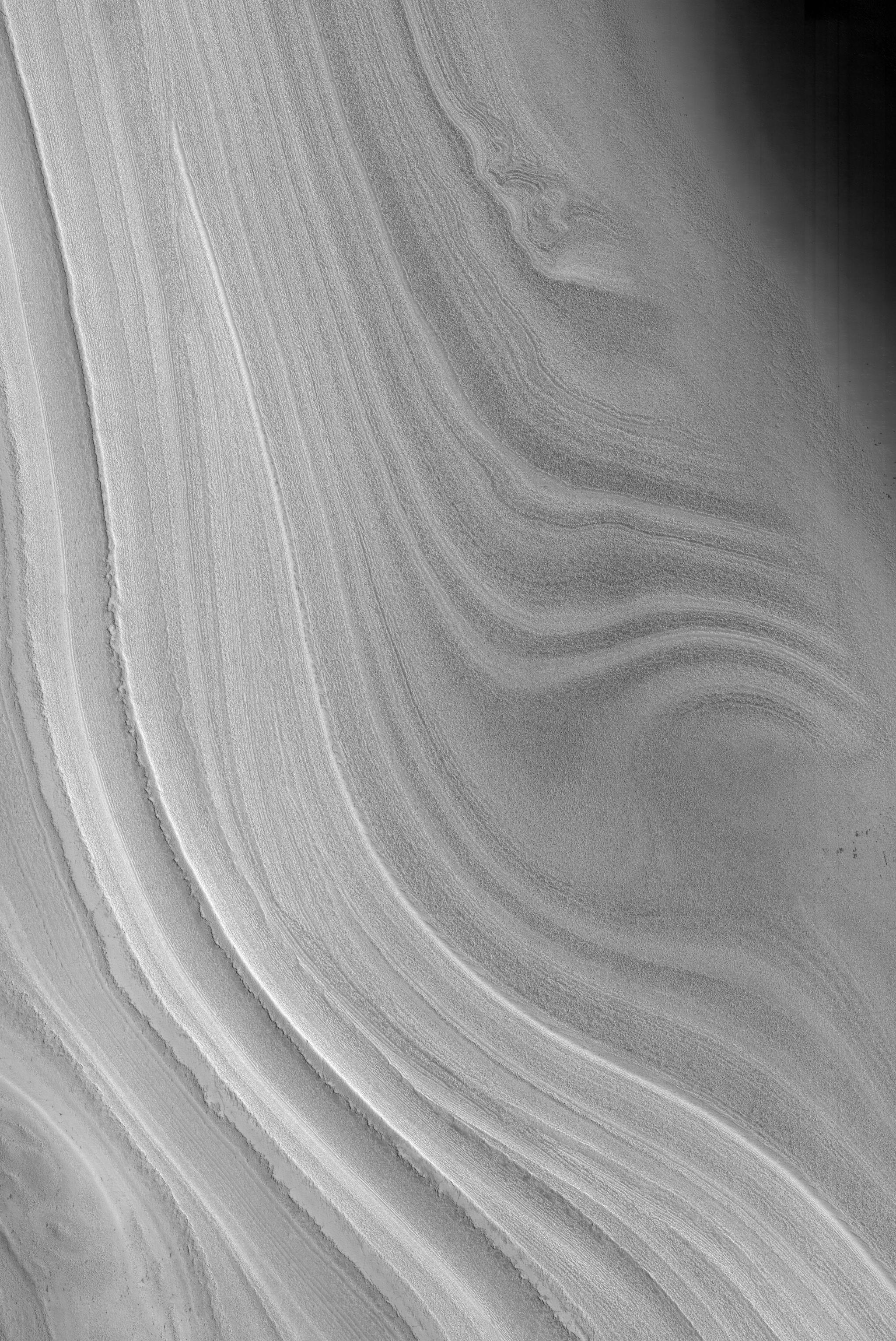
Unlike the Earth (which has a big Moon to anchor things), Mars has huge variations in insolation due to its obliquity and eccentricity cycles. These oscillations drive large variations in climate, which causes the cool layering in the Martian Polar Caps - the so called North Polar Layered Deposits. There are lots of cool pictures of these layers.
While it is true that both the Earth and Mars would exhibit climate changes if the solar luminosity changed, so far I have not heard of any evidence requiring this from Mars. Mars's internal and orbital dynamics are quite enough to keep the climate modelers busy.
-
Re:Gratuitous Global Warming Comment
No true believers are required.
Unlike the Earth (which has a big Moon to anchor things), Mars has huge variations in insolation due to its obliquity and eccentricity cycles. These oscillations drive large variations in climate, which causes the cool layering in the Martian Polar Caps - the so called North Polar Layered Deposits. There are lots of cool pictures of these layers.
While it is true that both the Earth and Mars would exhibit climate changes if the solar luminosity changed, so far I have not heard of any evidence requiring this from Mars. Mars's internal and orbital dynamics are quite enough to keep the climate modelers busy.
-
Re:Gratuitous Global Warming Comment
No true believers are required.
Unlike the Earth (which has a big Moon to anchor things), Mars has huge variations in insolation due to its obliquity and eccentricity cycles. These oscillations drive large variations in climate, which causes the cool layering in the Martian Polar Caps - the so called North Polar Layered Deposits. There are lots of cool pictures of these layers.
While it is true that both the Earth and Mars would exhibit climate changes if the solar luminosity changed, so far I have not heard of any evidence requiring this from Mars. Mars's internal and orbital dynamics are quite enough to keep the climate modelers busy.
-
Re:Gratuitous Global Warming Comment
No true believers are required.
Unlike the Earth (which has a big Moon to anchor things), Mars has huge variations in insolation due to its obliquity and eccentricity cycles. These oscillations drive large variations in climate, which causes the cool layering in the Martian Polar Caps - the so called North Polar Layered Deposits. There are lots of cool pictures of these layers.
While it is true that both the Earth and Mars would exhibit climate changes if the solar luminosity changed, so far I have not heard of any evidence requiring this from Mars. Mars's internal and orbital dynamics are quite enough to keep the climate modelers busy.
-
Re:It's in the water?
Only if you believe in homeopathy.
You're talking about something like 1:125,000,000 odds that any given water you drink will have testable levels of these chemicals in them.
-
Re:I see two unconditional jumps here
There is not much difference between "return 0;" and "ret=0; goto exit_function;".
Indeed.
Both are unconditional jumps there is no rational reason why one should be "considered harmful" and the other not.
The most anal of the anal retentives of the goto-less persuasion do indeed consider them the same and consider both harmful. Wirth's original Pascal did not have a return for that reason. I'm not sure why he allowed a goto and no return. He later reversed himself in Modula II where he added return, but removed goto.
Languages that provide a rich set of control structures (an if statement has an implied goto too) do not need goto. Icon (my favorite language for recreational coding) http://www.cs.arizona.edu/icon/refernce/ref.htm does not need a goto. Neither does the Unix shell.
Low level languages intended for systems programming do need a goto for the reason I noted above - every prefetched byte in the icache counts and you DO NOT want to mix slow path error handling code in with hot path usual case code. Even Ada, which otherwise frowns at non-local flow of control, provides a goto.
-
Re:Linus
This is my favorite test taking shirt for that exact reason =)
-
Fact Free Post
I stopped reading your post after the first paragraph because it was so fact-free.
The crater is 1 mile wide, not 3. The Barringer meteor was known to be an iron meteorite based on the debris found by the early settlers. The debris field was around 10 miles in diameter so San Francisco would have been safe. The earthquake the impact generated is thought to have been around a Magnitude 5, an event I've experienced more than once here in California. Exciting when it happens but not that big a deal in the overall scheme of things.
The impact would have been spectacular if you'd been within 50 miles but the rest of the folks in Arizona would have wondered wtf and then gone on with their daily activities. The folks in New Mexico probably never noticed it.
Ok I lied. I did read the rest of your post to see what other absurdities it held. And, verily, even though I'm an atheist, the good lord smiled upon my efforts...
It's not as if we're doing nothing right now. When we eventually see an asteroid headed our way that's large enough to warrant a response, odds are it'll be spotted way before impact. If it's a genuine hazard, it'll be big which means it will be visible to those good souls who make it their business to look for such a hazard. When that happens, assuming we haven't bombed ourselves back to the stone age, we'll be able to deal with the threat then. If we've bombed ourselves to oblivion, then we're toast anyway.
In the meantime, setting up a moon base to deal with the hazard is absurd.
We'll go to the Moon on a permanent basis if and when there's money to be made. It's what drove Isabella to back Columbus and it's what convinced Congress to underwrite Lewis and Clark. Both investments paid off in spades. The Moon has yet to promise any such return which is why we never went back.
-
Re:He has shown forty years of bias
"That completely misrepresents the opinion of climatologists." Really? Like James E. Hansen, Nasa's lead climatologist. Oh, no, I guess not. How about atmospheric scientists from the University of Oxford? Hmm. No. Or maybe you mean Jonathan Overpeck, the director for the University of Arizona's Institute for the Study of Planet Earth who once said of climate change, "The results suggest the threshold is close to the end of this century, and it could come sooner. The Arctic is already warming much faster than we thought it would. To think we're not going to get 4 to 5 degrees warmer in another 50 years is wishful thinking." Oh, no, you don't mean him. How about Damon Matthews, from Concordia University in Canada, or Ken Caldeira, from the Carnegie Institution for Science, Stanford
I've not found a climatologist who has said that raising CO2 levels are a good thing or even a neutral thing.
I can find meteorologists, economists, physicists, and many other very clever people who say such things, but if there are climatologists out there saying "Ah, nevermind the CO2, it's no big thing," then they are outnumbered 100 to 1 at best. Is that "far less" consensus than the rest? No, I don't think so. Maybe a little less. But I'm giving you a hypothetical. I still haven't even seen one of these mythical pro-CO2 climatologists of which you write. Please enlighten.
-
Re:60GHz is available because its almost useless
Sounds to me like you could have used a different antenna with a wider beam for your short haul application. Or better mounts. By the way, the parallel plane thing is nonsense - the polarization makes the signal drop off as the cosine of the angle, so a 10 degree misalignment will give about 1dB of loss. [Disclaimer: Where I work, 60 GHz is the lowest frequency we use. 700 GHz is the high end of our operating range.]
-
So, I used a calc on the impactthe calculator can be found here:
http://www.lpl.arizona.edu/impacteffects/And the results are (assumed that you are 2000km from impact - if it hit it would be in the ocean...)
Your Inputs: Distance from Impact: 2000.00 km = 1242.00 miles
Projectile Diameter: 30.00 m = 98.40 ft = 0.02 miles
Projectile Density: 8000 kg/m3
Impact Velocity: 17.00 km/s = 10.56 miles/s
Impact Angle: 90 degrees
Target Density: 1000 kg/m3
Target Type: Liquid Water of depth 100.00
meters, over typical rock.Energy: Energy before atmospheric entry: 1.63 x 10¹⁶ Joules = 3.90 MegaTons TNT
The average interval between impacts of this size somewhere on Earth is 314.0 yearsAtmospheric Entry: The projectile begins to breakup at an altitude of 14100 meters = 46100 ft
The projectile reaches the ground in a broken condition. The mass of projectile strikes the surface at velocity 10.8 km/s = 6.7 miles/s The impact energy is 6.58 x 10¹⁵ Joules = 1.57 MegaTons.
The broken projectile fragments strike the ground in an ellipse of dimension 0.151 km by 0.151 kmMajor Global Changes: The Earth is not strongly disturbed by the impact and loses negligible mass.
The impact does not make a noticeable change in the Earth's rotation period or the tilt of its axis.
The impact does not shift the Earth's orbit noticeably.Crater Dimensions:
What does this mean?The crater opened in the water has a diameter of 1.4 km = 0.866 miles
For the crater formed in the seafloor: Crater shape is normal in spite of atmospheric crushing; fragments are not significantly dispersed.
Transient Crater Diameter: 670 m = 2200 ft
Transient Crater Depth: 237 m = 777 ft
Final Crater Diameter: 837 m = 2750 ft
Final Crater Depth: 179 m = 586 ftThe crater formed is a simple crater
The floor of the crater is underlain by a lens of broken rock debris (breccia) with a maximum thickness of 82.8 m = 272 ft.
At this impact velocity ( Thermal Radiation: What does this mean?At this impact velocity ( Seismic Effects: What does this mean?
The major seismic shaking will arrive at approximately 400 seconds.
Richter Scale Magnitude: 4.4
Mercalli Scale Intensity at a distance of 2000 km:
Nothing would be felt. However, seismic equipment may still detect the shaking. -
Ocean Equivalent
Since Mars's Surface Area = 144 million km^2, this implies (for 2.5 million km^3 of ice) that ice caps are enough to supply a water layer 17 meters deep over the entire surface, or maybe 50 meters deep in Hellas and the Northern lowlands, if it was all melted. (If the polar caps entirely melted, that alone would raise the surface pressure above the triple point of water, so liquid water would be possible. The Hellas Basin is deep enough that the pressure is above the triple point now, and it definitely could have liquid water in it if the climate warmed some.)
Note that the polar caps show very clear signs of layering, presumably caused by the long period obliquity oscillations, and are in general very young geologically, so it is not beyond belief that, say, the Hellas basin fills up with water on a regular basis, every 500,000 years or so.
-
Ocean Equivalent
Since Mars's Surface Area = 144 million km^2, this implies (for 2.5 million km^3 of ice) that ice caps are enough to supply a water layer 17 meters deep over the entire surface, or maybe 50 meters deep in Hellas and the Northern lowlands, if it was all melted. (If the polar caps entirely melted, that alone would raise the surface pressure above the triple point of water, so liquid water would be possible. The Hellas Basin is deep enough that the pressure is above the triple point now, and it definitely could have liquid water in it if the climate warmed some.)
Note that the polar caps show very clear signs of layering, presumably caused by the long period obliquity oscillations, and are in general very young geologically, so it is not beyond belief that, say, the Hellas basin fills up with water on a regular basis, every 500,000 years or so.
-
Re:Mass Spec
Has any probe carried a mass spectrometer?
Yes, the TEGA instrument on the Phoenix lander (the "oven" device that they were having problems getting dirt into shortly after landing) was a mass spectrometer as well as a scanning calorimeter. There were also mass spectrometers on board the VIKING landers in the 1970's, the ill fated Beagle. -
Re:Five years for 36 gigabytes?
Most of that's relayed via MRO and Mars Odyssey. As others have remarked elsewhere, the drips and drops of data from MER is lost in the firehose from MRO. (Ever pulled a JP2 of HiRISE data? Those things are VAST. Here's a random example.) Incidentally the IAS quick-viewer is the third useful client-side Java application ever written, according to this book I just made up.
-
re
nothing that new i have been making maps for Celestia for quite a few years and for the most pare the imaging is just NOT available to be able to do this the Japanese craft to the moon can http://www.selene.jaxa.jp/index_e.htm it uses a forward and backward looking cam. to do this the "Mars Express High Resolution Stereo Camera" can http://www.esa.int/esaSC/SEM8Q2PR4CF_index_0.html the mars HIRISE can http://hirise.lpl.arizona.edu/anaglyph/ but in all cases so far only a small patch of ground is able to be maped will get better in time.
-
Re:Not enough history
There is a saying for modern historians that when you are faced with too much data, your job is to select representative sets.
No-one will ever be able to keep everything. I had to discard collections of 50 years of hard to get subscription papers, newsprint etc because no-one wanted them, no storage possible and no digital scanning available at the time. It got thrown out, with only some items kept. Even those are getting damaged over time, but I don't want to spend hours scanning them, storing the data or making them public. No-one cares for that sort of stuff and your own collections will eventually be thrown out. I'm faced with the same prospect and I hope someone will keep a representative set of what I had for a few years.
Ultimately, you backup, then convert, then backup as a cycle until you die.
Then, out of the blue, someone in the future will come across parts of your life represented by these collections, either in a 2nd hand shop, the garbage tip, deceased estate, relative or what/whoever and some of it may be kept.So you're approaching 60 and you still have 1000 LPs? Are you going to spend 45,000 minutes resurrecting them? Maybe some rarities.
Photos? 8mm film stock? I have 1000's of photos of dogs in dog shows in the 60s and 70s. Most of the people are dead, the dogs certainly are and as they are slides, there is no captions or any indication what they represent.
So the decision is - Is it worth archiving? Who will eventually be the custodian? What value has it for future generations?
When you look at it like that, then there's very little you want to keep.Here's some links for everyone's consideration.
Are you interested? http://www.cs.arizona.edu/patterns/weaving/lace.html
What about this? http://dsr.nii.ac.jp/toyobunko/index.html.en
-
Re:Bright vs. Hard Workers
-
Why not bring them back
It's far from certain that mammoth died out simply from climate change. Take a look at this link: http://packrat.aml.arizona.edu/Journal/v37n1/vartanyan.html Mammoth survived thousands of years beyond what most people think, into historic times (1700 b.c) It was a place that man didn't reach (hmmm...coincidence?), but Wrangel Island was too small to support a large population of them. It seems that wherever man went, large animals encountered "climate change". I don't doubt that climate was an issue, but nor do I doubt that man was either.
-
More info
As the NASA article mentions, you can find more info from the Phoenix team's official website: http://phoenix.lpl.arizona.edu/
Also, the Planetary Society has done a great job following the mission, and there's an extremely detailed update one of their members wrote based on a phone interview with the Phoenix project manager shortly after the last contact with Phoenix was made last week.
Here's a quick summary: Phoenix has been reducing operational tempo for several weeks. In anticipation of having too little power to run the robotic arm and inability to communicate in late November for a few weeks as Mars passes behind the sun, they hurried sample delivery to a few more TEGA ovens for analysis, but they still had one oven-load left to analyze when the dust storm hit that dropped power levels below a sustainable point. However, despite that, they had already met all of their operational objectives. The extra data would have been a bonus.
When they saw the dust storm coming, they tried to power down almost all non-essential systems, but weren't quite in time. As a result, the batteries drained completely and it "browned out." The next day, the batteries charged enough to wake up in what they call "Lazarus mode" and try communicating, but it likely missed the relay window with the orbiters. Over a couple days, they got some intermittent communications, and were hoping to be able to send instructions to properly time the wake-up for best chance at communications and best utilization of what little solar power its getting each day, but apparently that hasn't yet succeeded. They were hoping to get temperature and soil conductivity measurements periodically, and maybe even a few pictures of CO2 ice starting to cake up in the area.
It may still be in Lazarus mode, or something may have failed due to the thermal contraction of the electronics (ex: solder and circuit board material expand at different rates...too extreme of a temperature shift and things start popping apart) ending it for good. There is still some hope that Phoenix will survive the frigid temperatures and even the weight of a meter-thick layer of CO2 ice to awaken in the spring. That's what Lazarus mode was created for, but the hope of that has always been very small.
There's a really interesting tidbit about a microphone that's part of the descent camera. On a whim they tried to use it a couple weeks ago to record wind sounds, but it didn't start up. Then one of the team members had a conversation with blind man who pointed out that he'll never see a picture of Mars, so he had really been hoping the microphone would work so he could experience it through sound. That really motivated the team to try the microphone again, but unfortunately, it sounds like they didn't have a chance with that either.
I've been following this mission on a nearly daily basis since landing. It's been neat to see Phoenix in action, and no doubt a busy few months for the team. I'm sure they'll feel somewhat relieved to return to living by a 24 hour clock and have the leisure to analyze all the data and the 25,000+ pictures it returned. I'll never forget the shot Mars Reconnaissance Orbiter got of it drifting down to the surface with Heimdall Crater in the background. In my opinion, it's one of the top 10 space images ever. The MRO team even claims that if you look really close at the full size version, you can see a black-spec a few hundred pixels beneath the lander that is the just-released heat shield falling away.
Well done Phoenix. -
More info
As the NASA article mentions, you can find more info from the Phoenix team's official website: http://phoenix.lpl.arizona.edu/
Also, the Planetary Society has done a great job following the mission, and there's an extremely detailed update one of their members wrote based on a phone interview with the Phoenix project manager shortly after the last contact with Phoenix was made last week.
Here's a quick summary: Phoenix has been reducing operational tempo for several weeks. In anticipation of having too little power to run the robotic arm and inability to communicate in late November for a few weeks as Mars passes behind the sun, they hurried sample delivery to a few more TEGA ovens for analysis, but they still had one oven-load left to analyze when the dust storm hit that dropped power levels below a sustainable point. However, despite that, they had already met all of their operational objectives. The extra data would have been a bonus.
When they saw the dust storm coming, they tried to power down almost all non-essential systems, but weren't quite in time. As a result, the batteries drained completely and it "browned out." The next day, the batteries charged enough to wake up in what they call "Lazarus mode" and try communicating, but it likely missed the relay window with the orbiters. Over a couple days, they got some intermittent communications, and were hoping to be able to send instructions to properly time the wake-up for best chance at communications and best utilization of what little solar power its getting each day, but apparently that hasn't yet succeeded. They were hoping to get temperature and soil conductivity measurements periodically, and maybe even a few pictures of CO2 ice starting to cake up in the area.
It may still be in Lazarus mode, or something may have failed due to the thermal contraction of the electronics (ex: solder and circuit board material expand at different rates...too extreme of a temperature shift and things start popping apart) ending it for good. There is still some hope that Phoenix will survive the frigid temperatures and even the weight of a meter-thick layer of CO2 ice to awaken in the spring. That's what Lazarus mode was created for, but the hope of that has always been very small.
There's a really interesting tidbit about a microphone that's part of the descent camera. On a whim they tried to use it a couple weeks ago to record wind sounds, but it didn't start up. Then one of the team members had a conversation with blind man who pointed out that he'll never see a picture of Mars, so he had really been hoping the microphone would work so he could experience it through sound. That really motivated the team to try the microphone again, but unfortunately, it sounds like they didn't have a chance with that either.
I've been following this mission on a nearly daily basis since landing. It's been neat to see Phoenix in action, and no doubt a busy few months for the team. I'm sure they'll feel somewhat relieved to return to living by a 24 hour clock and have the leisure to analyze all the data and the 25,000+ pictures it returned. I'll never forget the shot Mars Reconnaissance Orbiter got of it drifting down to the surface with Heimdall Crater in the background. In my opinion, it's one of the top 10 space images ever. The MRO team even claims that if you look really close at the full size version, you can see a black-spec a few hundred pixels beneath the lander that is the just-released heat shield falling away.
Well done Phoenix.