Slashdot Mirror
Domain: arizona.edu
Stories and comments across the archive that link to arizona.edu.
Comments · 896
-
Re:Spin it & freeze it
In order for the 'mirror' to maintain its shape it would have to be continuously spinning during the 'freezing' phase.
That's pretty much the way real telescope mirrors are cast
-
Re:99.8 chance of what?!
This is not quite what you're looking for, but nice to play around with: Impact Effects Calculator.
-
University of Arizona has a solution
In Arizona, you don't cool computer, computer cools YOU!
http://blog.ltc.arizona.edu/ltcannouncements/archives/2008/07/green_ice_disco.html
Central chilled water runs through the supercomputer and cools the room too.
-
ICON
ICON: http://www.cs.arizona.edu/icon/
The original dead tree books are all available
as PDFs, and have been put in the public domain.Beautiful language.
S.
-
Re:*could* this affect Phoenix?
they are good for the rovers
Phoenix is too far north for it to do much good this time. From the UofA page:
The far northern latitudes on Mars experience no sunlight during winter. This marks the end of the mission because the solar panels can no longer charge the batteries on the lander and the frost covering the region as the atmosphere cools will bury the lander in ice. -
Re:Fujifilm 5000S
Um, spend a little time at this gallery or this one or this one or this one for gigabytes of very sharp, gorgeous imagery - some of it in extremely high resolution.
-
Lots of Color
There are plenty of color pictures from this mission and other current Mars missions on NASA's site and on the Phoenix team's site and on many amateur sites.
-
Re:Very little science?
No offense, but it sounds like you simply haven't been following the mission very closely.
http://phoenix.lpl.arizona.edu/newsArchive.php
And I think you're overestimating the scale of what you're seeing. The particles in the image are only about 1/100 as wide as a human hair...too small for the human eye to even see, much less resolve any details. Crude as they may be, the details that are visible are remarkable.
Also, a lot of the data is withheld until the principal investigators have a chance to go over it. They put the mission together, it's only fair that they get the first shot at writing papers on it. It would be difficult for anyone to steal their thunder just based on the RAW images. After that, except for occassional teasers that have some appeal to the broader public, data still isn't generally released outright. You have to file a request for the data. This is pretty standard for NASA projects, from the Apollo Program to the Hubble.
-
Picture
I don't know why so often we get articles linked to sources completely unrelated to the topic at hand. I understand and appreciate PCMag having articles unrelated to PC's occassionally for the edification of their readers, but there's no reason not to get a topical source for sharing on Slashdot. Space.com and spaceref.com are great news sites for lay-persons, and one thing NASA is generally outstanding about is having detailed, up-to-date, and accurate mission websites.
Anyways, I think calling this a picture affects readers' expectations. The atomic force microscope is a coordinate mapping tool rather than a camera. It uses tiny probes to sense the surface profile of a target and create elevation maps based on that data. It's more of a three-dimensional graph than a picture and it doesn't use light, but it can reveal much finer details than an optical microscope can.
Here's a similar image to that linked in the summary overlayed with an optical microscope picture of the same area. Note that the optical microscope image is about 3 mm across, of a target of micromachined silicon that has a bunch of tiny pits, posts, and bumps intended to hold dust particles of different types. The atomic force microscope image is 100 times the resolution of the optical image.
Actually, even the optical microscope on Phoenix is far higher resolution than any camera previously flown to another world, but the AFM takes the capability two steps further. Between the two, the Phoenix team is learning a lot about the soil on Mars that should allow them to deduce not only its bulk properties, but even hints about how it formed.
By the way, the Mars Rovers have "microscopic imagers," but these are really more like close-focus cameras than true microscopes. Offhand I can't think of any other robotic space missions that carried microscopes.
-
Picture
I don't know why so often we get articles linked to sources completely unrelated to the topic at hand. I understand and appreciate PCMag having articles unrelated to PC's occassionally for the edification of their readers, but there's no reason not to get a topical source for sharing on Slashdot. Space.com and spaceref.com are great news sites for lay-persons, and one thing NASA is generally outstanding about is having detailed, up-to-date, and accurate mission websites.
Anyways, I think calling this a picture affects readers' expectations. The atomic force microscope is a coordinate mapping tool rather than a camera. It uses tiny probes to sense the surface profile of a target and create elevation maps based on that data. It's more of a three-dimensional graph than a picture and it doesn't use light, but it can reveal much finer details than an optical microscope can.
Here's a similar image to that linked in the summary overlayed with an optical microscope picture of the same area. Note that the optical microscope image is about 3 mm across, of a target of micromachined silicon that has a bunch of tiny pits, posts, and bumps intended to hold dust particles of different types. The atomic force microscope image is 100 times the resolution of the optical image.
Actually, even the optical microscope on Phoenix is far higher resolution than any camera previously flown to another world, but the AFM takes the capability two steps further. Between the two, the Phoenix team is learning a lot about the soil on Mars that should allow them to deduce not only its bulk properties, but even hints about how it formed.
By the way, the Mars Rovers have "microscopic imagers," but these are really more like close-focus cameras than true microscopes. Offhand I can't think of any other robotic space missions that carried microscopes.
-
Picture
I don't know why so often we get articles linked to sources completely unrelated to the topic at hand. I understand and appreciate PCMag having articles unrelated to PC's occassionally for the edification of their readers, but there's no reason not to get a topical source for sharing on Slashdot. Space.com and spaceref.com are great news sites for lay-persons, and one thing NASA is generally outstanding about is having detailed, up-to-date, and accurate mission websites.
Anyways, I think calling this a picture affects readers' expectations. The atomic force microscope is a coordinate mapping tool rather than a camera. It uses tiny probes to sense the surface profile of a target and create elevation maps based on that data. It's more of a three-dimensional graph than a picture and it doesn't use light, but it can reveal much finer details than an optical microscope can.
Here's a similar image to that linked in the summary overlayed with an optical microscope picture of the same area. Note that the optical microscope image is about 3 mm across, of a target of micromachined silicon that has a bunch of tiny pits, posts, and bumps intended to hold dust particles of different types. The atomic force microscope image is 100 times the resolution of the optical image.
Actually, even the optical microscope on Phoenix is far higher resolution than any camera previously flown to another world, but the AFM takes the capability two steps further. Between the two, the Phoenix team is learning a lot about the soil on Mars that should allow them to deduce not only its bulk properties, but even hints about how it formed.
By the way, the Mars Rovers have "microscopic imagers," but these are really more like close-focus cameras than true microscopes. Offhand I can't think of any other robotic space missions that carried microscopes.
-
Source info and images
-
Re:Global Warming
Well, if they'd sacrificed all their goats, they might have had a chance against desertification.
-
Re:Contamination?From Phoenix Website:
What is the fuel type and operation mechanism of the in-flight thrusters and course correctors?
The Phoenix spacecraft uses a mono-propellant hydrazine system. The hydrazine passes through a catalyst chamber and decomposes exothermically into hydrogen, nitrogen and ammonia. The propellant is fed to the thrusters by pressure applied above the diaphragms in the tanks.Ok, so what does this mean for the contamination theory? I'm a dunce with the chemistry stuff.
-
Instruments
Let's assume that this is true, and not the imagination of some journalist. Before starting making comments about what the discovery might be, I would suggest first checking to see what instruments are onboard. Phoenix can't find something it can't look out for. Therefore it makes sense to first know what it can find before trying to make a prediction of what it might have found. Of course, the discovery may not be about something it *found* but rather about something it carried (eg Earth microbes contaminated Mars or something), but again it should have an instrument capable of detecting such contamination. Therefore, before making predictions, head up here to read about Phoenix's instruments.
-
Ok, my turn to speculate...
Raw image from Sol 58 (today is Sol 67), from the Optical Microscope, corresponding to Wheel Position "Strong Magnet"
http://phoenix.lpl.arizona.edu/images.php?gID=15547&cID=173
Picture taken under UV Light, if you compare to the "Dark Picture" there is a tiny trace of Fluorescence
It also very 'brilliant' under Green and Red (so, I guess one can say it may be 'yellow'/'orange')
Granted, lots of minerals have fluorescence, I am not a phd in chemistry, in fact I have no idea what I'm talking about...
But remember magnetite?!? And bacteria fluorescence??
-
Re:Colour me confused
MECA can't do that ("carbon chains" - are you thinking of amino acids?)
-
Re:suspected? are you kidding?
Phoenix is a big failure compared to its mission objectives.
Phoenix's mission objectives are to: (1) study the history of water in the Martian arctic and (2) search for evidence of a habitable zone and assess the biological potential of the ice-soil boundary. They've pretty much nailed them.
-
Re:Hurray!
No astrobiology experiments.
I was under the impression that Phoenix was equipped to detect organic compounds in the water vapor. Sure that's not about trying to grow terrestrial lichen or algae on Mars, but it's a good idea to see if there might be native microscopic life in the water/ice layer of Mars first. Just what sort of astrobiology experiments did you have in mind? -
Re:Your lack of faith is disturbing
Yeah, but the new one is pretty good. Learn about it before complaining. http://blogs.msdn.com/murrays/
This is somewhat off topic, but Murray Sargent, whose blog you linked to, is one smart guy. How many people can simultaneously claim to be a theoretical laser physicist and a software engineer?
-
Finally
One of the things that always annoyed me about NASA is that so little media gets released. You read news articles boasting how one of their probes has taken thousands of pictures, and maybe 10 of those ever get released to the general public. The public funds NASA, and I think a site like this can go a long way to convincing people that this funding is worth it.
HiRise is pretty cool too. -
Early wet Mars versus late wet Mars
These articles rarely mention that there are two camps in the scientific community, one of which is largely American, and rejects any evidence for recent liquid water on Mars, and the other of which is more European, and accepts it.
The Mars cratering model indicates that a billion year old surface on Mars should have multiple 100 meter craters per square kilometer, and maybe ten 50 meter craters per square km . Basically, if you see a picture of the Martian surface, and there aren't lots of little craters on it, then that is not a billion year old surface, regard of what the press release says. It isn't hard to find such images. Here is another, and another.
-
Early wet Mars versus late wet Mars
These articles rarely mention that there are two camps in the scientific community, one of which is largely American, and rejects any evidence for recent liquid water on Mars, and the other of which is more European, and accepts it.
The Mars cratering model indicates that a billion year old surface on Mars should have multiple 100 meter craters per square kilometer, and maybe ten 50 meter craters per square km . Basically, if you see a picture of the Martian surface, and there aren't lots of little craters on it, then that is not a billion year old surface, regard of what the press release says. It isn't hard to find such images. Here is another, and another.
-
Early wet Mars versus late wet Mars
These articles rarely mention that there are two camps in the scientific community, one of which is largely American, and rejects any evidence for recent liquid water on Mars, and the other of which is more European, and accepts it.
The Mars cratering model indicates that a billion year old surface on Mars should have multiple 100 meter craters per square kilometer, and maybe ten 50 meter craters per square km . Basically, if you see a picture of the Martian surface, and there aren't lots of little craters on it, then that is not a billion year old surface, regard of what the press release says. It isn't hard to find such images. Here is another, and another.
-
Re:I can't use this
And I wonder how many people's computers will absolutely CRY when trying to open a 50mpix tiff. My 6mpix jpegs are 2.5-3.5mb.
Here is a 24mb tiff from the Phoenix mission.
-
Re:what the hell?
So you're expecting the Martians to tag all the cameras and then tip over the probe soonish?
In three months time the probe will be underneath the north polar ice cap and the mission will be over. Additionally the TEGA instrument has developed a wiring fault and may become totally unusable soon.
Not everyone is as worked up over Phoenix as you seem to be.
I agree. This whole space exploration thing has become quite passe.
-
Re:what the hell?
Personally I find it strange that a member of the Mars Phoenix team left the project while the vehicle was still operating on Mars, and that the most of the team are taking the July 4 holiday off as if Phoenix will still be there in a years time.
With regards to the first post, the author is apparently a master's student who has completed his degree and is now leaving. More specifically, he's interested in science education and while I confess I'm not sure what E/PO Coordinator & Evaluator stands for, there's a good chance (with his background) that it means Education/Public Outreach. In which case its not a critical position and his leaving, if it was already planned (which it seems to have been), this is not a serious issue.
As for taking the weekend off, the people on the project have probably been working almost continuously ever since Phoenix landed. If they take 2 days off out of 90 its not the end of the world.
-
Re:what the hell?
Personally I find it strange that a member of the Mars Phoenix team left the project while the vehicle was still operating on Mars, and that the most of the team are taking the July 4 holiday off as if Phoenix will still be there in a years time.
With regards to the first post, the author is apparently a master's student who has completed his degree and is now leaving. More specifically, he's interested in science education and while I confess I'm not sure what E/PO Coordinator & Evaluator stands for, there's a good chance (with his background) that it means Education/Public Outreach. In which case its not a critical position and his leaving, if it was already planned (which it seems to have been), this is not a serious issue.
As for taking the weekend off, the people on the project have probably been working almost continuously ever since Phoenix landed. If they take 2 days off out of 90 its not the end of the world.
-
Re:what the hell?
Personally I find it strange that a member of the Mars Phoenix team left the project while the vehicle was still operating on Mars, and that the most of the team are taking the July 4 holiday off as if Phoenix will still be there in a years time.
-
Re:what the hell?
Personally I find it strange that a member of the Mars Phoenix team left the project while the vehicle was still operating on Mars, and that the most of the team are taking the July 4 holiday off as if Phoenix will still be there in a years time.
-
Better picture
That animation is actually cut off. The main sublimation that was observed is below the frame of that picture. There's a better one here, where you can actually see the small chunks farther down disappearing completely.
-
Re:This is why robots aren't great for sciencethe lander doesn't have an "ice" experiment/module on board TEGA has that capability. Verifying the presence of water ice is an explicit science objective of this mission.
-
Re:This is why robots aren't great for sciencethe lander doesn't have an "ice" experiment/module on board TEGA has that capability. Verifying the presence of water ice is an explicit science objective of this mission.
-
Re:invalidate the tests
based on this article: http://phoenix.lpl.arizona.edu/science_tega.php
the TEGA ovens go up to about 1000 degrees C...
This means they're likely to be able to vaporize water, many organic compounds, but not silicon dioxide (sand/glass), and not most metals. It would be interesting to know what they hope to detect at that temperature... -
Re:amusing
The Catholic church has changed a lot in the past couple of centuries.
You should read about their telescope. They're all about the science.
You're right about the soul-at-conception, but who's to say that the "soul" isn't the spark of life itself? We've not yet figured out abiogenesis, and I'm not sure if we ever will.
And for the sake of disclosure, I'm "techincally" catholic, in that I was baptized and given my last rites (I was 4 months old and didn't get a choice), but I'm an avowed Deist now. -
Re:Mod OP down.
Better yet, skip the tech blogs and go to the source: http://phoenix.lpl.arizona.edu/ http://www.jpl.nasa.gov/news/phoenix/main.php
-
Re:Who wants to track down which company
-
Re:Who wants to track down which company
-
Re:so let me ask the question
To follow up on that, the lander will continuously send back data on the soil. First of all, there is a camera on the arm that will examine the soil before they even bite into it, allowing NASA to assess the grain size and density of the soil and look for anything interesting but too small to be seen by the pancam, perhaps even frost. The camera has its own lighting and can resolve up to 23 microns per pixel, or about as fine as the hair on a person's forearm.
As they start digging, they'll continue to examine the soil for properties like cohesiveness and fine scale layering. I'd bet they'll also be able to tease out some details that will be of interest to geologists from things as mundane as current draw on the joint motors (correlates to digging force).
The most important data will come from the MECA and TEGA instruments. The scoop will deliver small samples of dirt to each one for detailed chemical analysis via spectrometry, calorimetry, microscopy, and electrochemistry. Unfortunately, these are single use instruments. MECA has four chambers, and TEGA has eight. There's no way to flush and neutralize the chambers after use, and no way to replenish their chemical reagents. I should add, however, that the MECA experiment includes a soil conductivity probe on the robotic arm and a pair of microscopes independent of these chambers. Regardless, this means NASA will have to be very careful about their selection of soil samples. Should they come from the center or the edge of a polygon? What depths should they be taken at? How much will ammonia residue from the thrusters affect their measurements of surface samples?
There's more information about these experiments on the Phoenix site.
And while doing all this, they have to be careful not to damage anything, either on the lander or from their samples. A seemingly trivial concern they're discussing right now is where to pile the dirt from their trenches. You wouldn't want to dump it in a pile in one spot only to later decide that's where you want your second hole. Between the need for care and precision, and the physical limits of the lander, it will be slow going.
It's exciting to watch, but at the same time, takes a lot of patience. You and I both want to see pictures and spectrographs now, but we'll have to wait. -
the original photo
here: the thing in the air and the thing on the ground
-
re
if any are interested here is the MRO site ( with Phoenix landing photos taken by HIRISE ) http://marsprogram.jpl.nasa.gov/mro/ hirise site ( with Phoenix landing photos taken by HIRISE ) http://hirise.lpl.arizona.edu/index.php --------- home page for the Phoenix Mars lander http://jpl.nasa.gov/news/phoenix/main.php
-
Re:False color?
or is it something NASA arbitrarily adds to impress viewers with notions about "the red planet"
It's a fairly accurate representation of what Mars would look like to the human eye.
The thing is none of the cameras on board the rovers or Phoenix take pictures in a "conventional" manner. Instead the imaging devices have a series of filters designed to focus on a specific range of wavelengths (ultraviolet, infrared, etc.). Those black and white images you see are the results of a picture being taken through one of those filters. This is why some images of the same scene will appear darker than others.
NASA can then take these images and composite them together to give a representation of what the surface would look like to the human eye. -
Re:False color?
or is it something NASA arbitrarily adds to impress viewers with notions about "the red planet"
It's a fairly accurate representation of what Mars would look like to the human eye.
The thing is none of the cameras on board the rovers or Phoenix take pictures in a "conventional" manner. Instead the imaging devices have a series of filters designed to focus on a specific range of wavelengths (ultraviolet, infrared, etc.). Those black and white images you see are the results of a picture being taken through one of those filters. This is why some images of the same scene will appear darker than others.
NASA can then take these images and composite them together to give a representation of what the surface would look like to the human eye. -
Re:False color?
or is it something NASA arbitrarily adds to impress viewers with notions about "the red planet"
It's a fairly accurate representation of what Mars would look like to the human eye.
The thing is none of the cameras on board the rovers or Phoenix take pictures in a "conventional" manner. Instead the imaging devices have a series of filters designed to focus on a specific range of wavelengths (ultraviolet, infrared, etc.). Those black and white images you see are the results of a picture being taken through one of those filters. This is why some images of the same scene will appear darker than others.
NASA can then take these images and composite them together to give a representation of what the surface would look like to the human eye. -
Re:False color?
or is it something NASA arbitrarily adds to impress viewers with notions about "the red planet"
It's a fairly accurate representation of what Mars would look like to the human eye.
The thing is none of the cameras on board the rovers or Phoenix take pictures in a "conventional" manner. Instead the imaging devices have a series of filters designed to focus on a specific range of wavelengths (ultraviolet, infrared, etc.). Those black and white images you see are the results of a picture being taken through one of those filters. This is why some images of the same scene will appear darker than others.
NASA can then take these images and composite them together to give a representation of what the surface would look like to the human eye. -
Re:Somebody explain to me how this is an "experime
From: http://phoenix.lpl.arizona.edu/science03.php "Objective 1: Study the History of Water in All its Phases Currently, water on Mars' surface and atmosphere exists in two states: gas and solid. At the poles, the interaction between the solid water ice at and just below the surface and the gaseous water vapor in the atmosphere is believed to be critical to the weather and climate of Mars. Phoenix will be the first mission to collect meteorological data in the Martian arctic needed by scientists to accurately model Mars' past climate and predict future weather processes." So, this simple device is tracking the movement of a key element (gaseous water vapor in the atmosphere) locally. Probably to detect how fast the surface wind is moving and calculate how much water vapor it can pick up from the solid water ice below the surface. The LIDAR probably takes a broader view while the orbital takes a global view. Just a guess.
-
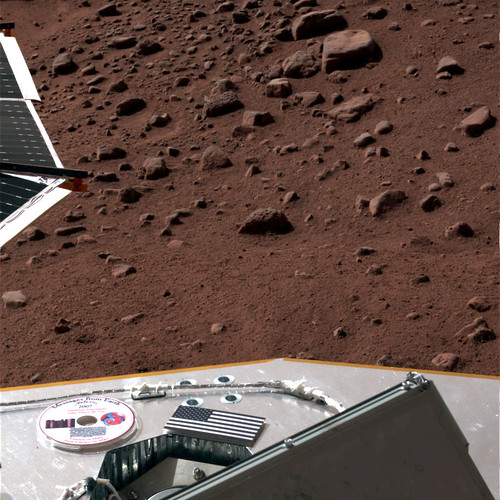
Will iTunes Run on that Thing?
...cause it took a CD up with it containing Earth's greatest hits!
http://fawkes4.lpl.arizona.edu/images/gallery/lg_532.jpg
Either that, or Apple's scored a deal with NASA to lock in the Martian music market... -
Re:Colour?
Digital imaging equipment doesn't see the world in colour. In a digital camera light causes electric charge to build up in photoelectric elements (CMOS or CCD) inside the camera. Lots of light makes lots of charge, less light makes less charge. In other words, an image that the camera sees is translated into brightness values - black, grey and white to you and me.
To turn this back into a colour image you need to take more than one photo, and place a filter over the top of the camera so that only light at certain wavelengths is seen.
If you do this for red, green and blue light then you get three different black and white images like this:
If you combine these together using a program like Photoshop or GIMP you get a a false colour composite. You can then tweak this to make it look how you want it.
Does it look like you'd really see it? I guess it depends on the person, but it's close enough for most of us.
* Note that I'm only guessing that the above Phoenix images were taken using red, green and blue filters - I have no information about them - but they seem to be pretty close.
-
Re:Colour?
Digital imaging equipment doesn't see the world in colour. In a digital camera light causes electric charge to build up in photoelectric elements (CMOS or CCD) inside the camera. Lots of light makes lots of charge, less light makes less charge. In other words, an image that the camera sees is translated into brightness values - black, grey and white to you and me.
To turn this back into a colour image you need to take more than one photo, and place a filter over the top of the camera so that only light at certain wavelengths is seen.
If you do this for red, green and blue light then you get three different black and white images like this:
If you combine these together using a program like Photoshop or GIMP you get a a false colour composite. You can then tweak this to make it look how you want it.
Does it look like you'd really see it? I guess it depends on the person, but it's close enough for most of us.
* Note that I'm only guessing that the above Phoenix images were taken using red, green and blue filters - I have no information about them - but they seem to be pretty close.
-
Re:Colour?
Digital imaging equipment doesn't see the world in colour. In a digital camera light causes electric charge to build up in photoelectric elements (CMOS or CCD) inside the camera. Lots of light makes lots of charge, less light makes less charge. In other words, an image that the camera sees is translated into brightness values - black, grey and white to you and me.
To turn this back into a colour image you need to take more than one photo, and place a filter over the top of the camera so that only light at certain wavelengths is seen.
If you do this for red, green and blue light then you get three different black and white images like this:
If you combine these together using a program like Photoshop or GIMP you get a a false colour composite. You can then tweak this to make it look how you want it.
Does it look like you'd really see it? I guess it depends on the person, but it's close enough for most of us.
* Note that I'm only guessing that the above Phoenix images were taken using red, green and blue filters - I have no information about them - but they seem to be pretty close.