 Slashdot Mirror
Domain: armadilloaerospace.com
Stories and comments across the archive that link to armadilloaerospace.com.
Comments · 301
-
Re:We aren't being held up by regulatory issues.What will you do with that fuel formula?
Will you give it to the public domain?
You can read considerably more than you could possibly want to know from the weekly updates on www.armadilloaerospace.com.
The fuel is a mixture of 50% peroxide and methanol, nothing revolutionary, just a nice solution to the problem.
-
Re:I've seen this before somewhere
John Carmack's Armadillo Aerospace group have also been doing vertical takeoff/vertical landing (VTVL) work. Both they and the Japanese group are concentrating on going lots of unmanned testing of subscale vehicles, so they're getting lots of experience and data at a fairly low cost.
Though, the Black Armadillo X Prize vehicle will use parachute recovery. I think that was because A) it's simpler and B) they were concerned about whether or not they would have the VTVL working on the big rocket in time. Maybe John Carmack will comment if he reads this.
Jon Acheson -
Reasons why I'm not impressed:
1) Solid rocket engines. They have made Peroxide+Gasoline rocket engines in small scale. Use one of them. At the very least a pressure fed John Carmack special style engine.
2) One stage. The Saturn V has 3 stages. This one, and all of the injection-molded toys before it, were only 1 stage. Where's the fun in that?
3) Injection molding. Where's the work in that? -
John Carmack will win the war in space.
Come on, it should be obvious! With his coding skills for 3D engines like Quake and Doom, plus his 1337 deathmatch skills...
Come on people! THINK ABOUT IT! He is the lead coder behind id Software and he works on rockets with Armadillo Aerospace.
Can't you people see the connection? Carmack is working to dominate space, any war fought in space will be dominated by Carmack! I strongly suspect that the real reason he is into rocket science is so that he can lauch missions to Mars for experiments on Phobos and Demios...
Sure, you are worrying about China or some other nation - but I tell you Texas is looking mighty scary right now... Mark my words - QUAKE IN SPACE!!!
(Note For the Humor Impaired: this is a joke.) -
XP Does Work on Spacecraft Control Software
-
Re:And space exploration is not easy!
My prediction, whoever wins the X-prize will be all the hell over Jay Lenno for a week, and then we'll hear about how they went out of business 6 months later.
I don't think that Scaled Composites (who have a pretty good chance of winning) is going out of business anytime soon. And Armadillo Aerospace doesn't seem to give a fig about "business" period.
The X-prize is strictly for show and consists of just getting to the edge of space. I haven't seen any competitor that plans to go any further (though I could be wrong). -
Re:Funding.
I guess the need to brown-nose Congress for funding is an ongoing part of any government space program... but statements like this (from the article) really worry me:
How much will this next generation vehicle cost? The budget goes first to the White House for approval, then to Congress. The final design will be announced in August 2004.
The way this is worded, it sounds like they're implying "the project will cost as much as you'll let us spend." I'm really leaning toward the view (often expressed by Slashdotters) that the government needs to move from a leading role to a supporting role in space technology. And note that in the term "government", I include the big government contractors like Boeing & co, whose corporate inertia is no better than government bureaucracy.
Give the funding to outfits like Armadillo and the rest of the X-Prize competitors. Why not a government-sponsored X-Prize competition, with the winner getting a juicy government contract?
But this current path -- fuzzy requirements, a budget subject to political whim, and a culture where "[acknowledgement of] failure is not an option" -- seems doomed to mediocrity. -
Re:Screw this!
I am! Let's ask John Carmack if he can help us.
(For those who didn't know (yeah right), Carmack is both pro-Open Source and a rocket scientist) -
Most of them have appeared
videophones have been around for a while in the UK and in other countries(seems to be broken?). The quality still isn't brilliant but Orange(I think) have started to offer Soccer highlights over the latest phones.
moon colonies, ok, we chose to put a space station up there first, and then realised it costs a lot of money for little (commercial or military) value. Moon colonies are sadly not as sexy as say a Mars colony, or even a Mars mission, which ESA has planned in 25 years, NASA tried and continues to test methods of producing enough food,air and water, other countries,notably India and China have planned Moon landings so we are going back. Space is unfortunately used as a pissing contest between nuclear neighbours, when this stops then some more science can get done(e.g. Hubble, Galileo, Beagle 2)
food in pills. You can get food in pills, just not the calories, vitamins will give you nearly all of the trace elements you need to live. Calories are a lot harder, to get 500 Calories into a pill means eating something with 40 times the energy concentration of sugar or twenty times the concentration of fats, I doubt the human body would have much success digesting such complicated food. You can however get protein and creatine supplements which are in tablet/powder form, and sugar sweets( those silly energy sweets which taste of really sour orange) have more calories than their equivalent weight in sugar. (The protein supplements also tend to taste bad and are fed to animals instead. )
cars that drive themselves; power steering has been around for a while, as has ABS and cruise control, that is about as much as the current laws will allow on the public roads. intelligent cars have been developed, which, when combined with other intelligent cars, are actually safe. It's the human drivers who freak out at the sight of a driverless car that's the problem
jet packs; Jet packs appeared in Thunderball (James Bond). You can buy them if you have enough money, or you can build them if you want. They're not used much because, much like the Segway, there are easier and cheaper way of getting around.
moving sidewalk's are in most airports now, as well as some metro stations. There have also been "moving stairs" around for just as long.
--This post brought to you by Google.com, paid for by Google For America, Inc.
-
Well peel me a bannana. Thanks for the pictures!
Thanks for the URL, EnglishTim.
If anyone hasn't looked through the pictures, perhaps they should start by looking at the one where their parachute drop test didn't yield good results. Here, I don't remember NASA having anything like this happen; just makes me feel more American that the team John joined is working for success! -
Re:Milled Engine vs Casted Engine
If you have a look on his page, you'll find the answers. His engines work by reacting hyrogen peroxide over platinum-plated meshes. These meshes are pretty expensive, and most of the engines have many layers of them to achieve full catylsation. Also remember that (IIRC) they have either four or five engines, as the engines are used for attitude control.
And platinum ain't cheap. -
Re-inventing the wheel
What Carmack (Armadillo Aerospace) is proposing is to "re-invent the wheel" every month or so until the deed is done.
My money's on the Canadian Arrow. Why? The Arrow's based on the German V2 rocket - a tried and tested, 1940's design which was then quite capable of putting a 738kg payload beyond the required 100km altitude - all for the measly sum of 119600 Reichsmarks ($47,840 US in 1940 dollars). Reference:V2 Rocket.com. Trade in the payload for 3 astronauts plus gear, install parachutes to recover the main bits, and the job's done.
Scaled Composites is my second favorite. Why? Based on another tried and tested design - the Pegasus - first launched 1990. The Pegasus can put a 455kg satellite in low earth orbit (about 150 kilometers up with a net velocity of at least 7,814 m/s ) - not much of a technical breakthrough required to put 3 astronauts up a mere 100 km. Reference:Orbital Pegasus Page
Also, here's a website that has a downloadable working simulator that illustrates how Scaled Composite's design (SpaceShipOne)works: PRE-Flight Sim Homepage -
Things I like about Armadillo Aerospace's program
I admire and respect Carmack's space program. He is doing a number of innovative things.
His program of building control systems and then big rockets is mentioned in the article. It's unfortunate that so far whenever they've tried to launch a rocket the computer has immediately crashed -- but they seem to have a handle on why this is happening and the current computer construction and mounting system is far better than the previous ones. He also has a tremendous amount of telemetry, and analyzes the inevitable failures exhaustively.
They is now using a fairly innovative mix of medium-strength hydrogen peroxide and some fuel to power the rocket. Other people (and Armadillo, previously) have used highly purified hydrogen peroxide, but that is hard to get (and expensive) in the quantities that they need. This mixed monopropellant has a higher specific impulse, too.
They are using a innovative final recovery system -- the ship lands nose first on a long aluminum cone that crushes to absorb energy. Unique, cheap, and innovative -- if funny-looking.
The thing I like the most, though, is his website http://www.armadilloaerospace.com (it will surely be slashdotted for the next couple of days.) Carmack is religious about posting the results of the last weeks efforts, warts and all. It appears that he receives substantial insight from people responding to these progress reports (apparently the mixed monopropellant research was instigated by somebody posting results of German WW2 torpedo experiments.) This kind of openness is quite rare in aerospace research.
Anyway, all the best to Carmack et al. I think that Rutan's Spaceship One project may win the X prize, but maybe not -- his system depends on a lot of planning and simulation being accurate, whe re Armadillo can respin the project many ways if things don't work out the first (or second) try.
thad -
Here's a picture of the "spacecraft"
http://media.armadilloaerospace.com/misc/all_set.
j pgGreat! Yeah, that's gonna work!
-
Re:stop making space planes, dammit>Inconel, the best commonly used alloy has a single use temperature limit of about 1030K, or 757C. It melts at ~1400C
The refractory metals are better, but less commonly used. Columbium/niobium is reasonable to form. Molybdenum and alloys like TZM take a bit more heat, but have a potentially annoing ductile to brittle transition point for systems that will cold soak. The state of the art is irridium coated rhenium, which doesn't melt until 2466 C / 4471 F.
We fabricated a TZM chamber a while ago at fairly high expense, but still burned through it after an extended length run:
This experience has convinced me that active cooling methods, like transpiration cooling, are probably a good idea for high reusability reentry vehicles.
John Carmack
-
Re:Warning bells.John Carmack et al. are abandoning the hard-to-get peroxide fuel and going for a mixed monoprop system. They have had some success recently:
We are really psyched about these results. The odds are looking very good that this will be the propulsion system for the X-Prize vehicle. Cheaper, higher performance, and no availability problems. Big wins.
So it looks like they'll be getting propellant soon. And anyway, check out some of the cool pictures!
-
Re:Warning bells.John Carmack et al. are abandoning the hard-to-get peroxide fuel and going for a mixed monoprop system. They have had some success recently:
We are really psyched about these results. The odds are looking very good that this will be the propulsion system for the X-Prize vehicle. Cheaper, higher performance, and no availability problems. Big wins.
So it looks like they'll be getting propellant soon. And anyway, check out some of the cool pictures!
-
Spaceports? Awesome!
The most exciting thing in the article to me was the fact that there are "over a dozen spaceports now under development". Rock!
I know about OSIDA, the one in Oklahoma that Armadillo is planning on using. Anybody know where the others are?
--riney -
Here's the damn thing HTML FormattedI'm posting this under my login, being the karma whore that I am. Next time I won't be so nice!
I mean, has Armadillo actually started constructing a rocket that can lift three crew members to 62.1 miles altitude, return safely, and do it again within two weeks??
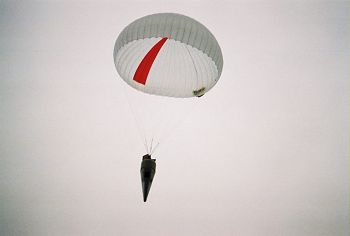
The short answer is yes, the vehicle is almost done. Here's a picture of it parachuting to the ground during a recent drop test on July 5th.For more pictures of the vehicle, go here. For an article about the drop test, go here.
But I must note that Scaled Composites will probably fly their vehicle to suborbital altitute before Armadillo does. John Carmack, leader of the Armadillo Aerospace team, posted some comments about his progress and schedule.
I believe that the Starchaser team are well-advanced on constructing the Thunderbird rocket that will attempt to win the prize late this year
Actually, Starchaser's current schedule calls for the Thunderbird launch in late 2004. What you are probably referring to is the Nova rocket, which will be launched this year to a height of 30,000 feet, carrying one man. Check out. -
Full text, posting as ACHelicopter Drop Test
http://www.armadilloaerospace.com/n.x/Armadillo/Ho me/Widget`s Corner?news_id=214
We finished up all of the prep work for the vehicle on Tuesday. We welded in strapping points to hold 600 pounds of passenger sandbags in the cabin area, and we mounted five 45 pound Olympic barbell plates on a peg at the end to simulate the weight of the final engines, plumbing, and backup recovery system that will be on the full size vehicle. We mounted four 2 throat engine shells as placeholders. Total weight is just under 2400 pounds. We use a combination of multiple chain hoists, a palette jack, and a forklift to move the full vehicle around and get it up on the trailer, but we did wind up breaking one of the castor wheels that we had mounted on our tank cradle. If we wind up having to use the 1600 gallon propellant tank (the current one is 850 gallons), we arent going to be able to stand the vehicle up under the main girder inside our shop, which will be inconvenient.
On Saturday, we headed out to our test site for the drop test. There were quite a few stares on the road in transit We had a few spatters of rain, and the wind occasionally gusted to 12 knots, but we were able to perform the drop in relatively calm 6 knot winds.
Anna rented a big RV for the day, which was very worthwhile. It was nice to be able to take a break in an air-conditioned space.
5 State Helicopters arrived with a big Sikorsky for the lifting. It was very convenient that they were based close by, and didnt have a problem with our unusual application (although they did have us contact the local mayor and sheriff for explicit permission). We were very impressed with the precision that they were able to do the lifting we were afraid that the vehicle might get dragged or bounced on the crush cone, which could buckle it before the test even started, but they were able to perfectly pivot it up on the nose, and gently lift it off the ground. If we had known they were that precise, we probably could have skipped renting the forklift truck for recovery and just had them lower the rocket back onto the trailer after the test.
We made several 18 diameter test parachutes that were weighted to drift at about the same rate that the full size parachute was expected to fall. We did the test drop from 1500 AGL, under the assumption that the big vehicle would fall several hundred feet before the main chute was fully deployed. The landing point for the test parachute was satisfactory, so we planned the full vehicle drop for 2000 AGL. Neil rode in the helicopter to do the parachute releasing, and Anna hung out the side of the helicopter (with a safety strap) to get aerial footage.
We had to abort our first attempt to drop the vehicle, because the line that we ran from the helicopter to the Sea-Catch toggle release above the rocket had wrapped itself around the chain so many times that Neil couldnt pull it hard enough to trigger the release. This was fixed by tying loose loops of plastic every few feet along the chain, which kept the pull-line in place.
On the second try, the release worked perfectly. You can clearly see the naturally unstable aerodynamics of the vehicle, as it starts to tip over almost immediately after release. We all held our breath as it started to fall, but the drogue immediately inflated and started pulling the main canopy out. It was nine seconds from release to full canopy inflation. The opening shock was negligible, barely hitting 2Gs. For high altitude flights, we are aiming for a 200 mph terminal velocity under the stabilizer drogue at the time of main canopy deployment, so opening shock will be much greater then.
The wake of the main canopy is so great that the deployment drogue just rests on the canopy during descent, without any inflation at all. The real deployment system will have a much longe
-
In case of Slashdotting
-
In case of Slashdotting
-
Re:What's the point of sending probes?They would be accomplishing something (albeit small) if they had a decent crew on the thing. After all, you never know what experiments may come in handy. Most of the experiments probably won't be useful at all (and frankly I don't want to have spiders in a space station with me, even if I'm going to do some weird experiment with them), but NASA and friends would be building up a body of knowledge if they weren't such cowards.
Personally, I've given up hope that NASA will do anything big or dramatic again, and I'm hoping that somebody manages to get in space seperately. I don't care who. Rutan, Armadillo, whoever; I WANT TO SEE PEOPLE IN SPACE! If it becomes cheaper, then we can get some real stuff done in space.
As for going to mars, having nuclear propelled spacecraft would be, IMHO, the only hope of sending actual people to mars. I'm also a bit bitter that people recoil whenever "nuclear" is mentioned.
But let's do something! Not just sit on our butts!
-
Carmack et. al. @ ArmadilloAerospace ....
... have been doing this for awhile. The PC104 stack in their VTVL rockets/crafts have always been linux kernels.
He's also been using 802.11 for communications.
His laptop control station is win32 though.
ArmadilloAerospace
-malakai -
Re:Space- where next?
What about the things that aren't profitable, require long-term commitments, or are just plain too expensive to attract the private sector?
Do you really think that any corporations care about the atmospheric makeup of Pluto, collecting samples from Mars, landing on asteroids, etc.? Of course they don't, there's virtually no possibility of direct monetary profit, and any indirect monetary profit would likely be too far off for most companies.
That's why we have NASA and the ESA. Sending probes is important. The experience gained from long-term human habitation of space is important (we're going to have to do it sooner or later; please, let's skip the "but manned spaceflights are worthless" arguments this time). But there isn't any money to be made doing it, so don't expect the corporations to make many advances there.
In all likelyhood, at least for the next few decades, corporate interest in space is going to end at Earth orbits closer than the moon, for a few Space Jets, satellites, and things like that. What corporation is going to want to send a probe to Europa to see if there's a liquid ocean under all that ice?
I'm not against the private sector getting involved in space. In fact, I think it's great and necessary. I already thought John Carmack was a cool guy, and the fact that he's bankrolling his own aerospace company makes him even cooler. But we still need to do the purely scientific stuff, and for the forseeable future that means NASA, the ESA, and whatever's left of the soviet space program. -
Re:Armadillo's page recently updated too!
-
Re:Armadillo's page recently updated too!
-
Re:Nerds in space
Well, the Rocket Guy isn't in IT, he's mainly a toy inventor. For that matter, I wouldn't call Carmack or Rutan IT guys, though "nerd" is probably appropriate. Who else are you thinking of as an IT guy trying to go into space?
-
$10 million goes a long way.
The specifications of such a device are as follows:
* It has to travel 62 miles - straight up.
* It has to travel 62 miles down and land in a controlled fashion so it can be re-used.
* It must not kill any passengers (of which it should be capable of carrying 3).
A $1000 motor scooter is a self-powered device that can easily go 62 miles there and back with a passenger - provided it's along the ground. For ten thousand times as much you ought to be able to come up with something nifty that'll go straight up. On the face of it, it is a simple problem.
One of the goals of the X-Prize is to reduce the cost of space travel. Private ventures may very well have to invent entirely new ways of solving technical spaceship problems.
90% of space projects so far are sponsored by governments, and as such they rarely innovate - they're too busy trying to satisfy a design commitee than to solve the problem with an elegant engineering solution.
I mean, come on. Look at what some of the X-Prize competitors have been up to:
Armadillo Aerospace - Powered manned lander working prototype that can hover and land safely. Look me in the eye and tell me that cost $10 million. In theory (assuming infinite onboard fuel and life-support) this thing could jet anywhere in the solar system - today. When they scale up the design it'll be capable of going to space with all the fuel it needs onboard.
Scaled Composites - The cockpit of their spaceship has a battery-powered digital kitchen timer clock glued to the control panel - a logical and practical cost-cutting measure that would never be seen in a US government program. It wouldn't suprise me if this spacecraft cost around $5 million to fabricate (especially since Scaled are an aircraft design and manufacturing company and could do it for cost). But it definitely did not cost $300 million.
Overpriced government projects have managed to convince you (and most of the public) that space travel needs to be expensive. The X-Prize will (with a bit of luck) end that myth. -
$10 million goes a long way.
The specifications of such a device are as follows:
* It has to travel 62 miles - straight up.
* It has to travel 62 miles down and land in a controlled fashion so it can be re-used.
* It must not kill any passengers (of which it should be capable of carrying 3).
A $1000 motor scooter is a self-powered device that can easily go 62 miles there and back with a passenger - provided it's along the ground. For ten thousand times as much you ought to be able to come up with something nifty that'll go straight up. On the face of it, it is a simple problem.
One of the goals of the X-Prize is to reduce the cost of space travel. Private ventures may very well have to invent entirely new ways of solving technical spaceship problems.
90% of space projects so far are sponsored by governments, and as such they rarely innovate - they're too busy trying to satisfy a design commitee than to solve the problem with an elegant engineering solution.
I mean, come on. Look at what some of the X-Prize competitors have been up to:
Armadillo Aerospace - Powered manned lander working prototype that can hover and land safely. Look me in the eye and tell me that cost $10 million. In theory (assuming infinite onboard fuel and life-support) this thing could jet anywhere in the solar system - today. When they scale up the design it'll be capable of going to space with all the fuel it needs onboard.
Scaled Composites - The cockpit of their spaceship has a battery-powered digital kitchen timer clock glued to the control panel - a logical and practical cost-cutting measure that would never be seen in a US government program. It wouldn't suprise me if this spacecraft cost around $5 million to fabricate (especially since Scaled are an aircraft design and manufacturing company and could do it for cost). But it definitely did not cost $300 million.
Overpriced government projects have managed to convince you (and most of the public) that space travel needs to be expensive. The X-Prize will (with a bit of luck) end that myth. -
Re:John Carmack
Yeah, his company is called armadillo aerospace, it uses a hydrogen peroxide engine and has no control surfaces, instead it is controlled by software so that the engines are independently controlled and can be used to stabalize the craft. check it out at Armadillo Aerospace
-
Re:government space?
I am not yet convinced that the technology exists to make space travel inexpensive enough for any organization that does not have the capability to spend hundreds of millions without seeing a return
Consider that there are multiple private organizations, on a relatively shoestring budgets, in the USA alone, who are doing their own stuff in this area. Check for Microcosm, Flometrics, even a department of a university, not to mention John Carmack's company, XCOR, Burt Rutan's Scaled, all regularly mentioned on the Slashdot. Add other countries - in Europe, for example - in short, a lot of guys are thinking different than you do.
And you won't believe how unsophisticated by today's standards is the technology of the first rockets. Just imagine, they were made out of steel, with almost no computers in the whole lifecycle of devices! It's literally a technology of times half a century back. It's not a technological issues anymore, you just use off-the-shelf components, well, for most of things you need. And you have tons of knowledge for what and how and why to do and not to do. Having all this in, one can wonder, why we still don't fly economically -
Re:In Secret?
this Will get you a Darwin Award. The other has a good chance at 10 million.
-
Re:Burt Rutan vs. John Carmack?According to their latest update, they just ran out of peroxide during the latest testing. While peroxide limits have certainly held them back somewhat, it doesn't sound like "significantly" is completely accurate. They have continued to make engineering strides (and bug fixes) while conserving fuel.
With respect to hybrid rockets, they have looked into them. At the end of the April 12 update, they state,
We are probably going to be at least two months without 90% peroxide. In that time, we will continue fabrication work on the full size vehicle, and we are going to do more tests with alternate propellant engines. Changing to a bipropellant will complicate our task quite a bit, but if we do work through it, it gives us more performance headroom and drastically cuts down the cost of flights. (Look at the silver lining, damnit...)
Needless to say, you can also reference John's earlier reply in this thread, above. -
Re:In Secret?
Ok I have just one question, how does this space craft compare to this
-
Burt Rutan vs. John Carmack?
While I realize that a paint job can cover many ills, it does appear that Rutan is significantly farther along in constructing his X-Prize vehicle than Carmack.
Comparing pictures, you see:
Armadillo Aerospace Launch Vehicle
vs.
Scaled Composites aircraft and drop ship
Perhaps one of the issues is that Armadillo publishes their status (and myriad problems) openly (see the latest update for example). No one knows what issues Scaled Composites has had as they worked in secret, but it's easy to feel like Rutan's running a professional company while Carmack is leading a group of (brilliant, talented) hobbyists.
I'd be interested in hearing Armadillo/Carmack's perspective on the competitive landscape, now that this new player has made an announcement. -
Burt Rutan vs. John Carmack?
While I realize that a paint job can cover many ills, it does appear that Rutan is significantly farther along in constructing his X-Prize vehicle than Carmack.
Comparing pictures, you see:
Armadillo Aerospace Launch Vehicle
vs.
Scaled Composites aircraft and drop ship
Perhaps one of the issues is that Armadillo publishes their status (and myriad problems) openly (see the latest update for example). No one knows what issues Scaled Composites has had as they worked in secret, but it's easy to feel like Rutan's running a professional company while Carmack is leading a group of (brilliant, talented) hobbyists.
I'd be interested in hearing Armadillo/Carmack's perspective on the competitive landscape, now that this new player has made an announcement. -
Re:He's not my favorite amateur rocketman!
I thought everybody on
-
I have some book recommendations
My girlfriend and I are planning a road trip for this May (our planned route is listed below), and I came across some books that you may want to look into. While they don't deal with wireless hotspots or technology in general, they do deal with things that are essential for any cross-country trip: weird stuff and good food.
The first book is called Eccentric America by Jan Friedman... It highlights many interesting, different, and just plain weird places to visit. For example, there's a guy in Washington state who is building and plans to fly a hydrogen peroxide-fueled rocket, not unlike what John Carmack is currently doing. The book is also useful to find out what is weird/eccentric/etc. in your own city or town.
The second book is called Roadfood , by Michael and Jane Stern. It is a compendium of restaurants, ice cream parlors, highway diners and so on across the country. I haven't read in too much detail, but it should come in handy.
For those of you who are interested, my girlfriend and I are planning the following waypoints for our roadtrip: Tallahassee, FL -> New Orleans, LA -> Austin, TX -> Roswell, NM -> Albuquerque, NM -> Grand Canyon -> Las Vegas, NV -> San Francisco, CA -> somewhere near the CA/OR border -> Eugene, OR -> Portland, OR -> elsewhere on the way back home. The trip back will wind through Helena, MT and Denver, CO to visit some relatives, with everywhere else just being nightly waypoints. Am I bringing my laptop? Probably not... Am I bringing a digital camera? You bet! -
Re:Why It Wont Be Built SoonWe're not doing it now because the tech isn't yet ready. Certain aspects of the nano-tubes tech has been seen to work in a lab, but it's not at a production level by any measure.
NASA should be commended for giving grants to do this research (twice), event though NASA and the government should NOT be the ones who build this.
If you would do a poll now asking the average American whether a space elevator could be done, I'm willing to bet a month's salary that the result will be: "90% think it's a ridiculous idea and it can never be done." and answers like "That's all science fiction, we better stick to our rockets, and by the way spacefaring is very complex it can't be done just by stepping into an elevator."
Keep your $1,700 bucks and keep your ridiculous satistical assumptions based on your view of your little world. They don't help us here. Quit trying to find reasons to blame others.
Because today's gov and NASA contractors still have a lot of expensive rocketry missions in store
And thats still usefull, a space elevator isn't going to get us to the Mars without some other propulsion. And I'd HATE to see all projects put on hold while we wait for the new Space Elevator to be developed, which will take 15-20 years with cost/project overruns. Everyone keep doing what your doing and if the Space elevator pans out we'll be even better off.
It makes me so sad when I see what we could achieve even within our lifetime, but our world's inherent corruption prevents it from becoming a reality...
Get off your ass, out of your parents basement, and DO IT. Try, aim, shoot, whatever it is go for it. Others have, why not you? Don't think you have the cash? Raise some. Don't have the talent? Read books. Go back to school. Go to school for the first time, just stop whining about how it's everyone elses fault (and those dumb "John Q Public" people) that you aren't out conquering some new solar system in your kilrathi fighter....
-Malakai -
Re:Is John Carmack building a bomb?
I would have to seriously question the veracity of their claims - has anyone noticed that they do not have any kind of video evidence of actually launching anything?
http://www.armadilloaerospace.com
Actually, I've noticed they do have said video evidence. In spades. -
Re:Carmack is fragbait.
Remember, you can't buy out someone who isn't for sale.
Armadillo's "How to invest in Armadillo Aerospace" page. -
Re:What kind?
Interesting video about the effects of H202 on clothing. The leather shoe displays an amazing reaction in less thant 2 minutes Test Video
-
Xenon's thoughts
Oddly enough, I have an opinion on this.
First, to understand where I'm coming from, you should peruse my report and video on the DC-X project, currently graciously hosted by John Carmack's Armadillo Aerospace site.
The Aerospace industry has collapsed, leaned down, merged and consolidated since the end of the cold war. We now have Boeing, Lockheed-Martin, and a few small fish. All the big fish merged together into these two big fish.
NASA has proven that it is a Government agency in the classic sense of the word, and does not have the proper motivations to perform its tasks quickly and efficiently. No offense to anyone at NASA. Most everyone I know there understands this as well as I do. Government agencies, and their funding and operations process are generally not conducive to fast efficient development. In addition, NASA has to live in fear of budget and political cuts from year to year. This is not conducive to good planning and development.
The Space Shuttle is still the most complex machine ever built by mankind. It is large, powerful, flexible and high-maintenance. We use the shuttle for a lot of missions that it is overkill for. We need a wider variety of launch vehicles that can take off some of the load of the shuttle. At a current catastrophic failure rate of 1.7% (2 failures in 113 launches), we need to reserve shuttle capability for only those missions that really require its capabilities. For most launches we should be relying on Atlas, Arianne, Proton or Pegasus (or the like) vehicles, and developing additional non-shuttle launch vehicles to assume any possible additional roles the shuttle currently can deliver that other existing systems cannot. Very promising systems such as DC-X and Roton have floundered when we most need them. Either one of these systems could have most likely been finished and flying using the budget NASA allocated to the failed and now cancelled VentureStar project.
For the most part, a lot of the ISS missions could probably be fulfilled by these less complex systems. Missions such as the Hubble servicing missions are what the shuttle was designed for. We should be able to use the ISS to its full manned capacity -- doing so would reduce the need for the shuttle itself to carry research missions up just to let them float around in zero-G space. This is what the ISS was built for. We aren't using it to full capability because we can't man it to capacity. We can't man it to capacity because it currently only has a 3-person escape vehicle, therefore only three staff can remain on ISS when the shuttle leaves. We only have a 3-person Soyuz escape craft because the development project for the ISS escape pod vehicle was cancelled by NASA due to technological problems and cost overruns.
The private sector seems to have a better record at taking risks in R&D, especially space R&D. This is rocket science, but it's now a science, not voodoo. We have companies capable of designing, building, testing and flying safe reliable launch vehicles. The reason they're failing is NASA. NASA holds the keys to space -- they determine who is certified to launch using criteria known to no-one but NASA. NASA has no motivation to endorse private-sector solutions -- these are seen as detrimental to NASA and of course will not be ruled in favor of.
Now, some research in space will only be possible with government support and funding. I believe NASA's role should shift from being a research/development and logistics operation, to a mostly research operation, leaving development and operations logistics more to the private sector, who will bid competitively to build and launch vehicles and research/craft and systems for NASA. NASA already has many of their systems built by subcontractors. They need to shed the day-to-day operations and drudgery of space launch and focus on the real research.
The one-of-a-kind facilities that NASA already owns/operates (Deep Space Network, launch sites, Mission Control) should be leased to a private contractor to operate. NASA (and others!) can then lease time, space and delivered capability from this contractor, with a contractual guarantee of a desired level of quality, reliability and availability. This should be done at market cost, no subsidies or discounts. Level the playing field. If then, another supplier can provide the desired level of quality, etc to a customer (NASA or otherwise), then the customer can seek out the supplier of the proper level of cost/benefit required for each individual mission. Not all missions require the massive support infrastructure of Kennedy Space Center and Mission Control. Even today a lot of missions are not launched from Kennedy -- we need to expand this. Outsource launches to Baikonaur, or to SeaLaunch or Pegasus if practical.
The last thing we should do is build another shuttle to replace Columbia. It will be over-budget, delayed and just as complex and risky as today's shuttles. We need to allow private ventures to flourish, and ensure they have a fair competitive stake in future space business. Only then will we be able to start bringing the cost per pound of orbital launch down to levels that actually encourage new research and commercialization of space, yes, even Tourism. Space travel need not be Rocket Science anymore. -
Xenon's thoughts
Oddly enough, I have an opinion on this.
First, to understand where I'm coming from, you should peruse my report and video on the DC-X project, currently graciously hosted by John Carmack's Armadillo Aerospace site.
The Aerospace industry has collapsed, leaned down, merged and consolidated since the end of the cold war. We now have Boeing, Lockheed-Martin, and a few small fish. All the big fish merged together into these two big fish.
NASA has proven that it is a Government agency in the classic sense of the word, and does not have the proper motivations to perform its tasks quickly and efficiently. No offense to anyone at NASA. Most everyone I know there understands this as well as I do. Government agencies, and their funding and operations process are generally not conducive to fast efficient development. In addition, NASA has to live in fear of budget and political cuts from year to year. This is not conducive to good planning and development.
The Space Shuttle is still the most complex machine ever built by mankind. It is large, powerful, flexible and high-maintenance. We use the shuttle for a lot of missions that it is overkill for. We need a wider variety of launch vehicles that can take off some of the load of the shuttle. At a current catastrophic failure rate of 1.7% (2 failures in 113 launches), we need to reserve shuttle capability for only those missions that really require its capabilities. For most launches we should be relying on Atlas, Arianne, Proton or Pegasus (or the like) vehicles, and developing additional non-shuttle launch vehicles to assume any possible additional roles the shuttle currently can deliver that other existing systems cannot. Very promising systems such as DC-X and Roton have floundered when we most need them. Either one of these systems could have most likely been finished and flying using the budget NASA allocated to the failed and now cancelled VentureStar project.
For the most part, a lot of the ISS missions could probably be fulfilled by these less complex systems. Missions such as the Hubble servicing missions are what the shuttle was designed for. We should be able to use the ISS to its full manned capacity -- doing so would reduce the need for the shuttle itself to carry research missions up just to let them float around in zero-G space. This is what the ISS was built for. We aren't using it to full capability because we can't man it to capacity. We can't man it to capacity because it currently only has a 3-person escape vehicle, therefore only three staff can remain on ISS when the shuttle leaves. We only have a 3-person Soyuz escape craft because the development project for the ISS escape pod vehicle was cancelled by NASA due to technological problems and cost overruns.
The private sector seems to have a better record at taking risks in R&D, especially space R&D. This is rocket science, but it's now a science, not voodoo. We have companies capable of designing, building, testing and flying safe reliable launch vehicles. The reason they're failing is NASA. NASA holds the keys to space -- they determine who is certified to launch using criteria known to no-one but NASA. NASA has no motivation to endorse private-sector solutions -- these are seen as detrimental to NASA and of course will not be ruled in favor of.
Now, some research in space will only be possible with government support and funding. I believe NASA's role should shift from being a research/development and logistics operation, to a mostly research operation, leaving development and operations logistics more to the private sector, who will bid competitively to build and launch vehicles and research/craft and systems for NASA. NASA already has many of their systems built by subcontractors. They need to shed the day-to-day operations and drudgery of space launch and focus on the real research.
The one-of-a-kind facilities that NASA already owns/operates (Deep Space Network, launch sites, Mission Control) should be leased to a private contractor to operate. NASA (and others!) can then lease time, space and delivered capability from this contractor, with a contractual guarantee of a desired level of quality, reliability and availability. This should be done at market cost, no subsidies or discounts. Level the playing field. If then, another supplier can provide the desired level of quality, etc to a customer (NASA or otherwise), then the customer can seek out the supplier of the proper level of cost/benefit required for each individual mission. Not all missions require the massive support infrastructure of Kennedy Space Center and Mission Control. Even today a lot of missions are not launched from Kennedy -- we need to expand this. Outsource launches to Baikonaur, or to SeaLaunch or Pegasus if practical.
The last thing we should do is build another shuttle to replace Columbia. It will be over-budget, delayed and just as complex and risky as today's shuttles. We need to allow private ventures to flourish, and ensure they have a fair competitive stake in future space business. Only then will we be able to start bringing the cost per pound of orbital launch down to levels that actually encourage new research and commercialization of space, yes, even Tourism. Space travel need not be Rocket Science anymore. -
Xenon's thoughts
Oddly enough, I have an opinion on this.
First, to understand where I'm coming from, you should peruse my report and video on the DC-X project, currently graciously hosted by John Carmack's Armadillo Aerospace site.
The Aerospace industry has collapsed, leaned down, merged and consolidated since the end of the cold war. We now have Boeing, Lockheed-Martin, and a few small fish. All the big fish merged together into these two big fish.
NASA has proven that it is a Government agency in the classic sense of the word, and does not have the proper motivations to perform its tasks quickly and efficiently. No offense to anyone at NASA. Most everyone I know there understands this as well as I do. Government agencies, and their funding and operations process are generally not conducive to fast efficient development. In addition, NASA has to live in fear of budget and political cuts from year to year. This is not conducive to good planning and development.
The Space Shuttle is still the most complex machine ever built by mankind. It is large, powerful, flexible and high-maintenance. We use the shuttle for a lot of missions that it is overkill for. We need a wider variety of launch vehicles that can take off some of the load of the shuttle. At a current catastrophic failure rate of 1.7% (2 failures in 113 launches), we need to reserve shuttle capability for only those missions that really require its capabilities. For most launches we should be relying on Atlas, Arianne, Proton or Pegasus (or the like) vehicles, and developing additional non-shuttle launch vehicles to assume any possible additional roles the shuttle currently can deliver that other existing systems cannot. Very promising systems such as DC-X and Roton have floundered when we most need them. Either one of these systems could have most likely been finished and flying using the budget NASA allocated to the failed and now cancelled VentureStar project.
For the most part, a lot of the ISS missions could probably be fulfilled by these less complex systems. Missions such as the Hubble servicing missions are what the shuttle was designed for. We should be able to use the ISS to its full manned capacity -- doing so would reduce the need for the shuttle itself to carry research missions up just to let them float around in zero-G space. This is what the ISS was built for. We aren't using it to full capability because we can't man it to capacity. We can't man it to capacity because it currently only has a 3-person escape vehicle, therefore only three staff can remain on ISS when the shuttle leaves. We only have a 3-person Soyuz escape craft because the development project for the ISS escape pod vehicle was cancelled by NASA due to technological problems and cost overruns.
The private sector seems to have a better record at taking risks in R&D, especially space R&D. This is rocket science, but it's now a science, not voodoo. We have companies capable of designing, building, testing and flying safe reliable launch vehicles. The reason they're failing is NASA. NASA holds the keys to space -- they determine who is certified to launch using criteria known to no-one but NASA. NASA has no motivation to endorse private-sector solutions -- these are seen as detrimental to NASA and of course will not be ruled in favor of.
Now, some research in space will only be possible with government support and funding. I believe NASA's role should shift from being a research/development and logistics operation, to a mostly research operation, leaving development and operations logistics more to the private sector, who will bid competitively to build and launch vehicles and research/craft and systems for NASA. NASA already has many of their systems built by subcontractors. They need to shed the day-to-day operations and drudgery of space launch and focus on the real research.
The one-of-a-kind facilities that NASA already owns/operates (Deep Space Network, launch sites, Mission Control) should be leased to a private contractor to operate. NASA (and others!) can then lease time, space and delivered capability from this contractor, with a contractual guarantee of a desired level of quality, reliability and availability. This should be done at market cost, no subsidies or discounts. Level the playing field. If then, another supplier can provide the desired level of quality, etc to a customer (NASA or otherwise), then the customer can seek out the supplier of the proper level of cost/benefit required for each individual mission. Not all missions require the massive support infrastructure of Kennedy Space Center and Mission Control. Even today a lot of missions are not launched from Kennedy -- we need to expand this. Outsource launches to Baikonaur, or to SeaLaunch or Pegasus if practical.
The last thing we should do is build another shuttle to replace Columbia. It will be over-budget, delayed and just as complex and risky as today's shuttles. We need to allow private ventures to flourish, and ensure they have a fair competitive stake in future space business. Only then will we be able to start bringing the cost per pound of orbital launch down to levels that actually encourage new research and commercialization of space, yes, even Tourism. Space travel need not be Rocket Science anymore. -
Re:Make it cheap, and they will come
I'm hanging my hopes on Armadillo Aerospace. Looking forward to them trying out for the X-Prize, and their approach of documenting everything on their website via pictures, video, and blog-type updates is great. I hope they succed - we need a commercial manufacturer of rockets that doesn't need to charge a premium to support overhead of non-space units.
Think cheap dumb boosters - the kind of vehicle the shuttle should have been before it was hijacked into being a commuter service. Keep in mind, we don't need to throw away the STS infrastructure (crusty as it may be.) Just replace the orbiter with a larger unmanned payload module, keep the external fuel tank and boosters. Then, build dozens of payload modules, external fuel tanks (screw the insulation - which is needed to keep ice from forming on the fuel tank, make the payload module disposable), and boosters, in order to get economies of scale. Since there's nobody on board, we don't have to worry about having 99.999999% reliability, nor do we have to waste money on life support.
Just so you know, this payload version of the shuttle already exists on paper, as one of the alternate configurations of the shuttle combo - known as the Shuttle C.
If you're curious about other never-built shuttle designs, visit http://www.abo.fi/~mlindroo/SpaceLVs/Slides/sld022
Or, we can buy Russian rockets wholesale, if we don't want to invest in our domestic rocket industry. Just don't put pilots in cargo vehicles - there's no point! If you want to send up pilots, put them in spacecraft specifically designed to deliver people... survivable spacecraft. -
independent space exploration
I really do believe that the future of space exploration lies in the hands of companies like Armadillo Aerospace. The US government is to clumsy and inflated to handle something like space exploration.
Can one of you Uber-geeks explain why craft like the shuttle need to take off vertically? Couldn't we take a really powerful jet, take it up to a rediculously high altitude, and then switch to rocket power for the last leg of the trip? The shuttle just doesn't seem like the most convenient/economical solution. -
Armadillo AerospaceYou want the future of space exploration? See these guys, or any of a number of efforts like it. Their most recent newspost acknowledges the Columbia disaster with an image at the top of the page, and then doesn't even mention it again. How's that for balls? 7 people were just killed in one of the most expensive space vehicles on Earth, and they don't even question whether they ought to press forward.
As long as our space efforts are funded by the government, they will always be politicized. People on Slashdot always say "we should give NASA more money," or "we should let NASA be more independent," but you just can't alter the fundamentally political way in which they're run. It's one of the bugs in democracy. Actually, it's present in other political systems as well ("In Soviet Russia, politicians assasinate YOU!"), but that's not important, because I don't think anyone here thinks we should give up democracy for the sake of greater efficiency in NASA. But look at the government programs that surround you every day. Look at the bitter controversies over what age sex education ought to be taught in the public schools (if at all, and should the subject of condoms be raised?). Look at the way the post office raises the price of stamps a penny every year, instead of a nickel every 5. So long as the entire county has to live under only one government, governmental programs are always going to be inefficent, as they must satisfy at least 50% of the population, and a few rich interest groups. The essence of democracy is what they say about a good compromise: "everyone's a little bit upset."
NASA probably was useful in its day. They did get the ball rolling after all. But today, with corporations sending up satellites as part of routine business, expecting a govenrment program to do all of America's space exploration is just not a good idea. We need sustainable space efforts, we need people who have an interest in bringing the cost of getting into space down, and who can take risks without having to think about what it'll mean next November.
Well, this has been a bit of a rant, but that's alright.
-
The Pervasiveness of Money
I don't know much about the way politics work, but I, for one, think that an opt-in list would be a great idea. Because the true problem is: when money is needed for -everything-, regardless of the nature of that thing which is being acquired, and money is limited (which it is), then increasing spending in one field necessitates decreasing spending in another, often wholly unrelated field.
When money is the issue, the question is not "Moon, or Mars?" The question is not "Shuttle, or new spaceplane?" The question isn't even "International Space Station: fly or scrap?" It becomes, "fly a shuttle... or feed the hungry?" "Space research... or cancer research?" Yes, of course I know there's corruption, and dollars don't go where they're supposed to go, but I'm talking about the principle of the matter. The principle of the matter is that there are more immediate issues here on earth, and those should be tackled first.
I don't know what NASA's future is, given such drastic budget cuts. Perhaps NASA will -ultimately- lose out to smaller start-up companies that are doing independent work to get sattelites, and humans into space (consider John Carmack's Armadillo Aerospace). Or maybe ultimately, it's another engineering problem: better materials for less money, faster and smaller computers, and complex systems that lend themselves to easy maintenance and repair. Only time will tell.




%20and%20its%20drop-ship%20the%20White%20Knight%20(background,%20top%20picture).%20The%20bottom%20image%20shows%20SpaceShipOne%20and%20the%20White%20Knight%20together.%20CREDIT:%20Scaled%20Composites)