Slashdot Mirror
Domain: astronautix.com
Stories and comments across the archive that link to astronautix.com.
Comments · 776
-
Re:InterestingBut don't try launching your rocket in sub-zero temps, 'cause h2o2 freezes at -1 degree. Also don't leave it in the earth's shadow for too long - same reason. It's really a shitty propellant for a clipper-style mission.
Check this link: for mor e info on using h2o2 as a propellant.
-
Re:Why not try for the ISS
-
Re:Why aren't his arguments convincing?
Well, I can't, since most of his points are absolutely accurate.
Exceptions:
Buran was a 3/4 scale duplicate of Shuttle, not the same size. It also never carried a crew...its one mission was unmanned. Read more here.
A crew escape section (a jettisonable cockpit, for instance) is a good idea for launch related problems. Howevet, on reentry, it would be absolutely impossible to get the capsule a) protected from the reentry heat and b) away from the Mach 20 reentering shuttle. It would also be absurdly heavy as a retrofit. I do believe that it should be considered for next-generation reusable spacecraft.
The reason that the Challenger problems were left up to the "old boy" network is the same reason the same engineers that crashed Mars Pathfinder builts its successors: There just aren't a hell of a lot of people who know how to do this stuff. It's horrifically complicated, and the stakes are impossibly high. You don't just let a recent graduate (like I will be soon! Yay!) design a new Shuttle. Or even a system on the shuttle. You use experienced, seasoned engineers, checking and cross-checking each other. And you still have fatal mistakes.
He's also wrong about his (rhetorical) contention that throttling up Challenger's engines was fatal. The solid rocket boosters were already burning (fatally), and they are not throttled. As soon as those things were lit (that is, before it left the ground), the fix was in. That ship was going to die.
I do disagree with a lot of his conclusions. This fellow doesn't seem to be committed to manned space exploration. His discussions about going to the Moon (which is a dead end: Been there, done that) are red herring arguments.
My personal feelings on the future of the space program are very ambiguous. I use that word in the sense that I have very strong, opposing opinions on the topic.
I believe passionately in
However, I think NASA is doing a very bad job of stewarding our resources. They're given a budget (although I certainly wouldn't call it lavish), with the understanding that that budget will be returned to the communities around major NASA installations, and the contractors that supply them. Good engineering or no, that is the only way you can get any sort of large-scale project done in this country: Spread the wealth to as many congresscritters' pork barrels as possible. I don't like it either, but I don't know how to change it.
So, I want people in space. But I don't think that going over and over to LEO accomplishes anything. If I thought it would be possible to say "OK, we're not going to fly any people for five years, but then by God we'll start flight testing our Mars hardware!" I'd be a happy guy. However, I believe that if we don't keep in the habit (if you will) of putting people in space, we will lose the political will to do it. I think that would be Bad, because we (America and its partners) would cede to somebody else (China?) primacy in solar exploration. I think that's a Baad Idea. -
solutions?
The other posters have said that when nasa gets slammed it has nothing to do with whether nasa engineers are smart or dim, and I totally agree with them.
I'll respect their answers to this question: where is the ISS?
I'm thinking that in the event of the crew cabin of the space shuttle having a creeping failure which didn't immediatly kill the crew, it might be nice to have a contingency plan to go someplace else for shelter.
Would it be possible to build an "Abort to ISS" option into the flight plan so that the shuttle can use its remaining fuel to go to the ISS and dock, instead of deorbiting?
There are already alternate landing sites on this side of the upper atmosphere, why not in space too?
as far as food and oxygen goes, most shuttle missions are actually shorter than the maximum supplies of food would last. Why not pack a few emergency oxygen supplies and dock with the ISS and stay there while rescue is arranged. Space would be cramped but it would be better than staying aboard a craft with a leaky cabin.
Of course if the crew is fine, but cannot re enter the atmosphere wasn't the plan to stay in space?
And what happened to those rescue balls?
or even the orange suits?
If some missions can have punishing spacewalks to repair hubble etc, why not each mission end with a wingtip to wingtip, nose to tail cone inspection space walk, before being pronounced safe to reenter the atmosphere?
I know that the people working on this most complex of all endevours are smarter than me. I know that they have considered the possibilities above and even designed equipment for them. What surprises me is that the flight plans did not let the astronauts use their orange space suits this time, or any of the other equipment, to save themselves. -
Would you like fries with that?At least 300 miles, probably much more. Project Babylon "would place a net payload of about 200 kg into orbit at a cost of $600 per kg." and HARP Of course, with the acceleration, you'd probably get mashed potatoes delivered to the space station.
First it was Pringles cans for war-driving, now this. Obviously the potatoes are terrorist tools, and must be banned!
-
Re:All I have to say...
" We allredy have Plasma Engines as well.
But well, they are build by ESA, so of course they are off limits for the NASA."
First off, if you're going to use something as vague as "plasma engine," you're bound to have it come back and bite you. On 12 October 1975 and 1 September 1976, the US Navy and NASA launched the Triad 2 and TIP 3 spacecraft respectively. Both of them successfully tested a pulsed plasma engine (amongst other things). My source.
(For those of you keeping track at home, the ESA didn't even exist until April 1974.)
"With Plasma Engines the trip would take roughly 33 days
That's interesting. JPL's VASIMR says it will take 3 months. Where are you getting your number?
Not that your number actually matters even if its correct. To provide the kind of specific impulse needed for a manned mission to Mars with a plasma-based engine, you're going to need a lot of electricity, so much that you'll need your own nuclear reactor. And it's pretty much accepted that the US Navy is the world leader in making small, efficient and safe nuclear reactors. -
Re:Nuclear Propulsion
It's called Project Orion. Several proof-of-concept flights using plastic explosives were successful. Of course, it's not quite as fun as a nuclear salt-water rocket, which makes Orion look as environmentally friendly as solar power.
However, I think they have something in mind more along the lines of NERVA, which involves pumping the reaction mass through an ordinary fission reactor. It's just like a chemical, combustion-based rocket, except the thermal energy is produced by the reactor instead of combustion, and you can get a lot more oomph. -
Re:Nuclear Propulsion
It's called Project Orion. Several proof-of-concept flights using plastic explosives were successful. Of course, it's not quite as fun as a nuclear salt-water rocket, which makes Orion look as environmentally friendly as solar power.
However, I think they have something in mind more along the lines of NERVA, which involves pumping the reaction mass through an ordinary fission reactor. It's just like a chemical, combustion-based rocket, except the thermal energy is produced by the reactor instead of combustion, and you can get a lot more oomph. -
Re:jet != rocketIn fact, this article is about solid rocket fuel, which up to this point has been mostly dirty stuff (often a mixture of polyurethane binder, ammonium perchlorate oxidizer and powdered aluminum fuel). It's not jet fuel at all. (Jet fuel is basically just kerosene).
As for liquid fuel, the upper stages of the Saturn V and the main Space Shuttle engines burn H2 and O2, producing nothing but pure water. OTOH, most liquid fuel rockets on unmanned boosters burn nasty chemicals like N2O4 and UDMH (because they were often derived from ICBMs, which you want to keep fueled all the time, so no cryogenic fuels.)
At any rate, if it can burn, some rocket has used it as a fuel. Find out more here and here.
-
Re:jet != rocketIn fact, this article is about solid rocket fuel, which up to this point has been mostly dirty stuff (often a mixture of polyurethane binder, ammonium perchlorate oxidizer and powdered aluminum fuel). It's not jet fuel at all. (Jet fuel is basically just kerosene).
As for liquid fuel, the upper stages of the Saturn V and the main Space Shuttle engines burn H2 and O2, producing nothing but pure water. OTOH, most liquid fuel rockets on unmanned boosters burn nasty chemicals like N2O4 and UDMH (because they were often derived from ICBMs, which you want to keep fueled all the time, so no cryogenic fuels.)
At any rate, if it can burn, some rocket has used it as a fuel. Find out more here and here.
-
Re:NASA Accounting> We've seen too much throwing good money after bad.
I agree. ISS is an example where good money was thrown after bad. BUT there have been many many times when the reverse has been the case at NASA. So often they have brought a project to 80% completion, only to cancel it at the last minute. The ones I can think of off the top of my head:
- Triana -- all hardware finished, never launched.
- Apollo 18, 19 & 20 -- All hardware finished, crews trained, never launched.
- Skylab B -- Entire space station was built, a Saturn V was available, never launched.
[Posting as a coward because I don't want to undo the mods I made earlier on this story.]
-
Re:I'm unimpressed...
The Russian launchers have, in general, better success records than average. The Proton has a 92% success rate, the R7/Soyuz even better -- by 2000, 1,628 had been launched with an unmatched success rate of 97.5%. US launchers like the Atlas and Delta families don't have better success rates.
-
Re:Lifetime Launch Vehicle Reliability
Heh. Ariane 5 has a reliability over 90% already.
Nice of them to put Atlas I & II in the same group. Otherwise Atlas I would look not very well with a reliability of 72.73%.
Atlas II had 100% reliability but less than a dozen launches.
Source: ENCYCLOPEDIA ASTRONAUTICA
-
Re:Conspiracy Theorists...
What? Like this?
-
Those were the PUBLIC landings...
Check out the US had plans for a Military Moonbase in 1959. The hardware featured is earlier designs; very Von Braun in fact!
. -
Re:Math makes them look the same
A little late replying but Buran *was* a direct copy of the US space shuttle. They figured not to try and build there own when they could copy the US's and improve/customize some things.
At any rate Buran used the Energia as it's launching vehicle, the actual Buran spacecraft had, compared to space shuttle, very little thrust *on the spaceship itself*. On the other hand, Energia is, and was, the most powerful rocket ever constructed by man with the possible exception of the Saturn V. It was enormous powerhouse of a rocket. For more info read the link. -
Re:The ISS's lifeboat
Well, Nasa has stopped their ISS crew rescue vehicle program last year for cost reasons. See here
Thanks for the info. I found some additional information . There was some talk of using this gold-plated mini-shuttle as the rescue vehicle. Then this design was being worked on. Even though its budget was, as Lars pointed out, cut for 2002, they still test launched it as recently as December 2001. This link has some info on the use of the Soyuz as the rescue vehicle.
I hadn't realized that US budget decisions had cut the ISS back to a skeleton crew. Here is a press release from a US Senator commenting on a recently released independent review of the Space Station's Science programs.
-
Re:The ISS's lifeboat
Well, Nasa has stopped their ISS crew rescue vehicle program last year for cost reasons. See here
Thanks for the info. I found some additional information . There was some talk of using this gold-plated mini-shuttle as the rescue vehicle. Then this design was being worked on. Even though its budget was, as Lars pointed out, cut for 2002, they still test launched it as recently as December 2001. This link has some info on the use of the Soyuz as the rescue vehicle.
I hadn't realized that US budget decisions had cut the ISS back to a skeleton crew. Here is a press release from a US Senator commenting on a recently released independent review of the Space Station's Science programs.
-
The R7 family still the most reliable booster
As it says here, the R7 family is "..the most often used and most reliable launch vehicle in history".
The unmanned versions are built to a lower spec, as the cargo isn't as important as human life. Manned soyuz boosters continue to be the safest way into orbit.
-
Re:H202You won't get far with the stuff from the pharmacy - between 2 and 10% H2O2. The rocket uses neat hydrogen peroxide which is nasty stuff.
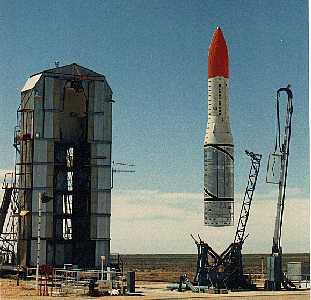
The British Black Arrow satellite launcher used kerosene and hydrogen peroxide in its first two stages. It made for a very compact rocket which didn't require the complexity of cryogenic fuels.
If you're ever in London you can see the sole remaining Black Arrow at the Science Museum. It's not quite as impressive as NASA's Saturn V, but its a pretty cool rocket nonetheless.
Best wishes,
Mike. -
Re:EraserWe don't, but the Russians do.
Bzzzt. Thank you for playing. Energia (which isn't even being built anymore) didn't even have the throw-weight of an Saturn V, and it's the biggest rocket the Russians have ever successfully launched. Compared to the Saturn, it's an Estes kit. It can't put the mass into LEO that the Saturn put into Translunar orbit.
Energia: LEO Payload: 34,000 kg. to: 200 km Orbit. Liftoff Thrust: 1,633,160 kgf. Total Mass: 1,022,800 kg. Core Diameter: 7.7 m. Total Length: 24.0 m. Flyaway Unit Cost $: 80.00 million. in 1985 unit dollars.
Saturn V: LEO Payload: 118,000 kg. to: 185 km Orbit. at: 28.0 degrees. Payload: 47,000 kg. to a: Translunar trajectory. Liftoff Thrust: 3,440,310 kgf. Total Mass: 3,038,500 kg. Core Diameter: 10.1 m. Total Length: 102.0 m. Development Cost $: 7,439.60 million. in 1966 average dollars. Launch Price $: 431.00 million. in 1967 price dollars.
-
Re:US and European Launches?For comparison, how much do US launches cost?
Around $250 million for a shuttle launch, closer to $1 billion if you figure in base maintenance etc. Or $85 million for a Titan IV.
What about the European Arienne rocket?
$85 million for an Ariane 4, around $200 million for an Ariane 5.
As usual, Russians manage the cheapest launches, putting a Soyuz up in orbit is figured to be less than $20 million.
Do remember that these figures (courtesy of Encyclopedia Astronautica) are not all that comparable, because the above costs are the price of putting the entire thing in orbit, when in practice they carry multiple satellites. An Ariane 5 can also lift up a hell of a lot more stuff than the Indian PSLV.
Cheers,
-j. -
Re:Got me thinking...> March 28, (1979) 3 Mile Island
Huh? Why does that belong there? Not a single person died. Nobody was injured. Granted, it was a PR disaster.
I'd add the Nedelin Catastrophe to your list. October 24 1960. Over a hundred Soviet rocket scientists burned alive. Destroying the USSR's ability to compete in the Moon race. Imagine what space would be like today if the space race continued beyond the Moon...
-
Re:The Russians must have built more powerful rock
-
Re:The Russians must have built more powerful rock
-
Re:The Russians must have built more powerful rock
-
Re:Actual Destinations?What you do have the potential for (given significant further progress) is very fast cruise missiles, not ICBM's.
Very fast ramjet cruise missiles were under development in the 1950's, but they fell out of favor because ICBMs are even faster and just about impossible to shoot down. However, they did look way cooler than today's boring ICBMs.
-
Re:A little more info
A little more info from Encylopedia Astronautica. A scramjet is vastly more efficent than standard chemical rockets because only half the fuel has to be carried (hydrogen). Also scramjets have a greater ISP than most regular chemical engines and have no moving parts, unlike the hundreds of parts on moden rocket engines.
Taken from here
air/LH2 (scramjet) ISP=1,550
Space Shuttle Main Engines
ISP = 453
Obviously scramjets are vastly more efficent. Of course ION engines have ISP values of roughly 5,000-6,000 and fusion another magnitude greater, etc. Still lots of room for improvement. -
Re:A little more info
A little more info from Encylopedia Astronautica. A scramjet is vastly more efficent than standard chemical rockets because only half the fuel has to be carried (hydrogen). Also scramjets have a greater ISP than most regular chemical engines and have no moving parts, unlike the hundreds of parts on moden rocket engines.
Taken from here
air/LH2 (scramjet) ISP=1,550
Space Shuttle Main Engines
ISP = 453
Obviously scramjets are vastly more efficent. Of course ION engines have ISP values of roughly 5,000-6,000 and fusion another magnitude greater, etc. Still lots of room for improvement. -
Re:A little more info
A little more info from Encylopedia Astronautica. A scramjet is vastly more efficent than standard chemical rockets because only half the fuel has to be carried (hydrogen). Also scramjets have a greater ISP than most regular chemical engines and have no moving parts, unlike the hundreds of parts on moden rocket engines.
Taken from here
air/LH2 (scramjet) ISP=1,550
Space Shuttle Main Engines
ISP = 453
Obviously scramjets are vastly more efficent. Of course ION engines have ISP values of roughly 5,000-6,000 and fusion another magnitude greater, etc. Still lots of room for improvement. -
NASA already blew $288 million on this.The article doesn't mention the Flight Telerobotic Servicer, a $288 million NASA project to do this that ran from 1987 to the mid-1990s. This project was actually funded. Martin Marietta had a $297 million contract to develop one. Didn't work.
NASA has a long-standing robotics program, but not a very successful one. It's embarassing, or ought to be.
-
Re:Knee jerk reaction...it seems like it is providing the basic research for Astronaut emergency reentry technology.
Define "basic research".
- 1960: "FIRST" Re-Entry Glider
- 1961: "Feasibility Study of an Inflatable Type Stabilization and Deceleration System for High Altitude and High Speed Recovery"
- 1989: U.S. Patent 4,832,288. Cone-shaped inflatable reentry system.
-
Re:Typical....> [extensive list deleted]
>
>I'd like us to do even more, but I'd hardly characterize the above as "crap".Magellan - shuttle - 1994
Galileo - shuttle - 1989
HST - shuttle - 1990
Ulysses - shuttle - 1990
Everyting from 1992 through 2002 inclusive:
NEAR - Delta 7925
Mars Observer - Titan 34D
Mars Pathfinder - three Delta 7925 launches
Clementine - Titan 2
SOHO - Atlas IIAS
Cassini/Huygens - Titan 4B
DS1 - Delta 7925
Mars Climate Orbiter - Delta 7925
Mars Polar Lander - Delta 7925
Stardust - Delta 7925
IMAGE - Delta 7925
2001 Mars Odyssey - Delta 7925
Genesis - Another Delta
CONTOUR - Another Delta
OK, so we've done some cool shit since the '80s. But I think I'm noticing a trend here in terms of whether we need the Shuttle to do it.
(Source for all launch vehicle data: Astronautix.com index of spacecraft.)
-
Re:An alternate point of view
I am sure the Russians were the first to have a manned flight orbit the moon.
I frankly don't understand how you can say something so incorrect. The Russians were never able to put a manned spacecraft in lunar orbit. A comprehensive history of the N1 program can be found at astronautix. There you will find that the closest the Soviets came to putting a manned spacecraft in lunar orbit was the November 1968 Zond 6 mission, an unmanned test run of the Soyuz 7K-L1 spacecraft. A seal failed during the return to Earth, resulting in immediate cabin depressurization. The main parachute also failed, and the spacecraft crashed. Apollo 8 successfully orbited the moon (first) with 3 crew on board and returned them safely in December of 1968. The only manned flight of the N1 succeeded only in demonstrating the effectiveness of the crew ejection system. It never made it into Earth orbit.
-
Re:bad starting point
Unfortunately the STS has a rough time making it into the ISS' orbit because it doesn't get a easterly boost from the Earth's rotation because it is launching itself so steeply northward to hit the ISS.
Not true. It is no more difficult for STS to achieve the ISS's orbit from Canaveral than it is for Soyuz to achieve the same orbit from Baikonur. The easterly vector provided by Canaveral's latitude (1337 ft/s) is much less than the easterly vector required to insert the ISS orbit, and is thus helpful. In fact Baikonur (45.6 deg N) pays a significant penalty compared to Canaveral (28.5 deg N) in reaching that orbit. The problem is the additional northerly vector that's required. But launching into a high-inclination orbit always incurs a penalty compared to minimal-inclination orbit (equal to your latitude) -- so STS can't launch nearly as much into 51.6 deg as it can into 28.5 deg.Yes, the 51.6 deg inclination was selected so that the Russians could launch to it from Baikonur, though another argument made for it is that it's better for earth observation.
One of the reasons Skylab was scrapped was its orbit was not very easy for the STS (then in develpement to be an adjuct system to a space station) to hit.
No. Skylab was scrapped because STS didn't get off the ground until 2 years after Skylab's ashes were scattered over Australia. NASA had plans to try to reboost Skylab on one of the earliest shuttle flights, but STS was delayed and simultaneously the predictions of atmospheric drag were incorrect due to high solar activity (which expanded the atmosphere.)Now, Skylab wouldn't have been a walk in the park to use -- it wasn't really designed for on-orbit servicing and resupply -- but it could have been useful, if only to study the effects of long-term exposure to the space environment. It's true that its 50 degree inclination orbit would not have been as good for STS as 28.5.
Jim Oberg wrote an interesting article about the fate of Skylab... and yes, he says that the 50 degree inclination was a mark against Skylab, but not a fatal one.
-
Not the first time.
Apparently, Russia thought of a plan back in 1989, proposed by NPO Energia. It was to be 716 days in length, with a crew of 4 (only 2 would go to the surface for 7 days). The craft that would go to mars would be constructed in space, and 5 Energia-class heavy-lift boosters would take it up there. Read about the plan here. Apparently, the project never got off the ground, so to speak.
-
Re:Solid, not liquidNow that is cool.
Hydrogen peroxide has also been used as an oxidiser with kerosene fuel. The British Black Arrow launcher used the system to put our only satellite into orbit.
Take a look at the photo of the launch of Prospero (it's a Geocities site so it might be slashdotted by the second person who uses it
Amazingly clean looking exhaust, the rocket almost seems to be hanging there.
The entire programme was cancelled in one of Britain's perennial financial crises of the time. The Black Arrow went on to become the first stage of Europe's ELDO launcher, which was in turn cancelled following failures of its upper stages. Sadly, we then abandoned rocket development.
Best wishes,
Mike. -
Re:Why? Well...You may pull close to 5G's on a particularly good coaster, but the duration of that force is nowhere near the length of exposure experienced by astronauts.
Maybe a roller coaster's G force rivals that of wimpy modern rockets, but it's nothing compared to old school space travel. Here's an example. (I'm sure there's better examples, but I happened accross this one a few days ago so I still remembered where to find it.) This is from the astronautix.com page about the cancelled 1970's Chinese moon program:
There is just enough space for a single astronaut within the FSW capsule (despite statements by some Western experts to the contrary). Drawings and photographs released show that the ablative impregnated-oak nose cap covered electrical equipment. The spherical aft dome contained the recovery parachute. The space for an astronaut in the intermediate bay would be quite limited. The ride would also be rough, worse than that of any other first generation manned spacecraft - 6 to 11 G's and 150 dB during launch, 8 to 20 G's on re-entry, and a landing speed of 4 to 14 m/s. In the absence of a soft-landing system, recovery at sea may have been necessary. Alternatively, the astronaut may have been provided with an ejection seat in order to bail out of the capsule before landing or in the case of launch vehicle failures (as in the Soviet Vostok spacecraft).
Maybe that should be an idea for a next-generation 20 G roller coaster. They could name it something like "Chairman Mao's Moon Blaster".
-
Re:Supersonic Pioneers
"It Steam-engines come steam-engine time." . There are only so many right ways to do things. Not every design that looks identical is a copy.
Yes, it IS American policy to brook no competition. Can't blame them for that, just make sure that they don't get away with it.
BTW it would be a good idea for the benefit of lurkers to give some links to the subjects under discussion. For example, the X-30 also here looks rather like the German "Saenger" rather than a HOTOL.
-
Information on Buran (Was Re:Delivery fees)For a comparison of the Shuttle & Buran you could do worse than have a look at http://www.astronautix.com/craft/buran.htm Lots of interesting stuff there including a table comparing the two, from that table it looks like the Buran is Lighter than the Shuttle, so I guess the US Jets that suck rocks might just be acceptable in this case
Anyway the astronautix website is a great resource its worth checking out.I wonder How they got the Buran To Sydney for the display a few years back, the website there is closed http://www.buran.com.au which is a pity, it had some good info.
-
Re:Russia's Space Program.You shouldn't assume what people know jack shit about. I am already aware most of your details about the Buran. You're focusing on technicalities of the propulsion system, which are not the most unique aspects of the shuttle. Here is an excerpt from astronautix (link broken this instant; here's the Google cache) describing of the decision process the Buran designers went through regarding the orbiter itself:
The final analysis of the problems indicated that the rational solution was an orbiter of the aircraft type. There was severe criticism of the decision to copy the space shuttle configuration. But earlier studies had considered numerous types of aircraft layouts, vertical takeoff designs, and ground- and sea- launched variants. The NPO Energia engineers could not find any configuration that was objectively better. This only validated the tremendous amount of work done in the US in refining the design. There was no point in picking a different inferior solution just because it was original.
Therefore a straight aerodynamic copy of the US space shuttle, was selected as the orbiter configuration on 11 June 1976. MiG was selected as subcontractor to build the orbiter.
This leaves little doubt about where the idea of a lumbering delta-winged orbiter vehicle strapped to the side of a huge gas tank originated.
-
Stolen? NOT!OK, for those of you who think this is just a rip-off of NASA's Shuttle: It's not
Most importantly:The American shuttle design was studied intensively by Russian rocket scientists, but important aspects of it were rejected based on Soviet engineering analysis and technology.
Space hardware is notoriously NOT modular - a design that works on American solid-fuel boosters doesn't work on Russian liquid-fuel boosters. Furthermore, and more importantly, all of the control systems on Buran were designed and built solely by the Soviets. This allowed Burtan to do something the US Shuttle can't - fly to space and back unmanned. -
Re:Atlas V is russian powered..
It's interesting to see 1960s Russian tech comfortably beating American tech, despite the sizable difference in available resources.
According to Encyclopedia Astronautica, RD-170 and RD-171, the original designs that led to Atlas III and Atlas V RD-180, were developed 1973-1985.
12 years - that's quite a bit of work. -
Re:The size of those engines!
Sadly, no.
That model was involved in one of the worst disaters of the Soviet space program. And given their track record, that speaks a lot.
-
More N1 Details
Check out this site for a detailed history of the Soviet N1 development effort.
-
Re:bad news for science
Actually, after reading the take by the Planetary Society, I'd have to say that (ignoring the chunks taken out of the manned space program) this is the most space-friendly proposal I've seen for a while now. And it all revolves around the nuclear propulsion bit.
More and more of our space exploration is taking place in the outer system, with only the occasional lunar mission (been there, done that) and two or three high-profile Mars missions. Everything including the asteroid belt and out are beginning to get the treatment that Venus and Mars got in the past decade (and as a result we know more about the surface of Venus than we do of the earth itself!)
However, because of the distances involved (Venus and Mars are a mere stone's throw away), all of these missions will require a lot of time and a lot of fuel. The more fuel you use to put the probe on its way to its destination, the less the probe can do. While the ion drive has a lot of promise and will probably continue to be researched, it's just not a near-term solution to this problem. On the other hand, there's nuclear propulsion.
As the Planetary Society pointed out, nuclear propulsion has been studied before (NERVA and Orionare the two most famous), has decades of research already there waiting to be used, and promises a near-term solution to deep space propulsion (if not launch vehicles). Combine this with the fact that the United States is the undisputed leader in the field of nuclear propulsion, and I can't help but see big results coming soon.
As an example: When I submitted the article, I was disappointed with the umpteenth cut of Pluto-Kuiper Express. But the Planetary Society take reminded me that, with the prospect of nuclear propulsion, there isn't anywhere near the pressing need to launch it immediately to make it to Pluto in time. Putting a nice liquid-fueld fission engine (for example) into the plan means that we aren't forced to launch "something, anything" now and can take the time to refine the probe before launching it.
So long as the anti-nuke folks don't kill the proposal in Congress, we've just taken a big step towards putting a person on Mars. -
Re:bad news for science
Actually, after reading the take by the Planetary Society, I'd have to say that (ignoring the chunks taken out of the manned space program) this is the most space-friendly proposal I've seen for a while now. And it all revolves around the nuclear propulsion bit.
More and more of our space exploration is taking place in the outer system, with only the occasional lunar mission (been there, done that) and two or three high-profile Mars missions. Everything including the asteroid belt and out are beginning to get the treatment that Venus and Mars got in the past decade (and as a result we know more about the surface of Venus than we do of the earth itself!)
However, because of the distances involved (Venus and Mars are a mere stone's throw away), all of these missions will require a lot of time and a lot of fuel. The more fuel you use to put the probe on its way to its destination, the less the probe can do. While the ion drive has a lot of promise and will probably continue to be researched, it's just not a near-term solution to this problem. On the other hand, there's nuclear propulsion.
As the Planetary Society pointed out, nuclear propulsion has been studied before (NERVA and Orionare the two most famous), has decades of research already there waiting to be used, and promises a near-term solution to deep space propulsion (if not launch vehicles). Combine this with the fact that the United States is the undisputed leader in the field of nuclear propulsion, and I can't help but see big results coming soon.
As an example: When I submitted the article, I was disappointed with the umpteenth cut of Pluto-Kuiper Express. But the Planetary Society take reminded me that, with the prospect of nuclear propulsion, there isn't anywhere near the pressing need to launch it immediately to make it to Pluto in time. Putting a nice liquid-fueld fission engine (for example) into the plan means that we aren't forced to launch "something, anything" now and can take the time to refine the probe before launching it.
So long as the anti-nuke folks don't kill the proposal in Congress, we've just taken a big step towards putting a person on Mars. -
Re:Saving some cable...
Not a physical reason why you shouldn't do this but an economic one.
The whole point of a space elevator is to get out of Earth's 'gravity well' cheaply. Nothing, and I mean nothing (well besides transporters) is as cheap as a space elevator (once you recoup building costs that is). Also, nothing is as safe as a space elevator (relatively speaking - as long as it doesn't come down on you).
Now for your scheme to build a 60-80km high tower consider how much money you would save. Virtually none. The platform isn't high enough to seriously affect a 'planes' carrying weight (at least not any more than a spacecraft or a Scram/Ram - jet powered spaceplane.
Simply put the benefits in a tower of that size can be more easily realized with two-stage to orbit spaceplanes or Scram or Ram jets.
Various Soviet Spaceplanets -
OK, now I'm disturbed...
I make a one-line post about the apparent lack of attention to non-American deaths and I get smacked down as flamebait? I wasn't even intending to be flamebait!
THIS is flamebait:
If Apollo 11 can commemorate the deaths of Gagarin and Komarov alongside the friends they lost on Apollo 1, why can't I even reference Soyuz 1 and Soyuz 11 missions in passing on Slashdot? -
OK, now I'm disturbed...
I make a one-line post about the apparent lack of attention to non-American deaths and I get smacked down as flamebait? I wasn't even intending to be flamebait!
THIS is flamebait:
If Apollo 11 can commemorate the deaths of Gagarin and Komarov alongside the friends they lost on Apollo 1, why can't I even reference Soyuz 1 and Soyuz 11 missions in passing on Slashdot?