Slashdot Mirror
Domain: astrosurf.com
Stories and comments across the archive that link to astrosurf.com.
Comments · 25
-
Re:The solution to fermi paradox
We all need to listen to Frank Drake (founder of SETI) on this one. We are not ever going to detect any alien communications (unless they are specifically targeted at us with that intent). We have a hard enough time talking to Mars: that whole 'Sun' thing makes for a terrible SNR. Not only that, but broadcasting high-energy analog signals is extremely wasteful. Humanity had about a 50-year period where we did this. Now, as you say, we use waveguides. We also don't send anything in analog form any more. Digital data that you don't know how to decode tends to look an awful lot like noise, even without being encrypted or compressed.
What SETI is doing is completely pointless, even compared to cryptocurrency mining.
Nice
-
Re:The solution to fermi paradox
We all need to listen to Frank Drake (founder of SETI) on this one. We are not ever going to detect any alien communications (unless they are specifically targeted at us with that intent). We have a hard enough time talking to Mars: that whole 'Sun' thing makes for a terrible SNR. Not only that, but broadcasting high-energy analog signals is extremely wasteful. Humanity had about a 50-year period where we did this. Now, as you say, we use waveguides. We also don't send anything in analog form any more. Digital data that you don't know how to decode tends to look an awful lot like noise, even without being encrypted or compressed.
What SETI is doing is completely pointless, even compared to cryptocurrency mining.
-
Re:Cell Phone
Or, people would like to be able to own homes in areas unblighted by rooftop antenna towers.
Do you seriously think this will lead to your neighbors putting up something like this rather than this?
What about a modest radio antenna makes it a "blight" in your neighborhood? Besides which, as soon as there's some sort of disaster or emergency, your neighbor in that "blighted" house is going to become your new best buddy. That's the entire point of this: having some ham operators in your area is a good thing for safety reasons.
-
Drake and Equations
Actually, according to Dr. Drake, the inventor of the Drake Equation, founder of SETI, Earth is becoming less visible all the time. The satellites you talk about aren't pointed out into space, they are pointed towards Earth. We have also switched from analog to digital transmissions, so essentially everything we're transmitting at this point is indistinguishable from noise. Broadcasting large amounts of energy into the universe in analog is not something that we can expect other civilizations to do for a very long time, if our own civilization is any guide. Not only that, but the Sun also produces a fair amount of radio-frequency radiation, so there's a pretty high noise floor. Even when we're trying to talk to Mars, the SNR is miserable.
The odds against detecting extraterrestrial transmissions, or extraterrestrials detecting us, are so insurmountably vast as to defy description. I think that Dr. Drake should accept the logical conclusions of his statements and end the SETI project. We have met the Great Filter and he is us.
-
Re:Extended?
You also need to consider that the ion propulsion merely needs to be under the threshold. For example, we already know atmospheric drag is less than the threshold else the station wouldn't have a microgravity environment to sully. Ion propulsion that just happens to exactly counter atmospheric drag would even improve the microgravity environment. Further, as I understand it, there is already some sort of electric propulsion on the ISS.
-
Re:Retard.
Electromagnetic fields do couple with human bodies. You do pick up EM radiation.
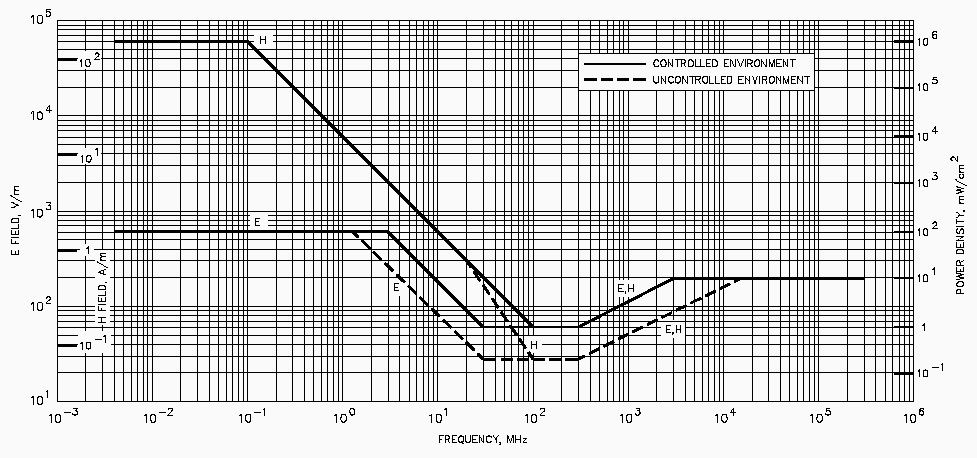
http://www.astrosurf.com/luxorion/Radio/table-power-field.gif
Note in the chart that the power densities are lowest among 10^2 - 5*10^2 MHz. There are several reasons for this. One is that when the chart was created a large number of devices used this frequency range.
Another important reason is the wavelength of such EM radiation.
For a human body to actually act as a receiver and extract power from an EM wave then the wavelength of that radiation must be on the order of the length of your body in a given orientation.
It just so happens that the most heavily regulated part of the frequency spectrum corresponds to the height of your average human.
It is also of interest as to why E fields are assigned lower values than H fields. This has to do with the relative permittivity being higher than the permeability of the human body which in turn affects the power extracted from a given EM wave.
EM radiation is not safe. The uninformed should not handle it. With a little bit of knowledge it is not all that bad. People with these Wi-Fi allergies should take a little bit of solace in the fact that people work to protect them from these harmful effects.
There is an incredible amount of people who think they know what EM radiation is but they do not. Do not spread your misinformation so freely
-
Re:Retard.
X-rays are most certainly detectable by humans.
The energy they contain is orders of magnitude higher than what a wireless router would emit.
Depending on the length of exposure you could determine whether or not you are being exposed to x-rays
Wi Fi is on the order of a GHz which is 10^9 Hz.
An X-ray is defined as a pretty large range but it starts at about 10^18 Hz.
Being that EM radiation energy is directly proportional to frequency you can see that the chances of experiencing thermal heating due to x-rays is not entirely unlikely. Not to mention you did not specify the intensity of the x-ray source.
My buddy in the Navy said he and a couple of crew members were accidently caught infront of one of the large radars on the ship.
They began to vomit immediately after exposure and felt terrible for hours.
Thats the power of EM radiation at high intensities...
You can also view the IEEE standards for allowable transmittable power densities at given frequency ranges. You think they would regulate this stuff if there was no danger?
http://www.astrosurf.com/luxorion/Radio/table-power-field.gif
I mean yeah what the guy is claiming is bogus but do not go so far as to claim x-rays are harmless. X-rays account for many times the mSv incurred on a given human body than any nuclear explosion or accident at a power plant has ever caused.
-
Re:What about video?
I also agree that an open source camera with support for Astronomy would be very well received. There are a number of lower level projects around webcams that have produced some remarkable work. See http://www.qcuiag.org.uk/ and http://www.astrosurf.com/re/audine.html. I would love to see an open source camera that had support for temperature stabilization and active cooling, long exposure, stacking, etc.
-
Re:I can think of a few
The formaldehyde absorption line at 4829.66MHz is pretty close to the low end of the UNII band at 5180MHz; even with only 40mW of power at that frequency, and taking into account the pattern, gain, and sidelobe rejection of the antennas, it is possible to desense the front end, filling in the absorption feature.
If it were an emission line (such as hydrogen at 1420) it wouldn't be as big of a deal. For instance, the methanol line at ~12GHz isn't impacted quite as much by Ku band geostationary satellites as you might think; however, the second harmonic of the upper range of the 802.11a spectrum (5.8GHz) is too close for comfort.
See http://www.astrosurf.com/luxorion/radioastronomy-lines.htm for a small list of interesting spectral lines.
-
Another way to view
You can view things up in orbit this way too. Just don't do it without the proper filtering protection.
-
Re:I for one, *sigh*...too easy...
-
DIY superresolution astrophotography
Here is a page describing how this can be done cheaply for amateur astronomy.
-
Cool pic's
Thierry Legault has taken some amazing pictures of the space shuttle leaving the Space station. The can be found at http://www.astrosurf.com/legault/iss_atlantis_tra
n sit.html -
Space Station and Shuttle, against the Sun
A bit off topic, but I just saw this and thought I would share:
http://www.astrosurf.com/legault/iss_shuttle.jpg
It is just amazing the amount of detail that can be seen from the earth. -
Re:Tea, Earl Grey. Hot.
Here is a picture of one.
-
Re:Passive Repeaters
Dipoles are 300 Ohm (that cheap wire antenna you get with an FM receiver is a dipole made out of 300 Ohm twin-lead), monopoles around 50 to 75.
There's nothing that says ALL "ladder lines" have to be 300 ohms or 450 ohm or any other specfic impedance. It's just a function of your wire diameter and the spacing.
Check out this page for a calculator.
Of course there are very good reasons that engineers choose the impedances they do. But it's still at least theoretically possible to make the whole passive repeater setup with two pieces of wire and some duct tape -
Re:God of WarBehind the name
By 1989, I had already started numbering Apollo objects using gaulish gods. One which I had not used was Toutatis since I thought it was an invention of Goscinny and Uderzo, authors of the well known comic book series "Les aventures d'Asterix". There are several dozens sites about this comic book series, you may want to look at few of them :
- Stephane Riviere Asterix's page
- Page on asterix in different languages
- The international Asterix homepage which contains many more links to Asterix pages elsewhere
One of their constant saying is "By Toutatis", another one is that their only fear is that the sky may fall onto their heads.
I discovered my ignorance of gaulish culture when I learned that Toutatis was ( or had been ) a real God. I also learned that the citation in Asterix was not a joke, but that it had been reported by some historians of Alexander the great who had met some gaulish warriors ( who had once invaded Italy and Great Britain ).
One of the first thing we learned about Toutatis was its record low inclination. This meant that it is indeed ( in a remote future ) a good candidate to fall onto our heads. The name stuck almost immediately at the telescope when I proposed it. Toutatis, also sometimes spelled "teutates" is a totemic deity, to which human sacrifices were made.
Don't be misled, very few french persons do know about the cruel god Toutatis, but most will talk to you about Asterix and his friends if you come to swear " By Toutatis ! ", provided you get the right (i.e. french) accent... -
Super-resolution
The idea was that you could take a standard resolution video that panned across a scene, and by merging the frames over time create amazingly high resolution images.
The technique is called "super-resolution". Some references:
motion super-resolution, super-resolution in forensic science, super-resolution in astrophotography, "Bayesian Image Super-resolution", "Example-Based Super-Resolution", "Limits on Super-Resolution and How to Break Them". -
Additional picture of Vega launcher
-
Smallest visible object on the moon from Earth...Umm... the eye doesn't work by seeing a percent of area - the eye has a working resolution, like a digital camera. The question is, what's the resolution of the human eye, and what's the smallest thing that can be resolved by that resolution at the distance of the moon?
This Article indicates that an average resolution is either 4 arc-minutes or 6 arc-seconds. The 6 arc-seconds makes more sense than 4 arc-minutes (4 arc-minutes is a whopping 1.2 mm at a distance of 1 m (I don't know about you but I can see better than that!), where 6 arc-seconds is 0.03 mm (about
"Using math since 1986 to sound like I know what I'm saying"
-
yes, I'm a spoilsport
I hate to put a dampener on things (this guy has perpetrated a really cool hack after all), but it's no more surprising that you can use a CCD from a digital camera for astrophotography than the widespread use of photosensitive chemicals (silver nitrate et al, IIRC) mounted on plastic film for the same means.
Basically, anything that detects photons will do the job. Sure, these photons are quite low-intensity, but that's no problem if you have a nice top of the range Schmidt-Cassegrain to help you along. Just point it at the star, start your motorised equatorial mount and wait as long as it takes for a nice clear image to pop up. (And you can take your time, you've got all night.) And even if this doesn't work too well, you can use photo-editing suites to pick out the finer details you were after.
Again, I'm not trying to steal this guy's thunder. (I'm probably just jealous of his 10" telescope after all -
Nice digicam pictures
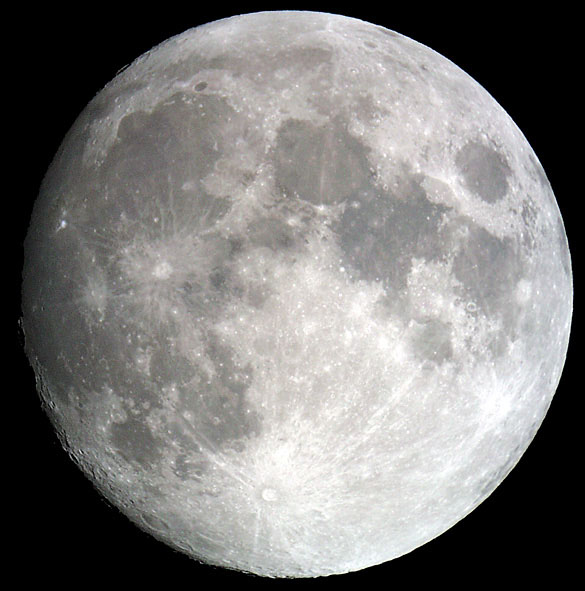
This moon picture is one of the most impressive digicam pictures I've seen.
Shame about the expensive telescope requirement, though. -
Re:hmm
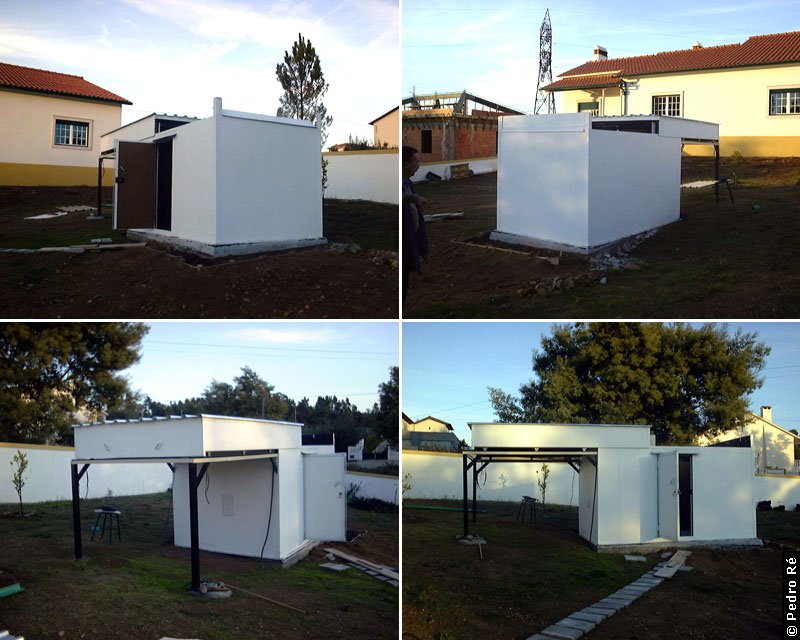
A lot of amature observatories have roofs that roll off. Based on that picture I'd be willing to guess that it's the same way here.
Here's an example. -
Re:photo realistic sky generator software
A number of people that I've talked with really like the free (beer) software Cartes du Ciel. You can find it at this website
There a great OpenGl lunar atlas that I'm using now as well (beats the heck out of the paper versions) here
There are links from either site to more software for variable star observering and sky chart contruction. -
Re:CostWhile it can be expensive in some fields to set yourself up as an amateur scientist, it doesn't have to be.
For example, with relatively inexpensive equipment ($500 or less), you can do lots of useful astronomy. Variable star observation, supernova discovery, comets, asteriods and meteor showers are just a few fields that are augmented (or even completely dominated) by amateurs. If you're handy, it's not all that hard to build a telescope, and you can save a few bucks (while learning a lot). For some activities you can get by on a pair of simple 10x50 or 7x50 binoculars.
For a big list of activities available to amateur astronomers, visit this link.