Slashdot Mirror
Domain: atomicinsights.com
Stories and comments across the archive that link to atomicinsights.com.
Comments · 78
-
Re:elect obama
I'd say obama's big support for ethanol has driven up food prices
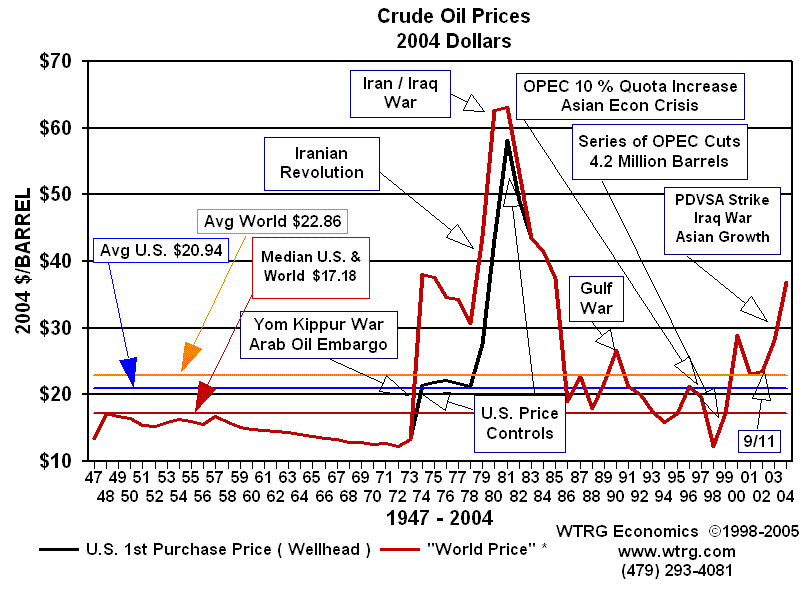
Did ethanol push up food prices? Yes, some farmers that were growing other things stopped to grow corn. Is it responsible for all (or even a majority) of food price increase? No, the fact the cost of oil tripled in the past decade did that.
And if the fact that the cost of inputs (oil, fertilizer, etc) increased tremendously wasn't enough, we had a record breaking corn crop last year, with an (as of the time of that article) expected surplus of 1.4bln bushels. Now, all the farmers growing corn instead of wheat might explain why the price of wheat or barley or soy or whatever else went up, but the price of corn increased too, despite that glut, so I think it's fair to say that "ethanol" isn't entirely at fault.
are worth MORE today than they were 7 years ago
Only if they were better than the S&P 500 and the Nasdaq indexes. The Dow is the only index that is still up over 2001. Nasdaq is down to 1998 levels, S&P 500 is down to 1999 levels.
-
Re:Actually...
You can't put a nuclear plant next to each village
That's not entirely true anymore. -
Re:Colbert isn't republican...
Bill Clinton's policies were fine
Including the Communications Decency Act and the Digital Millennium Copyright Act?
& don't forget about Clinton's nuclear power policies!
-
Re:Interesting "Failures"Orion overlapped a non-DARPA project called SNPO (pronounced "Snow-Poe") which was concerned with practical nuclear-powered space vehicles. For some reason, spewing radioactive material into the atmosphere became unpopular and the project was shelved, but not until working engines had been built and tested. They definitely picked some idiotic names for their project. Snow Poo is just one of them, another is from the article you linked:
The reactors were tested in Nevada at Jackass Flats.
I know it's probably the public anti-nuclear sentiment that stopped them from getting off the ground, but their name choices were really unlucky. -
Re:Interesting "Failures"
Orion overlapped a non-DARPA project called SNPO (pronounced "Snow-Poe") which was concerned with practical nuclear-powered space vehicles. For some reason, spewing radioactive material into the atmosphere became unpopular and the project was shelved, but not until working engines had been built and tested.
-
200,000 abortions
Sure, the number of deaths are low. But it's the long term effects such as birth defects.
Also 200,000 mothers decided to abort as they were concerned about the effects on their children:
http://www.atomicinsights.com/apr96/effects.html
Also, food was contaminated, so it was hard to get clean food. That only made the problem worse. -
Re:Andromeda Strain!!! or not...
That's just stupid. If it's just sitting there, it's not going to hurt anyone. It actually has to be aerosolized (which is REALLY hard to do without industrial equipment) and inhaled to pose a significant threat. Even indigestion poses only minimal risks as most cases have resulted in the PU passing through with no harm to the subject.
Stop listening to Nader. He doesn't know what he's talking about when it comes to Plutonium. -
Re:Whiskey Tango Hotel
The link serves two purposes:
1. Entertainment value mildly related to the topic at hand.
2. Showing just how diluted caffeine is in our softdrinks not to kill us. About 150 grams would do the trick, but through safe use, we are able to use caffeine without harm.
Sorry, I should have made that a bit more clear. Especially since I was planning to pair it with this article about the supposed dangers of Plutonium. Unfortunately, posts on Slashdot tend to be posted in rather short periods of time, so I didn't notice the flaw in my argument in time to correct it. Most posters seem to have understood the point, however. -
Re:Whiskey Tango Hotel
With plutonium OTOH "Extremely fine particles of plutonium (on the order of micrograms) can cause lung cancer if inhaled."
This is correct, with a few caveats:
1. It is extremely difficult to grind up plutonium into particulate matter. It's also so heavy that it doesn't float very well. So the issues with inhalation deal mostly with industrial work with the material, and not general safety precautions.
2. It increases the risk of cancer. Simply inhaling a microgram sized partical is not sufficient to guarantee health issues. You need a far larger dosage in your lungs to guarantee such an outcome. (i.e. a "lethal dose".)
Getting back to the more likely mode of contamination (ingestion) which would you rather ingest: 150 grams of caffeine or 150 grams of plutonium? If you're smart, you'll go for the plutonium.
FYI, I do not work in the nuclear industry. It is simply an interest of mine. Most of those who work in the industry deal with the stuff day in and day out. They treat the materials with the proper safety precautions, and it doesn't bother them in the slightest. They are no more dangerous to them than say, acids or arsenic. -
Re:Some bold statements from this article
"Strangely enough this is from a website that is sporting anti-bush t-shirts, buttons, and bumper stickers "
I find that a good sign. Your a fool if you think that both sides will not lie and abuse science to push their agendas.
One of the founders of Greenpeace has now come out and said that Greenpeace's protests and statements about nuclear power where all wrong. AKA they lied but they probably did believe their lie. Now he is all pro nuclear and he has lies again. Here he states that no one has died in the use civilian power program. http://science.slashdot.org/comments.pl?sid=188481 &op=Reply&threshold=1&commentsort=0&mode=thread&pi d=15535369
I guess you can claim that. The truth is four men died in a reactor malfunction in Idaho in 1961 the reactor the SL-1 was a power reactor being developed for the army. Notice how by adding the word civilian it gets you off the hook and makes it look like the only deaths where involving weapons development. http://www.atomicinsights.com/jul96/letter_Jul96.h tml
I am pro nuclear but I am even more pro truth.
Both parties lie, the envirmentalists lie, the unions lie, corperations lie. I try not to lie but I doubt that I manage to always tell the truth. As Regan said, "Trust but verify". -
Re:The major problem is still people.
Of course at that point it will be too late to head off an energy crisis since you can't exactly put nuke units up overnight.
Actually
http://www.atomicinsights.com/nov95/ML-1.html
Ex-MislTech -
Re:I remember the 1950s.
well Nuclear looks good if you compare it to coal.
but what if you try to compare it to
* Hydro
Virtually all potential large-scale hydro sites are in use. So we're not going to see any new large hydro plants come on-line.
* Wind
* Solar
* Geothermal
* Tidal
All have their good and bad points. There aren't a lot of places the wind blows consistantly enough to make a wind farm really economical. Solar only works during the day (though I wouldn't mind buying a few cheap solar panels to put on my roof). Not a lot of places where geothermal is economical. Tidal only supplies power when the tide is coming in or going out, not at high or low tide.
None of these replace coal, oil, gas or nuclear power plants which can supply non-stop power 24x7x365.
admitadly they all have problems, but Nuclear is Ripe with
* cost over runs
Which is mostly due to frequent nuisance lawsuits that require stopping and restarting construction every two weeks. The surest way to cause substantial cost-overruns on any construction project is to screwup the schedule, frequently.
* high per KW/h of electricity (taking account initial investment)
Screwup the construction schedule with nuisance lawsuits causing cost overruns and then turn around and claim nuclear power is too expensive. Good strategy.
* and well we disagree on the Nuclear waste issue
A few tons of nuclear waste every few years vs. thousands of tons of (mildly radioactive) coal ash every year (and the resulting air pollution). We can disagree which is worse.
Some reactors, like light-water breeder reactors, even consume their own nuclear waste. -
Re:For the record
I hate to break it to ya, but at least one of the byproducts of nuclear power (Plutonium) isn't around in your backyard
No, but there's plenty of Uranium. Plutonium should be burned up rather than stored as waste.
It also happens to be one of the most toxic substances we know of
Bullshit. It doesn't rate even close. Let me ask you, which would you rather ingest: 20 grams of caffine or 20 grams of plutonium?
If you value your life, you'll go for the plutonium.
What happens if the US descends into anarchy as a result of a stock market crash 100 years from now? Still safe? We've still got to deal with the stuff. And keep guards on the storage sites.
Safe from what? Your overactive imagination about glowing mutant babies? Most of the stuff they (will) stick in Yucca Mountain isn't even dangerous enough to shield against. Most of the stuff is only dangerous for the first month or so. (Which will stay in cooling pools until it cools off anyway.) The only real danger posed by the spent fuel is if it makes its way into the water table. That could cause an increase (not an epidemic, mind you, an increase) in the cancer rates.
If you have a SPECIFIC concern, please share it with us and I'll be happy to refute it. Otherwise stop watching so many bad movies. -
Re:Good
I'm less familiar with the Chinese.
Undesired heating of the pressure vessel is taken away by water cooling panels on its exterior. I once found an excellent >100 page document on the design of the HTR-PM, but all I can find right now is a brief 8 page summary
The helium definately plays an additional moderator role
You better get a cite for that. For example, from Atomic Insights:
"The selection of gas cooling required the designers to also choose a separate material to moderate (slow down) the neutrons. In a PWR, the coolant - water - happens to also be a good moderator, but gases are too low in density to have much effect on neutron speeds within a reactor."
PBMRs are known as helium-cooled, graphite-moderated systems.
the pebble temperature only rises to 1600 C
Do you know why carbon-carbon panels on reentry vehicles are covered in silicon carbide? Because when you reach those kinds of temperatures, carbon with graphene-style sp2 bonds (graphite, carbon-carbon, etc) oxidizes and erodes readily. While it is not known for certain, there is a widespread view based on Chernobyl, Windscale, and other graphite-moderated reactor accidents that graphite contaminated with decay products and bombarded with high level radiation can outright combust (very fiercely) at those temperatures.
Note that we haven't even discussed issues that could cause greater-than-expected temperatures - these are all "if things go as planned, but there's a rupture" scenarios. For example, Germany experienced pellet jamming in their pebble recycling equipment. A jam in the reaction chamber itself, while harder to occur, would prevent pellet expansion and thus turn the negative void coefficient system into a positive one.
Western Reactors have excellent safety records
I strongly disagree. Containment structures have saved our arses time and time again. There have even been superheated radioactive priamry coolant containment failure accidents with what is probably our safest reactor design currently in use in the west, the CANDU (Pickering 2, Bruce 5, etc - Pickering lost 140 tons of highly radioactive coolant). I already linked to a list of well known nuclear accidents (not all of them are nuclear power accidents, but I figured you can pick them out) - however, don't trick yourself into thinking that that list is anywhere near comprehensive. More nuclear power plants older than a decade have had a leak of radioactive material of some sort or another, which almost always was contained by the containment structure than not. A good number have had serious leaks. It is the containment structures that we owe our safety to.
Do you know why PBMRs don't use containment structures, by the way? It's about cost. PBMRs are small reactors. They'd easily be completely uneconomical if they had to have a containment structure. They use what is called a "confinement structure" - it's basically the sort of building that Chernobyl was housed in.
By the way, don't get me wrong - I'm a big supporter of nuclear power (I wouldn't have studied it so much if I wasn't -
Re:Consider the source
Different AC, but you're still an ass if you think nuclear decomm, [illegal and legal] disposal and clean up are _not_ costing billions (and going to cost more in the future after the denial ends) or are not using illegal immigrants for the dirty work - then I have two words to start you off with:
YuccaFuckingMountain Project
and the two big spook companies behind it; working hand-in-hand, synergistically to create the most highly secured place on earth where they and their friends can hide nuclear waste or anything else they want to hide.
http://www.google.com/url?sa=X&oi=scholarr&start=2 &num=3&q=http://www.state.nv.us/nucwaste/news2001/ nn11459.pdf
http://www.newsmax.com/archives/ articles/2004/7/12/165520.shtml
http://www.atomicinsights.com/FTROU/02-02-02.html
http://www.mindfully.org/Nucs/Yucca-Mountain-Cost- Uncertainties-GAOdec01.htm
http://www.greenscissors.org/energy/yuccamountain. htm
http://www.google.com/search?q=nuclear+waste+dispo sal+costs&btnG=Search&hs=JWI&hl=en&lr=&c2coff=1 -
Re:Careful...
Just how many wannabe X-Men are out there?
About 40. Let's just say that in WWII Plutonium was a rather new thing.
Linky. -
Re:Careful...
Plutonium is in fact quite chemically poisonous.
Plutonium is chemically toxic in sufficient quantities. However, at those quantities, the material would be so hot (as in temperature wise) from the radiation, that it would burn a hole through just about anything. The bright side is that you could use it to boil water in seconds!
Thanks for reminding me about cuts in the skin. That is probably the *most* dangerous vector for plutonium to enter the body, since you could potentially get it under your skin. As I said about digestion, they still warn about it but evidence suggests that it's mostly a non-issue. Here's a link for you. -
Re:Can you give us some links
-
Re:Well I'll be damned
When your [dog|kid] eats a gram of plutonium, it is far more toxic than eating an equivalent gram of lead, cadmium, or other non-radioactive heavy metal.
Have you been listening to Nader again? You might want to read this.
Ingestion is rarely a problem with Plutonium. The vector of most concern is inhalation. Thankfully, this isn't much of a problem as it takes SEVERE force to powderize plutonium. Basically, someone would have to intend to powderize it. And if they did powderize it, they're most likely to kill themselves rather than anyone else. Once dispersed, there wouldn't be sufficient quantities in the air for someone to get cancer from.
Read the first link on dirty bombs in my original post for more info. -
Re:stop-gap
One example is given here. Output was 75W (30A @2.5V), for a 25kg unit.
So that would only really work if you had a battery electric car - the car would auto-charge whilst stationary. Probably not really an option, for obvious reasons (public paranoia, accident safety).
It is slightly surprising that we don't already use electric cars for short journeys; the only reason they cost more is lack of mass production, and they are cheaper to run. Only problem is the ~100 mile range.
-
Re:I couldn't agree more
Really? Last I checked, there were several already there. Sure, that pesky scientific equipment wouldn't run anymore, but when compared to breathing...
-
Re:Plutonium, eh?
Not much.
Part of what makes reprocessing so bad is the hazards of handling the radioactive materials involved. The processing involved in Np-237 Pu-238 production is vastly different. The hazard from fission-product is essentially nil, because there is no fission product involved. But Pu-238 is 247 times more toxic (by weight) than Pu-239. Both Pu-238 and Pu-239 are routinely handled with rubber gloves because the radiation is so non-penetrating.
And again, a less energetic and toxic source could be used. Plutonium just happens to work the best. If better atomic generators could be invented, we could potentially extract tremendous amounts of energy from lightly radioactive materials. RTGs are damn near 40 years old! We haven't done anything but sit on them! (Well, save for the Plutonium in pace makers.)
-
Re:He forgot...
Reprocess it. Nuclear fuel is only "spent" inside fission reactors. In a more passive device such as an RTG, the mass is slowly degrading into radiation. So if you took Plutonium 232, in 69 years you'd have about half as much as you started with. All you need to do is take the old material, add some new material, repackage, and you're good to go! No waste, see?
As for Fission reactors, there are ways to convert the fuel instead of disposing of it:
http://www.atomicinsights.com/jun95/value.of.waste
http://www.atomicinsights.com/jun95/recycling.html
http://www.atomicinsights.com/jun95/opposition.htm l
BTW, I should mention that I have nothing to do with AEI. I just like how they have everything having to do with nuclear energy consolidated.
-
Re:He forgot...
Reprocess it. Nuclear fuel is only "spent" inside fission reactors. In a more passive device such as an RTG, the mass is slowly degrading into radiation. So if you took Plutonium 232, in 69 years you'd have about half as much as you started with. All you need to do is take the old material, add some new material, repackage, and you're good to go! No waste, see?
As for Fission reactors, there are ways to convert the fuel instead of disposing of it:
http://www.atomicinsights.com/jun95/value.of.waste
http://www.atomicinsights.com/jun95/recycling.html
http://www.atomicinsights.com/jun95/opposition.htm l
BTW, I should mention that I have nothing to do with AEI. I just like how they have everything having to do with nuclear energy consolidated.
-
Re:He forgot...
Reprocess it. Nuclear fuel is only "spent" inside fission reactors. In a more passive device such as an RTG, the mass is slowly degrading into radiation. So if you took Plutonium 232, in 69 years you'd have about half as much as you started with. All you need to do is take the old material, add some new material, repackage, and you're good to go! No waste, see?
As for Fission reactors, there are ways to convert the fuel instead of disposing of it:
http://www.atomicinsights.com/jun95/value.of.waste
http://www.atomicinsights.com/jun95/recycling.html
http://www.atomicinsights.com/jun95/opposition.htm l
BTW, I should mention that I have nothing to do with AEI. I just like how they have everything having to do with nuclear energy consolidated.
-
He forgot...
...atomic power should be a consumer product. Many people would rate this as a 4 cuckoo because of the "danger" of terrorists developing a nuclear weapon. The truth is that atomic power is exceedingly easy, safe, and clean to produce and should be a zero cuckoo idea. Don't think that they'd completely rid us of batteries tho. In order to power your car with a RadioIsotope Generator (non-fission), you'd need hundreds of pounds of plutonium. However, if combined with batteries, you could reduce the amount of plutonium significantly, and have an auto-recharging electric car. Sure, it means a few more pit stops on long trips, but you NEVER have to refuel!
A great site on atomic energy is:
http://www.atomicinsights.com/AEI_Topics.html
-
He forgot...
...atomic power should be a consumer product. Many people would rate this as a 4 cuckoo because of the "danger" of terrorists developing a nuclear weapon. The truth is that atomic power is exceedingly easy, safe, and clean to produce and should be a zero cuckoo idea. Don't think that they'd completely rid us of batteries tho. In order to power your car with a RadioIsotope Generator (non-fission), you'd need hundreds of pounds of plutonium. However, if combined with batteries, you could reduce the amount of plutonium significantly, and have an auto-recharging electric car. Sure, it means a few more pit stops on long trips, but you NEVER have to refuel!
A great site on atomic energy is:
http://www.atomicinsights.com/AEI_Topics.html
-
Re:Al-Qaeda Plots to Buy 10,000 AA Batteries
Al-Qaeda Plots to Buy 10,000 AA Batteries
Actually, that should read "Al-Qaeda Plots to Buy 10,000 Laptop Batteries." The truth of the matter is that access to atomic batteries would make no difference. There could be a headline in tomorrow's paper that reads "Al-Qaeda Plots to Buy 10,000 Smoke Detectors". Radium, Radon, and other radioactive materials are easy to come by. Yes, these could be used to create a "dirty bomb". However, the materials necessary to create a fission bomb, much less a fusion bomb, are carefully controlled by all major super-powers.
Even so, you'll never get all the batteries back at the end of their service lives. Some will get thrown out. Some dude will get pissed off when his girlfriend calls him to dump him and throw his nuclear-powered cell phone into a lake. A kid will take apart the old pager he found.
This would be expected. As long as the majority of atomic material never makes it to the landfill, the impact on the environment should be minimal. After all, there are TONS of natural formations that give out radiation. Even your own body gives off a few millirads per year!
The most frustrating part is that atomic batteries are already in use. Pacemakers use a miniscule atomic battery that keeps them running for the life of the patient. If people can get atomic batteries embedded in their bodies, why can't I have one in my laptop?!