Slashdot Mirror
Domain: att.com
Stories and comments across the archive that link to att.com.
Comments · 1,491
-
Re:Should be
I don't think there are centuries of relevant court rulings. At least not ones that come down on the side of the subscriber. If there were then these terms wouldn't be in the contract.
Read the Terms and practically every other sentence says "We reserve the right not to deliver any service of any kind, change your plan and terms at any time for any reason, or terminate you for even using your service in any way we don't like as strictly decided by us."
Heck, they say outright that service is entirely at their whim: "The purchase of an iPhone does not guarantee service." That seems like a 100% escape clause.
-
Re:And I demand a pony and some ice cream!
Phones have been hard wired to contracts for years now, the iPhone is only unique in that its popular so people actually care that only one service provider can support it
That's not true, it has nothing to do with popularity. The iPhone is the ONLY phone that AT&T will not unlock under any circumstance, even after the contract has expired. It's simply unacceptable.
-
Re:Lawsuits are really getting asinine
Apparently this doesn't apply to the iPhone
-
Re:Surprised?
Becides [sic]Edge is in the '3G' spec, so it should be '3G' too.
I used to work for AT&T Wireless. AT&T has never referred to their EDGE network as 3G; they have always called it 2.5G. I can't link to the document on it as it is on the company intranet and not accessible for public viewing. But, here's a quote from the AT&T website that clearly states that AT&T does not consider EDGE 3G: In areas where the 3G network is not available, customers will continue to receive service on the AT&T EDGE network, when coverage is available.
-
Re:Surprised?
Well not so much games. 3G was never supposed to indicate speed.
0G - Radio phones (walkie talkies, CB, and the like)
1G - Analog cellular phones
2G - Digital cellular phones (where data was added onto the 'talk' stream)
3G - Digital cellular phones with data desigend to be accomodated
Sprint, Verizon have ~1.4 Mbps system, and have the best coverage
ATT has ~3.5 Mbps "3G" And have OK coverage
T-Moblie has not specified their speed but probably have 7.2 Mbps, but have limited urban area coverage
And EDGE which ATT considers 2.5G is actually in the 3G specification. They advertize this so people don't expect 'fast' data access with 2G, and to get people to upgrade to 3G.
Sources:
http://aboutus.vzw.com/bestnetwork/network_facts.html
http://www.wireless.att.com/learn/why/technology/3g-umts.jsp
http://nextelonline.nextel.com/en/stores/popups/4G_coverage_popup.shtml
http://en.wikipedia.org/wiki/T-Mobile_USA#3G_upgrade -
Re:Surprised?
AT&T recently invested $65 to upgrade towers in the SF bay area. This upgrade was to the lower 3G speed. They have plans to upgrade to the higher 3G speed again in "2010".
http://www.att.com/gen/press-room?pid=4800&cdvn=news&newsarticleid=27561
I think this illustrates the degree to which AT&T is supporting its new "faster than Verizon" 3G network.
-
Re:Surprised?
Yes '3G' and OMFG '4G' HOLY SHIT !!!!!111!!11!!1eleven!!!11!!
3G does NOT MEAN ANYTHING!
And yes Verizon has upgrade all of it's towers to '3G'. That is because it is just an extention of their '2G' technology.
They didn't have any large hardware upgrades. It was programming and processing at their sites. ATT/TMoble had to basically install new towers everywhere.
And Sprint's '4G', which I assume is what Verizon will roll out (both being EVDO), isn't really that much faster than ATT 3G. Sprint advertizes 3-6 Mbps, which is on par with ATTs 3.6Mbps HSDPA network.
Sorry for the shitty flash intro: http://now.sprint.com/nownetwork/mbbProductPage.html?id9=vanity:4G
http://www.wireless.att.com/learn/why/technology/3g-umts.jsp -
Encyclopedia of Integer Sequences
Only (very) loosely related but deserving mention is the Encyclopedia of Integer Sequences.
This encyclopedia has proven very useful for me in that I have avoided 'solving' many problems with it. -
Re:I'm not seeing it.
I dunno... according to this map, they really are comparing 3G to 3G.
My exploration of AT&T's site seems to corroborate Verizon's map.
-
Re:Good
Bullshit, the AT&T 3G coverage from the Verizon ad is taken directly form AT&T's own site:
http://www.wireless.att.com/coverageviewer/#?type=voice&3g=t&lat=37.265625&lon=-96.416015625&sci=1
If AT&T doesn't like it, tough shit. -
Oh hey,
I learned to use the interweb...
AT&T's 3G network in Blue.
http://www.wireless.att.com/coverageviewer/#?type=voice&3g=t&lat=38.165700875&lon=-99.05553125&sci=1
-
Re:That'll learn 'em.
Remember that cable distance is often much different than walking distance - did you have to cross a railroad track or larger road? Sometimes there are limitations on where you can cross, and sometimes it's just a cable-layout thing. I'm about 7500 feet driving distance from my CO, but about 11-12000 cable feet, and I get 3 Mbps pretty reliably. YMMV, as they say.
If they're putting an AT&T U-verse(sm) box in front of your building, once the service is available, you should be able to get much faster DSL performance over that. I don't know if they're currently making it cost-effective to order just data without also getting TV service or not. The bandwidth available depends on your distance from the ugly box, typically about 25Mbps of which they burn ~15 for TV, and the Wikipedia article says they'll package Internet at up to 18 Mbps.
-
Re:Often they won't sell you the best they can do.
You can get a data-only U-verse account, but I had to ask through their sales chat in order to get a link to it. They charge $99 for installation unless you bundle cable with it, but there's no contract so you can cancel whenever. Here's the link, I'm not sure if it's still valid: https://uverse1.att.com/un/launchAMSS.do?target_action=serviceabilityCheck
-
Re:"Balkanization"? B.S.
You can get a really rough estimate from here PDF of Financial and Operational Results, Page 11, look in the Other segment, and page 12 under Wholesale and GEM solutions.
I say rough estimate, because it isn't broken down completely. You only get the totals for the entire segment, but that is where any government funding would be added in.
You can probably dig up more in the stuff found here as well.
The better question to ask is: "How much of my landline bill is being used to illegally cross-subsidize U-Verse/FiOS/DSL/Wireless?" (Seriously, there are numerous state telecoms laws across the country that disallow POTS income/revenue from being used on expansion of DSL/FiOS, etc, but the companies do it anyhow with seeming impunity).
Also, see here: http://www.teletruth.org/ and here: Bruce Kushnick: Nieman Watchdog Group
-
Re:"Balkanization"? B.S.
You can get a really rough estimate from here PDF of Financial and Operational Results, Page 11, look in the Other segment, and page 12 under Wholesale and GEM solutions.
I say rough estimate, because it isn't broken down completely. You only get the totals for the entire segment, but that is where any government funding would be added in.
You can probably dig up more in the stuff found here as well.
The better question to ask is: "How much of my landline bill is being used to illegally cross-subsidize U-Verse/FiOS/DSL/Wireless?" (Seriously, there are numerous state telecoms laws across the country that disallow POTS income/revenue from being used on expansion of DSL/FiOS, etc, but the companies do it anyhow with seeming impunity).
Also, see here: http://www.teletruth.org/ and here: Bruce Kushnick: Nieman Watchdog Group
-
Re:Seems a trifle disingenuous to me
The key is the carriers.
Verizon has the largest network and subscriber base, but doesn't have any good smart phones.
T-mobile has the g1, but T-mobile is a horrible company.
AT&T has the iphone but it costs a fortune for service.
The key will be what smart phone takes hold on Verizon; currently it looks like it is going to be an android phone.
Verizon Wireless: 87.7 Million subscribers
AT&T Mobility: 79.6 Million Subscribers
Sprint: 49.3 Million subscribers
T-Mobile: 38.2 million subscribers
Personally I'm waiting for a phone similar to the G1 to be available on the Verizon network. -
Re:I've got wikipedia reader in my pocket
Mine was $99 on a 2 year contract, which will actually be over in 20 months. It's still $99 for a 2-year contract as I just checked.
-
Cygwin or UWIN
If you want "close to the metal" POSIX API compatibility then there's Cygwin which is easier to use IMO and more actively developed but doesn't support the *full* POSIX spec or there is UWIN which supports most of the POSIX spec.
Combine this with OpenGL, OpenAL, the SDL and Cygwin/X, QT, a Java layer using the SWT from Eclipse, *shudder* GLUT *shudder*
jdb2 -
Re:Sure.. that will build 1 thousandth of the towe
Everyone here is looking askance at AT&T. And their policies may be problematic. But AT&T has incentive to build more towers and that incentive is called "Verizon." Of course in the iPhone-only world, there is no incentive but AT&T actually sells more than just the iPhone.
Their contract with Apple ends next year, unless the two companies want to renew. Problem is that since Verizon uses different signaling than does AT&T, if you want to switch to Verizon, you would have to purchase a different, Verizon-capable iPhone. Winner here is Apple, because they pocket the money for the phone.
I grew up in an era when all telephone calls, local or long-distance cost money and AT&T was the only telephone company. You had to rent your phone from the phone company and you had to pay for every call. That system tended to cause people to use the telephone for messages, not to chat. AT&T dropped local calling rates in the 1960s and stay-at-home moms everywhere started to carry on long conversations on the telephone with their neighbors. Long-distance remained a medium of message.
What changed? I believe that AT&T realized that there was pressure from their subscribers (nearly everyone in the US) to change. You still had to pay per call, but you didn't have to pay per minute. And the cost per call was pretty cheap. So long conversations over local calls became the norm. I don't recall hearing that the infrastructure was, somehow, overloaded.
I'll bet the real reason for this change was an overall computerization of the system. Since AT&T had introduced some pretty killer automation on their system, it was cost-effective to do this. When telephone companies started doing VOIP, the cost of long-distance came down and the era of unlimited long distance calling was ushered in. They're still using the same lines, folks, they're just packing the data in better.
The deal with radio signaling is that the costs are decreasing all of the time. Back when the government proposed digital television, there was no way that stations could broadcast a full high-definition signal in the bandwidth allocation offered by the FCC. Television companies immediately came up with encoding schemes that would compress the signal so that it would fit within the available bandwidth. In fact, it was discovered that the spectrum offered by the FCC was a real boon: Television stations could actually broadcast three separate stations within the digital bandwidth allocation and Congress had to come down on the Networks to require that they broadcast a 16x9 HD signal when the Networks announced that they had no specific plans to transition to HD and that they might use the extra two channels to make their O&Os more money.
Sure, the radio spectrum is limited. But digital compression keeps getting better and that opens up those limits. A great example is how cable systems are able to send many more channels (and many of them HD channels) over the same coax cable as they used to use when it was limited to some 90 channels (all standard definition). Additionally, they're also able to do high-speed internet at the same time over the same cable. Frankly, I think the bandwidth is more limited on that coax cable than is in the spectrum for cellular telephony. So I think arguments about lack of bandwidth are missing the point. Also arguments about building more cellular receivers and towers are, likewise missing the point. AT&T wants to compete with the other cell phone companies
The iPhone is a real money maker for AT&T (as well as Apple). AT&T keeps adding subscribers and pulling them away from other carriers because of the iPhone. If your iPhone suddenly cannot connect, or data slows a little, you will eventually get it, so AT&T can "throttle" data and keep happy customers. Additionally, Apple might have a s
-
Re:Why is tiered pricing evil?
"If unlimited data is $30 but 1Gb/month is $15 then the average iPhone user is saving money, on the other hand if instead the pricing was $1/Mb obviously the users would be losing."
I see both sides of this. You're right that if the metered usage is *reasonably* priced, then it's usually a pretty good deal. Right now, I'm doing pay-as-you-go "metered" wireless from T-Mobile for my phone (it's only voice, btw, no data). Before discussing the T-Mobile pricing, let me mention that before that, I was on a month-to-month plan with Verizon. I was paying $45/mo (the price was nominally $40/mo, but there were various bs fees, plus if you used 411 they charged you like $1.75 or $2.00 - something outrageous (thank goodness for 1-800-goog-411). That package gave me 300 'anytime' minutes, plus the normal 'unlimited nights after 9pm, and weekends'.
Thing is, my usage is not 'normalized'. That is, I don't make the same amount of calls every day/week/month, or talk the same amount of time every call. So, one month I might use 100 minutes, and the next month closer to the 300. One month I went 100 minutes over - 400 minutes instead of 300. That month, my cell phone bill ended up being something like $120 instead of the normal $40 (the extra minutes after 300 were billed at something like 45c/minute).
With the T-mobile pay-as-you-go, if I buy $100 of credit on the phone, I get 1000 minutes (or 10c/minute). The minutes last for a year (but only when you buy at least one $100 credit per year; otherwise they will typically expire after a month or three months, depending on how much you bought) Now, if I was going to talk 1000 minutes or more, every month, I'd maybe do better with an all-you-can-eat plan. So, that is one lonely example of a relatively *good deal* with metered payment. I never pay outrageous overage fees when I talk more than 300 minutes a month, I don't 'waste' minutes months I talk less, and I'm paying a relatively affordable rate for phone service (in my case, with the pay as you go, I'm paying an average of about $30/mo).
BUT, here's the important point here - T-Mo not withstanding, the mobile phone industry has a horrible track record with most 'tiered pricing' schemes. For the most part, with the mobile carriers, customers who wish to talk less minutes per month get charged *a lot more per minute* than customers who are in the higher tiers (I mean, you expect there to be *some* price difference, but sometimes the difference is astounding). Applied to data, I'm afraid the mobile industry really tends to screw their customers.
Check out this ATT page for laptop-dongle 3G data plans.
Notice how for a 50% increase in monthly cost, they give you an allocation that is approx twenty five times more data (200MB vs 5 GB, at $40/mo vs $60/mo). About a year ago, when I checked that page, they used to have one *lower* tier which was like $30/mo for 20MB or something. My point is, that the mobile industry likes to force people to spend more by making the 'lower' cost packages so ridiculously overpriced on a per-unit cost basis, that it's impractical. I mean, it would be *very easy* to go over your 200MB/mo allotment on your data plan. So, let's say you accidentally use 400MB one month (maybe some program is using your bandwidth and you don't realize). At $10/100MB, that means you payed $60 that month - the same price as the person who gets 5GB, but you only used 400MB. God forbid you use a Gigabyte one month, and end up paying $40 + (about)$80 = (about) $120 for the 1000MB.
To most of us, when you talk about metered pricing with telecoms companies, that's what we think of - getting slammed with unexpected phone bills that are God-aweful overcharges.
People "like" the monthly plans because, even though they are expensive, EVERY MONTH, it means that they are not likely to get any month that is 2-3 times larger than a normal month's bill. They can basically fix, budget for, and know what they will be paying.
-
Re:Not in Canada
To me, it's simply amazing that it take a company like amazon even brings this out, and I cheer them for it. Finally something that caters to the world outside the US (sometime companies pretend it doesn't exist) and more importantly for me, international travelers especially without being raped. If this is like the US version, no monthly fees even!
OTOH, you can't even take your cell phone with you internationally where some peope would need it most, without being screwed by outrageous voice/data rates:
http://www.wireless.att.com/learn/international/roaming/affordable-world-packages.jsp#1And if you look at the charge list, it's 1st world countries like Great Britain or Germany that start at $1.00 minute and up, others being much more expensive. Once you make more than 20 minutes of calls in any 1st worlder country, it's cheaper to chuck your cell phone and get a prepaid one there.
And the data rates. Somehow Amazon negotiated a good deal around the world but our telecoms can't:/ A $1 per megabyte is the cheapest mass rate at $200/month.
-
Re:What did ATT do with all taxpayer money?
How much did they get? According to their 2008 annual report (page 2), they spent $20 billion on construction and capital expenditures in 2008, and $17 billion in 2007:
http://www.att.com/Common/about_us/annual_report/pdfs/2008ATT_Financials.pdf
(They spend less from 2004-2006, but still, a total of $18 billion over those 3 years)
AT&T isn't my hero or anything, but I think the idea that the big consumer networking companies don't invest in infrastructure is pretty wrong.
-
Re:Are Silos The Problem?
If you could solve the first point above, would that be a problem if open hotspots (or something similar) were ubiquitous?
If a 802.11-derived network was designed to provide the features of a modern cellular network, it will retain little in common with 802.11. It's not possible to avoid centralized coordination of all access points; otherwise, you'd just be switching between different Internet connections every hundred feet or so.
It's already possible to have low-powered base stations that are connected to a residential Internet connection, though. AT&T offers such a device.
-
Re:AT&T wants to hold onto the big cash
Well, based on my wife's experience yesterday they already force text messaging plans on any new phone purchased that has a qwerty keyboard.
Specifically, she was looking at the Samsung Magnet.
Notice that you are required to get a text or data plan that is a minimum of $20 per month in addition to the cheapest voice plan at $40 per month. Absolutely insane.If we weren't both on our respective family plans (yeah, married for five years and both of us are on our parent's plans - though her brother gets their bill, and I get my family's bill, but still...) I'd ditch AT&T in a second. Of course, none of the other national carriers seem to offer a better value, and I do get that 0.0001% savings for also having AT&T DSL (which I've actually been extremely happy with - cheap and fast).
-
Re:Tethering on AT&T was a hack
http://www.wireless.att.com/cell-phone-service/services/serviceDetails.jsp?catId=cat1360001&skuId=sku2940233
http://www.verizonwireless.com/b2c/mobilebroadband/?page=products_connect
Yeah no one supports tethering!!! Looks like half (the much larger half) of the US market does support tethering! You're supposed to pay extra! -
Re:Buy a Pre - tethering not included
>
in the US, a Sprint Simply Everything plan (includes Unlimited data use) is around $1000.00 cheaper a year to have.
When will you idiots stop acting like tethering is allowed on any US carrier. SPRINT DOES NOT ALLOW TETHERING with smart-phones. Neither does any other us carrier. Sprints everything plan explicitly says tethering is not allowed.
Funny you should say that. My work smart-phone is an AT&T device, and it tethers to my laptop. Further, AT&T (a US carrier) allows tethering with smart phones.
You know, it's one thing to be wrong (which you clearly are). It's another to call people idiots (which isn't cool). But to be both wrong and call people idiots makes you look like...well you figure out what that makes you look like.
-
Re:Let me be the first to say - you lie
Is a blackberry a smartphone?
AT&T:
BlackBerry Personal plus Tethering $60
How about a "PDA?"
AT&T:
PDA Personal plus Tethering3 $60.00
http://www.wireless.att.com/businesscenter/popup/dataconnect-comp-table.jsp
AT&T is just the first carrier I happened to look at. But I think they offer tethering for smartphones. Really expensive tetherting, but tethering. -
Re:And I thought...
"Data usage pay-per-use rate is $.0195/KB , except in Canada where rate is $.015/KB."
My carries (telus) charges the company $8 / MB for my overage on my BB in Canada. Sadly thats much better then it was before a rival launched the iPhone here. Before that we were paying $60/month for a 8MB plan, with $20/GB overage.
-
Re:And I thought...
"Data usage pay-per-use rate is $.0195/KB , except in Canada where rate is $.015/KB."
2 cents/KB. That's $20 a MB!! Emails a few times and google maps here and there adds up to a few MB quickly.
As others have noted, there have been plenty of data-roaming horror stories, but I guess it still hasn't occurred to everyone to look this stuff up before traveling. My wife and I went to Scandanavia earlier this year, and we made sure to turn off data roaming and only used wifi when it was available. We also used occasional text messages to communicate with one another, rather than calls. $0.50/text, but still cheaper than calling.
-
Re:CDMA
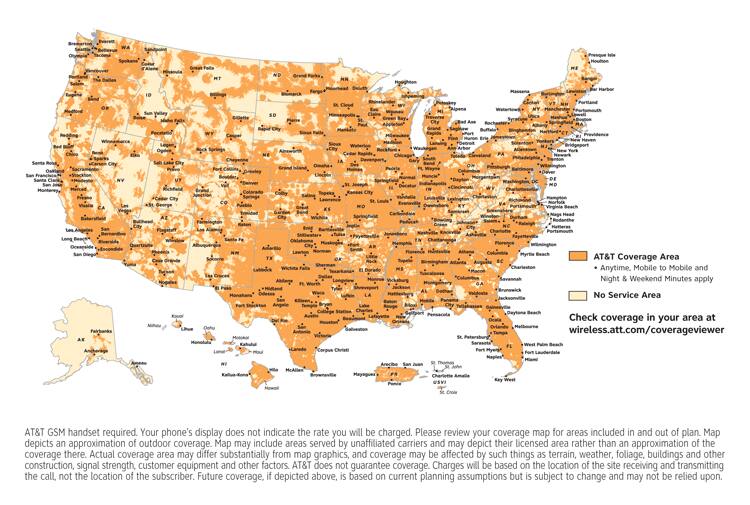
AT&T's coverage map. See all that vast, empty area? Here's a map from AT&T themselves. Still lots of empty areas, and if you zoom in on their interactive coverage map you'll find that the additional orange is actually "partner" service. What that means is that you can't get AT&T 'home' service if you are in those areas.
Also, I happen to live in one of the supposedly "Best" AT&T service islands in the middle of the vast empty area on the first map, and typing in my ZIP code on the AT&T "build your package" wizard returns a message that "this is one of the few areas we haven't reached yet." -
Re:CDMA
AT&T's coverage map. See all that vast, empty area? Here's a map from AT&T themselves. Still lots of empty areas, and if you zoom in on their interactive coverage map you'll find that the additional orange is actually "partner" service. What that means is that you can't get AT&T 'home' service if you are in those areas.
Also, I happen to live in one of the supposedly "Best" AT&T service islands in the middle of the vast empty area on the first map, and typing in my ZIP code on the AT&T "build your package" wizard returns a message that "this is one of the few areas we haven't reached yet." -
Re:Dinosaurs
Why should the US cellular companies cater to people that like foreign technology?
Exactly - they should keep offering technology from American companies like Samsung, LG, Sony/Ericsson, Nokia, Blackberry and HTC!
-
Re:Dinosaurs
Why should the US cellular companies cater to people that like foreign technology?
Exactly - they should keep offering technology from American companies like Samsung, LG, Sony/Ericsson, Nokia, Blackberry and HTC!
-
Re:Dinosaurs
Why should the US cellular companies cater to people that like foreign technology?
Exactly - they should keep offering technology from American companies like Samsung, LG, Sony/Ericsson, Nokia, Blackberry and HTC!
-
Re:Dinosaurs
Why should the US cellular companies cater to people that like foreign technology?
Exactly - they should keep offering technology from American companies like Samsung, LG, Sony/Ericsson, Nokia, Blackberry and HTC!
-
Re:Dinosaurs
Why should the US cellular companies cater to people that like foreign technology?
Exactly - they should keep offering technology from American companies like Samsung, LG, Sony/Ericsson, Nokia, Blackberry and HTC!
-
Re:Dinosaurs
Why should the US cellular companies cater to people that like foreign technology?
Exactly - they should keep offering technology from American companies like Samsung, LG, Sony/Ericsson, Nokia, Blackberry and HTC!
-
Re:AT&T is not really AT&T.
It helps to understand that AT&T is actually the old SBC. The AT&T name was sold to SBC. My understanding from talking with former SBC customers
is that the SBC trademark had little value because the company was so
abusive. So, the SBC managers decided to use another name.Are you serious? Even the Spanish Inquisition wouldn't gain popularity by renaming themselves to AT&T. Perhaps they should consider naming themselves NSDAP to seem even less abusive.
-
AT&T is not really AT&T.
It helps to understand that AT&T is actually the old SBC. The AT&T name was sold to SBC. My understanding from talking with former SBC customers is that the SBC trademark had little value because the company was so abusive. So, the SBC managers decided to use another name.
Those interested in how that happened can watch Stephen Colbert explain in a 1 minute 14 second video: The New AT&T. If that video is not available, try this one, but that requires watching a commercial. -
There are a few similar things out there
http://www.research.att.com/~njas/sequences/ This is huge.
http://www.amazon.com/Dictionary-Real-Numbers-J-Borwein/dp/0534128408 A Dictionary of Real Numbers (Hardcover)
-
Re:This is really stupid.
The context in which this kind of thing makes sense is mathematics (and the fields to which it has the most direct application). Many people have heard of The On-Line Encyclopedia of Integer Sequences where you can search for a particular sequence to find out more about what's known about it, but less well-known is the Inverse Symbolic Calculator where you can look up individual real numbers.
-
Sounds like the Encyclopedia of Integer Sequences
This sounds a lot like the Online Encyclopedia of Integer Sequences.
That site labels and stores integer sequences for easy lookup, and will let you simply search for a subsequence to find the one you're looking for. This proposed site keeps track of numbers instead and incorporates more than the pure math that the sequence encyclopedia limits itself to, but it sounds very similar in concept. -
Re:Hey guys...
really? I looked here again to make sure i didnt miss anything http://www.wireless.att.com/cell-phone-service/legal/service-agreement.jsp?q_termsKey=postpaidServiceAgreement&q_termsName=Service+Agreement but the same as the other day there isnt a time stamp
-
Re:well This shoudl F*CK Apple & AT&T some
According to AT&T's site:
http://www.wireless.att.com/iphone/
"iPhone is configured to work only with the wireless services provided by AT&T."
According to the article summary:
"Should the bill pass, Internet service providers will not be able to 'block, interfere with, discriminate against, impair, or degrade' access to any lawful content from any lawful application or device. "
If i understand correctly, the iPhone has a SIM card, and this means that any carrier willing or able to support and sell the iPhone should be able to. The exclusivity deal with AT&T is NOT neutral, since in overseas markets Apple is (isn't it?) forced to not have exclusive carrier deals. If Asian and European carriers using different variations of current generations of cell technology can support the iPhone, then so should US carriers be able to. So, to read "iPhone is configured to work only with the wireless services provided by AT&T." does not -- to me -- let AT&T off the hook. Somewhere in tiny minds of lawyers, bean counters and tech shapers, there had to be some serious hashing and gnashing back and forth over how to avoid anti-trust/conspiracy/collusion issues.
From what i know first hand, there are people who so badly want the iPhone but despise or otherwise don't want AT&T that they buy the iPhone, early term but only after the trial period, then keep the phone, having paid early termination, which still ends up being less than buying the phone without a contract.
Why do people have to go this route, a bunch of rigmarole bullshit extra work? I think it's because apple so jealously guards its image that it doesn't want EVERYbody to have an iPhone. Or, their calculus (mix machine/profit-margin-cache calculator) says, "mehhh, 170 MILLION is good, we don't need an extra 100M.", But, even IF apple could care less about there being 250M iPhone users, having ONE SOLE CARRIER would be a serious impediment.
So, in my serious, tin-foil-hat mindset, i'd dare say AT&T definitely had a hand in sweetening the pot for Apple to not go multi-carrier in the US. I'd say the phone's pricing was set to please Apple, please AT&T's board, and then prevent others domestic from carrying the phone. It's stupid, and it's mean. If Apple would love to have 20% of an additional 100 million iPhones and AT&T hasn't got the bandwidth, tough. Let other carriers prove they will or they have upgraded switching gear to route or manage the packets (content and quality) the iPhone sends/expects.
I ride BART almost every day (every day for work, and 1-2 times on the weekends) and on any given average commute (not even talking packed cars, but all seats full, with some standing riders), i can see 5-10 iPods or iPhones, and often 4-5 are in random clusters of unrelated riders. Can Motorola, Samsung, Hitachi, Panasonic, even HTC or Sony/Sony-Ericsson claim that? I serously doubt it.
I really hope the FCC ends this exclusivity deal and forces net neutrality down the throats of carriers and phone desingers. Design the database to CRM-like handle USER-MANAGED profiles, and knock of the delayed-billing/overbill game. Let users set up a basic profile to hard-stop calls or data streams if the handset is roaming rapidly as if stolen or passed around or cloned. Let the user have real-time syncing to the billing system to eliminate confusion, and to let the user have peace of mind.
(Had to re-write this tome because Opera 10Beta crashed on me when I used a rapid Ctrl+A keystroke (with the cursor outside the comment box). On this computer, it's repeatable. No, unlike Firefox, my beautifully-scripted masterpiece was NOT returned to the screen for me to hit "submit"....)
-
Re:Contracts aren't what they used to be...
AT&T's early termination fee is prorated.
-
Block lifted; moot provides details.
moot has posted the details on status.4chan.org.
Basically he confirms all the speculation that AT&T blocked 4chan because of ACK bouncebacks from a DDOS. Real
Also, being on AT&T and unable to access 4chan doesn't necessarily mean that it's been blocked. 4chan is up and down all the time, because they're under constant DDOS attacks, at pretty much all times, from various sources. It seems that DDOSing 4chan is a basic holding pattern for botnets that aren't otherwise occupied.
Here's what happened:
For the past three weeks, 4chan has been under a constant DDoS attack. We were able to filter this specific type of attack in a fashion that was more or less transparent to the end user.
Unfortunately, as an unintended consequence of the method used, some Internet users received errant traffic from one of our network switches. A handful happened to be AT&T customers.
In response, AT&T filtered all traffic to and from our img.4chan.org IPs (which serve
In the end, this wasn't a sinister act of censorship, but rather a bit of a mistake and a poorly executed, disproportionate response on AT&T's part. Whoever pulled the trigger on blackholing the site probably didn't anticipate [nor intend] the consequences of doing so.
We're glad to see this short-lived debacle has prompted renewed interest and debate over net neutrality and internet censorshipâ"two very important issues that don't get nearly enough attentionâ"so perhaps this was all just a blessing in disguise.
Aside from that, I'll also add that there is some big news due later this week. Keep an eye on the News page, Twitter, and global message for updates.
As always, I can be reached at moot@4chan.org.
---
PS: If any companies would like to hook us up with some better hardware, feel free! The architecture we've got powering this large and influential beast is really quite embarrassing. (
-
Re:Double billing also happens in EuropeThe joke's on you then, because when you let the call go to voicemail you'll be charged for it anyway.
Q. How am I charged for Voicemail calls while roaming internationally? A. Voicemail calls are charged as follows: When your device is on:
* Calls that you do not answer that are routed to the AT&T voicemail system will be charged as an international roaming incoming call to your device.
* In addition, the foreign carrier's routing of that call to the AT&T voicemail system may generate an outgoing call charge from your device's location to the U.S.
* These charges apply even if the caller disconnects from the voicemail system without leaving a message.
http://www.wireless.att.com/learn/international/roaming/faq.jsp
-
C++0x is really good though
I haven't been following C++0x, but after reading the C++0x FAQ I am very pleased. It really fills a lot of the simple, practical holes in the language.
I think the success of C# is part of why these things are being considered. For example, C# recently added an advanced form of initializer lists - which is now in C++0x. Another example is the scoping of enums, which has long been a pain. Many coding standards require enums to be ALL_CAPS_WITH_UNDER_SCORES because they don't obey scoping rules: this is fixed. NULL is now replaced with nullptr, which is a minor improvement that looks much like how this was done in C++/CLI. (That's the bastardized C++ for
Competition is good.
I know that everything I just listed probably exists in many other languages, but C# and Java are very prominent in enterprise development, and are making huge gains. I will be very very glad to see a real ISO standard gaining ground again.
-
Re:Does this unlock it though?
AT&T uses HSDPA.
http://www.wireless.att.com/learn/why/technology/3g-umts.jsp
-
AT&T DECT 6.0
I bought the AT&T DECT 6.0 from best buy not too long ago once my old land line died. It comes with 2 handsets (a base with answering service, and additional charger and handset). You can add as many more handsets as you want (I'm sure there is an upper limit...like 10 or 12).
http://telephones.att.com/telephones_ui/phone_store/dsp_product.cfm?itemID=3930&parent=23655
Sure I had to put some gaff tape over all the AT&T Logos, but small price to pay. When I walk in my house, my iphone cuts in automagically and all calls ring through to the home handsets. The only downer is that it pulls the caller ID information and compares it to the internal phonebook, and not the phonebook in your cell phone. If a number is in your phone but not in your AT&T phone it will just show you the number on the ID, and not the name. When I walk out of the house, by the time i'm down the block I'm into normal cell operation again. Haven't had any problems with it at all. Looks sleek too.