Slashdot Mirror
Domain: awea.org
Stories and comments across the archive that link to awea.org.
Comments · 97
-
Re:Unfortunately, birds save weight on brain...
I would say that at least two thirds of the results returned by googling those words are sensationalist rehashes of the same misinformation. Well-researched sources of information include: Advice from an Expert - Putting Wind's Impact on Birds in Perspective, What Kills Birds?, and the single-site-specific Impact of the CNE Wind Turbine on Bird Populations.
-
Re:Way to make safe for birds?The way to make wind turbines safer for birds is -- to study where migration paths are, and not to put wind turbines there.
Any kind of cage around the blades wouldn't be very feasible. This machine is 126m in diameter, so the structure would have to be massive, and would seriously impede the wind flow.
WindShare did a bird study for their turbine on the Toronto lakeshore. It seems that the 750kW, 52m diameter machine there might kill two birds per year. The front window of my house does about that, too, and it's an unremarkable suburban semi.
Buildings, cars and cats kill more than wind turbines. The unfortunate case of Altamont is not representative of the industry.
-
Here ya go
American Wind Energy Association, you can look around the reference library section there for costs, financing, etc sorts of questions. If you want more detailed and varied sources, just run a google search on wind generation cost analysis, ton of hits, I just checked, and it's where I got this one site I linked to.
As an aside, commercial wind power was one place where enron was really doing some good. GE picked up that division and it's still in operation and doing well, last I checked. -
Re:Wind power efficiencyDid you notice that you are citing American Wind Energy Association?
Perhaps your google search was too quick
-
Re:Wind power efficiency
I was actually wondering about the possible enviromental effects while checking out the pictures myself. My guess is that any effect would be negligable at best. Not to mention that the alternative method of producing this much power would be much more harmful. I guess if you think about it though, I cannot imagine that this alone, or even a field of these turbines would even come close to the effect that even a small city would have on wind. I don't have any real knowledge of this sort of thing so I am not really one to talk.
After a quick seach on google I came up with this basically, from what that says the effects seem to be minimal. -
Re:You forget about nuclear power
Here's an article on wind power ; it links to a 2001 list of levelized costs for different energy sources.
Check out the Earth Policy Institute's article and data on wind energy growth and falling prices. Nuclear energy is growing 2.2% a year, vs. 30% for wind from 1995-2002. With increased production, wind turbines are going down in price- look at that last graph.
If you are not happy with those numbers, I suggest you produce your own.
The arguments you offer against wind are a lot of FUD. Noise pollution and bird deaths are much lower with new turbines- and aesthetics are not something I like to make absolute statements about. Wind won't solve all our problems outright, but it does solve some problems well, without expensive, toxic waste. The problem of regional production is not that big a deal since wind is actually quite close to the demand side for electricity- when it produces only 10% of the power, a grid with a good mix can handle fluctuations without a problem. By the time we are ready to move beyond that level, hydrogen will likely be cost-effective as a short-term storage medium.
One last nitpick: nuclear can not reduce our impact NOW. Nuclear plants are net energy negative for a long time- it takes a lot of time and energy to get them up, so they're only net producers months after they start producing electricity. The first order of business is conservation: it's orders of magnitude cheaper than nukes, or other forms of energy production.
Take lighting: compact fluorescents -I prefer LEDs- cost much less per saved megawatt, at a much lower capital cost than a nuclear plant. They're also much, much easier and faster to deploy.
If you understand compound growth, and economies of scale, you'll be able to see from the stats I linked that it is inevitable that the future will be powered by wind and/or solar. The nuclear lobby is trying hard to use climatic change to justify a new lease on life, but we shouldn't be fooled by their arguments when we have cleaner, cheaper power already available. -
Re:Count the cost of free energy...> Wind energy kills birds in large numbers.
No, it doesn't. Buildings, cars and cats kill more than wind turbines. The unfortunate case of Altamont is not representative of the industry.
-
Re:Power Company Web Worth a Visit
May not even be that necessary, since there are enough on/off-shore sites to supply many times our electricity needs from wind - and in fact real-life usage has shown wind power is much more constant/reliable than first supposed. Just make sure that we have "oversupply", and yes, use the spare to make hydrogen fuel for cars, or store by pumping at hydro electric plants..
(British Wind Energy Association page)
(American Wind Energy Association page)
-
Its all a question of trade offs..
It has been estimated that 1 billion birds a year are killed by.. glass! Pretty much all tall structures cause some level of bird-deaths. *Every* power option has an environmental impact - it may be something we all have to accept as a cost of cheap clean power..
(British Wind Energy Association page)
(American Wind Energy Association page) -
Re:Whoa. Wait a minute.
What about not taking the word of recreational glider pilots--who tend not to fly on windier days, at least where I live--or of the company, and actually demand data from the company on wind speeds? It's their job to show that it makes sense, and maybe they haven't yet. (The report I linked to claimed to have "preliminary wind measurements", but they could easily have screwed up.)
Also, there are wind turbines in Minnesota, and more are being built. Apparently the six months of snow, ice, and freezing rain aren't enough to prevent decent power generation there.
Finally, if the company does go under, as another poster suggested, the city can sell the turbines. If you give them away for free, that shouldn't be a tax burden. You might want to insist on a contract whereby the wind turbines revert to the city in case of bankruptcy that prevents operation of the turbines, if such a contract is possible. -
Re:Birds really aren't that stupid...
The number of birds killed each year by plate glass windows, and various other human structures is huge -- many hundreds of millions in all. It doesn't seem likely that even if the US moved over massively to wind power, that wind turbines would make much difference in that area. http://www.awea.org/faq/sagrillo/swbirds.html/
-
Re:Whoa. Wait a minute.
1. You build wind power to reduce the use of fossil fuels, not to make the grid blackout-resistant. Widespread blackouts are caused by faulty control mechanisms, not the method of power generation. Why even bring this up?
2. Having a company in financial difficulty do *anything* can be problematic. This issue is of significant concern.
3. On what do these sources base their conclusions? Studies of bird deaths due to wind turbines show pretty minimal numbers, even with the old CA turbines that were unusually dangerous for raptors. Estimates are around two birds per year per turbine (compared to somewhere around 10/year per mile of road with average traffic). Maybe you should dig up your roads and walk everywhere instead--but that's no good, you need to get places, but electricity comes for free from nowhere! Er, wait.
4. If there's really not enough wind, then building these towers is really stupid. Building wind farms where there is no wind is a good way to bankrupt one's company once again. However, are the NWS stations on ridge-tops? You can have huge differences in wind-speed based on local terrain. You make a good case against building a wind turbine on top of the National Weather Service stations. You need to provide more information, however, to show whether the 30 year records are relevant. The company's
report claims that the ridge crest is a local wind corridor. Wind corridors are real, so your objection is only valid if they are wrong that it is a wind corridor, or if they are right but that even so there is insufficient wind. (Also keep in mind the difference in wind velocity as you go from ground-level to 80m above the ground.)
5. Ice is apparently a red herring. There simply isn't evidence that thrown ice is a danger, despite many installed wind farms in ice-prone areas. Besides, there are good physical reasons to think that ice would not be thrown a great distance (e.g. turbines are based on airfoils, and ice coatings don't preserve the airfoil shape, which is the whole problem with plane wings icing).
6. I have heard the new large 80m-ish Danish turbines. They're not that loud, and I don't personally find the noise that annoying. It's mostly sort of whooshing as the blades go past; the new designs have very little mechanical noise (unlike some of the old eggbeater designs in CA). It's hard to even hear them from a reasonable distance away (a few hundred meters). Why do you think that they are LOUD?
Anyway, it's nice that you're helping your dad out and all, and it's good for people to be involved in their community, but are you really arguing against it for the reasons you've given? Or is it instead because you don't like the look of giant windmills on the top of your ridge crest, and figure that if you can shoot it down you won't have to see a coal-fired power plant there instead?
People do this kind of thing all the time, often without realizing it. E.g. people where I used to live wanted to cut down all the trees for "fire protection", despite the fact that the shrub and annual grass that would have replaced the trees were a bigger fire hazard than the trees. Curiously, there was an extremely strong correlation between people who wanted to cut trees for "fire protection" and those whose views stood to improve the most, but only a weak correlation between people whose houses were near trees and the same desire.
Aesthetics are important. If that's the real reason you or your dad is fighting this, best to recognize it now so you can recognize when you're prone to believe something false because it provides an excuse for your position. Then if you still want to spread misinformation to the city council, or whatever, well, that's up to you. That happens all the time. At least you can be intellectually honest with yourself (and with readers here). -
Re:One thing to keep in mind (but it's wrong!)The energy cost in manufacturing the turbines is greater than the energy gain you get back from them
-
Re:I've actually...
-
Re:High Mileage Cars
Umm, I think you are attacking some unrelated generalization you've heard in the past, not the actual poster's comment. He made no statement about hydrogen or solving fossil fuel dependancy.
But, since you are on that topic, there are a number of avenues besides fossil fuel for generating the electricity or heat or whatever for creating hydrogen:
Bacteria. Some scientist at UCLA did some calculations, and determined that a decent sized canyon in the Mojave desert covered 2 feet of water and a sheet to collect the hydrogen produced by the bacteria would be enough for all of Southern California.
Geothermal
Photovoltaics
Tidal
Convection
Fission
Fusion
Biomass Fuels
Solar Thermal
Wind
Hydroelectric
So, who are you swinging your fists at? Certainly not the original poster?
LS -
Re:Look closer at that data
In other words, 6% of the contiguous US land area would have to be covered with windmill farms.
I'm don't claim to be an expert, but that's what it sounds like. Here's a reference within the paper itself that references the 6% figure again:
The amount of windy land available for power class 4 and above is approximately 460,000 square kilometers, or about 6% of the total land area in the contiguous United States. The potential average power from areas with class 4 and higher, which are suitable for development with advanced wind turbine technology, is estimated at 500,000 MW.
(The sizing assumptions fromt he study: 50-m hub height, 10 D x 5 D spacing, 25% efficiency, and 25% power losses.)
Another interesting figure:
Figure 4 shows the contribution that the wind energy of each state could make to meet the total electrical needs of the nation, assuming a moderate land exclusion scenario. North Dakota alone has enough potential energy from windy areas of class 4 and higher to supply 36% of the total 1990 electricity consumption of the 48 contiguous states.
How much does each windmill cost? (I don't know.) How much would a million of them cost?
The AWEA document includes basic information on cost. One of the charts tables shows a 1.65mW rated 71m diameter turbine to cost $1.3M in 2000. They give a capital cost estimate of building a class 4 50MW wind farm at about $1M/MW, with an annual power production (assuming 35% capacity factor) of 150M kWh.
Here's a 2001 study of Comparative Cost Of Wind And Other Energy Sources [PDF]. Citing a table from the California Energy Commission's 1996 Energy Technology Status Report (CEC calculations do not include subsidies or environmental costs), Wind is about even w/ coal (4.0-6.0c/kWh) and *much* cheaper than nuclear (not sure why the CEC's number differs so much from those floated by the Uranium Information Centre). Once externalities [PDF] are figured in of course, wind power is much cheaper than coal.
What would be the effect of taking that much energy out of wind patterns? Would rainfall in the region be affected? Regional temperatures? Flowering plant pollination rates?
I agree, the most common environmental problems seem to those affecting birds and aesthetic, etc. While I don't think that larger climactic changes are a significant concern at the scales we're talking about, it would be nice to see some numbers/empirical research. I haven't, however seen any such portential issues cited it anywhere, from the ANL's Wind EIS's concerns, the UCS, or any of the various reports I've read (I've done searching on Google and Citeseer), which you might expect to see if there were problems. What I have seen shows local net-positive effects in wildlife from reduced emissions in states implementing large-scale wind power. It might be worth doing more research on how Denmark is doing (they're at over 10%+ of their power being generated vy windmills, and aiming for 40-50% by 2030).
I haven't done enough research to actually nail down the numbers of whether it would be able to completely replace coal, but from the research I've done, wind power is actually something that is pretty close to viable in the US (unlike solar) and certainly very viable in other countries.
Of course getting rid of burning coal is great, but our oil consumption problem is really a totally different can of worms (w/ about 45% of the 20.0MMBD last year being gasoline).
-
Re:And that's why this isn't sustainable...
-
Re:Recession = cost doubling?I'm just wondering if your getting your units confused. 1,221,191 mega watts * 365 days * 12 hours = 5,348,816,580 mega watt hours = 5,348,816,580,000 kilo watt hours. Seems like this is more than the 3,848,000,000,000 kwh the doe quotes.
With that comes, I assume, the expectation that every possible free tract of land had a windmill farm stuck on it. Nope, current US capacity = 6,374 MW (American Wind Energy Association) so a 200 fold increase, a big increase but from a very low baseline.
-
Re:What about using the most obvious Nuclear Energ
An interesting analysis, and while I agree w/ that nuclear power would be far preferable to coal, (and without discussing further viability issues), I would just like to point out that wind power in the US should not be ruled out offhand. From the abstract of the 1993 Wind Energy Potential in the United States study by D.L. Elliott and M.N. Schwartz (which supercedes the 1991 study cited):
Good wind areas, which cover 6% of the contiguous U.S. land area, have the potential to supply more than one and a half times the current electricity consumption of the United States. Technology under development today will be capable of producing electricity economically from good wind sites in many regions of the country.
So yes, in theory, wind power could meet our power needs (but not w/o being coupled with advanced battery technologies.
Even cost per kWh, Wind does ok. From a March 2004 briefing published by the World Nuclear Association on The Economics of Nuclear Power, shows a present day cost of about 3.7c/kWh. A recent AWEA analysis of the The Economics of Wind Energy [PDF] places the cost/kWh for a 51MW wind farm at between 2.6-4.8c/kWh depending on wind speed. Even if we account for backup power and double the cost, we're not doing too badly either way.
Coal is at about 3.3c/kWh, but when calculating in the external costs "to put plausible financial figures against damage resulting from different forms of electricity production for the entire EU" as done in the decade long EC ExternE studies. Total cost of both nuclear (avg'ing 0.4 euro cents/kWh) and wind (0.1-0.2 ec/kWh) end up beating the snot over coal (4.1-7.3 ec/kWh).
Regardless, I agree with Lovelock. We really need to dump fossil fuels now.
-
Re:Economist Article
This is the closest I could get to a comparative table: http://www.awea.org/pubs/factsheets/Cost2001.PDF
These are 1996 figures, though and much has changed since- natural gas being more expensive, and wind and solar having continued to go down in price.
As far as calculating TCO, all those costs would be considered, plus an important variable: interest rates. With high interest rates, capital intensive options like nuclear and wind become more expensive compared to plants that are cheaper to build but require expensive fuel later. -
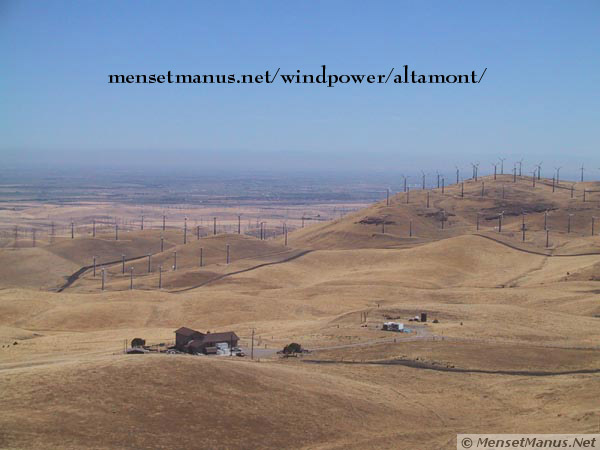
Re:Altamont windfarm photo
It's really neat to drive by this area. Here are some more photo links to give you an idea what it's like, if you've never been.
From here: pic1 pic2 pic3 pic4
another pic
some pics from the car driving by
pic with sun low in sky with long shadows
And finally here's a link describing all the wind power resources in California. -
Re:I think it has something to do with location
I think it also has a lot to do with the fact that there are 7000 turbines. The new wind farms that are being built here in Oklahoma each just have a couple dozen giagantic turbines. One of the wind farms that is now online produces 50 MWatts of power with 34 turbines. (link)
This webpage shows that the Altamont Pass wind farm consists of a wide assortment of different types of turbines including many small ones. There are two groups of over 1500 turbines (nearly 3200 turbines total) that produce only 160 MWatts each. -
wind is quickly on its way to dominance
Wind is nice and clean, but it takes a lot of windmills to generate enough power to replace a power plant. Windmill farms are regarded as many to be ugly so people don't want them around their houses.
Actually, the entire electricity requirements of the United States could be served by wind turbines with a combined land-use footprint of only 14,000 acres, including enough grid redundancy to provide 99.5% uptime through long grid transmission to areas experiencing calm winds. (The remaining 0.5% backup could be hydro or whatever.) That area is only twice the size of the Stanford campus, and as large as the amount of Oak forest that California loses each year.
Some people consider turbines ugly at first glance, but more people want wind turbines in their neighborhood than want mercury-spewing coal smokestacks in their state.
Wind power is the fastest growning renewable industry and is expected to be the dominant form of power production in less than 30 years.
Please see the Windpower FAQ for more information.
-
Great news for wind power!
Tiny particles of soot or chemical compounds like sulphates reflect sunlight and they also promote the formation of bigger, longer lasting clouds.
This means, as has been often noted, the atmosphere is absorbing more energy. That in turn is great news for wind power, a renewable industry which is growing rapidly and in fact is expected to be the dominant form of power production in less than 30 years.
-
waste of moneyFusion doesn't solve our dependence on fossil fuel for transportation, and the solution for stationary generation is already fully developed.
Wind power will easily serve 100% of our power geeneration needs, and it is already online, paying for its clean renewable self and creating wealth instead of sucking up our grandchildren's tax dollars.
Why should we spend a cent on fusion? We don't need any.
-
Re:GrandchildrenOf course, our grandchildren are going to be paying through the nose, still working on the interest, because of these boondoggles.
"Fusion" indeed; that has been 20 years away for the last 50 years and probably will be for the next 50. Wind power will easily serve 100% of our energy needs, and it is already online, paying for its clean renewable self creating wealth instead of sucking up our grandchildren's tax dollars.
-
Re:He-3Well, thank you for that correction. By "sustained," I mean, running for a few years at a time, rather than the few minutes of the experiments cited.
I still think the whole fusion reactor thing is a boondoggle. All we need for 100% of our electricity is wind (supplemented with a little hydropower and/or fossil gas to take up the slack during periods of calm.) Unlike fusion, with grandiose schemes of going to the moon for fuel, wind is actually in production and growing like crazy, crating thousands of jobs in addition to actual commercial power.
Ask me again about fusion and going to the moon in another hundred years.
-
Re:My car
This is the reason why we have to start now, long before the wells run dry. We are all too addicted/dependant on personal transport now to switch over to public transport totally (myself included), and its gonna take time to replace all those cars.
The point is its all feasable - Ive mentioned the wind power bit (USA) before - costs down to $0.03/kw/hr & falling - just turn it into Hydrogen, or power batteries direct if cheap/light enough. Its actually not gonna be that hard, just requires the will. Increasing taxes on petrol helps, but is not enough in itself. Actually I think costs could come right down as technologies improve (like PC's)- our kids could all be driving powerful SUVs running on cheap green electric/hydrogen, laughing at their dads who fought wars over oil.. -
Re:Important not to jump to conclusions (GET REAL)Right, This is much better...
Each Day, America converts PSCCO,US DOE,EIA
360,000,000 gallons of gasoline into
7,500,000,000 lbs carbon dioxide,
369,000,000 lbs carbon monoxide,
47,000,000 lbs hydrocarbons,
24,000,000 lbs nitrogen oxides,
1,000,000 lbs particulate matter,
7,500,000,000 miles are driven @ 20.83 mpg
for passenger vehicles only, not including the
higher emissions of heavy transport or diesel.
- 1 Gallon of Gas contains 132x10^6 joules of energy, equivalent to 125,000 BTU, 36.650 kwh(kilo-watt-hours), 31,000 food calories.
- A 70mpg Hybrid sips 0.52 kwh/mile, the average 20mpg car uses 1.76 kwh/mile and The Hummer H2 wastes 3.7 kwh/mile or more.
- Electric Vehicles use from 0.2 to 0.6 kwh/mile, that's up to 18 times more efficient. EV Album
- 7.5 Billion miles at 0.4 kwh/mile is just 3,000 Giga-Watt-Hours, as compared to 13,000 GWH. 23% as much power.
- America currently produces 27.3 Giga-Watts-Hours per day with wind power alone.AWEA
L8r
Ryan - 1 Gallon of Gas contains 132x10^6 joules of energy, equivalent to 125,000 BTU, 36.650 kwh(kilo-watt-hours), 31,000 food calories.
-
Distributed Power Systems+ plus+
Humm, seems to me that the root of the problem is that the general public, business, and industry is dependant on "the grid"(like duh). What I mean is each of us is dependant on power generation and delivery systems which are out of our individule control.(ok, so)...
Please keep in mind that had we spoke in person you would not have had the opportunity to observe my poor spelling, it's my message and not my grammer that you aught pay attention to.
To demonstrate, smaller co-op type wind farms would place more of the power generation in closer proximity to the loads. Reducing vulnerability to falures at the generation sources and transmission grid(s). They would provide jobs in construction and maintainance, and stabalize prices for power from a near-constant, free, renewable, and clean source.
Rather than investing in more Dirty Coal fireing plants that rob us all of our non-renewable natural resources; Instead of pushing the envelope with contriversal nuclear power, how about simply start utilizing our existing fision reactor, The Sun, in more direct methods? Such as Solar, which is about as direct as you can get at ~20% effeciency. Wind is probably the best solution powered near-directly by the sun aswell. Hydro-electric is already being extensively utilized, relying on the evaporative powers of the sun to circulate water to the highest peaks. If you think about it, coal and oil resources are also powered by the sun, which grew the plants that eventually turned into "fosil"-fuels. I wonder just how effecient this very-non-direct use of sunlight is. My guess, about 0.02% or less. Even Solar power starts to look a whole lot better put this way.
Or how about smarter tansportation that would actually Help correct this and many other problems that we are currently facing (Oil dependency, pollution, corruption, wars)... This T-Zero and other Electric Vehicles could aid grid overloading, utilize nightly power over-production provide clean reliable and FUN daily transportation producing zero emmissions and using zero oil. period. Check out their White Papers. and What's New area (especially the ev-based vehicle-to-grid demonstration project)! I know it's a little pricy, how about the GM EV1 with an MSRP of less than $40K, in low volume production (Oh ya, if it had ever been for sale). There we go, More Jobs again... And Imagin how the cost would come down if we built 100,000 of them here at home.
And for all of you that are going to diss on electric cars, keep in mind that you know nothing about them. They have power and range, and are very effecient at 80% to 90% from the outlet. Batteries are recyclable and safe.
Hybrids are not Electric cars. Gas cars are brute force machines, their ICE's only push, Friction breaks slow them down. Hybrids are the "Missing Links". They Push just the same, but are capable of "Recycling Kinetic Energy", however all power originates from the gassoline. EV's are the Answer, The Push even harder, Regenerate Better, use about 1/4 the energy, and produce Zero Emissions. Infinite MPG.
To Bring this full circle, I can make my own electricity, and more of us should. It shines down on us each day and blows above our homes durring each of our lifetimes. Build something usefull to our children, not more problems.
L8r
Ryan- Starve a terrorist, drive an electric vehicle.
- I love plugging in! Do you like pumping gas?
- Would you drive your car if the exhaust came out of the steering wheel?
- Sorry about your "GAS PROBLEM".
- It's not Electric if you Can't Plug It In.
-
Think again..
It strikes me that national power systems often have dangerous reliance on a small number of big power-providers - large coal/gas/oil/nuclear stations, with electricity imported/transported down a few very large critical power lines. Alternative energy may provide a solution, because by its nature it needs a higher level of redundancy and a more intelligent and distributed power supply model. And its good for the planet too.. Wind energy has really started to prove its use here in the UK, and is set to take off in the USA too. In the UK we should have 20% of national power from the Wind by 2020, and we have the offshore sites to get 100% eventually if we wanted. Add to that Solar, Tidal, etc.. Because of the very nature of these resources local/national distribution must be better, and include mechanisms to regulate in the case of a drop in power..
Oh, and what do you do when you have excess production? Turn the electricity into Hydrogen for your cars!
-
Its a good idea..
Whose time has come. Put solar windows in all office blocks, and solar tiles (both electric & water heating) in the roofs of all houses, and you go a long way toward solving the energy problems. Even in cooler countries these schemes pay-back after a few years - ie the extra it costs is paid back in electricty savings. In hot contries, a house can (in effect) generate as much electricity as it consumes - in Australia you have Zero annual electricity bills for these guys - the tiles make as much electricity as they take from the grid. (ok with gas heating, but the hot water supply is provided by the sun too). Check also This link, This link , This link or This link.. Want a large scale plant? What about the deserts of the world ?
Combine with Wind power, and other alternatives, and we may get 100% of our energy needs without nuclear, coal, gas.. What do you do when you have excess off-peak power? Turn it into hydrogen for your car!
-
Re:Cause: Overloaded grid and bad logic
Thanks for the backup on this one.
While I don't necessarily agree that regulation is the answer, it's a simple matter of ethics.
De-regulation wasn't really de-regulation. It was RE-regulation. The rules simply changed, and there became many more of them, one of which was that no new generating plants could be built. Why the hell they decided this was beyond me. Most of these generators were built "way back when" before the age of computers and ubiquitous use of air conditioning. PECO Energy became the most expensive electricity in the nation after PA "de-regulated" the electricity industry. I pay almost $0.16 per kWh, which is ridiculous by any standard. That money is used to pay for electricity that is practically given away to neighboring producers like PP&L and ConEd.
Anyway...
You'd be AMAZED at what percentage of all generated power is dissipated in either a computer or an air conditioner/chiller/etc. 100 million computers at 200 watts each is 20 BILLION watts. 20 GIGAwatts. That's the capacity of more than 20 average-sized nuclear reactors. Limerick here in PA has two reactors each capable of about 1.134 (I was really hoping it was 1.21, really I was!) gigawatts.
Here's a Link to a list of all U.S. Nuclear facilities and their statistics and capacities.
And here is a link to a list of all the reactor statuses showing they're loaded to the teeth - almost all of them at 100%.
The U.S. Department of Energy maintains lots of useful information about the power grids in the United States and how they are running. There are also publicly available status reports on each generation facility.
One graph on the DoE site showed that generation capacity hasn't increased at all since about 1992 (when Clinton took office, what a surprise... bastard killed the military AND our power infrastructure... but that's another thread)...
It's not surprising that this happened since we've been increasing generation rapidly due to the deployment of computers and other tech gadgets, but not increasing capacity to make up for it. It also doesn't help that there's no incentive other than cost for people to use Alternative Energy like solar or wind. Well, that's not totally true, there are actually Lots and Lots of Incentives in some states for end-user renewable energy, but it's still really expensive.
-
Re:footprint area!"Please correct me if I am wrong"
OK, here goes...
First off, your link is broken. However here's one yanked from another post:
American Wind Energy Association
That link indicates that instead of 14,000 acres, 16,000 square miles is needed. And all that area addresses NOT 100% of US demand, but only 20%. So it looks like I was right to be suspicious of your numbers.
And considering insurance. This is a good point. But how many significant nuclear accidents have their been in the US since the 50s? TMI 1979; that's it. There have been other incidents, but that was the only serious one; and no one died and the plant is still operating. The upshot is that since inception in 1957, this act has resulted in basically nil payout/cost to taxpayers.
The fact is that there are far more deadly and far more numerous accidents in other industries (like chemical plants) every year much less over 40 plus. And I don't see these boys getting walloped by insurance rates that jack their costs n-fold.
I seriously doubt that insurance adequately adjusted for the risk would cost much. The concern I have is with the irrational fear of nuclear power. That combined with our general out-of-control tort process could result in irrational insurance rates that don't reflect the real risk -- at least in the short term. Nevertheless, I'd like to see this like most other forms of govt subsidies phased out. I believe after an initial spike, insurance rates would come down to something reasonable once the insurance companies were able to weigh the risks throughly.
In addition liability cost for the current PWR plants would not apply for passively safe designs like the new Pebble Bed Reactors. The latter are designed to avoid an accident even with the total loss of coolant flow. They can't meltdown -- as field tests in the US and Europe have shown. Hence the former worst case scenario is not possible which means less liability and less insurance cost for any new plants that use such a design.
Finally, I think your disposal cost argument is weak. The volume of nuke waste is so tiny that shipping and even temp storage are not huge costs; and storage of every bit of the stuff permanently at Yucca is therefore also not a problem; and costs for the latter are already sunk. Decommissioning is 10% of capex but decades in the future. And plants are getting new commissions for extra life of 20 or more years like clockwork. that means the decommissioning is fractions of a cent in terms of the amortized cost.
-
Re:Wind Farms don't work
Yes, but then you take energy out of the wind that you are trying to harvest. The bird issue is not really as large of a problem as people make it out to be.
I think it's kind of funny myself. Which is the lesser of two evils? A few birds a year die, or tons of greenhouse gases and pollutants are released into the atmosphere.
I'm admittedly biased -- I work for a wind power company -- but really people, think about it.
The American Wind Energy Association (AWEA) just held its yearly conference in Austin, TX and I was there for a little while talking to people at my company's booth. Wouldn't you know, someone came over and started grilling me with questions about this issue (and further, he wanted to know about the impact of wind turbines on butterflies!).
Bottom line, studies are performed (at least on my end) to be sure that the impact on the environment is minimal. In all honesty I think that people have to accept that sometimes in order to do a greater amount of good, you have to live with a little bit of the bad. -
Re:NIMBY
Several articles that I have read recently on wind power have stated that the current generation of turbines don't produce much noise at all. The American Wind Energy Association says that the noise level from a wind turbine at 250ft is 45DB -- about the same as a refridgerator. This is significantly less than the 150DB output of a jet airplane. An airport is several THOUSAND times louder than a wind farm.
-
Re:NIMBYThe wind mills don't kill any more birds than any large structure, for example a power line tower, or a radio tower. This article has more details:
-
Re:Problems with wind power?Regarding bird kills:
No matter how extensively wind is developed in the future, bird deaths from wind energy are unlikely to ever reach as high as 1% of those from other human-related sources such as hunters, house cats, buildings, and autos. Wind is, quite literally, a drop in the bucket.
-- from the AWEA FAQ, 2002, emphasis mine.
Oil leakage is an old-technology problem,and then only in the case of poor maintenance. New turbines, like the Lagerwey we built in Toronto, don't use hydraulics.
Turbines failing in high winds seldom, if ever, happen. New generator technology allows wind turbines to generate -- small amounts of power, admittedly -- in winds you can barely feel. There's nothing generates bad feeling like a stopped wind turbine.
-
Re:Renewable Energy Policy ProjectThe results are positive, by the way.
The above quoted from the AWEA (American Wind Energy Association) news release.
-
Re:Bullshit
The bird thing was a strange consequence of the early Altamont Pass windfarms - they had put lattice towers under the small, fast turbines, and slapped the whole thing on a migratory raptor route. The raptors liked perching on the lattice and would drop off to hunt...smack.
Your average turbine now spins much slower (because they're much bigger) and sits on a tube tower. It seems like when the birds aren't actively perching on them, they do pretty well percieving and avoiding the blades. Though birdstrikes are down to nearly nothing (check AWEA for stats,) you still have to do a big EIS on any site to avoid migratory routes and nesting sites, etc. - to keep the strike numbers down and because they might avoid windfarms during migration, to their detriment energy-balance-wise.
Also, a megawatt turbine (ca. 3-400 homes,) doesn't really exclude a lot of land. In the US, out West, there's (anecdotally) enough otherwise unused grazing land in the Dakotas alone on high wind sites to provide our year-to-year energy growth for quite a while, once they build (and access) the transmission.)
Climatologically, 360 GW of atmospheric energy is pretty trivial, actually. (for instance, all that excess heat produced by our combustion engines is a below-roundoff-error calculation as well. But we could stand to pull some energy (aka heat) out of the atmosphere, given the rate we're increasing its retention with the CO2 blanket.
What it really comes down to, with wind and solar - how much energy can we really get out of it? More than 100 times as much as we have so far, that's for sure. So let's get on the stick about it! A good start, if you've read this far and still care, would be to go Buy some yourself!
-
Re:Disaster coming to a sidewalk near you.
-
Electricity generation
- There is a [PDF]Pedal Powered Electricity Generator in the MIT Thinkcycle).
- There are small personal windgenerators (cheap?) used for yachting, caravaning,... (<100 watts) (by example Rutlands)
- There are small watergenerators (low head (2') or low stream (10gal/min)) like these from microhydropower.
Beware of car generators to produce electricity : they need high rpm's and are efficient (to be checked, I am not sure) when producing hundred's of watts (tens of amps at 12 volts). -
A magnificent view of the Hamersley Ranges......from a scaled-down version of Bucky Fuller's Old Man River city [pictures RH column bottom, Google or Babelfish will translate for you], probably sans the canopy. Heaps of bandwidth, regular supply trucks, an airstrip not too far away, copious silent pole-free solar power (but some wind gennies tucked away somewhere for the few low-sun days).
Other sites you may consider include near Broome, with it's fabulous beaches, or Denmark, much colder and more crowded but with many lovely large trees, or perhaps somewhere along the scenic vehicle-destroying Gibb River Road.
(some Hamersely views included here, mostly from Transmission Hill (AKA Wireless Hill or Radio Hill depending on sobriety levels) at Paraburdoo, Western Australia, some Broome views in the earlier sessions).
-
Re:Residential wind power?
Heh, should have looked before I posted the first time. This might be helpful to you:
http://www.awea.org/faq/smsyslst.html
BTW, don't let my previous comment disparage you if you feel like you would want a wind turbine. I was mostly speaking from a commercial standpoint, as that is where my knowledge on the subject lies. -
Re:Noise?
Take a look at this:
http://www.awea.org/faq/noisefaq.html
AWEA stands for American Wind Energy Association -- I'd say they are a trusted source, and a good source of any other wind energy information as well. -
Re:Residential wind power?
According to this site, it's a helluva lot cheaper than solar panels of equivalent power.
-
Re:Historical problem
Ironically, nuclear power represents a short-term solution to the greenhouse effect, by giving an immediately practical alternative to coal- and gas-fired generators.
Yes, although we still haven't figured out quite what to do with the waste of nuclear power generation. This makes it as unattractive than burning fossil fuels for energy. There is no one fix-all technology for these problems, but there are plenty of practical things we could decide to do as a society that make sense at many levels, including lessening the potential threats of global climate change (i.e. global-warming/cooling). I think by pursuing the Kyoto agreement (or some similar thing) would be a Good Thing (tm) to provide an incentive toward taking steps away from fossil fuels to a cleaner, healthier environment.
There is plenty of data by "real" scientists that global warming (better termed climate change, IMO) is occurring and it is tied to massive burning of fossil fuels by humans. And even if it won't lead to near-future (i.e. a few hundred years) catastrophe, we still have plenty of other incentives to wean ourselves from fossil fuels. Smog and air-quality are problems in many cities (ask a city-dweller with asthma). Energy efficiency is often better for the bottom line -- when a long term view (oh-so-rare in America) is taken (check out Natural Capitalism by ).
Personally, I think we should focus on natural gas in the short term (rather than more oil drilling and coal burning), start to develop fuel cells, and begin investing (seriously) in alternative energy source research and infrastructure. More wind power, decentralized power generation (via fuel cells), and non-fossil-based burnable fuels would be a great place to start.
None of this is pie-in-the-sky. Wind-farms are not uncommon in the US, and when planned properly are efficient and environmentally friendly. The oft-mocked call of "Liberals" for energy conservation deserves to be taken seriously -- it's good for us all and for the bottom line. Decentralized, cleaner sources of power could help to eliminate dependencies on large, monopolistic corporations for basics like power, and put decision making power closer to the grassroots.
Of course, with the current quarter-by-quarter mentality of shareholders that leads corporations to seek as much profit as soon as possible, leads corporate decisions makers to leave out the big picture and future consquences. This gets us super-marketed, inefficient, expensive Sport Utility Vehicles and advertising designed to reinforce the modern American impulse to consume-consume-consume at all costs. Combined with the incredible power and influence of Old Energy in DC and internationally (hell, we fight wars for them), old habits like burning fossil fuels will die hard. Very hard. The habits will die, or we will...