Slashdot Mirror
Domain: bleepingcomputer.com
Stories and comments across the archive that link to bleepingcomputer.com.
Stories · 538
-
New Technology Combines Lip Motion and Passwords For User Authentication (bleepingcomputer.com)
An anonymous reader writes: "Scientists from the Hong Kong Baptist University (HKBU) have developed a new user authentication system that relies on reading lip motions while the user speaks a password out loud," reports BleepingComputer. Called "lip password" the system combines the best parts of classic password-based systems with the good parts of biometrics. The system relies on the uniqueness of someone's lips, such as shape, texture, and lip motions, but also allows someone to change the lip motion (password), in case the system ever gets compromised. Other biometric solutions, such as fingerprints, iris scans, and facial features, become eternally useless once compromised. -
Company's Former IT Admin Accused of Accessing Backdoor Account 700+ Times (bleepingcomputer.com)
An anonymous reader writes: "An Oregon sportswear company is suing its former IT administrator, alleging he left backdoor accounts on their network and used them more than 700 times to search for information for the benefit of its new employer," reports BleepingComputer. Court papers reveal the IT admin left to be the CTO at one of the sportswear company's IT suppliers after working for 14 years at his previous employer. For more than two years, he's [allegedly] been using an account he created before he left to access his former colleagues' emails and gather information about the IT services they might need in the future. The IT admin was fired from his CTO job after his new employer found out what he was doing.
One backdoor, which enabled both VPN and VDI connections to the company's network, granted access to a "jmanming" account for a non-existent employee named Jeff Manning... -
Windows 10 UAC Bypass Uses Backup and Restore Utility (bleepingcomputer.com)
An anonymous reader writes: "A new User Access Control (UAC) bypass technique relies on altering Windows registry app paths and using the Backup and Restore utility to load malicious code without any security warning," reports BleepingComputer. The technique works when an attacker launches the Backup and Restore utility, which loads its control panel settings page. Because the utility doesn't known where this settings page is located, it queries the Windows Registry. The problem is that low-privileged users can modify Windows Registry values and point to malware. Because the Backup and Restore utility is a trusted application, UAC prompts are suppressed. This technique only works in Windows 10 (not earlier OS versions) and was tested with Windows 10 build 15031. A proof-of-concept script is available on GitHub. The same researcher had previously found two other UAC bypass techniques, one that abuses the Windows Event Viewer, and one that relies on the Windows 10 Disk Cleanup utility -
Chrome 57 Limits Background Tabs Usage To 1% Per CPU Core (bleepingcomputer.com)
An anonymous reader quotes a report from BleepingComputer: Starting with Chrome 57, released last week, Google has put a muzzle on the amount of resources background tabs can use. According to Google engineers, Chrome 57 will temporarily delay a background tab's JavaScript timers if that tab is using more than 1% of a CPU core. Further, all background timers are suspended automatically after five minutes on mobile devices. The delay/suspension will halt resource consumption and cut down on battery usage, something that laptop, tablet, and smartphone owners can all relate. Google hinted in late January that it would limit JavaScript timers in background tabs, but nobody expected it to happen as soon as last week's Chrome release. By 2020, Google hopes to pause JavaScript operations in all background pages. -
Millions of Smart Meters May Over-Inflate Readings by up to 600% (bleepingcomputer.com)
"Lab tests carried out by Dutch scientists have shown that some of today's 'smart' electrical meters may give out false readings that in some cases can be 582% higher than actual energy consumption," reports BleepingComputer. An anonymous reader quotes their report: The study involved several tests conducted on nine different brands of "smart" meters, also referred to in the industry as "static energy meters." Researchers also used one electromechanical meter for reference... Experiments went on for six months, with individual tests lasting at least one week, and sometimes several weeks. Test results varied wildly, with some meters reporting errors way above their disclosed range, going from -32% to +582%...
The results of the study also matched numbers posted on an online forum by a disgruntled Dutchman complaining about high energy bills... Researchers blamed all the issues on the design of some smart meters, and, ironically, electrical devices with energy-saving features. The latter devices, researchers say, introduced a large amount of noise in electrical current waveforms, which disrupt the smart meter sensors tasked with recording power consumption...
Long-time Slashdot reader ClarkMills points out the researchers estimate that "potentially inaccurate meters have been installed in the meter cabinets of at least 750,000 Dutch households," while the article suggests that worldwide, "the numbers of possibly faulty smart meters could be in the millions,especially after some governments, especially in the EU, have pushed for smart meters to replace classic electromechanical (rotating disk) meters." -
Will WebAssembly Replace JavaScript? (medium.com)
On Tuesday Firefox 52 became the first browser to support WebAssembly, a new standard "to enable near-native performance for web applications" without a plug-in by pre-compiling code into low-level, machine-ready instructions. Mozilla engineer Lin Clark sees this as an inflection point where the speed of browser-based applications increases dramatically. An anonymous reader quotes David Bryant, the head of platform engineering at Mozilla. This new standard will enable amazing video games and high-performance web apps for things like computer-aided design, video and image editing, and scientific visualization... Over time, many existing productivity apps (e.g. email, social networks, word processing) and JavaScript frameworks will likely use WebAssembly to significantly reduce load times while simultaneously improving performance while running... developers can integrate WebAssembly libraries for CPU-intensive calculations (e.g. compression, face detection, physics) into existing web apps that use JavaScript for less intensive work... In some ways, WebAssembly changes what it means to be a web developer, as well as the fundamental abilities of the web.
Mozilla celebrated with a demo video of the high-resolution graphics of Zen Garden, and while right now WebAssembly supports compilation from C and C++ (plus some preliminary support for Rust), "We expect that, as WebAssembly continues to evolve, you'll also be able to use it with programming languages often used for mobile apps, like Java, Swift, and C#." -
Nearly 200,000 Wi-Fi Cameras Are Open To Hacking (bleepingcomputer.com)
An anonymous reader quotes a report from BleepingComputer: What started as an analysis of a simple security flaw in a random wireless IP camera turned into seven vulnerabilities that affect over 1,250 camera models and expose nearly 200,000 cameras to hacking. The flaws affect a generically named product called Wireless IP Camera (P2P) WIFICAM, manufactured by a (currently unnamed) Chinese company, who sells it as a white-label product to several other camera vendors. Security researcher Pierre Kim says the firmware produced by this Chinese vendor comes with several flaws, which have all made their way down the line into the products of other companies that bought the white-label (unbranded) camera. In total, nearly 1,250 camera models based on the original camera are affected. At the heart of many of these issues is the GoAhead web server, which allows camera owners to manage their device via a web-based dashboard. According to Kim, the cameras are affected by a total of seven security flaws. Yesterday, Kim said that around 185,000 vulnerable cameras could be easily identified via Shodan. Today, the same query yields 198,500 vulnerable cameras. Proof-of-concept exploit code for each of the seven flaws is available on Kim's blog, along with a list of all the 1,250+ vulnerable camera models. -
The Dark Web Has Shrunk By 85% (bleepingcomputer.com)
An anonymous reader quotes a report from BleepingComputer: The number of Dark web services has gone down significantly following the Freedom Hosting II hack that took place at the start of February, and only consists of around 4,400 services, according to a recently published OnionScan report. Previous research published in April 2016 by threat intelligence firm Deep Light had the total number of Dark Web services at around 30,000. Comparing the two numbers, the report shows a decrease of over 85% in the overall size of Dark Web in the last year alone. According to the recent OnionScan statistics, the Dark Web is laughably small, with around 4,000 HTTP websites, 250 TLS (HTTPS) endpoints, 100 SMTP services, and only 10 FTP nodes. -
Third-Party Vendor Issues Temporary Patch For Windows Vulnerability (bleepingcomputer.com)
An anonymous reader writes: "A vulnerability discovered by Google Project Zero security researchers and left without a patch by Microsoft received a temporary fix from third-party security vendor ACROS Security," according to Bleeping Computer. Microsoft is set to officially patch the flaw on March 15, after it previously pushed back February's Patch Tuesday for next month.
"According to Google researchers, attackers could leverage malformed EMF files to expose data found in the victim's memory, which can then be leveraged to bypass ASLR protection and execute code on the user's computer... ACROS Security has issued a temporary patch that can be applied to Windows computers via its product, called 0patch, a platform that applies fixes for zero-days, unpatched vulnerabilities, end-of-life and unsupported products, for legacy OSes, vulnerable 3rd party components, and customized software." When Microsoft issues an official update, the temporary patch will stop working immediately. -
Researcher Breaks ReCAPTCHA Using Google's Speech Recognition API (bleepingcomputer.com)
An anonymous reader writes: "A researcher has discovered what he calls a "logic vulnerability" that allowed him to create a Python script that is fully capable of bypassing Google's reCAPTCHA fields using another Google service, the Speech Recognition API," reports BleepingComputer. The attack is incredibly simple and works by downloading a version of the reCAPTCHA audio challenge, feeding it into Google's Speech Recognition API, getting the text-version of the audio challenge, and feeding it back into the reCAPTCHA field. Proof-of-concept code is available on GitHub, and the researcher says Google has failed to patch the issue, albeit it's unclear if he ever notified the company. The attack also only works against reCAPTCHA v2, not other versions like v1, or the upcoming Invisible reCAPTCHA (v3). Because the source code for the exploit is available online, security experts expect to see it ported to JavaScript and used to create browser extensions that bypass reCAPTCHA fields, especially when using the Tor Browser. -
Severe SQL Injection Flaw Discovered In WordPress Plugin With Over 1 Million Installs (bleepingcomputer.com)
According to BleepingComputer, "A WordPress plugin installed on over one million sites has just fixed a severe SQL injection vulnerability that can allow attackers to steal data from a website's database." The plugin's name is NextGEN Gallery, which has its own set of plugins due to how successful it is. From the report: According to web security firm Sucuri, who discovered the NextGEN Gallery security issues, the first attack scenario can happen if a WordPress site owner activates the NextGEN Basic TagCloud Gallery option on his site. This feature allows site owners to display image galleries that users can navigate via tags. Clicking one of these tags alters the site's URL as the user navigates through photos. Sucuri says that an attack can modify link parameters and insert SQL queries that will be executed by the plugin when the attacker loads the malformed URL. This happens due to improper input sanitization in the URL parameters, a common problem with many WordPress and non-WordPress web applications. The second exploitation scenario can happen if website owners open their site for blog post submissions. Because attackers can create accounts on the site and submit a blog post/article for review, they can also insert malformed NextGEN Gallery shortcodes. Sucuri says the plugin's authors fixed this flaw in NextGEN Gallery 2.1.79. -
Google Discloses Yet Another New Unpatched Microsoft Vulnerability In Edge/IE (bleepingcomputer.com)
An anonymous reader quotes BleepingComputer: Google has gone public with details of a second unpatched vulnerability in Microsoft products, this time in Edge and Internet Explorer, after last week they've published details about a bug in the Windows GDI (Graphics Device Interface) component... The bug, discovered by Google Project Zero researcher Ivan Fratric, is tracked by the CVE-2017-0037 identifier and is a type confusion, a kind of security flaw that can allow an attacker to execute code on the affected machine, and take over a device.
Details about CVE-2017-0037 are available in Google's bug report, along with proof-of-concept code. The PoC code causes a crash of the exploited browser, but depending on the attacker's skill level, more dangerous exploits could be built... Besides the Edge and IE bug, Microsoft products are also plagued by two other severe security flaws, one affecting the Windows GDI component and one the SMB file sharing protocol shipped with all Windows OS versions...
Google's team notified Microsoft of the bug 90 days ago, only disclosing it publicly on Friday. -
UK Police Arrest Suspect Behind Mirai Malware Attacks On Deutsche Telekom (bleepingcomputer.com)
An anonymous reader writes: "German police announced Thursday that fellow UK police officers have arrested a suspect behind a serious cyber-attack that crippled German ISP Deutsche Telekom at the end of November 2016," according to BleepingComputer. "The attack in question caused over 900,000 routers of various makes and models to go offline after a mysterious attacker attempted to hijack the devices through a series of vulnerabilities..." The attacks were later linked to a cybercrime groups operating a botnet powered by the Mirai malware, known as Botnet #14, which was also available for hire online for on-demand DDoS attacks.
"According to a statement obtained by Bleeping Computer from Bundeskriminalamt (the German Federal Criminal Police Office), officers from UK's National Crime Agency (NCA) arrested a 29-year-old suspect at a London airport... German authorities are now in the process of requesting the unnamed suspect's extradition, so he can stand trial in Germany. Bestbuy, the name of the hacker that took credit for the attacks, has been unreachable for days." -
Severe IE 11 Bug Allows 'Persistent JavaScript' Attacks (bleepingcomputer.com)
An anonymous reader writes: New research published today shows how a malicious website owner could show a constant stream of popups, even after the user has left his site, or even worse, execute any kind of persistent JavaScript code while the user is on other domains. In an interview, the researcher who found these flaws explains that this flaw is an attacker's dream, as it could be used for: ad fraud (by continuing to load ads even when the user is navigating other sites), zero-day attacks (by downloading exploit code even after the user has left the page), tech support scams (by showing errors and popups on legitimate and reputable sites), and malvertising (by redirecting users later on, from other sites, even if they leave the malicious site too quickly).
This severe flaw in the browser security model affects only Internet Explorer 11, which unfortunately is the second most used browser version, after Chrome 55, with a market share of over 10%. Even worse for IE11 users, there's no fix available for this issue because the researcher has decided to stop reporting bugs to Microsoft after they've ignored many of his previous reports. For IE11 users, a demo page is available here. -
World's Largest Spam Botnet Adds DDoS Feature (bleepingcomputer.com)
An anonymous reader writes from a report via BleepingComputer: Necurs, the world's largest spam botnet with nearly five million infected bots, of which one million are active each day, has added a new module that can be used for launching DDoS attacks. The sheer size of the Necurs botnet, even in its worst days, dwarfs all of today's IoT botnets. The largest IoT botnet ever observed was Mirai Botnet #14 that managed to rack up around 400,000 bots towards the end of 2016 (albeit the owner of that botnet has now been arrested). If this new feature were to ever be used, a Necurs DDoS attack would easily break every DDoS record there is. Fortunately, no such attack has been seen until now. Until now, the Necurs botnet has been seen spreading the Dridex banking trojan and the Locky ransomware. According to industry experts, there's a low chance we'd see the Necurs botnet engage in DDoS attacks because the criminal group behind the botnet is already making too much money to risk exposing their full infrastructure in DDoS attacks. -
PHP Becomes First Programming Language To Add 'Modern' Cryptography Library In Its Core (bleepingcomputer.com)
An anonymous reader writes from a report via BleepingComputer: The PHP team has unanimously voted to integrate the Libsodium library in the PHP core, and by doing so, becoming the first programming language to support a modern cryptography library by default. Developers approved a proposal with a vote of 37 to 0 and decided that Libsodium will be added to the upcoming PHP 7.2 release that will be launched towards the end of 2017. Scott Arciszewski, the cryptography expert who made the proposal, says that by supporting modern crypto in the PHP core, the PHP team will force the WordPress team to implement better security in its CMS, something they avoided until now. Additionally, it will allow PHP and CMS developers to add advanced cryptography features to their apps that run on shared hosting providers, where until now they weren't able to install custom PHP extensions to support modern cryptography. Other reasons on why he made the proposal are detailed here. Arciszewski also says that PHP is actually "the first" programming language to support a "modern" cryptography library in its core, despite Erlang and Go including similar libraries, which he claims are not as powerful and up-to-date as PHP's upcoming Libsodium implementation. -
Google Discloses An Unpatched Windows Bug (Again) (bleepingcomputer.com)
An anonymous reader writes: "For the second time in three months, Google engineers have disclosed a bug in the Windows OS without Microsoft having released a fix before Google's announcement," reports BleepingComputer. "The bug in question affects the Windows GDI (Graphics Device Interface) (gdi32.dll)..." According to Google, the issue allows an attacker to read the content of the user's memory using malicious EMF files. The bad news is that the EMF file can be hidden in other documents, such as DOCX, and can be exploited via Office, IE, or Office Online, among many.
"According to a bug report filed by Google's Project Zero team, the bug was initially part of a larger collection of issues discovered in March 2016, and fixed in June 2016, via Microsoft's security bulletin MS16-074. Mateusz Jurczyk, the Google engineer who found the first bugs, says the MS16-074 patches were insufficient, and some of the issues he reported continued to remain vulnerable." He later resubmitted the bugs in November 2016. The 90-days deadline for fixing the bugs expired last week, and the Google researcher disclosed the bug to the public after Microsoft delayed February's security updates to next month's Patch Tuesday, for March 15.
Microsoft has described Google's announcements of unpatched Windows bugs as "disappointing". -
A Source Code Typo Allowed An Attacker To Steal $592,000 In Cryptocurrency (bleepingcomputer.com)
An anonymous reader writes: "A typo in the Zerocoin source code allowed an attacker to steal 370,000 Zerocoin, which is about $592,000 at today's price," reports BleepingComputer. According to the Zcoin team, one extra character left inside Zerocoin's source code was the cause of the bug. The hacker exploited the bugs for weeks, by initiating a transaction and receiving the money many times over.
"According to the Zcoin team, the attacker (or attackers) was very sophisticated and took great care to hide his tracks," reports the site. "They say the attacker created numerous accounts at Zerocoin exchanges and spread transactions across several weeks so that traders wouldn't notice the uneven transactions volume... The Zcoin team says they worked with various exchanges to attempt and identify the attacker but to no avail. Out of the 370,000 Zerocoin he stole, the attacker has already sold 350,000. The Zcoin team estimates the attacker made a net profit of 410 Bitcoin ($437,000)." -
JavaScript Attack Breaks ASLR On 22 CPU Architectures (bleepingcomputer.com)
An anonymous reader quotes a report from BleepingComputer: Five researchers from the Vrije University in the Netherlands have put together an attack that can be carried out via JavaScript code and break ASLR protection on at least 22 microprocessor architectures from vendors such as Intel, AMD, ARM, Allwinner, Nvidia, and others. The attack, christened ASLRCache, or AnC, focuses on the memory management unit (MMU), a lesser known component of many CPU architectures, which is tasked with improving performance for cache management operations. What researchers discovered was that this component shares some of its cache with untrusted applications, including browsers. This meant that researchers could send malicious JavaScript that specifically targeted this shared memory space and attempted to read its content. In layman's terms, this means an AnC attack can break ASLR and allow the attacker to read portions of the computer's memory, which he could then use to launch more complex exploits and escalate access to the entire OS. Researchers have published two papers [1, 2] detailing the AnC attack, along with two videos[1, 2] showing the attack in action. -
Chrome's Sandbox Feature Infringes On Three Patents So Google Must Now Pay $20 Million (bleepingcomputer.com)
An anonymous reader writes: After five years of litigation at various levels of the U.S. legal system, today, following the conclusion of a jury trial, Google was ordered to pay $20 million to two developers after a jury ruled that Google had infringed on three patents when it designed Chrome's sandboxing feature. Litigation had been going on since 2012, with Google winning the original verdict, but then losing the appeal. After the Supreme Court refused to listen to Google's petition, they sent the case back for a retrial in the U.S. District Court in Eastern Texas, the home of all patent trolls. As expected, Google lost the case and must now pay $20 million in damages, in the form of rolling royalties, which means the company stands to pay more money as Chrome becomes more popular in the future. -
34 'Highly Toxic Users' Wrote 9% of the Personal Attacks On Wikipedia (bleepingcomputer.com)
Researchers used machine learning to analyze every single comment left on Wikipedia in 2015. An anonymous reader shares their results: 34 "highly toxic users" were responsible for 9% of all the personal attacks in the comments on Wikipedia, according to a research team from Alphabet's Jigsaw and the Wikimedia Foundation. They concluded that "significant progress could be made by moderating a relatively small number of frequent attackers." But at the same time, in Wikipedia's comments "less than half of attacks come from users with little prior participation; and perhaps surprisingly, approximately 30% of attacks come from registered users with over a 100 contributions. These results suggest the problems associated with personal attacks do not have an easy solution... the majority of personal attacks on Wikipedia are not the result of a few malicious users, nor primarily the consequence of allowing anonymous contributions."
The researchers "developed a machine learning algorithm that was able to identify and distinguish different forms of online abuse and personal attacks," reports Bleeping Computer, adding that the team "hopes that Wikipedia uses their study to build a comments monitoring dashboard that could track down hotspots of abusive personal attacks and help moderators ban or block toxic users." The paper describes it as a method "that combines crowdsourcing and machine learning to analyze personal attacks at scale." -
Attacks On WordPress Sites Intensify As Hackers Deface Over 1.5 Million Pages (bleepingcomputer.com)
An anonymous reader writes: "Attacks on WordPress sites using a vulnerability in the REST API, patched in WordPress version 4.7.2, have intensified over the past two days, as attackers have now defaced over 1.5 million pages, spread across 39,000 unique domains," reports BleepingComputer. "Initial attacks using the WordPress REST API flaw were reported on Monday by web security firm Sucuri, who said four groups of attackers defaced over 67,000 pages. The number grew to over 100,000 pages the next day, but according to a report from fellow web security firm WordFence, these numbers have skyrocketed today to over 1.5 million pages, as there are now 20 hacking groups involved in a defacement turf war." Making matters worse, over the weekend Google's Search Console service, formerly known as Google Webmaster, was sending out security alerts to people it shouldn't. Google attempted to send security alerts to all WordPress 4.7.0 and 4.7.1 website owners (vulnerable to the REST API flaw), but some emails reached WordPress 4.7.2 owners. Some of which misinterpreted the email and panicked, fearing their site might lose search engine ranking. -
Attacks On WordPress Sites Intensify As Hackers Deface Over 1.5 Million Pages (bleepingcomputer.com)
An anonymous reader writes: "Attacks on WordPress sites using a vulnerability in the REST API, patched in WordPress version 4.7.2, have intensified over the past two days, as attackers have now defaced over 1.5 million pages, spread across 39,000 unique domains," reports BleepingComputer. "Initial attacks using the WordPress REST API flaw were reported on Monday by web security firm Sucuri, who said four groups of attackers defaced over 67,000 pages. The number grew to over 100,000 pages the next day, but according to a report from fellow web security firm WordFence, these numbers have skyrocketed today to over 1.5 million pages, as there are now 20 hacking groups involved in a defacement turf war." Making matters worse, over the weekend Google's Search Console service, formerly known as Google Webmaster, was sending out security alerts to people it shouldn't. Google attempted to send security alerts to all WordPress 4.7.0 and 4.7.1 website owners (vulnerable to the REST API flaw), but some emails reached WordPress 4.7.2 owners. Some of which misinterpreted the email and panicked, fearing their site might lose search engine ranking. -
Attacks On WordPress Sites Intensify As Hackers Deface Over 1.5 Million Pages (bleepingcomputer.com)
An anonymous reader writes: "Attacks on WordPress sites using a vulnerability in the REST API, patched in WordPress version 4.7.2, have intensified over the past two days, as attackers have now defaced over 1.5 million pages, spread across 39,000 unique domains," reports BleepingComputer. "Initial attacks using the WordPress REST API flaw were reported on Monday by web security firm Sucuri, who said four groups of attackers defaced over 67,000 pages. The number grew to over 100,000 pages the next day, but according to a report from fellow web security firm WordFence, these numbers have skyrocketed today to over 1.5 million pages, as there are now 20 hacking groups involved in a defacement turf war." Making matters worse, over the weekend Google's Search Console service, formerly known as Google Webmaster, was sending out security alerts to people it shouldn't. Google attempted to send security alerts to all WordPress 4.7.0 and 4.7.1 website owners (vulnerable to the REST API flaw), but some emails reached WordPress 4.7.2 owners. Some of which misinterpreted the email and panicked, fearing their site might lose search engine ranking. -
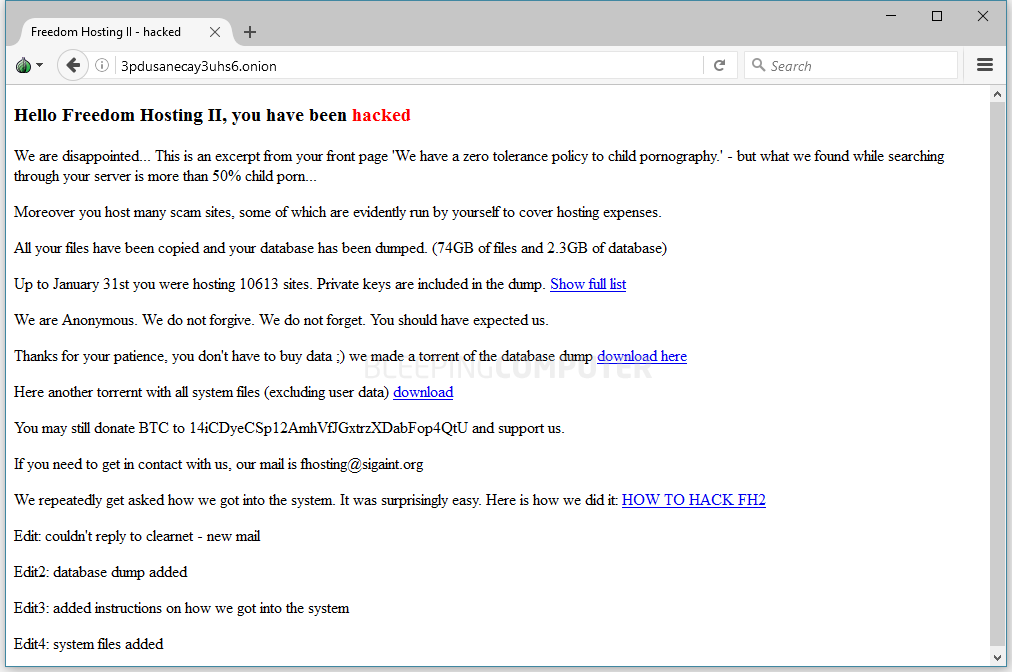
Anonymous Takes Down 10,613 Dark Web Portals (bleepingcomputer.com)
An anonymous reader writes: Anonymous hackers have breached Freedom Hosting II, a popular Dark Web hosting provider, and have taken down 10,613 .onion sites. In a message left on all Freedom Hosting II sites, the hackers claim to have found massive troves of child pornography imagery hosted on the company's servers. The hackers dumped 74GB of server files (half of which they say contained child pornography) and a database dump of 2.3GB. Security researcher Chris Monteiro has analyzed some of the dumped data. He says he discovered .onion URLs hosting botnets, fraud sites, sites peddling hacked data, weird fetish portals, more weird stuff, and child abuse websites targeting both English- and Russian-speaking buyers. Freedom Hosting II hosts about a fifth of all .onion URLs. The first Freedom Hosting service was targeted by Anonymous in 2011 and eventually shut down in 2013 after the FBI also found child pornography hosted on its sites. -
Mozilla To Drop Support For All NPAPI Plugins In Firefox 52 Except Flash (bleepingcomputer.com)
The Netscape Plugins API is "an ancient plugins infrastructure inherited from the old Netscape browser on which Mozilla built Firefox," according to Bleeping Computer. But now an anonymous reader writes: Starting March 7, when Mozilla is scheduled to release Firefox 52, all plugins built on the old NPAPI technology will stop working in Firefox, except for Flash, which Mozilla plans to support for a few more versions. This means technologies such as Java, Silverlight, and various audio and video codecs won't work on Firefox.
These plugins once helped the web move forward, but as time advanced, the Internet's standards groups developed standalone Web APIs and alternative technologies to support most of these features without the need of special plugins. The old NPAPI plugins will continue to work in the Firefox ESR (Extended Support Release) 52, but will eventually be deprecated in ESR 53. A series of hacks are available that will allow Firefox users to continue using old NPAPI plugins past Firefox 52, by switching the update channel from Firefox Stable to Firefox ESR. -
A Hacker Just Pwned Over 150,000 Printers Exposed Online (bleepingcomputer.com)
Last year an attacker forced thousands of unsecured printers to spew racist and anti-semitic messages. But this year's attack is even bigger. An anonymous reader writes: A grey-hat hacker going by the name of Stackoverflowin has pwned over 150,000 printers that have been left accessible online. For the past 24 hours, Stackoverflowin has been running an automated script that searches for open printer ports and sends a rogue print job to the target's device. The script targets IPP (Internet Printing Protocol) ports, LPD (Line Printer Daemon) ports, and port 9100 left open to external connections. From high-end multi-functional printers at corporate headquarters to lowly receipt printers in small town restaurants, all have been affected. The list includes brands such as Afico, Brother, Canon, Epson, HP, Lexmark, Konica Minolta, Oki, and Samsung.
The printed out message included recommendations for printer owners to secure their device. The hacker said that people who reached out were very nice and thanked him.
The printers apparently spew out an ASCII drawing of a robot, along with the words "stackoverflowin the hacker god has returned. your printer is part of a flaming botnet... For the love of God, please close this port." The messages sometimes also include a link to a Twitter feed named LMAOstack. -
Windows DRM-Protected Files Used To Decloak Tor Browser Users (bleepingcomputer.com)
An anonymous reader writes from a report via BleepingComputer: Downloading and trying to open Windows DRM-protected multimedia files can deanonymize Tor Browser users and reveal their real IP addresses, security researchers from Hacker House have warned. On Windows, multimedia files encoded with special Microsoft SDK will automatically open an IE window and access a URL to check the file's license. Since this request is sent outside of the Tor Browser and without user interaction, this can be used to ping law enforcement servers and detect the user's real IP address and other details. For example, law enforcement could host properly signed DRM-protected files on sites pretending to host child pornography. When a user would try to view the file, the DRM multimedia file would use Internet Explorer to ping a server belonging to the law enforcement agency. The same tactic can also be used to target ISIS militants trying to view propaganda videos, illegal drug and weapons buyers trying to view video product demos, political dissidents viewing news videos, and more. A video of the attack is available here. -
Ransomware Infects a Hotel's Key System (dailymail.co.uk)
An anonymous reader writes: A luxury hotel "paid "thousands" in Bitcoin ransom to cybercriminals who hacked into their electronic key system. The "furious" hotel manager says it's the third time their electronic system has been attacked, though one local news site reports that "on the fourth attempt the hackers had no chance because the computers had been replaced and the latest security standards integrated, and some networks had been decoupled." The 111-year-old hotel is now planning to remove all their electronic locks, and return to old-fashioned door locks with real keys. But they're going public to warn other hotels -- some of which they say have also already been hit by ransomware.
UPDATE: The hotel's managing director has clarified today that despite press reports, "We were hacked, but nobody was locked in or out" of their rooms. -
Police Department Loses Years Worth of Evidence In Ransomware Incident (bleepingcomputer.com)
"Police in Cockrell Hill, Texas admitted Wednesday in a press release that they lost years worth of evidence after the department's server was infected with ransomware," reports BleepingComputer. "Lost evidence includes all body camera video, some in-car video, some in-house surveillance video, some photographs, and all Microsoft Office documents." An anonymous reader writes: Most of the data was from solved cases, but some of the evidence was from active investigations. The infection appears to be from the Locky ransomware family, one of the most active today, and took root last December, after an employee opened a document he received via via a spam email. The police department backup system apparently kicked in right after the infection took root, and created copies of the already encrypted data. The department did not pay the $4,000 ransom demand and decided to wipe all its systems. -
Russia Arrests Top Kaspersky Lab Security Researcher On Charges of Treason (bleepingcomputer.com)
An anonymous reader quotes a report from BleepingComputer: Russian authorities arrested Ruslan Stoyanov, one of Kaspersky Lab's top-ranked security researchers, under article 275 of the Russian criminal code, which refers to treason. According to Russian newspaper Kommersant, who broke the story today, Stoyanov was arrested in December, together with the head of the Russian Secret Service (FSB) information security department Sergei Mikhailov. In a statement released today by Kaspersky Lab, the company says that Stoyanov was arrested based on activities he partook in before joining the company. Details regarding the investigation are murky, but according to the Russian newspaper who quotes anonymous sources, Stoyanov was involved in facilitating the transfer of funds from foreign companies to Mikhailov's accounts. According to Stoyanov's LinkedIn account, before serving as Head of the Computer Incidents Investigation Team at Kaspersky, he worked as Deputy Director for a company called Indrik, but also as a Major in the Ministry of Interior's Cyber Crime Unit. -
Dropbox Kept Files Around For Years Due To 'Delete' Bug (bleepingcomputer.com)
Dropbox has fixed a bug that caused old, deleted data to reappear on the site. The bug was reported by multiple support threads in the last three weeks and merged into one issue here. An anonymous Slashdot reader writes: In some of the complaints users reported seeing folders they deleted in 2009 reappear on their devices overnight. After seeing mysterious folders appear in their profile, some users thought they were hacked. Last week, a Dropbox employee provided an explanation to what happened, blaming the issue on an old bug that affected the metadata of soon-to-be-deleted folders. Instead of deleting the files, as users wanted and regardless of metadata issues, Dropbox choose to keep those files around for years, and eventually restored them due to a blunder. In its File retention Policy, Dropbox says it will keep files around a maximum 60 days after users deleted them. -
Database Attacks Spread To CouchDB, Hadoop, and ElasticSearch Servers (bleepingcomputer.com)
An anonymous reader writes: Two weeks after cybercriminal groups started to hijack and hold for ransom MongoDB servers, similar attacks are now taking place against CouchDB, Hadoop, and ElasticSearch servers. According to the latest tallies, the number of hijacked MongoDB servers is 34,000 (out of 69,000 available on Shodan), 4,681 ElasticSearch clusters (out of 33,000), 126 Hadoop datastores (out of 5,400), and 452 CouchDB databases (out of 4,600). Furthermore, the group that has hijacked the most MongoDB and ElasticSearch servers is also selling the scripts it used for the attacks.
Two security researchers are tracking the attacks on Google spreadsheets, and report that when a ransom is paid, many victims still report that their data is never restored. But the researchers also identified 124 Hadoop servers where the attacker simply replaced all the tables with a data entry named NODATA4U_SECUREYOURSHIT. "What's strange about these attacks is that the threat actor isn't asking for a ransom demand," reports Bleeping Computer. "Instead, he's just deleting data from Hadoop servers that have left their web-based admin panel open to remote connections on the Internet." -
Database Attacks Spread To CouchDB, Hadoop, and ElasticSearch Servers (bleepingcomputer.com)
An anonymous reader writes: Two weeks after cybercriminal groups started to hijack and hold for ransom MongoDB servers, similar attacks are now taking place against CouchDB, Hadoop, and ElasticSearch servers. According to the latest tallies, the number of hijacked MongoDB servers is 34,000 (out of 69,000 available on Shodan), 4,681 ElasticSearch clusters (out of 33,000), 126 Hadoop datastores (out of 5,400), and 452 CouchDB databases (out of 4,600). Furthermore, the group that has hijacked the most MongoDB and ElasticSearch servers is also selling the scripts it used for the attacks.
Two security researchers are tracking the attacks on Google spreadsheets, and report that when a ransom is paid, many victims still report that their data is never restored. But the researchers also identified 124 Hadoop servers where the attacker simply replaced all the tables with a data entry named NODATA4U_SECUREYOURSHIT. "What's strange about these attacks is that the threat actor isn't asking for a ransom demand," reports Bleeping Computer. "Instead, he's just deleting data from Hadoop servers that have left their web-based admin panel open to remote connections on the Internet." -
Oracle to Block JAR Files Signed with MD5 Starting In April (bleepingcomputer.com)
An anonymous reader quotes BleepingComputer: Oracle says that starting with April 18, 2017, Java (JRE) will treat all JAR files signed with the MD5 algorithm as unsigned, meaning they'll be considered insecure and blocked from running. Oracle originally planned MD5's deprecation for the current Critical Patch Update, released this week, which included a whopping 270 security fixes, one of the biggest security updates to date. The company decided to give developers and companies more time to prepare and delayed MD5's deprecation for the release of Oracle Java SE 8u131 and the next Java CPU, scheduled for release in April...
Oracle removed MD5 as a default code signing option from Java SE 6, released in 2006. Despite this, there will be thousands of Java apps that will never be resigned. For this, Oracle will allow system administrators to set up custom deployment rule sets and exception site lists to allow Java applets and Java Web Start applications signed with MD5 to run. Sometimes in the second half of 2017, Oracle also plans to change the minimum key length for Diffie-Hellman algorithms to 1024 bits. These updates are part of Oracle's long-standing plan for changes to the security algorithms in the Oracle Java Runtime Environment and Java SE Development Kit. -
Dutch Developer Added Backdoor To Websites He Built, Phished Over 20,000 Users (bleepingcomputer.com)
An anonymous reader quotes a report from BleepingComputer: A Dutch developer illegally accessed the accounts of over 20,000 users after he allegedly collected their login information via backdoors installed on websites he built. According to an official statement, Dutch police officials are now in the process of notifying these victims about the crook's actions. The hacker, yet to be named by Dutch authorities, was arrested on July 11, 2016, at a hotel in Zwolle, the Netherlands, and police proceeded to raid two houses the crook owned, in Leeuwarden and Sneek. According to Dutch police, the 35-years-old suspect was hired to build e-commerce sites for various companies. After doing his job, the developer also left backdoors in those websites, which he used to install various scripts that allowed him to collect information on the site's users. Police say that it's impossible to determine the full breadth of his hacking campaign, but evidence found on his laptop revealed he gained access to over 20,000 email accounts. Authorities say the hacker used his access to these accounts to read people's private email conversations, access their social media profiles, sign-up for gambling sites with the victim's credentials, and access online shopping sites to make purchases for himself using the victim's funds. -
Opera Presto Source Code Leaks Online (bleepingcomputer.com)
Catalin Cimpanu, writing for BleepingComputer: An unknown third-party has leaked the source code of the old Opera Presto browser engine on GitHub, and later on Bitbucket, two services for hosting and sharing source code online. Opera Presto is the layout engine at the heart of the old Opera browser. Opera Software used Presto between Opera 7 and Opera 14 and replaced Presto with Blink, Chrome's layout engine, in Opera 15, released in May 2013. Despite its removal from the company's main product, Opera engineers continued to use Opera Presto for the Opera Mini and Opera Mobile browsers. According to timestamps, the Opera Presto source code was first uploaded on GitHub but was taken down last Friday, on January 13, after Opera's lawyers filed a DMCA request. -
Fingerprinting Methods Identify Users Across Different Browsers On the Same PC (bleepingcomputer.com)
An anonymous reader quotes a report from BleepingComputer: A team of researchers from universities across the U.S. has identified different fingerprinting techniques that can track users when they use different browsers installed on the same machine. Named "cross-browser fingerprinting" (CBF), this practice relies on new technologies added to web browsers in recent years, some of which had been previously considered unreliable for cross-browser tracking and only used for single browser fingerprinting. These new techniques rely on making browsers carry out operations that use the underlying hardware components to process the desired data. For example, making a browser apply an image to the side of a 3D cube in WebGL provides a similar response in hardware parameters for all browsers. This is because the GPU card is the one carrying out this operation and not the browser software. According to the three-man research team led by Assistant Professor Yinzhi Cao from the Computer Science and Engineering Department at Lehigh University, the following browser features could be (ab)used for cross-browser fingerprinting operations: [Screen Resolution, Number of CPU Virtual Cores, AudioContext, List of Fonts, Line, Curve, and Anti-Aliasing, Vertex Shader, Fragment Shader, Transparency via Alpha Channel, Installed Writing Scripts (Languages), Modeling and Multiple Models, Lighting and Shadow Mapping, Camera and Clipping Planes.] Researchers used all these techniques together to test how many users they would be able to pin to the same computer. For tests, researchers used browsers such as Chrome, Firefox, Edge, IE, Opera, Safari, Maxthon, UC Browser, and Coconut. Results showed that CBF techniques were able to correctly identify 99.24% of all test users. Previous research methods achieved only a 90.84% result. -
Latest Adobe Acrobat Reader Update Silently Installs Chrome Extension (bleepingcomputer.com)
An anonymous reader writes: The latest Adobe Acrobat Reader security update (15.023.20053), besides delivering security updates, also secretly installs the Adobe Acrobat extension in the user's Chrome browser. There is no mention of this "special package" on Acrobat's changelog, and surprise-surprise, the extension comes with anonymous data collection turned on by default. Bleeping Computer reports: "This extension allows users to save any web page they're on as a PDF file and share it or download it to disk. The extension is also Windows-only, meaning Mac and Linux Chrome users will not receive it. The extension requests the following permissions: Read and change all your data on the websites you visit; Manage your downloads; Communicate with cooperating native applications. According to Adobe, extension users 'share information with Adobe about how [they] use the application. The information is anonymous and will help us improve product quality and features,' Adobe also says. 'Since no personally identifiable information is collected, the anonymous data will not be meaningful to anyone outside of Adobe.'" -
Latest Adobe Acrobat Reader Update Silently Installs Chrome Extension (bleepingcomputer.com)
An anonymous reader writes: The latest Adobe Acrobat Reader security update (15.023.20053), besides delivering security updates, also secretly installs the Adobe Acrobat extension in the user's Chrome browser. There is no mention of this "special package" on Acrobat's changelog, and surprise-surprise, the extension comes with anonymous data collection turned on by default. Bleeping Computer reports: "This extension allows users to save any web page they're on as a PDF file and share it or download it to disk. The extension is also Windows-only, meaning Mac and Linux Chrome users will not receive it. The extension requests the following permissions: Read and change all your data on the websites you visit; Manage your downloads; Communicate with cooperating native applications. According to Adobe, extension users 'share information with Adobe about how [they] use the application. The information is anonymous and will help us improve product quality and features,' Adobe also says. 'Since no personally identifiable information is collected, the anonymous data will not be meaningful to anyone outside of Adobe.'" -
Browser Autofill Profiles Can Be Abused For Phishing Attacks (bleepingcomputer.com)
An anonymous reader quotes Bleeping Computer: Browser autofill profiles are a reliable phishing vector that allow attackers to collect information from users via hidden form fields, which the browser automatically fills with preset personal information and which the user unknowingly sends to the attacker when he submits a form... Finnish web developer Viljami Kuosmanen has published a demo on GitHub... A user looking at this page will only see a Name and Email input field, along with a Submit button. Unless the user looks at the page's source code, he won't know that the form also contains six more fields named Phone, Organization, Address, Postal Code, City, and Country. If the user has an autofill profile set up in his browser, if he decides to autofill the two visible fields, the six hidden fields will be filled in as well, since they're part of the same form, even if invisible to the user's eye.
Browsers that support autofill profiles are Google Chrome, Safari, and Opera. Browsers like Edge, Vivaldi, and Firefox don't support this feature, but Mozilla is currently working on a similar feature. -
Ultrasound Tracking Could Be Used To Deanonymize Tor Users (bleepingcomputer.com)
New submitter x_t0ken_407 quotes a report from BleepingComputer: Ultrasounds emitted by ads or JavaScript code hidden on a page accessed through the Tor Browser can deanonymize Tor users by making nearby phones or computers send identity beacons back to advertisers, data which contains sensitive information that state-sponsored actors can easily obtain via a subpoena. This attack model was brought to light towards the end of 2016 by a team of six researchers, who presented their findings at the Black Hat Europe 2016 security conference in November and the 33rd Chaos Communication Congress held last week. Their research focuses on the science of ultrasound cross-device tracking (uXDT), a new technology that started being deployed in modern-day advertising platforms around 2014. uXDT relies on advertisers hiding ultrasounds in their ads. When the ad plays on a TV or radio, or some ad code runs on a mobile or computer, it emits ultrasounds that get picked up by the microphone of nearby laptops, desktops, tablets or smartphones. These second-stage devices, who silently listen in the background, will interpret these ultrasounds, which contain hidden instructions, telling them to ping back to the advertiser's server with details about that device. Advertisers use uXDT in order to link different devices to the same person and create better advertising profiles so to deliver better-targeted ads in the future. The attack that the research team put together relies on tricking a Tor user into accessing a web page that contains ads that emit ultrasounds or accessing a page that contains hidden JavaScript code that forces the browser to emit the ultrasounds via the HTML5 Audio API. -
Over 1,800 MongoDB Databases Held For Ransom By Mysterious Attacker (bleepingcomputer.com)
An anonymous reader writes: "An attacker going by the name of Harak1r1 is hijacking unprotected MongoDB databases, stealing and replacing their content, and asking for a 0.2 Bitcoin ($200) ransom to return the data," reports Bleeping Computer. According to John Matherly, Shodan founder, over 1,800 MongoDB databases have had their content replaced with a table called WARNING that contains the ransom note. Spotted by security researcher Victor Gevers, these databases are MongoDB instances that feature no administrator password and are exposed to external connections from the internet. Database owners in China have been hit, while Bleeping Computer and MacKeeper have confirmed other infections, one which hit a prominent U.S. healthcare organization and blocked access to over 200,000 user records. These attacks are somewhat similar to attacks on Redis servers in 2016, when an unknown attacker had hijacked and installed the Fairware ransomware on hundreds of Linux servers running Redis DB. The two series of attacks don't appear to be related. -
Over 1,800 MongoDB Databases Held For Ransom By Mysterious Attacker (bleepingcomputer.com)
An anonymous reader writes: "An attacker going by the name of Harak1r1 is hijacking unprotected MongoDB databases, stealing and replacing their content, and asking for a 0.2 Bitcoin ($200) ransom to return the data," reports Bleeping Computer. According to John Matherly, Shodan founder, over 1,800 MongoDB databases have had their content replaced with a table called WARNING that contains the ransom note. Spotted by security researcher Victor Gevers, these databases are MongoDB instances that feature no administrator password and are exposed to external connections from the internet. Database owners in China have been hit, while Bleeping Computer and MacKeeper have confirmed other infections, one which hit a prominent U.S. healthcare organization and blocked access to over 200,000 user records. These attacks are somewhat similar to attacks on Redis servers in 2016, when an unknown attacker had hijacked and installed the Fairware ransomware on hundreds of Linux servers running Redis DB. The two series of attacks don't appear to be related. -
Android Was 2016's Most Vulnerable Product, Oracle the (bleepingcomputer.com)
An anonymous reader writes: According to CVE Details, a website that aggregates historical data on security bugs that have received a CVE identifier, during 2016, security researchers have discovered and reported 523 security bugs in Google's Android OS, winner by far of this "award." The rest of the top 10 is made up by Debian (319 bugs), Ubuntu (278 bugs), Adobe Flash Player (266 bugs), openSUSE Leap (259 bugs), openSUSE (228 bugs), Adobe Acrobat DC (227 bugs), Adobe Acrobat Reader DC (227 bugs), Adobe Acrobat (224 bugs), and the Linux Kernel (216 bugs).
When it comes to software vendors, the company for which the largest number of new CVE numbers have been assigned was Oracle, with a whopping 798 CVEs, who edged out Google (698 bugs), Adobe (548 bugs), Microsoft (492 bugs), Novell (394), IBM (382 bugs), Cisco (353 bugs), Apple (324 bugs), Debian Project (320 bugs), and Canonical (280 bugs). -
Koolova Ransomware Decrypts For Free If You Read Two Articles About Ransomware (bleepingcomputer.com)
An anonymous reader quotes a report from BleepingComputer: We have a new in-development variant of the Koolova Ransomware that will decrypt your files for free if you educate yourself about ransomware by reading two articles. Discovered by security researcher Michael Gillespie, this in-development ransomware is not ready for prime time. In fact, I had to mess with it a bit and setup a local http server to even get it to display the ransom screen. In its functional state, Koolova will encrypt a victim's files and then display a screen similar to the Jigsaw Ransomware where the text is slowly shown on the screen. This text will tell the victim that they must read two articles before they can get a decryption key. It then tells you that if you are too lazy to read two articles before the countdown gets to zero, like Jigsaw, it will delete the encrypted files. This is not an idle threat as it actually does delete the files. The articles that Koolova wants you to read are an article from Google Security Blog called Stay safe while browsing and BleepingComputer's very own Jigsaw Ransomware Decrypted: Will delete your files until you pay the Ransom article. Once you read both articles, the Decripta i Miei File, or Decrypt My Files, button becomes available. Once you click on this button, Koolova will connect to the Command and Control server and retrieve the victim's decryption key. It will then display it in a message box labeled "Nice Jigsaw," in reference to the Jigsaw Ransomware, that displays your decryption key. A victim will then be able to take that key and enter it into the key field in order to decrypt files. -
Koolova Ransomware Decrypts For Free If You Read Two Articles About Ransomware (bleepingcomputer.com)
An anonymous reader quotes a report from BleepingComputer: We have a new in-development variant of the Koolova Ransomware that will decrypt your files for free if you educate yourself about ransomware by reading two articles. Discovered by security researcher Michael Gillespie, this in-development ransomware is not ready for prime time. In fact, I had to mess with it a bit and setup a local http server to even get it to display the ransom screen. In its functional state, Koolova will encrypt a victim's files and then display a screen similar to the Jigsaw Ransomware where the text is slowly shown on the screen. This text will tell the victim that they must read two articles before they can get a decryption key. It then tells you that if you are too lazy to read two articles before the countdown gets to zero, like Jigsaw, it will delete the encrypted files. This is not an idle threat as it actually does delete the files. The articles that Koolova wants you to read are an article from Google Security Blog called Stay safe while browsing and BleepingComputer's very own Jigsaw Ransomware Decrypted: Will delete your files until you pay the Ransom article. Once you read both articles, the Decripta i Miei File, or Decrypt My Files, button becomes available. Once you click on this button, Koolova will connect to the Command and Control server and retrieve the victim's decryption key. It will then display it in a message box labeled "Nice Jigsaw," in reference to the Jigsaw Ransomware, that displays your decryption key. A victim will then be able to take that key and enter it into the key field in order to decrypt files. -
Koolova Ransomware Decrypts For Free If You Read Two Articles About Ransomware (bleepingcomputer.com)
An anonymous reader quotes a report from BleepingComputer: We have a new in-development variant of the Koolova Ransomware that will decrypt your files for free if you educate yourself about ransomware by reading two articles. Discovered by security researcher Michael Gillespie, this in-development ransomware is not ready for prime time. In fact, I had to mess with it a bit and setup a local http server to even get it to display the ransom screen. In its functional state, Koolova will encrypt a victim's files and then display a screen similar to the Jigsaw Ransomware where the text is slowly shown on the screen. This text will tell the victim that they must read two articles before they can get a decryption key. It then tells you that if you are too lazy to read two articles before the countdown gets to zero, like Jigsaw, it will delete the encrypted files. This is not an idle threat as it actually does delete the files. The articles that Koolova wants you to read are an article from Google Security Blog called Stay safe while browsing and BleepingComputer's very own Jigsaw Ransomware Decrypted: Will delete your files until you pay the Ransom article. Once you read both articles, the Decripta i Miei File, or Decrypt My Files, button becomes available. Once you click on this button, Koolova will connect to the Command and Control server and retrieve the victim's decryption key. It will then display it in a message box labeled "Nice Jigsaw," in reference to the Jigsaw Ransomware, that displays your decryption key. A victim will then be able to take that key and enter it into the key field in order to decrypt files. -
Firefox 52 Borrows One More Privacy Feature From the Tor Browser (bleepingcomputer.com)
An anonymous reader writes: Mozilla engineers have added a mechanism to Firefox 52 that prevents websites from fingerprinting users using system fonts. The user privacy protection system was borrowed from the Tor Browser, where a similar mechanism blocks websites from identifying users based on the fonts installed on their computers, only returning a list of "default fonts" per each OS. While sabotaging system font queries won't stop user fingerprinting as a whole, this is just one of the latest privacy-related updates Mozilla has added to Firefox, taken from Tor. Back in July 2016, Mozilla engineers started the Tor Uplift project, which aims to improve Firefox's privacy features with the ones present in the Tor Browser. -
Microsoft Tests New 'Green Screen of Death' On Latest Windows 10 Builds (bleepingcomputer.com)
An anonymous reader writes: Windows 10 Insider builds will now feature Green Screen of Death (GSOD) instead of the classic Blue Screen of Death (BSOD) error page we have all become accustomed to. The change was teased on Twitter by Matthijs Hoekstra, Senior Program Manager for Windows Enterprise Developer Platform, and spotted by a user that goes by the nickname of Chris123NT. According to Hoekstra, only Windows 10 Insider builds will feature the green error screen, while stable Windows 10 versions will continue to use the classic blue-themed error page. Hoekstra didn't elaborate on the reasons behind the color change, but the color-coded error screens would allow Microsoft support staff to triage bugs and prioritize customers.