Slashdot Mirror
Domain: bls.gov
Stories and comments across the archive that link to bls.gov.
Comments · 1,395
-
Re:Why?
Isn't there? When I had young children I heard about that constantly; men can make a very valuable contribution to the traditional women's jobs.
Child day care services jobs in the US are 94% female.
Nursing care is 84.9% female.
Health care average is 78.5% female.
http://www.bls.gov/cps/cpsaat1...Incidentally, HC alone is some 20.077.000 jobs.
Manufacturing (which is male dominated) is 15.338.000 jobs, while information industry (also male dominated) which includes everything from news and libraries to software and film industry is 2.988.000 jobs.
BTW, women also dominate the veterinary services (80.7%) - i.e. care for animals.It's almost as if women gravitate towards (and clearly excel at) jobs which allow them to care for others.
Even when those they care for may bite, hiss and claw at them.
Yeah... women also dominate beauty (91.9%) and nail salon (73.2%) services too. -
Can't outsource or robotize human bodies.
You can't outsource or replace with robots services catering to humans and their bodies.
Nor can you outsource or robotize salesmanship, leadership and all the other -ships.
And there will probably always be legal reasons why legal services and public administration can't be out given out to foreign employees or machines.But speaking of services for humans...
Education and health services are about as female dominated as manufacturing tends to be male dominated.
Actually, slightly more... 74.65% for E&H vs 71.9% for manufacturing.
But much more important is that there are more than twice as many jobs in E&H services (33,678 thousands ) than in manufacturing (15,338 thousands).
Education and health services is actually the BIGGEST industry in the US, making up more than a fifth (but not quite a quarter - 22.62%) of ALL JOBS in the USA.
http://www.bls.gov/cps/cpsaat1...You can't outsource child care or health care cause you can't outsource people. And robots are nowhere near to be able to do that job.
Making those E&H jobs safe and secure.
Amazingly, that category has the most humans who, thorough a quirk of biology, tend to have the need for a safe and stable environment in order to gestate, give birth to and raise the next generation of humans.
Whodathunkit, right? -
Re:You do, obviously
You just said you don't trust the evil right-wing blogs.
It's got very little to do with blogs being evil or right-wing, and far more to do with spouting unsourced assertions. And yes, evil left-wing blogs do this too.
But when Bernie does it his numbers "have merit" and are "mostly true." When Trump does it he's "misleading" and "mostly false." Fuck you politifact.
The difference is that Sanders qualified his statements to refer to a more specific demographic:
"If you look at Latino kids between 17 and 20 who graduated high school, 36 percent of them are unemployed or underemployed. African-American kids are unemployed or underemployed to the tune of 51 percent."
(emphasis mine). Trump didn't; his claim was far more sweeping:
"If you look at what’s going on in this country, African-American youth is an example: 59 percent unemployment rate; 59 percent," Trump said.
Politifact asked both candidates to clarify; Sanders pointed them at research supporting his more-specific claim, while Trump did not respond. They speculate that Trump perhaps meant everyone who wasn't working, including students and others who weren't even looking for work, which is not the official definition of "unemployment rate". There's a reason the BLS lists Employed and Unemployed rates separately; they measure different things.
Surely you can see the difference between those two claims? Trump's broader claim, using the normally-accepted definition of "unemployment", does not come close to the current figures. Sanders' more-specific claim was supported by research. If Trump wants his assertions to be accepted, he either needs to be more specific, or to back them up with sources.
More importantly, Politifact a) examined the actual words said, with some context, b) provided sources for their figures, and c) fully explained their reasoning. That's all we can ask a fact-checking site to do, as it allows us to see why they made their judgement. You're free to assume a different interpretation of the words if you like, and also to link to other fact-checking sites that hopefully provide equally lucid reasoning. But claiming that "they said the same thing and Politifact supported one and not the other" is clearly not the case.
Also, I did not claim that the left doesn't tear down sources (they certainly do), I said "they rarely work this hard to tear down every reputable source". Perhaps we have different definitions of "reputable"? My idea of a reputable source is one that provides well-researched sources (peer-reviewed where possible) for their claims, and makes it clear when they are indulging in speculation. There are plenty of blogs on both sides that fail at this, but fact-checking sites generally try harder. I'm sure Breitbart comes out with well-researched pieces too, but there's a lot of articles full of unsourced assertions mixed in with them, which does not do their reputation much good. One can hope that their higher-quality points are picked up and repeated by more reputable sites, where they may get a broader audience.
My point was less about political mud-slinging, since that's a god-awful mess on both sides that I have little interest in (not being American), but more about the common theme of science denial that a fairly large proportion of conservatives seem fond of (in my country too). That this is being extended to fact-checking sites worries me, particularly the assumption that any fact-checking site would automatically be assumed by the right to be biased towards the left. Is objective truth really considered so hard to pin down, now? Are there no well-sourced fact-checking sites that the political right feels comfortable with?
-
Re:You do, obviously
You just said you don't trust the evil right-wing blogs.
It's got very little to do with blogs being evil or right-wing, and far more to do with spouting unsourced assertions. And yes, evil left-wing blogs do this too.
But when Bernie does it his numbers "have merit" and are "mostly true." When Trump does it he's "misleading" and "mostly false." Fuck you politifact.
The difference is that Sanders qualified his statements to refer to a more specific demographic:
"If you look at Latino kids between 17 and 20 who graduated high school, 36 percent of them are unemployed or underemployed. African-American kids are unemployed or underemployed to the tune of 51 percent."
(emphasis mine). Trump didn't; his claim was far more sweeping:
"If you look at what’s going on in this country, African-American youth is an example: 59 percent unemployment rate; 59 percent," Trump said.
Politifact asked both candidates to clarify; Sanders pointed them at research supporting his more-specific claim, while Trump did not respond. They speculate that Trump perhaps meant everyone who wasn't working, including students and others who weren't even looking for work, which is not the official definition of "unemployment rate". There's a reason the BLS lists Employed and Unemployed rates separately; they measure different things.
Surely you can see the difference between those two claims? Trump's broader claim, using the normally-accepted definition of "unemployment", does not come close to the current figures. Sanders' more-specific claim was supported by research. If Trump wants his assertions to be accepted, he either needs to be more specific, or to back them up with sources.
More importantly, Politifact a) examined the actual words said, with some context, b) provided sources for their figures, and c) fully explained their reasoning. That's all we can ask a fact-checking site to do, as it allows us to see why they made their judgement. You're free to assume a different interpretation of the words if you like, and also to link to other fact-checking sites that hopefully provide equally lucid reasoning. But claiming that "they said the same thing and Politifact supported one and not the other" is clearly not the case.
Also, I did not claim that the left doesn't tear down sources (they certainly do), I said "they rarely work this hard to tear down every reputable source". Perhaps we have different definitions of "reputable"? My idea of a reputable source is one that provides well-researched sources (peer-reviewed where possible) for their claims, and makes it clear when they are indulging in speculation. There are plenty of blogs on both sides that fail at this, but fact-checking sites generally try harder. I'm sure Breitbart comes out with well-researched pieces too, but there's a lot of articles full of unsourced assertions mixed in with them, which does not do their reputation much good. One can hope that their higher-quality points are picked up and repeated by more reputable sites, where they may get a broader audience.
My point was less about political mud-slinging, since that's a god-awful mess on both sides that I have little interest in (not being American), but more about the common theme of science denial that a fairly large proportion of conservatives seem fond of (in my country too). That this is being extended to fact-checking sites worries me, particularly the assumption that any fact-checking site would automatically be assumed by the right to be biased towards the left. Is objective truth really considered so hard to pin down, now? Are there no well-sourced fact-checking sites that the political right feels comfortable with?
-
UBI is a fantasy
UBI is a solution that won't work, for a problem that doesn't exist.
This story that "all the jobs are going away" is false. Just take a quick look at the Employment Rate (not the Unemployment Rate) over at the BLS and you can see that a great percentage of the population is employed today (59.8%) than at any time before November of 1978. If UBI was the answer it would have come about in the previous decades when fewer people were employed, not today. And certainly not during the 2008 bubble when this whole UBI theory started gaining traction.
But even if it were the case that jobs are going away, UBI still wouldn't be the answer. The idea that you can just give cash handouts to the whole population is silly. The GDP per capita in the US is about $50k. If you going to give everyone enough income, about $12k according the Dept. Health, that means a tax rate of 24% of GDP to pay for bare minimum of UBI. And that is on top of the 27% that the government currently taxes, which already doesn't bring in enough income to balance the budget. To balance the budget you would need to bring the tax rate up to the expenditure rate which is currently 41% of GDP and add UBI's 24% on top of that. By the time it's all said and done the government would account for almost 2/3rds of the entire economy; for a minimum UBI. If you want a UBI that allows for a little more comfort, say $20k, then the government would now account for 4/5ths of the entire economy. Who the hell is going to invest in an economy like that?
Never mind what a disaster it would be for the labour force. We know that the utility of income is marginal. A $0.50 pay raise means a lot more to someone making $10/h than it does to someone making $50/h. People today work for $10/h because that is a huge step up from nothing. But if everyone is getting a $20k/year free handout who is going to work for $10/h? $10/h is only $20k/year, that's a paltry marginal increase for having to work an extra 40hrs a week. So in order to attract workers, pay will have to rise, which means price of good and services will rise, which means the UBI will have to rise. You think big business is shipping jobs to China and India now? Just wait until the price of labour in the new UBI economy stabilizes.
UBI is a classic example of something that sounds like a great idea in theory, but in practice would be an unmitigated disaster.
-
Re: A UBI can actually foster more jobs
Bureau of Labor Statistics. http://www.bls.gov/bdm/entrepr...
It's been the largest year over year increase because the recession produced the lowest nadir in entrepreneurship since the Great Depression. We're only just now getting back to 2005 levels, and per-capita we're still not anywhere close to normal historical levels. On top of that, small business employment among these smaller firms is low because business expansion is inherently risky; many of these businesses are simply self-employed persons, which is why the employment numbers for small firms is extremely low vis a vis historical trend. -
Re:Overstepping Constitutional authority
By what measure have the last 8 years sucked? Just curious, but please be objective and stick to the facts.
Stock market did well: http://www.macrotrends.net/135...
GDP slowly rising: http://www.tradingeconomics.co...
Unemployment steadily decreasing http://data.bls.gov/timeseries...
Steadily decreasing gas prices: https://blog.gasbuddy.com/Reta...
Believe it or not, decreasing crime rate: http://www.nationalreview.com/...
No major new gun control laws or other major trampling of the constitution
Many additional safeguards on disadvantaged segments of the population
And finally a reasonable record of kept campaign promises: http://www.politifact.com/trut...
To be sure not a perfect record; for example:
Middle East and Syria in particular - probably would have happened regardless
Relations with Russia and China - hard to say what could have been done differently
"Affordable" Health Care Act - although we couldn't live with what we had we should have done better. At least children are covered now...
Education - we owe our children and future more
Care for the environment - oils spills and global warming
Race relations and policing - Black Lives Matter
If you want to pin a failure on Barack Obama, blame him for not finding a way to reach out to congress - let's face it that situation is f'd up. Barack can't get an A on his report card because he failed that test. While maybe the most powerful person around, the president of the US certainly is not omnipotent. I challenge anybody to say they could have really done better. -
Re:"Always remain unemployed"
"Starting your own business" only works if there's a market. To be more complete (but still horribly undetailed to the point of inaccuracy): there's a total amount of income each year and, thus, a total amount of spendable money in one year's time frame, and what can be sold is what can be produced for less than that amount of money. Products are made by labor time, labor time incurs wages, wages are paid out of revenues, revenues come from consumer purchasing, purchasing comes from income.
A new business either draws purchasing away from an old business or it competes for new purchasing available as population or productivity (amount of stuff made per labor-hour, thus decrease in cost and thus price relative to number of spendable consumer dollars) increase.
More to the point: unemployment has decreased during 2016. The labor force participation rate has increased by 0.5% since September 2015, and the number of employed Americans has increased by 3 million while the number of unemployed Americans has increased by 0.014 million (we didn't add as many jobs as we added people in the workforce, but we added more jobs than the proportional employment rate, thus the unemployment rate went down, the number of employed went up, and the number of unemployed also went up).
Per the past three months, the number of unemployed increased by 0.169 million since July 2016, while the number of employed increased by 0.469.
[...]some 330,000 in all at major tech companies.[...]
[...]"The layoffs I predicted have been occurring." And worse, he says, these laid-off workers are never again going to find tech jobs: "They will always remain unemployed," at least in tech, he said. "Their skills will be obsolete."[...]
I don't see 330,000 newly forever-unemployed IT workers. That would be literally 8.25% of the computer and mathematics workforce. We'd be talking about 13% unemployment today.
Unfortunately, I don't have occupational employment statistics newer than May, 2015. At that time, employment in computer and mathematical occupations number 4,005,250. Some longer-term analysis includes charts that show only normal fluctuation, although computers and mathematical has a long-running up-trend and a current down-trend not substantially different from 2008-2009.
-
Re:"Always remain unemployed"
"Starting your own business" only works if there's a market. To be more complete (but still horribly undetailed to the point of inaccuracy): there's a total amount of income each year and, thus, a total amount of spendable money in one year's time frame, and what can be sold is what can be produced for less than that amount of money. Products are made by labor time, labor time incurs wages, wages are paid out of revenues, revenues come from consumer purchasing, purchasing comes from income.
A new business either draws purchasing away from an old business or it competes for new purchasing available as population or productivity (amount of stuff made per labor-hour, thus decrease in cost and thus price relative to number of spendable consumer dollars) increase.
More to the point: unemployment has decreased during 2016. The labor force participation rate has increased by 0.5% since September 2015, and the number of employed Americans has increased by 3 million while the number of unemployed Americans has increased by 0.014 million (we didn't add as many jobs as we added people in the workforce, but we added more jobs than the proportional employment rate, thus the unemployment rate went down, the number of employed went up, and the number of unemployed also went up).
Per the past three months, the number of unemployed increased by 0.169 million since July 2016, while the number of employed increased by 0.469.
[...]some 330,000 in all at major tech companies.[...]
[...]"The layoffs I predicted have been occurring." And worse, he says, these laid-off workers are never again going to find tech jobs: "They will always remain unemployed," at least in tech, he said. "Their skills will be obsolete."[...]
I don't see 330,000 newly forever-unemployed IT workers. That would be literally 8.25% of the computer and mathematics workforce. We'd be talking about 13% unemployment today.
Unfortunately, I don't have occupational employment statistics newer than May, 2015. At that time, employment in computer and mathematical occupations number 4,005,250. Some longer-term analysis includes charts that show only normal fluctuation, although computers and mathematical has a long-running up-trend and a current down-trend not substantially different from 2008-2009.
-
Re:Fear is a good thing for business
Why move goalposts when inflation does it for you? A millionaire in 1950 would be worth about $10m today, and one in 1913 would be worth about $24m. In other words, being a millionaire 103 years ago meant you were rich enough to live very comfortably without ever having to work a day in your life, since you had the equivalent of $300k/yr for 80 years in modern dollars. Now it just means you can maybe afford to retire and live like the median household, at $50k for 20 years.
-
Re:It's okay, inflation is only 1.6%
The TV adjustment seems pretty reasonable to me (if we're talking year on year).
I suspect towards the end of CRTs availability, sticking with 27" CRTs would have resulted in larger negative inflation, not less. In reality, nobody was replacing a 27" CRT with a 42" Plasma at that price increase within a year.
The reality is that TVs have overall been getting less expensive or holding fairly steady.
1996, TV is 490 2011 dollars, or 340 nominal cost, in 2011 it's 319.
in 77 a TV a discontinued 25" TV was nominally $530.
TVs have been roughly the same nominal cost, or slightly negative for much of the time since their inception (not as extreme as that -7% from the BLS page, but it's not fair to pretend they went up 400% as you imply either.
that 27" CRT was replaced either for a very cheap CRT, or a roughly the same nominal price 32 inch flat-screen.
sources:
https://theawl.com/how-much-mo...http://data.bls.gov/cgi-bin/cp...
Your point stands to a point, but it's not quite as extreme as you imply it.
-
Re:Strikes
That attitude is why union membership is sinking. Take away the public sector and unions have become pretty much a non-factor, mostly because they keep screwing the people who pay their wages.
-
Re:Was logging in to post exactly this
WRONG!
Average GROSS wage in the U.S. is only $55,086
(pre-tax, pre-deductions.
California is $61,386 for ALL employees (of course overloaded for the megapay CEO's) -
Machinists
While that's true, there are only a few prototypes made for each product. What of all the machinists who used to crank out production parts? Those jobs are gone forever...
News of the death of machinists is greatly exaggerated. Even in high wage areas. According to BLS statistics there are approximately 400,000 machinists in the US. While that is a far cry on a percentage basis from days of yore, there still is steady demand and it isn't going to go away any time soon. Manufacturing has become a little like farming. The percent of the workforce directly involved has decreased as productivity has increased but the same jobs still exist and there still is substantial employment opportunity.
Manufacturing is almost all CNC now, and consumer products are either non-repairable or last longer than they used to.
It is untrue that manufacturing is all CNC. It's not even close to all CNC. I am in metal fabrication plants on a routine basis and there are plenty of plants with numerous machines without any computer controls at all. People who think everything in manufacturing is computerized are almost invariably people who don't work in manufacturing. CNC is widespread and important but it has not and will not eliminate all non-CNC manufacturing any time soon. I've worked a plant with 50 turret lathes that date from around WWII - still going strong today. No CNC machine is going to drive them out any time soon for economic reasons if nothing else because CNC is expensive.
Anecdotally, my father in law has an entire plant filled with machines that require skilled operators. Most of the machines he owns are older than most of the people reading this, myself included. He has CNC machines too but they aren't universal like you are implying. In my plant roughly half our presses are computer controlled and the other half aren't. We aren't going to replace the non-computerized presses either - they are built like tanks, are fully depreciated, easy to repair, and work great for numerous applications. It would be economically stupid to replace them.
Even in places where there are CNC machines you still need a skilled machinist in most cases. CNC machines are not plug and play and you need people who understand fabrication to get the most out of them, set them up, diagnose problems, etc.
-
Machinists
While that's true, there are only a few prototypes made for each product. What of all the machinists who used to crank out production parts? Those jobs are gone forever...
News of the death of machinists is greatly exaggerated. Even in high wage areas. According to BLS statistics there are approximately 400,000 machinists in the US. While that is a far cry on a percentage basis from days of yore, there still is steady demand and it isn't going to go away any time soon. Manufacturing has become a little like farming. The percent of the workforce directly involved has decreased as productivity has increased but the same jobs still exist and there still is substantial employment opportunity.
Manufacturing is almost all CNC now, and consumer products are either non-repairable or last longer than they used to.
It is untrue that manufacturing is all CNC. It's not even close to all CNC. I am in metal fabrication plants on a routine basis and there are plenty of plants with numerous machines without any computer controls at all. People who think everything in manufacturing is computerized are almost invariably people who don't work in manufacturing. CNC is widespread and important but it has not and will not eliminate all non-CNC manufacturing any time soon. I've worked a plant with 50 turret lathes that date from around WWII - still going strong today. No CNC machine is going to drive them out any time soon for economic reasons if nothing else because CNC is expensive.
Anecdotally, my father in law has an entire plant filled with machines that require skilled operators. Most of the machines he owns are older than most of the people reading this, myself included. He has CNC machines too but they aren't universal like you are implying. In my plant roughly half our presses are computer controlled and the other half aren't. We aren't going to replace the non-computerized presses either - they are built like tanks, are fully depreciated, easy to repair, and work great for numerous applications. It would be economically stupid to replace them.
Even in places where there are CNC machines you still need a skilled machinist in most cases. CNC machines are not plug and play and you need people who understand fabrication to get the most out of them, set them up, diagnose problems, etc.
-
Re:Won't work in America
I heartily agree with resurrecting the CCC and/or WPA. Unfortunately I see two major political obstacles to their return. The first would come from the private construction sector who would argue the government would effectively underbid them on all public construction projects and thereby force them out of that market. The second would be the http://www.bls.gov/web/empsit/cpsee_e16.htm). I could easily see someone like Ta-Nehisi Coates claiming such programs were inherently racist, due to the kind of work being done.
-
Re:Good
Let's look at your claim that the inflation rate has been near zero for three decades:
http://www.bls.gov/data/inflat... [bls.gov]
$1000 in 1986 is the equivalent of $2195.68 today
That supposed "near zero" inflation rate has reduced the value of $1 to 45 cents
Compound interest. Either you understand it or you don't. You can argue about whether 2.66% is "near zero", but hyperinflation it isn't.
-
Re:Good
Let's look at your claim that the inflation rate has been near zero for three decades:
http://www.bls.gov/data/inflat...
$1000 in 1986 is the equivalent of $2195.68 today
That supposed "near zero" inflation rate has reduced the value of $1 to 45 cents
As for the Federal Reserve not printing money, here is how Alan Greenspan described the process of the Federal Reserve buying over $2 TRILLION in US Government securities:
http://neweconomicperspectives...
“Now, you might ask the question, well, the Fed is going out and buying 2 trillion dollars of securities – how did we pay for that? And the answer is that we paid for those securities by crediting the bank accounts of the people who sold them to us, and those accounts, at the banks, showed up as reserves that the banks would hold with the Fed. So the Fed is a bank for the banks. Banks can hold deposit accounts with the Fed, essentially, and those are called reserve accounts. And so as the purchases of securities occurred, the way we paid for them was basically by increasing the amount of reserves that banks had in their accounts with the Fed."
They "credited the bank accounts of the people who sold them". That is creating money out of thin air.
-
Re:More proof
This US government report [census.gov] says the same thing.
Does it? I've looked into it and what I saw on page 16 (figure 9) was that 70.8% of STEM workers are white and not hispanic or latino. On page 19 there is figure 19, which shows that 70.7% of Science and engineering graduates are white and not hispanic or latino. So the other races are represented just as fairly in the workforce as they are in the graduation stats.
The only difference I can see in the stats is that 77.2% of females with science and education degrees are employed, while for men the number is 87.7% (figure 12 on page 20). Still, in other fields there is a difference too, just look at [2], it says that in july 2016, 81% of the males that were 20 or older were employed in (civilian) jobs, while it was only 71% for the females (note that I had to calculate the percentages myself as the link only shows absolute numbers).
The most probable cause for this difference is the women staying at home to take care of the children, out of free choice, and not some discrimination by the employers. Also maybe because they didnt find proper child care and getting children were more important for them and their spouses than the woman having a job as well. But, it is present in all fields and not just STEM.
So I don't think this reports says what you claim it says. On the contrary, the report shows that employers are fair and dont advantage whites over minorities, they just take what's graduated.
-
Re:Basic Math time
a 5% unemployment rate for 2016
Sure that number has its uses, but it is pretty fake. Once someone quits looking for a job, they are no longer "unemployed". When someone retires they are not "unemployed". Total employment in the US is just shy of 60%. Notice that it dropped almost 5% after 2008 and has not recovered very much of that. The great recession is still going on.
-
Re:Oh boy
The unemployment rate is low only because so many people have dropped out of the labor force entirely. The labor force participation rates among 16-54 year olds have all fallen; the only group that labor force participation has risen in is among the 54+, indicative of an inability to retire. Post-recession economic growth has been poor as well compared to other recessions. And Obama's massive crony capitalist handouts have utterly failed to live up to the economic promises he made for them while making the fiscal situation even worse.
So, if the promise is that Clinton will continue Obama's record on the economy, I'm not interested; as far as I'm concerned, even a bumbling idiot like Trump doing nothing for four years is likely better than that.
Utter bullshit. BLS statistics show that since 2010 employment has increased by 14M jobs. Meanwhile, the drop in participation rate is about 2%, or 3M people. So your stats are only off by a factor of 5. Thats actually pretty good for a Repulican liar.
None of you want to admit that the economy always improves under Dems, and gets robbed blind under Repubs.
-
Re:EPA MPG != CAGE MPG
I was curious, and looked it up on the Bureau of Labor and Statistics website. If I'm reading that right, Civilian Labor Force, Employed, Percent of Population peaked in 2000 at 64.4%, which is 5% higher than 2000 levels.
Looking at the wikipedia definitions (especially that third image), I think the interesting metric is the employment-to-population ratio (i.e. all employed people over all people, eligible to work or not). That default view does show a 5% drop since about mid-2008 that never recovered. It was previously around 60% in the early eighties (if you adjust the graph to start from the earliest available year, 1948).
Also interesting is part time workers as a percentage of all workers, which was a sharp (3%) increase in 2009 and slowly dropping off at 0.2% per year (eyeballing it).
Other interesting stuff can be found in this PDF of charts. For example, on page 17 it shows that most of the layoffs in 2008/2009 were permanent, not temporary.
Thanks for leading me to look at this stuff; it's rather interesting.
-
Re:EPA MPG != CAGE MPG
I was curious, and looked it up on the Bureau of Labor and Statistics website. If I'm reading that right, Civilian Labor Force, Employed, Percent of Population peaked in 2000 at 64.4%, which is 5% higher than 2000 levels.
Looking at the wikipedia definitions (especially that third image), I think the interesting metric is the employment-to-population ratio (i.e. all employed people over all people, eligible to work or not). That default view does show a 5% drop since about mid-2008 that never recovered. It was previously around 60% in the early eighties (if you adjust the graph to start from the earliest available year, 1948).
Also interesting is part time workers as a percentage of all workers, which was a sharp (3%) increase in 2009 and slowly dropping off at 0.2% per year (eyeballing it).
Other interesting stuff can be found in this PDF of charts. For example, on page 17 it shows that most of the layoffs in 2008/2009 were permanent, not temporary.
Thanks for leading me to look at this stuff; it's rather interesting.
-
Re:EPA MPG != CAGE MPG
I was curious, and looked it up on the Bureau of Labor and Statistics website. If I'm reading that right, Civilian Labor Force, Employed, Percent of Population peaked in 2000 at 64.4%, which is 5% higher than 2000 levels.
Looking at the wikipedia definitions (especially that third image), I think the interesting metric is the employment-to-population ratio (i.e. all employed people over all people, eligible to work or not). That default view does show a 5% drop since about mid-2008 that never recovered. It was previously around 60% in the early eighties (if you adjust the graph to start from the earliest available year, 1948).
Also interesting is part time workers as a percentage of all workers, which was a sharp (3%) increase in 2009 and slowly dropping off at 0.2% per year (eyeballing it).
Other interesting stuff can be found in this PDF of charts. For example, on page 17 it shows that most of the layoffs in 2008/2009 were permanent, not temporary.
Thanks for leading me to look at this stuff; it's rather interesting.
-
Re:EPA MPG != CAGE MPG
I was curious, and looked it up on the Bureau of Labor and Statistics website. If I'm reading that right, Civilian Labor Force, Employed, Percent of Population peaked in 2000 at 64.4%, which is 5% higher than 2000 levels.
Looking at the wikipedia definitions (especially that third image), I think the interesting metric is the employment-to-population ratio (i.e. all employed people over all people, eligible to work or not). That default view does show a 5% drop since about mid-2008 that never recovered. It was previously around 60% in the early eighties (if you adjust the graph to start from the earliest available year, 1948).
Also interesting is part time workers as a percentage of all workers, which was a sharp (3%) increase in 2009 and slowly dropping off at 0.2% per year (eyeballing it).
Other interesting stuff can be found in this PDF of charts. For example, on page 17 it shows that most of the layoffs in 2008/2009 were permanent, not temporary.
Thanks for leading me to look at this stuff; it's rather interesting.
-
Re:I'm totally shocked...
Better? Nope.
Lots of inflation of consumer prices...
13.5% increase in incomes vs. 15+% increase in consumer prices over 10 years
But hey, what about unemployment?
Still over 10%...
Why is the US' rate under 6%?But yeah, Europe is doing great. Really. The acid truth of the numbers and the failure of the blue state model is antithetical to you, but true.
-
Re:corporate fanboyism
If you're going to draw comparisons between different decades, you need a standard measurement. Keep the way inflation was calculated, and you'd find the GDP would be about 10% lower - because that's the impact of inflation on it. And by that measure - we're still in the recession that started in 2007.
Even if, as I point out, the economy changes and new productivity categories are added that GDP doesn't take into account? What you're proposing is the equivalent of only measuring what was the whole economy in the 1980's but is only part of the economy in 2010 and then saying "look, that hasn't grown!". Well, no, it hasn't. Because we've added more stuff that isn't categorized by the old measurement into the economy and the old stuff became commodities after everyone has one.
Let's do analogy time. In 2003, I come up with a way to measure the revenue of a company. Let's call that company Apple Computers. Let's pretend we don't have full shareholder reporting and are kinda blind (like we are with the US economy). But I know that 99% of the revenue collected by Apple Computers is based on number of Macintosh computers sold. So I define my "iGDP" as "lets measure number of Macs sold every year" as an indirect way of defining "productivity" of Apple Computers.
In 2013, if I used the same method of measuring "iGDP", I'd say "hey! Apple Computers (now Apple Inc) has only grown by ~50%" since number of Macs sold every year has only gone up 50%. That's essentially what you're proposing. "Keeping the measurement method the same".
The flaw with the above approach, of course, is that since 2003, Apple Computers has become Apple Inc and has added whole new product lines that my original "iGDP" measurement didn't take into account. In 2003, measuring "iGDP" by counting number of Macs sold was accurate enough. In 2013, it's wildly off. Because in reality, Apple Inc hasn't grown 50%, it's grown roughly 2000%. If I made the statement "Apple Inc has had the best year ever, growth has been 2000%" it'd be way more accurate than "Apple Computer has had the best year ever, growth has been 50%". Yet you're proposing the later, not the former.
"GDP" is just a best-effort approximation. What it represents is the whole productive power of the U.S. economy. That "best-effort" changes as the economy changes. But stating that the economy has grown and grown faster than past decades is not inaccurate.
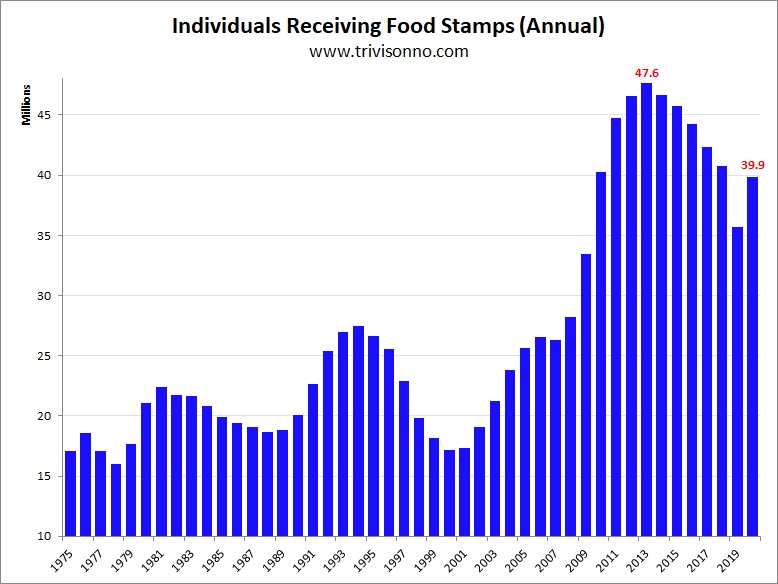
Lowest labor force participation rate in 2 generations [bls.gov]. Record levels of food stamps use [trivisonno.com]. Record numbers on welfare [cnsnews.com]. Stagnant wages [pewresearch.org]. A Federal Government adding $4 billion in debt every day [treasurydirect.gov]. It's not all roses now, not at all...
Unemployment rate 1980-2016 is lower, Federal revenue is much higher.
I can hand-pick stats that favors my narrative as well. Especially since 2 of your stats naturally goes up as the population increases.
About the only thing I think you and I can agree on is that stagnant wages are a problem. Also, to note, labor force participation rate from 1980-2016 changed from ~64% to ~63%. Hardly the insane apocalypse you seem to imply.
-
Re:corporate fanboyism
How do you determine what "real" GDP growth is? Again, you seem to imply that how it was done in the 1970's and 1980's were the "correct way".
If you're going to draw comparisons between different decades, you need a standard measurement. Keep the way inflation was calculated, and you'd find the GDP would be about 10% lower - because that's the impact of inflation on it. And by that measure - we're still in the recession that started in 2007.
All I hear is that people "feel" like they aren't as well off compared to some rose-colored memory of decades past. That "feeling", of course, is greatly affected by what kind of narrative their favorite media source paints.
Lowest labor force participation rate in 2 generations. Record levels of food stamps use. Record numbers on welfare. Stagnant wages. A Federal Government adding $4 billion in debt every day. It's not all roses now, not at all...
-
Re: I Know Where The 22,000 Went!
It's 66% of the population age 16 and above, with some minor exceptions.
From the Bureau of Labor Statistics glossary:
Labor force participation rate
The labor force as a percent of the civilian noninstitutional population.Civilian noninstitutional population (Current Population Survey)
Included are persons 16 years of age and older residing in the 50 states and the District of Columbia who do not live in institutions (for example, correctional facilities, long-term care hospitals, and nursing homes) and who are not on active duty in the Armed Forces.It includes everyone who has retired and who lives on their own, and yes, the baby boomers have had a large effect on it. Ben Casselman at FiveThirtyEight discussed this a couple of years ago, noting that the LFPR began declining in the early 2000s. Short version: about half, maybe a little less, of the decline can be attributed to Baby Boomer retirement. Other factors, including more people in school and some people not returning to the workforce, account for the rest.
-
Re:Cars Are Not More Expensive--BS!!!
-
Cause and effect, not virtue and vice
It's not about "virtue" and "vice". It's cause and effect. Unless of course you want to define "vice" as "error" and "virtue" as "stuff that works". That's not too far off - when many people think of vice and virtue, they think of things the Old Testament/Torah/Koran says to do and not do. That text uses uses the Greek words "hamartema" and "sophia". What in English we call "sin" is hamartema, which literally means "to miss" (the target or goal). "Virtue" in the Greek is sophia, which means wisdom or knowledge. One can miss their target, or one can have knowledge of what works well.
As a very simple example, sending out resumes to a dozen of relevant companies each week, then following up, works a lot better than sending one, waiting three weeks to hear hear back, sending one more, etc. One approach is effective, it is wise. The other approach is foolish if you're unemployed, it misses the mark.
> But if the rules of the game require there to be a loser, that's irrational - if there's less jobs than applicants then someone is going to be left
There are 5.8 million job opening in the US right now, and less than 2 million people who have been unemployed for a long time:
http://www.bls.gov/news.releas...
http://www.bls.gov/news.releas...There are two million who have been unemployed for a short time. Simple arithmetic shows there are enough jobs not only for the four million unemployed, but there would still be 1.8 million jobs leftover. Therefore your proposition "if there's less jobs than applicants" is false. There are almost 6 million open jobs and 4 million unemployed people.
-
Cause and effect, not virtue and vice
It's not about "virtue" and "vice". It's cause and effect. Unless of course you want to define "vice" as "error" and "virtue" as "stuff that works". That's not too far off - when many people think of vice and virtue, they think of things the Old Testament/Torah/Koran says to do and not do. That text uses uses the Greek words "hamartema" and "sophia". What in English we call "sin" is hamartema, which literally means "to miss" (the target or goal). "Virtue" in the Greek is sophia, which means wisdom or knowledge. One can miss their target, or one can have knowledge of what works well.
As a very simple example, sending out resumes to a dozen of relevant companies each week, then following up, works a lot better than sending one, waiting three weeks to hear hear back, sending one more, etc. One approach is effective, it is wise. The other approach is foolish if you're unemployed, it misses the mark.
> But if the rules of the game require there to be a loser, that's irrational - if there's less jobs than applicants then someone is going to be left
There are 5.8 million job opening in the US right now, and less than 2 million people who have been unemployed for a long time:
http://www.bls.gov/news.releas...
http://www.bls.gov/news.releas...There are two million who have been unemployed for a short time. Simple arithmetic shows there are enough jobs not only for the four million unemployed, but there would still be 1.8 million jobs leftover. Therefore your proposition "if there's less jobs than applicants" is false. There are almost 6 million open jobs and 4 million unemployed people.
-
Re:This sort of thing is why people like Trump
Not even the fact he considers failure (i.e bankruptcy) his first option rather than the last will dissuade those who are pissed a black guy is in office, the stock market is at its highest levels ever, all the jobs lost by the last president have been recovered and then some and gas prices are low. All they want to hear are platitudes and bloviating from a white guy who is on his third marriage.
Smooth Wombat,This was fine until the last paragraph. Obama is only half black and I'm sure many are bothered by the race of our president, but it's only speculative. If it was John Kerry doing and saying the same things, I doubt the approval rating would change at a noticeable amount. Very recently I've seen a few people touting how great everything is now thanks to Obama, but I would disagree. There are countless aspects to consider and books could be written about these topics. How many trillions of debt have we piled on under Obama that we will never recover from? All of that debt is propping up our image on the short term, but hosing us and our children in the long term. Given how careless I've seen many people are with money, I'm not surprised we elect fiscal irresponsible people to represent us. Just tax the rich more? In 2012?, you could tax the rich at 100% and it wouldn't have covered the deficit. Given our recent record tax revenue and continued deficit, we obviously have a spending problem. The stock market is a complex world with many factors influencing it. To give credit to one man is a bit exaggerated, especially given Congress has changed power during that time. Dow Jones was around 12600 when Dems took control of Congress in January 2007. It down to about 8000 when Obama came in. It dropped as low as 7000 in the following weeks. When republicans took over the House side of Congress it was at about 11800. It's at 17800 now. Based on the numbers, you can't really draw any conclusions. In 2008 the numbers would point to the democrats being the problem, but that alone would be a naive conclusion. The market is influenced by many things, such as the value of the dollar, investing in foreign markets, bonds, taking money out of real estate, corporate profits, etc. For example, because interest rates are so low, someone in retirement might switch from a traditional, safer, but abnormally low return to a riskier investment like the stock market because they are seeing less money coming in. The low interest rates are another example of a feeling of false wealth. They haven't gone up since Obama came into office. Gas prices are low now, but if you compare the average between Bush and Obama, it was actually lower on average under Bush. Last, but not least, you hear that unemployment is down. That can be a good thing, but the labor participation rate has actually decreased. http://data.bls.gov/timeseries... I am not a Trump or Bush supporter.
-
Re:Eric? Can you come out of the ivory tower a sec
It's all really lovely and swell that we're on the verge of making incredible medical and scientific progress and certainly we, as a species, should put our minds to such ideas.
It's just hard to argue that to people whose most pressing problem isn't curing cancer but finding a place to park the car they live in 'cause they got evicted. They might have a different idea of "important".
Or worse, can't get a job in the Obama economy.
2 million more people not in the labor force from just one year ago.
Capcha: canned
Seems apropos
-
Re:Recession is really a depression
Tripled no, but it's basically doubled since 2010. That's about a 12% increase annually...
-
Re: Recession is really a depression
The price for ground beef has basically doubled since 2010. That's about a 12% annual inflation rate. Quite a bit different than the story you're pitching.
-
Re: Recession is really a depression
Please, provide the data and not anecdotes that show that the food prices are rising significantly faster than the official inflation figures.
After 2 minutes of googling I found this: http://data.bls.gov/timeseries/APU0000703112
Series Id: APU0000703112
Area: U.S. city average
Item: Ground beef, 100% beef, per lb. (453.6 gm)Jan 2011: 2.533
Jan 2016: 3.978It wobbles around a bit, but ground beef has approximately doubled in price over the last 5 years. That's approximately a 14-15% rate of inflation per year. Round it down to 10% if you don't like it so.
I don't really have a horse in the race of this thread, but I'm tired of Slashdotters of all people shitposting in threads when the data is literally right there. People need to post links, not waste the thread calling for someone else to do it. -
Re:Canada gets screwed by the AGW scam
I think it will probably take one generation.
The true believers keep saying this. What the hell - are you all poor at math?
The average age of cars on the road right now is around 11 years. If every single new car buyer, starting right now, bought an electric car over an ICE car, you have a minimum of 11 years before a mere half the cars on the road are electrics.
Over a decade - that's your best case scenario, where everybody stops buying ICE immediately and buys electric. But that is not what is happening, is it? So that's your lower bound - 11 years.
...
You aren't in a strong position to be mocking people's math abilities. A generation is usually taken as 25 years. Only 10% of the vehicles on the road are 20 years or older. Note also that the number of miles driven per vehicle drops at the high end of the lifespan - you don't see many heavily driven commuter cars that are 20 years old. So the mere fact that they exist and are in use does not mean they are significant over-all contributors to mileage driven or fuel used.
-
Adidas
And in related recent news, Adidas will be moving shoe manufacturing to Germany and the US by replacing USD $1 to 3/hr workers in Asian factories with automation. (Estimated wage - the BLS data is only as recent as 2009.)
Here is the text of a Bloomberg article from 2013 (since going to the website itself didn't load for me) discussing "Asia Soaring Wages" where people make USD $226/mo in Indonesia and USD $10/day in Thailand which is apparently a significant increase (or not, depending on who the article author talked to.) China factories outsourcing to Indonesia and Thailannd factories is discussed. The drive to automation is discussed.
Automation is certainly not anything new. Even without minimum wage increases it's still an inevitability. -
Some facts
So-called 'Universal Basic Income' will not scale up; everyone points to small EU countries who are only talking about it, haven't actually done it, who don't have trillions in National Debt to deal with. It won't work here in the U.S and in any number of first-world countries.
You UBI people also make another fatal assumption: That people, not having to work, will 'find their purpose in life'. They will not. Most people have no clue, their entire lives, what their 'purpose' is, and never find one; these people need to be given a purpose; it's called 'earning a living and surviving', AKA 'having a job'. Most people will sit around, eat, have sex, get fat, litter the planet with their directionless offspring, and otherwise get in trouble out of utter boredom and too-much-time-on-their-hands, all on the government dole.
Okay, calm down.
You are predicting that something won't work based on little more than your opinion. Let's throw some facts into the mix.
POINT 1
Taking the US as an example, since you mentioned it specifically, note that the GDP per capita in the US is a little over $53K per person. If the productivity output of the US were evenly distributed, that means that every man, woman, and child could spend $53,000 on goods and services this year, and next year they would have another $53 to spend.
Count only the working adults (about half the population) and that number doubles.
POINT 2
Productivity has about doubled since 1970. That's only 40 years ago. If you believe the trend is linear, it will double again in another 40 years, but if it is exponential, then it will quadrouple in another 40 years.
POINT 3
A hypothetical $1,000,000 invested in an index fund is expected to return around 7% interest over the long term. You need to take the long view on this rate, and not cherry-pick individual past decades - it's been consistent with the rise of productivity. See point 2 above.
Given 1% for management fees and 2% to account for inflation, that $1 million would pay out $40,000 per year in perpetuity.
The US could start a process of putting $1 million deposits aside and awarding the payouts to working class people on some schedule. A lottery, for example. If you want to work, you don't have to enter the lottery.
Note that the cost of the Iraq war was $1.7 trillion dollars, spent over a decade. That amount of money awarded to worker annuities could have reduced the workforce by 1.7 million workers, making the remaining jobs easier to find.
POINT 4
Note that we are rapidly developing self-driving vehicles. The first self-driving semi is on the road right now!
Even if the self-driving vehicle isn't useful 100% of the time (snow, limited visibility), by my calculations this will dump 2.5 million into the labor force almost instantly.
Note that Amazon is experimenting with delivery by drone. This could potentially drop another million into the workforce almost overnight. (If you include postal workers and some others not accounted for in the previous link.)
POINT 5
Regardless of whether you think it will work or not, something has to change.
You either make it work, or try to survive the burning destruction of the US, a modern recast of the French Revolution.
Do you have kids? You might consider what type of world you want them to live in.
-
Re:Good.
We'll just add it to the other extra labor available for other things. Someday maybe someone will come up with a use for all of it.
-
Re:Not just laptops
81.2%, only slightly lower than the all time high of 84.6% right before the dotcom bubble popped.
That 3.4% is huge, actually... The 1-decade drop among people older than 16 (your kid is exempt) is only 3% — and that is troublesome. Note, how proud Obama was of every 0.5% reduction of unemployment. Thanks for the citation.
-
Re:Not just laptops
1978 was due to women entering the workforce in large numbers
Workforce participation by women, actually, declined less in recent years, than that by men. That is, quite indisputably, a sign of decline. Because, contrary to all the talk of "equality", women remain the only sex capable of giving birth — an activity, which takes months and years away from employment. If, despite this, their withdrawal from the labor is slower than that by men, we are in trouble.
the U.S. is lower than nearly all major industrialized nations
None of those "major industrialised nations" can afford to defend themselves from the likes of Russia without our help. Sad but true. Because Socialism sucks — and the more of it there is in a country, the worse off the people.
If corporations returned more of the revenue to the workers
Yeah, sure, blame corporations... Sitting in their corporation buildings, acting all corporationy...
-
Not just laptops
Some official statistics may look decent, but the labor-force participation (a figure not prone to fudging like politically redefined unemployment) is the lowest it has been since 1978.
With over 94 million not even looking for work — and thus not included in the unemployment statistics — we can afford less and less non-necessities.
With the constantly rising food-prices and the incomes of those still working stalling, expect further declines.
Socialism — measured as the part of the GDP spent by government — sucks.
-
Where is the lie ?
http://www.bls.gov/dolfaq/bls_...
No really, aside real estate, and maybe internet or phone, I am seeing actually a quite wide slice of items. So can you precise exactly what you mean is missing ? -
Re:"even fewer jobs"?Labor participation rate is the lowest in the past 30 years. The only reason total number of jobs have risen is due to population growth. That doesn't help. There are significantly fewer working people for every non-working person, which means a much larger social burden on everyone who works.
The limit on how many people work isn't job availability (that's pretty much inexhaustible and infinite), but availability of people willing to do the jobs.
2 problems with this:
- 1. You assume infinite demand. Jobs exist to service demand. But clearly any single individual cannot use infinite resources, even if it's available to them. Therefore demand is finite, and by extension, so are jobs.
- 2. You assume all jobs can be done by all people. This is clearly false. Even with education, most people cannot do creative or highly technical work well enough to make money. There will always be a large segment of the population who are not suited to the new jobs.
What is your solution to these people?
-
Re:Capitalism has strengths
There are plenty of "dirty jobs"
Plenty? 15 million (U-6 unemployed) of them? You have the job listings somewhere to prove it, or is this one of those things where you're sure there's 15 million jobs not being done and the only proof you have of these "dirty jobs" is your assertion they exist and it's not your job to find jobs for the 15 million people who are "too lazy" to find them themselves because you know they exist even if you can't find them, they exist because you say they exist. QED.
BTW Obama's best "seasonal adjustments" for job openings for his amazing economic recovery is 5 million for February. Do you know about 10 million jobs Obama doesn't? If so, I'm sure he'd love to hear from you so he can show how awesome his economy is doing.
Or maybe you're full of shit and lying to everyone. In that case, you should stop being a lying asshole and just admit you want to see real life hunger games where people kill each other for the right to work those "dirty jobs". That way you can get rid of the "lazy bums" and be entertained at the same time!
-
Re:So...
3% of that was inflation though.
Still better, but not as dramatic as it looks. Banks have definitely benefited from the everyone kinda needs an account to exist now, low interest, lots of small deposits model.
-
Re: So is he wrong?
Productivity is soaring and has been for over 20 years.
Wrong. Productivty growth is lower than it has been at anytime since WW2.
productivity gains from automation and robotics go straight to Capital.
That already happened in agriculture a century ago, and in manufacturing 30 years ago. It is not happening in services.
Projections are for 38% to 45% of jobs in the united states to be automated over the next 17 years.
Lots of things are "projected". Finding actual evidence to support those projections is much harder. It is quite likely that AI/robots will automate many or most service jobs in the next 17 years, but there is NO SIGN of that happening today.
-
Re:Terrifying stupidityLess than 2% of the US workforce is directly involved in agriculture.