Slashdot Mirror
Domain: caltech.edu
Stories and comments across the archive that link to caltech.edu.
Comments · 1,527
-
Re:Fair enough
"Believing in creationism is a sure sign of a bad scientist. "
I don't think you understand that people can compartmentalize just fine. Most peoples religious beliefs do not effect their work, many of histories greatest scientists were also pretty kooky by today's standards.
As support to what wjousts said, I refer you to Richard Feynman's lecture entitled "The Relation of Science and Religion." A transcript of the lecture can be found here: http://calteches.library.caltech.edu/49/2/Religion.htm Hopefully we can agree that Feynman should be considered to be a respectable member of the scientific community?
-
Re:Port Royal Jamaica Analogs?
"The reason I'm asking is, has the land that is flooded in Japan actually subsided to below sea level due to the earthquake, or is it simply still flooded?"
In general, it's flooded temporarily. The very wide tsunami wave comes up, WAY up, stays up for 15-30 minutes, starts flowing back out again. Draining could take a while, but it will happen. There weren't particularly major changes of land elevation in association with this earthquake, although they might be significant in some areas (see below). Even small changes are measurable (GPS measurements are very precise and the arrays in Japan are very extensive), but we're probably talking no more than a metre, and usually a lot less. Big changes in elevation (several metres, like you describe in Jamaica) tend to happen closer to the area where the fault plane shifts, and in this case most of the displacement on the fault occurred quite some distance offshore, so the land elevation changes are comparatively small.
There's a nice map of the horizontal and vertical displacements (measured and modeled) at this Caltech site. From my quick look it appears all the vertical displacements are indeed less than a metre. If I'm reading the plot right (I'm assuming "down" on the plot is "down" in the real world), on land they are mostly down, which isn't so good. You might be right about the possibility of some permanent flooding, but we're still talking small changes in places already within a metre of sea level, not "sink the city" scale.
The slip map on that same page is a little harder to explain and requires some understanding of the fault geometry, but basically it shows the amount of displacement that occurred across the fault plane and the direction it moved. The fault has a thrust geometry in this case, which is typical where you have lateral compression, such as where you have the Pacific Plate converging with the Eurasian Plate along the subduction zone that runs in the oceanic trench beside Japan. With the fault plane likely dipping down towards the northwest (NW), it means the NW side of the fault (the hanging wall) moved up, whereas the SW side (the footwall) moved down. In the horizontal plane, where most of the motion appears to have been, that also means the NW side (Japan) moved towards the ESE (i.e. towards the Pacific). Other data (earthquake focal mechanisms) provide information about the geometry of the fault (it's probably a very low-angle thrust), and further details will emerge with more analysis.
-
Re:AI Winter
Each neuron is connected to at most 200K other neurons. This greatly simplifies the problem.
Yeah, but they're starting to think there may be some 'wireless' interaction between neurons via electric fields, too.
In other words: well, shit. The human-level AI goalposts just got moved back another light year or two.
-
Re:rhetorical question
The host galaxy of SN2011b is moving away at 1400km/s (NASA/IPAC Extragalactic Database). The velocity of the SN will be around that. Quite a bit faster than GPS satellites (or we'd have to launch new ones every day).
-
Re:Why would any kid want to be an engineer?
From 1994: http://www.its.caltech.edu/~dg/crunch_art.html
"I would like to propose a different and more illuminating metaphor for American science education. It is more like a mining and sorting operation, designed to cast aside most of the mass of common human debris, but at the same time to discover and rescue diamonds in the rough, that are capable of being cleaned and cut and polished into glittering gems, just like us, the existing scientists. It takes only a little reflection to see how much more this model accounts for than the pipeline does. It accounts for exponential growth, since it takes scientists to identify prospective scientists. It accounts for the very real problem that women and minorities are woefully underrepresented among the scientists, because it is hard for us, white, male scientists to perceive that once they are cleaned and cut and polished, they will look like us. It accounts for the fact that science education is for the most part a dreary business, a burden to student and teacher alike at all levels of American education, until the magic moment when a teacher recognizes a potential peer, at which point it becomes exhilarating and successful. Above all, it resolves the paradox of Scientific Elites and Scientific Illiterates. It explains why we have the best scientists and the most poorly educated students in the world. It is because our entire system of education is designed to produce precisely that result."Also:
http://www.johntaylorgatto.com/chapters/16a.htm
"I'll bring this down to earth. Try to see that an intricately subordinated industrial/commercial system has only limited use for hundreds of millions of self-reliant, resourceful readers and critical thinkers. In an egalitarian, entrepreneurially based economy of confederated families like the one the Amish have or the Mondragon folk in the Basque region of Spain, any number of self-reliant people can be accommodated usefully, but not in a concentrated command-type economy like our own. Where on earth would they fit? In a great fanfare of moral fervor some years back, the Ford Motor Company opened the world's most productive auto engine plant in Chihuahua, Mexico. It insisted on hiring employees with 50 percent more school training than the Mexican norm of six years, but as time passed Ford removed its requirements and began to hire school dropouts, training them quite well in four to twelve weeks. The hype that education is essential to robot-like work was quietly abandoned. Our economy has no adequate outlet of expression for its artists, dancers, poets, painters, farmers, filmmakers, wildcat business people, handcraft workers, whiskey makers, intellectuals, or a thousand other useful human enterprises--no outlet except corporate work or fringe slots on the periphery of things. Unless you do "creative" work the company way, you run afoul of a host of laws and regulations put on the books to control the dangerous products of imagination which can never be safely tolerated by a centralized command system."A related post I made here:
http://groups.google.com/group/openmanufacturing/msg/98e7c08690c377cfAnd from eetimes:
"Engineering: The next generation"
http://www.eetimes.com/electronics-news/4209831/Engineering--The-next-generation
"We often hear from readers who are engineers that they try to dissuade sons and daughters from entering the profession. Their reasons vary, but most have reached the conclusion that globalization has made it impossible to build a career, much less make a living, as an engineer.
This is a sad state of affairs. One result is that too much talent has been diverted to unproductive pursuits lik -
Links on problems with peer review
Also: http://www.google.com/#q=peer+review+as+censorship
http://www.counterpunch.org/mazur02262010.html
http://www.suppressedscience.net/censorship-medicine.htmlA key point being that keeping information from the public is not the same as modding up (or revising interactively) information like on slashdot. What would slashdot be like if every comment needed "peer review" before it was posted? Instead, slashdot uses after the fact moderation. (Nothing is perfect, of course.)
In general:
http://www.suppressedscience.net/
http://www.disciplinedminds.com/
http://www.jamesphogan.com/books/book.php?titleID=37
http://www.newciv.org/whole/schoolteacher.txt
http://www.johntaylorgatto.com/chapters/16a.htmAnd from a previously posted link (from 1994 from the Vice Provost of Caltech, and it has probably gotten worse since):
http://www.its.caltech.edu/~dg/crunch_art.html
"Peer review is usually quite a good way to identify valid science. Of course, a referee will occasionally fail to appreciate a truly visionary or revolutionary idea, but by and large, peer review works pretty well so long as scientific validity is the only issue at stake. However, it is not at all suited to arbitrate an intense competition for research funds or for editorial space in prestigious journals. There are many reasons for this, not the least being the fact that the referees have an obvious conflict of interest, since they are themselves competitors for the same resources. This point seems to be another one of those relativistic anomalies, obvious to any outside observer, but invisible to those of us who are falling into the black hole. It would take impossibly high ethical standards for referees to avoid taking advantage of their privileged anonymity to advance their own interests, but as time goes on, more and more referees have their ethical standards eroded as a consequence of having themselves been victimized by unfair reviews when they were authors. Peer review is thus one among many examples of practices that were well suited to the time of exponential expansion, but will become increasingly dysfunctional in the difficult future we face.
We must find a radically different social structure to organize research and education in science after The Big Crunch. That is not meant to be an exhortation. It is meant simply to be a statement of a fact known to be true with mathematical certainty, if science is to survive at all. -
More links on research problems
http://www.naturalnews.com/z030209_placebo_medical_fraud.html
http://www.wired.com/medtech/drugs/magazine/17-09/ff_placebo_effect?currentPage=all
http://www.theatlantic.com/magazine/archive/2010/11/lies-damned-lies-and-medical-science/8269/
http://www.its.caltech.edu/~dg/crunch_art.html
http://www.theatlantic.com/past/docs/issues/2000/03/press.htm
http://www.scoop.co.nz/stories/HL9910/S00096/rankin-on-thursday-where-communism-succeeded.htm
http://www.nybooks.com/articles/archives/2004/jul/15/the-truth-about-the-drug-companies/
http://www.bloomberg.com/news/2010-10-26/glaxo-said-to-settle-u-s-drug-manufacturing-lawsuit-for-750-million.htmlWired on the orginal article:
http://www.wired.com/wiredscience/2010/12/the-truth-wears-off/Anyway, this New Yorker article once again underscores the folly of going to extremes against common sense or long standing cultural traditions, based on some new scientific report or another, without looking at the broad big picture on overall weight of all the evidence we have from a variety of perspectives.
But even when there is a wide variety of good science, often policy ignores it.
Problems with the recent timid vitamin D recommendation:
http://www.grassrootshealth.net/recommendation
Dr. Joel Fuhrman on how much money the USA spends on sick care for very poor outcomes:
http://vimeo.com/16682935 -
The bigger picture: The Big Crunch
http://www.its.caltech.edu/~dg/crunch_art.html
"The period 1950-1970 was a true golden age for American science. Young Ph.D's could choose among excellent jobs, and anyone with a decent scientific idea could be sure of getting funds to pursue it. The impressive successes of scientific projects during the Second World War had paved the way for the federal government to assume responsibility for the support of basic research. Moreover, much of the rest of the world was still crippled by the after-effects of the war. At the same time, the G.I. Bill of Rights sent a whole generation back to college transforming the United States from a nation of elite higher education to a nation of mass higher education. Before the war, about 8% of Americans went to college, a figure comparable to that in France or England. By now more than half of all Americans receive some sort of post-secondary education. The American academic enterprise grew explosively, especially in science and technology. The expanding academic world in 1950-1970 created posts for the exploding number of new science Ph.D.s, whose research led to the founding of journals, to the acquisition of prizes and awards, and to increases in every other measure of the size and quality of science. At the same time, great American corporations such as AT&T, IBM and others decided they needed to create or expand their central research laboratories to solve technological problems, and also to pursue basic research that would provide ideas for future developments. And the federal government itself established a network of excellent national laboratories that also became the source of jobs and opportunities for aspiring scientists. Even so, that explosive growth was merely a seamless continuation of a hundred years of exponential growth of American science. It seemed to one and all (with the notable exception of Derek da Solla Price) that these happy conditions would go on forever.
By now, in the 1990's, the situation has changed dramatically. With the Cold War over, National Security is rapidly losing its appeal as a means of generating support for scientific research. There are those who argue that research is essential for our economic future, but the managers of the economy know better. The great corporations have decided that central research laboratories were not such a good idea after all. Many of the national laboratories have lost their missions and have not found new ones. The economy has gradually transformed from manufacturing to service, and service industries like banking and insurance don't support much scientific research. To make matters worse, the country is almost 5 trillion dollars in debt, and scientific research is among the few items of discretionary spending left in the national budget. There is much wringing of hands about impending shortages of trained scientific talent to ensure the Nation's future competitiveness, especially since by now other countries have been restored to economic and scientific vigor, but in fact, jobs are scarce for recent graduates. Finally, it should be clear by now that with more than half the kids in America already going to college, academic expansion is finished forever.
The crises that face science are not limited to jobs and research funds. Those are bad enough, but they are just the beginning. Under stress from those problems, other parts of the scientific enterprise have started showing signs of distress. One of the most essential is the matter of honesty and ethical behavior among scientists.
The public and the scientific community have both been shocked in recent years by an increasing number of cases of fraud committed by scientists. There is little doubt that the perpetrators in these cases felt themselves under intense pressure to compete for scarce resources, even by cheating if necessary. As the pressure increases, this kind of dishonesty is almost sure to become more commo -
Re:What schools were for.... (history)
Ancient Greece and Ancient Rome did not have compulsory education, were they not "advanced" for their time?
The Haudenosaunee (Iroquois) had no compulsory schooling as we know it hundreds of years ago, but the USA borrowed ideas from their society for its constitution.
The USA did not have compulsory education for most of the 1700s and 1800s. Was US American not advanced for its time? Was it perhaps in some ways more advanced back then, as Gatto suggests, with more independent self-educated people with a higher degree of literacy?
Anyway, another reply by someone else (who you may have confused with me?) makes a related point.
There are lots of better educational alternatives than compulsory mainstream public schooling listed here:
http://www.educationrevolution.org/Why not just give the money that now goes to compulsory schools directly to the parents to let them decide how to spend it on their children's behalf? A related specific proposal:
http://www.pdfernhout.net/towards-a-post-scarcity-new-york-state-of-mind.htmlAnd if you say, you can't trust the parents to look out for their own children's interests, then what does that say about the value of thirteen years of compulsory schooling?
Anyway, there are lots of alternative ideas out there if you look around with an open mind. But the whole point of compulsory schooling is to close people's minds and distract them. That may not be the intentional purpose of most schoolteachers, but it is the end result of the systemic process, and as Gatto suggests, that process is doing exactly what it was designed to do, so if you give it more resources, it will only dumb people down faster and more comprehensively.
See also from a previous vice-provost of Caltech and a previous editor of Physics today that say related things:
http://www.its.caltech.edu/~dg/crunch_art.html
http://www.disciplined-minds.com/ -
Re:Fractint
...or PCs, it would seem.
Anyway, I just remembered one more shiny: http://www.cs.caltech.edu/~keenan/project_qjulia.html (in "Ports" few variants which might be more to your liking; this page includes also "2D" mandelbrot and julia gpu viewer)
-
Why academia is bloated (as a pyramid scheme)
-
Re:Why Still Pursuing This?
Wow buddy, you ok? I can see you are a foe of a friend, but no need to get all personal here ok? Rapport, that's Dutch for report. My bad. Any way, because there seems to be(no phun intended) a bit of confusion here. I do believe bee's can fly. However, they do fly really really weird. As has been proven in 2009. http://media.caltech.edu/press_releases/12772
-
Re:FOSS
internal polls show that only around 10% of users -and it seems "end users" are implyied, not sysadmins, were dissatisfied and 80% were satisfied with the new environment (I'd bet that's and expectable turnaround for *any* environment change
Expectable? I suspect most PMs who specialise in migration projects would think all their birthdays had come at once if they got anything close to those numbers.
-
And yet Caltech seems to have few problems...
...with cheating.
Surely it couldn't have anything to do with something SO old fashioned and outdated as the Honor Code.
"no member of the Caltech community shall take unfair advantage of any other member of the community."
-
Re:Tar sands
To know how much oil you really have, you need at the least seismic sounding, seismographs with analog tape recorders, and some form of DSP, even if on punched cards.
The DSP side of it was demonstrated to be doable at the earliest in the mid-40s, Feynman-style. I doubt that Standard Oil et al. had scientists and equipment of that caliber at that time.
-
The real problem...
is, beyond what you suggest, also, from: http://www.its.caltech.edu/~dg/crunch_art.html
"I would like to propose a different and more illuminating metaphor for American science education. It is more like a mining and sorting operation, designed to cast aside most of the mass of common human debris, but at the same time to discover and rescue diamonds in the rough, that are capable of being cleaned and cut and polished into glittering gems, just like us, the existing scientists. It takes only a little reflection to see how much more this model accounts for than the pipeline does. It accounts for exponential growth, since it takes scientists to identify prospective scientists. It accounts for the very real problem that women and minorities are woefully underrepresented among the scientists, because it is hard for us, white, male scientists to perceive that once they are cleaned and cut and polished, they will look like us. It accounts for the fact that science education is for the most part a dreary business, a burden to student and teacher alike at all levels of American education, until the magic moment when a teacher recognizes a potential peer, at which point it becomes exhilarating and successful. Above all, it resolves the paradox of Scientific Elites and Scientific Illiterates. It explains why we have the best scientists and the most poorly educated students in the world. It is because our entire system of education is designed to produce precisely that result."See also:
"Sustainable Education"
http://www.greenmoneyjournal.com/article.mpl?articleid=195&newsletterid=1
"Nevertheless, there is an education revolution going on, and it is long overdue. It is moving in the diametrically opposite direction of the "testing" push. The latter comes from the bureaucrats from within that dying system, who do know there is something wrong. But since they can't think "out of the box," the only remedy they can come up with is longer hours, more homework, and "teaching to the test," in other words, more of the same. The education revolution is coming from people who have created alternative schools and programs, thousands of them, and from others who have checked "none of the above" and have decided to home educate. There are now nearly two million people home educating. The first charter school was started in 1991. Now there are 2500 of them! And there are over 7500 additional alternatives in our database and many thousands more we have yet to discover. All of these fall in the general category of "learner-centered" approaches. We list many of them in our book, The Almanac of Education Choices. These people are steadfastly OPPOSED to the governmental thrust for more "standardization" and testing. " -
Re:3... 2... 1... before that old H1B rant
Did you think about paying relocation for someone from, say, the midwest to come to CA? (Yes, I know with the price of CA homes that would have been really expensive, to pay the difference on an equivalent house in a walkable community.) Did you consider paying a lot more, like double? Did you consider just hiring someone with more experience (also for more money)? Did you consider investing in training someone? Did you consider relocating your company to a place with a lower cost of living. Apparently not, and probably why, because it costs more.
So, basically, you took the (perceived) cheaper route. Now, as a business person, than makes sense. Even globally it may make sense (to help other countries bootstrap themselves up in high technology). And sure, maybe all your perceived competitors are doing the same, so you feel compelled to follow suit, even if you did not want to. But, from the perspective of the near-term prosperity of the USA, what our legislators did to support you in doing that is extremely problematical (to use nice words.
When a run down house in a town in CA costs US$400K, then US$80K a year is essentially poverty wages. Kids out of college are getting US$50K to start. Why is it that someone with a grad degree is then only give a bit more? Also, programmers can range 1000X in terms of productivity (some programmers are even negative in their contributions), so the entire notion of tying pay to performance is very broken in the field.
Anyway, with your focus on money and "resources", for another perspective, you might want to consider rethinking how you motivate people in your company. Some pointers to get you started:
http://groups.google.com/group/openmanufacturing/msg/6819187b74f4b7db
http://groups.google.com/group/openmanufacturing/msg/fa4459793c6b7ed3
http://groups.google.com/group/openmanufacturing/msg/04fbdf60ad463dbbOr you can look at how SAS does things to be rated as the #1 place to work in corporate America (although they are not open source, which is the biggest perk for most good software developers over convenient concierge-type services).
Anyway, if local people don't want to work for your company, you might ask why? Has it gotten a bad reputation somehow (long hours, stressful arguments)? Or is it an outstanding place to work that has suffered from a lack of a good reputation getting spread around? Etc. Why is not word of mouth bringing you in more qualified people than you have slots for?
In any case, you'll get more out of your "resources" if you tell everyone to get their vitamin D levels checked (as vitamin D deficiency is an occupational hazard of indoors work):
http://www.vitamindcouncil.org/treatment.shtmlAnd if you want to understand the social dynamics behind the truth of some of what you say (that indeed most kids coming out of US schools are effectively illiterate in math and science), go talk to Dr. David Goodstein at Caltech (previously the vice-Provost):
http://www.its.caltech.edu/~dg/crunch_art.html
"I would like to propose a different and more illuminating metaphor for American science education. It is more like a mining and sorting operation, designed to cast aside most of the mass of common human debris, but at the same time to discover and rescue diamonds in the rough, that are capable of being cleaned and cut and polished into glittering gems, just like us, the existing scientists. It takes only a little reflection to see how much more this model accounts for than the pipeline does. It accounts for exponential growth, since it takes scientists to identify prospective scientists. It acc -
Re:Huh?
Well, clearly you've never had a run-in with the complaints department of the Sirius Cybernetics Corporation.
-
Re:how is this measured?
"You don't have to be really patient... plates move at 2-10 cm/year so you'd start getting GPS data within 2-5 years"
It's faster than that. A few days/weeks of monitoring with the right equipment is sufficient at a given station (these are *not* handheld GPS units!), allowing the motion of entire regions to be studied from many points in a year or two of fieldwork moving the stations around. And many regions now have permanently mounted GPS networks to monitor continuously. A couple of years of continuous data is sufficient to get great detail and precision. That allows geologists to study not only the motion of entire plates, but the details of deformation of mountain ranges at the plate boundaries and the effects of individual earthquakes -- essentially real-time monitoring of the motion of the Earth's surface at millimetre precision. Here are a few papers [PDF].
If you want to know how fast you are moving at your own location with respect to a given reference frame try this, which is derived from current whole-Earth models of plate motion. Please note that it probably won't be accurate in areas with complex deformation near plate boundaries (it models the plates as rigid), but if you're within the plate somewhere it will be a reasonable approximation.
One of the coolest analogies of scale ever: the plates move at about the same rate that your fingernails grow.
-
Re:It's "Caltech", not "CalTech" or "Cal Tech"
Seriously, Slashdot gets it wrong EVERY TIME. Next time, would it kill the editor to go to http://www.caltech.edu/ and, you know, read any of the words on the page?
who gives a shit? Only pedantic Slashdotters, thats who!
-
It's "Caltech", not "CalTech" or "Cal Tech"
Seriously, Slashdot gets it wrong EVERY TIME. Next time, would it kill the editor to go to http://www.caltech.edu/ and, you know, read any of the words on the page?
-
Re:Mod shit down
It's got absolutely nothing to do with analog computers.
Really? Because the Fine Article from the OP, says:
Internally, Lyric's probability gates are essentially analog devices typically working with analog values called pbits that have a digital resolution of approximately 8-bits although the approach is applicable for different resolutions as well.
"[A]nalog devices working with analog values" does actually imply it is an analog computer, at least in part. Still, the overall usage sounds does novel, through the usage of Bayesian statistics "operations" logic as an alternative to the better known Boolean logic operations used in binary digital computers.
While electronic analog computers are primarily considered rare artifacts these days, analog electronics still exist, and continue to be used in various applications where an embedded computer is either overkill (no need for a re-programmable computer, application is trivial in analog), or less suitable (few very simple evaluations at very high speeds).
-
Re:This is real science.
After reading David Goodstein's take on the Millikan affair, I find it hard to consider him a scientific forger: pdf of his American Scientist essay Perhaps you will explain what Millikan should have done differently.
-
Re:Not really
Just out of curiosity, what are "the big 3 in California"? Stanford, Berkeley, and
CalTech, based on the web-rankings... seems about what I remember from 15 years ago, too.
-
College Daze links I put together
http://listcultures.org/pipermail/p2presearch_listcultures.org/2009-October/005379.html
Just to pick one from there:
"The Big Crunch" by David Goodstein, Vice Provost, Caltech
http://www.its.caltech.edu/~dg/crunch_art.html -
Citations on why the current system is broken
These posts of mine lead to endless links about what is wrong with the current schooling system at all levels:
"[p2p-research] College Daze links (was Re: : FlossedBk, "Free/Libre and Open Source Solutions for Education")"
http://listcultures.org/pipermail/p2presearch_listcultures.org/2009-October/005379.html
"[p2p-research] The Higher Educational Bubble Continues to Grow"
http://listcultures.org/pipermail/p2presearch_listcultures.org/2009-November/005584.html
"[p2p-research] Rebutting Communiqué from an Absent Future (was Re: Information on student protests)"
http://listcultures.org/pipermail/p2presearch_listcultures.org/2009-November/006005.htmlBut key ideas can be found at these links:
"Disciplined Minds" by Jeff Schmidt
http://www.disciplined-minds.com/"The Big Crunch" by David Goodstein, Vice Provost, Caltech
http://www.its.caltech.edu/~dg/crunch_art.html"What Makes Mainstream Media Mainstream" by Noam Chomsky
http://www.chomsky.info/articles/199710--.htm"University Secrets:Your Guide to Surviving a College Education" by
Robert D. Honigman
http://web.archive.org/web/20060707100524/www.universitysecrets.com/us.htm
http://web.archive.org/web/20060710145531/www.universitysecrets.com/table.htm"The Kept University"
http://www.theatlantic.com/issues/2000/03/press.htm"We're NOT Off to See the Wizard: REVISITING THE IDEA OF COLLEGE"
http://unconventionalideas.wordpress.com/?s=wizard"The Underground History of American Education" by 1991 NYS Teacher of
the Year John Taylor Gatto
http://www.johntaylorgatto.com/underground/toc1.htm"In Defense of Childhood: Protecting Kids' Inner Wildness " by Chris
Mercogliano, who spent thirty-five years teaching at the Albany Free School
http://www.chrismercogliano.com/childhood.htmAnd there are many more I link to in the posts, but these are starting points.
It would take years to read through all the references I link to in the three posts (and it has.
AERO is one place that catalogs most of the alternatives:
http://www.educationrevolution.org/ -
Re:More Info & Dashboard
No one is doubting Global Warming.
That's simply not true. There's a large contingency of folks who are outright denying even the temp rises. They're typically the mindless followers of Beck & Limbaugh.
By "solar weather theory" are you referring to the false arguments that AGW is caused by cosmic rays and/or temps are increasing on other planets? If so, no problem. Here's 34 different scientific papers that refute each aspect of them.
So, you ready to change your business model now? -
Re:Time will have to tell.
One possible solution to your posed problem is use of a Medea element. Professor Bruce Hay at Caltech has done some fascinating work developing genetic elements that ensure spread of an introduced gene throughout a wild population (see http://www.its.caltech.edu/~haylab/), specifically for the purposes of using it conjunction with an anti-malarial gene.
-
Re:That's a lot of pixels
They're going to automate the process, much like the people at the LHC have to automate particle track finding and fitting in their terabytes of data.
http://www.cacr.caltech.edu/hotwired/program/presentations/htn.2007.pdf
-
Re:For those who don't know about the Game of Life
There's some really fascinating research going on with Cellular Automata by Biologists and Chemists. For instance Seeman, Winfree and others have investigated building cellula automata cells directly out of DNA, and encoding the rules of the CA as dangling "sticky ends". This means that as the cells float around in a test tube (or whatever) they have single strands of DNA reaching out into the solution. If two of these strands come together which have complementary bases (they are designed to complement if they represent a valid rule application) then they pair up to form a double strand, which sticks the two cells together. This makes a physical cellular automata, where a spatial dimension is incremented in place of time.
For a non-in-depth video see here http://www.ted.com/talks/lang/eng/paul_rothemund_details_dna_folding.html
For a bit more meat you can see a physical cellular automata made of DNA here http://pubs.acs.org/doi/abs/10.1021/nl0722830
and a discussion of the computational power of DNA crystallisation here http://www.dna.caltech.edu/Papers/self-assem.pdf . There is LOADS of cool research on this here http://www.dna.caltech.edu/DNAresearch_publications.htmlI'm fascinated by this stuff, and used it as the topic for a University essay that I may as well shamelessly promote here http://chriswarbo.webs.com/DNAEssay.pdf
-
Re:For those who don't know about the Game of Life
There's some really fascinating research going on with Cellular Automata by Biologists and Chemists. For instance Seeman, Winfree and others have investigated building cellula automata cells directly out of DNA, and encoding the rules of the CA as dangling "sticky ends". This means that as the cells float around in a test tube (or whatever) they have single strands of DNA reaching out into the solution. If two of these strands come together which have complementary bases (they are designed to complement if they represent a valid rule application) then they pair up to form a double strand, which sticks the two cells together. This makes a physical cellular automata, where a spatial dimension is incremented in place of time.
For a non-in-depth video see here http://www.ted.com/talks/lang/eng/paul_rothemund_details_dna_folding.html
For a bit more meat you can see a physical cellular automata made of DNA here http://pubs.acs.org/doi/abs/10.1021/nl0722830
and a discussion of the computational power of DNA crystallisation here http://www.dna.caltech.edu/Papers/self-assem.pdf . There is LOADS of cool research on this here http://www.dna.caltech.edu/DNAresearch_publications.htmlI'm fascinated by this stuff, and used it as the topic for a University essay that I may as well shamelessly promote here http://chriswarbo.webs.com/DNAEssay.pdf
-
Re:Checksum failures...
This paper appears to argue that Benford's law doesn't work for determining election fraud. Presumably because election results are not distributed appropriately for analysis by Benford's law. I would guess, not having read the paper yet, that the precinct sizes are not sufficiently distributed across multiple orders of magnitude for the law to work.
--
JimFive -
Re:20 years is "many times"?
I could swear the hubble has been up for 20 years.
Indeed. But Hubble's optics and instruments are optimized for operating in the near-ultraviolet and visible ranges. The more recent Spitzer telescope operates in infra-red (3 micron to 180 micron), so it is a more salient comparison. Spitzer's operational life is limited by its coolant supply of 360 liters of liquid helium http://www.spitzer.caltech.edu/technology/cryostat.shtml, unlike Hubble, which does not need cryogenics.
-
Re:But now
'The point is that a great many of the computers he accessed didn't even have password protection. And while that doesn't excuse McKinnon's intrusion, it does explain why the US armed forces are annoyed about this all. McKinnon made them look like idiots, and so they want to make an example of him in return.'
Which is of course the time-honoured response to breaches of inadequate military/government security. Here's Richard Feynman on a fence at Los Alamos:
http://calteches.library.caltech.edu/14/2/FeynmanLosAlamos.htm
'One day I discovered that the workmen who lived further out and wanted to come in were too lazy to go around through the gate, and so they had cut themselves a hole in the fence. So I went out the gate, went over to the hole and came in, went out again, and so on, until the sergeant at the gate begins to wonder what's happening. How come this guy is always going out and never coming in? And, of course, his natural reaction was to call the lieutenant and try to put me in jail for doing this. I explained that there was a hole...You see, I was always trying to straighten people out. And so I made a bet with somebody that I could tell about the hole in the fence in a letter, and mail it out. And sure enough, I did. And the way I did it was I said, "You should see the way they administer this place (that's what we were allowed to say). There's a hole in the fence 71 feet away from such and such a place, that's this size and that size, that you can walk through."...Now, what can they do? They can't say to me that there is no such hole? I mean, what are they going to do? It's their own hard luck that there's such a hole. They should fix the hole. So I got that one through.'
By the logic of one recent case, perhaps it's the US admins who failed to password protect the PCs who whould be extradited:
http://www.msnbc.msn.com/id/37107291/ns/technology_and_science-security/
-
End of the optical spectrum?
Seems like Hubble will be the last space telescope to operate in the visible range. One would guess theres only so much information that can be gleaned from there and further efforts will focus on the IR and X-Ray range and beyond. Still,a loss of no worries on a loss of pretty pictures as the Spitzer (also in the IR range) shows us.
Thiscould be the successor to even the James Webb. -
Re:No.
Francis Crick & Koch blew off "the position that the mind is more than a mere product of physical phenomena has been far more convincing to most people throughout human history" by simply suggesting the time to start the analysis is now. The time for philosophizing is over.
Once the NCCs are fully mapped, insofar as they can be, then people can start looking for additions to physics, as need be, and if necessary
-
It is spelled Caltech NOT CalTech
http://media.caltech.edu/press_releases/13334
If you cannot spell Caltech properly - please turn in your nerd card.
-
Re:Don't mine all of them
actually it will probably look more like this:
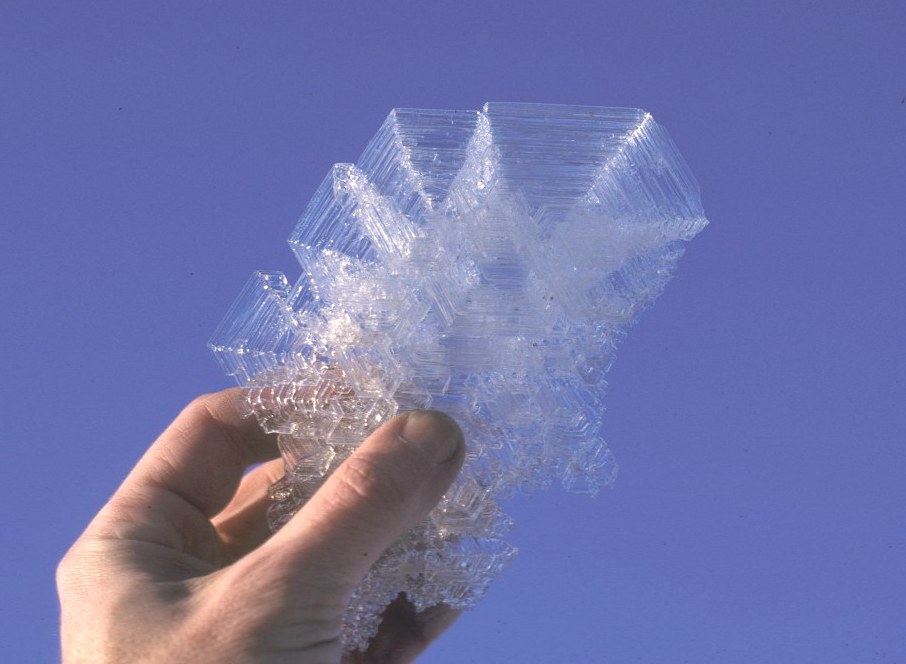
http://www.its.caltech.edu/~atomic/snowcrystals/frost2/Tape.jpgOnly bigger, which I think would be pretty impressive and worth saving.
-
Not smoothing
The article was a bit poor. The data sets aren't really incomplete in most cases. They only seem that way from a traditional standpoint. The missing samples often contain absolutely no information, in which case the original image/signal can be reconstructed perfectly. In brief, nyquist is a rule about sampling non-sparse data, so if you rotate your sparse data into a basis in which it is non-sparse, and you satisfy the nyquist rule in that basis (though not in the original one), you are still fine.
I like this link better l1 magic
-
Predicted photovoltaic efficiency only 14.5%
Here's the actual scientific paper, "Predicted Efficiency of Si Wire Array Solar Cells". That's by the same authors mentioned in the press release. While the thing does trap most of the light hitting it, only a fraction of the energy in that light is converted to electricity. In fact, this thing is currently less efficient than the better commercial solar cells.
From the paper:
So, an interesting development, but no big breakthrough. There's a claim that it might be a cheaper way to make solar cells, but everybody who comes up with a new design makes that claim. (Nanosolar comes to mind; their technology is supposed to be cheaper, but so far they've spent half a billion dollars and apparently have only produced sample panels.)
-
Here ya go
Sorry to disappoint, I only do journal entries, not front page submissions. You would have gotten your fix sooner. This link for yet another amazing solar breakthrough that will get buried like the rest of them was from a few days ago.
-
Contemporary Counterpart
As a photographer, I've been a fan of Snowflake Bentley for a long time.
His contemporary counterpart is Ken Libbrecht. -
EVO, developed at CalTech for physics community
You should take a look at EVO . It was developed by CalTech for use in the high-energy physics projects at CERN. It is a Java application, no installation required, but works surprisingly well even with consumer webcams in mac and linux. You can use it for free by just registering and organizing a meeting in the 'universe' group, or you can request that your own organization is added (and still use it for free). It has all necessary features: multiple video streams, collaborative white board, recording and replay, file storage,... At particle physics labs around the world the meeting rooms are basically built around EVO, and polycom has virtually disappeared. It helps if you are close to one of those labs, or on an educational backbone.
-
Re:We do this...
I recommend EVO
-
Re:They are another layer
Hi again. You do not sound like a jerk to me, at all. You ask the correct questions bluntly.
Honestly, the TSA is trying, and their goal is to "stop the stupid terrorists." There will always be threats we cannot detect. There are always ways to circumvent security systems. As someone who is in the field and around these people all the time, I do not believe that the point is "something else entirely," in any way. We're trying -- not to make money -- but to save some lives.
Yes it is expensive, but that is how all applied research goes. Whether or not the application is appropriate to you is the issue. Some would rather we spend gobs of money on developing thinner, higher-contrast televisions, or faster network pipes. Some want increased security. Some want more fuel-efficient cars. Some want to stop global climate change. All of these areas of research cost money, and someone will always step up and say that the application is of "marginal use."
As I said in another post, a lot of applied research has multiple uses. For example, millimeter-wave/terahertz imaging/sensing has applications in the medical world, aircraft/helicopter landing systems (including the NASA Mars Science Lab landing system), monitoring atmospheric pollutants, etc. The people I know in these research areas are scientists for the sake of science, even though after years of research, at the end of the day, you just see a contractor's logo affixed to the final product, and $Billions of your tax dollars going somewhere you don't want them to.
Anyway, we're getting really off topic. Thanks to slashdot, I can only respond about once per half hour (or less). I'll go address something more technical next. -
Good news for gravitational waves hunters
Great, the collision of these things is exactly the kind of event we need for detecting gravitational waves. These kind of 'inspirals' emit very distinct pattern, which can be retrieved very efficiently from the noise with matched filter banks. The higher the mass, the lower the frequency of this 'chirped' signal, so it is probable that these colliding super-massive black-holes cannot be detected with the ground-based kilometer long observatories, which are measuring right now. This is probably more something for the space-based LISA mission, which can probe much lower frequencies since it has a base-line of millions of kilometers.
-
Re:You never discard the data
An accessible link on defending Millikan: http://eands.caltech.edu/articles/Millikan%20Feature.pdf
-
Moving pictures of the 4D microscope
Can be seen here: http://ust.caltech.edu/movie_gallery/#paper3
-
Re:no ufos
Good point, this one was a weather balloon. It can't be an UFO if it was identified.
-
Links about academia
Related Links About Academia:
http://novia.net/~pschleck/academia/
Sample link:
"Generation Debt; Wanted: Really Smart Suckers: Grad school provides exciting new road to poverty"
http://www.villagevoice.com/news/0417,kamenetz,53011,1.html
"Here's an exciting career opportunity you won't see in the classified ads. For the first six to 10 years, it pays less than $20,000 and demands superhuman levels of commitment in a Dickensian environment. Forget about marriage, a mortgage, or even Thanksgiving dinners, as the focus of your entire life narrows to the production, to exacting specifications, of a 300-page document less than a dozen people will read. Then it's time for advancement: Apply to 50 far-flung, undesirable locations, with a 30 to 40 percent chance of being offered any position at all. You may end up living 100 miles from your spouse and commuting to three different work locations a week. You may end up $50,000 in debt, with no health insurance, feeding your kids with food stamps. If you are the luckiest out of every five entrants, you may win the profession's ultimate prize: A comfortable middle-class job, for the rest of your life, with summers off. Welcome to the world of the humanities Ph.D. student, 2004, where promises mean little and revolt is in the air.Sounds like it is getting worse. Here is part of why:
http://www.its.caltech.edu/~dg/crunch_art.html
http://www.disciplined-minds.com/