Slashdot Mirror
Domain: carltonbale.com
Stories and comments across the archive that link to carltonbale.com.
Comments · 44
-
No need to own one
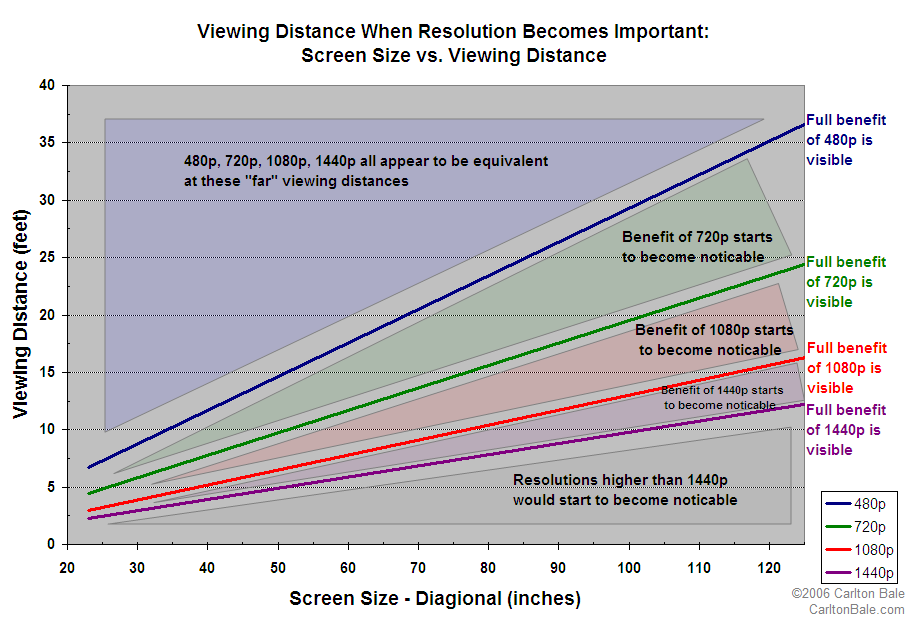
Buy a "dumb" TV and a Raspberry Pi. Install Kodi and some emulators. Get rid of cable. And as far as 4K TVs go, a lot of people don't realize that with 50 inch, you have to sit 3 feet or closer to notice the details for 20/20 vision. If it's 1080p 50 inch, you can be 7 feet away. http://carltonbale.com/1080p-d.... Maybe it's the Hz's we're noticing? Watching 1930's Dracula on a 120Hz TV is just weird.
-
Re:This never works
I can certainly tell the difference between 1080 and 720 on my 60" TV when watching from about 10 feet away or so, although it's certainly not a dramatic difference. According to charts I've seen, I'd need an 80" TV to even begin seeing any benefit to 4K, and it tops off at 160". For most people, at least for TVs, 4K just doesn't make any sense.
Here's a handy chart to see the optimal resolutions given a particular TV size and viewing distance.
-
Re:Too many pixels = slooooooow
No, it's roughly the limit of 20/20 vision. I checked using the spreadsheet here and my 28" 3840x2160 screen that I sit 60 cm in away from is perfect for anyone with 20/18.5 vision or worse. However, that's only the lower limit for what is considered "normal" vision, not perfect visual acuity:
Healthy young observers have a binocular acuity superior to 20/20; the limit of acuity in the unaided human eye is around 20/10-20/8 (6/3-6/2.4), although 20/8.9 was the highest score recorded in a study of some US professional athletes.
I know that I at one point could make out most of the 20/16 line, not anymore though. Moving to 8K would double the pixel density so the same screen, same distance at 7680x4320 would be good up to 20/9.25 vision, covering 99.9% of the population in their prime. It is actually possible that this athlete could marginally detect a >8K monitor. So no, 8K makes sense if you want everyone to have a perfect picture.
-
Re:Too many pixels = slooooooow
Maybe if you're only concerned with getting the pixels on the screen, but does it really matter if you can't distinguish pixels?
We're talking less than 3 feet away for a 30" 4k screen to be useful. For an 8k screen it would either have to be massive, or your nose makes contact with the screen. I find when I'm editing photos, I tend to zoom in quite a bit to fix small issues here and there... I don't think I would spend the money for looking at a photo when that is only 2% of the time the thing is on screen.
-
Re:What is the point
Cute, but a flawed analogy. TVs and monitor resolutions are upper-bounded in terms of useful resolution because of the inherently limited resolution of our own Mark I Eyeballs.
Here's a handy chart so you can see whether you or you wife should win the argument of whether to get a 4K set. As an example, if you're sitting about eight feet away from your TV, you'll need about a 70 inch TV to even start to see the difference between 1080p and 4K displays, and you'd need to jump up to 120 inches to get the full benefit of that resolution. If your TV is any smaller, you're sitting farther away, or you have worse eyesight, then you won't actually see any improvement.
Don't let me stop you from buying a new 60 inch 4K TV that you sit eight feet away from, but don't get annoyed at your wife when she tells you that she can't see any difference between this TV and the old one.
-
Re:I won't notice
Anyone labelled 'videophile' is expected to be blown away by new video equipment. Or gold-plated optical connectors. So.
Do an actual blind-study where you downsample the same original material and then run through 20 random samples, half with the lower-res material and half with the higher, guess what you're seeing and have the computer tally the results. At a viewing distance of 10 feet, with a 50 inch screen, I don't do much better than chance on 720 vs 1080 and I've got 20/20 as long as I'm wearing glasses. Nor should I, as that barely even touches 1080 perceivable territory.
Here's a helpful chart to assist with appropriate placement distance for that display: http://s3.carltonbale.com/reso...
About 3-4 feet and you'll get your money's worth.
Now, on the other hand, if they could improve contrast ratios to the point I can get sunburn from watching Dune, then I'll start getting excited about improved display quality.
-
Re:Too small to be of any benefit.
At 55" and average viewing distances of 8ft you're not going to notice all the detail of even 1080p. You literally need to be sat a couple of feet away to get the full benefit of 4K on a 55" display.
The people who are replying that the viewing distance charts are wrong need to understand what the recommendations apply to.
First, they apply to the average person, whoever that may be. Since we all have slightly different eyesight, there are people who will see jaggies at the recommended range and people who will not.
Secondly, the vast majority of the distance recommendations refer to televisions and video, not computer monitors and text or still images. Computer monitors tend to have more precise pixel color and lighting control which makes them sharper but also makes it easier to see jaggies.
The point is that the charts were developed for TVs playing video and they tend to be accurate for this usage. Any application beyond that is pretty much out of scope.
-
Too small to be of any benefit.
At 55" and average viewing distances of 8ft you're not going to notice all the detail of even 1080p. You literally need to be sat a couple of feet away to get the full benefit of 4K on a 55" display.
-
Oh good...
Now I can fully enjoy 4k video from the totally comfortable distance of 5 feet in front of my 55" television.
http://s3.carltonbale.com/reso... -
Re:Soon, no more bookstores.
4K has only 4X more pixels than 1080p. Netflix says that currently, you need a 5mbit connection for Hidef streaming, or 7mbit for super hidef.
Netflix is lying to you. Their hidef isn't blu-ray quality. Its 1080p with compression artifacts. The audio isn't as good either.
I don't think they ever said that it *is* Blu-ray quality, but the point is, it's "good enough". I own dozens of Blurays and while I can see a different because blu-ray and streaming content, it just isn't that important to me.
Its better than then the regular hd which is even more compressed, and even that is better than some of the so called hd channels on cable some of which are badly compressed.
Compared to bluray though its a complete joke.
It's good enough, and there are only a handful of titles I would even care enough to pay extra for bluray, never mind "4k" but at the same time what's the point drooling over a netflix compressed 4k stream if their superHD is still well beneath even mere bluray 1080p.
Because it has 4x more pixels, which I thought was the whole point of 4K? If I'm happy with my 60" TV when I sit 8 feet away, if I had a 4K TV, then either I can sit at half the distance (4 ft), or get a TV that's twice as large (120") and get a more immersive movie experience with the same perceived quality.
-
Re:Whay doesn't /. save some time
Maybe if you're within 10 feet, have perfect vision and are staring at a still image. See chart.
http://s3.carltonbale.com/resolution_chart.html
I doubt you'll see pixels when the picture is animated. And if the movie/tv show is any good, the pixels completely disappear no mater what the resolution.
-
Re:No comparison
"Kicks its butt"
As in:
- Commands a much larger share of the market.
- Carries a greater variety of product.
- Is ubiquitously installed in almost every home in a way Blu-Ray is most definitely not.As for your claims of technical superiority, I say that Blu-Ray is technically superior. Being able to push 7.1, high-quality sound and 1080p video is quite something.
-HOWEVER-
When you're talking about that "superiority" to people who sit 8 feet away from a 20-30 inch screen, possibly even a CRT, and their sound system is the same stereo speakers that have always been built into the set, Blu-ray's technical superiority means precisely two things: JACK and SQUAT. And it's because the rest of the system, even if they were to hook up a Blu-Ray player, DOES NOT CARE. It cannot play back 7.1 sound. It cannot play back any more meaningful visible content than the 480p or possibly 720p that is native to its resolution (maybe even 480i in the case of a CRT). Even if it is a 30" 1080p screen, sitting at 6-8 feet from it you quite literally cannot see the difference because your eyes are not that good.
Blu-Ray is niche for the upper end for that reason. It is GREAT, if you have a 5.1 or 7.1 sound system and a TV screen of 55+ inches. Below that, you encounter diminishing returns quite quickly.
-
Re:There is another issue and it is a constant one
If the projected screen size is greater than 45", it should be noticeable at 6-8'. If it is greater than 75", it should be obvious. You're right for 4k screens at "normal" sizes, though.
-
Re:Waste
calculations based on the resolution of the human eye when corrected to only 20/20 suggest that the base model 4K display should have been on the order of 100 inches or so. Less if you're using it as a display for your computer, Considerably less if you're squinting at it like a radiologist.
A 100 inch display is 7 feet wide-- too large for many homes.
-
Re:Isn't the internet already meeting demand?
but considering that most people can't tell the difference between 720p and 1080p, I doubt that will ever happen.
Uh, what?
I can see the difference. I can even see the difference between 1080p and 1440p, or 1440p and 2160p. And it's not a slight difference that I could understand people missing. In informal tests, comparing my laptop playing 1080p video to my parent's 720p "HDTV", 100% of those surveyed responded "holy crap that looks better" (margin of error for 95% confidence interval: 9.38%).
You're not "most people" - "most people" haven't even seen 1440p.
And how do you make any sort of fair comparison between a 17" laptop screen and a 32" (or larger?) HDTV? There's no way to fairly compare the two because of the screen size difference.
At normal viewing distances, most people can't see the difference between 720p and 1080p -- you'd need to be within 5 feet of your 40" TV to see the difference. Sure, maybe you have a home theater with a 60" TV and seats 6 feet away, but most people have a TV in the corner of the living room and don't arrange seating for optimal 1080p viewing distance.
-
Re:Cool tech, but
You beat me to it. What we need is a chart like this but for handhelds. Then, print it out, wrap it around a 2x4, and smack OEM presidents in the head with it until they quit making tiny screens better and start shipping a goddamn laptop screen at something better than 1366x768.
-
Re:Blu-Ray vs. DVD
Please cite, because I can cite a buttload of sources that back up what I say.
http://en.wikipedia.org/wiki/Optimum_HDTV_viewing_distance
http://hdguru.com/wp-content/uploads/2006/11/hdtv_distance_chart.pdf
http://www.hdhes.com/tv/hdtvviewdistance.aspx
any my favorite that a lot of people have tested and in fact have found to be accurate.
http://carltonbale.com/1080p-does-matter
Sorry but you perceive sharpness. put up a real resolution chart and try again. Because this is what I have done as well as others and their findings fit mine.
42" TV at 12 feet is SDTV to your eyes no matter what the signal.
-
Re:Listen to what I have to say
Given the size of my living room, a 720p 50" Sony I bought years ago is doing just fine. It doesn't need 1080p, because at the distance I'm sitting from it, the eye can't tell the difference anyways.
-
Re:The problem is resolution
It's not quite that bad - 1080p's recommended viewing range is over 50", over 4' away, for over 1080p resolution. Even 1440 is over 36". 65" TV gives you 9' to enjoy full 1080p.
Still, I agree with you. There are reasons why extra resolution isn't really necessary unless you're presenting a piece where people are only intended to look at a small subsection at a time. You're already looking at viewing distances darn near 1:1 for the size of the screen, so you're bleeding into the periphial vision for the presentation - which is lower resolution yet. If the story to the video is engrossing, you don't need more 'bling'.
-
Sold my Boxee Box for 2 ATV2/XBMC
I was under the impression that the Boxee Box was going to be an open platform only to find out that it wasn't so I sold it about a month later and got two AppleTV2's, for the same price and installed XBMC on them. I've never been happier with this combo. ATV2 is just enough hardware to play 720p smoothly which is all I want. You don't need 1080p unless you have a 60" set and you're watching it within 8 feet which I don't. http://s3.carltonbale.com/resolution_chart.html It uses about 8 Watts, has 8GB of solid state versus the 1GB on the Boxee Box. Content metadata, playback settings and thumbnails are all stored in a central location along with all my media. I can also watch my PVR content because of the MythTV support. I haven't seen any media centre come close to doing what XBMC does.
-
Re:How Good is "Good Enough?"
-
Re:Not bothered
In fact most people, where their new 42" LCD is at and where they sit, they cant SEE the difference between a bluray and a DVD. Most people sit more than 12 feet away from their nice shiny LCD widescreen. and this is too far for a 42" to see the resolution increase a 720p signal gives you. you have to sit even closer to see 1080p
SO the rich guy that has his 62" above the fireplace and he sits 20 feet away... he cant see the 1080p he paid for. It's why I laugh hard at people that are shopping for 690hz and has to be 1080p! Why are you payng for all that buddy? You wont see it! Your wife wont let you put the TV where it will deliver the best picture.
http://s3.carltonbale.com/resolution_chart.html
Then let's look at cost.. At new release, Blurays are 2X or more than the price of a DVD.
Similar to a previous post I made, I don't laugh at these people, I encourage it (if they are not family). They needing the bells and whistles and top tier features just drives down the cost for me when I go to purchase a tv. So by all means, if you have the means, spend, spend, spend, on items I will likely buy in the future at cheaper prices.
-
Re:DVDs are better.
There's a larger issue than just "people don't change formats for picture quality," though I _do_ agree with that:
Picture quality isn't a compelling argument for most consumers because:
a) It's a fairly minor improvment - I'm sure some moron's going to waste our time blathering about resolution, but the truth is: Doubling the resolution of a 240 line VHS with DVD represents a vastly more important improvement than (somewhat less than) doubling the the resolution of a 480 line DVD with a 720p Blue-ray. 1080 is more, sure; But you're still just throwing pixels at a picture that already looks pretty damn good.
b) A nontrivial fraction of consumers can't tell the difference anyway - You need a large HDTV set to be able to see a difference. What distance do people watch movies at? 12, perhaps 15 feet? At that distance all formats are indistinguishable on sets smaller than 50':
http://s3.carltonbale.com/resolution_chart.html
Ultimately, Blu-ray is going to go the way of Laser-disc because it's an answer to a question that nobody ever asked.
Oh, and also because of porn. Between Sony discomfiture releasing porn on Blu-ray, and the porn industry's reluctance to get into bed with Blu-ray (ho, ho), porn's not driving Blu-ray adoption. (A lot of porn stars have to get work done before they'll appear on Blu-ray - Think the HDTV scene from 30 Rock.)
For Blu-ray to succeed it would have to be the first new media to succeed without porn since the Guttenberg Bible. -
Re:Not bothered
http://carltonbale.com/1080p-does-matter
Forgot the link
-
Re:I can't see a difference on my system!
Article: http://carltonbale.com/1080p-does-matter
Chart: http://s3.carltonbale.com/resolution_chart.htmlBasically, from this I can tell that my under-40-inch LCD screen, when seen at most viewing ranges in my living room (under 10 feet) MIGHT be noticeably better at 720p, but that better than that willl likely go unnoticed. Fascinating stuff, all based on math and geometry.
-
Re:I can't see a difference on my system!
Article: http://carltonbale.com/1080p-does-matter
Chart: http://s3.carltonbale.com/resolution_chart.htmlBasically, from this I can tell that my under-40-inch LCD screen, when seen at most viewing ranges in my living room (under 10 feet) MIGHT be noticeably better at 720p, but that better than that willl likely go unnoticed. Fascinating stuff, all based on math and geometry.
-
Re:Not bothered
+1 to you sir!
It's very true that one can obtain a Blu-ray for relatively cheap considering the benefit of it. The movies are also becoming much more reasonable (I have personally been buying the combo packs for movies I desire, as they are usually only another $3-$5 to get the Blu-ray and DVD). The deal breaker is that 800$ HDTV you need to grab for it to be worth it.
This was posted a month or two ago on slashdot, and it is worth sharing again. A chart for screen-size/viewing distance and when the resolutions become apparent.
http://carltonbale.com/1080p-does-matter
Another point to consider is also portables. My parents got a new big screen HDTV and blu-ray player. They enjoy the blu-ray and how crisp it is on the tv, but it doesn't dictate their movie buying habits really. It really comes down to the criteria of if the movie is something my Mom would watch on her portable dvd player. If no, then blu-ray usually wins. If yes, then they buy a combo pack (if available) or the DVD version. Portable DVD players are pretty cheap ($80-$120), but a portable blu-ray player is usually almost double the price of its DVD counter-part. I'm sure there are a lot of people that feel if they can't watch their new movie in every room and portable device in the house, then why bother to upgrade any of the devices. The other choice is to buy the movie twice (not consumer friendly), or rip the blu-ray movie, re-encode it, and burn it to dvd (not anybody friendly considering studios don't want you to be able to rip the movies at all). I'm sure most slashdotters could do the latter, but even to us it would get old.
-
Re:Not bothered
In fact most people, where their new 42" LCD is at and where they sit, they cant SEE the difference between a bluray and a DVD. Most people sit more than 12 feet away from their nice shiny LCD widescreen. and this is too far for a 42" to see the resolution increase a 720p signal gives you. you have to sit even closer to see 1080p
SO the rich guy that has his 62" above the fireplace and he sits 20 feet away... he cant see the 1080p he paid for. It's why I laugh hard at people that are shopping for 690hz and has to be 1080p! Why are you payng for all that buddy? You wont see it! Your wife wont let you put the TV where it will deliver the best picture.
http://s3.carltonbale.com/resolution_chart.html
Then let's look at cost.. At new release, Blurays are 2X or more than the price of a DVD.
-
Re:BS: Or you have a ridiculously huge TV.
That also seems a bit far fetched. Try this Acuity test:
http://carltonbale.com/visual-acuity-viewing-distance-test-it-for-yourself
-
Re:The hidden perk of 3D...
Actually, you get more detail from color saturation than from raw resolution - counterintuitive perhaps, but true.
Many people claiming greater detail on their 1080p sets may be sitting beyond the resolution point for their eyes - but - the newer set may have superior color, and if transitioning from SD to HDTV (specifically, going above CRT tech), is likely to not have convergence issues.
Add to that the fact that the seating charts spec'd by the SMPTE is an excellent guideline, it's not the bible. Try a test card and see for yourself - you may be seeing much better or much worse than that chart suggests.
I can't find the original ISF statement, but here are two derivative sources:
http://www.cnet.com/hdtv-resolution/
http://carltonbale.com/1080p-does-matter
The stated claim is that the order of importance is: contrast, color saturation, color accuracy and finally - actual pixel-resolution.
One thing that any TV engineer will tell you: you'll see more detail on a TV with excellent color and medium resolution than you will with a TV with so-so color and excellent, high resolution.
Counter-intuitive or not - I know this to be true. I'd actually had a case of watching an SD show where I was certain it was HD - but it was just a case of excellent color. The detail was astounding.
Therefore - another reason that many consumers may be liking 1080p sets could simply be that as these HDTVs improve, they're improving on all fronts - not just resolution.
Thus 90% of people that own a 1080p set cant see that it's any better than a 480p set. and this is why a regular DVD looks as good as a BluRay to most people.
I'd say that 90% of the people that can't see the difference between good and bad sources either have lousy HDTVs (read: "hahaha, I don't black is important" or "tech X is by definition superior tech Y" fanbois) or don't have them set up anywhere close to right ("my TV is calibrated - I set it to what I found on the internet!").
Or they watch lousy movies or have bad eyesight.
The last one's particularly hilarious among HDTV fanbois. After all, everyone is *entitled* to good eyesight, so everyone has it and you're an elitist if you say differently.
Otherwise, I totally agree in principle with what you're saying (sincerely) - just wanted to add a caveat and some spin. Cheers.
-
Re:I always maintained blue ray was moot
It's not that 1080p is only good on large TVs, it's that you won't get the full benefit depending on your viewing distance. Here's a handy chart:
http://s3.carltonbale.com/resolution_chart.html
And keep in mind that just because you may not be able to see all 1080 lines doesn't mean you won't still see my than the 480 lines on a DVD. So the image should still look better in most cases. Also, the BR format has better colors. The debate over 1080 and screen size is usually discussed when comparing 720p to 1080p TVs.
-
Re:I work in he rental industry
Normal Viewing Distance is really the essential part.
To fully notice the detail 1080p you need to sit approx 7 feet away from a 50 inch TV.
If you bought one of those 32inch TVs... Try 4 feet away. You'll only start to the benefits of 720p at 9 feet.If you watch your TV from across a decent sized room, you need an exceptionally large screen to really soak in the benefits.
http://s3.carltonbale.com/resolution_chart.html
http://www.carltonbale.com/2006/11/1080p-does-matter/ -
Re:I work in he rental industry
Normal Viewing Distance is really the essential part.
To fully notice the detail 1080p you need to sit approx 7 feet away from a 50 inch TV.
If you bought one of those 32inch TVs... Try 4 feet away. You'll only start to the benefits of 720p at 9 feet.If you watch your TV from across a decent sized room, you need an exceptionally large screen to really soak in the benefits.
http://s3.carltonbale.com/resolution_chart.html
http://www.carltonbale.com/2006/11/1080p-does-matter/ -
Re:I work in he rental industry
You may find this website useful in determining whether or not your screen resolution and viewing distance can/should be adjusted to affect any discernible difference.
http://www.carltonbale.com/home-theater/home-theater-calculator/
-
Re:Release should be fine
Why in the world would you want a handheld device with a built-in 720 display? Do you plan to rest your eyeballs directly on the screen? That's about what you'd need to do to be able to perceive HD detail on a screen that size.
-
Re:DVD is poor by comparison, but is "good enough"
Actually, according to this chart, you're far too far from your set to be able to appreciate 1080P. At 10' away, you might as well have saved your money and bought a 720P set.
I sit 9 feet away from a 92" screen and Blu-ray is quite obviously far superior, but the problem for HD is that most people are sitting 10 feet away from a 40" or smaller screen.
-
Re:HD pulled me back
I'm not sure I'm following all of your points.
Yeah, shiny new things are nice and it takes some time for the "new" to wear off. You could argue that it was a gigantic waste of money since it does the *exact* same thing as the TV that it replaced, but then again does your new Maytag do anything different than your old washer/dryer? The answer will depend on your point of view, just don't expect everyone to see things from exactly your point of view, I don't.
HDTV's do cost more but they aren't "required" to be large. However, there is some science to back up why people are buying larger TV's than in the past (other than ego).
I'm not 100% sure, but the reason that DVD isn't capable of doing HD has nothing to do with filesize, but the codecs. Most DVDs are "stored at a resolution of 720×480" or 345,600 pixels, whereas 1080p HD is 1920×1080, or 2,073,600 pixels...or 6 times the resolution. So, I think your filesize complaint is also wrong/invalid.
Don't know if you are misinformed about the fancy "Digital TV" thing either. If you have cable, then they can track what you are watching whether digital or analog. If you were referring to broadcast TV, then they can't track what you are watching whether digital or analog, PLUS analog broadcasts are going away in 2009. So your fantasy about watching non-traceable analog TV is about to crumble before your eyes.
Bottom line, you sound like you have a chip on your should and are just blabbering away on topics you have little to zero "factual" information about. I enjoy my HDTV and you are scared/angry at it. I wash my clothes and put them in the closet or the drawer, you are popping popcorn and watching it as your form of entertainment because big brother can't track you doing that. -
Re:o rly?
Come on. HD looks great on a 42". I'm sure everyone who sits the maximum THX recommended max distance of 3ft, even after the eye strain sets in.
-
Re:Most (older) customers have no reason for HDAt some point, we will hit diminishing returns. Do you know of any studies that test the limit of resolution for a person with 20/20 vision? (It probably can be approximated from eye chart information.) http://www.carltonbale.com/2006/11/1080p-does-matter/
Have you seen this? I'm not sure if it's exactly what you're talking about, but it does show that 1080p or even 720p can certainly be "as good as it gets" depending on screen size and viewing distance. The chart appears to be accurate as well, I checked it out on my 1080p 42" with 1:1 pixel mapping and the distance where I could no longer tell each pixel apart matched that predicted by the chart very well. -
Re:Who cares? They're cheap.
My educated guess is that they include 720p sets in that figure (720p sets are regularly sold with "HDTV" labelling). In the case of a 720p set, I believe that a standard-def DVD player with an HDMI cable will provide the same output quality as a hi-def player.
Yes, 720p is considered HD, and it has about 4x the resolution of a standard 480i signal. Either BD or HD DVD material (which are almost always 1080p sources) looks stunning on a mid-sized 720p set, and definitely outperforms even upconverted SD DVD. Here's a nice chart that shows you screen size vs viewing distance for the various resolutions. Basically, for most home living room configurations, a 720p set is more than adequate. 1080p becomes a bigger factor if you happen to have a very good-sized viewing room, or you plan on setting up a proper home theater. -
Re:A pox on both their houses
Distance. I don't see 6 ft from my TV, I set more like 10. Most people don't sit that close, either. To tell the difference between 1080 and 720, you have to be 9.8 ft or less from a 50" screen, and to see it well, you have to be less than 6.5 ft.
http://www.carltonbale.com/2006/11/1080p-does-matter/
I'm not denying there's a difference. I'm denying that it matters to most people.
To make things even muddier, most HDTVs upscale the standard signal and it actually looks quite good. Both my parents have HDTVs now (bought them off me when I upgraded) but they don't have an HD signal. Despite having watched TV at my house, with HD cable (I almost never tuned to regular channels) my parents were initially impressed, but didn't care enough to even ask their providers (DirecTV) how much it would cost... Not even enough to look it up on the web.
In the end, it's just not a big enough jump for most people to care, like other television advances. (Radio to B&W, B&W to color, etc.) It'll eventually take over, but not because it's so much better... Just because it's getting to be as cheap to make HD TVs as regular ones... It'll soon make no sense to keep producing regular TVs. -
Re:Excellent Point!
Keep in mind that any kind of "high definition," as opposed to let's say normal DVD definition, only really makes any kind of sense if you have a 6-foot (2 meter) or larger LCD or plasma screen.
No, optimal resolution is a function of both screen size and seating distance. The easiest way to show that you're wrong is that you're suggesting a person viewing on a computer in front of a 21" LCD can't benefit from the added resolution of HD video. Clearly, given a particular screen size, when you're close enough, you can see the added detail. -
Viewing distance calculator
Here is a viewing distance calculator (in Excel) you can use to figure out way more about home theater setups than you'll ever really need.
It has viewing distances for user selectable monitor/TV/projector resolutions & sizes, seating distances, optimal viewing distances, seating heights(?!), THX viability(?!) etc. It's well researched and cited.
No I'm not affiliated with it, I just found it and liked it. -
Re:1080 resolutions aren't that important
You're on the money from what I can find out. You might find this interesting. It saved me from making the mistake of going for a 1080p set when I looked at the size of TV I could fit in my entertainment cabinet (46" or less) and my viewing distance (12 ft).