Slashdot Mirror
Domain: cbpp.org
Stories and comments across the archive that link to cbpp.org.
Comments · 180
-
Re: That wasn't the idea at all.
"And economically, the US hasn't done much to recover since the recession. It's worth noting here that doing nothing leads to a quicker recovery than what we're seeing in the US. Partly, it's Keynesian economics poorly applied and partly it's an administration more intent on ideology than economic recovery."
Can you read graphs?
http://www.cbpp.org/images/cms//5-10-11bud-f1.jpg
http://images.sodahead.com/profiles/0/0/2/3/9/1/6/6/5/drf-48787079017.jpeg
http://images.sodahead.com/profiles/0/0/2/3/9/1/6/6/5/drf-48787134389.jpeg
-
Re:I like his choice in where to focus
Why do you care that they're paying fewer taxes, when they're getting the wealth to the people who need it more directly?
Exactly right.
Giving money to government is the LEAST efficient way to improve the lives of the poor.
Look at the graphic on this page: http://www.cbpp.org/cms/?fa=view&id=1258 as to where your federal tax dollars go.
Compare that to where the Gates Foundation spends their money.It quickly becomes apparent that the Gates foundation can get more money and programs into the hands of the poorest people
in the world by completely bypassing government at all levels. Apparently WillAffleckUW thinks that Gates should strip 20% off of the
top of the billions he spends and use it to beef up the US Military, and another 60% to fund US based welfare programs, and maybe allocate
1% to his programs in Africa, South America, and elsewhere around the world. That's how government does it. All Hail Glorious Government. -
Re:Sales tax
Fair means each group pays the same percentage of the overall taxes. Not 1 person pays more then another person.
As a group, yes the poor pay more. 12% of taxes come the the bottom 20%
7.9% come from the top 1%The top 1% pays the least percentage of tax revenue then any other group.
http://www.cbpp.org/cms/?fa=view&id=350510% of 8000 has a hell of a lot bigger impact on a person. / family then 39% of 400,001
-
YEAH!
What the parent said!
Teapartierss read this, please.
I'm a centrist.
I'm sympathetic to cutting spending. But really, give a realistic solution. The biggest expenditures for the US are untouchable - military, Medicare, Interest on current debt - I mean, why are you fighting?
-
Getting me started, man!
The public has no idea about the level of US spending.
Here is a breakdown on where out money goes.Defense, SS, Medicare, Medicaid, and CHIP - where 2/3rds goes to Medicare.
The perception is that our tax money is wasted on Space, Welfare Queen's Pink Cadillacs and other entitlement programs which I take to be code words for giving money to "lazy (Black) poor people" from folks who want to appear to be PC.
When the truth is we are wasting money on wars and transferring wealth to the old.
And I find it laughable and sad that the Teapartiers are mostly old white people and if they REALLY wanted what they think they wanted, they'd have to shoot themselves in the pocketbook and give up this notion the the US of A has to have a superior military and go off fighting "evil".
Cut military spending to post WWII levels. Stop this one man show when containing roque nations - we need more UN involvement; which is a whole other bugaboo with the Teaparty people and most conservatives.
-
BS to that
Linked is the average tuition rise over the last five years for all 50 states. In most cases, the rise is 20-30%. In the extreme upper end, the rise is nearly 80% (I'm looking at you Arizona...). http://www.cbpp.org/images/cms/3-19-13sfp-f3.jpg This clearly outpaces cost of living growth over the last five years.
The next link is the growth in administrative costs for one example, the University of California system, which has massively ballooned over the last several decades. http://californiareview.net/2011/08/24/graph-of-uc-administrative-growth/ This is not an isolated phenomenon. While professor salaries and direct education expenses have stayed relatively flat over the last few decades (or tracked inflation in some cases), the number of, and salaries provided to, administrative positions have dramatically increased across the board at most institutions (public or private).
For further example, look at total compensation for the top university executives across the US from 2011-2012. We are compensating many university execs in excess of $500,000 a year (some over $2 mil). http://old.post-gazette.com/images5/20130513presidential_pay691.png At many state schools, with limited external funding, and tuition rise limited by law, we're still paying execs $3-400,000. What value do these people add that is worth $300,000 - $2 million?
-
DId you get a slice of increased productivity ?
Productivity of the average American worker went through the roof since 1979:
http://www.motherjones.com/politics/2011/06/speedup-americans-working-harder-charts
http://www.ibtimes.com/us-worker-productivity-rising-faster-wage-growth-1114871
Did your inflation-adjusted paycheck? Oh hell no, you're (the average American ) treading water.
http://www.cbpp.org/cms/?fa=view&id=3220
and have been for decades... DECADES
OK then. All this cost savings is pocketed by billionaires , not passed on to you. The ONLY form in which it's ever passed on to ordinary people is at their own expense, e.g. Walmart prices and Walmart
http://www.dailykos.com/story/2013/06/03/1213437/-What-Walmart-Costs-Taxpayers
http://www.walmarteffectbook.com/
So if you want to realize what any of the productivity gains / cost savings you've worked for and created, start a company, force everyone who works for you be to be part time, steal the benefits of THEIR increase in productivity, lobby your congresspig for tax breaks for the wealthy..... oh and shop at Walmart.
America is a nation of by and for billionaires, who fund our elections, occupy our political offices, write our laws and own our media. They do this for their own benefit and anything which does not effect their personal lives is not *real* and doesn't matter.
http://video.pbs.org/video/2296684923/
So no- it's not for you.
Now get back to work.
-
Re:Modest changes
The interested parties (military industrial complex anyone? what the US spends most of its budget on)
Actually, Medicare, Medicaid, and the Children's Health Insurance Program (CHIP) - together accounted for 21 percent of the budget. Defense and international security assistance was 20 percent... tied with Social Security. A fair breakdown can be had here. http://www.cbpp.org/cms/index.cfm?fa=view&id=1258
-
Re:Nice!
No we're not. Between the state and Federal governments, nearly a trillion dollars a year is spent on over 120 different poverty assistance programs. That's enough to just give every family in poverty $60K/year. These and other entitlements are growing & out of control. We could drop DoD spending to zero and we'd still have massive deficits.
And between those same governments, they bring in nearly $6 trillion dollars, and that's even with some of the lowest tax revenues in relation to GDP in over half a century. Anyone who doesn't think defense spending, Medicare/Medicaid and Social Security do not make up the majority of our spending clearly has never done any research on the subject. Those three things alone comprise over 60% of our federal government spending. So-called safety net programs make up roughly 13% of our spending.
You've been given your source, so if you wish to continue denying it that's your right, but it won't change the truth.
-
Re:Nice!
I'm sure food stamps are abused on occasion, but I can't imagine that this happens on a large enough scale that anyone should care.
According to the USDA, the average (nation-wide) food stamp benefit was $133.42 per month. That's $4.39 per day! At a maximum, an individual can get $200 per month, or $6.57 per day.
http://www.fns.usda.gov/pd/18SNAPavg$PP.htm
http://www.cbpp.org/cms/index.cfm?fa=view&id=1269How the fuck could any of these people have anything left over after buying the minimum amount of food they need to not feel hungry? The idea that there are large numbers of poor people living large, paying for alcohol and drugs and strippers with their EBT cards, is retarded. Even if it does happen once in a while, it cannot be enough of a problem to warrant the amount of anti-poor vitriol that are in the comments here.
Why not go after things that actually waste significant amounts of money? Like tax evaders, corporate bailouts, corn subsidies, the broken health care system, useless wars, etc.
And if you think there really is any significant amount of food stamp money going to strippers, at least provide some proof and numbers to back up your claims.
-
The problem is not spending.
The problem is not spending. The problem is politics of financing it.
Public debt would be in good shape if Bush tax cuts would have not been implemented. See the graph in this page. And Contrary to "Entitlement Society" Rhetoric, Over Nine-Tenths of Entitlement Benefits Go to Elderly, Disabled, or Working Households
Unnecessary wars and overblown and ineffective internal security apparatus are expensive, but surprisingly not even they could not cause fiscal crisis. (Unfortunately) America is so rich that it has money to blow into wars and still go on. What we should do is to fix healthcare. It would not be even hard; Just look at what others are doing and do the same. This is just absurd.
Just increase taxes and cut war spending and America is fine: 2013 United States federal budget / Total revenues and spending.. This crisis is fundamentally just political. This problem is fundamentally caused by GOP and it's lost coherence. John Boehner has no authority to negotiate with Obama, nobody in GOP has any authority to negotiate.
-
Re:You are so naive
I would agree those were cherry picked so how about we look at a few of the major trends:
Trust of politicians and government in general: http://www.people-press.org/2010/04/18/public-trust-in-government-1958-2010/
Income disparity (who is getting all the new wealth): http://www.cbpp.org/cms/index.cfm?fa=view&id=3629
I don't have a particular link to environmtal damage but if you can't see that in just about every news source (even the terrible US ones) then you are working hard not to see it.
I will say that not everything is gloom and doom butpeople commenting on corruption, corporate greed and increase in power seems to me just being perceptive not overly negative. Most statistics I've seen and real world experience for the average person seem to support this. I would also point out there is strong evidence that government control is increasing and "rule of law" is decreasing. Again I don't have specific metrics for these but I certainly can point to several pieces of legislation as well as personal experience dealing with governmental institutions (border crossings, airports, traffic stops, tax assessment, building departments). Apparently you do not see this trend but the large number of comments about this just might be from people who see these trends or have experienced them first hand.
Finally, the impetus behind pointing this out just might be a desire to fix some of these issues. The first step in fixing a problem is to identify the problem. Refusing to acknowledge real problems does no service to people facing them or to resolving the problem itself. Just a few things you might want to consider. Hope this helps, -
Re: Question
I'd stop throwing that 51% number around - it demonstrates a bit of ignorance on recent tax policy (Those numbers are partially a result of temoporary tax breaks enacted in 2009 and recently expired), demographics (Retired seniors and students frequently have extremely low income, and thus little or no income tax burden, so we EXPECT that about 40% of households will have no income tax burden), and reality (First, there are plenty of other taxes in play, even at the shallow end of the income pool; Second, poor people typically aren't subject to corporate taxes either).
This excerpt from http://www.cbpp.org/cms/index.cfm?fa=view&id=3505 may help you out:
The 51 percent and 46 percent figures are anomalies that reflect the unique circumstances of the past few years, when the economic downturn greatly swelled the number of Americans with low incomes. The figures for 2009 are particularly anomalous; in that year, temporary tax cuts that the 2009 Recovery Act created — including the “Making Work Pay” tax credit and an exclusion from tax of the first $2,400 in unemployment benefits — were in effect and removed millions of Americans from the federal income tax rolls. Both of these temporary tax measures have since expired.
In 2007, before the economy turned down, 40 percent of households did not owe federal income tax. This figure more closely reflects the percentage that do not owe income tax in normal economic times.[4]
These figures cover only the federal income tax and ignore the substantial amounts of other federal taxes — especially the payroll tax — that many of these households pay. As a result, these figures greatly overstate the share of households that do not pay federal taxes. Tax Policy Center data show that only about 17 percent of households did not pay any federal income tax or payroll tax in 2009, despite the high unemployment and temporary tax cuts that marked that year.[5] In 2007, a more typical year, the figure was 14 percent. This percentage would be even lower if it reflected other federal taxes that households pay, including excise taxes on gasoline and other items.
Most of the people who pay neither federal income tax nor payroll taxes are low-income people who are elderly, unable to work due to a serious disability, or students, most of whom subsequently become taxpayers. (In years like the last few, this group also includes a significant number of people who have been unemployed the entire year and cannot find work.)
Moreover, low-income households as a group do, in fact, pay federal taxes. Congressional Budget Office data show that the poorest fifth of households paid an average of 4.0 percent of their incomes in federal taxes in 2007, the latest year for which these data are available — not an insignificant amount given how modest these households’ incomes are; the poorest fifth of households had average income of $18,400 in 2007.[6] The next-to-the bottom fifth — those with incomes between $20,500 and $34,300 in 2007 — paid an average of 10.6 percent of their incomes in federal taxes.
Moreover, even these figures greatly understatelow-income households’ totaltax burden because these households also pay substantial state and local taxes. Data from the Institute on Taxation and Economic Policy show that the poorest fifth of households paid a stunning 12.3 percent of their incomes in state and local taxes in 2011.[7]
When all federal, state, and local taxes are taken into account, the bottom fifth of households pays about 16 percent of their incomes in taxes, on average. The second-poorest fifth pays about 21 percent.[8]
-
Re:Actually, he doesn't need the power
Your problem is that the Democrats have been telling you that the Bush tax cuts were a "rich thing" for so long that you now believe it. The Bush tax cuts were pretty much across the board, rich, poor, middle class.. everyone got a cut.
Technically true, and misleading: If you look at the numbers, Bush tax cuts were about 2.5% for poor and middle-class people, and over 6% for upper-class people. Those in the richest 1% got approximately 85% of the value of the tax cut. So yes, it is mostly a "rich thing", because their $60K annual savings were much bigger, even as a percentage, than the average family's $1K cut (or the poor family's $100 cut).
-
Re:*different* scores for *standardized* tests
How will this encourage racism? Are we to think all races learn all subjects equally in school?
Uh, yes. If you believe that someone's race means that they cannot learn a subject, than you are a racist fuckwit. Please go hit yourself in the head with a clue-by-four until enlightenment results,
How about men and women's learning abilities and aptitudes?
And if you believe that someone's gender means that they cannot learn a subject, than you are a sexist fuckwit. Please continue the beating.
I think funding is a minor issue as funding does not equate to schools with high performing students.
Except, you know, that student achievement is in fact linked to school funding levels.
-
Re:.... and the US deficit continues to balloon
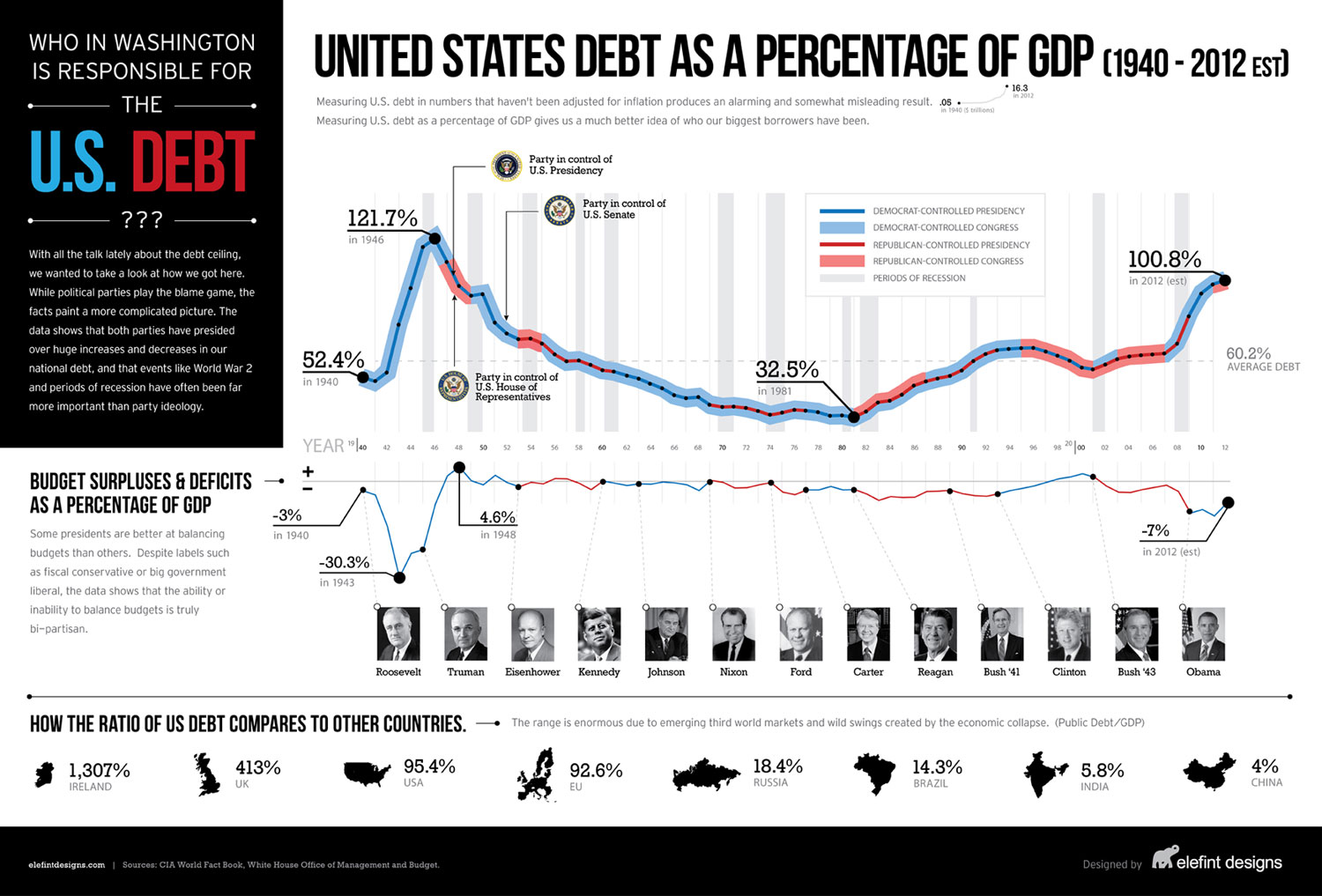
Can you put two and two together looking at this graph?
(Numbers and graph Courtesy of the non-partisan Center for Budget and Policy Priorities).
The bad thing about the right's ideological radicalization over the past decade is that there is no such as thing as "non-partisan" anymore. Anyone who puts forth numbers, facts, arguments, etc, against them is automatically part of the liberal media conspiracy.
The example of the hour, of course, is the right's attack on Nate Silver. To be fair, Nate did support Obama in this election, but his analysis was based on raw number crunching, not wishful thinking (like these eight conservative pundits who predicted a Romney win), which is why he was able to correctly predict the outcome of all 50 states (assuming no FL surprises). Meanwhile, the Red States guys were predicting a 3.5% win for Mitt the day before election. (Not to mention their hilarious exit poll that favored Mitt 5.4% with a 1.44% margin of error!)
They just stripped away all statistical corrections that professional polling organizations normally use in order to get the result they want even when the underlying reality was completely different . Now that the cold light of day has shown them wrong, we'll see if an apology, methodology change, or indeed any indication of humility or self-growth is forthcoming, but I'm not holding my breath.
Unfortunately, most complex things (global warming, taxation policy, etc.) aren't resolved simply and quickly like this polling "controversy". Right-wing ideologues will continue to manufacture misinformation and attack anyone who disagrees with them, and because of that: truth is dead, in a sense. (This can apply to left-wing ideologues too, but it's right-wing ideologicalization that has been more prevalent over the past decade.)
-
Re:.... and the US deficit continues to balloon
Can you put two and two together looking at this graph?
(Numbers and graph Courtesy of the non-partisan Center for Budget and Policy Priorities).
-
Re:Norway leads the way.
Trying to explain away Norway's social and economic successes by saying "but they've got oil" does not cut the mustard.
Texas had also had in the past had oil revenues of a similar high level (20% of the state GDP in 1981): http://www.cbpp.org/cms/index.cfm?fa=view&id=3739 , which is the same as Norway's today: http://www.state.gov/r/pa/ei/bgn/3421.htm . Yet Texas never developed the same level of social well-being, short work hours, or even economic development. The per capita GDP of Texas is far behind that of Norway (or California for that matter).
-
Re:much as I like NASA...
Much as I like NASA, if that's what it takes to get the deficit under control, then that's what needs to happen.
This won't do squat about getting the deficit under control. The cause of the deficit is Medicare/Medicaid. The Congressional Budget Office has been telling us this for over a dozen years. Left as it is, Medicare/Medicaid will consume all tax revenue in 50-70 years. All the savings from cutting defense since the 1960s (when it consumed over 10% of GDP - half the federal budget) has been counteracted by growth in Medicare/Medicaid.
Unfortunately, (1) The most powerful voting block is retired people, who are the primary beneficiaries of Medicaid/Medicare. They vote against anyone suggesting it be cut or restructured to slow its growth. And (2) most members of one of the major political parties absolutely refuse to believe social programs are the cause of our budget woes (they're excluded from the automatic cuts if sequestration hits). They think everything can be fixed by cutting defense spending, even though we'd still be running a budget deficit if we dropped military spending to zero. And no, FICA taxes do not cover Social Security and Medicare/Medicaid. Medicare/Medicaid outlays have exceeded Medicare/Medicaid tax revenue for over a decade, and Social Security outlays began exceeding Social Security tax revenue in 2010. We've known for 3 Presidents exactly what the problem is. We've just refused to do anything about it.
Don't take my word for it, don't take some pundit's word against it. Read the CBO reports. Read their older reports if you like. Then decide for yourself. -
Re:I visited the National Ignition Facility this y
Coincidentally, the CBO analysis of the Ryan plan shows a shutdown of the entire government within a decade except defense, medicare, and social security.
http://www.cbpp.org/cms/index.cfm?fa=view&id=3708
Does that seem sane, smart, wise?
What is with this insistance on keeping a defense budget over the total of the next 20 nations combined? Could we perhaps get by on a defense budget over the total of the next 10 nations combined and leave a little money for the SEC, the agencies that prevent massive chemical spills, those who fund the national high way system, perhaps a small space program, etc?
-
Re:Oy
-
Re:So what?
Almost none of our taxes go to that as it is.
Not to be too picky, but yeah, it does.
This is just a quickie list of what the impoverished get by dint of being impoverished:
--
Medicare/Medicaid/CHIP (which eats 21% of the total budget)
Non-Medicare "Safety Net" programs (which eat an additional 13% of the total budget)
--
That's over 34% of the total US tax revenue going towards the poor. By contrast, the defense budget is around 20% of the pie in spite of two simultaneous wars in progress. -
Re:I trust
The entitlement society is a myth, or I prefer GOP Bogeyman. I myself have grown out of the scared of the Bogeyman phase of my life, right around my 9th birthday if I recall. When are you going to catch up?
http://www.cbpp.org/cms/index.cfm?fa=view&id=3677 (citation) -
Re:Not smart Enough?
What needs to be fixed is the income tax system. What is it up to now, 46%? 47%? 48%? More? That pay NO income tax...
In 2007 approximately 37.9% paid no income tax which is in the middle of the range under normal economic conditions. Don't you think the recession we were in has something to do the high rate of people paying no federal income tax? If you're unemployed you probably don't have enough income to tax.
-
Re:Probably Right....
The 47% of the people who don't pay the IRS are mostly because they're too poor to afford it. They're exempted because the IRS is a progressive tax that doesn't give those people an impossible taxation. They still pay the other taxes, like Social Security, property, sales and use taxes, which are even worse for people who can't afford it.
Meanwhile the top 20% by income pay 63.5% of collected taxes, but receive 66% of tax expenditures. That's a 4% return on their tax investment, which isn't supposed to earn any profit at all. The numbers surely are weighted by the richest of that 20% getting an even better return than the rest. BTW, over 90% of "entitlements" go to old people, disabled people or working people.
Your "entitlement generations" are a fake, designed to make you sick.
Also, any government can take someone's private property, in whatever way they do that. And without a government, anyone with the force can take the property. In fact, we have thousands of years of history showing that "no government" guarantees that people will collect whatever force, even momentarily, to take others' property, and that democracies are the best at protecting private property.
It might be easy to just repeat the corporate anarchy propaganda cooked up for you. But you're helping your masters steal from you.
-
Re:What Disgusting Moderation
If I understand correctly, that extra revenue from 'taxing the Rich' won't even make a tiny dent in our deficit.
You don't understand correctly. The extra revenue would cut the deficit to less than half of what it is. If you look at the graphs on that page, you should be able to see that the Bush tax cuts are more than half of the structural deficit and will increase over time.
If that is true then it really illustrates what an empty "class warfare" argument this is.
It's not true, and it really illustrates how empty the "class warfare" argument is.
It's just a smoke screen to hide the failings of congress and the president to cut expenses and balance the budget.
Yes and no. Cancelling the tax cuts would help balance the budget, however, the Republican controlled congress refused to accept a budget that included a mixture of cuts and reversing the Bush tax cut on people earning over $250,000. So there is an impasse here because the Republicans refuse to seriously consider any budget that includes new tax revenue. The Democrats, on the other hand, are willing to negotiate and actually had worked out a deal that included both with the Republican leadership, however, the "Tea Party" Republicans revolted against the deal and sunk it.
BTW, I think it would be better to cut out the loopholes and simplify the tax code.
The Repbulicans can't do that either, again because of Grover Norquist. He considers "closing loopholes" to be "raising taxes". Republicans aren't allowed to do that unless they lower taxes by more than the closed loophole would raise in revenues.
-
Re:USA has 11 aircraft carriers
They're very relevant. Ending the Bush tax cuts would cut the deficit to less than half of what it is, and given the current activities of the "job creators" whom it would effect, it would have next to no impact on the economy. They're not spending that money creating jobs. Do you know what they're doing with that money? They're loaning it back to the government and charging interest on the loan. That's exactly how stupid the Bush tax cuts are.
-
Re:Going to the moon, with what money??
From 1950 to 1980, we were paying it down quite nicely (as a percentage of GDP) because we had sane tax rates. Same thing again in the 90's. The debt is growing simply because of the Bush tax cuts. This chart here shows it. Here is another one. Notice how the only component of the deficits that is expanding is the Bush tax cuts.
I'm all for paying less in taxes. Who isn't? But you can't lower revenue before you lower spending (*). Even if "starve the beast" worked, you'd still be left with the old debt still on the books. To use the simplistic home budget analogy, if you are in debt and want to get out, you have to keep working overtime until the debt is paid off, not just until you can afford the minimum payments. You can't spend what you don't have, sure, but you also can't pretend that your past debts don't exist. You have to keep earning more than you need until the debt is paid off.
Also, not all federal debt is a bad thing. The Treasury needs to be able to issue temporary debt to keep the money flowing. You know who is the biggest holder of US debt? US citizens. A couple trillion of it is in Social Security holdings, and then there are the bonds held by citizens and businesses as savings. Further, if you look at it from a very macro level, the debt is a way for us to get our money back. Think about it: we buy foreign goods. They give us stuff, we give them dollars. They use those dollars to buy our stuff, and when they have bought all the stuff they can handle, they still have some dollars left over. They can't use dollars, so they give them back to us in exchange for pieces of paper (bonds). So the US has their stuff, AND we get our dollars back. They will only start reversing the flow when they need dollars for something, and that can really only be to buy more of our stuff. So we would STILL get our dollars back. It's not as bad as people make it out to be.
(*) And government spending doesn't just disappear. Every dollar they spend goes into someone's pocket. Some of it is "wasteful" in that it lines the pockets of the owners of the big contractors, but much of it goes into people's paychecks. Less spending means fewer jobs. Eventually, hopefully, that would work out as those laid off workers retrain and get other jobs. But the friction in that process means that in the meantime, there will be more people in the unemployment lines, and more people competing for a relatively fixed number of private sector jobs. Being more experienced means that they will probably get more of those jobs, meaning that the more entrenched jobless remain jobless, putting further pressure on social services, further dampening the "savings" of the lower spending. I don't know if it would even be break-even, budget-wise. Even if it was, they would be saving a little money to the detriment of many citizens. The time to reduce spending is not when unemployment is high. -
Re:You obviously have chosen a side
This is somewhat true, if 9/11 hadn't happened, if the U.S. hadn't invaded Afghanistan and then invaded Iraq, then the Bush cuts might have only prevented the U.S. from paying down it's deficit. That's still a problem. Governments should pay down debt when the economy is doing well, and accrue debt when the economy is doing poorly. This allows the government to cushion the people from the harsh realities of laissez faire capitalism. However, if you ignorant give away your tax revenues to the rich during good times, you end up with a bare cupboard when the inevitable bad times arrive.
Beyond that, tax cuts have been shown over and over again to be a poor way to incite economy growth. The CPBB has a nice artilce on the The Myths of Tax Cuts. One important lines:
Making the Bush tax cuts permanent will "likely to reduce, not increase, national income over the long run".
and
Notably, informed observers such as Federal Reserve Chairman Ben Bernanke (then a Federal Reserve Board governor) were predicting improvement in the economy before the 2003 tax cuts were enacted. In addition, supporters of enacting these tax cuts, such as conservative economist Gary Becker, acknowledged at the time that, whatever the tax cuts’ long-run effects on economic growth, they would not boost the economy in the short term.
So the tax cuts would not boost the economy in the short term, nor in the long term. It doesn't seem like such a good idea, now does it?
-
Re:You obviously have chosen a side
There are some great infographics that show the debt over time and the effect Bush's unfunded programs had on the debt. I think it was even shown on the Daily Show one night. Looking at the first graphic, the white area at the bottom is what the deficit might look like if neither Bush nor the economic downturn hadn't happened. You might have a hard time seeing the white area, it's very small. Looking at the second chart, you'll noticed the single largest contributing factor to the debt is the Bush tax cuts, and it's contribution gets larger each year. In theory, if Bush had been replaced with an inanimate carbon rod, the U.S. debt would be almost half of what it stands at today.
Of course, there are other informative graphics, like this Debt as a Percentage of GDP graphic. The most important fact to note from this graphic is that the rate of growth of the debt is actually slowing. If Obama were making the problem worse, the debt should be growing faster.
There's also a pair of infographics on this article from the New York times. The first one shows the difference between Clinton's policies and Bush's policies. At the end of Clinton's (Jan 2001), the Congressional Budget office was predicting 10 years of surpluses, if Clinton's policies were continued and the economy continued to grow at the same rate. At the end of Bush's term (Jan 2009) the congressional budget office was predicting 10 years of massive deficits if Bush's policies were continued even if the economy returned to normal growth.
The second New York Times graphic shows the contributions of Bush and Obama to the debt by policy change ($5.07 trillion for Bush and $1.44 trillion for Obama). $1.136 trllion of the Obama's debt contribution is stimulus spending and stimulus tax cuts. $0.278 trillion is non-defense discretionary spending and $0.152 trillion is health reform and entitlement changes. Both the Iraq and Afghanistan wars, and the Bush tax cuts each were responsible for more debt by themselves than all of Obama's policies combined (projected costs across 2 terms to make the numbers comparable).
-
Re:Run to the USA to fund the murder of the purps?
The average Israeli gets more USA federal tax dollars spent on them than the average USA citizen.
Can you support this? I went looking, and it seems that Israel receives about $3,000,000,000 in aid. With a population of about 7.8 million people, this works out to less than $400/person.
This page, the 2011 federal budget was about $3.5E12. If you focus on the social programs, retirement benefits and highway spending, then these account for about 68% of the federal budget. Dividing this total by a population of about 310 million people, I arrive at a total spending figure of about $7,700 per US citizen.
I've double-checked everything and can't see where I've made a mistake, other than in the arbitrary decision to exclude all defense, research and interest payments.
-
Wages as percentage of GDP peaked in 1972
Increased automation was supposed to bring more leisure time and higher pay --- instead it's been used to prop up corporate profits:
http://www.cbpp.org/cms/index.cfm?fa=view&id=1345
I want a politician to stand up and demand a shorter work week --- force companies to either hire more workers or pay more overtime.
-
Re:To me, the one side means the most
Your questions (and those from others) bothered me. With as much business education and capabilities, I should be able to answer your questions better. However I type a reply and realize, I haven't really addressed the underlying fundamental question, "Where is that money going?" If the owners are pulling it out, then it has to go SOMEWHERE and usually there's taxable income. So at least the government benefits somewhat, however, their tax income isn't. One could say, "Loopholes", but given I'm only one step from the highest tax bracket and paying every penny, I'd love to know what those are. I'm a "3%"er and unlike Google, I'm getting hammered. I digress.
Then I hit, this article, "Labor's Share of Non-Farm Business Income," with this graph(it's below in the comments, which are all very insightful. I wish every on-line comment section was this civilized), and you can quantify clearly what is happening now, versus previous recoveries. To date, I've seen no explanations other than those who sound a lot like the politicians. "Blame Wall Street." "Blame the 1% Rich," etc. To me that's not meaningful because it's too close to false logic. This article shows that the difference is that clearly corporations are holding onto the profit more than at any other time in history. Now again, I don't agree capitalism has failed. If it was a failure, then why did it rebound EVERY other time. You can't define the majority by the minority in my opinion. So the meaningful dialogue is, "What changed?" You can't say people all of a sudden got greedy. Well maybe you can. But WHY did they get greedy when EVERY other time they didn't? We didn't invent greed in 2006. As I articulated in a different reply, you hand a company a $1 so that you can get $1.07 or more back (assuming 10 Yr T-Bills are paying 6%). Likewise, companies that have retained earnings (read: profits) should want to take the $1.07 THEY brought in to make ANOTHER $1.07 (or more). Holding onto it get's you $1.06 OR LESS (again assuming Tbills 6%) unless you start speculating, which no CFO worth a lick wants to do. I'll stop here but here is another article along the same lines, Income Redistribution: The Key to Economic Growth?.
What's the solution? NOT the government. If we rely on the government to be the watchkeeper of income distribution, than we will all suffer. To give an example, I read the Obama Stimulus Package being pushed through the Senate. It's been a few years so I won't have the numbers exact in spending, but I will have the percentages. For $30B in increased Food Stamps, they carved off $10.5B for "overhead." I'll let you define what that means to you, but apply it to income redistribution. If we're trying to take $15B from retained earnings sitting on the side (not investing or distributed to workers), do you want $5B spent by the government on "overhead"? No. You can regulate the behavior, but don't dictate it. For example, the government doesn't force you to buy a house, or have kids, but they do make your tax burden insanely easier (until you earn a magic number around $200k combined household) when you A) Get married w/ kids B) Buy a house. These are just ideas. Keep in mind during there are other contrary that might work as well. Under Reagan or Bush (can't remember) we lost deductions for credit card interest, and yet consumer borrowing skyrocketed.
So in summary, you're right. Although, your phantom corps sounds more like tin foil hat fodder, since the IRS or someone would love to catch someone being stupid with switching money around.
-
Re:Costs of education?
Yep. A state with the 5th largest gap in the entire US in wealth between the rich class and middle class really must be a progressive state. http://www.cbpp.org/files/4-9-08sfp-fact-tx.pdf . I lived inside the loop, and though there are neighborhoods like you said, the majority of what I saw were people renting poorly maintained apartments, with poorly maintained infrastructure around it. There were pot holes, sidewalks breaking apart, dangerous street drains that were about to collapse, and more fucking homeless people everywhere than I have ever seen in my entire life prior or since. Then, you go to a "wealthy" neighborhood and the streets are all well maintained and the houses dwarf everything else by about 10 fold. The sales tax is ridiculous at over 8 percent on everything including food, and the rent isn't all that cheap unless you want to live in a cockroach infested hell-hole with drug addicts living next door. If you want to live in the suburbs and work at a reasonable job you have to either own a car, or use the shittiest city transit system in existence. To top it all off, just going out to get a beer, or a decent meal, or even groceries cost about 1.5 times as much as it does anywhere else I have been partially due to the sales tax, and partially due to the fact that businesses liked to charge a lot for things that cost much less. Im glad you like it there, but my experience there pretty much sucked.
-
Re:The "tax excuse" for not adaptingActually, Amazon has already calculated the taxes for every region where they sell. They actually collect that tax when they're re-selling items from other retailers (for example, K-Mart).
http://www.cbpp.org/cms/index.cfm?fa=view&id=2990
So their opposition has nothing to do with the "OMG it'd be an unholy nightmare" scenario. Bezos has even said Amazon incorporated in Seattle specifically for the tax advantage, and Amazon's own shareholder's documents specifically identify sales taxes as a competitive advantage.
But in fact, Amazon's CEO, Jeff Bezos, likes to say that Amazon already collecting state sales taxes. In this year's shareholders' call in June, Bezos told investors that "in more than half of the geographies where we do business - certain states, as well as Europe and Asia - all together, more than half of our business is in jurisdictions where we already collect sales tax or its equivalent, like the value-added tax."
-
Re:Maybe Corporate America Should Loose Up the Pur
"The federal government takes in plenty of money from taxes. The problem is that they spend too much. I suggest even, across the board, cuts to balance the budget."
Amazing how two people can look at the same data and come to radically different views. Yes, the federal government has typically taken in around 18% of GDP in taxes (of one form or another). However the federal government has taken in only 14.9% of GDP in 2009 and 2010 (lowest since 1950) according to your chart; here's the actual numbers. So no, the government is not taking in plenty of money from taxes. I don't know about you but I really notice a ~20% drop in income and that's a major reason behind the current and projected budget deficits. So if we want to get serious about the budget we must start by repealing the disastrous Bush tax cuts, not by enacting recession-prolonging austerity measures borne entirely by the lower and middle classes. -
Ask and you will receive
Citation needed.
ask and you will receive. This is the best I could find in the 2 minutes I had: http://acivilamericandebate.wordpress.com/2011/04/10/the-30-year-growth-of-income-inequality/ it's about just past 1/3 way down the page. 1% a year before inflation growth sense 1979. (Site is sourcing http://www.cbpp.org/ feel free to crawl that site).
-
Re:The government can't do anything right?
-
Re:Level playing field
Yeah, those family owned businesses like Walmart that are lobbying for this bill really need our support! How about the Democrats get their buddies at GE to start paying taxes first before they expand regressive taxation that literally takes food out of the mouths of the peasantry?
Literally???
-
Re:Surprised?
Negative, cutting taxes INCREASES revenues because it allows more capital for investment and grows the economy which results in greater revenues. Do you think when stores run sales they do it to lose revenue? No, they do it to increase revenue by getting more purchase activity. Largely the same concept.
Read history, cutting taxes increases revenues, especially in the mid term (1 year plus).
Oh my. This argument was old 50 years ago.
Claim That Tax Cuts "Pay For Themselves" Is Too Good To Be True Data Show No "Free Lunch" Here
tax cuts raise revenue completely debunked
We need to increase the taxes on the highest 1% to about 60%.
The middle class is being fleeced something terrible. The super rich have all the money and the poor/middle class have all the voting power. It is a sad thought to me that people are so sure they are going to become one of the super rich that they let themselves be used and abused the way they do.
-
Re:Shutup Bonehead
Senator obama voted for the bailouts, and can't wash his hands of them.
Agreed, but neither can the sitting members of the House and Senate who voted the same way. For many of those people to now label them "Obama's bailout" is political posturing at its ugliest, and does little to support their claim that their only interest is in fixing the budget.
Also, you are simply wrong that we would have a surplus currently without iraq and the bush tax cuts. The current deficits exceed the maximum possible savings from both combined. Granted, they are a large portion, but even the best number produced by a left wing group show them causing no more than half of the current deficits.
If that was what I claimed, I would agree. There's also the six years of uncontrolled spending unrelated to the Iraq war or the tax cuts, with nary a thought on how to pay for them. PAYGO expired in 2002, and it would have done a lot towards protecting the 2010 surplus projected in 2000. For the Congress sitting at the time to allow that to expire, and the party in majority at the time to now express outrage at the consequences of that action (as well as the run-up in spending), is at the very least misleading.
-
Re:Shutup Bonehead
Senator obama voted for the bailouts, and can't wash his hands of them. Also, you are simply wrong that we would have a surplus currently without iraq and the bush tax cuts. The current deficits exceed the maximum possible savings from both combined. Granted, they are a large portion, but even the best number produced by a left wing group show them causing no more than half of the current deficits.
-
Re:But it's a good idea...
Parents who want to drink, smoke, or shoot-up the money their kids need for food will do so whether the kids get free food or not. I've seen it, but by all means, show these kids that the world is a callous place and they should look only at cost and benefit (for themselves). Most crime has excellent cost benefit ratios. There is also a substantial public interest in people working within the system. Starving people or people who never have a hope of getting ahead do very dangerous things, and they don't look to the future (or avoid pregnancies).
From a budget perspective, these programs appear to account for 14% of the budget, money well spent IMHO. There are some child health care costs rolled up in the 21% on that page for medicaid, but 25% of the 21% is spent in the last year of life. So the spending on older Americans who may or may not need a social program dwarfs the spending on children.
Children are a national treasure. -
Re:But think of the accountants!
"The U.S. corporate tax burden is smaller than average for developed countries.[1] Corporations in 19 of the member states of the Organization for Economic Co-operation and Development paid 16.1 percent of their profits in taxes between 2000 and 2005, on average, while corporations in the United States paid 13.4 percent.
Nevertheless, some have argued that U.S. corporate tax rates unduly burden U.S. companies by pointing to the country’s top statutory tax rate, which is 35 percent. For example, a recent Wall Street Journal editorial calling for corporate tax cuts noted that this is the second highest top statutory tax rate among developed countries.[2] While true, this gives the false impression that the corporate tax burden is greater here than in other developed countries. Because the U.S. tax code offers so many deductions, credits, and other mechanisms by which corporations can reduce their taxes, the actual percentage of profits that U.S. corporations pay in taxes — or what analysts refer to as their effective tax rate — is not high, compared to other developed countries."
http://www.cbpp.org/cms/?fa=view&id=784
The article advocates true tax "reform" which seeks to streamline the taxcode (last major overhaul was in 1983), by removing many of the arcane deductions and exceptions, and in turn, reducing the corporate tax rate accordingly, to arrive at the same level of tax revenue. FYI, Obama had advocated such changes, but thus far no movement has been made. The ones who have the real control over this are the congressmen on the "House commitee on Ways & Means".
Tax overhaul is difficult because every deduction and exception had a purpose behind it. Someone wanted that clause there. The political reality is that if you want to pass legislature, you have to get votes. To get votes, you throw someone a bone, getting a seat on The House committee on Ways & Means is a very powerful position because you have a lot of bones when you're tasked with writing tax law proposals. At the same time, passing any of those tax law proposals means you need to throw out a lot of those bones.
So to get tax reform passed, you need to hand out deductions for all the representatives trying to get laws that favor their constituencies. And doing so defeats the purpose of streamlining the tax code. This limits the chance of real tax reform to minor clean-ups of obsolete clauses.
-
Re:We're Broke!
We're doing well? We're going broke because we cannot continue the path we've started. Entitlements are what are killing us. Take a look at this. Nearly 2/3 of all federal spending is social programs and other entitlements. You figure out how to eliminate the deficit without cutting into any of that and you'll win the Nobel Prize for Economics.
-
Re:Medicare bigger than DoD, Social Security close
Increasing taxes does very little to increase federal revenue, though we might squeeze 10% or so out of higher taxes
This is dogma spread by people who don't want taxes raised, and it's in complete opposition to empirical fact.
If you want to figure out how to balance the budget, take a look at Federal revenues both before and after the Bush tax cuts. Take a look at Federal revenues both before and after the Clinton tax hikes.
Finally, take a look at the long-term CBO projections of what makes up the next ten years worth of deficits.
If we hiked tax rates back to Clinton-era levels, if we reduced most of the military spending that came after 2001 (especially the ongoing wars) and if the recession ends, we can get close to balancing the budget. Some modest tweaks to entitlements and non-military spending and we're there.
The problem, of course, is that the next 10 years don't matter at all compared to the next 30 years, when Medicare spending wipes us all out.
-
Medicare bigger than DoD, Social Security close
Defense and security: In 2010, some 20 percent of the budget, or $715 billion, will pay for defense and security-related international activities. The bulk of the spending in this category reflects the underlying costs of the Department of Defense and other security-related activities. The total also includes the cost of supporting operations in Iraq and Afghanistan, which is expected to total $172 billion in 2010.
Social Security: Another 20 percent of the budget, or $708 billion, will pay for Social Security, which provided retirement benefits averaging $1,117 per month to 36 million retired workers (and their eligible dependents) in December 2009. Social Security also provided survivors’ benefits to 6.4 million surviving children and spouses of deceased workers and disability benefits to 9.7 million disabled workers and their eligible dependents in December 2009.
Medicare, Medicaid, and CHIP: Three health insurance programs — Medicare, Medicaid, and the Children’s Health Insurance Program (CHIP) — will together account for 21 percent of the budget in 2010, or $753 billion. Nearly two-thirds of this amount, or $468 billion, will go to Medicare, which provides health coverage to around 46 million people who are over the age of 65 or have disabilities. The remainder of this category funds Medicaid and CHIP, which in a typical month in 2010 will provide health care or long-term care to about 64 million low-income children, parents, elderly people, and people with disabilities. Both Medicaid and CHIP require matching payments from the states.
-
Re:Wow! Delusional much?The average after-tax income of the top one percent of the population nearly tripled, rising from $314,000 to nearly $868,000 — for a total increase of $554,000, or 176 percent. (Figures throughout this paper were adjusted by CBO for inflation and are presented in 2004 dollars.) "By contrast, the average after-tax income of the middle fifth of the population rose a relatively modest 21 percent, or $8,500, reaching $48,400 in 2004. The average after-tax income of the poorest fifth of the population rose just 6 percent, or $800, over the past 25 years, reaching $14,700 in 2004.[3]
You bleeding heart Capitalist.
-
Re:Typical IT cognitive distortions...
From http://www.cbpp.org/cms/index.cfm?fa=view&id=1648 :
Simple rate-of-return comparisons such as those Glassman and many other individual-accounts proponents use fail to take into account the costs of continuing to pay for the benefits of current beneficiaries (and the benefits that current workers have accrued) when computing rates of returns for individual accounts, while including these costs in the rate of return computed for Social Security. These costs remain, however, even if Social Security is eliminated for new workers and replaced entirely by individual accounts. As a result, such comparisons are inherently biased. Since the payments to current beneficiaries (and the benefits that current workers have accrued) are not avoided by setting up individual accounts, the returns on individual accounts should not be artificially inflated by excluding the cost of these payments.In other words, we have the obligation to pay for people who don't have 401ks yet.
Also, 10% earnings is unrealistically optimistic! I just looked up my Vanguard accounts, and over 10 years, 5% is more typical. And, *then*, you have to subtract off inflation. In the real world (vs. one's dreams) one has to settle for about 3% yield over inflation.
So, sorry, parent post. You're all wrong.
-
Re:NO!
I think most people will find this clearer:
Policy Basics: Where Do Our Federal Tax Dollars Go?
In fiscal year 2010, the federal government is projected to spend $3.6 trillion, amounting to 24 percent of the nation’s Gross Domestic Product (GDP). While the level of 2010 expenditures — as a share of GDP — exceeds those of recent years, the composition of the budget largely resembles the patterns of recent years. Of that $3.6 trillion, almost $2.2 trillion will be financed by federal tax revenues. The remaining $1.4 trillion will be financed by borrowing; this deficit will ultimately be paid for by future taxpayers. (See box for the recession’s impact on the budget.) As shown in the graph below, three major areas of spending each make up about one-fifth of the budget:
Defense and security: In 2010, some 20 percent of the budget, or $715 billion, will pay for defense and security-related international activities. The bulk of the spending in this category reflects the underlying costs of the Department of Defense and other security-related activities. The total also includes the cost of supporting operations in Iraq and Afghanistan, which is expected to total $172 billion in 2010.
More here.